
Gold Coast Terpenes, a Redondo Beach, CA supplier, makes 100% botanically derived terpene blends, not cannabis-derived inputs. That matters because the Golden Pineapple name is a market label first, not a chemical promise, and formulators who treat it like a fixed recipe usually end up chasing the wrong profile.
If you build carts, distillate SKUs, or strain-inspired blends, stop trusting the name. Golden Pineapple is useful only as a sensory target, and the job is to reconstruct the aroma and loading from a real certificate of analysis, not from strain mythology.
Why Golden Pineapple Is a Market Identity Not a Formula
Gold Coast Terpenes sells botanically derived profiles, which is exactly the kind of input you want when the strain name itself isn't a reliable spec. Golden Pineapple is not one genetically standardized cultivar, so the label can point to different genetics, different sensory outcomes, and different finished-product behavior.
The common commercial story says Golden Goat crossed with Pineapple Kush, but that is only one reported lineage. Other accounts point to different pedigrees, including a White Widow-leaning line and a separate Green Bodhi S1, so the name travels farther than the chemistry does. What strain-specific terpene names really mean
Treat the name like a flavor brief
If a buyer hands you “Golden Pineapple,” the right response is not “I know that profile.” The right response is, “Show me the lot.”
That sounds blunt because it needs to be. Products sold under the same name can differ in aroma, effects, and cannabinoid content, so the name is a starting point for flavor direction, not proof of composition. For brand owners, that means your SKU language should describe the sensory target, then anchor the chemistry in the batch COA.
Practical rule: if the lot doesn't have a batch-specific COA, don't build a cartridge profile from the strain name alone.
Gold Coast Terpenes' strain-inspired blends fit that workflow because the goal is sensory consistency, not romantic strain accuracy. Once you accept that, the rest of the formulation becomes cleaner, faster, and easier to defend internally.
Reading the Golden Pineapple Terpene Hierarchy
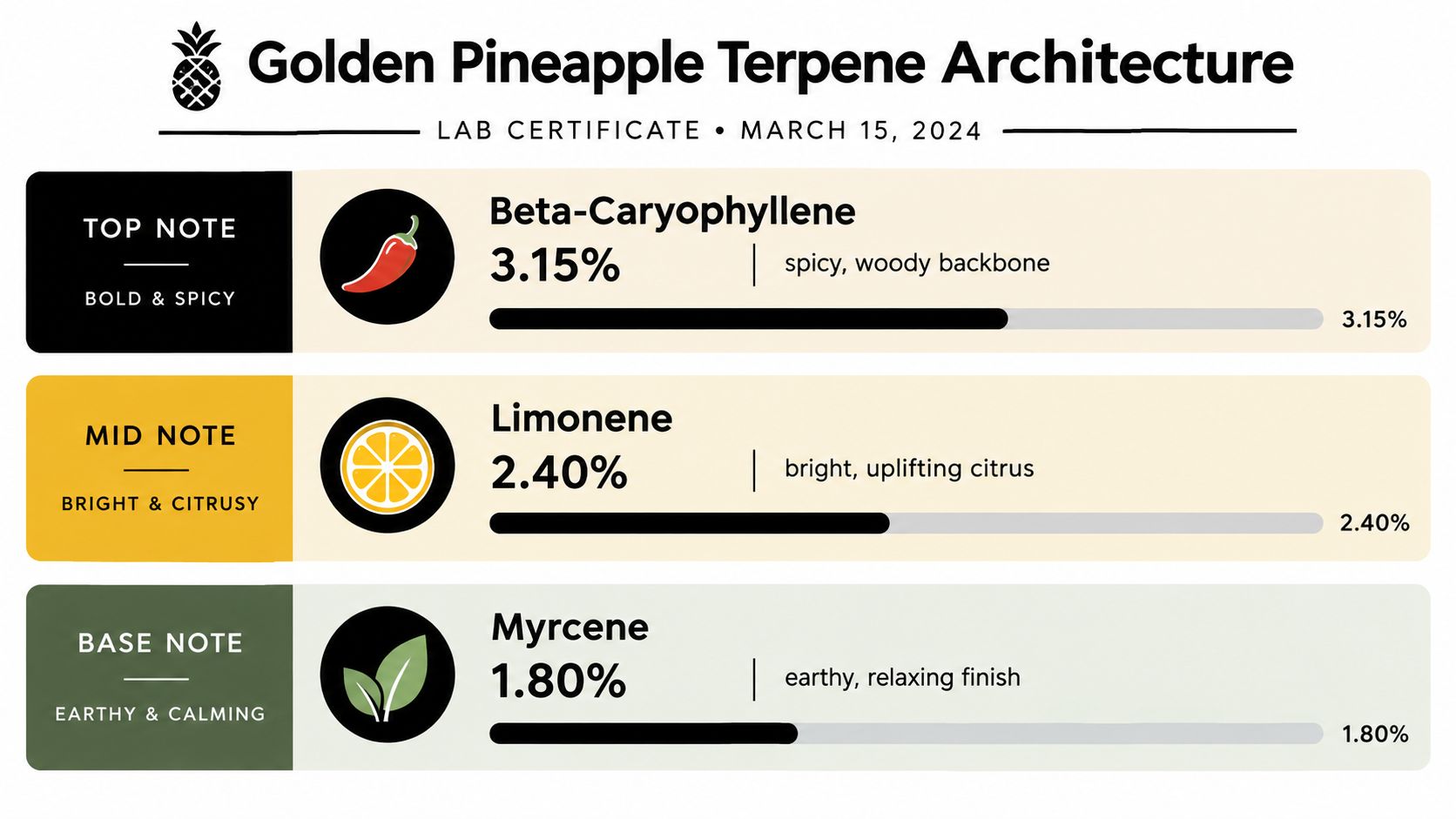
The March 15, 2024 certificate gives you a usable starting structure. The dominant note is beta-caryophyllene at 3.15%, then beta-myrcene at 2.37%, d-limonene at 1.09%, alpha-humulene at 0.727%, and linalool at 0.506%. Golden Pineapple lab report
Build the note stack, not just the flavor words
Think of beta-caryophyllene as the base note. It carries the peppery, woody backbone and gives the profile its structure, which is why a flat pineapple-only blend misses the mark. Beta-myrcene sits in the middle, grounding the profile with herbal depth and ripe fruit weight, while d-limonene supplies the bright top note that reads as citrus and lift.
Alpha-humulene reinforces the dry, woody structure that keeps the blend from turning candy-like. Linalool softens the edge and adds a floral accent, which matters because the sample isn't just “pineapple.” It's layered, and the layering is what makes the profile feel believable.
The certificate also shows alpha-bisabolol, fenchyl alcohol, alpha-pinene, alpha-terpineol, beta-pinene, borneol, caryophyllene oxide, camphene, and terpinolene, which tells you something important. Reproducing this profile means more than mixing four headline compounds and calling it done.
The ratio is the recipe. The strain name is just the label on the jar.
For a strain-inspired terpene blend, a supplier like Gold Coast Terpenes becomes useful. You're not buying a literal cannabis extract, you're buying a structured flavor build that can be tuned against the target ratios instead of guessed from a menu description. Terpene flavor chart
Botanical Versus Cannabis-Derived and Nature-Identical Inputs
For commercial formulation, the input category matters as much as the flavor target. Cannabis-derived terpenes come from the plant, nature-identical terpenes are synthesized to match plant molecules, and botanical-derived terpenes come from non-cannabis plant sources such as fruit, spice, and herb material.
Gold Coast Terpenes' 100% botanically derived positioning sits in the cleanest operational lane for many brands. You get a strain-inspired sensory target without the supply variability that often comes with cannabis-derived material, and without leaning on a generic nature-identical shortcut that may be fine on paper but weak in brand storytelling.
What B2B buyers should care about
Consistency matters first. A vape brand can't afford a profile that shifts too much from run to run, especially when multiple labs, packaging cycles, and hardware types are involved. Labeling clarity comes next, because the input type affects what you can say, how you document the blend, and how you manage internal QA.
Allergen disclosure and certification language can matter too, especially for buyers who need kosher or halal-compatible sourcing decisions. If your product line spans multiple markets, the procurement file should show exactly what the terpene input is and what it isn't.
| Input Type | Source | Labeling | Consistency | Best Fit |
|---|---|---|---|---|
| Cannabis-derived | Cannabis plant material | More tightly tied to cannabis supply and testing | Variable by crop and extraction lot | Limited runs, plant-authentic projects |
| Nature-identical | Synthesized to match plant molecules | Chemically specific, but less story-rich | High molecular consistency | Formulas needing exact molecule control |
| Botanical-derived | Non-cannabis plant sources | Clear for many mainstream product lines | Strong batch usability | Vape, distillate, and strain-inspired SKUs |
Understanding synthetic, botanical, and cannabinoid terpene inputs
Loading a Golden Pineapple Blend Into Distillate and Carts
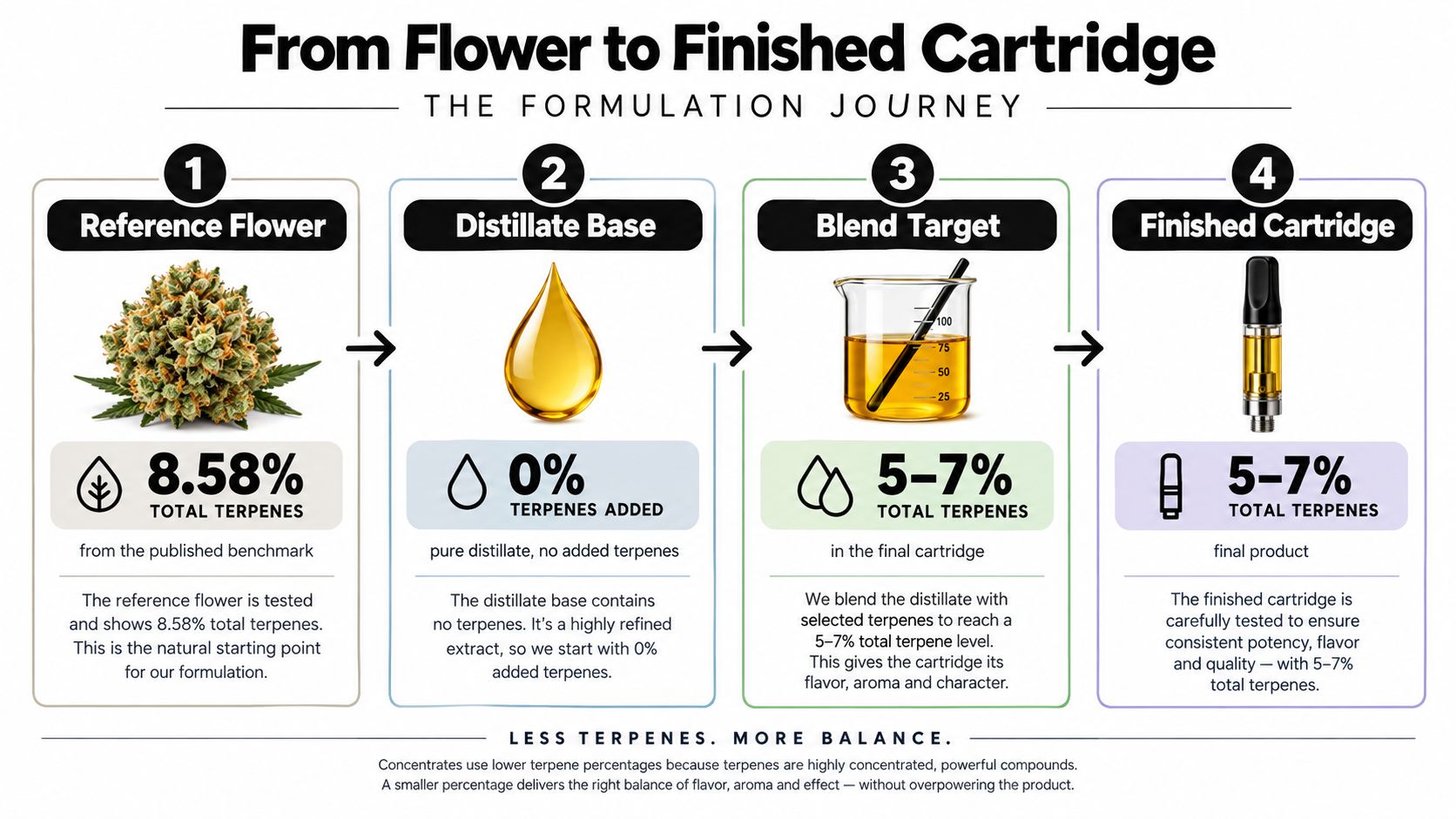
Start with the finished product target, not the flower number. For a Golden Pineapple-inspired 510 cartridge, I would anchor the finished oil at about 20 mg of total terpenes per gram of finished product, or 2.0% by mass. That is the practical starting point, because you are building an oil that still wicks, heats, and tastes cleanly. For the full step-by-step on ratios and order of addition, see how to mix distillate with terpenes.
The flower panel showing 8.58% total terpenes is a reference point, not a transfer target. Flower chemistry does not carry over cleanly into a cartridge. You are translating a market name into a finished oil, not stuffing the cart with raw plant chemistry.
Use the loading number as the control point
For distillate, 2.0% is the right anchor because it fits finished-oil reality. If the hardware runs thin or the flavor hits too hard, step down. If the blend tastes muted and the system can handle more load, move upward, but do not confuse stronger with better.
The inhalation-product terpene review reported that distillate products averaged around 20 mg/g, while rosin products averaged around 68 mg/g. That gap matters, because it shows why a terpene ratio that looks fine in flower can overwhelm a cartridge if you copy it exactly. Inhalation-product terpene review
Loading rule: set finished-oil concentration first, then tune the ratio for viscosity and wick behavior.
Gold Coast Terpenes keeps this practical because the blends are formulated without VG, PG, PEG, or MCT, which is a clean starting point for standard hardware compatibility. I treat that as a procurement advantage, not a slogan.
A Representative Golden Pineapple Cartridge Build
A realistic build starts with a 1,000 g distillate batch and a 2.0% terpene target, which means about 20 g of total terpenes in the finished oil. From there, I'd map the dominant ratio around the reference certificate, with caryophyllene, myrcene, limonene, and humulene doing the heavy lifting.
That doesn't mean you pour in only four materials. It means those four compounds set the frame, and the trace layer fills in the edges.
How I'd structure the formula
- Base structure: caryophyllene first, because it anchors the spicy, woody backbone.
- Middle weight: myrcene next, because it adds fruit depth and keeps the profile from feeling thin.
- Top lift: limonene for the citrus flash that keeps the blend bright.
- Structural support: humulene to dry the finish and keep the profile from drifting sweet.
- Secondary complexity: pinene, terpinolene, and linalool in small amounts to recover the freshness and lift the majors can't fully deliver.
A 3.0 ohm ceramic cart will usually punish sloppy mixing fast. If the blend is too heavy, wick saturation suffers. If it's too light, the flavor can bloom early and fade before the oil is fully consumed. That's why the build has to be validated at room temperature before anyone scales it.
The catalog reference for Apple Fritter from Gold Coast Terpenes is useful as a structural comparison, because it shows how a fruit-forward SKU can be built and labeled as a finished formulation rather than a vague strain promise. Apple Fritter elevated terpene profile
Why Batch COAs Beat Strain Names Every Time
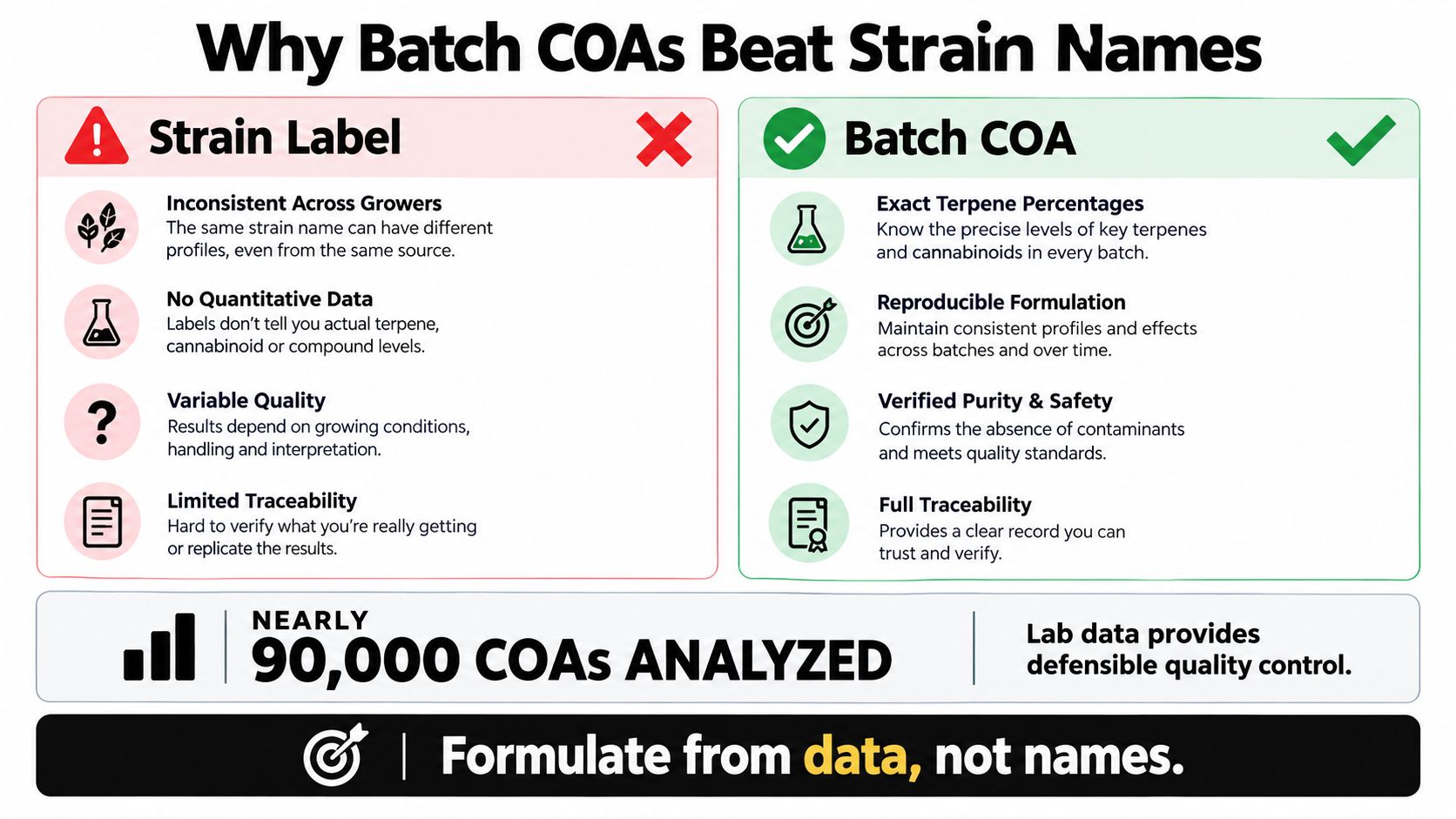
A defensible Golden Pineapple product starts with the lot COA, not the strain label. The reason is simple, product names and category labels don't consistently match the underlying chemistry, and some named strains vary so much across products that the label stops being useful for formulation.
That's not theory. It's the reality of commercial cannabis input. If you want reproducibility, you need to build from measured values and documented targets.
Three operational steps that actually work
- Request the COA for every terpene and distillate lot. If the supplier can't provide it, don't scale the run.
- Set acceptance ranges for total terpenes and the caryophyllene to myrcene to limonene ratio. That keeps the blend reproducible.
- Document the sensory target. Use words like tropical fruit, citrus, pine, floral, and spice, then tie those words to the measured compounds.
The most useful formulation files are dull on purpose. They show the input lot, the actual percentages, and the final sensory goal, which makes them easier to defend when a buyer, lab, or compliance reviewer asks how the SKU was built.
Gold Coast Terpenes' lab-verified documentation fits that kind of workflow because it supports the chemistry file without turning the packaging into a strain fantasy. Keep the label disciplined, avoid medical claims, avoid dispensary-style language, and let the COA carry the authenticity argument.
Putting It All Together for Your First Batch
Use a strict order. First, confirm the input category. Then set the finished-product target at 2.0% total terpenes by mass, allocate the caryophyllene, myrcene, limonene, and humulene structure, add a secondary layer for complexity, and validate the blend against the actual lot COA before you lock the label.
That is the whole game. The strain name can inspire the build, but it can't certify the build.
A clean workflow for the next run
- Check the input class first. Botanical-derived, cannabis-derived, and nature-identical inputs do different jobs.
- Set the loading target second. For a 510 cart, start at 2.0% and adjust to hardware behavior.
- Tune the sensory target third. Keep the profile caryophyllene-forward, with fruit and citrus as support.
- Validate against the COA last. If the batch doesn't match, the label doesn't matter.
- Lock the language carefully. Say what the product is, not what it promises to do.
Gold Coast Terpenes' Mixing Calculator and Terpenes 101 are practical tools for this kind of work, especially when you need to move from a strain-inspired brief to a repeatable production process. If you're scaling, the bulk and wholesale programs, free U.S. shipping over $100, and discounts above 64 oz are the procurement details that start to matter.
Formulator Questions About Golden Pineapple Terpene Blends
Can a strain-inspired blend match a cannabis-derived sensory target? Yes, if the label stays honest and the chemistry file is tight. Gold Coast Terpenes supports that kind of build with documented terpene inputs.
What loading should a 510 cart start with? Start at 2.0% by mass, then adjust for viscosity and hardware. That's the cleanest anchor for a Golden Pineapple-inspired distillate SKU.
Does the caryophyllene-forward profile fit live resin and rosin too? Yes, but rosin can support a heavier terpene load, with the 68 mg/g benchmark acting as a ceiling reference rather than a target. Gold Coast Terpenes' documentation helps keep that distinction clear.
How should a brand document the Golden Pineapple name? Treat it as a market identity, then tie sensory and chemistry claims to the batch COA. Gold Coast Terpenes can supply the terpene side of that file with SC Lab-tested documentation.
If you're building a Golden Pineapple-inspired cart, start with the chemistry file and stop trusting the name. Gold Coast Terpenes supplies strain-specific terpene blends, botanical inputs, and formulation tools that help you turn a loose market identity into a repeatable SKU. Visit Gold Coast Terpenes to review terpene options, compare profiles, and build from a real loading target instead of a romantic label.