
A client asks for a Gelato X vape, and the request sounds simple until the samples hit your bench. One lot leans creamy and peppery. Another pushes fruit-candy on the nose. A third carries the Gelato name but behaves like a different family entirely once it's in oil.
This is the underlying formulation problem concerning the Gelato X strain-inspired terpene blend for vape cartridges. The market treats Gelato X like a stable identity. In production, it often isn't. If you build around the name instead of the chemistry, you end up chasing moving targets, reworking batches, and explaining avoidable inconsistency to brand teams.
The Formulators Challenge with Gelato X
Commercial formulation fails when a marketing label stands in for a chemical specification. Gelato X is a good example. Brand owners want a recognizable sensory story, but the source material sold under that name can vary enough to disrupt cartridge flavor, inhale character, and finish.
For extractors and cartridge manufacturers, the problem isn't academic. It shows up in the tank. Top notes flash off too fast. Sweetness lands without structure. The profile reads thin in one batch and muddy in the next. If you're formulating for distillate, those differences become more obvious because the carrier matrix won't hide a weak terpene architecture.
What usually goes wrong
A lot of teams start with the flower name and work backward. That sounds reasonable, but it creates three predictable issues:
- Name-first sourcing: Someone buys a “Gelato X” reference sample assuming the label guarantees the same aromatic target every time.
- Overweight top notes: Fruity compounds get pushed too hard to satisfy the “X” part of the story, and the profile loses the creamy dessert center that makes it commercially believable.
- No house standard: Production keeps trying to match whichever input lot arrived last instead of locking a repeatable internal target.
Practical rule: Treat Gelato X as a formulation brief, not a botanical fact.
That shift matters. The goal isn't to recreate every batch sold under the name. The goal is to define a branded sensory target that customers can recognize every time they open the package or take a draw.
The professional approach
A useful formulation guide for Gelato X for cannabis product formulation starts with deconstruction. Separate the profile into its note layers, define what belongs in the top, mid, and base, then rebuild it around a stable internal specification. Once you do that, the strain name becomes a shorthand for a controlled output rather than a gamble tied to inconsistent source material.
Understanding the Gelato X Genetic Puzzle
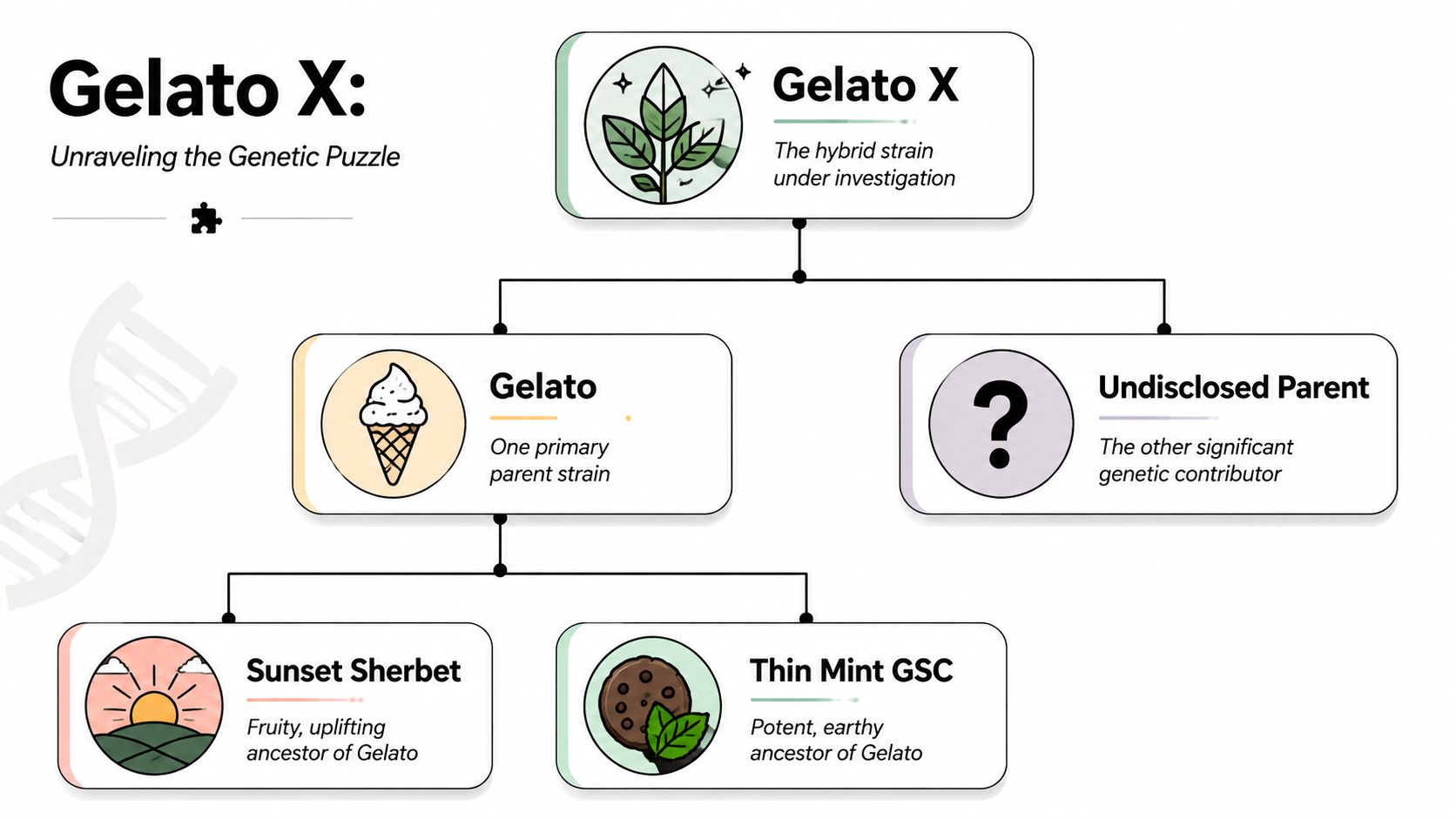
The biggest reason Gelato X creates formulation trouble is that the name carries more certainty than the underlying genetics. The most common market view is that Gelato X comes from Gelato crossed with Original Z (Zkittlez). That version matters because it explains why many operators expect extra fruit-candy lift and stronger limonene presence compared with classic Gelato.
At the same time, Gelato itself has a clearer identity. It's established as Sunset Sherbet × Thin Mint GSC, and that parent line is one reason formulators associate Gelato-type profiles with a dessert-forward core and a caryophyllene-led backbone. The trouble starts when “Gelato X” gets used as a catch-all term rather than a fixed chemovar.
Why the name creates instability
One of the clearest warnings for formulators is that “Gelato X” is often marketed as a cross with Original Z (Zkittlez) to boost limonene and fruit-candy volatiles, creating a divergent terpene profile from the original Gelato. This ambiguity is exacerbated by conflicting lineage data, with some sources listing different crosses, highlighting the need for formulation based on a stable chemical target, not a variable genetic name (Mr. Nice Guys DC on Gelato lineage ambiguity).
That one point changes how you should build the product. If the genetic label is unstable, your formulation target can't depend on breeder claims alone. It has to depend on the sensory and analytical outcome you want in finished oil.
A useful reference point is how operators already think about the broader Gelato strain family and profile expectations. The parent family has recognizable traits. Gelato X may not preserve them in a uniform way.
What this means on the bench
When a sample is called Gelato X, ask two questions before blending:
- Is the request really for a Gelato-led dessert profile with a little fruit lift?
- Or is it for a fruit-candy extension of Gelato where Original Z influence is intentionally obvious?
Those are different products. One needs a firmer, more anchored base. The other can support brighter top notes, but only if the mid-layer still holds the blend together.
The more ambiguous the genetics, the more disciplined the chemistry has to be.
That's why the best work on replicating flavor of Gelato X for distillate starts with a chemical target and uses the strain name only as packaging language.
Target Chemical Profile for Gelato X Formulation
For actual product development, the useful part of Gelato X isn't the label. It's the chemotype you're trying to express in a consistent way. The production target is a high-THC, low-CBD profile with meaningful terpene load, because that combination shapes how the aroma presents and how dense the overall experience feels in a cartridge.
The strongest verified benchmark for that target is straightforward. Gelato X consistently tests with THC levels between 19% and 29%, with some batches reaching 31.2% THC and a substantial terpene content of 3.02%. This high-potency, high-terpene chemotype is what formulators must aim to replicate to capture the strain's characteristic immersive effects (Joint Commerce on Gelato X chemotype).
The cannabinoid frame
For cartridge design, that benchmark tells you three important things:
- THC-forward identity: The profile is associated with a strong THC-dominant character, not a balanced THC-CBD expression.
- Minimal CBD support: CBD typically remains low, so don't expect it to round out rough formulation choices.
- Terpene load matters: A profile associated with a terpene result of 3.02% sets a clear expectation for aromatic presence in the reference material.
If your finished product smells flat, tastes generic, or burns through the top notes on the first pulls, the problem usually isn't the strain story. It's that the terpene architecture isn't carrying enough shape.
Top, mid, and base note logic
For a terpene profile for Gelato X for vape cartridges, I treat the profile as a three-layer structure:
- Top notes create the first impression. In Gelato X-style builds, fruit-candy brightness and citrus lift are usually found.
- Mid notes create identity. This layer decides whether the profile reads creamy, dessert-like, floral, or diffuse.
- Base notes provide staying power. They anchor sweetness, add body, and stop the profile from feeling hollow in warm hardware.
The exact percentages of individual terpenes should come from your own target profile and lab validation. Because the available verified data doesn't provide terpene-by-terpene numeric ranges, the correct move is to define them qualitatively and confirm them analytically.
Target Terpene Profile for Gelato X Replication
| Terpene | Typical Range (%) | Sensory Contribution (Note) |
|---|---|---|
| Beta-Caryophyllene | House target based on sensory validation | Peppery, warm, structural depth (base) |
| Limonene | House target based on desired fruit lift | Bright citrus, candy-like sparkle (top) |
| Myrcene | House target based on blend softness | Sweet herbal body, roundness, diffusion support (mid) |
| Humulene | Use when the profile needs drier restraint | Woody, slightly earthy tension that reins in sweetness (base) |
| Supporting sweet-fruit compounds | Set by internal reference panel and CoA review | Candy, jammy, or tropical accents that push the “X” identity (top to mid) |
A lot of formulators miss the role balance here. They hear “Gelato X” and reach for extra fruit first. That can work in a tasting vial. It often collapses in a cartridge because the blend lacks a stable mid and base.
For deeper process fundamentals around layering and volatility, a resource like Terpenes 101 for formulation planning is useful because it reinforces how individual compounds behave once they're inside oil instead of on raw flower.
What a reliable target actually sounds like
A strong Gelato X-inspired profile should read in this order:
- A bright fruit-forward opening.
- A creamy, dessert-like center that keeps it from reading like generic candy.
- A grounded finish with enough weight to survive repeated pulls in heated hardware.
If you lose step two, the product stops reading like Gelato-derived. If you lose step three, the profile feels thin and short. That's the formulation tension to manage.
Navigating Inconsistency in Source Materials
A common mistake is treating source flower as the truth and the finished cartridge as the imitation. In manufacturing, that logic breaks down fast. Agricultural inputs vary. The product on shelf can't.
If a brand brings you a batch of flower and says, “Match this Gelato X exactly,” the right answer isn't automatic agreement. The right answer is to decide whether that batch represents the long-term brand target or just a temporary outlier with a marketable label.
Match the brand standard, not the last jar
Experienced formulators separate sensory development from raw-material nostalgia. You can appreciate a standout flower lot without letting it dictate every future batch.
If the source material changes every harvest, your SKU needs a specification that doesn't.
That's especially important when harvest timing, cure quality, and trichome maturity all shift the aroma of nominally similar material. Teams that understand how harvest timing affects resin and expression usually have an easier time accepting why a strain name alone won't give them a repeatable cartridge target.
A better decision framework
Use a simple internal filter when evaluating Gelato X source materials:
- Keep it if the sample supports your defined Gelato X house profile.
- Reference it if it contains one element worth borrowing, such as a cleaner fruit top note.
- Reject it as a template if it forces you too far away from the identity your customers already know.
This isn't about being rigid. It's about manufacturing discipline. A house standard protects fill consistency, consumer expectation, and packaging credibility.
What works and what doesn't
What works is building a strain-inspired terpene blend for cannabis product formulation around a locked sensory specification. Then you use incoming source material as comparison data, not as a command.
What doesn't work is reinterpreting Gelato X every time a supplier sends a new “cut.” That creates label continuity with product instability. Most brands can't afford that once the SKU gains traction.
Replicating Flavor for Distillate and Vape Cartridges
In distillate, Gelato X needs more than a pleasant aroma concentrate. It needs a structure that survives heat, repeated draws, and shelf time. The most reliable builds start with a dessert-style foundation, then add fruit-candy lift in measured steps until the profile reads “Gelato X” instead of merely “sweet.”

Build in layers
For formulating Gelato X for distillate, the order matters as much as the ingredients.
- Start with the base. Build the caryophyllene-led structure first. This gives the blend weight and stops the finish from disappearing.
- Shape the middle. Add the creamy, rounded center before you touch the brightest top notes. If the middle is weak, extra fruit won't fix it.
- Tune the opening last. Add limonene-driven brightness and any sweet fruit accents in small increments. Volatile top notes are easier to overshoot than to pull back.
A lot of failed strain replications come from reversing that order. Teams chase the first sniff instead of the full inhale-to-finish sequence.
Bench workflow that holds up
A practical lab sequence looks like this:
- Prepare a control sample: Keep an unmodified base on hand so every top-note adjustment has a true comparison.
- Run warm and room-temperature evaluations: A blend that smells balanced cold can become sharp in active hardware.
- Log sensory language tightly: “Creamy,” “bright,” “peppery,” and “candy” are more useful when your panel uses them consistently and doesn't switch descriptors every round.
For process basics on integrating terpenes into oil, how to use terpenes in cartridges and concentrates is the kind of reference teams use when they need practical handling guidance during production.
Distillate-specific trade-offs
Distillate strips away some of the complexity people expect from flower. That means your replicating flavor of Gelato X for vape cartridges work has to compensate on purpose.
- Too much limonene: The blend reads sharp and generic.
- Too little base support: The profile opens well but leaves no memory on exhale.
- Overbuilt sweetness: The cartridge smells attractive in the room and tastes flat after several pulls.
Blend for the second and third draw, not just the first aroma hit out of the tank.
That's the point many teams miss. Shelf appeal matters, but repeat-use performance is what determines whether the SKU gets reordered.
Don't skip your calculation step
Even experienced formulators make avoidable scaling mistakes when moving from bench blends to production lots. A terpene mixing calculator for cartridge formulation helps standardize additions and reduce operator error when you convert a promising trial blend into a manufacturing-ready batch.
Lab Testing and Quality Control Protocols
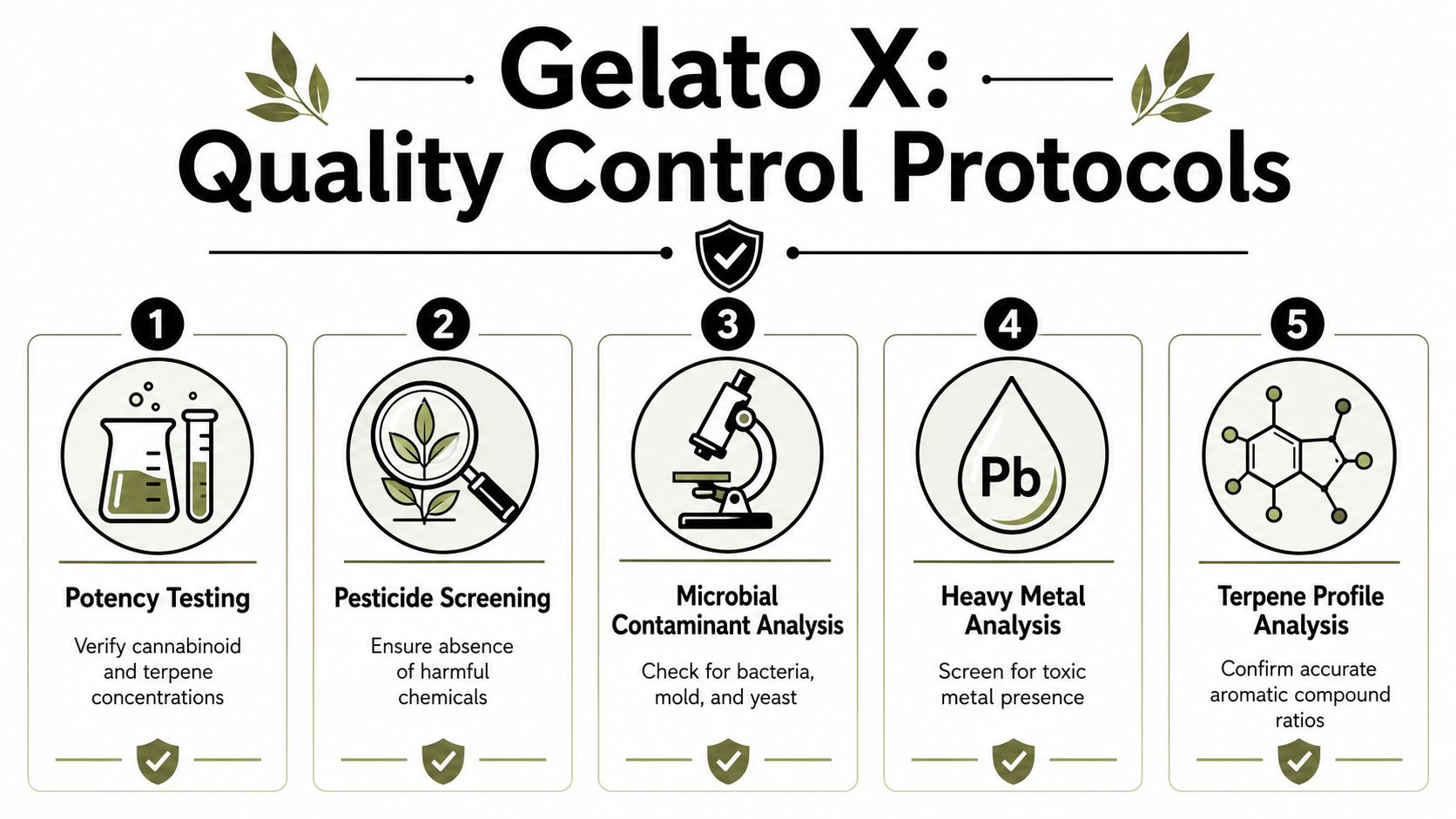
A strong Gelato X profile on the bench isn't enough. If you can't verify it, you can't protect it. Quality control is where a strain-inspired concept becomes a dependable commercial SKU.
That matters even more with a name like Gelato X because ambiguity invites drift. Without testing, small formulation changes, supplier variation, or operator substitution can move the product away from the target while the label stays the same.
What to check on a CoA
For terpene-driven cartridge development, your review should cover both incoming ingredients and finished goods.
- Identity check: Confirm the dominant aromatic compounds align with your internal Gelato X target.
- Ratio check: Make sure the balance between bright, creamy, and grounding components still matches the approved reference.
- Contaminant review: Screen for the standard safety issues that can turn a good formulation into a liability.
- Lot-to-lot comparison: Compare each production run against your retained standard, not just against the supplier document.
If your team needs a refresher on analytical interpretation, chromatography testing in terpene and extract workflows is the kind of educational resource worth keeping in the SOP library.
QC as brand protection
Some companies still treat testing like overhead. That's a short-term view. In practice, QC protects three things at once:
| QC focus | Why it matters commercially |
|---|---|
| Sensory consistency | Customers can recognize the SKU across batches |
| Compliance confidence | You reduce avoidable risk tied to unverified inputs |
| Reformulation control | Your team can troubleshoot drift with actual data instead of guesswork |
Bench note: A passing aroma evaluation is not a substitute for analytical confirmation.
The standard that actually scales
The best operators archive a retained sample, a sensory reference, and the associated analytical record for every approved profile. That way, if a later run feels brighter, flatter, or harsher, the team can identify whether the shift came from raw materials, blending order, or hardware interaction.
That discipline matters more than strain storytelling. Plenty of products can sound premium. Fewer can reproduce the same flavor architecture batch after batch.
Positioning and Marketing Your Gelato X Product
If you've done the formulation work correctly, marketing gets simpler. You don't need to oversell uncertain genetics. You need to describe a consistent sensory result in language your customer can trust.
That means leading with profile, not pedigree. A cartridge can be positioned around a creamy dessert core, sweet fruit lift, and grounded finish without making breeding claims that your supply chain can't consistently support.
Better claims for an ambiguous name
For a Gelato X-inspired SKU, the strongest positioning usually sounds like this:
- Sensory-first: Describe what the product smells and tastes like in repeatable terms.
- Process-aware: Emphasize careful formulation and batch consistency.
- Avoid overclaiming: Don't anchor the entire product identity to one disputed lineage story.
This approach is stronger commercially because it aligns your package language with what your manufacturing team can control.
The honest advantage
A lot of brands think genetics are the headline. In cartridge development, consistency is the headline. If your Gelato X product delivers the same flavor architecture every time, buyers remember that. If the profile swings from dessert to candy to spice depending on the lot, the name stops helping.
The better strategy is simple. Market the profile you can reproduce. Let the formulation discipline become the product's real differentiator.
If you're building a Gelato X strain-inspired terpene blend for vape cartridges, Gold Coast Terpenes offers strain-specific profiles, isolates, and formulation tools that help teams create repeatable flavor targets instead of chasing inconsistent source material. For extractors, cartridge manufacturers, and brand owners who need precision in distillate and concentrate development, it's a practical place to source components and support your next bench trial.