
You've got a distillate batch on the bench, a brief that says “Gelato Purple Punch,” and a consumer-facing flavor description that sounds nice but doesn't tell you how to build the cart. The problem isn't the name. The problem is translating a dessert-fruit strain concept into a blend that still flows, wicks, and tastes like the profile people expect after the first puff.
For formulators, Gelato Purple Punch is useful because it sits right in the commercial sweet spot. It's a dessert-style, indica-dominant hybrid built from Gelato #33 × Purple Punch, and published strain guides commonly place it around 20% to 25% THC, with CBD usually below 1% and an 8 to 9 week indoor flowering window (Kind Green Buds). Those numbers matter less as consumer trivia than as a clue to what brands are buying when they ask for this profile, a premium, flavor-led identity that carries weight in flower, carts, and concentrates.
Why the Gelato Purple Punch Strain Matters for Formulators
A lot of failed carts start with the right name and the wrong mental model. A brand asks for a gelato purple punch strain profile, the lab reaches for a generic berry blend, and the finished oil tastes thin, candied, or oddly sharp because nothing in the blend was built to carry the creamy dessert body. That gap matters at the bench. This cultivar gives product teams a recognizable flavor target that can still be tuned for hardware, viscosity, and batch behavior.
Why brands keep chasing this profile
Dessert-fruit hybrids keep winning SKU launches because they read as premium without depending on loud, fuel-heavy notes. Gelato and Purple Punch both sit inside the modern California dessert lineage, and that lineage carries clear commercial weight. Their combination pushes flavor first, then aroma, then visual identity, which is exactly what many vape buyers respond to.
For a formulator, the practical value is simpler. Caryophyllene, limonene, linalool, and myrcene are the four levers that show up again and again in published strain guides for this cross, and they explain why the profile smells sweet, creamy, and berry-forward instead of earthy or diesel-heavy. That gives you a real working target, not just a strain story.
Practical rule: if the first draft smells like candy but not dessert, the base is too light. The blend is missing the creamy bridge that keeps the top notes from turning synthetic.
The other reason this cultivar matters is that flavor-led interpretation has largely replaced old indica and sativa label habits in product development. Teams do not win shelf space by saying “indica.” They win by making a cart taste authentic from the first draw to the last one, even when the hardware is unforgiving. That means the formulation question is not “What is this strain?” It is “Which note structure makes this strain believable in oil?”
Gelato strain terpene reference notes remain useful if you need a nearby benchmark for how dessert-leaning Gelato material behaves in a commercial flavor context.
Lineage and Chemotype at a Glance
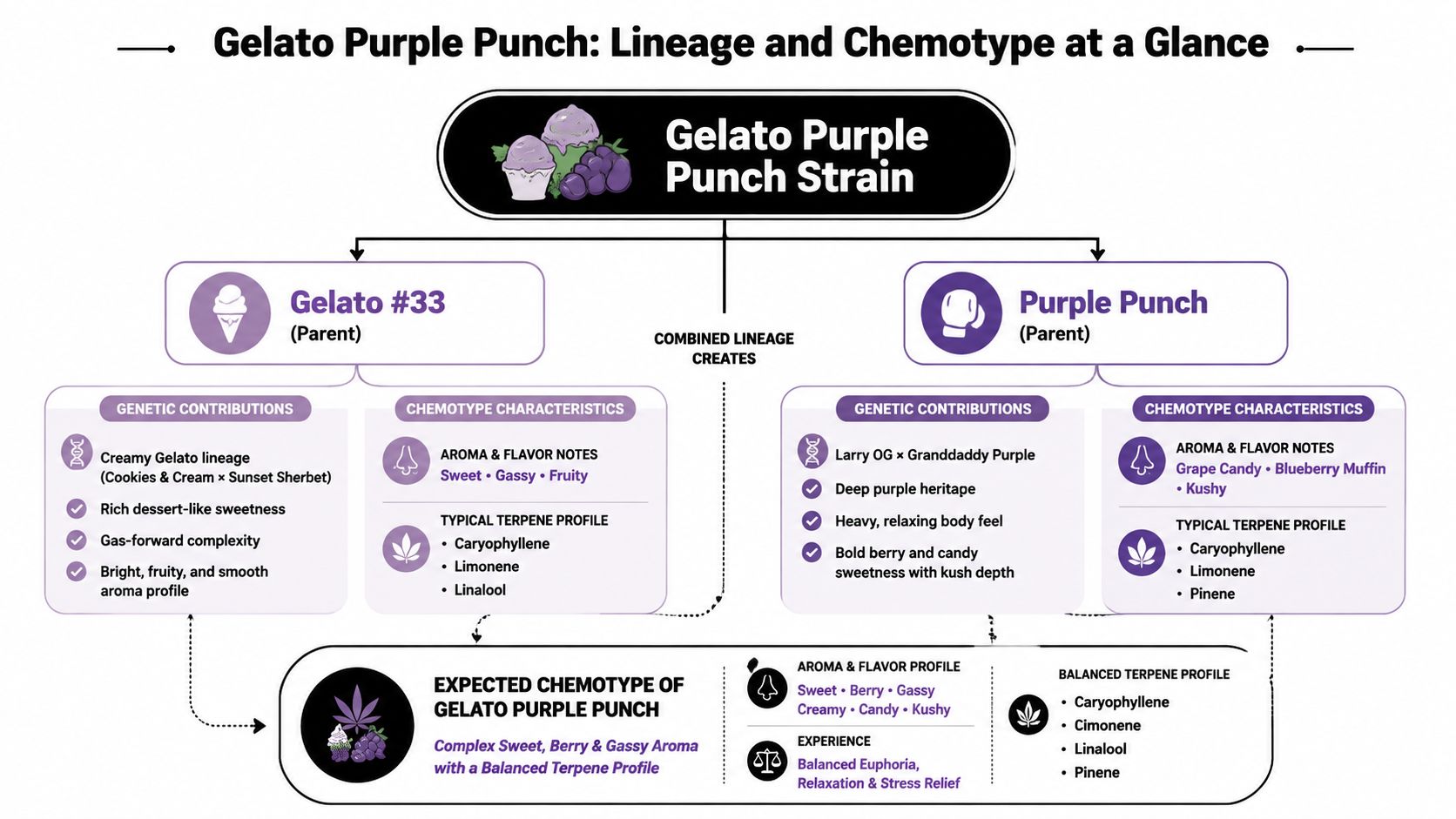
On the bench, lineage matters because it tells you where the flavor is likely to sit before the jar ever opens. Gelato Purple Punch comes from Gelato #33 × Purple Punch, and both parents sit in the dessert-fruit lane that tends to produce sweet fruit, cream, and berry candy. Gelato #33 is commonly described as Sunset Sherbet × Thin Mint GSC, while Purple Punch is commonly identified as Larry OG × Granddaddy Purple.
What that means for aroma design
That ancestry gives you a usable starting map. Gelato-side material usually pushes sweet, gassy, fruity character, while Purple Punch contributes grape candy, blueberry muffin, and kushy notes, along with the darker fruit core that keeps the profile from reading like simple dessert sugar. Put those pieces together and the expected aroma becomes layered, sweet-berry, creamy, and lightly structured underneath.
The technical read matters just as much. Published strain guides describe Gelato Purple Punch as a Type I, high-THC, low-CBD chemotype, with THC commonly in the 20% to 25% range and CBD usually below 0.5%, while total cannabinoids in mature flower are often described around 22% to 30%. That tells you the market is paying for flavor and intensity, not CBD balancing. For a broader cultivar benchmark, Gold Coast Terpenes' Gelato strain terpene profile notes remain useful.
Pin this next to the mixing station:
- Parentage: Gelato #33 × Purple Punch.
- Chemotype: Type I, high-THC, low-CBD.
- Flavor direction: sweet cream, berry, grape candy, soft spice.
- Brand implication: treat aroma as the value driver, not raw potency alone.
The lineage also explains why consumers describe the profile in dessert language rather than in herbaceous or earthy terms. Gelato #33 comes from two influential California dessert lines, and Purple Punch brings the grape-berry sweetness that has become a shorthand for premium-flower flavor. That is the commercial reason this cross keeps appearing in premium cartridges and extract menus. It is easy to recognize, but hard to fake well.
Signature Terpenes and Their Role in the Profile
A clean Gelato Purple Punch cartridge starts with terpene architecture, not with a heavy flavor dump. The profile holds together when caryophyllene provides the base, limonene lifts the opening, linalool softens the middle, and myrcene rounds out the body. That order matters in finished oil because buyers notice whether the cart opens bright, settles into cream, and finishes with fruit, or whether it collapses into generic sweetness.
Gelato Purple Punch Signature Terpene Roles
| Terpene | Note Position | Aroma Role | Starting % in Distillate |
|---|---|---|---|
| Caryophyllene | Base | Creamy spice, peppered backbone, dessert depth | 0.20% to 0.40% |
| Limonene | Top | Citrus lift, brightness, first impression | 0.15% to 0.30% |
| Linalool | Mid | Floral softness, berry roundness, smoother finish | 0.10% to 0.25% |
| Myrcene | Base and mid | Musky fruit body, plush sweetness, fuller mouthfeel | 0.15% to 0.35% |
Those ranges work as starting points for distillate formulation, not as fixed targets. Hardware, solvent-free base oil, and terpene source all shift perception once the oil is heated. A restrained limonene dose keeps the profile from drifting into a detergent-like brightness, while a stronger myrcene floor helps the cart read like a dessert cultivar instead of a candy flavor. For a broader terpene context, Common cannabis terpene reference guide is useful when you want to compare how isolated terpenes behave before you lock in the final ratio.
How the notes actually read in oil
Caryophyllene does more than register as spice. It anchors the profile so the sweeter notes do not vanish into top-note vapor. Linalool does quieter work in the middle, especially when the batch needs a rounder finish and less scratch on inhale. Myrcene supplies the plush fruit impression that makes the profile feel ripe instead of merely sugary.
A formula that leans too hard on limonene can smell lively in the jar and still taste thin after the hardware heats it. Too little caryophyllene and myrcene leaves the cart pretty on the bench but flat on the first draw, because there is no base to carry the fruit.
That is why terpene percentages need to be read as a system. A cart with too much limonene can feel loud for one puff and hollow by the second. A cart with too little caryophyllene and myrcene can smell appealing in the bottle, then fail on the first draw because the fruit has nothing underneath it to sit on.
Blending Ratios for Carts, Distillate, and High-Terpene Extracts
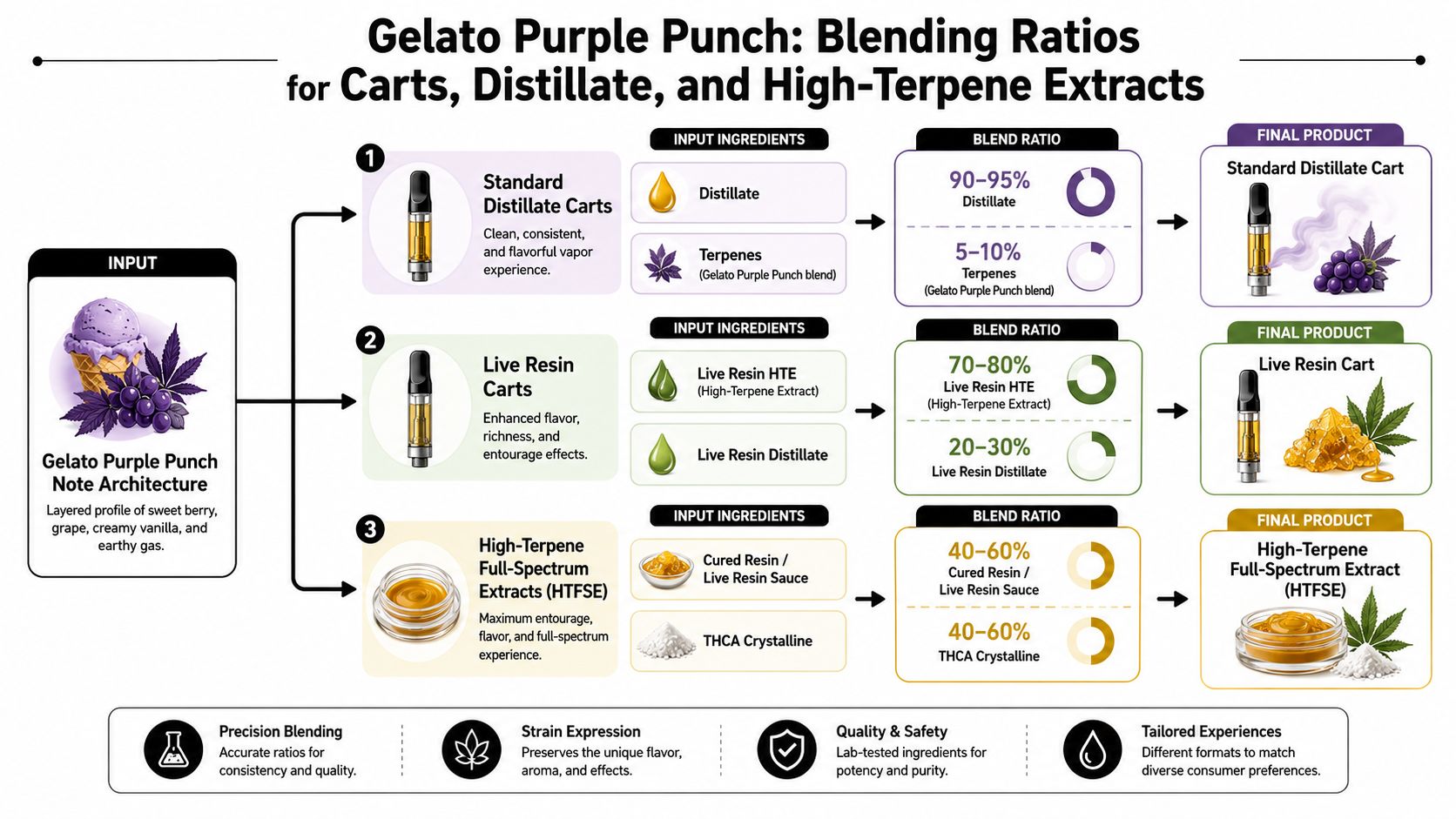
Start with the hardware, not the flavor brief. A gelato purple punch strain impression can survive different formats, but only if you respect how much terpene load the oil can physically carry. The profile that works in a high-terp cart can leak or wick poorly in a standard 510 cart if you push the same ratio into a thinner distillate base.
Standard distillate carts
For a standard distillate cart, a practical starting point is 90% to 95% distillate and 5% to 10% Gelato Purple Punch terpene blend. That keeps viscosity in a workable range while still letting the dessert-fruit signature come through. Push much beyond that and the oil can thin out fast, which raises the risk of leakage, harsh pulls, and unstable performance in weaker hardware.
Live resin carts
Live resin carts can usually carry more aromatic weight, so the starting structure can move toward 70% to 80% live resin HTE and 20% to 30% live resin distillate as indicated in the product brief. That format can feel more authentic when the extract itself already contributes some native fruit and gas, but it still needs flavor reinforcement if the batch varies. I prefer to treat the terpene blend as a correction tool here, not a mask.
High-terpene full-spectrum extracts
High-terpene full-spectrum extracts are a different animal. The reference formulation is 40% to 60% cured resin or live resin sauce and 40% to 60% THCA crystalline. This format can carry the most strain-native complexity, but only when the crystalline fraction and sauce fraction are balanced tightly enough to stay stable through packaging and shelf life.
One shortcut worth considering is a strain-specific terpene blend that already sits close to the Gelato Purple Punch target. Gold Coast Terpenes offers that kind of starting point, along with a mixing calculator and product education resources for teams that want to fine-tune rather than build from scratch.
How to mix distillate with terpenes is the right reference if you want a bench-level reminder of how to avoid over-thinning a cart base before scale-up.
Effect Direction Without Medical Claims
The same flavor architecture can be steered in different commercial directions without changing the core identity. If you want the SKU to feel calmer and heavier, weight the blend a little harder toward myrcene and linalool. If you want a brighter, more open impression, let limonene lead slightly more, but keep the myrcene floor in place so the profile still reads as Gelato Purple Punch instead of citrus candy.
How small shifts change the impression
Formulation gets more interesting than strain marketing. A two-point shift in the wrong terpene can change whether a cart feels rounded or sharp, especially in lower-mass hardware that blows off top notes quickly. A stronger caryophyllene base tends to make the profile feel fuller and more grounded, while a lighter base can leave the citrus and berry notes exposed.
The wide variation in consumer descriptions makes sense once you look at the chemistry. Published strain guides don't report one single effect signature for every sample, they point to a profile that can lean calm-forward, euphoric, or more energetic depending on batch and expression. For a brand owner, that means the experience needs to be defined before the blend is finalized.
If the brand promise is “evening dessert,” don't let the formula drift into bright daytime territory. The wrong ratio can fight the positioning before the customer ever opens the box.
The useful decision is not whether the strain is “indica” or “sativa.” The useful decision is whether the first puff should feel plush and relaxing, or sparkling and lifted, because that tells you which lever gets more weight in the master blend. Once that choice is made, the rest of the formulation becomes disciplined instead of exploratory.
Lab Data, Stability, and Hardware Compatibility
A dessert-fruit cart only works if the oil stays stable long enough to sell through. Terpene load changes viscosity immediately, and that's why a blend that looks perfect in a beaker can misbehave inside a cartridge if the hardware wasn't chosen for the final flow profile. Ceramic systems usually tolerate more nuanced oils than cotton-heavy setups, but the ultimate answer still depends on fill volume, draw resistance, and how aggressive the terpene load is.
The variables that decide whether the batch survives
Viscosity is the first one. As terpene percentage rises, the oil moves more easily, which can be helpful until it starts pulling too thin for the cart body. Oxidation is the second one, and it's the quiet killer of berry and cream profiles because limonene and linalool drift toward off-notes when they're exposed to air and heat for too long.
A disciplined storage and handling routine matters more than people admit.
- Use dark glass: It limits light exposure during holding and QA.
- Keep seals tight: Headspace and air exchange shorten flavor life.
- Avoid unnecessary heat: Warm holding can flatten bright top notes quickly.
- Match hardware to flow: A good blend still fails in a mismatched cartridge.
- Test the finished batch: Finished-product lab data should confirm the actual oil, not just the raw ingredients.
For extract teams, SC lab testing on the finished batch is essential. You need the post-blend result documented, especially when the formulation uses THC-free, VG/PG/PEG/MCT-free terpene inputs, because that makes downstream compliance cleaner and avoids avoidable solvent questions later.
What to watch before scale-up
A cart that tastes excellent in a small test batch may behave differently at production fill because thermal stress, wick response, and storage time all change. That's why you should treat heat stability as part of the flavor work, not as an afterthought. If the profile drifts after warm aging, it wasn't stable enough to begin with.
Boiling point and terpene stability notes help when you need to map aroma loss against heat exposure during formulation and fill.
Compliance, Labeling, and Documentation Checklist
Compliance is boring until a batch gets held up. Then it's the most expensive part of the project. A gelato purple punch strain inspired product needs the same disciplined paperwork you'd use for any premium cartridge SKU, because state rules, labeling expectations, and traceability requirements can change the launch path fast.
What should be on file
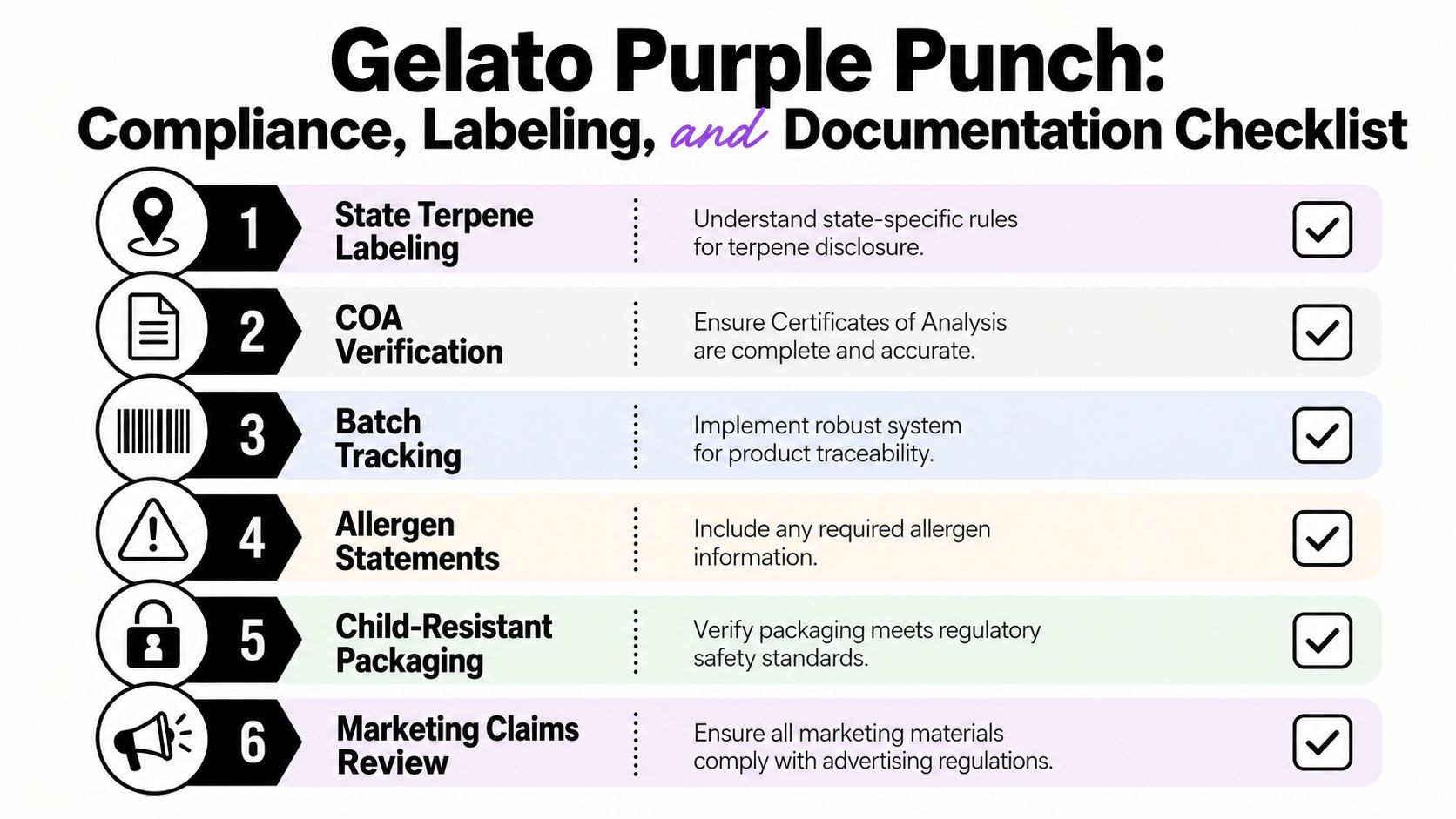
The first item is the Certificate of Analysis. If the COA doesn't match the finished batch, the strain name doesn't matter. You also want a clear terpene breakdown, residual solvent panel where required, batch traceability records, and packaging files that show the cart or jar is in the correct compliant format for the state or market you're shipping into.
Labeling is where teams often get sloppy. Some states expect more explicit terpene disclosure than others, and marketing copy needs to stay aligned with what's on the product label. Child-resistant packaging is another point that can't be improvised after production, because it has to be built into the packaging decision, not patched later.
A practical documentation stack usually includes:
- COA verification so the batch data matches the finished oil.
- Batch tracking so you can trace ingredients and fills.
- State-specific terpene labeling review before print files go live.
- Allergen and warning review where required by the market.
- Child-resistant packaging confirmation before the SKU ships.
- Marketing claims review so the strain language doesn't outrun the regulatory language.
The compliance posture gets even cleaner when you keep formulation records tight enough to defend a batch in an audit. That matters whether you're selling within one state or handling non-cannabis terpene products across borders.
Putting It All Together
A reliable Gelato Purple Punch cart starts with a clear chemotype target and ends with hardware that can hold the oil you built. The strain sits in a high-THC, low-CBD dessert category, so the formulation job is to preserve the creamy berry identity while keeping the blend stable enough for commercial packaging. If the cart smells right but performs badly, the recipe lost the fight with viscosity or oxidation somewhere along the way.
The bench checklist that matters today
- Confirm the target profile. Decide whether the SKU should lean calmer, brighter, or more dessert-heavy.
- Set the terpene architecture. Keep caryophyllene, limonene, linalool, and myrcene in balance rather than chasing one loud note.
- Choose the right hardware. Match the viscosity window to the cart or pod format.
- Run stability checks. Verify that the aroma survives heat, air, and storage.
- Lock the paperwork. Keep the COA, batch records, and label files aligned before launch.
If you want a strain-specific starting point, a mixing reference, and technical terpene education in one place, Gold Coast Terpenes keeps those resources organized for cartridge and extract development teams. The practical move is to use a known-good dessert profile as your baseline, then tune the blend only after you've confirmed how the oil behaves in your own hardware. For brands building around this profile, start with Gold Coast Terpenes, compare the strain blend to your base oil, and test it on the exact cartridge format you plan to ship.
If you're building a Gelato Purple Punch cart, Gold Coast Terpenes supplies strain-specific terpene blends, isolated compounds, and formulation tools that fit cartridge and extract workflows. Use their terpene resources to get a clean starting point, then dial in your own hardware and flavor target with less trial-and-error.