
In a market saturated with fruity and sweet profiles, the Garlic Cookies terpene signature offers a distinct competitive advantage. Its uniquely savory, gassy, and slightly sweet aroma is a powerful draw for experienced consumers, creating a significant opportunity for product formulators seeking market differentiation. Replicating this profile accurately is not just about flavoring a vape cartridge—it's about engineering a memorable sensory experience that builds brand loyalty.

Why Target the Garlic Cookies Strain-Inspired Terpene Blend?
The commercial appeal of Garlic Cookies is its aggressive, unconventional flavor, often referred to as "GMO" for its distinct garlic, mushroom, and onion notes. It stands in stark opposition to the ubiquitous berry and citrus profiles, which is precisely its strength.
For a product developer, this distinction is a strategic asset.
By formulating with a Garlic Cookies strain-inspired terpene blend, you connect directly with a dedicated consumer segment actively seeking potent, chem-heavy, gassy aromas. This is not a fleeting trend; it is a stable flavor category with proven market endurance.
The Formulation Advantage
Achieving this profile gives your products a distinct identity, moving them beyond generic flavors to deliver an authentic experience that drives repeat purchases. The first step is a technical understanding of the aromatic compounds that create its signature scent.
At its core, formulating with the Garlic Cookies profile is about control. Instead of being subject to agricultural variability, you are empowered to consistently produce a distinct sensory experience that defines your product line and meets consumer expectations every time.
However, translating this profile into a stable vape cartridge or concentrate involves more than simple addition. A formulator must understand how these volatile compounds interact with each other and with the base concentrate. This guide provides the technical framework for that process.
Garlic Cookies Profile at a Glance for Cannabis Product Formulation
This table breaks down the key characteristics of the Garlic Cookies profile from a product development perspective.
| Attribute | Formulation Significance |
|---|---|
| Dominant Savory Notes | Creates a bold, unmistakable flavor that separates products from common fruity or sweet options. |
| Complex Gassy Undertones | Adds a pungent, fuel-like aroma that signals potency and attracts connoisseur-level consumers. |
| Subtle Sweet Finish | Balances the profile's harshness, adding depth and preventing the flavor from being one-dimensional. |
| Proven Market Demand | Taps into a popular and established strain, reducing the risk associated with launching new flavor profiles. |
These attributes serve as the building blocks for creating a differentiated product.
By deconstructing the key aromatic components, this guide will provide the insights needed to begin formulating your own Garlic Cookies products with confidence. Next, we will examine the genetics and history that created this profile, providing the context required to develop a truly authentic product. Explore our terpene formulation resources for more advanced guides.
Genetic Origins and Commercial Impact
Before formulating a Garlic Cookies product, it is critical to understand the strain's market dominance. This is not an incidental success; it is a genetic powerhouse built from industry-defining predecessors. Its lineage is a direct cross of Chemdog and Girl Scout Cookies, creating a perfect storm of commercially desirable traits.
This lineage is the source of the iconic "chem-cookie" profile that formulators aim to replicate. Chemdog contributes the sharp, gassy, chemical funk, while Girl Scout Cookies provides its signature doughy sweetness and dense structure. The result is a flavor profile that is complex, memorable, and distinct from the majority of commercial offerings.
Why This Strain Profile Became a Market Leader
The success of Garlic Cookies was driven by its unique flavor and potent effects, which cultivated a massive following among discerning consumers. This specific combination of savory, gassy, and sweet notes established its reputation, making it a target profile for brands aiming to connect with a more sophisticated audience.
For a formulator, this history is market research. It demonstrates a sustained demand for this exact sensory profile, removing much of the guesswork from new product development. If you can accurately replicate this profile, you are not hoping to create a new market; you are tapping into an existing one. For a deeper dive into building complex profiles, check out our terpene guides.
The commercial gravity of the Garlic Cookies profile is a direct result of its elite genetics. Its success provides a clear roadmap for formulators: deliver an authentic, pungent, and savory experience to capture a built-in, receptive audience.
A Proven Profile in the Lab and on the Shelf
Garlic Cookies emerged in the 2010s during the peak of the Chemdog and GSC era that defined modern craft cannabis. Its rise coincided with expanding legalization, which allowed breeders to selectively refine the traits that make it commercially valuable: its powerful garlic-fuel aroma, high bud density, and exceptional resin production ideal for extraction. You can dig into the strain's full history on seedfinder.eu for the complete backstory.
This intensive selection process is precisely why Garlic Cookies is an excellent profile for replication. The traits that made it a cultivation success also make its terpene profile ideal for commercial products. Its aromatic structure is robust and stable, holding up well in applications like distillate cartridges, ensuring the end consumer receives the intended experience.
Understanding this lineage is key to appreciating why the accurate formulation of a Garlic Cookies strain-inspired terpene blend is a direct path to market relevance and success. The blueprint has been validated by years of consumer demand; the task is flawless execution.
Deconstructing the Garlic Cookies Terpene Profile
To accurately replicate the Garlic Cookies profile, one must approach it like a perfumer. The final aroma is an interplay of specific aromatic compounds, where each terpene fulfills a distinct role as a top, mid, or base note. A correct combination produces the unmistakable savory, gassy, and slightly sweet signature.
Achieving this balance is what differentiates an authentic Garlic Cookies experience from a generic "garlic" flavor. Understanding how these layers function together allows a formulator to move beyond simple imitation to engineer products that meet precise consumer expectations.
This unique profile originates from its parentage: Chemdog and Girl Scout Cookies.
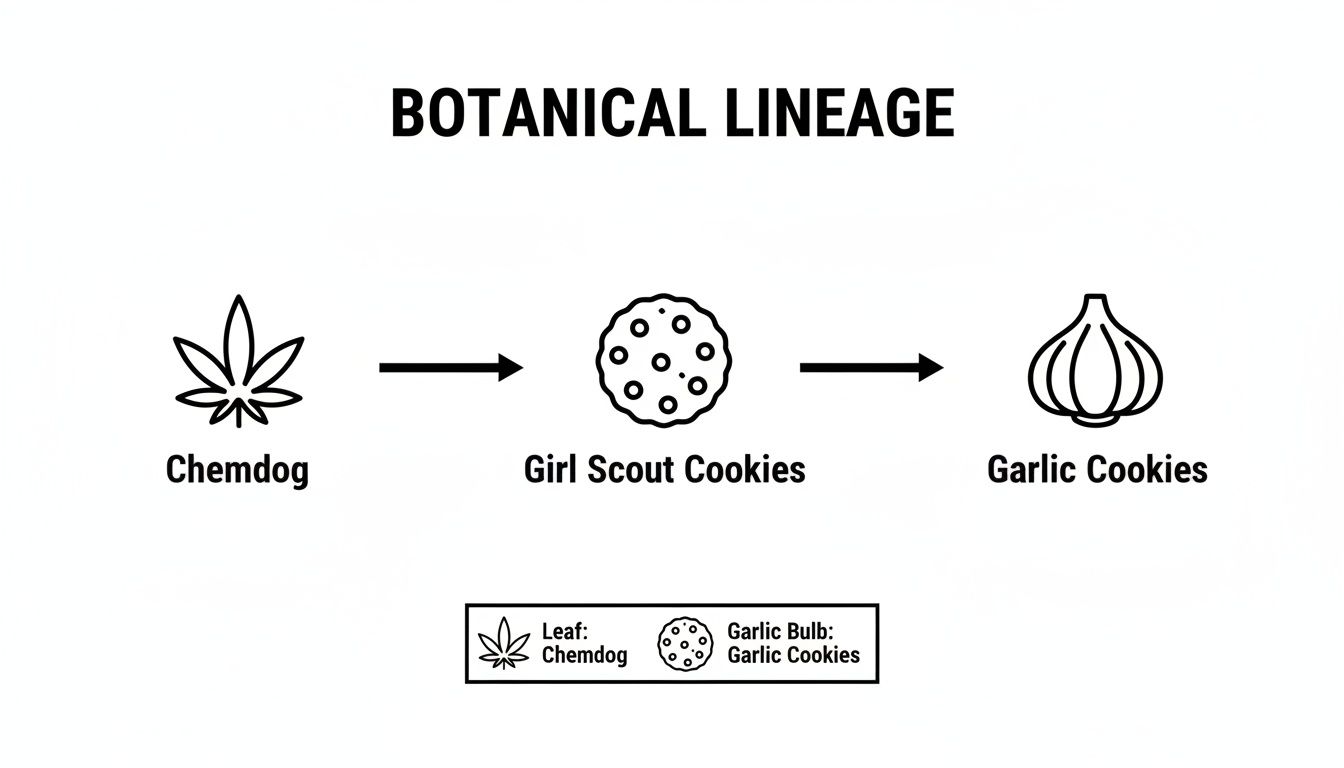
The sharp, fuel-forward notes from Chemdog fuse with the sweet, baked-goods complexity of Girl Scout Cookies. This combination forms the foundation for the entire Garlic Cookies aromatic structure.
Caryophyllene: The Spicy Foundation (Base Note)
Every robust profile requires a solid foundation, and for Garlic Cookies, that is Beta-Caryophyllene. As the dominant terpene, it establishes the spicy, peppery, and musky base. It is the heavyweight compound providing the core savory punch.
In formulation, Caryophyllene functions as the "base note." It is a heavy molecule that anchors the entire scent and flavor profile, providing longevity and depth. Without a significant Caryophyllene presence, any attempt to replicate this strain will lack the characteristic funk and feel incomplete.
Limonene and Myrcene: The Pungent Core (Mid Notes)
Layered on top of the peppery base are the "mid-notes," which define the signature gassy and earthy character of Garlic Cookies. This is where Limonene and Myrcene are critical.
Limonene, despite its citrus association, contributes a sharp, fuel-like, solvent-esque note. It cuts through the heaviness of Caryophyllene and provides the profile's aggressive chemical edge. For a closer look, check out our guide to D-Limonene's aromatic properties.
Myrcene balances this sharpness by adding a subtle earthy, herbal musk. These two terpenes work in concert to form the heart of the aroma, creating a seamless transition from the spicy base to the lighter top notes.
Synergy in Formulation: Limonene provides the aggressive "chem" kick, while Myrcene grounds it with a dank earthiness. This prevents the profile from becoming excessively sharp or one-dimensional.
While cannabinoid potency is high, the formulation story lies in the terpenes, which can comprise 1.5–3.0% of the flower's dry weight. Key analytes often include Limonene (~11.0 mg/g), Beta-Caryophyllene (~5.0 mg/g), and Beta-Myrcene (~4.0 mg/g). This specific trio drives the aromatic signature.
The Finishing Touches: Minor Terpenes (Top Notes)
Finally, the "top notes" provide the subtle details that complete the profile. These are delivered by minor terpenes such as Humulene and Pinene.
Humulene, structurally related to Caryophyllene, reinforces the woody, earthy base with hoppy undertones. Pinene adds a touch of clean, sharp pine to brighten the overall aroma and prevent it from becoming overly heavy.
These minor compounds are the final polish. Though present in small quantities, their absence would be immediately noticeable.
The table below provides a data-driven overview of this terpene synergy, essential for benchtop formulation.
Garlic Cookies Primary and Secondary Terpene Breakdown
| Terpene | Typical % Range | Aromatic Role (Note) | Flavor Contribution |
|---|---|---|---|
| Caryophyllene | 30% – 40% | Base Note | Spicy, peppery, woody, and funky. Provides the core savory body. |
| Limonene | 20% – 30% | Mid Note | Pungent, gassy, and sharp diesel. Adds the signature "chem" character. |
| Myrcene | 10% – 15% | Mid Note | Earthy, musky, and subtly fruity. Grounds the profile and adds depth. |
| Humulene | 5% – 10% | Top/Mid Note | Hoppy, woody, and earthy. Complements Caryophyllene's spicy notes. |
| Pinene | 2% – 5% | Top Note | Sharp pine and clean herbal notes. Adds a touch of aromatic brightness. |
Achieving the correct ratios is the key to moving from a rough approximation to a precise replication of the Garlic Cookies strain profile.
A Practical Formulation Guide for Vape Cartridges
Translating the theoretical terpene profile of Garlic Cookies into a high-performance vape cartridge is a matter of technical precision. The objective is not simply to mix ingredients, but to artfully reconstruct the signature funky, savory experience within a delivery system. This requires deliberate selection of base materials, accurate ratio calculations, and thorough homogenization.
The foundation of any formulation is the base extract. This choice significantly impacts the final product's character, even when using an identical terpene blend.
Choosing Your Base Oil for Distillate Formulations
For most formulators, the choice is between cannabis distillate and less-refined extracts like live resin. Each presents distinct advantages and challenges when replicating the Garlic Cookies profile.
Cannabis Distillate: This is a blank canvas. As a highly purified concentrate, distillate contains high levels of cannabinoids but negligible native terpenes. This is ideal for precision. When a Garlic Cookies strain-inspired terpene blend is introduced, it will account for 100% of the final flavor and aroma. This affords maximum control and ensures batch-to-batch consistency.
Live Resin or other BHOs: These extracts are more complex starting materials, as they retain some of the source plant's native terpenes. This complexity introduces variability. Adding Garlic Cookies terpenes to live resin becomes an act of layering new flavors over existing ones, requiring careful testing to ensure the profiles are complementary rather than conflicting.
For formulators prioritizing consistency and precise flavor targeting, distillate is the superior choice as it eliminates agricultural variables.
Calculating Ratios for Optimal Flavor
The terpene percentage is the most critical variable in the formulation. For a bold, pungent profile like Garlic Cookies, the goal is to find the balance point where the flavor is robust but not harsh.
A reliable starting point for flavoring distillate is between 5% and 8% terpenes by weight.
Formulator's Tip: Initiate test batches at the low end of the range, around 5%. The aggressive, savory notes from Caryophyllene and Limonene in the Garlic Cookies profile can become overpowering quickly. It is far simpler to incrementally add terpenes than to correct an overly potent batch.
For a 100-gram test batch at a 6% concentration, the calculation is straightforward:
- Weigh out 94 grams of cannabis distillate.
- Separately, weigh out 6 grams of your Garlic Cookies terpene blend.
- Combine for homogenization.
This methodical approach allows for confident scaling once the ideal ratio is perfected in small-batch trials. While a different profile, similar formulation principles can be seen in our guide on replicating its distinct profile.
Homogenization for Stability and Safety
Proper mixing is a non-negotiable step. Terpenes and cannabinoid oils have different densities and will not self-homogenize. Inadequate mixing results in "hot spots"—pockets of concentrated terpenes that create a harsh, inconsistent, and unpleasant user experience.
The industry-standard method for achieving a perfect blend utilizes a magnetic stirrer and controlled heat.
- Set Temperature: Gently warm the distillate to between 40°C and 60°C (104°F to 140°F). This reduces the oil's viscosity for easier mixing without volatilizing the terpenes.
- Mixing Speed: Start the stirrer at a low-to-medium speed to create a gentle vortex.
- Introduce Terpenes: Slowly pour the pre-weighed terpene blend directly into the vortex.
- Homogenize: Allow the mixture to stir for a minimum of 15-20 minutes, or until the solution is perfectly clear and uniform with no visible streaks.
Once fully homogenized, the blend is stable and ready for filling. This process ensures that every unit delivers the consistent, authentic Garlic Cookies flavor intended by the formulator. Next, we will cover strategies for maintaining this consistency at scale.
Achieving Consistency and Scaling Production
Developing a successful Garlic Cookies formulation is a significant achievement. Ensuring batch #1 has the exact sensory profile as batch #100 is a different challenge altogether. For any brand, consistency is paramount. A vape cartridge that deviates from a consumer's previous experience risks eroding trust and damaging brand reputation.
The primary obstacle to consistency is the inherent variability of cannabis agriculture. A single cultivar like Garlic Cookies can exhibit a wide range of terpene expressions depending on cultivation environment, from lighting and soil to curing methods. Relying solely on cannabis-derived terpenes for large-scale production introduces an unacceptable level of inconsistency.
Formulated, botanically-derived terpene blends solve this problem by removing agricultural variables from the equation.
The Economics of Formulation for Cannabis Products
When sourcing terpenes, formulators have two primary options: building a profile from individual isolates or purchasing a pre-formulated, strain-specific blend.
Building from Isolates: This approach offers maximum creative control but incurs higher R&D costs, more complex inventory management, and a greater risk of costly formulation errors. It requires significant in-house expertise.
Using Pre-Blended Profiles: This is the most efficient path to consistency and scale. A reputable supplier has already invested in the R&D, sourcing, and quality control. They provide a reliable, tested solution that can be integrated directly into a production line, saving significant time and operational overhead.
For most brands, the economics favor pre-blended profiles. The savings in labor, R&D, and waste mitigation typically outweigh the cost of a ready-to-use blend, especially at scale.
Overcoming Agricultural Bottlenecks
While Garlic Cookies is a high-yielding cultivar, this agricultural success highlights the core problem for manufacturers. A large harvest does not guarantee a consistent terpene profile. One crop may be higher in Caryophyllene, while the next expresses more Limonene due to minor environmental shifts. For a brand requiring product uniformity, this is an untenable risk.
A reliable terpene supplier acts as a buffer against agricultural volatility. They provide a standardized ingredient that enables a predictable, scalable manufacturing process. The result is a consistent end-user experience, every single time.
Ultimately, scaling production with consistency is a matter of strategic sourcing. By shifting from variable plant inputs to standardized terpene blends, formulation evolves from an agricultural art to a precise, repeatable science suitable for commercial manufacturing.
Troubleshooting Common Formulation Issues
Even with a precise formulation, challenges can arise. The Garlic Cookies profile is notoriously complex, and its signature savory funk is a delicate balance. Issues like harshness or flavor instability are common hurdles, but they are almost always correctable with minor process adjustments.

Perfecting the manufacturing process is what distinguishes an adequate cartridge from a premium product that commands brand loyalty. Let's address the most common issues encountered when replicating the flavor of Garlic Cookies for vape cartridges.
Problem One: The Flavor is Excessively Harsh or Peppery
If feedback indicates a "spicy" or throat-irritating experience, the cause is almost certainly a terpene imbalance. When a blend presents as sharp or peppery, the primary suspect is an overabundance of Beta-Caryophyllene. While it provides the essential funky, spicy backbone, it can easily dominate the more subtle terpenes, resulting in a harsh, one-dimensional product.
- Solution: Reduce the Beta-Caryophyllene concentration in the next test batch by 0.5% to 1%. This small adjustment can have a significant impact. To compensate for the volume and round out the profile, consider a slight increase in a mid-note terpene like Myrcene, which will soften the peppery edge.
Problem Two: The Final Product is Cloudy
A hazy or cloudy final oil is a critical quality control failure. The goal is a crystal-clear, professional product. Cloudiness indicates an issue with either the starting materials or the homogenization process.
The two main culprits are residual lipids or waxes in the distillate (a sign of improper winterization) or incomplete blending of terpenes and oil, causing microscopic separation.
- Solution: First, verify the purity of your base distillate. If the base material is clean, the issue lies in your mixing procedure. Ensure the mixture is gently heated to between 40°C and 60°C and homogenized with a magnetic stirrer for a minimum of 20 minutes. Full homogenization is a critical, non-skippable step. For more technical advice, our collection of terpene guides can offer further insight into proper handling procedures.
A stable, crystal-clear formulation is non-negotiable for premium vape cartridges. Any visual imperfections suggest an underlying process or material issue that will ultimately compromise the end-user experience and your brand's reputation.
Problem Three: The Savory Notes Degrade Over Time
A common frustration is a product that has an excellent profile immediately after formulation but loses its signature savory character weeks later. This is flavor degradation, a preventable issue caused by the breakdown of volatile terpenes.
The most aromatic compounds, such as Limonene and Myrcene, are sensitive to oxygen, light, and heat. Exposure causes them to oxidize and degrade, leaving the blend tasting flat.
- Solution: Implement a strict post-production handling protocol. Fill and cap cartridges promptly to minimize air exposure. Utilize packaging that blocks UV light. Finally, educate your distribution chain on proper storage. Advise distributors and retailers to store the final product in a cool, dark environment to preserve the integrity of your Garlic Cookies strain-inspired terpene blend.
Answering Your Garlic Cookies Formulation Questions
Even with a detailed guide, specific questions will arise when dialing in a profile as unique as Garlic Cookies. Let's address the most common queries from extractors and product developers.
What is the ideal terpene percentage for formulating with distillate?
For a robust profile like a Garlic Cookies strain-inspired terpene blend, the optimal range is typically 5% to 7% by weight. Its savory, gassy character is potent, meaning a lower concentration is often sufficient.
Start test batches at 5%. It is simple to titrate upwards if a stronger flavor is desired. Exceeding 8% is generally not recommended, as it can lead to a harsh vapor that overwhelms the profile's nuanced notes. This percentage is the critical factor when you are replicating the flavor of Garlic Cookies for distillate.
My vape cartridges taste harsh. What is the likely cause?
A harsh Garlic Cookies cartridge typically points to one of three issues, with the most common being an excess of Beta-Caryophyllene.
- Check Your Ratios: Ensure the Caryophyllene concentration is not overpowering the other terpenes in the blend.
- Confirm Homogenization: Incomplete mixing can create "hot spots" of concentrated terpenes, leading to harshness.
- Evaluate Your Base Oil: Low-quality distillate can introduce its own harshness, independent of the terpene blend.
Expert Tip: A smooth vapor experience is a function of balance and process. If ratios are confirmed to be correct, critically evaluate your homogenization procedure. Proper temperature and sufficient mixing time are essential for creating a fully integrated, stable solution. For a deeper analysis, consult our terpene formulation resources.
Can this terpene profile be used for edibles or tinctures?
Yes, but the application requires significant adjustment. While this profile is ideal for inhalation products, its use in edibles, beverages, or tinctures demands a much lower usage rate, often below 1%.
The funky, savory notes can easily overwhelm an ingestible product if not used with extreme care. Successful formulation for non-inhaled products requires extensive R&D and sensory panel feedback to achieve a subtle, balanced flavor.
Ready to create a standout product with an authentic, savory profile? Gold Coast Terpenes offers lab-verified, strain-specific terpene blends and isolates to help you achieve perfect consistency and flavor. Explore our full selection at https://www.goldcoastterpenes.com.