
The most common advice about food grade terpenes is also the least useful: if the bottle says food grade, you're covered. You aren't. Food grade is a status attached to one substance, at one purity, for one intended use, at one use level. Change the route, the dose, or the market, and the status doesn't automatically travel with it. Buyers who treat the phrase as a blanket approval end up with a flavor that's legal in one product and unreviewed in another. The fix isn't a better label. It's a document-by-document check before you commit to volume.
What Food Grade Means on a Terpene Label
Food grade isn't one certificate that covers every terpene you buy. Think of a pan marked oven safe. That mark tells you it handles a 400 degree oven, not a direct flame on a grill. The same logic applies here: a food-use conclusion covers the conditions it was reviewed for, and nothing beyond them.
Our terpenes are botanically derived, extracted from fresh plants and free of mixtures, chemicals, and additives. That describes the source and the purity. It doesn't replace the food-use review for each compound.
The terms buyers mix up
| Term | What it actually tells you |
|---|---|
| Food grade | The material meets food-use rules for a named substance at a stated purity and use level |
| Botanically derived | The terpene comes from plant material rather than being synthesized |
| Isolate | One compound, such as limonene or myrcene, judged by assay value and minor components |
| Blend | Several terpenes combined to hit a target profile, so you need the full component list and ratios |
| Certificate of analysis | The lab report for one lot, identified by lot number, test date, and lab name |
| THC-free | The material contains no THC, which is a separate question from food status |
United States rules judge flavoring substances one at a time. Under 21 CFR 172.515, synthetic flavoring substances and adjuvants may be used only at the minimum quantity required to produce their intended effect and in accordance with good manufacturing practice, and the list includes cedarwood oil terpenes. Natural flavoring substances sit under 172.510, while 21 CFR 182.60 identifies limonene, including d-, l-, and dl-limonene, as generally recognized as safe for its intended use as a synthetic flavoring substance or adjuvant.
A terpene occurring naturally in a plant isn't automatically permitted in food. The label tells you where to start. The documents tell you whether the material fits your product.
Where Food-Grade Terpenes Fit in Flavor Work
A beverage team wants a bright citrus top note over a flat base. Limonene carries that note, so start with the isolate, taste it in the actual base, then decide whether the profile needs a second component for depth. If the target is a rounded fruit character rather than a single note, a prepared blend gets you closer faster than stacking isolates by guesswork.
An isolate works like one instrument playing one clear line. A blend works like a small ensemble, where several parts create a fuller profile. That distinction matters because a food-use decision attaches to a named substance, a specific use, and a dose level, so each route and batch needs its own document check before a formulation moves toward scale.
Common flavor targets and starting isolates
| Target Note | Common Starting Isolate or Blend | Matching Note |
|---|---|---|
| Citrus | Limonene | Start low and taste in the finished base |
| Fruit profiles (blueberry, lemon, strawberry, grape, peach) | Fruit-profile blend | Match the blend to the base before adding more |
| Herbal or woody | Alpha pinene or terpinolene | Watch for sharpness at higher doses |
| Floral | Linalool | Test with sweeteners and acids present |
| Spicy or peppery | Beta caryophyllene | Keep the dose low to avoid bitterness |
Gold Coast Terpenes offers terpene flavors ranging from blueberry, lemon, and strawberry to grape and peach. The isolate lineup includes Alpha Pinene, Beta Caryophyllene, Limonene, Linalool, Myrcene, and Terpinolene, and customers can choose isolates and terpene profiles based on personal preference. For a closer look at how these notes behave in edible and drink formats, our guide to terpenes in food covers the application side.
Terpenes are potent. Raising the dose to fix a weak profile usually produces harshness, so change the blend or base first. A small increase can make the aroma sharp before it makes the flavor richer, which is why the first adjustment should improve fit rather than force intensity.
Use a matching routine that keeps results readable:
- Taste the base alone first. You need a baseline, or you'll credit the terpene for sweetness the base already had.
- Add at a low pilot level. One small, logged addition tells you more than three unlogged ones.
- Rest, then taste again. Aroma settles into the matrix over time.
- Change one variable at a time. Dose, base, or sweetener, never two at once.
The same terpene reads differently in a carbonated beverage, a candy mass, and an oil-based tincture, so treat each base as its own test. Keep the sample conditions consistent enough that a change in aroma can be traced to the terpene, the base, or the dose. That habit becomes more useful as the batch grows, because small sensory differences become easier to notice at scale and harder to correct after production.
Dosing and Dilution Math for Batch Planning
Start with the formula, because everything else follows from it: percent load equals terpene weight divided by total batch weight, times 100. Put 10 g of terpene into a 100 g batch and you have a 10% load. Note that the denominator is the finished batch, not the carrier alone.
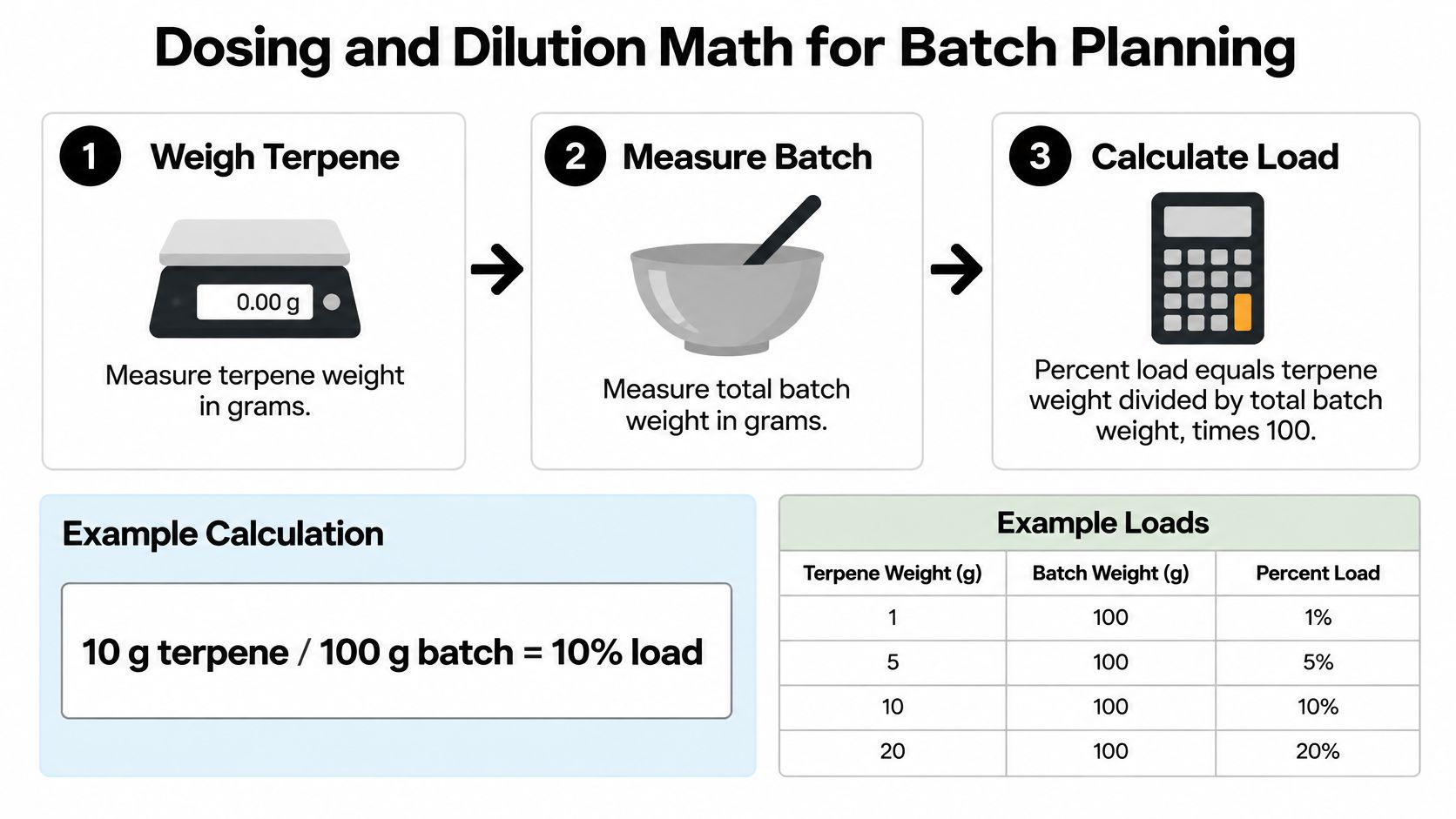
Example terpene loads for trial batches
These are arithmetic examples for planning a trial, not recommended use levels for any product.
| Batch Size | Trial Load | Terpene Weight |
|---|---|---|
| 100 g | 1% | 1 g |
| 100 g | 3% | 3 g |
| 100 g | 5% | 5 g |
| 1 kg | 2% | 20 g |
| 1 kg | 5% | 50 g |
Carrier choice belongs in the same file as the dose. Any base oil or distillate you add becomes part of the finished formulation, so document its identity, compatibility, and food-use status alongside the terpene. Our terpenes for carts are free from additives, VG, PG, PEG, and MCT, which keeps the carrier decision in your hands rather than hidden in the flavor component.
The legal ceiling matters as much as the sensory one. FDA rules for natural flavoring substances in 21 CFR Part 172, Subpart F require the minimum quantity needed to produce the intended physical or technical effect, under good manufacturing practice, and the material must also be approved, previously sanctioned, or otherwise permitted for food use.
The batch routine
- Set the batch size, so every later number has a fixed denominator.
- Choose a trial load and write down why you picked it.
- Calculate the terpene weight before you open a bottle. Our mixing ratios calculator handles the conversion if you'd rather not do it by hand.
- Weigh the carrier into the vessel first, tare, then add terpene.
- Add by weight, not volume, because density differs between materials and a milliliter of one isolate isn't a milliliter of another.
- Mix until uniform, then let the batch rest before judging aroma.
- Record lot number, load, and date on the batch sheet.
Practical rule: don't raise the load to fix a weak aroma without a logged test behind the change.
Safe Handling and Storage That Limits Oxidation
Four things change terpenes in storage: oxygen, light, heat, and time. They drive oxidation, and oxidation creates new compounds that shift the smell and can irritate skin and airways. Purity on arrival is only half the story. What the material becomes on your shelf is the other half.
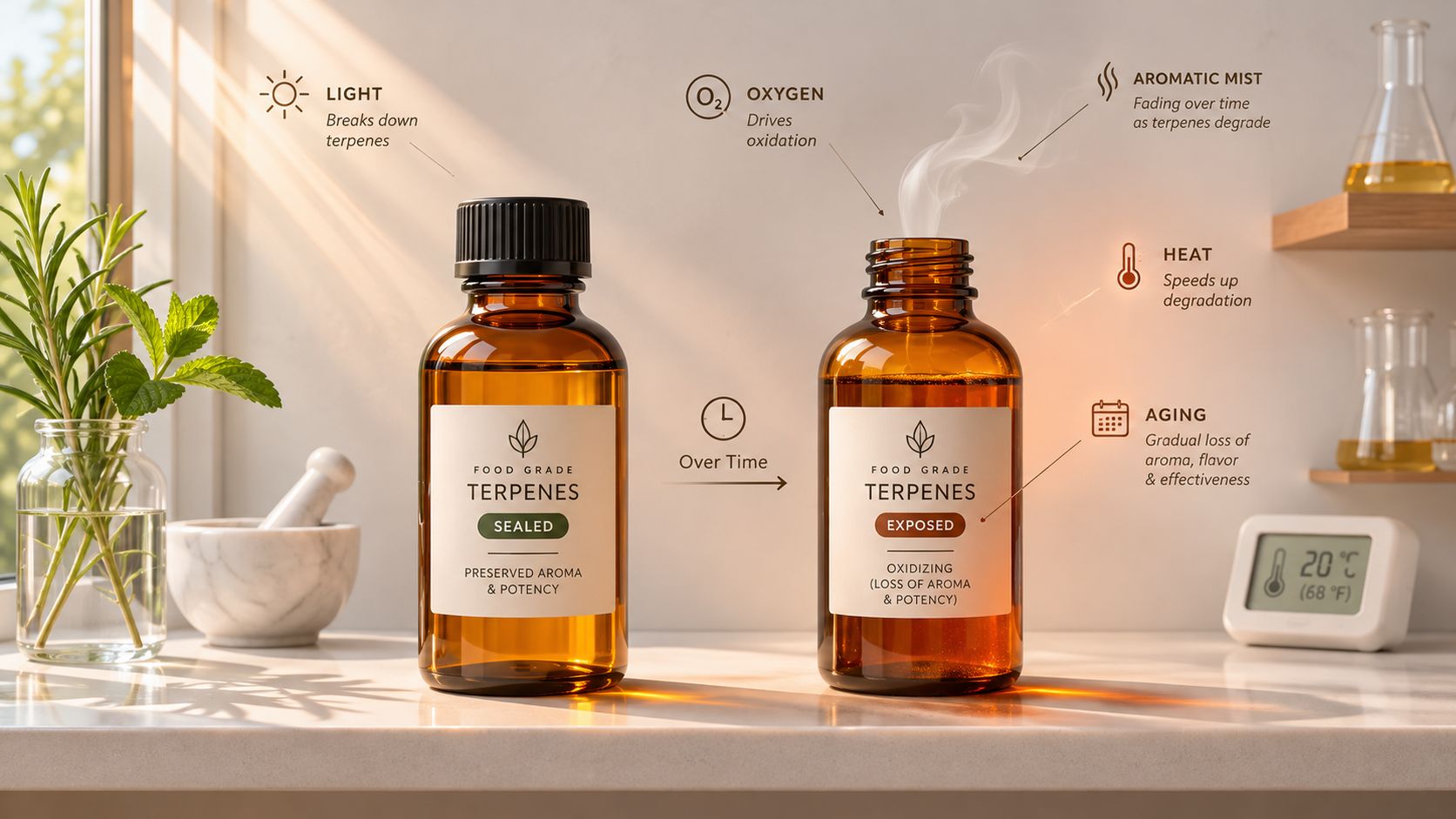
The chemistry isn't theoretical. A review of non-cannabis additives in inhalable cannabinoid products prepared for the Oregon Liquor Control Commission documents irritation and allergic reactions associated with oxidized monoterpene oils, and reports that limonene oxidation products including 4-OPA can induce oxidative stress and alter inflammatory markers in human bronchial and alveolar cell models in concentration- and time-dependent ways.
Build the handling routine as habits a line worker can follow without thinking:
- Seal and match the container. Use tightly sealed, compatible containers, and check that caps and liners suit the material.
- Keep it cool and dark. A closed cabinet away from windows and equipment heat beats a shelf under a light.
- Decant as stock drops. Move remaining material into smaller containers so there's less air above the liquid.
- Open only when you're dosing. Every open cycle adds oxygen and lets light volatiles escape.
- Rotate first in, first out. Date labels on receipt, not on first use.
Test stability in the finished base, not only on the neat terpene certificate, because the oil or beverage matrix changes how the material ages. Where your lab can run them, add lot-specific peroxide or oxidation checks.
Concentrated material also needs workplace controls. Read the safety data sheet, use the protective gear it lists, and train staff on spills and skin or eye contact. Our Terpene Safety & Documents page keeps that paperwork in one place.
Storage checklist for every lot: container, temperature, light, headspace, date, and SDS on file.
Why Food Grade Does Not Prove Inhalation Safety
No. Food-grade status doesn't by itself make a terpene suitable for inhalation. A food-grade drum is fit for a recipe. It was never qualified for a spray line, and the same gap applies to a flavor ingredient moving into an aerosol product.
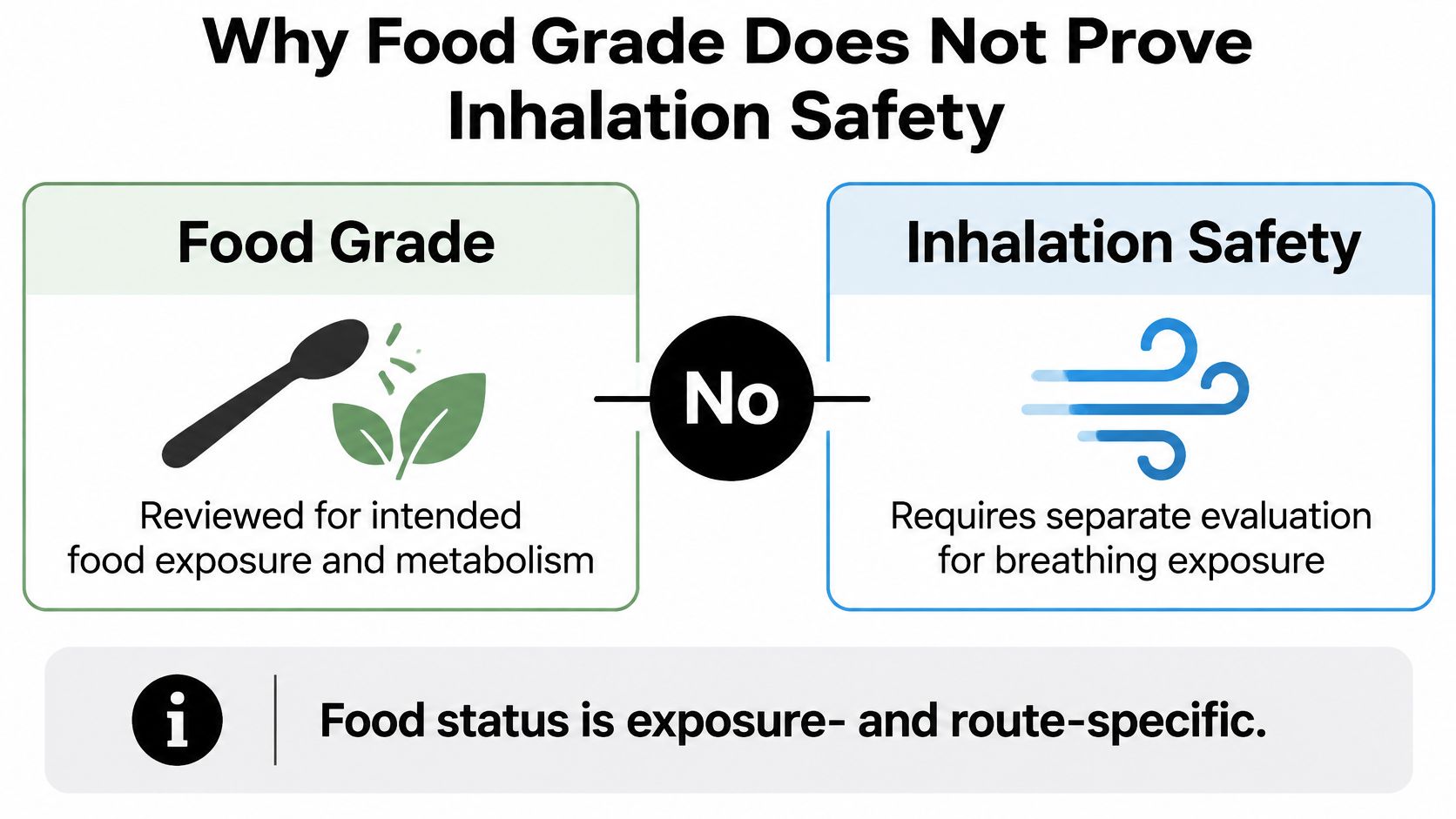
The reason sits in how the review was built. FEMA's expert-panel framework, indexed in the EPA HERO reference record on terpene hydrocarbon flavor safety, evaluates these compounds using intended food exposure, structural relationships, metabolism, pharmacokinetics, and toxicology, and the rationale for reaffirmed GRAS status rests on low flavor-use levels, rapid absorption and metabolic detoxification, excretion, and wide margins between conservative dietary-intake estimates and no-observed-adverse-effect levels. Every one of those assumptions is oral. Breathing a heated aerosol doesn't share them.
Does food-grade status cover each use route
| Use Route | Covered by Food-Grade Status? | What Else You Need |
|---|---|---|
| Oral flavoring in food or beverage | Yes, within the authorized use and level | Market-by-market compliance check |
| Topical or cosmetic use | Not established by food status | Separate safety review for the route |
| Inhalation or aerosol in a vape product | No, not established | Route-specific toxicology and thermal testing |
| Workplace handling of concentrates | Not addressed | Safety data sheet and staff hazard training |
Heat changes the chemistry, so thermal testing has to match your real coil temperature, power, carrier composition, and dose. Bench data from a different device tells you little. For a fuller treatment of that gap, see our explainer on whether terpenes are safe to vape.
Market rules add a second layer. Regulation (EC) No 1334/2008 requires business-to-business flavorings not intended for final consumers to carry labeling that is clearly visible, legible, and indelible, and it sets maximum levels for certain naturally occurring substances in named foods, including estragole at 50 mg/kg in categories such as dairy products and processed fruits, vegetables, nuts, and seeds. Those limits apply to the finished food, so you calculate the contribution from every component.
Ask your supplier for four things before scaling an inhalable product: route-specific toxicology, thermal behavior data, residual solvent and contaminant results, and a written statement of intended use. The regulatory status of the finished product is the maker's responsibility, not the ingredient seller's.
Documents to Check Before You Buy
Two lots sold under one name can differ in their assay and minor components, so the specification is what you buy. Two materials sold as myrcene can smell different for that reason. The EU flavoring specification entry for myrcene requires at least 90% myrcene, allows secondary C15H24 terpene hydrocarbons, and notes that traces of limonene, alpha-pinene, beta-pinene, and other common C10H16 terpenes may occur. A broad ingredient name hides those details, which is why the specification works like a label on a spice jar: the title gives you the category, while the fine print tells you what is inside.
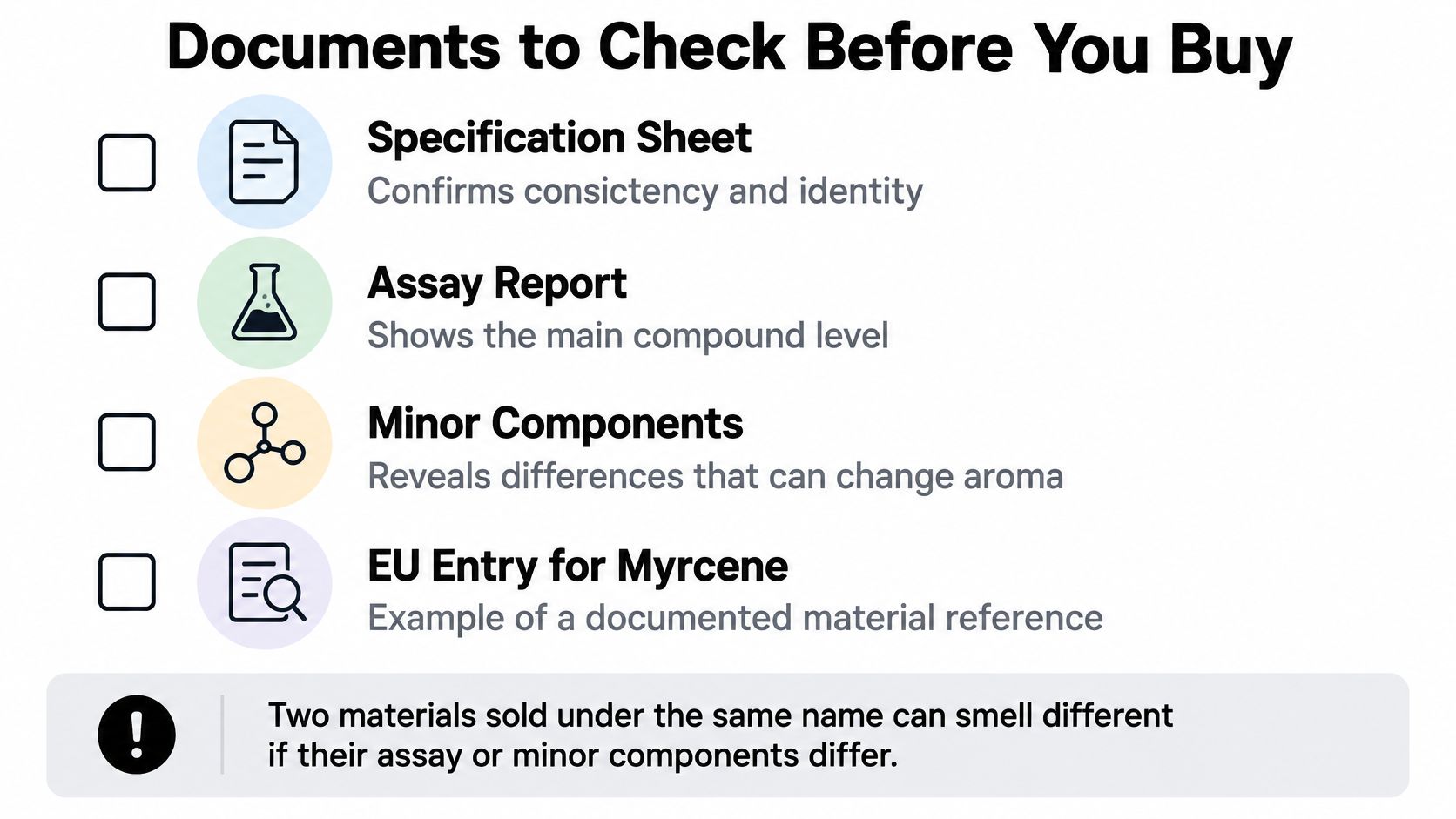
For a screening reference, the JECFA evaluation of flavoring substances published through the FAO lists beta-caryophyllene, d-limonene, myrcene, alpha-pinene, beta-pinene, terpinolene, and valencene with a "no safety concern" status under the Committee's stated conditions. Use this list as a screening starting point, and check each isolate against its stated conditions of use. Gold Coast Terpenes' cartridge terpenes are SC Lab-tested, and terpene information for its products is provided by SC Labs. That gives buyers a named laboratory source for the figures used in lot comparisons.
Supplier documents and red flags
| Document | What It Confirms | Red Flag |
|---|---|---|
| Certificate of analysis | Identity, assay and lot number | No lot number or test date |
| Component breakdown (GC-MS) | Minor terpenes and overall purity | Only a product name is given |
| Residual solvent and contaminant results | Solvents, pesticides, heavy metals | Results missing or unnamed lab |
| Safety data sheet | Hazards, handling and protective gear | Not provided on request |
| Composition statement | Full list of components and ratios | Vague blend names with no ratios |
Run the same five checks on every incoming lot:
- Request the certificate of analysis for the exact lot you received, not a representative one.
- Confirm identity and the assay range against your approved specification.
- Compare minor components with your last approved lot, since that's where aroma drift usually starts.
- Run a side-by-side flavor test at the same dose in your base, old lot against new.
- File the documents with the batch record so a complaint six months later is traceable.
A matched test result is a document too. Keep it with the paperwork.
Our guide to reading a certificate of analysis covers what each line on the report means. Keep one checklist per lot: lot number, assay, minor components, residual solvent results, SDS on file, intended-use statement, and matched test result.
Request Samples and Confirm Your Next Order
Buying at scale before tasting the material in your own base is the expensive way to learn. A sample order works like a fitting before a uniform order. The small batch shows how the aroma sits in the base, how long it takes to settle, and whether the notes still match the target after rest time.
Three actions keep the order step practical:
- Choose two or three isolates or blends that match your target notes. For a dessert-style profile, Bananna runtz sits in the flavor hybrid range alongside single isolates. Existing isolates and profiles let buyers compare options by personal preference before choosing a direction.
- Request samples and run the trial batch. Use the weight-based method and log the load, the base, and the rest time so the result is repeatable.
- Send your document checklist and expected volume. That lets the supplier plan supply and confirm the paperwork needed for your market.
Food-grade status supports only the uses it has been reviewed for. Confirm route fit and destination-market rules before committing to production quantity. Free shipping applies on all orders above $100, which helps a sample-and-trial order make sense before bulk purchase.
Pick target notes, trial samples in your own base, and send your checklist and volume to Gold Coast Terpenes when you are ready to order.