
Fenchyl alcohol is a bicyclic monoterpenoid alcohol, C10H18O, CAS 1632-73-1, FEMA 2480, used as a low level camphoraceous accent in cannabis and botanical terpene blends. Gold Coast Terpenes, a Redondo Beach, CA supplier, makes 100% botanically derived terpene blends, not cannabis derived, and treats this fenchyl alcohol terpene as a precision accent rather than a universal strain marker.
That distinction changes how you buy, dose, and document it for vape cartridges and distillate.
What Fenchyl Alcohol Is and Why Formulators Care
Fenchyl alcohol matters because a small, correctly specified addition can add camphoraceous lift to a strain inspired terpene blend, while a vague specification can shift aroma, clarity, and batch consistency. It rarely dominates a profile, so you're not buying headline flavor. You're buying control.
Gold Coast Terpenes, based in Redondo Beach, CA, offers a 100% botanically derived, THC free blend portfolio for formulators who need repeatable inputs. That botanical versus cannabis derived distinction matters for labeling, supply continuity, and cost planning, especially when you're building a terpene profile for vape cartridges at scale.
The Three Decisions That Gate Everything Else
First, confirm identity. Fenchyl alcohol, also called fenchol, isn't fenchone, and alpha and beta forms aren't interchangeable by default. If the purchase order only says fenchyl alcohol, your lab and your supplier may not be talking about the same material.
Second, secure documentation before sensory work. Ask for exact chemical name, CAS, isomer profile, purity, and analytical method on the certificate of analysis. Without that, your bench trial doesn't create a defensible spec.
Third, place it correctly in your note architecture. Think of it as a bridge between piney top notes and woody structure:
- Top note support: It can sharpen pine and camphor facets without becoming the lead note.
- Mid note transition: It links bright terpenes to warmer, resinous components.
- Base note restraint: It shouldn't replace heavier base materials that provide persistence.
Practical rule: If you can't name the isomer on the bench sheet, don't scale the formula.
For a new SKU, keep fenchyl alcohol on the active bench only when the target profile needs that cool, woody lift and you can verify the lot analytically. If the concept is fruit forward with no camphoraceous edge, leave it on the research shelf. For cannabis product formulation, precision beats inclusion for its own sake.
Identity, CAS Numbers, and Stereoisomer Specifications
A certificate of analysis that reads "fenchyl alcohol, 98% purity" leaves the most important question unanswered: which fenchyl alcohol? The full specification is 1,3,3-trimethylbicyclo[2.2.1]heptan-2-ol, CAS 1632-73-1, with the isomer stated on the purchase order. PubChem fenchyl alcohol records list alpha fenchyl alcohol at 154.25 g/mol in the (2R) configuration, while beta fenchyl alcohol carries the same C10H18O formula and molecular weight with a different three dimensional arrangement.
That difference shows up on the bench. Odor perception, volatility, and sensory character can shift between isomers, so two lots that share a label can behave differently once diluted into distillate.
Fenchyl Alcohol Registry Identifiers
| Identifier | Value | What It Confirms |
|---|---|---|
| CAS | 1632-73-1 | Chemical identity for purchasing and CoA matching |
| Systematic name | 1,3,3-trimethylbicyclo[2.2.1]heptan-2-ol | Exact structure behind the common name |
| Formula and weight | C10H18O, 154.25 g/mol | Bicyclic monoterpene alcohol classification |
| FEMA | 2480 | Flavor ingredient nomenclature reference |
| JECFA | 1397 | Flavoring evaluation reference |
| FLAVIS | 02.038 | Additional registry consistency check |
The JECFA flavouring reference for fenchyl alcohol anchors nomenclature for flavor applications. It does not clear a material for inhalation products, which fall under a separate review from food grade FEMA status, so treat registry entries as identity anchors and verify each commercial lot against them.
A compliant chromatographic result has a specific look. The peak table reports alpha and beta fenchyl alcohol as two resolved peaks, each with its own retention time and area percent, and the method field names the column and conditions used to achieve that separation. A single peak labeled "fenchyl alcohol" on a method that cannot resolve the pair is a misidentified lot waiting to reach your formulation.
Write the acceptance language straight into the purchase order:
Fenchyl alcohol, alpha isomer (or specified stereochemical profile), CAS 1632-73-1
Assay and isomer ratio by validated GC method resolving alpha and beta peaks
CoA required: full peak table, purity, residual solvents, melting behavior, appearance
Fenchol alone is not a spec, and neither is the generic name without an isomer callout. Gold Coast Terpenes publishes isomer level documentation on strain specific profiles, and that reporting depth is the baseline to expect from any terpene supplier for vape brands. When you're deciding how to choose a terpene supplier, ask how they report non detects and closely eluting compounds. A supplier who can't explain alpha versus beta separation is asking you to absorb the risk.
Aroma Character and How It Differs From Fenchone, Borneol, and Camphor
Fenchyl alcohol earns its place as a measured accent: camphoraceous at the top, woody through the middle, piney when the matrix stays light, and cooling only if the dose stays disciplined. Sigma-Aldrich fenchyl alcohol product information fits that lane, placing it among aromatic terpene alcohol materials rather than as a standalone character impact chemical. Two lots can share the name and still land differently if the alpha to beta ratio shifts, so the sensory call belongs next to the isomer call, never apart from it.
| Candidate | What the nose gets | Common bench mistake | Better decision |
|---|---|---|---|
| Fenchyl alcohol | Woody, piney lift with a camphor edge | Overdosing until the note turns medicinal | Use when a pine forward chemovar needs lift, not weight |
| Fenchone | Sharper ketone edge in the same broad camphor conversation | Treating alcohol and ketone as interchangeable | Evaluate as its own ingredient with sensory and GC checks |
| Borneol | Rounder, heavier camphor family feel | Assuming “cooling” means interchangeable | Choose when the target wants depth over brightness |
| Camphor direction | Harsher, more medicinal risk | Letting a blotter test decide cartridge dose | Approach cautiously where the brief already reads sharp |
Before choosing between neighbors, review borneol and camphor formulation distinctions; then keep the sensory decision separate from regulatory status, because food grade recognition and inhalation suitability answer different questions.
At the bench, I screen candidates at a matched 1% terpene load in the intended base oil, smell the blotter, rest the sample, then reassess in a warmed matrix. Record load, base, rest time, and descriptor for every run. That turns a pleasant sniff into a repeatable accent and keeps one loud terpene alcohol from flattening a strain inspired profile.
Natural Occurrence in Plants and Cannabis Chemovars
A chemovar can smell piney and still return no fenchyl alcohol on the chromatogram. In the Cannabis terpenoid classification and profiling research, one sample reported fenchyl alcohol at 29.0 ± 5.0 µg/g while other samples were below detection or quantification limits, so treat it as a trace accent that shows up in selected material, not a cultivar signature.
Outside cannabis, buyers will hear it named around bitter orange, nutmeg, pine needle, basil-type oils and other essential oil bearing botanicals. That botanical supply is useful for a strain inspired profile because the input can be specified, assayed and repeated without tying a launch to one harvest. Gold Coast Terpenes follows that model across 37 Strains and 40 Enhanced style strain profiles, with botanical versus nature identical labeling handled as a specification item.
Cannabis derived material is different work. A flower lot can be compliant and still contain no reportable fenchyl alcohol after drying, extraction and recovery; if a profile needs the note, standardization or an added isolate has to carry it. Ask whether the method separated alpha- from beta-fenchyl alcohol and whether the result is plant, extract or finished oil, because a "detected" line without isomer or matrix context can mislead a label claim.
Run the gate in order: confirm in your biomass or extract, fix botanical or cannabis derived labeling, then dose in the finished matrix to sensory effect.
Keep FEMA flavor status in the food lane; for inhalation, request residual solvent, pesticide, heavy metal and isomer-resolved assay data on the COA. The variability is the signal: use fenchyl alcohol where a piney, camphoraceous lift earns its place, and standardize it when the product promise depends on repeatability.
Blend Role, Synergies, and a Starting Dose Window
In most terpene profiles for distillate, fenchyl alcohol belongs as a low level top to mid note accent that lifts pine character and connects bright top notes to a woody base. Start at approximately 0.05 to 0.5 percent of the finished blend matrix for accent work, and explore 0.5 to 2 percent only when the concept intentionally leans camphoraceous.
Those windows are starting points, not guarantees. Total terpene load, carrier, hardware, and neighboring isolates change the result, so convert percentages into grams per batch before you weigh anything. The practical steps in how to use terpenes in formulation work pair well with Gold Coast Terpenes mixing calculator, which helps a formulator translate batch size and total terpene load into a weigh sheet.
Synergy by Note Position
- Top, limonene or pinene: Fenchyl alcohol can give the bright opening a cooler, piney edge. Keep it restrained so citrus or pine stays recognizable.
- Mid, linalool: The contrast can keep a floral mid note from reading flat, but test after rest because the balance shifts as the blend homogenizes.
- Base, beta caryophyllene: A woody, spicy base gives the camphoraceous lift somewhere to land, which helps a strain inspired terpene blend for vape cartridges feel structured.
Matrix matters as much as pairing. In distillate, evaluate after full homogenization and again after the filled unit has rested. In live rosin or other concentrate matrices, native terpenes already occupy part of the sensory space, so your added accent should be lower and justified by a direct comparison. With isolates, build a small ladder of trials rather than one large batch.
Bench habit: Change one variable per trial and retain a control. Without a control, you can't tell whether fenchyl alcohol improved the profile or the base simply varied.
Scale only after the winning trial survives repeat weighing, thermal exposure, and hardware testing. For formulating terpene profiles for vape cartridges, that discipline prevents a pleasant bench sample from becoming an inconsistent production lot.
Physical Properties and Handling for Concentrate and Cartridge Work
Fenchyl alcohol arrives as crystals, and that shapes every handling decision downstream. It sits solid or semi solid near typical room temperature, so a jar pulled from a cool storeroom will not pour, weigh cleanly, or homogenize until fully melted. ChemicalBook fenchyl alcohol property data list a melting point of approximately 43 to 46 °C and a boiling point of approximately 201 to 202 °C. JECFA reference data describe the material as white to pale yellow crystals with a camphoraceous odor, melting at approximately 35 to 40 °C in that specification context, with a reported assay benchmark of 97% minimum of C10H18O.
The spread between those ranges reflects real differences between material forms. Alpha and beta fenchyl alcohol soften at different temperatures, so the isomer ratio shifts where a given lot liquefies. Never average the ranges and assume the drum will pour. The lot specific CoA, with the alpha to beta split stated, is the controlling document.
| Stage | Bench instruction | Batch record entry |
|---|---|---|
| Warm-up | Gentle heat until completely liquid; partial melt creates sampling error | Bath temperature and duration |
| Dissolution | Work in the oil phase; the isolate is soluble in vegetable oils and ethanol, very slightly soluble in water | Carrier used, clarity result |
| Equilibration | Return the batch to a defined temperature and inspect for crystals or haze before filling | Temperature and visual check |
| Thermal cycling | Cool, then rewarm the finished blend to simulate cool warehouses and winter shipping | Cycle count and post-cycle clarity |
Write the warm-up as a single unambiguous line. One workable format: Warm-up bath 48 °C, 15 min, full melt confirmed, operator initials. A second operator should reproduce the batch from the record alone.
Water based systems need a different plan. Direct addition will fail, so use a defined solubilization strategy and validate clarity before scaling. Gold Coast Terpenes formats its lab verified blends free of VG, PG, PEG, and MCT, a useful reminder that carrier choice is a deliberate formulation decision. Adding a crystal forming isolate to an undefined diluent system invites phase separation and haze that post-hoc mixing will not fix.
Extraction Recovery, Matrix Effects, and Why Single Numbers Mislead
Send one fenchyl alcohol lot to three labs and you can get three defensible numbers.
Cannabis analytical research on oxygenated terpenoid recovery reported d-α-fenchyl-alcohol at roughly 77.79 to 121.70 across olive-oil capture conditions, and about 809.58 ± 99.82 in another setup; read each value with its matrix, units, dilution factor and run conditions attached. Spread like that is generated by capture efficiency, polarity, temperature, injection behavior and how completely alpha and beta forms are resolved.
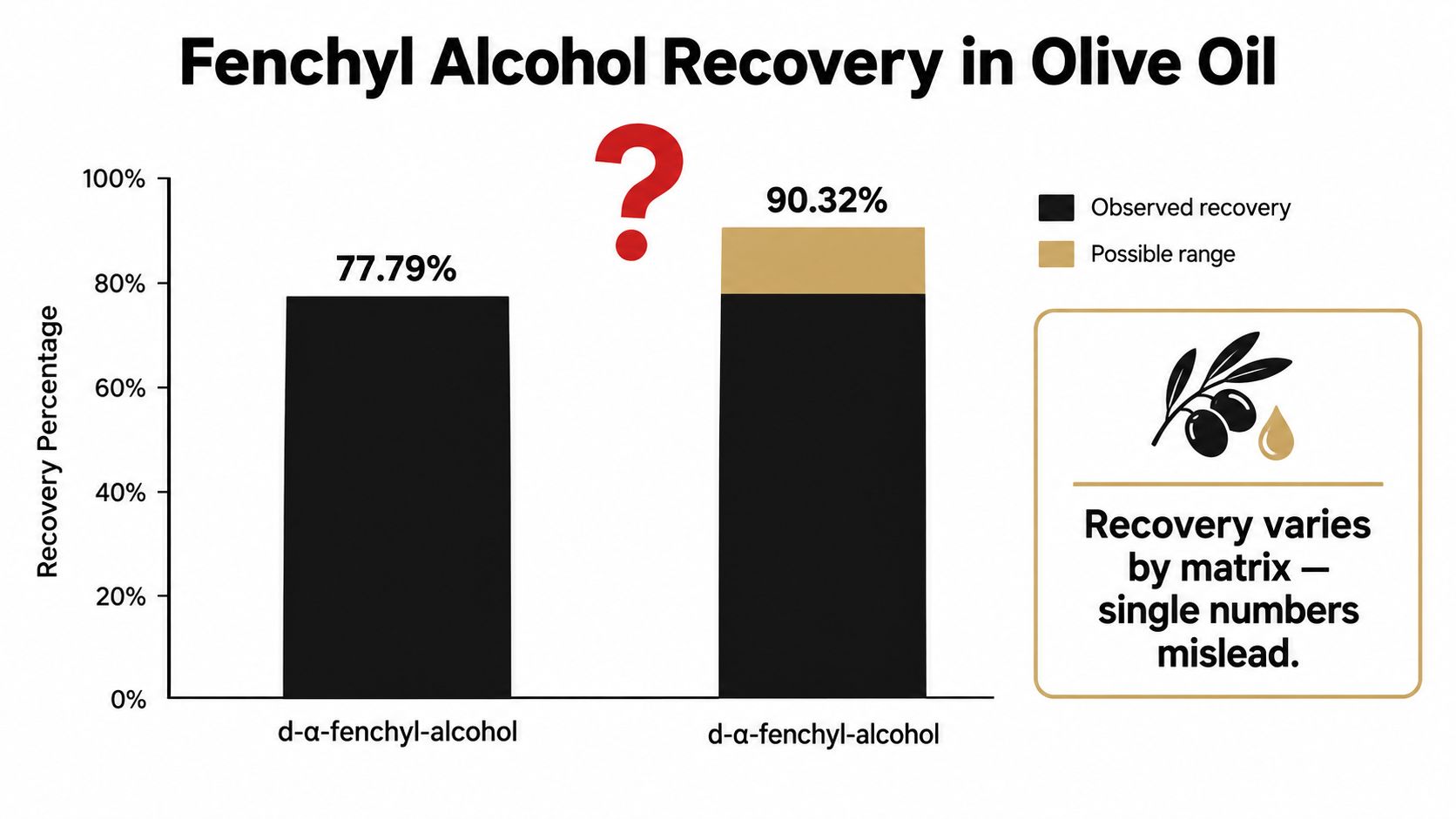
For purchasing, quote the method before the number. A usable spec names the matrix (flower, olive-oil capture, distillate, rosin, finished cartridge oil), extraction and GC-MS conditions, the alpha/beta separation basis, detection limit, dilution, and whether the result is normalized or as-recovered. Terpene extraction methods and recovery considerations are a useful benchmark, but your matrix-specific validation is the acceptance test.
I treat a copied plant value as a hypothesis. In distillate work, set the target in the finished oil, verify fenchyl alcohol by GC-MS after blending, then compare against aroma after dilution. Gold Coast Terpenes specifies profiles by GC-MS documented composition rather than cultivation origin, which matches how repeat production is controlled. The order sheet should carry method and reporting basis beside the result so a high recovery number and a low one can be audited on the same terms.
Regulatory and Safety Frameworks for Inhalation Products
FEMA 2480 and JECFA 1397 identify fenchyl alcohol as a flavoring substance. Neither number clears it for a heated, inhaled product. Fenchyl alcohol regulatory and FEMA reference information lists FEMA number 2480, JECFA number 1397, and a reference to 21 CFR 172.515 for flavoring substances, with JECFA reporting no safety concern at current levels of intake when used as a flavoring agent.
Jurisdiction shifts the acceptance bar more than formulators expect. A state-licensed cannabis market can treat added terpenes as declared ingredients and hold the finished cartridge to inhalation product testing, while the same isolate sold into a food application only has to satisfy flavoring rules. One material, two different reviews. Assess whether terpenes are safe to vape from an inhalation compliance perspective as part of a product specific evaluation, never as a blanket clearance.
For each production lot, the compliance file I assemble covers the current CoA matched to lot number and release status, identity and purity results naming the isomer and the GC-MS method behind them, a residual solvent panel suited to the finished matrix, safety data and handling records, a documented toxicology review for the inhalation route, and the federal and state category requirements that apply to the finished product. Any gap holds the lot out of production until it closes.
A flavoring identifier is a traceability tool. It is not a substitute for inhalation risk assessment.
Label copy stays inside flavor and aroma language. Detection in cannabis, laboratory bioactivity research, or food flavoring status doesn't justify a therapeutic statement on a cartridge or concentrate. Gold Coast Terpenes positions its profiles for flavor and aroma formulation, and brand owners should hold that same boundary during copy review.
Build the compliance file before launch, while supplier, dose, or label language can still change. Reconstructing it after production is expensive and usually incomplete.
Quick-Reference Specification Checklist Before You Order
The weakest CoA that crosses my bench reads "fenchyl alcohol" and stops: one assay figure, no isomer call, no lot traceability. You are buying a precision accent, so the isomer line is where a supplier earns or loses the order. Require a lot specific package confirming identity, CAS, isomer, assay, melting behavior, residual solvents, and batch traceability. Anything missing makes the material unapproved for production, even when a small sample smells right.
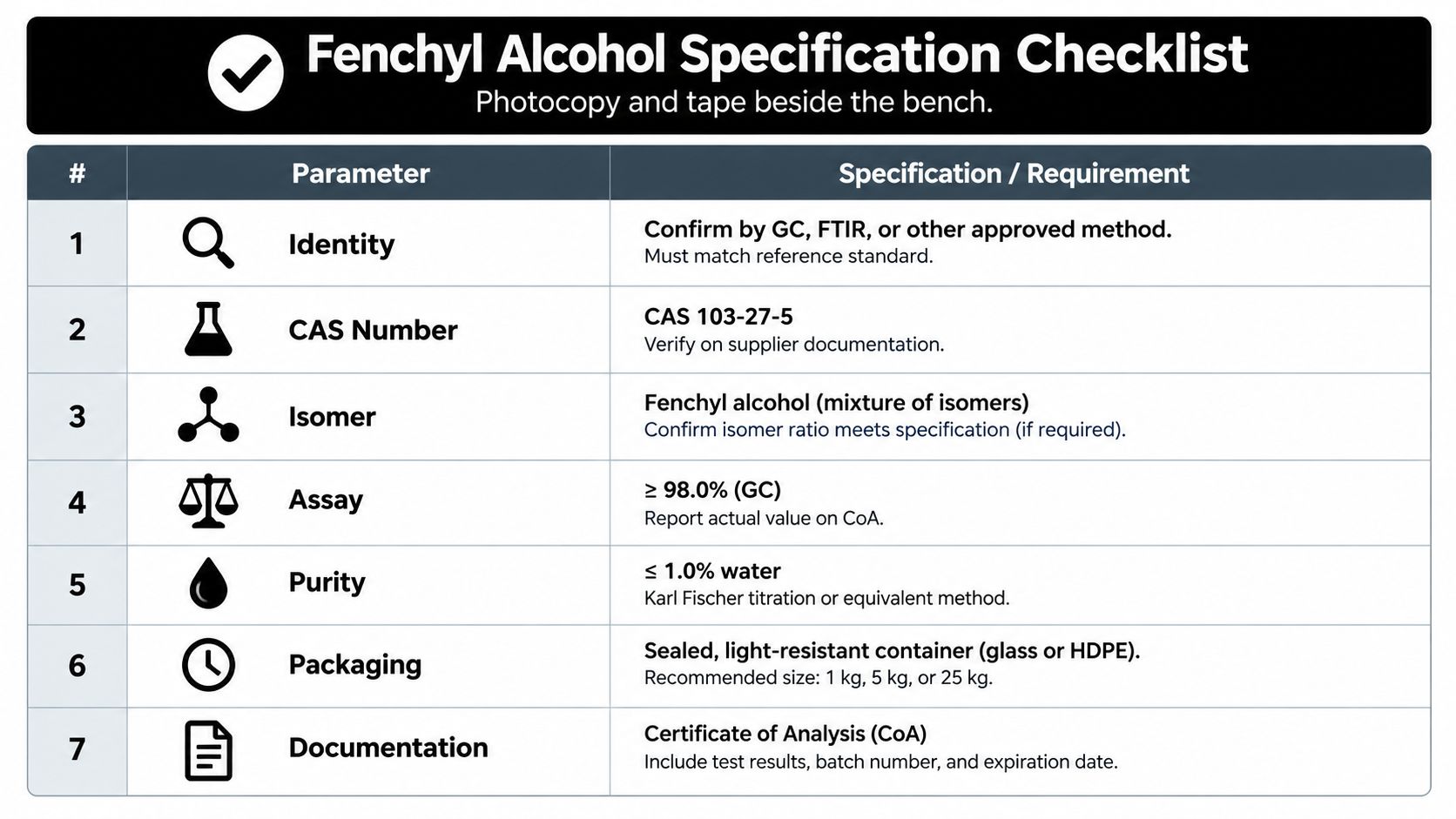
The same acceptance criteria in text form, ready to paste into an RFQ or spec sheet:
| Specification line | Require on the CoA and RFQ | Hold the lot when |
|---|---|---|
| Identity | Chemical name tied to CAS 1632-73-1 on both CoA and label | Name or CAS is missing, generic, or mismatched |
| Isomer | Alpha, beta, or a defined stereochemical profile, with GC-MS separation from borneol and camphor peaks | Isomer unstated or reported as a single unresolved peak |
| Assay | Purity result and method named for the shipped lot | Result references another lot or lists no method |
| Physical form | Appearance and melting behavior consistent with your warming and weighing procedure | Material behaves differently at bench temperature than specified |
| Residual solvents | Panel documented for the finished product category | Panel absent or run for a different product category |
| Traceability | Lot number matches across CoA, label, and container | Any number fails to match |
| Commercial terms | MOQ, pack size, lead time, shipping conditions, and reorder lot continuity written on the RFQ | Terms agreed verbally only |
Order size changes how you apply the gate, not whether you apply it. For a 1 kg distillate batch, order the isolate as a single accent only after your ladder trial defines grams per batch at the chosen percentage. Keep a retain sample and record warm up conditions so production can reproduce the bench result.
For a larger strain inspired terpene blend, order fenchyl alcohol as a documented component of the full formula rather than as a last minute adjustment. Gold Coast Terpenes can be evaluated alongside other bulk terpene suppliers against these same rows: CoA quality, MOQ, and consistency across lots. Tape the table beside the bench and require initials at receiving. That habit stops most preventable formulation failures.
Cross-References to Related Terpene Profiles, Isolates, and Tools
Use fenchyl alcohol in context by connecting it to neighboring isolates, strain profiles, and calculation tools before you commit to a production order. Compare borneol, camphor direction, and beta caryophyllene in the same base, then review profiles such as OG Kush, Blue Dream, Forbidden Fruit, and Green Crack for whether a camphoraceous accent fits the flavor brief.
Gold Coast Terpenes organizes 50+ profiles that are SC Lab tested, THC free, and free of VG, PG, PEG, and MCT for formulation use. Within that catalog, Elevated Strains can be reviewed as one flavor reference when you're mapping where a subtle accent might or might not belong.
Use the Terpenes 101 primer for team onboarding and the mixing calculator to convert a target percentage into grams per batch. For sizing, review wholesale and bulk programs, including free U.S. shipping over $100 and discounts on orders exceeding 64 oz, before you set MOQ expectations. Keep this guide in your /learn/ or /formulation/ workflow and link the final bench sheet to the exact product page, lot, and calculator output. That navigation trail helps a new operator understand why the fenchyl alcohol terpene was included and how much was intended.
Fenchyl Alcohol Terpene FAQs for Formulators and Brand Owners
Are fenchyl alcohol and fenchol the same thing on a label
They're commonly used names for the same compound family, but a label should still state the exact chemical name, CAS 1632-73-1, and isomer profile. Gold Coast Terpenes documentation approach is useful here because generic naming alone doesn't prove which stereochemical form was supplied.
Why are Gold Coast Terpenes blends THC free and botanically derived
Gold Coast Terpenes makes 100% botanically derived, THC free strain inspired terpene blends rather than cannabis derived blends. That supports consistent flavor matching, clearer labeling, and supply planning for vape and distillate brands that don't want production tied to cannabis biomass.
What should a new brand ask about MOQ and bulk pricing
Ask for MOQ by pack size, bulk pricing tiers, lead time, shipping terms, and whether the same profile can be reordered to the same GC-MS spec. Gold Coast Terpenes offers bulk and wholesale programs, so confirm current terms directly before costing a launch batch.
How do you verify identity by GC-MS
Require a validated method that separates fenchyl alcohol from fenchone, borneol, camphor, and related peaks, with alpha and beta forms reported distinctly. Keep the chromatogram method, detection limits, assay, and lot number with the CoA rather than accepting a pass fail summary alone.
If you're formulating a terpene profile for vape cartridges or distillate and need a documented camphoraceous accent, compare profiles, isolates, the mixing calculator, and bulk options from Gold Coast Terpenes against your specification checklist before you order. Bring your target batch size, total terpene load, isomer requirement, and CoA gate to the conversation so you can move from bench trial to production with a defensible, repeatable blend.