
A Durban Thai brief usually lands in a development meeting right after someone says the cart has to feel bright, sweet, spicy, and clean. Gold Coast Terpenes, a Redondo Beach, CA supplier, makes 100% botanically derived terpene blends, not cannabis-derived material, so it fits the kind of repeatable formulation work that starts with a sensory target instead of a loose strain name.
That distinction matters because the durban thai strain is better treated as a lineage-driven aromatic brief than a fixed recipe. For brand teams building cartridges or concentrates, the question isn't whether the name exists, it's what terpene profile for that name can be recreated reliably across batches, hardware, and shelf life.
Why Durban Thai Is a Sensory Brief, Not a Fixed Recipe
A good Durban Thai project starts when the team asks for the aroma, not the legend. The name points to a historical family of traits, but it doesn't give you a universally reproducible build sheet, so the formulator has to work backward from the sensory end point.
What the name really tells a lab
Durban Thai is best understood as a modern expression of Durban Poison and Thai lineage, not as a standardized landrace. Historical strain names were often used informally, and undocumented breeding means that products sold under the same label can drift in composition from breeder to breeder as described in the historical overview of Durban and Thai lineages. The practical consequence is simple, the name tells you the heritage, not the finished formula.
Practical rule: start with the sensory brief, sweet, spicy, herbal, anise-like, then build a formula that reaches that target in the finished device.
That's the right framing for a cartridge SKU. A buyer might ask for “Durban Thai flavor,” but a lab can only reproduce what it can define, verify, and hold stable in the oil matrix. Gold Coast Terpenes' strain terpene profiles are the kind of reference library that helps bridge that gap without pretending the label name is itself a formula.
Lineage and Aromatic Heritage of Durban Thai
A Durban Thai brief usually starts with a lineage question, because the profile only makes sense when the South African and Southeast Asian sides are handled as separate inputs. In production terms, that means you are balancing two aromatic traditions, not copying a single fixed recipe.
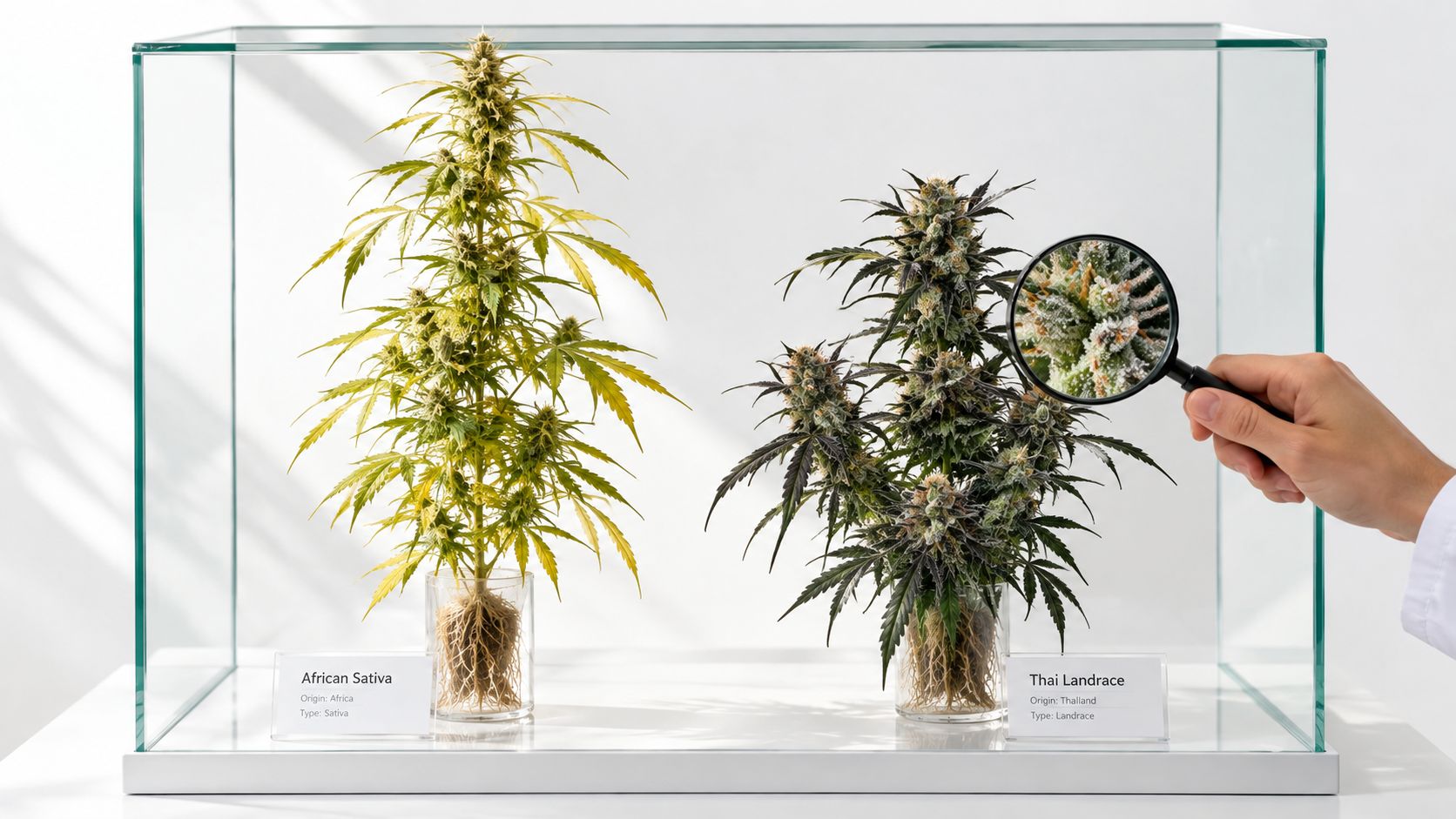
What Durban and Thai each contribute
Durban Poison reached Amsterdam from South Africa in the 1970s through cannabis activist and breeder Ed Rosenthal, which helped establish Durban genetics in Western breeding circles historical route and lineage context. On the bench, that side is commonly associated with sweet, spicy, herbal, anise-like notes. Thai genetics are usually read as tropical, incense-like, and cerebral, which shifts the blend toward a lighter, brighter top end lineage and sensory descriptions.
Thai cannabis became internationally visible in the 1960s and 1970s as seeds and plant material reached the United States during the Vietnam War era and the counterculture movement. That route helps explain why Thai references often carry a higher, more airborne opening note than many modern hybrids. For a related lineage reference, see Gold Coast Terpenes' Chocolate Thai profile, which shows how the Thai side of the family is handled on its own.
Why heritage matters in a product line
The commercial value of Durban Thai sits in the overlap of equatorial African and Southeast Asian gene pools. Breeders historically selected that overlap for vigor, distinctive aromas, and energetic effects historical lineage summary. For a SKU brief, that translates into a sparkling opening, a spicy herbal center, and enough pine or floral lift to keep the profile from going flat.
Gold Coast Terpenes' Elevated Strains line shows how a catalog groups strain-inspired profiles into hybrid flavor families. That is useful when you are filing a Durban Thai SKU, because it keeps the sensory target organized even when phenotype-driven variation changes the final aroma.
Terpene Profile Ranges and What They Tell a Formulator
Durban Thai terpene data is useful when it helps you choose compounds, and misleading when it gets treated like a universal spec sheet. Published results vary across samples, so a formulator should start with verified analytics instead of a copied strain chart.
Reading the range instead of the headline
One recorded Durban Thai sample reported about 0.80% total terpenes, including 0.25% terpinolene and 0.06% beta-pinene sample-specific lab report. A commercial strain guide describes typical total terpene concentrations of roughly 1.5 to 3.0% of dry weight, with about 2.0% cited as a common optimized-indoor benchmark, plus terpinolene at 0.4 to 0.9%, limonene at 0.2 to 0.6%, and combined alpha- plus beta-pinene at 0.2 to 0.6% commercial guide ranges.
| Published Durban Thai Terpene Ranges Side by Side | |||
|---|---|---|---|
| Source type | Total terpenes | Dominant compounds | Practical takeaway |
| Sample-specific lab report | approximately 0.80% | 0.25% terpinolene, 0.06% beta-pinene | Use as a real-world data point, not a universal standard source |
| Commercial strain guide | roughly 1.5 to 3.0%, with about 2.0% as a common benchmark | terpinolene, limonene, alpha- and beta-pinene | Useful for directional targets, not label guarantees source |
Those ranges define a working window, not a promise. In a 0.5 g cartridge, the first puffs usually carry the most volatile material, while the later pulls are shaped by what stays in solution and survives heat.
What the variance means for a brand team
One report on Durban Thai Highflyer by Fleur du Mal, a separately branded line, puts myrcene around 6 to 8% of total terpenes. Another puts limonene at 35 to 40% of total terpenes, with pinene and caryophyllene as secondary compounds commercial comparison of phenotype reports. That spread shows how far phenotype naming can drift.
A Durban Thai purchase order should ask for batch-specific GC-MS data, not a promise that an internet profile is the profile. It should also ask whether the blend has been checked for inhalation fit, because a terpene load that looks tidy on paper can flash off too fast, irritate the draw, or fall apart in storage.
For formulating a strain-inspired terpene blend, the better target is a validated sensory brief, then a compound list that can be matched analytically. If the oil has to taste the same on fill day and on the last third of the cartridge, the blend has to be engineered from confirmed inputs, not from a single average.
Building Top, Mid, and Base Notes for a Durban Thai Blend
Durban Thai works best as a layered aroma. The opening should be bright and volatile, the middle should hold the herbal and spicy identity, and the finish needs enough weight that the cart doesn't collapse into a thin citrus burst.
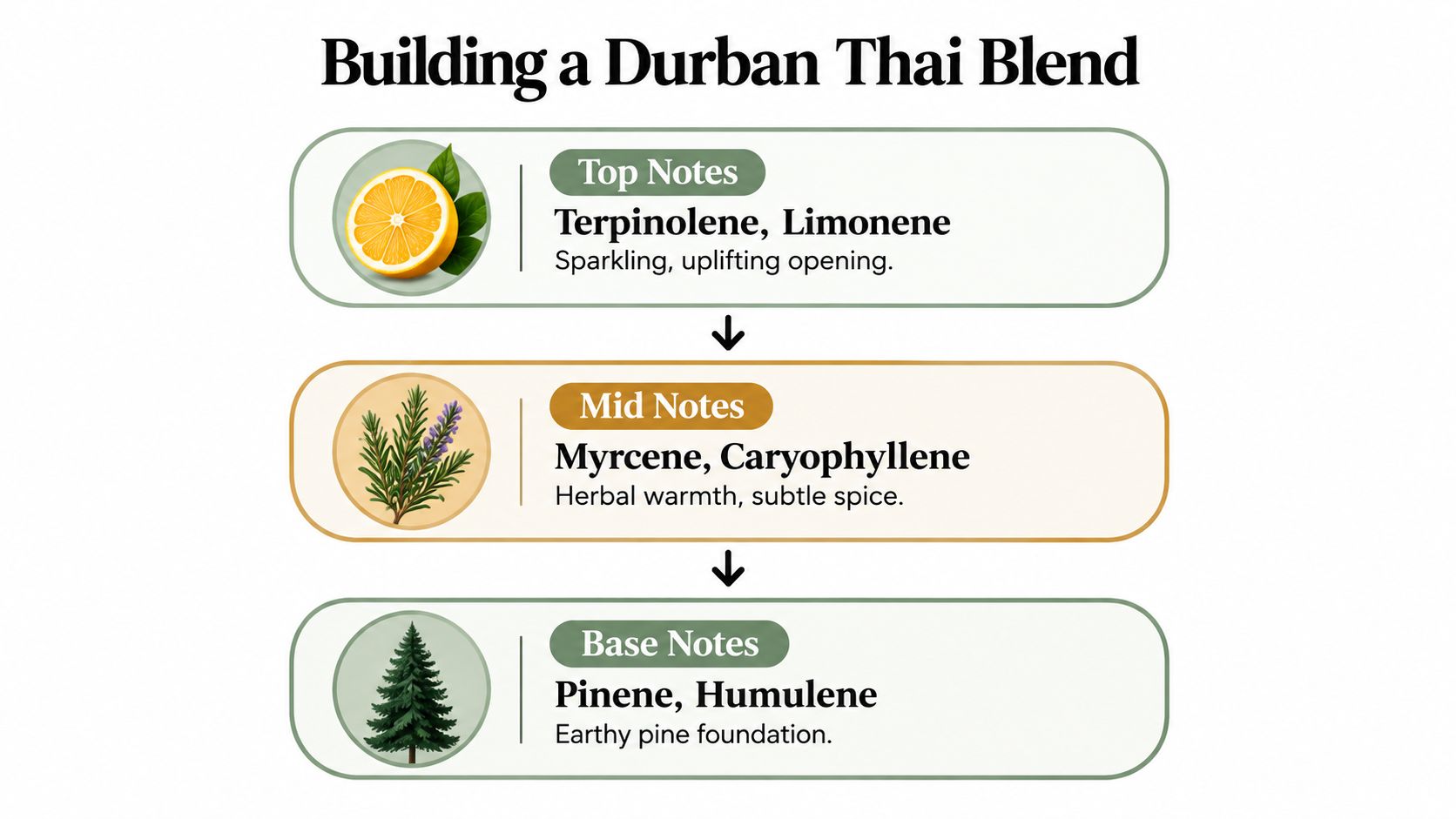
Top notes do the first job
Use terpinolene and limonene to establish the first impression. Those compounds carry the sparkling, citrus-led opening that most buyers recognize as “bright” or “uplifting,” and they're the first to show whether the profile reads as Durban Thai or just generic fruit.
Mid notes hold the identity
Use linalool and pinene to bridge the opening into something more herbal and resinous. Published Durban Thai descriptions link the profile to sweet, spicy, herbal, and tropical directions, so the middle has to feel rounded, not harsh. A little myrcene can support body, but too much can mute the crispness that makes the name recognizable.
Base notes keep the cartridge from collapsing
Use beta-caryophyllene or humulene to add a woody, persistent base. Vaporization research shows that monoterpenes are lost first because of their evaporation behavior, and that terpenes are inhaled before cannabinoids during vaping vaporization behavior and note loss. That means your first puff can smell right even when the back half of the cartridge is already flattening, unless the base has enough structure to carry the finish.
The cleanest way to brief a lab is to define the sensory progression in the finished oil, then score it after fill and after storage. Gold Coast Terpenes' terpene flavor chart is a practical reference for mapping that progression without confusing neat-terpene aroma with device performance.
Formulation rule: evaluate the blend in the cartridge, not just in the beaker.
Botanical Versus Cannabis-Derived and How to Choose a Supplier
Botanical and cannabis-derived terpenes solve different buying problems. Botanical material usually wins on repeatability, scale, and cleaner labeling pathways, while cannabis-derived inputs may appeal when a brand wants a full cannabis-only story, but they often make consistency and logistics harder.
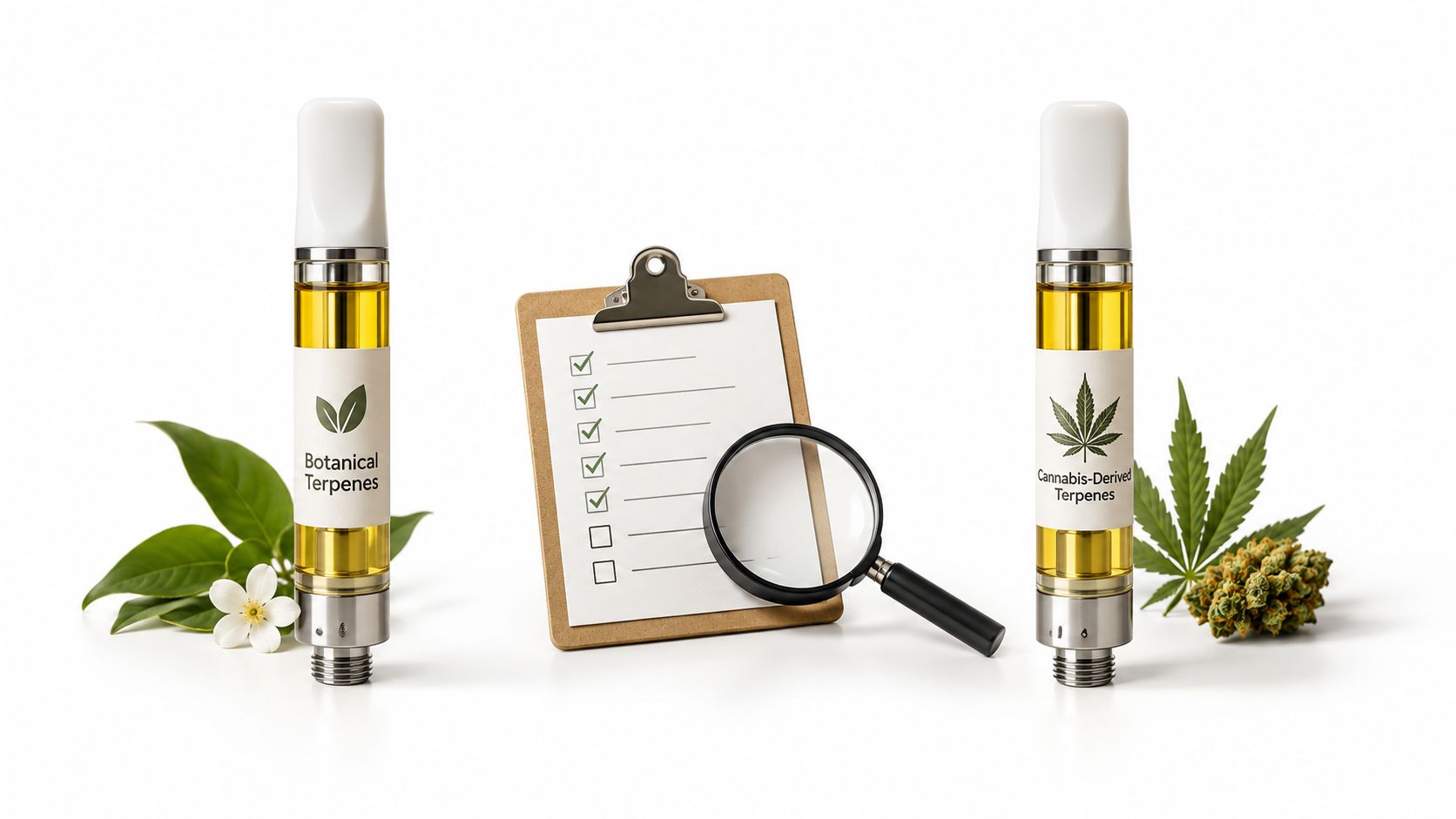
What matters when you buy for a SKU
Gold Coast Terpenes is positioned as a lab-verified, THC-free, SC Lab-tested supplier of 100% botanically derived terpene blends. That matters for vape and extract brands that need batch-to-batch repeatability, and it matters again when the label has to stay clean and defensible.
A supplier comparison should start with four questions.
- Source type: botanical, cannabis-derived, or isolate-based blend.
- Documentation: batch COA, safety docs, and terpene breakdown.
- Scale fit: whether the supplier can support your MOQ and recurring reorders.
- Labeling fit: whether the finished formula can match your jurisdiction and brand language.
Why blend purchasing often beats isolate shopping
A single isolate can be useful when you're tuning one compound, but a strain-inspired blend usually saves time when the brief is sensory, not analytical. Gold Coast Terpenes' catalog is built around strain-specific profiles and formulation tools, which is more useful than assembling an aroma from scratch when the target is Durban Thai character rather than a one-note citrus spike.
For buyers comparing options, the choice isn't just botanical versus cannabis-derived. It's also whether you want to spend development time on compound sourcing, or whether you want a pre-built aromatic framework you can tune to fit your hardware and jurisdiction.
A Development Matrix for Durban Thai Distillate Cartridges
A Durban Thai cartridge should be developed like a matrix, not a one-off blend. Hold the oil constant, vary terpene load deliberately, and score the cartridge under the same hardware and draw conditions every time.
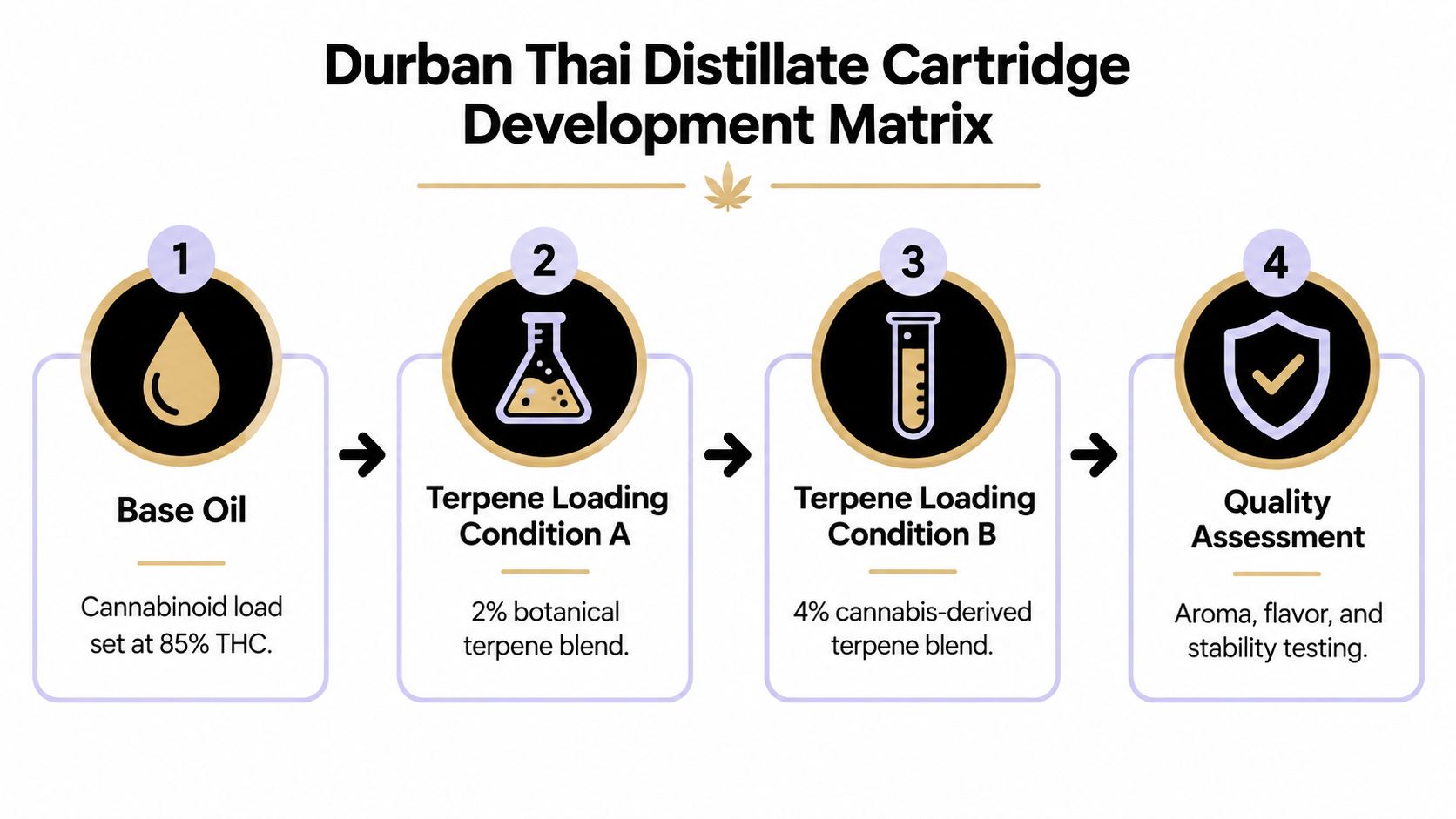
A simple build plan
- Set the base oil first. Fix the cannabinoid load before you touch flavor, because terpene changes only mean something if the oil stays constant.
- Run a lower-terpene condition and a higher-terpene condition. A California-funded study on cannabis vapor found that oils containing 0%, 7.5%, and 15.0% added terpenes showed no significant effect on aerosol mass production, which is useful because it separates sensory loading from a basic output assumption terpene and aerosol study.
- Score the first puff separately from the later puffs. Citrus or anise can hit hard upfront, then fall off fast if the blend is too top-note heavy.
- Check viscosity, leak resistance, and coil behavior at the same time. A cartridge that smells good but floods, clogs, or scorches is not a usable spec.
The same development logic is what saves time in contract manufacturing. Gold Coast Terpenes' Mixing Calculator and strain-specific blends can shorten the iteration loop when a brand already knows the target family and just needs to tune the percentage range.
What to log during testing
Use a short scorecard for each build:
- Opening aroma: bright citrus, anise, or pine.
- Mid-draw character: herbal, floral, or spicy.
- Finish: woody, resinous, or thin.
- Device behavior: leakage, clogging, harshness, or clean draw.
Keep the hardware fixed. If the atomizer changes, the result changes, and the data stops being useful for a formulation decision.
Inhalation Safety and Why More Terpenes Is Not Always Better
A Durban Thai cartridge can get louder as terpene loading rises, but louder is not the same as safer or better. Once the oil is heated, the brief shifts to thermal behavior, aerosol chemistry, and whether the flavor gain justifies the added risk.
Why the heat question matters
Recent toxicology literature notes that cannabinoids and terpenes are thermally labile and can react during heating and aerosolization to produce toxic emissions a 2025 toxicology review of heated cannabinoid and terpene emissions. The same review points to California-funded work showing that terpene additions may increase formation of potentially harmful emissions, so a stronger profile can also mean a harsher inhalation path.
Human airway and immune-cell models used in cannabis-vaping research have also shown oxidative-stress and inflammatory responses in association with commercial high-THC products. That finding is not specific to Durban Thai, but it still supports a formulation rule that matters in practice, test the heated aerosol system, not just the raw ingredient blend.
Stability is part of the flavor brief
An accelerated storage study found that cannabis inflorescence stored with vapor-phase terpenes lost 18.0% of total Δ9-THC over 127 days, compared with a 34.3% loss in samples stored without external terpenes, a 47.4% reduction in cannabinoid degradation storage stability study. The inflorescence data is not a cartridge result, but it justifies putting the terpene system inside the stability plan from day one.
For teams that want a practical formulation lens on emissions, storage, and device behavior, Gold Coast Terpenes' vaping safety guide is a useful reference. For Durban Thai, the target is a profile that survives heat and shelf time without flooding the oil with volatile top notes.
Quick Answers for Durban Thai Buyers and Brand Teams
What should a Durban Thai supplier hand me? Ask for a batch COA, terpene breakdown, and clear source language. Gold Coast Terpenes is useful here because its blends are described as lab-verified and THC-free, which makes documentation easier for brand teams.
How do I position Durban Thai on a label? Use the name as a flavor or lineage reference, not as a promise of effect. Keep the wording sensory and formulation-focused, and avoid medical claims.
What should I test before scaling a cartridge? Test aroma retention, device compatibility, and stability after fill and after storage. If the profile is meant for a for vape cartridges line, the blend has to survive the hardware, not just the bench sample.
What if I want a strain-inspired blend instead of building from isolates? A pre-blended reference can save time, especially when the goal is a repeatable sensory target. Gold Coast Terpenes and its Mixing Calculator can help a lab translate a Durban Thai brief into a working development range.
Gold Coast Terpenes supplies strain-specific terpene blends, isolated compounds, and formulation resources for vape brands, extractors, and product developers who need repeatable flavor targets. If you're building a Durban Thai-inspired cartridge or concentrate, visit Gold Coast Terpenes to review terpene profiles, mixing tools, and documentation that can support your next SKU.