
The fastest way to answer does sativa make you paranoid is to stop treating “sativa” like a chemical diagnosis. In formulation work, that label is usually a marketing shorthand, not a reliable predictor of whether a cart, concentrate, or infused product will feel clean and focused or edgy and overwhelming. The evidence points somewhere else entirely, to THC dose, the THC-to-CBD balance, terpene architecture, and the person taking the hit.
That matters because product teams still inherit old strain language and then blame the cultivar when a SKU triggers complaints. The lab data tells a different story. In an Oxford experiment, THC significantly increased paranoia in healthy volunteers, and about 1 in 5 participants had paranoia attributable to THC exposure rather than placebo, while paranoia also fell as THC left the bloodstream, showing the effect tracks exposure, not a sativa tag (Oxford report). If you're building products for repeat purchase, that distinction is not academic.
Why the Sativa Label Is the Wrong Variable
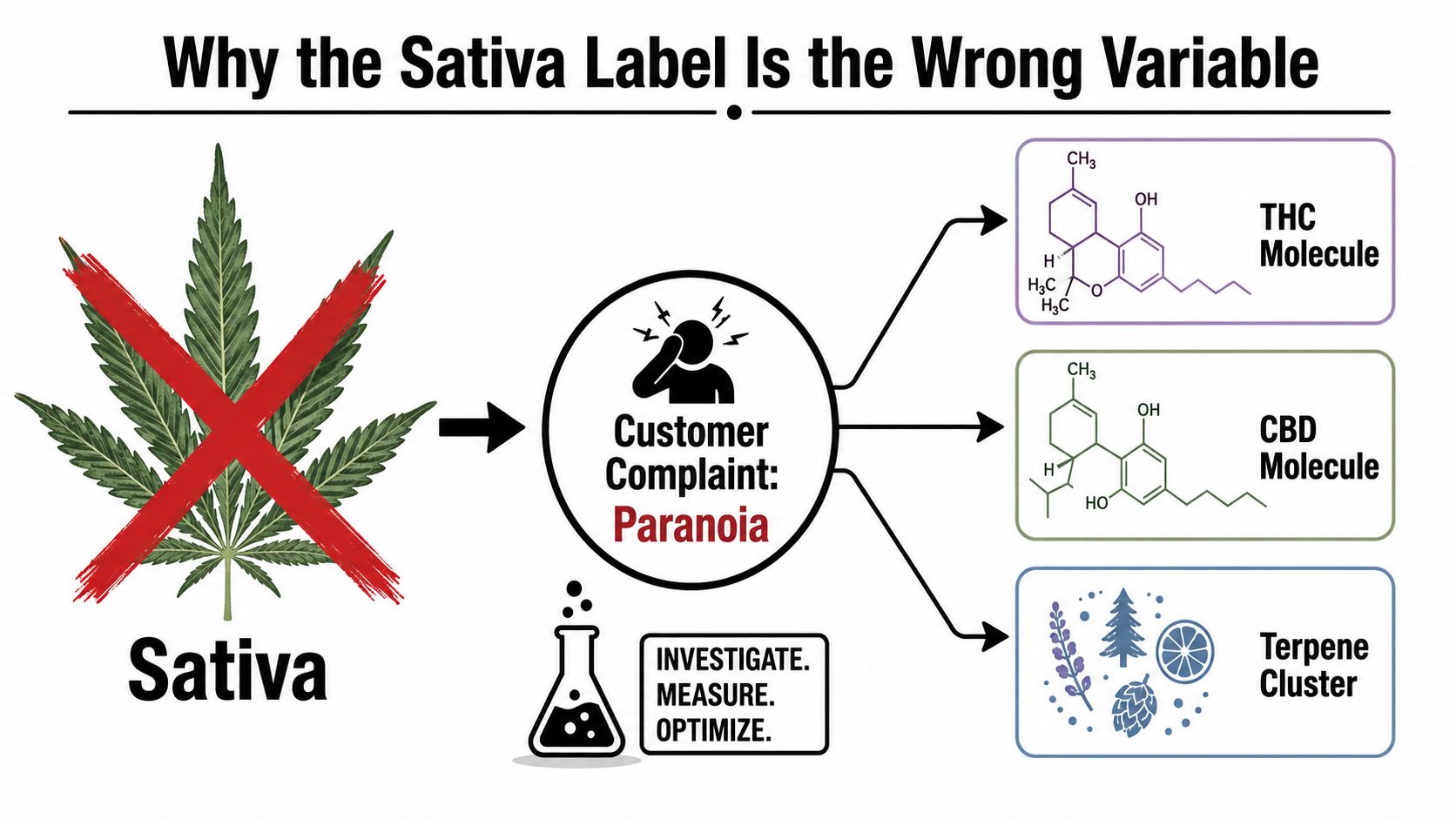
A “sativa made me paranoid” complaint sounds categorical, but the chemistry never was. Two products sold under the same strain family can behave very differently on the shelf if one is high-THC and thin on CBD, while the other is buffered, better rounded, and easier to dose. The Oxford experimental study showed that THC itself raised paranoia in healthy volunteers, with the effect statistically significant, and 50% of participants reported paranoid thoughts after THC versus 30% after placebo, meaning about 1 in 5 had paranoia directly attributable to THC exposure (Oxford analysis).
What operators should read from that result
If paranoia followed the label, then indica products would stay clean every time, and they don't. The useful question is how much THC is present, how much CBD is there to buffer it, and what the terpene mix is doing to perceived intensity. That's the primary formulation liability, because strain language can hide a product that's materially more likely to create racing thoughts, bad reviews, or returns.
Practical rule: treat “sativa” as a flavor and branding clue, not a safety signal.
The commercial risk is simple. A team that keeps presenting a label as if it were a formulation variable is giving the buyer a promise the chemistry can't always keep. Once that happens, the brand doesn't just lose one sale, it loses trust in the next launch, especially when the same customer gets a calmer result from a different product class.
See the broader sativa-versus-indica framing used by many operators
The Chemistry That Drives Paranoia
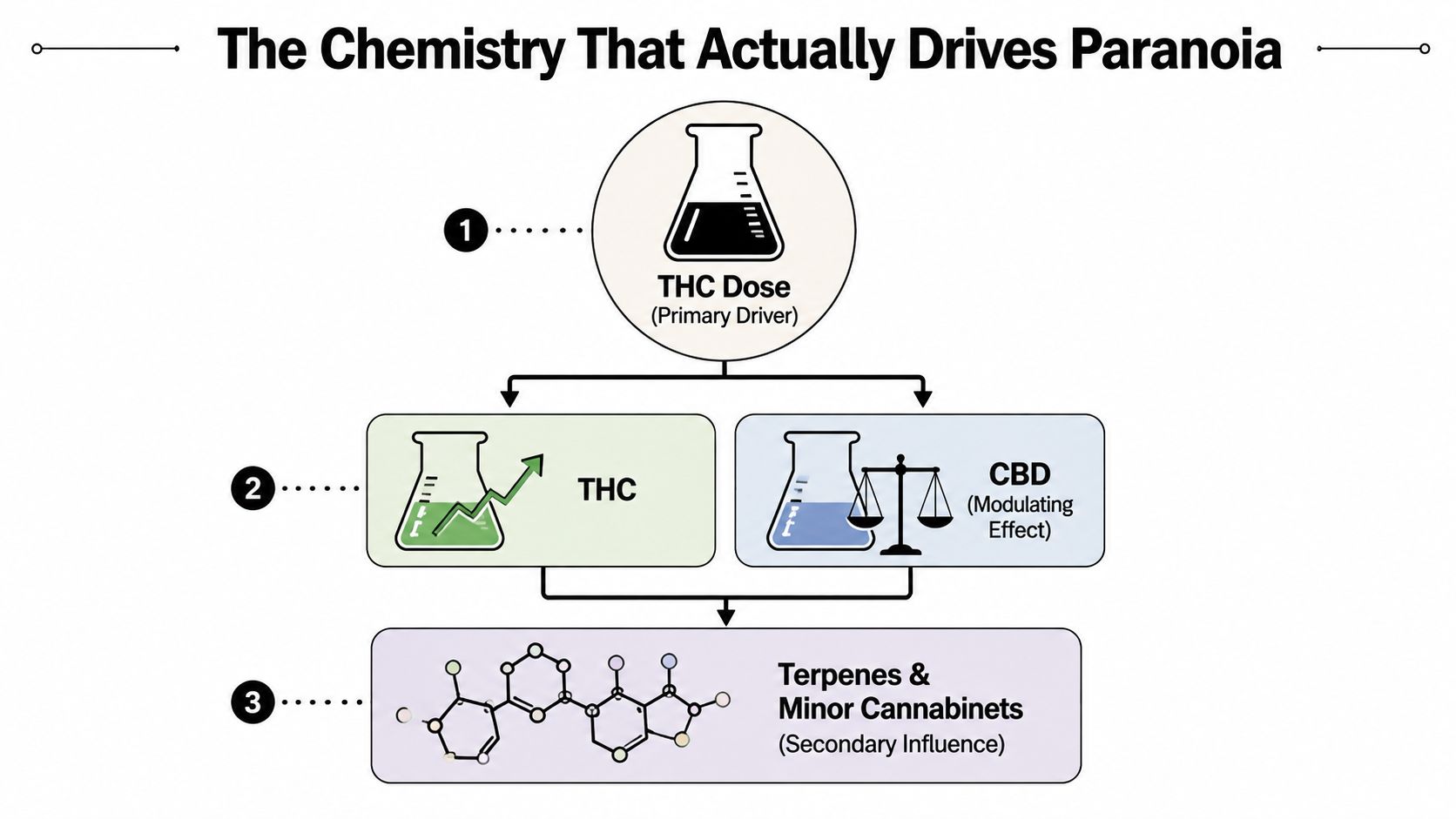
THC is the primary lever, and it is the one formulators control. Clinical and experimental evidence keeps pointing in the same direction. A review of human studies concluded that acute THC consistently produces anxiogenic effects, especially at higher doses, while CBD shows a consistent anxiolytic effect and can reduce THC's anxiogenic effect when it is combined with it (clinical review).
THC is the first place to look
Dose matters more than product mythology. NIH-linked review material describes THC-related psychiatric risk as dose-dependent, with regular users about 2 times more likely to develop psychosis and heavy users about 4 times more likely, and it notes that short-term use at high doses or high potency can induce paranoia (NIH review). That does not mean every high-THC product will cause trouble, but it does mean the ceiling matters far more than the cultivar label.
CBD is the buffer. In one clinical finding, CBD pretreatment reduced clinically significant positive psychotic symptoms with an OR of 0.22, and the same body of evidence showed lower post-THC paranoia scores than placebo. For product builders, that is the design logic that holds up under lab scrutiny. You are not just choosing a potency number, you are deciding whether the formulation has any built-in braking system.
Terpenes shape the feel, not the fundamental risk
Terpenes do not replace THC as the main driver, but they do shape whether a product feels bright, racy, grounded, or smooth. A terpene profile can make the same cannabinoid load feel more focused or more spiky, which is why two SKUs with similar potency can land very differently. If you want the uplifting side without the nervous edge, terpene selection needs to support that goal rather than just mimic a strain name. For a practical read on how aroma compounds are discussed in product design, see this terpene behavior review.
A good formulation does not fight THC, it frames it.
What the Population Data Says About Real Risk
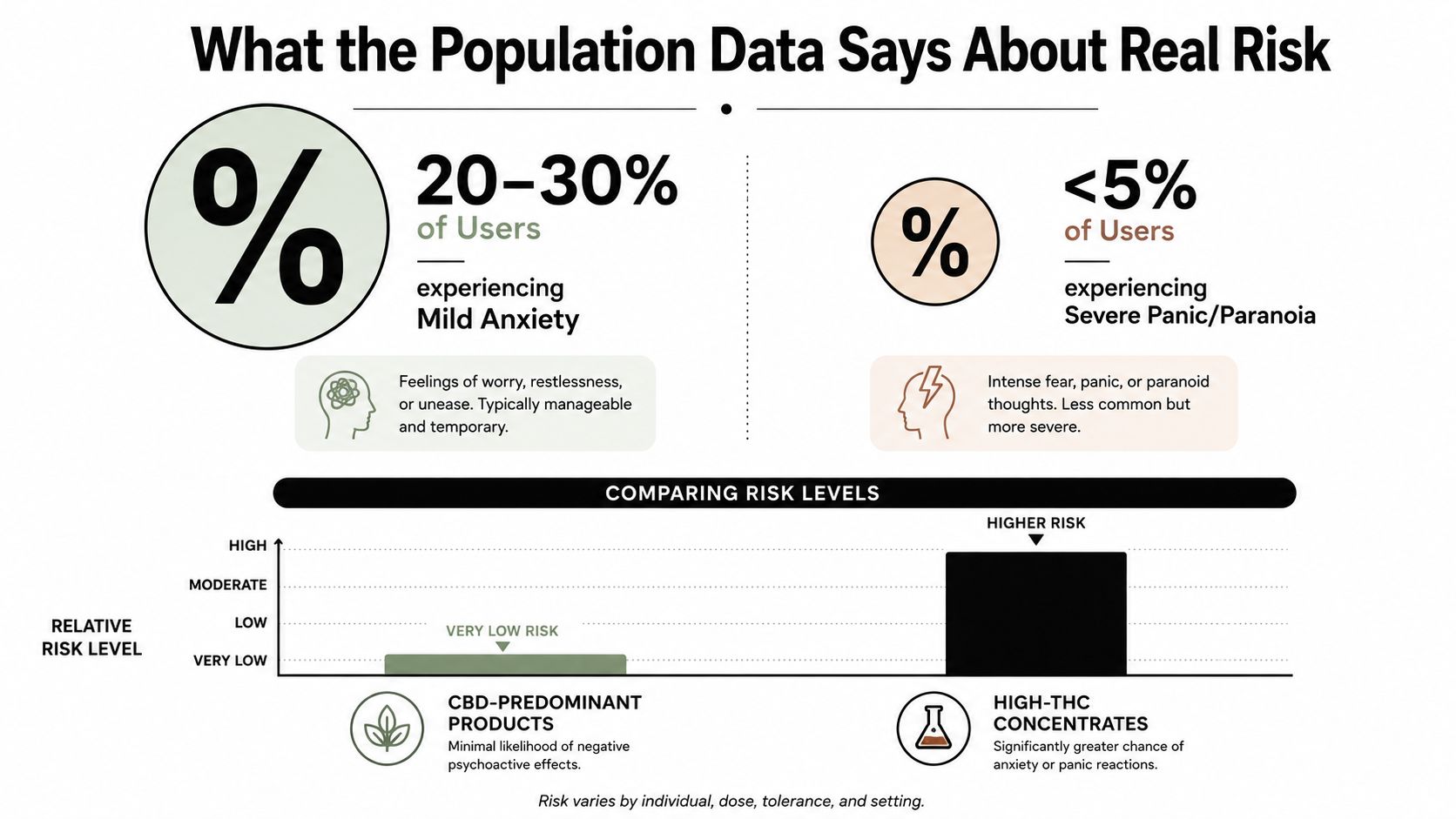
Population-level numbers cut through the strain-name story fast. A 2022 Nature study estimated that 0.47% of people who used cannabis reported lifetime cannabis-associated psychotic symptoms requiring emergency medical treatment, which the authors described as about 1 in 200 users, and the same study estimated a 0.19% rate in the prior year. A broader 2024 Nature Mental Health analysis found that observational studies reported cannabis-associated psychotic symptoms in 19.4% of exposed individuals and THC-challenge experiments reported them in 21% of participants, while medicinal cannabis studies reported much lower rates of 1.5%.
Why those numbers matter for product teams
Those figures are high enough to show up in reviews, complaints, and customer retention, but they do not mean the market is automatically doomed to paranoia. The same analysis estimated a combined rate of a full psychotic episode at 0.52%, again about 1 in 200 users. For manufacturers, that means product design can still move the needle, especially when the brief is daytime use, focus, or uplift.
The medicinal-cannabis number is the clearest clue. Lower THC exposure and more CBD-rich or balanced formulations track with less severe outcomes, which lines up with what formulators see when a product is too hot for broad use. The practical takeaway is precision, not fear. The broader pattern also matches the usual formulation guidance around CBD vs THC ratios, where CBD-rich inputs are used to blunt the edge of a high-THC base. See the product-side framing in this CBD and THC comparison review.
What to tell a buyer or investor
If a SKU is meant to feel energetic without tipping into panic, the formulation has to keep the user from overshooting the threshold. Potency control comes first, then formulation balance, then the delivery system itself. A cart that doses aggressively on each pull can turn a tolerable blend into a complaint generator.
See the risk framing used in the broader mental-health guidance
Setting the THC to CBD Ratio That Keeps Customers Calm
Shelf appeal matters, but the ratio decides whether a product feels composed or edgy. In formulation terms, higher THC and lower CBD means greater paranoia risk. That does not make every strong product a mistake, but it does mean CBD belongs in the formulation conversation whenever the brief is upbeat, focused, or daytime-friendly. For teams comparing cannabinoid strategy, the CBD-versus-THC comparison review is a useful starting point.
A workable ratio mindset
For a distillate cart, the first question is whether the THC load is being asked to carry the whole experience on its own. If that is the case, the formula needs support from CBD isolate or a broader cannabinoid base so the user is not hit with a pure THC spike. As noted in the chemistry section, CBD pretreatment reduced clinically significant positive psychotic symptoms with an OR of 0.22 (CBD and THC interaction study). That kind of signal matters because it points to real buffering, not just a wellness narrative.
Live resin and full-spectrum SKUs usually start from a better place because the extract can carry more of the compounds that soften the edge. That does not eliminate the need to think about ratio. It does mean the starting material may be less likely to produce the hard, narrow profile that shows up in ultra-potent, stripped-down oils. If the goal is energetic without anxiety, that difference is worth protecting through the whole spec.
What to verify before approval
- THC percentage. This is the main driver of intensity.
- CBD percentage. This is the main buffer you can verify on paper.
- The ratio. Total cannabinoid numbers alone do not tell you how the product will feel.
- Hardware and viscosity fit. Dose per pull is part of the formula, not an afterthought.
The most common mistake is approving a polished formulation and then putting it in hardware that delivers too much per inhalation. The cannabinoid balance can be reasonable, yet the user still gets a blast that feels loud instead of focused. That is how a SKU meant for daytime use ends up generating complaints.
Choosing Terpenes That Uplift Without the Edgy Edge
Terpenes are where a formulation either supports the experience or undermines it. Top-note terpenes like limonene and terpinolene can create the bright, citrusy, activating character people associate with classic sativa-leaning products, but a heavy terpinolene profile can feel overstimulating to sensitive users. That's why one product reads as lively and another, built from the same broad idea, starts to feel too sharp.
Build from top, mid, and base notes
A good terpene architecture doesn't let the top notes dominate the whole experience. Mid-notes like beta-caryophyllene and pinene help steady the profile, while base notes like linalool and myrcene soften the finish and keep the blend from tipping into jittery territory. The goal isn't to flatten character, it's to preserve lift without letting the product feel electrically tense.
| Terpene | Note Position | Reputation in Uplift Blends | Typical Use Range |
|---|---|---|---|
| Limonene | Top note | Bright, citrus-forward, helps create an energetic first impression | Use as a supporting leader, not the whole profile |
| Terpinolene | Top note | Very stimulating in some sativa-style blends, can feel edgy if overdone | Keep restrained if sensitivity is a concern |
| Beta-caryophyllene | Mid note | Grounding, peppery, useful as a stabilizing bridge | Often used to cushion sharper top notes |
| Pinene | Mid note | Crisp and focused, good for clean daytime positioning | Works best when paired with softer base notes |
| Linalool | Base note | Smooth, floral, calming finish | Useful for rounding the blend |
| Myrcene | Base note | Softens the profile and helps the blend feel less abrasive | Helpful as a stabilizer in uplift formulas |
Blending logic that holds up in production
A strong daytime profile usually works best when the top notes announce the effect, the mid notes keep it coherent, and the base notes prevent the finish from getting harsh. That gives the brand a recognizable character without making the user feel overdriven. If the formula has no grounding elements, even a good citrus opening can end up reading as anxious.
Formulation rule: let the uplifting note lead, let the grounding note finish.
Review terpene choices that tend to create anxiety-prone profiles
Two Formulas Side by Side, One Calm and One Risk-Prone
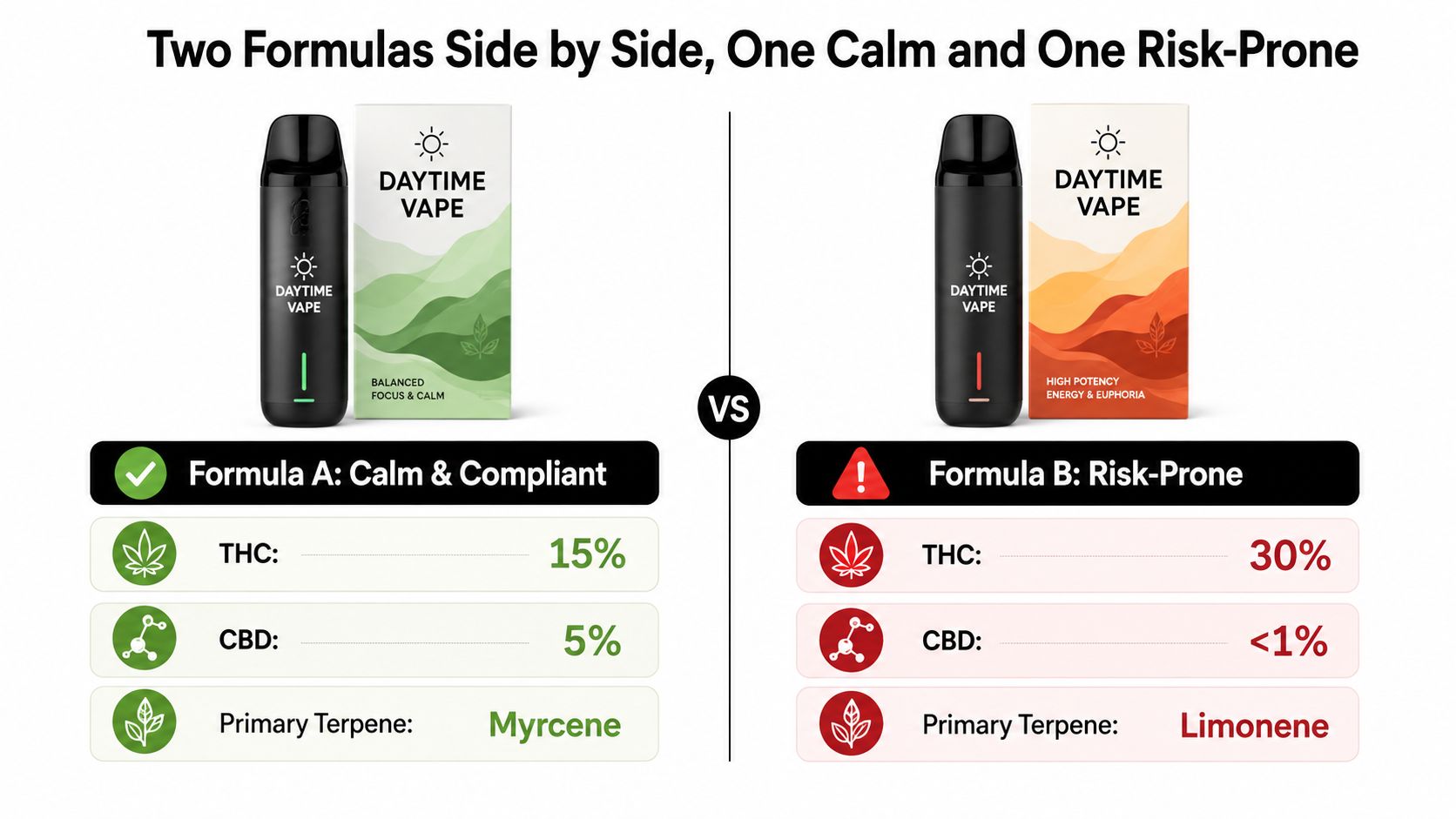
The difference between a repeat-purchase cart and a complaint-heavy cart usually shows up fast once you compare the inputs. Both products can target the same daytime buyer. One just gives the body a chance to settle into the experience, while the other pushes too hard, too early.
Formula A versus Formula B
| Factor | Formula A, Calm and Compliant | Formula B, Risk-Prone |
|---|---|---|
| THC load | Moderate | Very high |
| CBD support | Present | Minimal |
| Terpene leadership | Balanced, with grounding support | Terpinolene-forward and aggressive |
| Base-note anchoring | Yes | No |
| Dose control through hardware | Moderated | Fast and heavy |
Formula A gives the customer a familiar arc. The initial lift is there, but the blend has enough support to keep the edges round. Formula B makes the promise louder, then lets the hardware and cannabinoid load do the rest, which is exactly how a daytime SKU becomes a “too much” SKU.
The five questions worth asking before signoff
- How much THC is in play?
- How much CBD is there to buffer the effect?
- Which terpenes are leading the experience?
- Is the profile anchored by base notes?
- What dose does the hardware deliver per pull?
Those five questions are faster than a full rework and more useful than a strain name. They tell you whether the brief is shaping a product that feels clean, or one that will likely produce the kind of feedback teams don't want to hear. If you answer them truthfully, the label becomes much less important.
A Repeatable Workflow for Calmer Carts and Concentrates
A good SOP keeps this from becoming a taste debate. Start with the desired effect, not the flower mythology. If the product needs to feel focused, set the cannabinoid ceiling first, then decide whether the CBD floor needs to move up to keep the blend calm.
A practical sequence for formulators
Step 1, define the target experience. Decide whether the SKU should read as uplifting, focused, or neutral.
Step 2, set THC and CBD boundaries. Build the ratio before you fine-tune flavor.
Step 3, design the terpene stack. Choose top, mid, and base notes to match the brief.
Step 4, run a sensory pass. Check whether the blend feels coherent, sharp, or overactive.
Step 5, verify the hardware fit. A great liquid can still fail if the dose per pull is too aggressive.
The documentation that saves later headaches
Keep batch records for the ratio, terpene percentages, and lot results. That way, when a complaint comes in, the team can trace it back to a specific run instead of guessing. It also helps separate a chemistry issue from a device issue, which is where a lot of bad internal assumptions start.
Traceability isn't bureaucracy. It's how you keep one bad batch from becoming a brand narrative.
One mistake worth avoiding is trying to replicate a cultivar by chasing its exact gas-chromatography fingerprint. What the customer buys is the experience, not the instrument readout. Match the effect first, then tune the profile until the flavor tells the same story.
Putting It Together for Your Next SKU
The answer to does sativa make you paranoid is that the label is the weakest variable in the room. For product development, that shortcut creates more risk than clarity because it pushes teams to defend a cultivar story instead of the chemistry a customer inhales. The stronger variables are THC dose, THC-to-CBD ratio, and the terpene structure that either supports focus or pushes the profile into an edgy register.
That matters because the practical goal is not just to avoid paranoia, it is to preserve the upbeat, clear-headed effect brands want to sell. A SKU built for calm uplift should be specified from the start as a chemistry problem, not a branding problem. If the product has to feel energetic without getting sharp, set the cannabinoid frame first, then tune the terpene layer to stay within that lane.
The evidence is steady across lab work and population findings. THC increases paranoia in a subset of users, CBD can blunt that response, and the highest-risk products are the ones with strong THC and little CBD delivered too aggressively, as noted earlier in the review. For formulators, the commercial takeaway is straightforward. If you want a product that reads as uplifting without tipping into stress, build the ratio first, then use terpenes to keep the profile lively without adding strain.
A quick formulation checklist helps keep the brief honest.
- Choose the experience first. Decide whether the SKU should read as uplifting, focused, or calm.
- Set the cannabinoid boundaries before flavor work. If the effect needs to stay smooth, do not let the THC ceiling drift upward because the aroma profile sounds appealing.
- Decide whether the CBD floor needs to move. A little more CBD can give a product more room before the experience turns edgy.
- Use terpenes as support, not cover. Bright top notes can help an uplifting brief, but they should not be doing the work of controlling the experience.
- Check the delivery format. A cart, concentrate, or edible can all feel different even with similar chemistry, so the dose per use has to fit the format.
- Review the batch against the promise. If the product smells energetic but feels tense, the formula is speaking with two different voices.
That checklist is where the brand promise gets tested against the bench. It is also where a calmer product can still feel premium instead of muted. The best results usually come from a profile that is clear, restrained, and easy to repeat across runs.
If you are building a cart, concentrate, or custom blend around a calmer uplift profile, Gold Coast Terpenes can help you source strain-inspired terpene blends, isolated compounds, and formulation-friendly inputs that match the effect you want to sell. Visit Gold Coast Terpenes to review blend options and start matching the chemistry to the brief.