
You've probably hit this exact problem already. The blend looks right on paper, the limonene is bright, the pinene is clean, the terpinolene lifts the top end, and the finished cart still misses that dry woody backbone that makes certain legacy profiles feel authentic.
That gap is often Delta 3 Carene.
In commercial work, this isolate matters less as a headline terpene and more as a correction tool. It helps close the distance between a blend that smells generally piney and one that reads as cedar, resin, earth, and slightly sweet wood. For teams focused on replicating flavor of classic profiles for vape cartridges or building a strain-inspired terpene blend for distillate, that distinction shows up fast in bench trials.
Why Delta 3 Carene Is a Critical Isolate for Formulators
A bench sample can look balanced on paper and still fail the first sensory round. Citrus is clear. Pine is present. Sweetness is in range. Then the panel calls it flat, hollow, or vaguely generic. In commercial formulation, that usually points to a missing structural note, and Delta 3 Carene is often the fix.
Carene earns its place because it solves a narrow but expensive problem. It helps connect pine, sweet resin, and dry wood into a profile that reads as intentional instead of approximate. That matters most in vape and concentrate work where strain-inspired blends need to survive both first smell and first pull.
Where formulators usually get into trouble
The common mistakes are predictable:
- Using carene too late in development. Teams often try to repair a hollow profile by pushing louder terpenes first. That can make the blend brighter or sharper, but it rarely creates the dry woody spine the profile was missing.
- Treating it like a simple aroma add-on. Carene changes structure and sensory feel, so dosage has to be managed with the full system in mind.
- Dropping it after one bad trial. A rough or drying result usually points to poor balance, not a useless isolate.
I see this most often in distillate blends built around limonene, alpha-pinene, and terpinolene. The aroma comes across as recognizable, but the finish feels thin and the profile does not hold together in vapor. Carene can correct that, but only if it is handled like a structural component and not a last-minute accent. For a practical example of how formulators describe those sensory effects, Gold Coast Terpenes covers carene terpene effects in finished blends.
Practical rule: If the target profile needs dry cedar, resin lift, or a woody link between citrus and pine, bench carene before increasing the loudest top notes.
Why it earns bench space
Carene affects two outcomes that matter in production. First, it improves flavor accuracy in profiles that need dryness, wood, or old-growth pine character. Second, it can push the sensory finish toward dryness if the blend is poorly balanced.
That trade-off is exactly why formulators keep it on the bench. Used with restraint, carene makes a blend feel more complete and more believable. Used carelessly, it can make a cartridge feel sharp, thin, or fatiguing over repeated pulls.
This distinction makes the section a working guide for formulators building carts, concentrates, and distillate-ready terpene systems where aroma accuracy has to coexist with a smooth enough inhale to survive real customer use.
Delta 3 Carene Chemical Properties and Aroma Profile
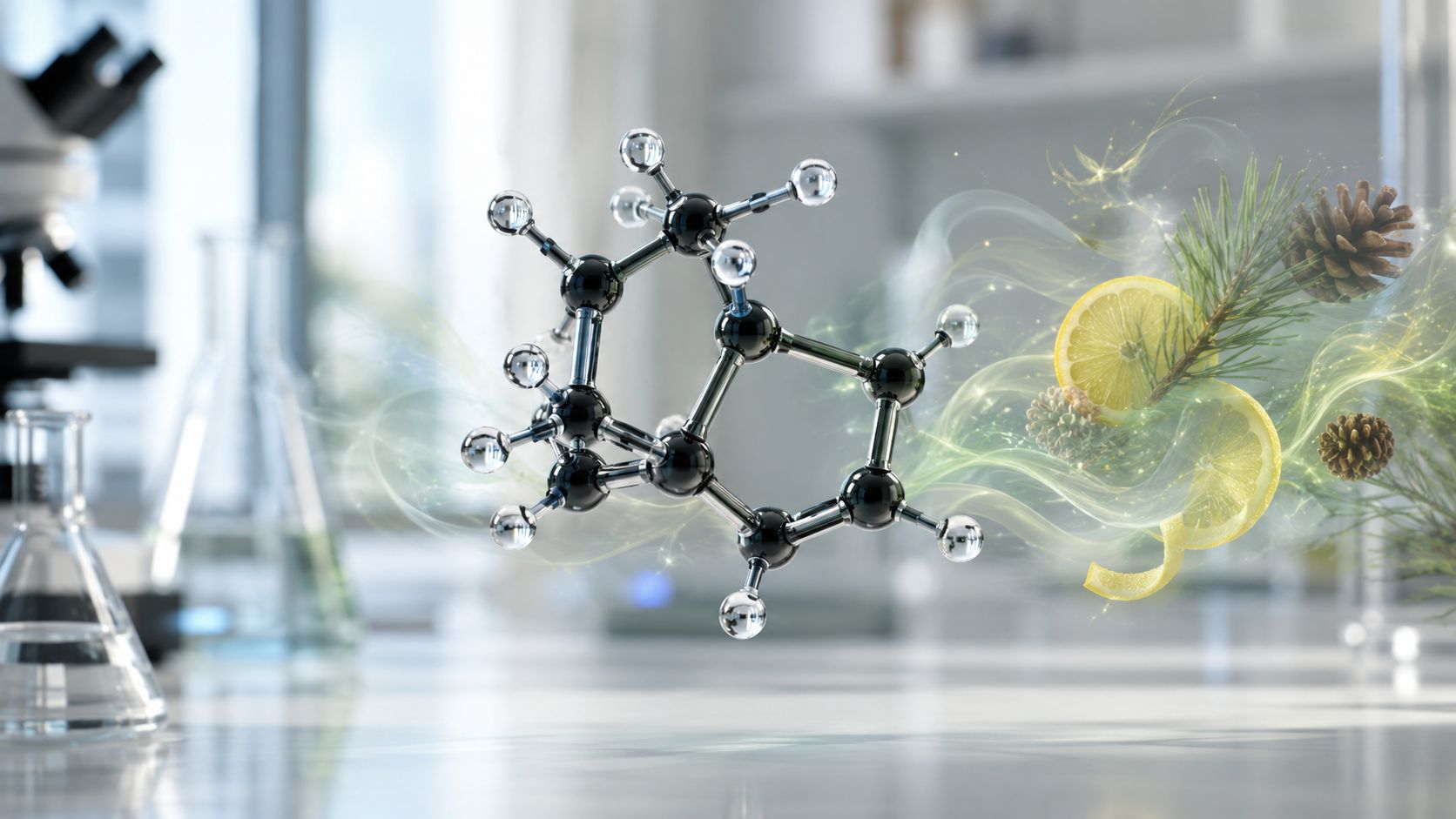
Delta 3 carene is a bicyclic monoterpene. That matters in formulation because bicyclic monoterpenes don't behave like soft, diffuse sweeteners. They bring shape, edge, and persistence to a terpene system. In a blend, carene usually reads as a mid-to-base structural note, especially when paired with more volatile citrus and herbal components.
From a perfumery perspective, its profile sits in a useful lane. It adds earthy wood, dry cedar, sweet pine, and faint citrus brightness. Those facets don't all show up at once. The exact expression depends on what surrounds it. With limonene, it can sharpen into a cleaner citrus-wood effect. With caryophyllene, it feels drier and more resinous. With terpinolene, it helps “old-school” profiles smell less hollow.
The numbers that matter in formulation
For physical handling, a few published properties are worth noting. The molecular weight of delta-3-carene is 136.24 g/mol, and it has a density of 0.864, with use in spicy, woody, and citrus fragrance notes according to Strainprint's delta-3-carene breakdown. That same source reports an RD50 of 1345 ppm, making it approximately four times more potent as a sensory irritant than d-pinenes.
Those figures don't tell you exact use rates for every formula. They do tell you to respect it.
For a broader sensory background, the Carene terpene effects guide is a useful companion read when you're comparing aromatic intent against user comfort.
How it behaves inside a blend
Think of Delta 3 Carene as a bridge terpene.
It can connect:
- Citrus tops to woody mids
- Pine notes to earthy bases
- Sweet high notes to dry, realistic strain character
That's why it often succeeds where simpler pine-forward systems fail. Alpha-pinene can give a profile lift. Limonene can make it pop. Carene is one of the pieces that helps it smell finished.
A blend can have enough pine and still not smell woody. That usually means the profile needs structure, not more intensity.
What it does not do well
It's not a forgiving filler terpene. It doesn't disappear into the background the way some broader notes do. If the profile already leans dry, dusty, or sharp, carene can exaggerate the problem. It also won't rescue a blend that lacks sweetness or diffusion. In those cases, the fix isn't more carene. The fix is usually better balance around it.
Sourcing and Quality Control for Delta 3 Carene
A batch can smell balanced on the bench, then turn papery, harsh, and thin once it hits hardware. I have seen that happen with formulas that were otherwise sound. The failure point was the carene lot.
Delta 3 Carene is one of the easier isolates to misuse at the purchasing stage because weak material can still look acceptable on a simple spec sheet. If the incoming lot is oxidized, poorly purified, or inconsistently handled, those problems show up fast in the finished cartridge. Carene does not hide.
A key supply-chain fact explains why. Delta-3-carene is a bicyclic monoterpene that can make up up to 42% of turpentine by volume depending on botanical source, as noted by Lab Effects in its delta-3-carene glossary. Industrial relevance is not the problem. Supplier discipline is. Botanical origin, purification method, and packaging standards all affect whether the isolate reads clean and resinous or crude and abrasive.
What to check before approving a lot
For terpene profile for distillate work, ask for lot-specific documents, not a polished PDF with generic claims. A supplier selling into inhalation applications should be able to show exactly what was tested, how it was packaged, and how the lot was cleared.
Use this screening list:
- Identity confirmation: The paperwork should name Delta 3 Carene directly, with lot-level analytical support.
- Purity review: Check for a clean isolate profile and review any secondary peaks that could shift aroma or increase harshness.
- Contaminant screening: Review residual solvents, pesticides, and heavy metals as part of supplier approval.
- Storage and packaging: Headspace, oxygen exposure, light, and repeated opening all matter with a dry, expressive isolate like this one.
- Commercial fit: A Delta 3 Carene isolate for inhalation-focused formulations should be presented with the kind of documentation and handling detail you would expect for production use, not just flavor-house language.
Red flags that show up in production
Low-quality carene usually announces itself before full-scale production. The aroma gives the first warning. Instead of dry cedar, sweet pine, or a realistic woody lift, the lot throws an industrial note that makes the whole blend feel synthetic.
The second warning is drift between pilot runs.
If one lot gives controlled woody definition and the next pushes dryness or throat feel with the same formula, review the raw material before changing the recipe. Formulators often blame pairing or dose. Procurement variance is a common cause.
Cheap carene gets expensive after it goes into filled hardware.
What works in supplier qualification
Strong procurement teams treat Delta 3 Carene as a managed isolate, not a spot buy. They keep retains, compare new lots against a known internal standard, and run each lot through the same reference blend before release. That process catches sensory drift that a pass/fail COA can miss.
For cannabis product formulation, that discipline matters because carene can sharpen realism in one SKU and push another SKU too dry or too rough. The more recognizable its sensory fingerprint is in your formula, the tighter your supplier controls need to be.
Formulation Guide for Distillate and Vape Cartridges
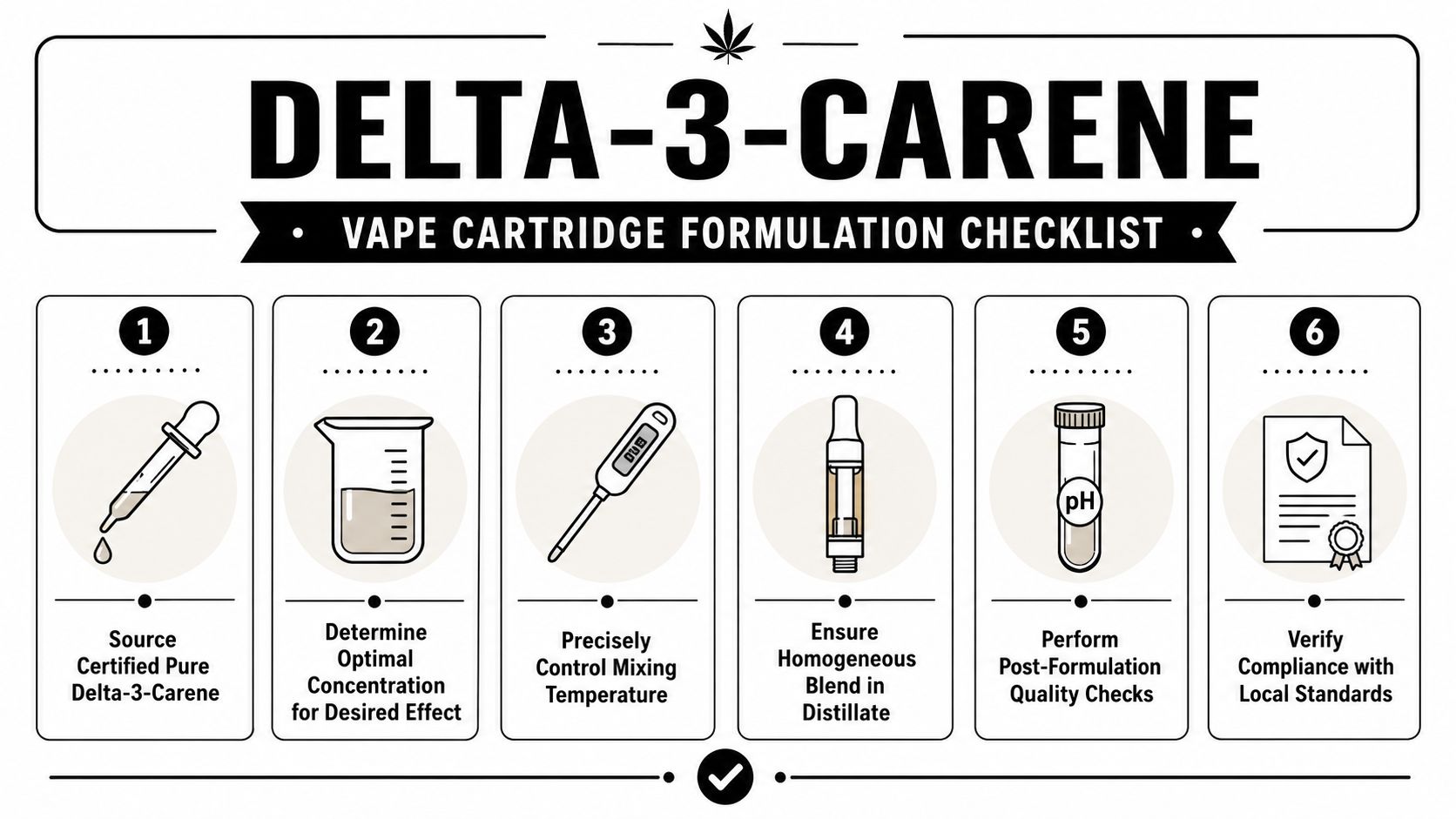
Delta 3 Carene works best when you treat it like a controlled modifier, not a signature note. In formulating for vape cartridges, the goal is usually to restore realism, sharpen woody definition, or add a dry resinous connection between brighter terpenes. Small additions can change a blend fast.
The common failure mode is simple. A formulator likes what carene does in the bottle, scales too quickly, and ends up with a cartridge that tastes drier and rougher than expected. The fix is not complicated, but it does require discipline in sequence, temperature, and pairing.
Start with role before dosage
Before you add carene, decide what job it's doing:
- Backbone correction for a thin pine-citrus blend
- Woody realism in a strain-inspired terpene blend
- Dryness accent for a profile that needs a sharper finish
- Bridge note between top-heavy and base-heavy components
If you can't name the role, don't add it yet. Carene isn't a “just because” isolate.
A practical bench workflow
Use a tight process for Delta 3 Carene for distillate applications:
- Build the full terpene blend first: Don't dose carene into raw distillate as an isolated experiment unless you're testing its sensory limit.
- Add incrementally: Evaluate small bench revisions instead of one large jump. Carene is easier to increase than to disguise.
- Mix under controlled heat: Use only enough heat to fully homogenize the terpene system into the oil. Excess heat pushes you toward aroma loss and roughness.
- Let the sample settle: Freshly mixed samples can read sharper than they will after full integration.
- Retest in hardware: A formula that smells balanced in a vial can still overexpress dryness in a cartridge.
For manufacturers comparing carriers and hardware behavior, the cannabis vape liquid resource is useful context for matching terpene systems to final product format.
A short production overview helps when you're aligning lab and manufacturing teams:
Managing the dryness problem
This is the issue most general terpene guides gloss over. Delta-3-carene has a distinctive drying effect. A published description from ChemicalBook's delta-3-carene profile notes that it can remove body fluids including mucus and tears, which is associated with cottonmouth and red eyes, and that this effect is typically managed by combining it with limonene and eucalyptol.
For formulators, the takeaway is practical:
- If the blend is already dry, don't solve authenticity by increasing carene alone.
- Use limonene when the profile needs lift and moisture perception.
- Use eucalyptol when the profile needs cleaner airflow character without more woody weight.
Keep Delta 3 Carene in a supporting role unless the target profile specifically demands a dry cedar-forward finish.
What works and what doesn't
A few rules hold up in production:
| Approach | Usually Works | Usually Fails |
|---|---|---|
| Pine-heavy profile correction | Adding a small amount of carene to create dry wood and cedar realism | Replacing all woody character with pinene alone |
| Citrus-woody carts | Pairing carene with limonene for brightness and balance | Letting carene dominate the mid note |
| Legacy profile replication | Using carene to add authentic dryness and resin structure | Chasing “old-school” flavor with sweet terpenes only |
| Distillate integration | Fully homogenizing before fill | Evaluating only in open-air aroma and skipping hardware tests |
One commercial option for isolate sourcing is Gold Coast Terpenes, which supplies natural terpene blends and isolates used in cartridges, concentrates, and formulation work.
Safety Toxicity and Regulatory Notes
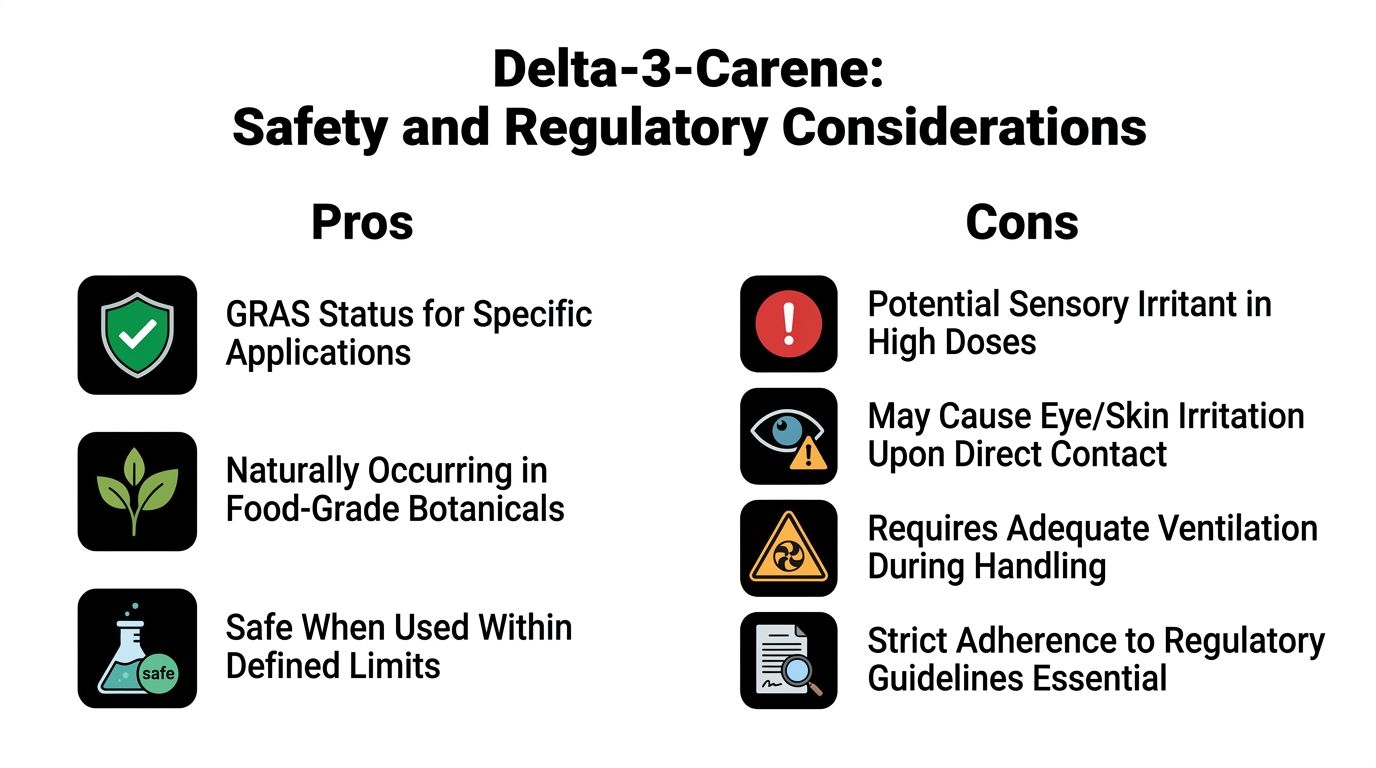
A cart can smell perfect on the bench and still fail the test after ten pulls. Delta 3 Carene is one of the isolates that exposes weak safety review fast. If the formula is too dry, too sharp, or inconsistent lot to lot, the problem shows up in user comfort, complaint rates, and internal signoff.
Treat carene like a high-impact tool. It is naturally occurring, but concentrated use in inhalable products still demands disciplined handling, route-specific review, and clean documentation. Teams that only score aroma miss the part that affects returns and reformulation work.
Earlier in the article, the sensory drying effect was already established. For commercial formulation, the practical point is simple. Dryness is not just a flavor note. It is a tolerability variable, and it needs to be reviewed that way.
What safety review should include
For Delta 3 Carene for vape cartridges, review the ingredient under actual production and use conditions, not just in a smelling strip or open beaker.
- Direct handling risk: Concentrated terpene isolates can irritate skin, eyes, and the respiratory tract during weighing, blending, and transfer.
- In-use comfort: A formula may smell accurate and still present as scratchy or overly drying once aerosolized through hardware.
- Ventilation and PPE: Open-container work needs local ventilation, gloves, eye protection, and transfer procedures suited to volatile concentrates.
- Lot traceability: If a complaint comes back tied to harshness or sensory drift, batch records need to identify the exact isolate lot and finished formula quickly.
SDS review should happen before scale-up, not after a complaint. The guide to why safety data sheets matter in terpene handling is a useful internal reference for setting that standard.
GRAS does not settle inhalation risk
Food and fragrance status does not answer the cartridge question. Inhalation changes perceived intensity, throat feel, and exposure pattern. That matters with carene because even small shifts in level can push a profile from crisp and believable to dry and abrasive.
I treat this as a formulation control issue as much as a safety issue. If a terpene creates a consistent comfort problem in hardware testing, the blend is not finished, even if the target profile is technically accurate.
“Natural” is not a sufficient safety rationale for an inhalable formula.
Labeling and compliance practice
Regulatory requirements vary by market, but the operating habits are consistent.
| Compliance area | Good practice |
|---|---|
| Ingredient transparency | Keep internal records of isolate inclusion rate and final terpene composition |
| Supplier documentation | Maintain current identity, purity, and safety paperwork for each lot |
| Handling controls | Train operators on concentrated terpene exposure, spill response, and closed-transfer habits where possible |
| Complaint review | Log feedback related to dryness, harshness, irritation, and profile drift by batch and hardware type |
The working standard is practical. Use enough Delta 3 Carene to get the profile you need, then confirm the result is tolerable in the actual device, on the actual fill, at the actual terpene load.
Strain Replication and Complementary Terpene Blends
The best use of Delta 3 Carene is usually in synergy. On its own, it tells you what direction the profile can go. Inside a complete blend, it tells you whether the profile feels believable.
That's why replicating flavor of classic profiles for vape cartridges often comes down to pairing discipline. Carene rarely carries the whole blend. It sharpens, dries, anchors, and connects. The surrounding terpenes decide whether that reads as crisp and authentic or flat and abrasive.
Pairing logic that works in production
Use these pairing instincts:
- With limonene: cleaner citrus-wood expression, more lift, less sensory heaviness
- With terpinolene: classic bright herbal-dry character for legacy-inspired profiles
- With beta-caryophyllene: more structure, peppered wood, and resin
- With myrcene: softer body and less brittle dryness
- With eucalyptol: cleaner respiratory impression and less stuffy finish
A blend table keeps this practical.
Sample Delta-3-Carene Blend Ideas
| Target Profile | Primary Terpenes | Delta-3-Carene % (of total terpenes) | Formulation Note |
|---|---|---|---|
| Jack Herer-inspired | Terpinolene, Beta-Caryophyllene, Pinene | Low to moderate | Use carene to create dry cedar realism without flattening the herbal lift |
| Super Lemon Haze-inspired | Limonene, Myrcene, Terpinolene | Low | Keep carene restrained so citrus stays bright and the finish doesn't turn dusty |
| AK-47-inspired | Caryophyllene, Myrcene, Pinene | Moderate | Useful for adding woody depth and a slightly sharper exhale |
| Cedar-pine house blend for distillate | Limonene, Eucalyptol, Pinene | Low to moderate | Good for strain-inspired terpene blend work where pine alone feels too simple |
These aren't fixed formulas. They're starting frameworks for bench evaluation.
Carene works best when the rest of the blend gives it context. Without that context, it can smell harsher than it really is.
A useful way to think about top, mid, and base roles
For terpene profile for cannabis product formulation, assign roles before adjusting percentages:
- Top notes create first impact. Limonene and terpinolene often sit here.
- Mid notes shape profile identity. Carene frequently works in this lane.
- Base notes hold the finish together. Caryophyllene and heavier woods often support this area.
When teams skip note architecture, they tend to overcorrect with whichever terpene is easiest to smell in the bottle. Delta 3 Carene becomes much easier to control once you treat it as part of the profile's internal structure instead of a flavor shortcut.
Mastering Delta 3 Carene in Your Formulations
A blend can smell balanced in the beaker, then turn papery and thin once it sits in hardware for a week. Delta 3 Carene is often the reason. It rewards disciplined formulation and exposes weak process fast.
Used with intent, it gives profiles something many terpene systems lack. Dry cedar definition, sharper woody contour, and a more believable finish. That matters when a strain-inspired terpene blend for distillate needs to read as specific and complete, not generically piney.
The working rule is simple. Treat carene as a control point, not a decoration. Small changes can shift a profile from crisp and architectural to dusty, hollow, or throat-forward. In production, that affects more than aroma. It affects repeatability across lots, how the cart tastes halfway through the fill, and whether the finished profile still feels accurate after storage.
The short list that matters
- Buy against documents, not assumptions: Review COAs, lot consistency, and oxidation handling before approving a supplier.
- Use carene to shape the frame: It performs best when it builds woody structure and supports realism.
- Write dryness into the brief: If the target profile cannot tolerate a dry exhale, reduce carene early instead of trying to cover it later.
- Balance around the finish: Limonene can keep lift, eucalyptol can clean the edges, myrcene can add body, and caryophyllene can anchor the back end.
Good teams do not win with carene by pushing it harder. They win by setting limits, stress-testing the blend in actual hardware, and adjusting for how the profile degrades over time.
For production work, compare sourcing specs, lot documents, and sensory performance before you lock a woody or legacy-style profile. As noted earlier, the isolate itself is only half the decision. The rest is process discipline.
Gold Coast Terpenes supplies natural terpene blends, strain-specific profiles, and isolates for cartridges, concentrates, and cannabis product formulation. If you're building a terpene profile for vape cartridges, refining a strain-inspired terpene blend, or sourcing components for replicating flavor of classic profiles for distillate, review the formulation tools, isolate catalog, and technical resources at Gold Coast Terpenes.