
Copying a published strain ratio is the wrong starting point for a Biodome Purple Sticky Punch formulation guide. Gold Coast Terpenes supplies premium, 100% natural terpene blends, but a strain name alone does not provide a repeatable recipe.
For a vape or extract brand, define the sensory target, master blend, loading window, and finished-device release specification. Start with peppery berry candy. Then confirm that the loaded cartridge delivers that profile and passes emissions checks, since aroma strength alone does not establish acceptable performance.
Why Is Biodome Purple Sticky Punch a Brief Instead of a Formula?
Biodome Purple Sticky Punch is a sensory brief, not a fixed chemical specification. Write the target as sweet berry and candy, supported by floral-herbal character and a dry pepper finish, before selecting terpene inputs.
Say a product developer needs a fruit-forward distillate cartridge that purchasing can reorder without changing the approved flavor. The useful reference isn't a photograph of flower or a retail description. It's a retained sample paired with an analytical fingerprint and a sensory scorecard.
That scorecard should distinguish berry character, candy sweetness, floral-herbal depth, and pepper intensity. Otherwise, one evaluator may approve a bright citrus confection while another expects darker fruit and spice.
Keep the history separate from the specification
The name comes from the 1996 film Bio-Dome, and the commonly cited lineage is Purple Afghan crossed with Chemdawg, according to AllBud's Purple Sticky Punch listing, which describes approximately 60% sativa and 40% indica, notes reversed versions, and reports 20%–25% THC.
Those figures describe a retail strain reference, not the finished oil you're manufacturing. A Hytiva profile also documents approximately 1% CBD, but neither that figure nor the strain name establishes your batch's cannabinoid content.
Phenotype, cure, extraction lot, and storage can change the volatile profile. A terpene purchase therefore cannot substantiate a THC claim, and a flower description cannot establish the composition of a distillate cartridge.
Practical rule: Approve the flavor against a retained reference and the chemistry against laboratory results. Don't approve either against the name.
Turn the description into acceptance criteria
Give the development team a short working record:
- Target character: Sweet berry and candy, floral-herbal support, and a recognizable pepper finish.
- Reject character: Dominant citrus peel, excessive pine, or spice that obscures the fruit.
- Reference matrix: The actual distillate or concentrate intended for production.
- Release evidence: Ingredient identity, finished-oil composition, device performance, and aerosol assessment.
The distinction matters commercially. A fragrance-like premix can smell attractive undiluted yet miss the intended profile in oil.
Use the terpene roles below to translate those descriptors into a controlled blend. Gold Coast Terpenes's formulation education can support that work, but your signed reference remains the authority for the SKU.
Should a Purple Sticky Punch Reference Be Botanical or Cannabis-Derived?
The sourcing decision determines what can be controlled and what must be verified. A botanical strain-inspired blend provides a THC-free flavor input with a defined composition, while cannabis-derived material reflects the volatile profile of a selected plant lot. For a repeatable cartridge spec, choose by product requirements and supplier documentation, not by strain name alone.
Botanical blend versus cannabis-derived oil
| Criterion | Botanical strain-inspired blend | Cannabis-derived oil |
|---|---|---|
| Cannabinoid contribution | Formulated as a THC-free flavor input | May carry native cannabinoids from the source lot |
| Repeatability | A documented master blend can be reordered against its lot COA | Phenotype, cure, and extraction can change the volatile profile |
| Label language | Describe the source accurately as botanical or nature-identical, as applicable | Identify the material as cannabis-derived |
| Best use | Vape, distillate, and repeatable flavor matching | Evaluating the characteristics of a specific plant lot |
| Neighboring candy direction | Compare with a separately named fruit-forward reference | Keep its identity distinct from the Purple Sticky Punch target |
The sourcing choice should follow the product promise and the level of lot-to-lot variation the formulation can accept.
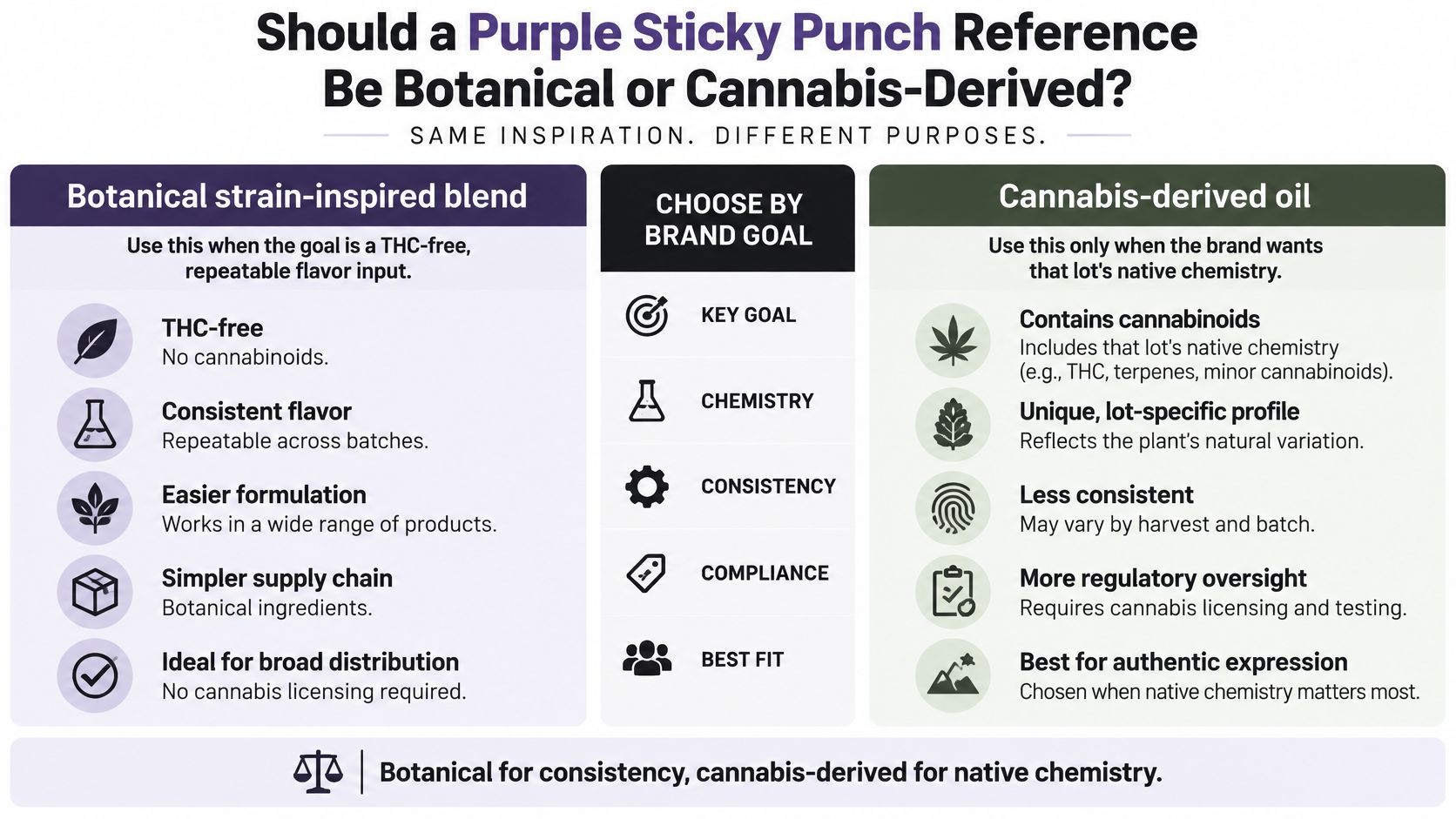
Choose the reference you can maintain
A botanical master blend lets the formulator specify constituent identity and relative concentration. That supports repeat purchasing against an approved flavor target, provided the supplier maintains appropriate documentation and change control.
Cannabis-derived material can retain characteristics that a simplified reconstruction may not capture. Treat it as a lot-specific ingredient: an identically named replacement does not guarantee an identical fingerprint. Confirm identity and relevant analytical results against the actual material intended for production.
Neither origin alone establishes quality or inhalation safety. Request appropriate identity, contaminant, and application testing for the chosen route. The botanical versus cannabis-derived terpene guide can help clarify how source descriptions differ from performance in a formulation. When comparing suppliers, assess documentation, reorder consistency, change control, and application support rather than relying on strain names.
Keep origin and flavor labels accurate
Botanical and nature-identical describe different sourcing categories. Gold Coast Terpenes offers terpene blends, including a 24k gold punch profile that may serve as a separately identified comparison in a flavor panel. Its name alone does not establish its composition or make it a substitute formula.
Keep peppery berry candy as the Purple Sticky Punch sensory target, and record the material's origin accurately in purchasing and ingredient documentation. A cannabis-like flavor does not establish cannabis-derived origin, and a supplier's marketing category alone does not confirm cannabinoid absence. Check the relevant specification and analytical reporting limits before approving packaging.
Which Terpenes Shape a Purple Sticky Punch Blend?
Start with beta-caryophyllene, limonene, and myrcene as the main sensory roles, then use pinene or linalool only to address a specific gap. Their top, middle, and base positions describe a blending framework, not a measured ranking or a fixed recipe.
Note roles for a Purple Sticky Punch reference blend
| Note role | Terpene | Sensory job | Place in the blend |
|---|---|---|---|
| Top | Limonene | Citrus-candy lift | Major |
| Mid | Myrcene | Fruity, herbal, earthy depth | Major |
| Base | Beta-caryophyllene | Dry pepper and spice | Major |
| Modifier | Alpha-pinene or beta-pinene | Fresh herbal edge | Minor and optional |
| Modifier | Linalool | Soft floral roundness | Minor and optional |
A peer-reviewed analysis of commercial cannabis chemistry found myrcene, beta-caryophyllene, and limonene among the terpenes frequently present at comparatively high levels. Products labeled Purple Punch clustered around caryophyllene-limonene chemistry. Use the Purple Punch terpene-profile guide as a neighboring comparison when shaping the sensory brief, rather than as a specification for Purple Sticky Punch.
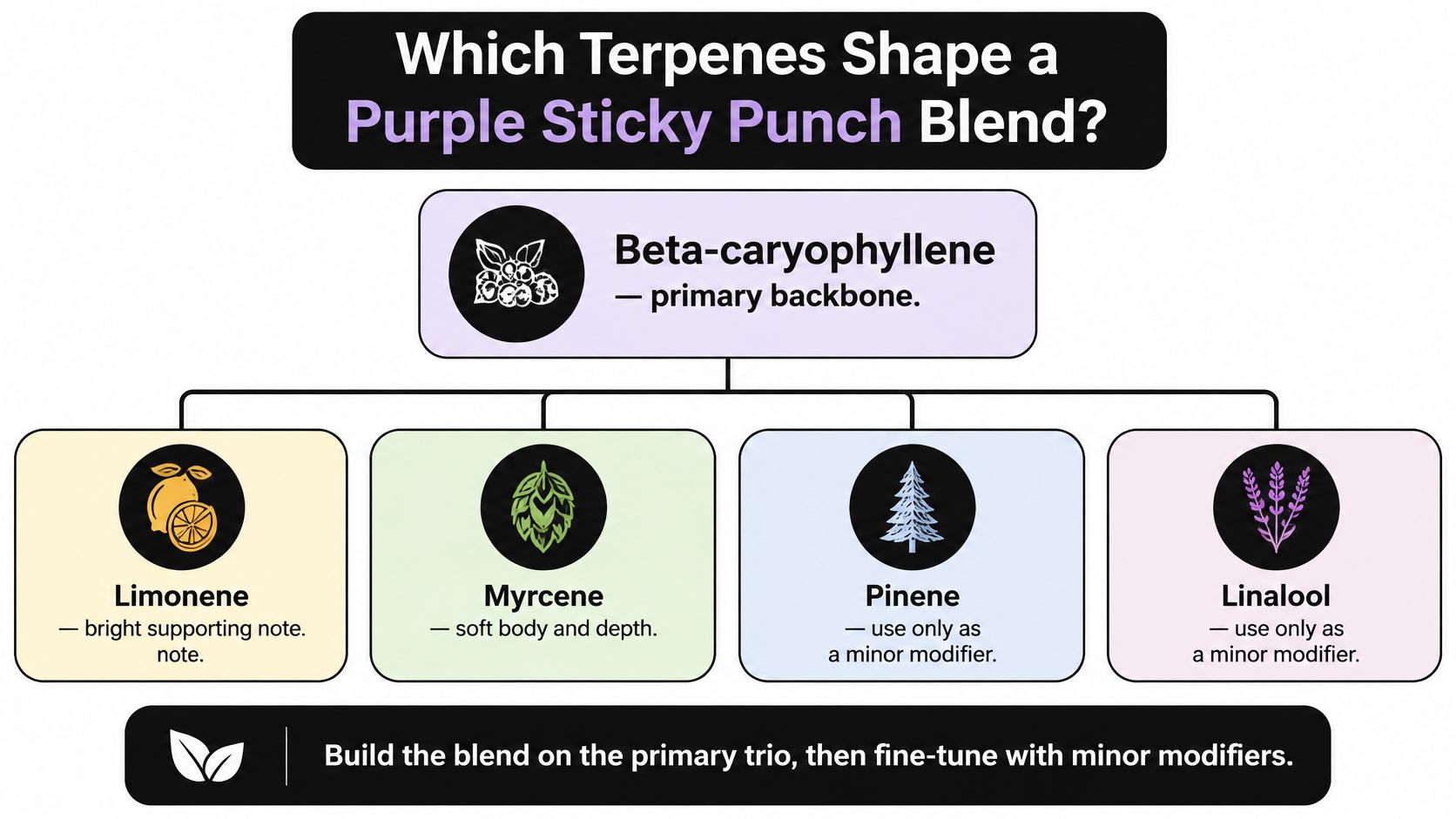
Adjust the fruit direction without losing the backbone
Limonene provides lift. Increasing its relative contribution can make the reference read brighter, with more punch and citrus-candy character. Too much can pull the profile away from berry, so assess it in the intended oil, not just from the isolate bottle.
Myrcene adds body. Its fruity, herbal, and earthy character can fill out the middle, while an excessive contribution may obscure the cleaner candy target. Use it to connect the bright opening to the darker finish.
Beta-caryophyllene supplies structure. Dry pepper and spice distinguish this target from a generic sweet-fruit blend. Increasing myrcene and beta-caryophyllene together shifts the reference toward heavier confectionery fruit. Increasing limonene relative to the pepper backbone creates a brighter direction.
A peppery finish can define the profile without becoming the strongest sensation.
Use modifiers to solve a named problem
Add pinene when the reference needs a fresher herbal edge. Add linalool when the floral character needs rounding. Balance the primary trio first; introducing both modifiers earlier makes it harder to identify which change improved the blend.
Gold Coast Terpenes offers isolated compounds including limonene, myrcene, and beta-caryophyllene, alongside 50+ classic and contemporary profiles for reference comparisons. The strain name alone does not establish a formula. Use the comparison to refine sensory direction, then specify the actual blend by its ingredients and proportions.
There is no universal percentage for replicating the flavor of Purple Sticky Punch. Receptor activity and entourage narratives do not establish a predictable finished-vape outcome. First lock the relative sensory contribution of the major constituents. Then determine how much of that master blend the oil and cartridge can accommodate.
What Loading Range and Build Steps Work for Distillate and Cartridges?
The loading figure is a starting point for a pilot, not a production specification. The cannabis vape-emissions study describes approximately 5%–15% terpene amendment by mass as common practice and reports higher gas-phase degradation products with added terpenes than with THC alone, including isoprene, methacrolein, benzene, and methyl vinyl ketone. Use the range to frame a controlled screen, then qualify the blend in the intended oil and cartridge.
Loading constraints for a cartridge trial
| Constraint | Figure | What it means | Formulator action |
|---|---|---|---|
| Common distillate amendment | Approximately 5%–15% by mass, as described in the study above | Flavor and emissions both change with load | Screen conservatively; don't start at the upper end |
| Research concentrate sample | 9:1 THC-to-terpene ratio | Experimental ratio from a concentrate-vaping study, not a validated production specification | Use it to understand the study conditions, not as the SKU specification |
| Viscosity | Terpenes thin the concentrate | Flow and mouthfeel change with percentage | Check the filled production cartridge |
| Gas-phase products | Higher with added terpenes than THC alone | Includes the degradation compounds identified above | Test emissions at the actual voltage and coil |
| Device | Voltage and coil specific | The same oil can taste and degrade differently | Lock hardware before flavor sign-off |
A concentrate-vaping study used a 9:1 THC-to-terpene ratio for practical experimental samples and noted that terpenes moderate viscosity. This ratio reflects that study's experimental samples; cannabinoid matrix and device conditions still need to guide commercial formulation.
Build a controlled pilot rather than chasing aroma
Use a defined sequence to formulate Biodome Purple Sticky Punch for distillate. Keep analytical controls separate from sensory judgments so a favorable flavor result cannot conceal a mechanical failure or an emissions concern.
- Record the starting oil COA and matrix identity.
Capture cannabinoid potency, existing terpenes, supplier lot, and processing history. Check whether the analytical report measures the constituents needed for your calculation. Retain a sample of unamended oil for comparison if the pilot develops an unwanted note.
The starting oil is not necessarily chemically blank. Native volatiles can shift the finished profile even when the added master blend stays unchanged.
- Map the sensory target to the major constituents.
Write sweet berry and candy, floral-herbal support, and dry pepper as separate evaluation attributes. Use limonene, myrcene, and beta-caryophyllene to organize the starting direction, without assuming those molecules alone reproduce every berry nuance.
A target described only as “fruity” gives a panel too little to assess. Distinguish fruit identity from brightness, perceived sweetness, herbal depth, and spice. Keep the scorecard stable throughout the trial so changes in the descriptors do not cloud comparisons.
- Weigh and document the master blend.
Use a calibrated balance, compatible closed vessels, and constituent lot records. Record weighed masses rather than reconstructing the blend from drop counts.
Start with the major trio and introduce at most one optional modifier during the initial comparison. Document each candidate's composition. Any unmeasured, by-eye adjustment breaks reproducibility until it is weighed and recorded.
- Dose pilot lots on a final-mass basis.
For the first pass, screen below the upper end of published practice. A stronger-smelling undiluted reference is not a reason to raise loading.
Define added-blend loading as the mass of added blend divided by the final mixture mass. If the starting oil already contains terpenes, keep added blend percentage distinct from total measured terpene concentration. Confusing the starting-oil mass with final mixture mass changes the calculation.
The guide to adding terpenes to distillate can help structure the calculation. A calculator can catch arithmetic errors, but it cannot determine whether a formulation suits the device.
- Rest the blend, measure flow, and fill production-intent hardware.
Document equilibration conditions and limit unnecessary air exposure. Record the temperature used for viscosity or flow assessment; without it, the result is difficult to reproduce.
Fill the intended cartridge, not just a convenient bench device. Check for leakage, flooding, poor replenishment, and inconsistent delivery under the intended operating conditions. Oil that pours well can still wet and feed the cartridge poorly.
- Compare the finished system with the retained control.
Evaluate both the diluted oil and filled cartridge using the same reference vocabulary. Compare candidates under controlled conditions, with consistent device settings.
A balanced vial aroma may become an overly spicy finish after heating. Don't automatically add more bright material. The cause may be hardware, loading, or the starting matrix rather than the master ratio, so change one factor at a time.
- Confirm identity and concentration before scale-up.
Use GC-MS or another validated compositional method suited to the analytes and matrix. Confirm that the laboratory report covers the constituents in the master record and can distinguish relevant overlapping signals.
Gold Coast Terpenes blends are formulated without VG, PG, PEG, and MCT. Preserve that requirement in procurement and finished-product checks. A premix COA alone does not confirm that weighing, mixing, and filling were correct; verify the finished oil separately.
Keep the formula and device under one change-control record
Do not address weak flavor by increasing voltage without reopening the assessment. A cartridge replacement, even with a nominally similar model, also requires reassessment of the approved operating conditions.
Hold-sample rule: Keep the signed master, its COA, the loading record, starting-oil identity, and device settings together.
Retain the approved premix, finished oil, and filled hardware under documented storage conditions. If production changes an ingredient lot, mixing condition, or cartridge component, assess the change against the complete reference rather than a smelling strip alone.
Why Does a Passed Oil Sample Still Fail in the Aerosol?
A premix certificate and a rested oil sample don't describe everything that leaves the coil. Heating can alter the delivered composition, so oil approval and aerosol approval are separate decisions.
Keep both sample types in the release workflow.
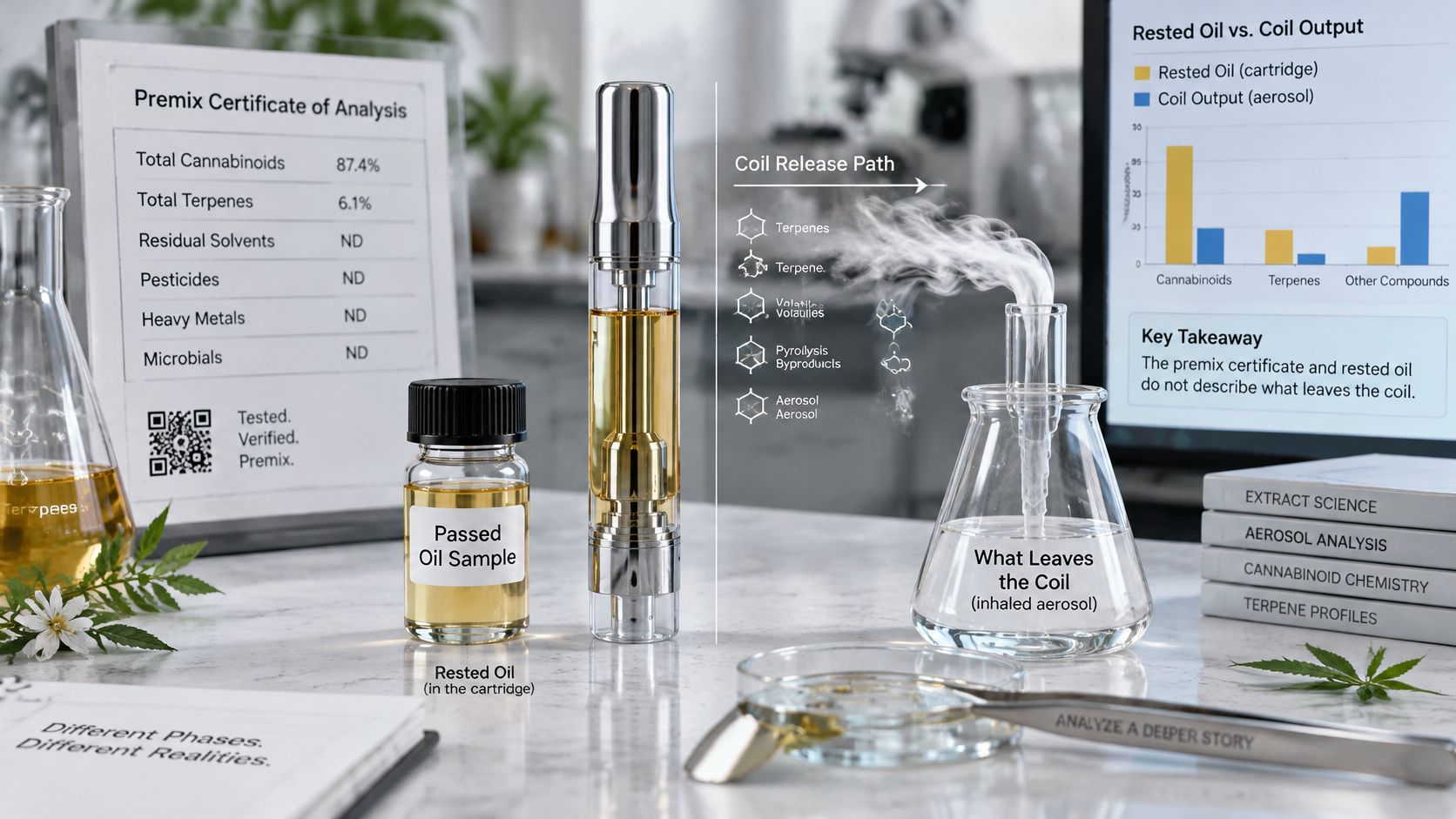
A California cartridge-analysis study identified more than 100 terpenes and natural extracts, 19 cannabinoids, and potentially hazardous additives including vitamin E acetate, polyethylene glycols, and medium-chain triglycerides; it also found that vaporization and aerosolization can generate additional terpenes and minor cannabinoids. Its sample findings are California-specific, not a description of every cartridge market.
Set separate release gates
Treat ingredient identity, oxidation state, residual solvents, pesticides, thermal behavior, and cutting diluents as distinct quality attributes. Require finished-oil and aerosol evaluation before approving artwork, with acceptance criteria established by the quality team and qualified laboratory.
Release tests before artwork approval
| Release test | What it catches | Pass criterion |
|---|---|---|
| Oil certificate of analysis | Identity and terpene concentration | Matches the master blend record within approved analytical tolerances |
| Oxidation and residual solvents | Oxidation state and solvent carryover | Meets preapproved stability specifications and applicable solvent limits |
| Pesticide and diluent screen | Pesticides, VG, PG, PEG, MCT | Meets applicable pesticide limits; prohibited diluents not detected at agreed reporting limits |
| Aerosol test on production hardware | Terpenes and minor cannabinoids generated on heating | Tested at production voltage and coil; meets approved emissions criteria |
| Sensory retest after coil | Spicy or harsh shift after heating | Matches the retained control within approved sensory tolerances |
Gold Coast Terpenes components should face the same incoming-material scrutiny as other ingredients. Supplier identity doesn't replace the brand owner's release responsibilities.
This video can accompany the technical review, but it doesn't replace a laboratory method or product-specific results.
If a diluent screen fails, quarantine the affected material and investigate ingredient records, the oil supplier, and possible hardware contributions. Changing the fruit ratio won't correct contamination.
What Must Be Confirmed Before You Lock a Production Spec?
Lock the production specification only when the master ratio, loading, device settings, finished-oil results, and aerosol assessment support the approved sensory reference. Purchasing and quality assurance should be able to reproduce that decision from the production records.
Confirm the order before committing to scale
Before ordering a production quantity, confirm the selected profile, ingredient identity, and lot documentation with Gold Coast Terpenes. Treat wholesale minimum order quantities and production lot sizes as unconfirmed until the supplier documents them. A strain name or sample alone does not establish a repeatable formulation.
The 3ml Strain Picker Pack allows selection of any three different catalog profiles in 1.5ml or 3ml sizes. It can support terpene testing and custom vape or tincture formulation. The Explorer Pack complements the Pioneer Pack with additional ingredients for fuller, more complex strain profiles.
Use the quality-assurance processes guide to align incoming inspection, retained samples, and release documentation. Tie regulatory review to the destination market, and treat supplier documents as supporting evidence. Record the approved formulation version, ingredient lot, and change-approval owner so purchasing and production can trace any revision.
Frequently asked questions
Does the film name authorize a THC claim?
No. Keep the ingredient record in the ingredient file. Support any finished-product THC statement with the applicable batch analysis and labeling rules.
Is 15 percent terpene loading required?
No. Set loading through the formulation and validation process described in the loading section.
Does botanical mean cannabis-derived?
No. Keep origin documentation attached to the material code and review it whenever a supplier or ingredient changes.
Can a supplier COA replace aerosol testing?
No. A supplier COA documents an ingredient. Trace aerosol results using both the ingredient lot identity and the filled-device lot identity.
Which documents should travel with the SKU?
Maintain a version-controlled dossier with the signed formulation, ingredient and oil COAs, manufacturing record, hardware specification, release results, approved label, and lot references. Assign a change-approval owner to preserve a clear audit trail.
Gold Coast Terpenes offers botanical blends, isolated compounds, and reference packs for developing a controlled Purple Sticky Punch-inspired flavor. Use the Mixing Calculator to support formulation work, and confirm wholesale requirements before scaling the approved cartridge specification.