
The usual advice for replicating the flavor of Animal Gas is to buy a strain-named blend and adjust until it smells right. Gold Coast Terpenes supplies SC Lab-tested terpenes for cartridges, but even a tested ingredient needs a defined formulation target: a strain name isn't a recipe.
For product developers, the useful specification combines terpene ratios, sensory descriptors, finished-oil loading, and hardware performance. An Animal Gas strain-inspired terpene blend should reproduce a documented aroma profile, not imply that every plant sold under that name has identical chemistry.
Which Animal Gas Cultivar Are You Replicating?
The Animal Gas name alone doesn't identify the chemistry you're replicating. Two reported lineages share the label, so the first purchasing decision is which reference profile your team intends to match.
The AllBud Animal Gas listing describes the commonly reported Chemdog 91 x Animal Cookies lineage as an indica-leaning hybrid associated with gassy, lemon, vanilla, and cookie notes; coverage also identifies Berry GPS x Apple Fritter under the same name, with limonene, caryophyllene, and myrcene emphasized. That naming conflict matters more to formulation than the broad hybrid classification.
Two lineages sold under the Animal Gas name
| Lineage | Reported profile | THC reported |
|---|---|---|
| Chemdog 91 x Animal Cookies | Indica-leaning hybrid; gassy, lemon, vanilla and cookie notes | Listing range, not a batch specification |
| Berry GPS x Apple Fritter | Limonene, caryophyllene and myrcene as key terpenes | Not established for this lineage in the cited material |
| Market listings (HashDash, 2025) | Terpene ratios vary by batch | 21% average |
The market-context figure is specific: HashDash reported an average THC content of 21% for Animal Gas in 2025. It isn't a dose recommendation, a distillate specification, or proof that either lineage consistently meets that value.
Turn the name into a purchasing specification
Request the batch-specific certificate of analysis, then compare terpene percentages, cannabinoid levels, harvest date, and testing laboratory against the reference you selected. Ask whether the sample you're evaluating comes from the tested batch, rather than assuming the sales sample and production lot are interchangeable.
Two products labeled Animal Gas can differ in aroma and reported effects because the label doesn't chemically standardize the contents. A botanical reconstruction can match the expected sensory archetype without reproducing every constituent of a particular plant.
Purchasing rule: Approve a defined chemical and sensory target, not the cultivar name printed on the quotation.
Use the All Gas OG profile page as a separately named comparison reference, not as evidence that All Gas OG and Animal Gas are interchangeable. Your specification should state the selected reference, the named terpene window, and descriptors such as citrus opening, herbal body, and woody persistence.
That gives purchasing, quality assurance, and the flavor team the same acceptance criteria.
What Terpene Profile Does Animal Gas Contain?
The reported Animal Gas profile contains approximately 6.91% total terpenes, led by beta-myrcene, limonene, and beta-caryophyllene. The CannMenus compiled COA dataset gives their respective means as 1.70%, 1.53%, and 1.01%, with the remaining reported constituents shown below.
These are COA means, not a finished-cartridge recipe. Gold Coast Terpenes' SC Lab-testing credential gives a development team an ingredient-documentation checkpoint, but it doesn't establish that an ingredient lot matches this particular reference.
Reported Animal Gas terpene profile from COA means
| Terpene | Reported mean (%) | Calculated share of reported total |
|---|---|---|
| Beta-myrcene | 1.70% | 24.60% |
| Limonene | 1.53% | 22.14% |
| Beta-caryophyllene | 1.01% | 14.62% |
| Ocimene | 0.72% | 10.42% |
| Linalool | 0.55% | 7.96% |
| Humulene | 0.28% | 4.05% |
| Beta-pinene | 0.20% | 2.89% |
| Guaiol | 0.19% | 2.75% |
| Alpha-bisabolol | 0.15% | 2.17% |
| Alpha-pinene | 0.14% | 2.03% |
| Nerolidol | 0.13% | 1.88% |
| Unlisted remainder | 0.31% | 4.49% |
| Total terpenes | 6.91% | 100% |
Shares are calculated from the reported means and rounded independently. The unlisted remainder is the difference between the named constituents and reported total, not an identified ingredient.
Use the means without overstating their precision
The dataset doesn't establish which of the competing lineages produced these means. Don't assign the table to Chemdog 91 x Animal Cookies or Berry GPS x Apple Fritter without a batch COA that makes that connection.
Nor should you turn the mean values into invented acceptance tolerances. Establish your target window through reference-lot analysis, sensory evaluation, and manufacturing capability. A laboratory average describes the reference dataset; it doesn't tell your blending operator how much variation your brand will accept.
The unlisted remainder deserves particular care. Don't fill it with a convenient isolate to make the formula total correctly. Identify the missing fraction through further analytical documentation, or explicitly document that the reconstruction covers only the named constituents.
For the practical formulation read, myrcene and limonene together account for about 46.8% of the reported terpene fraction, calculated from the cited means. A reconstruction that misses their balance is unlikely to match this target, regardless of how carefully the smaller notes are adjusted.
Which Terpenes Lead, Carry and Anchor the Blend?
The Animal Gas name is a label, not a formula. Build the target around a verified terpene window and sensory profile: limonene and ocimene can lead the opening, myrcene and linalool can carry the body, and caryophyllene, humulene, and guaiol can anchor the finish. These assignments guide the sensory brief; they don't predict aerosol behavior.
A perfume-style pyramid helps organize the roles. Top notes shape the first impression, middle notes supply recognizable body, and base notes contribute persistence. The layers overlap, so changing one ingredient can shift the perceived balance of the whole blend.
Build an opening without turning it into citrus flavor
Limonene brightens the lead, while ocimene adds an airy aromatic lift. Alpha-pinene and beta-pinene fit as sharper accents rather than the main body.
Beta-pinene accounts for a familiar cannabis odor often associated with pine trees and turpentine. Evaluate that edge separately from citrus intensity. Raising both together can make the opening sharper without making it more faithful to the intended profile.
Give the center weight and the finish definition
Myrcene supplies herbal density. Linalool adds floral softness through the middle and can round the transition from the bright opening to the heavier finish.
Beta-caryophyllene provides peppery, woody persistence. Alpha-humulene contributes the hoppy aroma associated with cannabis, while guaiol helps shape the woody foundation. The strain name alone cannot specify their proportions; set those from the analytical target and sensory brief.
A convincing open-vial aroma may lose its identity in a cartridge. Assess the layers in the intended product, because sensory roles alone do not establish how the blend will behave in a device.
Increasing the loudest ingredient rarely repairs a weak match. Too much top-note emphasis can read as generic citrus, while an insufficient base may leave little recognizable character later in use.
Keep a sensory worksheet with separate fields for opening, body, finish, and unwanted notes. Use each field to direct adjustments: a flat opening calls for a different change than an overly floral middle or an excessively dry, woody finish.
How Do You Build and Verify a Strain-Inspired Terpene Blend?
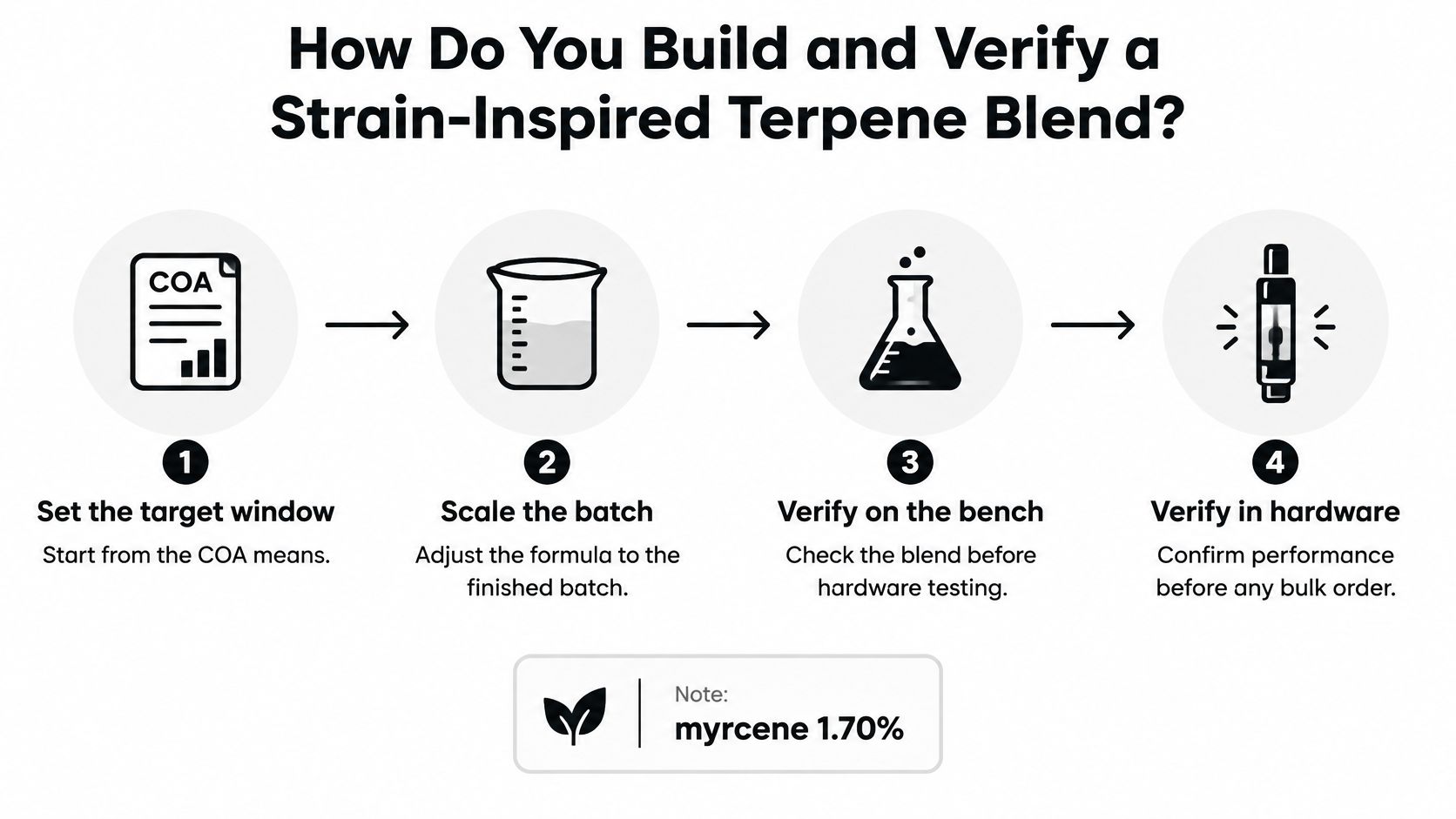
The Animal Gas name is a label, not a formula. Build to a defined terpene window and sensory target, then verify the blend in the intended product and device before scaling an order. Keep composition, loading, and sensory acceptance as separate specifications.
A botanical blend lets a formulator set constituent ratios directly. A cannabis-derived reference can provide a different starting material. Record the source accurately, and use a certificate of analysis (COA) and device testing to assess the finished blend.
Move from reference to a controlled bench formula
Set the target window. Start with the reported constituent means, then define acceptable ranges using the reference samples available to you. A common formulation error is to treat the source material's total terpene concentration as the required addition rate for oil. These are different specifications.
Normalize and scale by mass. Calculate each constituent's share of the intended terpene concentrate, then scale that concentrate to the selected finished-batch loading. Use mass records, not volume measurements, when comparing trial formulas; otherwise, the basis for comparison changes.
Select ingredients by function. Gold Coast Terpenes offers isolates including Myrcene, Limonene, Beta-Caryophyllene, Linalool, Alpha Pinene, and Terpinolene. These can help form the target's structure, while the blend still needs to match the defined window and sensory goal. Its isolate catalog is a starting point for choosing compounds. The Apple Fritter strain profile offers a flavor-led comparison, not evidence that it reproduces Animal Gas. Gold Coast Terpenes' Elevated Strains are made by Master Terpologists, who raise levels of selected rare and exotic terpenes to bring out fruity and flavorful nuances. For comparative sampling, the 3ml Strain Picker Pack lets customers select three different profiles in 1.5ml or 3ml sizes.
Dilute before evaluating in the product. These terpene strains are highly concentrated and need proper dilution before use. A strong aroma neat does not establish that the diluted formula has the right balance.
Make a small, traceable bench batch. Record ingredient lot numbers and exact masses with a suitable precision balance. Change one component at a time when correcting a mismatch so the effect of each adjustment remains clear.
Make verification the bulk-order gate
Compare chemistry and sensory output. Use the COA interpretation resource to review analytical documentation, compare the blend with your acceptance window, and arrange analysis of the finished blend. Terpenes 101 can support foundational learning, but release decisions require measurements from the actual formulation.
Approve the device before procurement scales up. Confirm minimum order quantity, bulk packaging, lead time, documentation, and permitted origin language for the product label before placing a production order. A small sample format does not establish the terms for a bulk order.
Prioritize lot traceability, ingredient identity, analytical documentation, and repeatable flavor matching when selecting a supplier. Accept the formula only when its sensory profile meets the target in the intended product: a bright opening, an herbal body, and a base that remains recognizable after heating.
How Does Heat Change Animal Gas Terpenes in Vape Carts?
Myrcene and the sesquiterpenes showed comparatively strong survival in the cited heating work, while terpinolene showed substantially lower survival at higher tested temperatures. That contrast supports hardware testing, not a blanket claim that a terpene is stable or safe in every cartridge.
The laboratory illustration provides context for evaluating thermal behavior, rather than evidence of a particular device's performance.
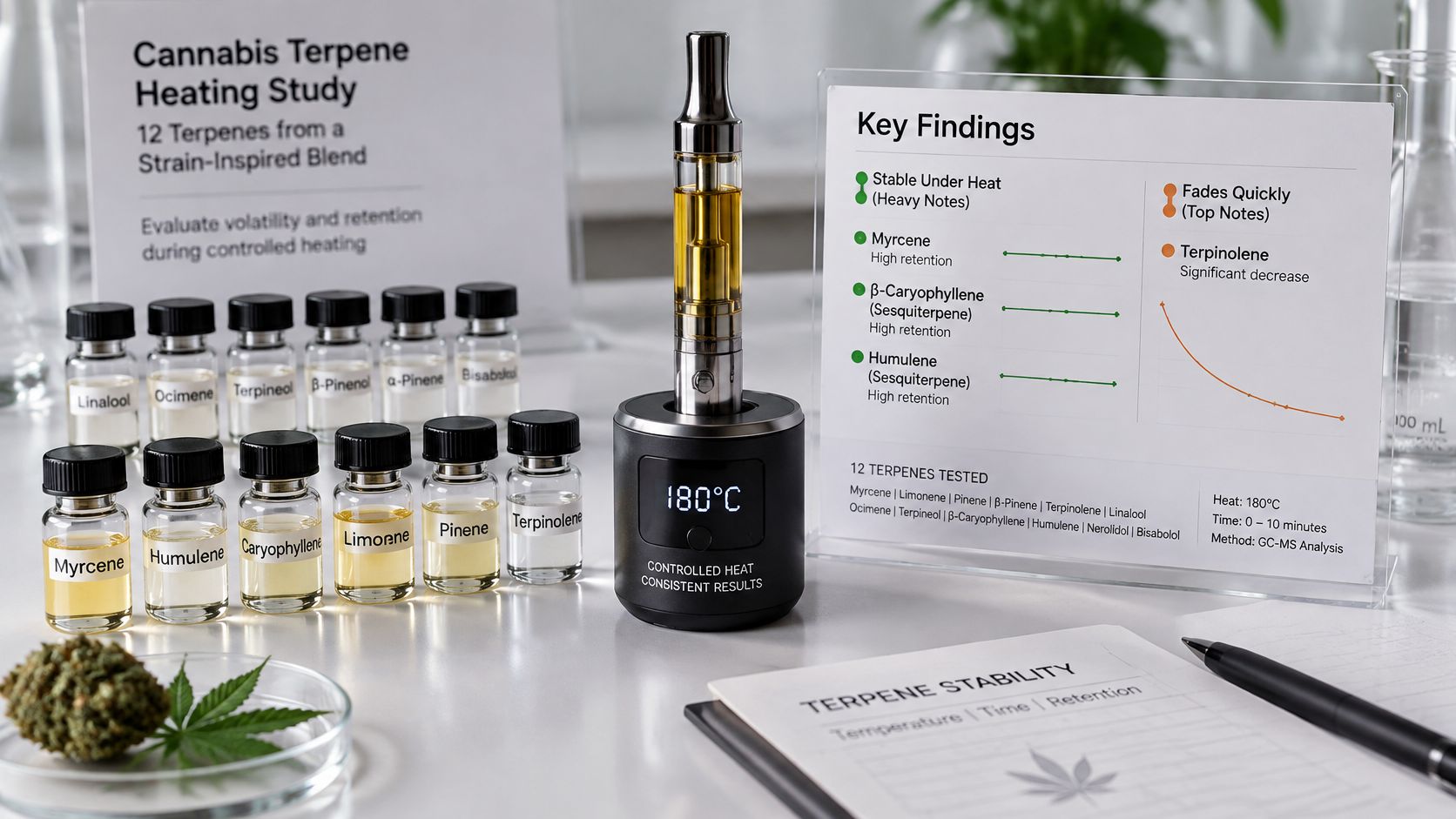
The Entour technical summary describes a study of 12 cannabis terpenes heated from 100°C to 500°C, reporting approximately 97–98% survival for myrcene and 11–28% for terpinolene at higher tested temperatures. It also describes comparatively strong survival for beta-caryophyllene and humulene across the tested range.
Terpene survival at higher tested heating temperatures
| Terpene | Reported survival at higher temperatures |
|---|---|
| Beta-myrcene | 97–98% |
| Terpinolene | 11–28% |
| Beta-caryophyllene | Strong across tested range; exact percentage not reported |
| Humulene | Strong across tested range; exact percentage not reported |
| Limonene | Survival not reported in the source |
Terpinolene is a useful thermal comparator here, not a reason to add it to the Animal Gas target. Limonene's survival isn't established by this summary, so don't assign it a value based on another terpene's result.
Caryophyllene's higher-boiling behavior can support peppery, woody persistence, while the perceived balance of volatile top notes may shift during aerosol generation. The terpene boiling-point guide supplies background, but boiling point alone doesn't predict degradation or emissions in a working cartridge.
This accompanying video provides an additional visual reference.
Check the actual aerosol
Evaluate mouthpiece aroma under a controlled device setting, repeat the comparison with another device, and submit aerosol for laboratory analysis. Record coil or ceramic construction, power settings, and the test protocol so the team can distinguish formula changes from hardware variation.
Survival isn't an inhalation-safety result. A persistent aroma still requires an emissions assessment.
What Loading Limits Apply to Animal Gas Distillate?
There's no universal safe terpene loading established for Animal Gas distillate. Start with a controlled, lower-loading design, document the exact mass ratio, and evaluate the formulation in its intended cartridge.
A California-supported distillate emissions study tested commercial terpene-mixture additions at 0%, 7.5%, and 15% by mass and observed carbonyl-emission increases as high as ninefold under the tested conditions. Those results don't establish a universal safe or unsafe threshold for other mixtures, devices, or operating conditions.
They do challenge a common shortcut: assuming that a familiar flower concentration is automatically an appropriate cartridge addition rate. A source-material COA describes that material, while a cartridge formula describes a different matrix subjected to a different exposure process.
Release criterion: An acceptable liquid analysis isn't a substitute for heated-aerosol testing.
Write the test obligations into the batch plan
- Specify finished-batch loading. State terpene mass as a fraction of the complete formulation, not as an ambiguous addition relative to the starting oil.
- Include an unflavored control. Compare the base distillate with the terpene-containing trial so the team can separate matrix and additive contributions.
- Evaluate a lower-loading candidate. Select the starting point through formulation and toxicological review, rather than treating a study's test levels as recommendations.
- Use production-intent hardware. Test the cartridge construction and operating settings the brand intends to sell.
- Measure heated emissions. Include carbonyl analysis and an appropriate broader assessment before commercialization.
- Preserve traceability. Record ingredient lots, exact masses, mixing conditions, cartridge lots, and laboratory sample identifiers.
The distillate loading resource can support calculation work, but the final specification needs evidence from your product.
Gold Coast Terpenes' terpenes for cartridges are SC Lab-tested. Match the ingredient documentation to the exact test batch, while keeping ingredient testing distinct from finished-aerosol testing.
A THC-free botanical ingredient doesn't make the finished formulation THC-free when it's added to THC distillate. Likewise, origin labeling doesn't establish compliance in every destination market; the finished product needs its own labeling and regulatory review.
What Formulators Ask About Animal Gas Blends
Animal Gas is a product label, not a transferable formula. For development work, define the target through an approved sensory profile and measured constituent ranges, then use the same criteria to assess each candidate blend.
Is the name Animal Gas enough to define a terpene blend?
No. Specify the profile by its intended aroma, named constituents, and acceptable ratio windows. A strain name can help communicate the direction, but it does not set the composition or establish that two products with the same label will taste alike.
Which terpenes should a vape brand start with?
Choose candidates by how well their measured composition fits the target, not by the strain name alone. Compare the full profile with the desired aroma, including its opening, body, and finish. A match on a few prominent constituents may still leave the overall sensory result off target.
Can the concentrated blend go straight into finished oil?
Concentrated terpene profiles need proper dilution before use. Set the amount as a defined part of the finished formulation, rather than adding an unmeasured volume to the oil. Gold Coast Terpenes offers concentrated profiles and isolates, so selection should reflect the product’s intended flavor and formulation requirements.
How should a team check a batch?
Compare the batch’s measured constituents with the approved profile and record whether it meets the specified ranges. Retain a sample linked to the batch record, so later sensory or laboratory findings can be traced to the material assessed. Ingredient results and finished-product results answer different questions and should be documented separately.
What is the first test to run?
Begin with a small formulation trial and assess whether the blend is uniform and fits the intended flavor target. Record the amounts used and compare candidate profiles against the same sensory criteria. Once a candidate meets the specification, use the production formulation and intended cartridge to determine whether it remains suitable for release.
Gold Coast Terpenes offers terpene profiles and isolates for formulators choosing components by personal preference. Explore the available options at Gold Coast Terpenes.