
You've got a clean batch of winterized distillate on the bench. Potency is where you want it. Color looks good. The oil is ready. And yet that batch is still nowhere near a retail-ready cartridge.
The hard part starts after extraction. You still need to decide what profile you're building, which hardware can carry it, how much terpene load the oil can tolerate, what the finished aroma should do on the first inhale and the exhale, and whether the batch will taste the same when you remake it at production scale. That's where most expensive mistakes happen.
A lot of teams treat formulation as a mixing problem. It isn't. It's a product development problem. If the concept is vague, the spec is loose, or the raw materials don't match the hardware, no amount of last-minute tweaking fixes the outcome. The cartridge may fill fine and still fail in the market because the flavor drifts, the oil darkens too fast, or the profile doesn't fit the brand position.
The strongest workflow starts before the first terpene hits the distillate. It starts with a written target, a sensory plan, a sourcing standard, and a repeatable path from bench sample to packaged SKU. That's what separates random batches from a true strain-inspired terpene blend for vape cartridges that can survive scale-up.
If you need a refresher on the extraction side before formulation, this overview of how cannabis concentrates are made is worth reviewing.
Introduction From Raw Extract to Retail-Ready Product
A good vape product doesn't come from one smart decision. It comes from a chain of disciplined ones.
The first bad shortcut usually sounds harmless. Someone says the distillate is good enough, so the team can pick a flavor later. Someone else grabs a blend that smelled nice in a jar, tests it in one cart body, and calls the profile close enough. Then production starts, and the same oil behaves differently once it's heated, filled at volume, capped, boxed, shipped, and stored.
That's why the best practices for product development matter so much in vape. The work is integrated. Extract quality affects terpene load. Terpene selection affects viscosity and perceived flavor intensity. Hardware affects how top notes present. Packaging and storage affect shelf stability. Retail performance reflects every one of those choices.
I've seen technically solid distillate turned into weak products because the team skipped the product definition phase. They knew what oil they had, but they didn't know what finished experience they were trying to create. A daytime profile can't be built the same way as a heavy dessert cart. A bright botanical blend for distillate won't behave like a dense cannabis-derived profile. A profile made to smell loud in a sample vial can become harsh in hardware.
The gap between “good extract” and “good SKU” is process discipline.
The practical path is straightforward. Define the target. Build the specification. Select terpenes with intent. Formulate in controlled test batches. Validate safety and compliance. Then scale against a documented golden batch. That workflow is slower on day one, but it prevents the much slower problems that show up after launch.
Foundational R&D for Cannabis Product Formulation
The bench work should follow the document, not replace it. Before you start any cannabis product formulation guide for distillate, write the specification.
A technically rigorous spec keeps people from filling in gaps with assumptions. Product development guidance from Product School puts it plainly: “A core best practice in product development is the creation of a technically rigorous Product Specification (Spec) that eliminates ambiguity by using objectively verifiable terms and explicit cause-effect rationales for every component, ensuring that requirements are not just 'haves' but functional necessities tied to customer problems.” Read the full reference on technically rigorous product specifications.
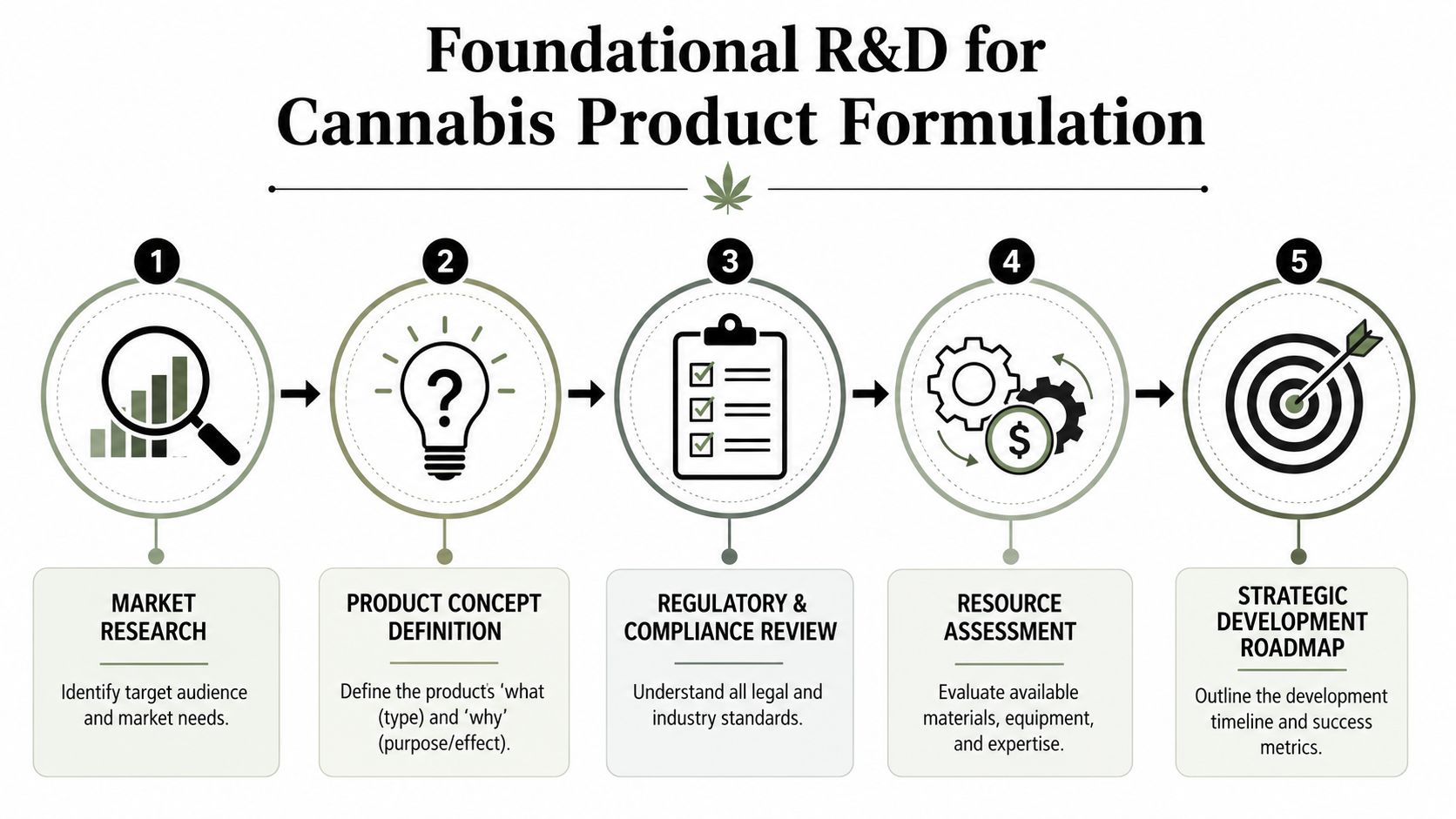
What belongs in the spec
Start with the business reality. Who is this cartridge for, and where will it sit in the lineup?
If the answer is “everyone,” the product is already off track. A serious spec defines the lane. Daytime functional profile. High-aroma premium line. Classic strain-inspired release. Value distillate with controlled flavor intensity. Those are all different products, even if they share the same base oil.
Then define measurable targets rather than soft descriptions.
- Flavor target: Bright citrus opening, herbal heart, peppery finish, or another clearly stated structure tied to the intended profile.
- Viscosity target: Fill behavior, wick behavior, and compatibility with the exact cartridge hardware you plan to use.
- Color and appearance: Acceptable visual range for the finished oil after terpene addition.
- Process constraints: Mixing temperature ceiling, hold time, fill temperature, and packaging window.
- Commercial constraints: Intended shelf position, compliance limitations, and whether the profile needs to be recreated across multiple cannabinoid inputs.
The spec should connect problem to formula
A weak spec reads like a wishlist. A strong one connects every requirement to a reason.
If the profile needs a sharp top note, document why. If you're capping terpene intensity because the cartridge is intended for broad retail appeal, document that too. If the hardware has a narrower intake and runs hotter, the spec must reflect that operating reality before you choose a blend.
That discipline reduces rework. Verified product development data notes that technically rigorous specifications can reduce post-development rework by up to 40% in agile environments in the Product School reference above. In practice, that matters because rework in vape doesn't just cost time. It burns extract, terpenes, packaging, and launch windows.
Bench rule: If two formulators can read the same spec and produce meaningfully different results, the spec isn't finished.
Build the R&D file before the first test batch
Keep the first version simple, but complete enough to guide decisions:
| Spec element | What to document |
|---|---|
| Product concept | What the cartridge is supposed to feel and smell like |
| Target profile | Strain replication, effect-led blend, or house profile |
| Input oil | Distillate type, color, behavior, and known limitations |
| Hardware pairing | Cartridge model, intake style, and expected heating behavior |
| Success criteria | What has to be true for the formula to move forward |
It's tempting to jump straight to mixing because it feels productive. Writing the spec feels slower. It isn't. It saves the batch from becoming your notebook.
Selecting Terpenes for Your Strain-Inspired Blend
Once the spec is set, terpene selection becomes much cleaner. You're no longer asking what smells good. You're asking what belongs in this profile and what role each terpene has to play.
That's the right mindset for any terpene profile for vape cartridges or strain-inspired terpene blend for cannabis product formulation. Think like a perfumer, but formulate like a manufacturer.

Top, mid, and base note roles
A lot of formulation problems come from treating the whole profile as one flat aroma. It isn't. The first inhale, the center of the flavor, and the lingering finish often come from different terpene contributions.
Here's the simplest working model:
- Top notes: Fast, bright, volatile impressions. These create the first hit of citrus, pine, freshness, or lift.
- Mid notes: The center of the profile. These carry the character and keep the blend from feeling thin.
- Base notes: The finish and body. These add depth, anchor the aroma, and keep the profile from tasting hollow.
If your top notes dominate without support, the cart smells exciting in the room but tastes empty in use. If your base notes are too heavy, the profile turns muddy and dulls the opening.
Replication versus interpretation
Not every launch needs exact replication. Some brands need a precise reference point. Others need a recognizable direction with better hardware performance or broader retail appeal.
Use this distinction:
| Approach | Best use case | Common risk |
|---|---|---|
| Exact replication | Legacy profile, strain-specific line, menu consistency | Overcommitting to a profile that doesn't suit the hardware |
| Interpretation | New SKU development, house blends, effect-led lines | Drifting so far that the name and flavor no longer align |
For a terpinolene-forward concept, the structure matters. Verified formulation data notes that in terpinolene-dominant cannabis profiles, the primary compound typically represents 15–40%+ of total terpene content, and terpinolene becomes the unmistakable lead aromatic when it climbs above 30% in the blend, which directly informs terpinolene-dominant strain-inspired terpene formulation.
That kind of ratio matters because terpinolene isn't just a note. At the right level, it defines the identity.
If you're tuning by hand, review a practical guide on how to use terpenes in formulations.
When isolates make sense
Complete blends are efficient when you already know the destination. Isolates are useful when one note is missing or overexpressed.
Use isolates carefully for corrections such as:
- Lifting the opening: Add a brighter component when the formula tastes compressed in hardware.
- Adding body: Reinforce the center or finish when the inhale drops off too quickly.
- Reducing confusion: Remove overlap when too many similar notes make the profile indistinct.
Verified formulation guidance also notes that most professional cannabinoid-terpene blends use between four and eight terpenes depending on the effect target and delivery format, with fewer than three often failing to create differentiated effects and blends above ten becoming harder to control for consistency. See the reference on combining cannabinoids and terpenes in formulation.
The cleanest blend isn't the one with the most ingredients. It's the one where every note has a job.
A Formulation Guide for Vape Cartridges and Distillate
This is the part people rush. Don't.
Formulating for carts is less about creativity than controlled restraint. The oil needs to taste right, fill cleanly, move through the hardware, and remain stable in the package. If any one of those fails, the formula fails.

Start with concentration discipline
The first technical rule is simple. Verified guidance states that terpenes should make up no more than 10% of a finished solution in vape cartridges or distillate formulations, with the carrier oil at 90–99%, and formulators should start with a 1% concentration of terpenes and add more gradually to reach the desired aroma and flavor. See the formulation reference on using terpenes in vape and distillate solutions.
That's one of the most useful rules in this entire workflow because it prevents the common failure mode of overloading a test batch. An over-terped sample can smell impressive in open air and perform badly once heated. It can also mask the actual behavior of the oil.
For day-to-day bench work, keep the workflow tight:
- Warm the distillate only as much as needed for workable flow.
- Add the terpene blend by weight, not by guesswork.
- Mix until the oil is visually uniform.
- Let the sample rest briefly so trapped air can release.
- Test in the exact cartridge hardware intended for launch.
If you need background on finished oil behavior, this resource on cannabis vape liquid formulation is useful context.
Build the terpene blend before the final oil
Separate two calculations in your mind. First, the composition of the terpene blend itself. Second, the percentage of that blend in the finished vape oil.
That distinction matters when you're replicating flavor of Jack Herer for vape cartridges or another known profile. Verified data for Jack Herer replication recommends starting the terpene architecture with 30–40% Terpinolene, 8–14.7% Beta-Caryophyllene, 7% Myrcene, and 5–11% Limonene within the terpene blend itself, before final oil loading. See the reference on Jack Herer terpene blueprint ratios.
So if your finished cartridge oil uses a low initial terpene loading, that doesn't change the internal structure of the blend. It only changes how much of that blend enters the distillate.
Practical rule: Fix the architecture first. Then adjust the loading in the oil.
Test what the cartridge actually delivers
A formula that tastes balanced on a hot plate sample may shift in real hardware. Atomizer temperature, airflow, wick exposure, and intake design all change perception.
Check these points during evaluation:
- Cold aroma in the filled cart: Does the profile match the intended shelf impression?
- First activation: Are the top notes too sharp, too weak, or correct?
- Middle pulls: Does the profile flatten once the coil is warm?
- Late-session behavior: Does the finish stay clean, or does it become heavy and cooked?
You also need to watch physical behavior. If the oil is too thick, the hardware may struggle. If it's too thin, leakage and overfeeding become more likely. Don't compensate for poor material fit by reaching for shortcuts that damage product quality.
A practical walkthrough can help the team stay aligned during trials:
What usually does not work
A few habits create predictable trouble:
- Chasing intensity too early: Loud aroma isn't the same as a complete flavor profile.
- Testing in the wrong hardware: Bench conclusions mean very little if the launch cartridge differs.
- Changing multiple variables at once: If you swap the blend, fill temperature, and hardware together, you won't know what fixed or broke the result.
- Using undesirable cutters: If the formula only works with ingredients you wouldn't want in the final product, the formula needs to be rebuilt.
The cleanest teams keep small retained samples, log exact weights, and document sensory observations immediately. Memory is unreliable. Batch notes aren't.
Ensuring Safety and Compliance in Product Development
The best tasting cartridge in the room is still a bad product if the documentation is incomplete or the compliance work is sloppy.
Too many operators treat safety and compliance as paperwork after the formula is done. That's backwards. In vape, raw material quality, documentation quality, and finished product testing are part of the formula. If you don't trust the inputs, you can't trust the output.
Start with supplier documentation
Every terpene and every non-cannabinoid input should arrive with current supporting records. At minimum, teams should review Certificates of Analysis and Safety Data Sheets, verify the material identity, and confirm that the paperwork matches the actual lot being used.
This isn't just legal hygiene. It protects the sensory work too. If a profile shifts from lot to lot and the records aren't tight, the team can waste days “fixing” a formula that was compromised upstream.
A useful working standard is simple:
- Match lots to paperwork: Don't accept generic documentation detached from the shipped material.
- Review recency and completeness: Old or partial records aren't enough for production decisions.
- Keep internal traceability: Every production batch should map back to its exact terpene and extract lots.
For a practical framework, keep a regulatory compliance checklist for cannabis product development in the release workflow.
Finished product testing protects the brand
Once the oil is formulated, the risk profile changes. You now need evidence that the finished product is what you believe it is.
Third-party testing matters because the final cartridge is the commercial unit, not the raw distillate and not the terpene bottle. The finished oil should be reviewed for the testing categories required in the relevant market, and the resulting records need to align with the product label, packaging, and release file.
A clean ingredient list doesn't replace finished product verification.
Compliance also reaches beyond the oil itself. Packaging, warning language, cartridge materials, transport rules, and state-specific cannabis requirements all affect whether the product is launchable. Teams that wait until the end to review these constraints often discover that a finished SKU can't be sold as packed.
Compliance is part of long-term product viability
There's also a commercial reason to stay strict here. Regulatory drift is hard on brands that operate loosely. If your records are fragmented, your labels are inconsistent, or your release process depends on tribal knowledge, every change in market rules creates more exposure.
The operators who last tend to work the other way around. They build the release system so a batch can be defended on paper, repeated in production, and explained to distributors without scrambling.
That discipline doesn't make the product less creative. It makes it survivable.
Scaling From Formulation to Full-Scale Production
A bench sample and a production run are not the same event. They may share a formula, but they behave differently because the process behaves differently.
At small scale, a formulator can correct by eye, nose, and experience. At production scale, the operation needs controls. The only reliable bridge is documentation backed by quality checkpoints.
Treat the approved sample as the golden batch
Once a trial formula is approved, lock it. That retained sample becomes the reference for future production.
Don't leave the “real” formula spread across a text message, a notebook margin, and someone's memory of how warm the vessel felt that day. The production file should record material lots, exact ratios, mixing order, temperature range, hold times, and any observations that affected the result.
Broader product development discipline offers utility. A projected view of modern methodology for 2026 notes that teams are combining agile speed with data-driven decisions, and that effective user feedback loops should inform every sprint rather than sitting in occasional review cycles. See the reference on modern product development methods and feedback loops. In a vape operation, that translates well. Capture what the production team learns from each run and feed it back into the next revision instead of treating launch as the end of development.
Build QC into the process, not after it
The common mistake is testing only at the end. By then, most of the cost has already been incurred.
A stronger production flow uses checkpoints:
| Stage | What the team checks |
|---|---|
| Incoming extract | Identity, appearance, and expected behavior |
| Incoming terpene blend | Aroma consistency and lot confirmation |
| Mixed bulk oil | Uniformity, visible consistency, and process record match |
| Pre-fill hold | Stability during the short hold before filling |
| Filled carts | Fill quality, leak check, and sensory spot review |
Those checkpoints aren't bureaucratic. They isolate failure faster. If a profile smells wrong before filling, you haven't wasted hardware. If viscosity is drifting before packaging, you can stop the run before cartons are printed and sealed.
Scale changes what small mistakes cost
At bench scale, a minor ratio error wastes a test sample. At production scale, the same error can affect an entire batch and every unit packed from it.
That's why scale-up plans should answer practical questions before the run starts:
- Can the mixing vessel achieve uniform distribution with this oil and this terpene load?
- Does the fill line hold temperature consistently enough for the chosen hardware?
- Can the team reproduce the same sensory profile when the oil sits longer in process?
- Is there a clear decision point for hold, release, or rework?
Production consistency comes from controlled repetition, not from hoping the first successful pilot somehow repeats itself.
Cross-functional work matters here too. Formulation, operations, packaging, and QA all touch the same SKU. If one team changes a component without updating the others, consistency disappears fast.
Building a Brand on Quality and Consistency
A cartridge becomes a brand asset only when the experience repeats. One strong batch doesn't build trust. The second, fifth, and fiftieth matching batch do.
That's why the best practices for product development aren't just operational advice. They're branding infrastructure. Verified product innovation data shows that the best-performing companies achieve an average success rate of 76%, compared with 51% in other companies, underscoring the value of rigorous process discipline. The source is this review of product innovation success rates and development practices.
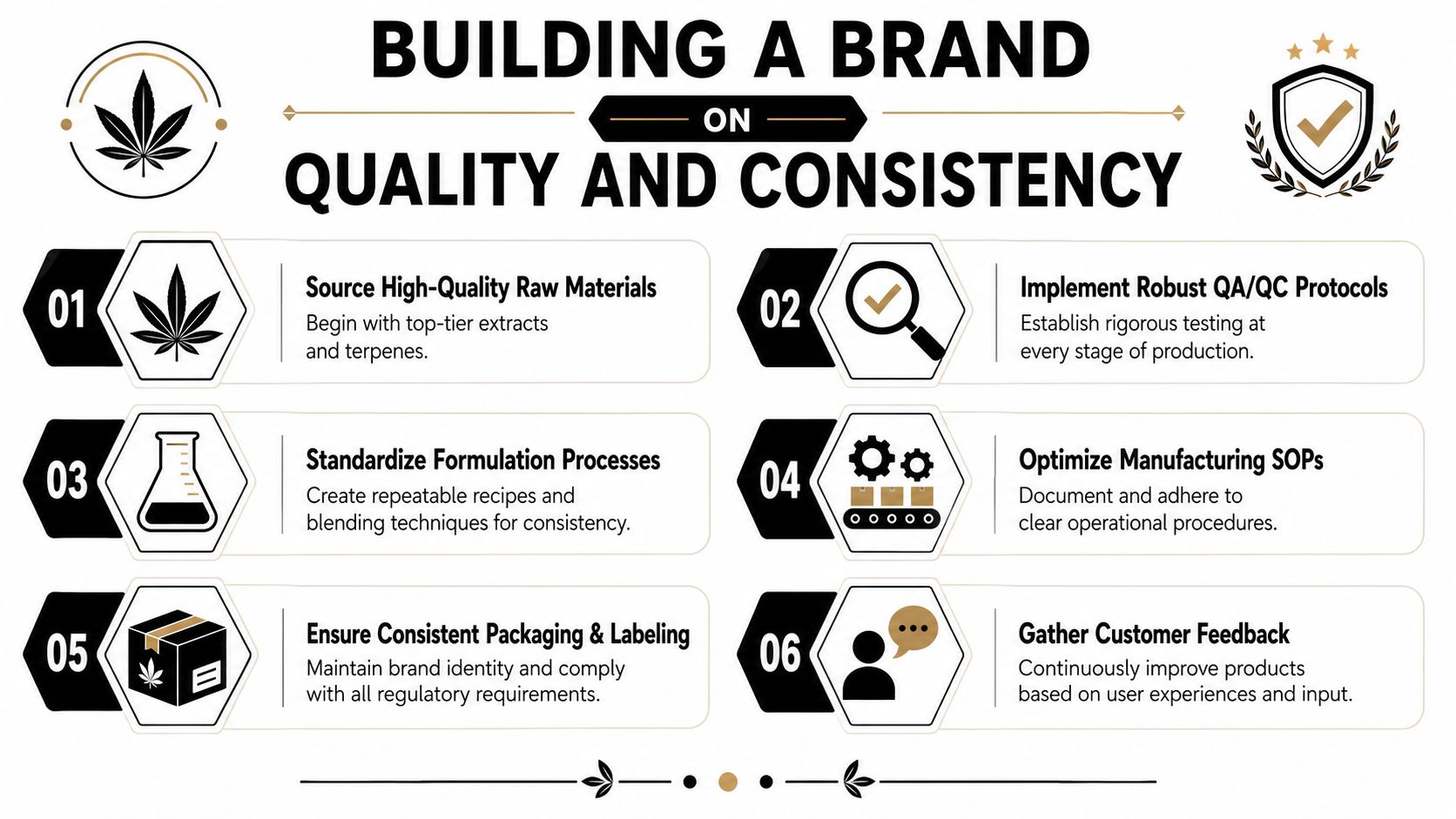
Launch materials should reflect the actual product
Packaging and label copy should match the actual sensory identity of the SKU, not an inflated marketing version of it. If the cart is built around a sharp botanical opening and a dry herbal finish, train sales teams on that structure. If the profile is a deliberate interpretation instead of a lab-faithful replication, say so internally and keep the story consistent.
Short education sheets help a lot. Give retail teams the usable facts: intended profile family, dominant note structure, hardware type, storage guidance, and what makes this SKU distinct in the lineup. Don't leave them to invent the story.
Consistency is what customers remember
People notice when a cartridge they liked last month tastes different today. They may not know whether the cause was blend drift, hardware variance, or poor storage, but they will remember that the brand felt unreliable.
The opposite is also true. When the profile stays stable and the packaging tells the truth, buyers start to trust the line. That trust is hard to win and easy to lose.
The strongest brands don't treat quality as a department. They build it into concepting, formulation, compliance, scale-up, packaging, and release. That's how raw extract turns into a product people reorder.
If you're developing a terpene profile for vape cartridges, need a strain-inspired terpene blend for distillate, or want reliable inputs for cannabis product formulation, Gold Coast Terpenes offers natural terpene blends, isolates, formulation tools, and technical resources built for manufacturers, extractors, and vape brands that care about repeatable flavor accuracy.