
The usual Animal Cookies advice is backwards: find a profile, copy the numbers, call it done. Gold Coast Terpenes, a supplier of 100% botanically derived terpene blends, treats the name as a flavor target to verify rather than a formula to trust. A strain name spans a family of cuts and a range of chemistry. A certificate of analysis pins down one lot, one harvest, one lab.
That gap decides whether a cartridge tastes like the label or the last blend on the bench.
What Terpenes Define the Animal Cookies Profile
Five terpenes carry the profile, and you can specify all five yourself. Gold Coast Terpenes works from 100% natural terpene blends and isolates that are lab-verified, THC-free and SC Lab-tested, so a profile you build is a profile you can measure against a panel.
Limonene brings the citrus lift. Beta-caryophyllene brings peppery, woody base depth. Alpha-humulene adds earthy, hoppy support, myrcene supplies the soft resinous weight that makes the profile read as dessert instead of fruit, and linalool threads a floral line through the middle so the fuel doesn't take over.
Say you're briefing a cartridge client who wants "cookies, but gassy." The dough note is the easy half. Deciding whether the citrus or the spice leads is the hard half, because that call fixes the limonene-to-caryophyllene relationship before anything touches a scale.
How to read the five-terpene map
The table is a starting map, not a formula. Each row pairs a target terpene with the note it plays and the reason it earns a place, and the roles matter more than exact figures at this stage.
Terpene roles in the reported Animal Cookies profile
| Terpene | Formulation role | Note |
|---|---|---|
| Limonene | Top note | Volatile; citrus lift |
| Beta-caryophyllene | Base note | Frequent dominant or co-dominant; peppery depth |
| Alpha-humulene | Mid note | Earthy, hoppy support; in certificate panel |
| Myrcene | Top to mid note | Volatile; leading terpene in some profiles |
| Linalool | Mid note | Floral lift; in certificate panel |
Treat the map as a sensory reference. Commercial records for this name cover several cuts and phenotypes, and a PLOS ONE analysis of roughly 90,000 commercial cannabis samples across six U.S. states found that labels did not consistently align with measured cannabinoid and terpene profiles, with samples sharing a name differing substantially. The name narrows the neighborhood. Your certificate names the house.
Three moves before you weigh anything:
- List the five targets by name. Limonene, beta-caryophyllene, alpha-humulene, myrcene and linalool, written into the development brief so nobody works from memory.
- Rank the two drivers. Limonene and beta-caryophyllene carry the first impression and the base, so fix their relationship first and treat the other three as balance.
- Mark the gaps. Any target with no measured value on your current panel stays a placeholder until you pull a fresh certificate for the lot you'll use.
What Lineage and Potency Figures Can and Cannot Tell You
A GSC x Fire OG cross predicts a flavor direction. It does not certify one. Animal Cookies is most often described as a Girl Scout Cookies and Fire OG hybrid, and Green Point Seeds lineage notes record that cross while noting that some commercial pedigrees render it as GSC x Fire OG Bx3, where Bx3 means the line was backcrossed three times toward Fire OG.
The parentage explains the aroma split. GSC contributes the sweet, dough-like cookie note, and Fire OG contributes the sharper fuel and citrus edge. If you're building the dough half deliberately, the Girl Scout Cookies terpene profile is the comparison reference for that sweet side of the blend.
Lineage records from the pre-legalization period were informal, and multiple cuts and phenotypes have circulated under the Animal Cookies name ever since. The label has never guaranteed a single genetically uniform cultivar. What it gives a formulator is a starting hypothesis about which terpene families to expect, and each lot still has to be measured on its own.
What the potency ranges are actually worth
A Quality Roots strain reference lists a typical 20% to 27% THC range and describes the cultivar as roughly 60% indica and 40% sativa, while a second commercial catalog gives a narrower 22% to 27% window. Both figures are market-positioning benchmarks. Potency shifts with phenotype, cultivation, harvest timing, curing, storage and testing method, so a printed range describes where samples have landed and nothing tighter.
Award history travels even less well. A GSC cutting associated with BC Bud Depot was reported as winning the hybrid category at the 2013 High Times Medical Cannabis Cup in Los Angeles, a milestone for the parent line. No Animal Cookies phenotype inherits chemistry from a trophy.
An independent compilation of reported strain chemistry lists an Oregon laboratory result of 26.04% total THC with about 0.05% CBD, and identifies beta-caryophyllene as a frequent dominant or co-dominant terpene, commonly accompanied by limonene and humulene. Useful as a single-sample sanity check, and no more than that.
The document that earns a place in your batch record is a current certificate. A laboratory certificate for an Animal Cookies flower sample reports 26.041% total THC, 29.420% THCA and 0.239% Delta-9 THC, with limonene measured at 0.67% and CBD below major-constituent levels.
Those lines aren't interchangeable. Multiply 29.420% THCA by the 0.877 conversion factor, add 0.239% Delta-9, and you land on the 26.041% total the certificate states. Decarboxylation state, harvest conditions, phenotype and processing all move the numbers, which is exactly why a flower percentage can't be lifted into a cartridge specification.
Reported THC and terpene benchmarks by source
| Source | THC reported | Terpene detail | Use in formulation |
|---|---|---|---|
| Strain reference | 20%-27% THC | No terpene panel published | Market benchmark only |
| Commercial catalog | 22%-27% THC | No terpene panel published | Market positioning only |
| Oregon laboratory result | 26.04% total THC; about 0.05% CBD | Beta-caryophyllene named as frequent dominant or co-dominant, with limonene and humulene | Single-sample check |
| Certificate of analysis sample | 26.041% total THC; 29.420% THCA; 0.239% Delta-9 THC | Limonene 0.67% | Batch-level reference |
Specification rule: a name plus a number is a description. A name plus a target range and an acceptable tolerance is a specification.
The three-item checklist for a compliant label
- Documented lineage. State GSC x Fire OG (or the Bx3 rendering) as reported history, without implying the cross guarantees chemistry.
- Phenotype or cut name. One word here saves a customer argument later, because two Animal Cookies cuts can read very differently on a panel.
- Batch certificate of analysis. Lot number, cannabinoid totals broken out by THCA and Delta-9, terpene panel, and the test date.
Why Top, Mid and Base Notes Matter in a Blend
Top, mid and base notes exist because terpenes leave the cartridge and reach the user at different rates. A blend that smells correct in the bottle can taste hollow halfway through a cart if the volatile fraction has already moved off.
Here's the picture to hold in mind while you're weighing.
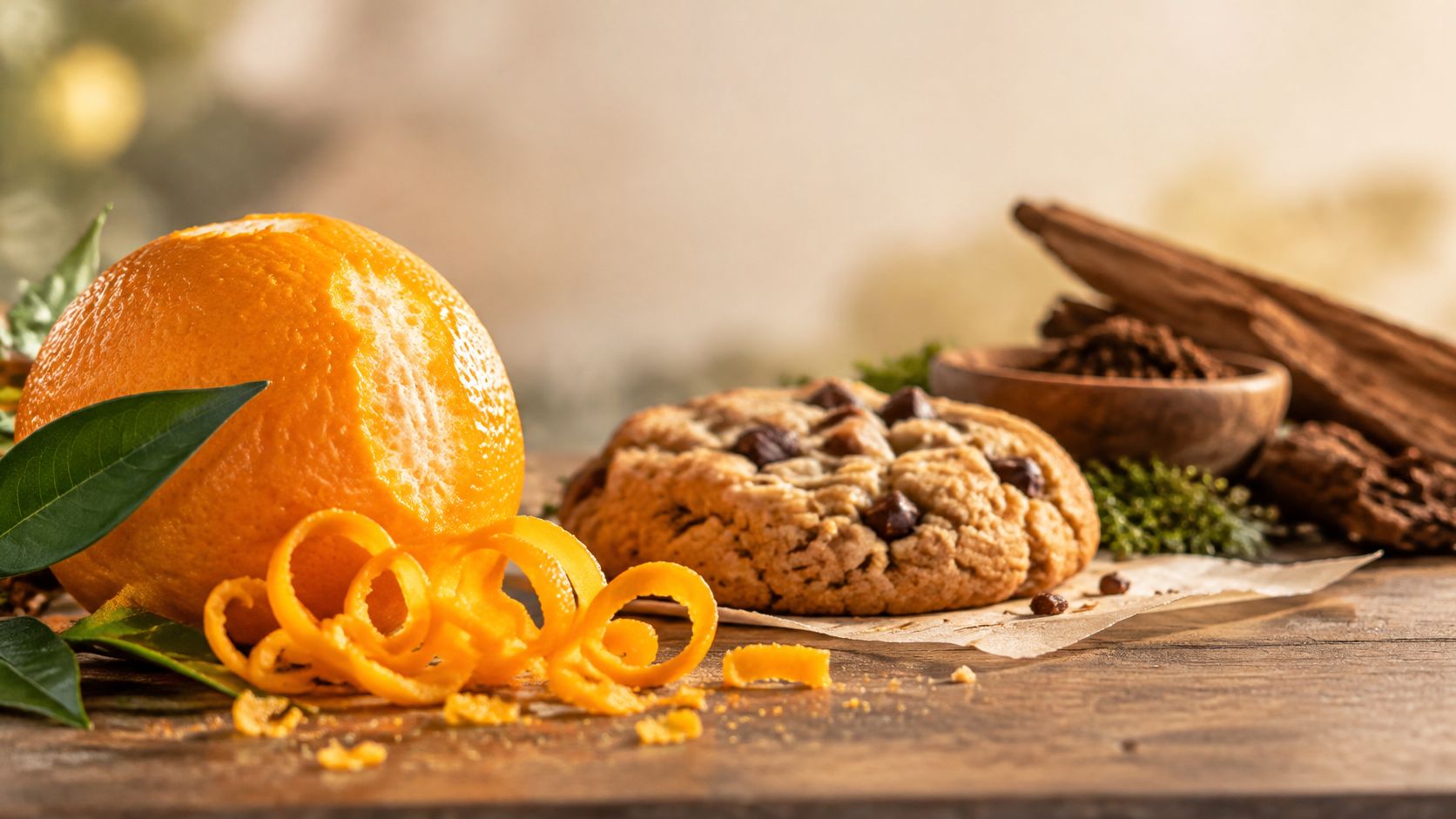
Think of a bakery counter. Citrus zest reaches you first, sweet dough sits in the middle, and the spice stays on the palate after you swallow. An Animal Cookies-inspired blend reads the same way. Limonene and myrcene are the zest, humulene and linalool carry the body, and beta-caryophyllene holds the spice at the end.
What volatility does inside a cartridge
A peer-reviewed review of terpene behavior in cannabis products reports that monoterpenes evaporate first, that terpenes are inhaled before cannabinoids during vaping, and that beta-myrcene's vapor pressure at ambient temperature is approximately 80 times higher than beta-caryophyllene's. The same review notes volatile-terpene losses of 70 to 95 percent under a cited low-temperature method.
The formulation consequence is direct. Limonene and myrcene need a deliberate anchor, because they're the fractions most likely to shift during storage and draw-off, while caryophyllene gives you a comparatively persistent spicy base.
If you want a faster read on which terpenes sit in which band before you start weighing, the terpene flavor chart maps aroma families against roles.
Flavor choice also changes what gets inhaled. California-sponsored research examined how terpenes can affect aerosol emissions from cannabis distillate, indicating that terpene selection and concentration may influence the aerosol itself rather than only the taste. A richer dessert or fuel note is a formulation change, not a cosmetic one.
Stability rule: test the aged sample, not the fresh one. When the aged blend drifts, restore the top-note share before you touch the base.
Run the comparison as a proper test: initial ratios, ratios after accelerated aging, and ratios from a partially used cartridge. If limonene has fallen away from caryophyllene, you have a volatility problem you can fix with a ratio adjustment, not a sourcing problem.
How Botanical and Cannabis-Derived Terpenes Compare
Source type decides labeling, compliance and the claims a brand can put on a package. Three source types reach a vape line: botanical terpenes isolated from plants other than cannabis, cannabis-derived terpenes, and nature-identical compounds synthesized to match a natural molecule.
Gold Coast Terpenes supplies 100% natural, botanically derived, THC-free blends rather than cannabis-derived material, and the labels name the terpene source instead of implying a cannabis effect. That distinction matters commercially, because a flavor claim and an effect claim live under different rules.
Botanically derived material needs a documented origin statement plus a certificate covering identity and residuals. Cannabis-derived material changes the regulatory category entirely and may carry THC, so confirm the rules in every market before you print anything. Nature-identical compounds need an origin statement and a compound identity check, since "matches a natural terpene" isn't the same as "isolated from a plant."
Where the three source types differ on a label
The table below is the comparison to run before you approve artwork.
Botanical, cannabis-derived and nature-identical terpenes compared
| Source type | Typical label | Cannabis-derived | Check before use |
|---|---|---|---|
| Botanical terpenes | Botanically derived | No | Confirm origin statement, residual solvent and certificate |
| Cannabis-derived terpenes | Cannabis-derived | Yes | Confirm THC content, regulatory category and certificate |
| Nature-identical terpenes | Nature-identical | No | Confirm the origin statement and compound identity |
A brand that wants to sell into multiple states and into hemp channels usually lands on botanically derived material for the simple reason that the paperwork travels. A brand building a single-state cannabis story may choose otherwise, and then owns the extra documentation.
The three-question label check
- What is the source? Written origin statement, not a marketing phrase on a spec sheet.
- What is the THC status? A written THC-free confirmation if that's the claim on the pack, plus the test that supports it.
- Which certificate supports the claim? Lot-matched, dated, and available on request to a distributor.
The fuller breakdown of how the two families differ in practice sits in this comparison of cannabis-derived versus botanically derived terpenes, and it's worth reading before a label review rather than after one.
How to Build and Verify a Strain-Inspired Terpene Blend
Build the blend from the sensory target outward, then verify it against the lot certificate before you commit to a volume order. That order of operations is the whole method, and skipping the second half is how a promising development batch turns into an expensive inventory problem.
- Write three target descriptors and rank them. Sweet dough, citrus, fuel. Mark which one must lead, because every ratio decision later resolves against that ranking. The common slip is three descriptors that all mean "sweet," which leaves you no tiebreak when a trial batch reads flat.
- Set the lead top note first. Limonene usually takes that slot in this profile. Volatile top notes create the first impression and leave fastest, so they need the most deliberate anchor in the formula.
- Add beta-caryophyllene as the persistent base layer. It sits underneath the citrus and gives the blend somewhere to land. Load it too early and too heavy and the cart reads peppery at the halfway point.
- Use alpha-humulene and linalool in support roles. Small amounts, matched to the certificate panel you're working from, not enough to dominate. Humulene can turn hoppy fast, and linalool turns soapy faster.
- Weigh on a calibrated scale and log every addition on a batch sheet. Note the order of addition, the temperature and the mix time. The most common failure here is adding top notes last into a warm mix, which drives off the fraction you just paid for.
- Blend a small development batch in the intended carrier. A blend that reads clean in a beaker can flatten in a viscous distillate or shift character in a 510 cartridge. Test in the matrix you'll ship.
- Run the stability test from the volatility work. Initial ratio, aged ratio, post-use ratio. Compare all three before you declare the blend finished.
- Adjust in small steps and retest. Change one variable per round. Two simultaneous changes give you a result you can't attribute.
Every ingredient Gold Coast Terpenes ships is lab tested, and the catalog lets you choose isolates or a full profile depending on how much of the ratio you want to control yourself. Starting with a single isolate such as limonene and adding a second component is often faster than debugging a finished blend you didn't build.
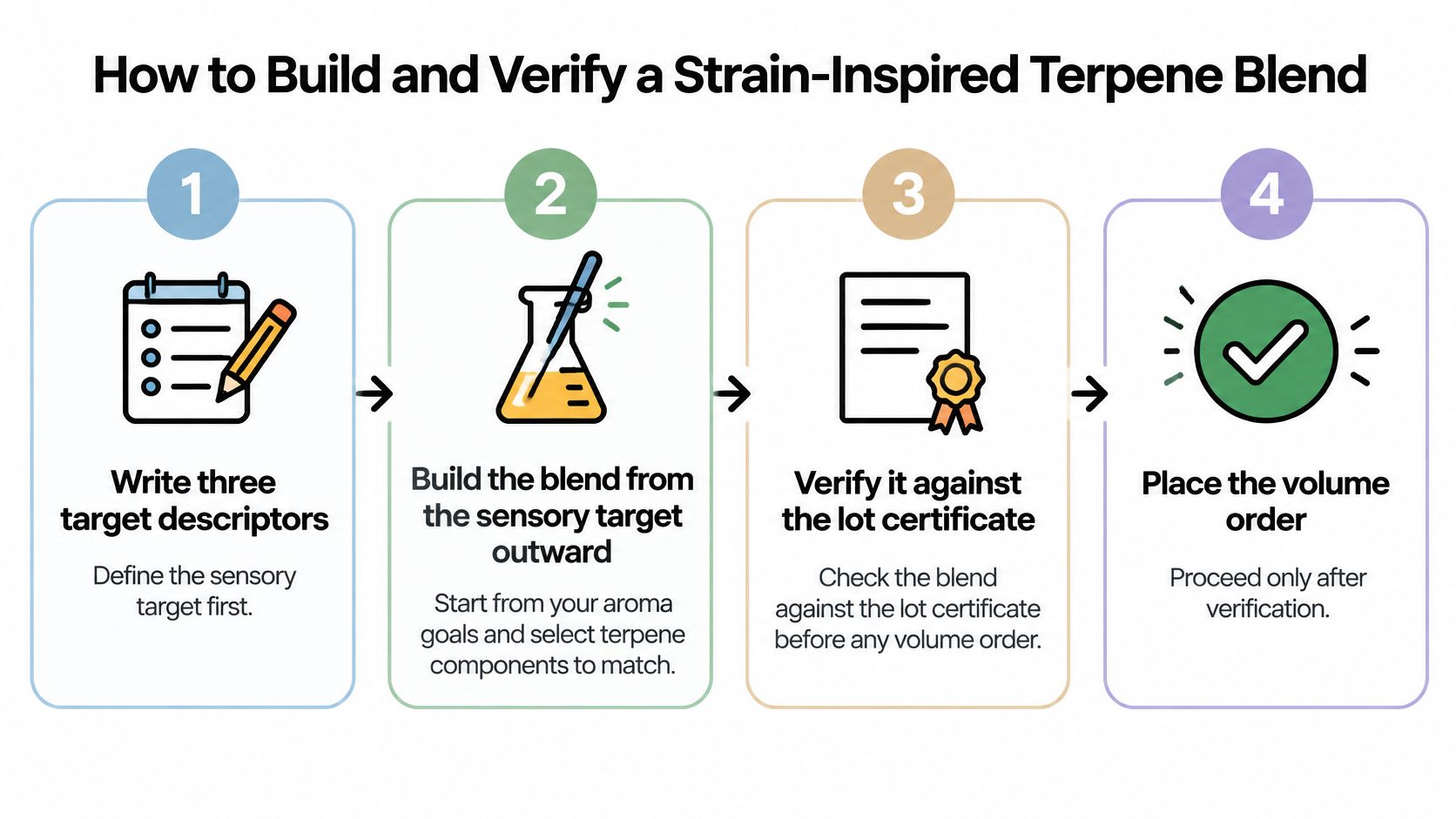
Development rule: one variable per round, and no scale-up on a blend that hasn't survived an aged test.
Before you order volume, pull the Gold Coast Terpenes certificate for the specific lot, compare its terpene panel line by line with your target, and confirm order terms, including the wholesale pricing that applies to strain orders totaling over 64oz. That conversation belongs after the blend is locked, because the cost per unit means nothing until the formula is fixed.
The blend is ready when the aged sample still reads as the target on all three descriptors. Not when the fresh sample does.
How to Choose a Terpene Supplier for a Vape Line
A long catalog is weak evidence. Judge a supplier by documentation, repeatable lots, and clear answers before payment, because an Animal Cookies target is a flavor specification that has to be verified batch by batch, not a name that guarantees chemistry.
Gold Coast Terpenes fits that model when the paperwork supports it: the materials are described as 100% botanically derived, THC-free, lab tested, and free of VG, PG, PEG and MCT, which keeps vape-line claims tied to aroma, flavor and composition.
What to put in the supplier request
Send one email and ask for documents, not assurances. The speed and completeness of the reply are part of the audit.
Supplier criteria for a vape terpene order
| Criterion | What to request | Why it matters |
|---|---|---|
| Source statement | Written botanical or cannabis-derived origin | Sets labeling and regulatory category |
| Batch certificate | Terpene panel for each lot | Allows comparison of each lot to your target |
| THC status | Written THC-free confirmation | Determines marketing claims and compliance |
| Lab testing | Confirmation that ingredients are lab tested | Supports repeatable flavor matching |
| Isolates and profiles | Isolates such as limonene and myrcene, plus profile options | Lets you start with one isolate and add a second |
| Order terms | Minimums, bulk ordering and wholesale thresholds | Sets cost once the blend is scaled |
Isolates deserve their own line because they change how a team debugs. Testing limonene alone tells you whether a harsh note comes from the citrus fraction or from the carrier, which a finished blend will never reveal.
For a broader survey of suppliers and formats, this guide to where to buy terpenes covers the categories worth comparing. Choose suppliers that can promptly provide lot-level documentation and precise pre-order answers; vague replies become expensive once a formula is locked.
Animal Cookies Terpene Questions Answered
Can a THC-free blend reproduce the psychoactive effects of cannabis?
No. Gold Coast Terpenes THC-free blends are built to match aroma and flavor, so claims should stay on sensory traits such as citrus lift, dough sweetness and fuel depth. Treat any product description that promises an effect from a terpene blend alone as a compliance risk.
What minimum order quantities apply?
Confirm the current MOQ directly with Gold Coast Terpenes before you plan a production run, since wholesale pricing applies to strain orders totaling over 64oz. Lock the formula first, then size the order against your fill schedule. If the blend is still moving week to week, a smaller run keeps you from aging inventory around an unset ratio.
Which resources help with ratio checks?
Terpenes 101 covers the role basics, the Mixing Calculator handles ratio math, and the state information page gives regulatory context by market. Use the calculator on every ratio revision and keep the output with the batch sheet. A saved calculator output plus the lot certificate gives you a cleaner record than a spreadsheet rebuilt from memory.
Is there a catalog product named Animal Cookies?
Check the current strain list before you write the spec. The catalog covers 50+ Indica, Sativa and Hybrid profiles and adds new terpene strains each month, but a name is not a chemical specification. If Animal Cookies is listed, verify each lot against its certificate. If it is not, build the target from available profiles and the confirmed isolates limonene, myrcene and beta-caryophyllene, then verify the result the same way.
A strain-inspired blend is only as good as the documentation behind it, and Gold Coast Terpenes supplies 100% natural, THC-free, SC Lab-tested material that lets you build the Animal Cookies target from limonene, myrcene and beta-caryophyllene or from a close profile, then prove it against a lot certificate. Start with an isolate or a profile, run the aged test, and scale only when the numbers hold. Visit Gold Coast Terpenes to compare profiles, isolates and bulk terms for your next cartridge run.