
Legal-market vape-cartridge sales in the United States and Canada increased from approximately $1.0 billion in 2018 to $2.8 billion in 2022, according to Headset figures reported by MJBizDaily. Gold Coast Terpenes supplies botanically derived terpenes for adding distinct flavor to winterized distillate oils, but the formulation decision extends beyond what goes into the mixing vessel. A commercially repeatable cartridge needs a market-compliant blend, compatible hardware, and release evidence from the filled, heated device.
How Does a Distillate Cartridge Differ from Live Resin and Liquid Diamonds?
Gold Coast Terpenes' botanical approach gives formulators control over the flavor added to a refined cannabinoid base. Distillate cartridges use that added profile, while live resin targets retained fresh-plant character and liquid-diamond formulations require scrutiny of the actual cannabinoid and terpene preparation.
The commercial reason to understand these differences is substantial: distillate accounted for 56.7% of United States vapor-pen sales in 2025, according to Headset. That figure describes the extract category, not a guarantee that every device carrying it performs alike.
Cartridge formats compared for formulation
| Format | Terpene source | Viscosity | Formulation role |
|---|---|---|---|
| Distillate cartridge | Most native terpenes removed during refining; selected terpenes added afterward | High in the unblended base; adjusted through terpene loading and temperature | Controlled base for a strain-inspired blend |
| Live resin cartridge | Native terpenes retained from fresh-frozen plant material | Extract composition and processing determine flow | Benchmark for a native fresh-plant profile |
| Liquid diamonds | Terpene carrier combined with processed crystalline cannabinoids | Carrier composition and cannabinoid preparation determine flow | Flavor set by the carrier terpene blend |
Read the formulation, not just the format name
Distillate provides a relatively neutral starting point. The formulator defines the flavor specification rather than accepting the aromatic balance of a particular extraction lot.
Live resin reverses that priority. The incoming extract's native profile is part of the product identity, so processing and hardware should preserve that character rather than overwrite it.
Liquid diamonds isn't a complete manufacturing specification. Confirm whether the incoming material contains residual crystals, dissolved cannabinoids, or decarboxylated oil, then establish its behavior under storage and operating conditions. A marketing name doesn't establish wick compatibility.
Decision rule: Choose distillate when controlled, repeatable flavor is the target. Choose live resin when retaining a particular fresh-plant profile is the product's defining requirement.
For strain replication, write the reference clearly: are you matching flower aroma, an extracted resin, or the flavor of a finished cartridge? Those are different targets, and a supplier can't resolve an undefined reference by changing the strain name on a bottle.
Why Are Distillate Cartridges Shifting to 2 mL Disposables?
Purchasing is shifting toward larger integrated devices, so the standard threaded cartridge shouldn't remain the automatic development platform. The evidence supports format migration, not a simple conclusion that buyers are abandoning distillate.
Between mid-2025 and mid-2026, point-of-sale analysis reported 500 mg distillate cartridges down 36.4%, 1,000 mg distillate cartridges down 10.9%, and 2 mL distillate disposables up 34.6%, according to Cannabis & Tech Today. A brand can therefore lose cartridge sales while buyers continue choosing the same extract in another delivery system.
Separate purchasing preferences from engineering requirements
A Canadian discrete-choice study published in 2023 surveyed 384 cannabis consumers, found price and THC potency were the most important attributes overall, and identified a regulation-oriented group of approximately 40% willing to pay $56 more for a regulated product, as reported in the peer-reviewed study. These are study-specific preferences, not universal buyer segments, but they show why hardware, cost, and documented compliance belong in product development.
For each SKU, define:
- Delivery platform: Identify the reservoir, heating element, airflow, and available power settings.
- Service life: Evaluate flavor and flow near the beginning, middle, and end of reservoir use.
- Commercial constraint: Set the cost and release-testing requirements before narrowing candidate blends.
Gold Coast Terpenes' fresh-plant sourcing establishes ingredient origin, not a performance claim for a particular disposable. Put supplier samples through the intended platform rather than treating a successful threaded-cartridge trial as transferable evidence.
The useful development unit is one formulation in one qualified hardware configuration. Changing either creates a validation task.
What Are the Top, Mid and Base Terpene Layers in a Cart Blend?
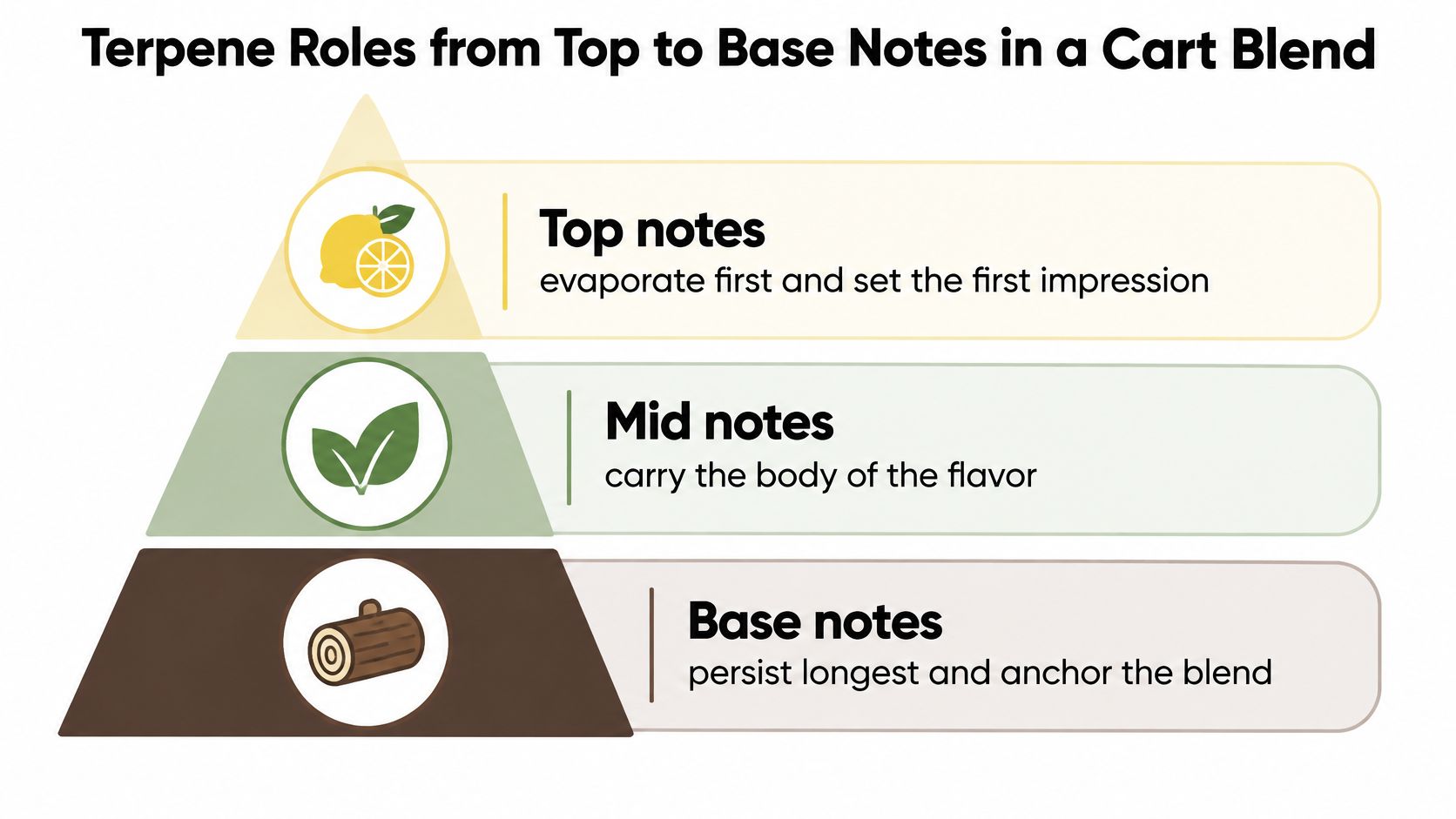
Top notes establish the first impression, mid notes provide flavor body, and base notes anchor the finish. Use these as sensory formulation layers, not rigid boiling-point categories or promises about aerosol behavior.
Gold Coast Terpenes' botanical sourcing gives developers an origin framework for terpene selection. The compounds below are working examples for organizing a target, not a claim that each molecule occupies only one sensory layer.
Terpene note layers and their formulation role
| Note layer | Evaporation behavior | Example compounds | Formulation job |
|---|---|---|---|
| Top notes | Tend to present early and change readily during handling and heating | Limonene, terpinolene, ocimene | Establish the first impression |
| Mid notes | Contribute body through the draw; presentation is matrix-dependent | Linalool, myrcene, alpha-pinene | Shape the strain-inspired character |
| Base notes | Tend to contribute a more persistent finish | Beta-caryophyllene, humulene, bisabolol | Anchor the blend and support continuity |
This pyramid is a practical way to describe the intended balance before bench mixing.
Build a sensory specification before choosing a loading rate
Start with the finish you want to retain, add the middle character, then set the intensity of the opening notes. This is a design sequence; the eventual physical mixing sequence also needs its own validated procedure.
A blend can contain the expected compounds and still miss the target. Excessive opening intensity can obscure the middle, while an underdeveloped finish can make the profile seem incomplete once the initial aroma subsides.
Use the terpene flavor chart to translate broad descriptions into a more useful specification. Replace “more strain-like” with a defined adjustment such as a brighter citrus opening, a clearer herbal middle, or a more persistent woody finish.
Keep the target profile separate from the total loading rate. Changing flavor balance and total terpene concentration together makes the result harder to interpret.
For one target strain-inspired terpene blend, document each layer's intended contribution, acceptable sensory boundaries, and reference material. Evaluate that specification in the finished device, because bottle aroma alone doesn't establish cartridge flavor accuracy.
What Terpene Ceiling Does Each Market Set for a Cartridge?
Set the market constraint before designing the blend. For New York inhaled products, total terpenes must not exceed 10% by volume, synthetic terpenes are prohibited, and botanical source records are required under the New York requirements for flavored vaporized or inhaled cannabis products.
That ceiling isn't a recommended loading rate. It also doesn't replace requirements concerning ingredient eligibility, labeling, testing, or device performance.
Terpene requirements by market and rule
| Market or rule | Requirement | What to do in formulation |
|---|---|---|
| New York flavored inhaled products | Total-terpene volume ceiling and prohibition on synthetic terpenes | Leave a documented margin below the ceiling and retain source records |
| Minnesota terpene quantity claim | Measured concentration must satisfy the label tolerance | Verify the filled cartridge against the claim before release |
| Canada composition guidance | Cannabinoids and terpenes uniformly distributed throughout the extract | Control mixing, addition sequence, and sampling locations |
| Washington State flavor-label research brief | Natural, artificial, botanical, and synthetic terminology lacks uniform legal definitions | Document component origin and check binding rules in each destination market |
Different rules control different failure modes
Health Canada's composition guidance requires cannabinoids and terpenes to be uniformly distributed throughout a cannabis extract. A passing average doesn't resolve an inadequately mixed batch if different fill positions receive different compositions.
The Washington State regulatory research brief identifies inconsistent definitions around flavor-origin terminology. It isn't a universal permission to use anything labeled natural.
For botanical versus cannabis-derived terpenes, record the actual source. For nature-identical labeling, establish whether the ingredient was synthesized rather than assuming that molecular similarity satisfies an origin restriction.
The application guidance on spray-on terpenes concerns a different use context; don't transfer an application method into an inhaled-oil specification without validating it.
Compliance check: A shared formula must satisfy the compatible requirements of every destination market. If ingredient or labeling rules conflict, create separate SKUs.
Confirm the current rules before printing labels. Ingredient documentation, concentration compliance, and demonstrated finished-device performance are separate release requirements.
How Do I Build a Strain-Inspired Terpene Blend for Distillate?
Begin with a defined sensory target and a controlled loading experiment, not a random combination of isolates. Treat the loading ratio as an engineering variable that must satisfy both the market rules and the intended hardware.
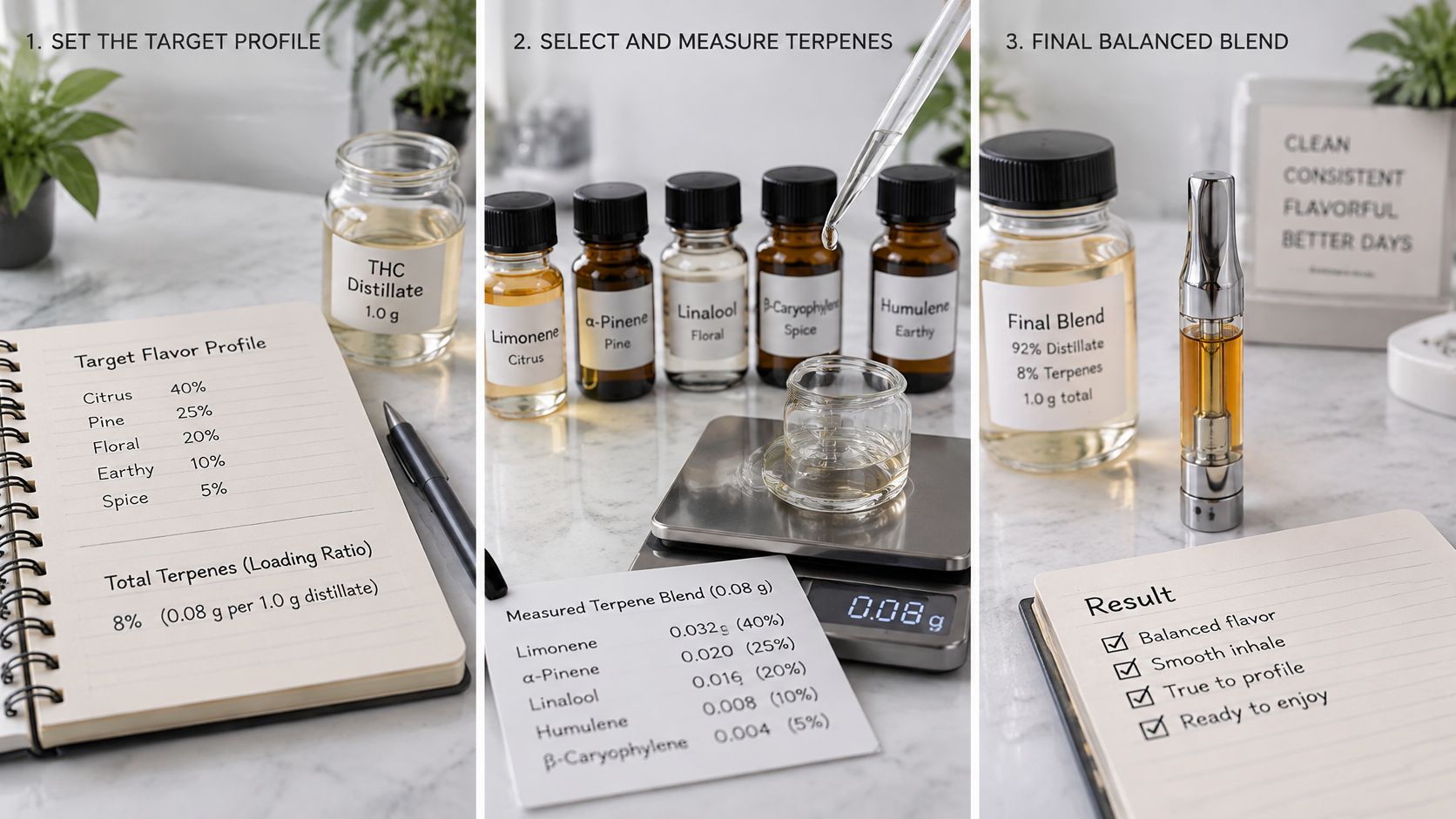
Use the blending diagram as a workflow aid, not as a substitute for a batch record.
Establish the target and the measurement basis
Write the layer specification. Assign a proposed proportion of the terpene blend to the top, middle, and base layers, then identify the individual components within each. Keep those proportions separate from the terpene percentage in the finished oil.
Choose a viscosity benchmark, not a commercial recipe. A peer-reviewed cannabis-vaping study used a 9:1 THC-to-terpene ratio that produced material neither excessively viscous nor excessively fluid, while higher terpene ratios could cause excessive fluidity and leakage. That finding doesn't establish a universal distillate formulation, a safe inhalation concentration, or compatibility with your device.
Check the market ceiling before mixing. Confirm whether the applicable limit uses volume or mass, and account for terpenes already present in the base. A ratio involving THC isn't automatically equivalent to a ratio involving commercial distillate, which contains other constituents.
Control the process, then evaluate the result
Warm the distillate using a controlled vessel and calibrated temperature probe, using only enough heat to achieve workable mixing. Add the base, middle, and top components in a documented sequence, keeping exposure of volatile components to unnecessary heat as short as practical.
Fix the mixing conditions. Record vessel geometry, impeller position, agitation, addition order, and mixing duration, then collect samples from the top, middle, and bottom. Visual clarity isn't a substitute for analytical agreement across sampling locations.
Compare analytical composition and finished-device sensory results with the target. Adjust one layer at a time, retain a control sample, and repeat the same hardware and operating conditions so the comparison remains interpretable.
The embedded video can accompany the practical workflow; the written specification and laboratory results remain the release references.
Cannabinoids and terpenes can react during heating and aerosolization, so an accurate initial blend doesn't guarantee stable delivered flavor. Record early-, middle-, and late-reservoir observations alongside analytical results rather than approving the formulation from the first draw.
Suggested development gate: Require the target layer balance and analytical specification to hold across three consecutive pilot batches. That's an internal reproducibility criterion, not a regulatory standard, and it doesn't replace finished-cartridge testing.
How Do I Qualify Hardware and Release a Filled Cartridge?
Qualify and release the filled device, not just the incoming oil. The reservoir, coil, solder, and seals can contact the formulation, while the battery and power profile determine how the assembly heats it.
A peer-reviewed cartridge-metals publication describes findings of chromium, copper, nickel, and smaller amounts of lead, manganese, and tin migrating into oil and aerosol, and Canadian findings in which cobalt, nickel, and zinc contributed substantially to product variability. These findings make hardware qualification a contamination-control task, not merely a check for leakage.
Diagnose symptoms without treating them as proof
Use the cartridge-selection guidance to frame compatibility questions, then investigate each failure in the actual assembly.
- Leakage with thin oil: Evaluate lower terpene loading, seal compatibility, fill conditions, and hardware tolerances. Don't assume every leak is a viscosity problem.
- Clogging with thick oil: Check wick supply, airflow, condensation, and operating temperature before changing the ratio.
- Metallic taste: Quarantine the affected lot and investigate hardware and aerosol chemistry. Taste can't identify or exclude metal contamination.
- Rapid flavor fade: Compare power delivery and late-reservoir performance before increasing persistent notes. Adding base notes won't correct an overheating device.
A formulation adjustment that stops a visible symptom still needs analytical confirmation. For example, changing a seal may resolve leakage while introducing a new compatibility question.
Run a documented release sequence
Minnesota's cannabis technical guidance requires evaluation after cartridge filling because components can leach metals, requires terpene testing when terpenes are added or claimed, and sets a terpene quantity-claim tolerance of ±15% of the stated value. The tolerance concerns agreement with a claim, not permission to exceed a composition ceiling.
- Identify the inputs. Fill the qualification batch from a documented oil lot and terpene lot, retaining the associated ingredient records.
- Record the hardware lot with the formulation record, including the approved component configuration and power settings.
- Test representative filled cartridges for metals. Use the destination market's required method, sampling plan, and limits.
- Measure terpene concentration and verify the label using the applicable tolerance and reporting units.
- Run a documented stability protocol and leak checks, including relevant storage orientations and conditions.
- Evaluate aerosol under representative puff conditions. Perform required emissions testing and retain the operating settings with the results.
- Confirm that retained top, middle, and bottom blend samples satisfy the predefined uniformity specification.
- Release only after authorized review confirms that all applicable analytical, physical, labeling, and traceability checks pass.
Accelerated stability is useful for identifying weaknesses, but it shouldn't be treated as automatic proof of shelf life. Continue real-time stability work under the intended storage conditions.
Pass-fail release sheet for a filled cartridge batch
| Check | Pass limit | Record to keep |
|---|---|---|
| Terpene concentration | Within applicable label tolerance and composition ceiling | Measured value, units, method, and claim |
| Metals in filled unit | Below the target market's limits | Laboratory report linked to hardware lot |
| Leak and accelerated stability | No leakage; profile remains within written specification | Conditions, dates, observations, and results |
| Batch uniformity | Sampling locations agree within predefined analytical tolerances | Sample positions and results |
| Lot traceability | Every unit links to documented inputs | Oil, terpene, and hardware lot numbers |
| Aerosol metals under puff conditions | Meets applicable market requirements | Puff settings, device configuration, and results |
A clean ingredient list doesn't establish a safe inhaled product. Release evidence must address what the assembled device stores, heats, and delivers.
Which Terpene Supplier Should I Choose for a Distillate Line?
A supplier qualifies on paper long before it qualifies in hardware. The profiles you shortlist only matter if the vendor can document identity, origin, and batch traceability for the exact material you intend to buy.
Gold Coast Terpenes offers 50+ classic and contemporary strain profiles, alongside isolates for targeted adjustments. Its terpenes for cartridges are SC Lab-tested, extracted from fresh plants, and free from additives, VG, PG, PEG, and MCT. Treat those credentials as entry requirements. The filled, heated device still has to pass your own release testing, whether it ships as a 510 cartridge or a 2 mL disposable.
Compare suppliers against the same purchasing specification
- Batch documentation: Require the applicable certificate of analysis, identity information, and traceable lot identification.
- Origin: Establish whether each component is botanical, cannabis-derived, or synthetic.
- Composition: Confirm the complete ingredient declaration, including carriers and additives.
- Concentration: Highly concentrated profiles need proper dilution before use, so confirm the supplier states handling guidance and offers compatible diluents.
- Flavor coverage: Match the candidate to a written top, middle, and base specification.
- Commercial fit: Confirm sample availability, minimum order quantity, bulk pack sizes, and change-notification terms before approving supply.
The guide to choosing where to buy terpenes is a purchasing starting point for evaluating the available profiles. Sample before you commit volume.
Gold Coast Terpenes' 3ml Strain Picker Pack lets customers select any three different catalog profiles in 1.5ml or 3ml sizes, with listed use cases covering terpene testing, custom vape formulation, and comparing Indica versus Sativa effects. Load each candidate into the same hardware and apply the same release criteria, so the comparison reflects device performance rather than bottle aroma.
Keep the procurement decision separate from flavor preference. A profile that matches the target still needs a workable supply specification and a qualified manufacturing process.
Common Questions About Distillate Cartridges
Will a blend built for a 510 cartridge perform the same in a 2 mL disposable?
Don’t assume that it will. Different coil geometry, power delivery, and reservoir residence time require a new compatibility trial that includes beginning-, middle-, and end-of-reservoir performance.
What’s the difference between botanical and cannabis-derived terpenes?
The distinction identifies the plant source: cannabis-derived terpenes come from cannabis, while botanical commonly describes terpenes sourced from other plants. Gold Coast Terpenes extracts its terpenes from fresh plants; document the specific origin needed for your destination market rather than relying on a broad natural label.
What should a manufacturer test beyond potency and terpene identity?
Use the filled-cartridge qualification and release procedure for incoming documentation, lot traceability, hardware compatibility, stability, leakage, and applicable finished-vapor testing.
Why use the study’s THC-to-terpene ratio as a starting point?
Use the viscosity-benchmark discussion in the formulation procedure to design a controlled trial, not to adopt a universal commercial recipe.
Does a natural flavor label prove inhalation safety?
No, use the market-ceiling and ingredient-origin checks to establish eligibility, then qualify the filled device rather than treating a flavor label as safety evidence.
Gold Coast Terpenes offers botanically derived profiles, isolates, and sample options for developing flavor in winterized distillate. Visit Gold Coast Terpenes to select candidates for your next bench trial, then compare them in the intended hardware using a documented formulation and release specification.