
Only 62.5% of products labeled Tangie clustered into one terpene group in the large-scale chemotaxonomic analysis of tens of thousands of commercial cannabis samples. The strain name cannot set a formulation by itself.
Gold Coast Terpenes supplies 100% natural terpene blends for cartridges, concentrates, and product formulation. Treat that listing as a flavor reference while you set ratios from your own batches.
I would treat Tangie as a flavor target, then rebuild it from measured batch ratios, post-heating sensory checks, and a written tolerance. A citrus SKU that drifts every lot fails a production line. A strain-inspired terpene blend held to those checks is one cartridge and distillate makers can repeat.
Which Terpenes Define the Tangie Profile
A reported Tangie profile is led by myrcene at 36%, with humulene at 15%, beta-caryophyllene at 14%, and limonene at only 4%, according to the True Terpenes Tangie profile listing on Leafly. Those four shares already total 69%. The other 31% is where terpinolene, alpha-pinene, and the rest of the certificate have to fit.
Gold Coast Terpenes supplies 100% natural terpene blends and lists Tangie among more than 50 strain profiles, described as citrus, orange, and sweet. Use that listing as a commercial reference when you set batch targets. The useful reading is architectural: a heavy base and mid layer, then a smaller, brighter top. Limonene is the highlight inside that top, not the citrus load.
Tangie Terpene Roles and Reported Shares
| Terpene | Role in blend | Reported share | Sensory contribution |
|---|---|---|---|
| Myrcene | Base | 36% | Earthy, soft body |
| Humulene | Base to mid | 15% | Dry, woody-herbal structure |
| Beta-caryophyllene | Mid | 14% | Peppery, warm accent |
| Terpinolene | Top | Part of remaining 31% | Fresh citrus, pine and floral lift |
| Limonene | Top | 4% | Bright citrus highlight |
| Alpha-pinene | Top | Part of remaining 31% | Pine freshness |
Caveat beside the numbers: These percentages come from one commercial profile, not a universal Tangie specification. Use them as a starting map, then replace them with your batch data.
Buyers expect citrus before they open a sample. A strain name can point in that direction. The certificate for the lot you are matching decides which ratios production has to hit, and those ratios move from batch to batch.
How to Read Each Role
Myrcene does the quiet work. At the largest share in this reference, it gives the blend body and keeps the citrus top from tasting thin or candy-like in distillate. If myrcene drops too far, the profile can smell bright in the bottle and hollow in the cartridge.
Humulene and beta-caryophyllene supply structure that citrus isolates do not. Humulene keeps the blend dry and herbal. Beta-caryophyllene adds warm, peppery depth through the middle. Together they push the profile toward peel, resin, and fresh plant material rather than orange soda.
Limonene should stay a highlight, not the bulk. Leading with it often produces a clean lemon-orange note and loses the sharper top that makes Tangie recognizable. Before you raise it, review the role described in the limonene terpene guide and test the change against the base, not as a solo oil.
Terpinolene and alpha-pinene explain the lift. Terpinolene brings fresh citrus with pine and floral edges. Pinene sharpens the opening so the aroma does not turn sweet and flat. This profile does not split out their individual shares, so do not assign them a target from the table. Pull both from the certificate for the material you are matching, then move them in small steps.
Build base and mid first. Add top notes second. Leave ratios open until the actual batch is checked. I would not scale any Tangie-inspired terpene blend for distillate from the table alone.
Why a Tangie Name Cannot Set Your Formula
The name Tangie isn't a fixed chemical specification, because only 62.5% of products labeled Tangie fell within one terpene cluster, compared with 96% of products labeled Purple Punch, in the 2022 PLOS ONE analysis. That analysis examined 89,923 commercial cannabis flower samples from six U.S. states and grouped products by measured terpene composition rather than marketing name. It used GC-FID or GC-MS measurements and identified compounds including limonene, β-myrcene, β-caryophyllene, α-humulene, pinene isomers, ocimene isomers, and terpinolene.
That gap hits manufacturers in a practical way. You can keep the same label, switch biomass, distillate, or terpene inputs, and lose sensory equivalence without changing anything on the front of the package. A buyer won't compare your certificate to last month's certificate. They'll compare the first draw to their memory of the last cartridge, and they'll notice when the top note turns softer, sweeter, or more generic.
Write a Specification Instead of a Strain Name
- Dominant compound ranges: Set target ranges and acceptance limits for myrcene, humulene, beta-caryophyllene, terpinolene, limonene, and pinene.
- Defined minor-terpene set: Name the supporting compounds that must be present, even when each one sits at a low share.
- Total terpene concentration: Record the total for every lot, since ratio alone doesn't tell you intensity in the final oil.
- Dominant-terpene percentage: Track whether the lead compound still leads by the margin your reference sample requires.
- Oxidation markers: Set a limit and a retest point, because aged top notes don't present the same freshness.
- Contaminant limits: Tie acceptance to the batch certificate, not to a supplier claim or a strain label.
Gold Coast Terpenes lists a Tangie profile among its 50+ strain blends, so your team can benchmark internal certificates against a published commercial reference instead of debating flavor memory. Use that benchmark as a reference point, not as proof that every Tangie lot matches it.
Match the batch data, not the name. A strain name can brief your flavor target, but only measured ratios can release a production lot.
If two lots both smell citrus-forward in an open beaker, don't assume they'll match after filling. Check the dominant ratio, the minor set, and the total concentration first. That discipline protects replicating flavor of Tangie across suppliers, seasons, and hardware changes.
How Do You Build and Validate a Tangie-Inspired Terpene Blend?
Build the blend from the batch's measured ratios, then validate it after heating, rather than starting from a generic citrus recipe. Tangie is described with the flavors Citrus, Orange & Sweet, but those words don't tell your team how much base, structure, or top-note lift a lot needs. The process below turns a flavor brief into a repeatable formulation guide for a Tangie profile for vape cartridges and distillate.
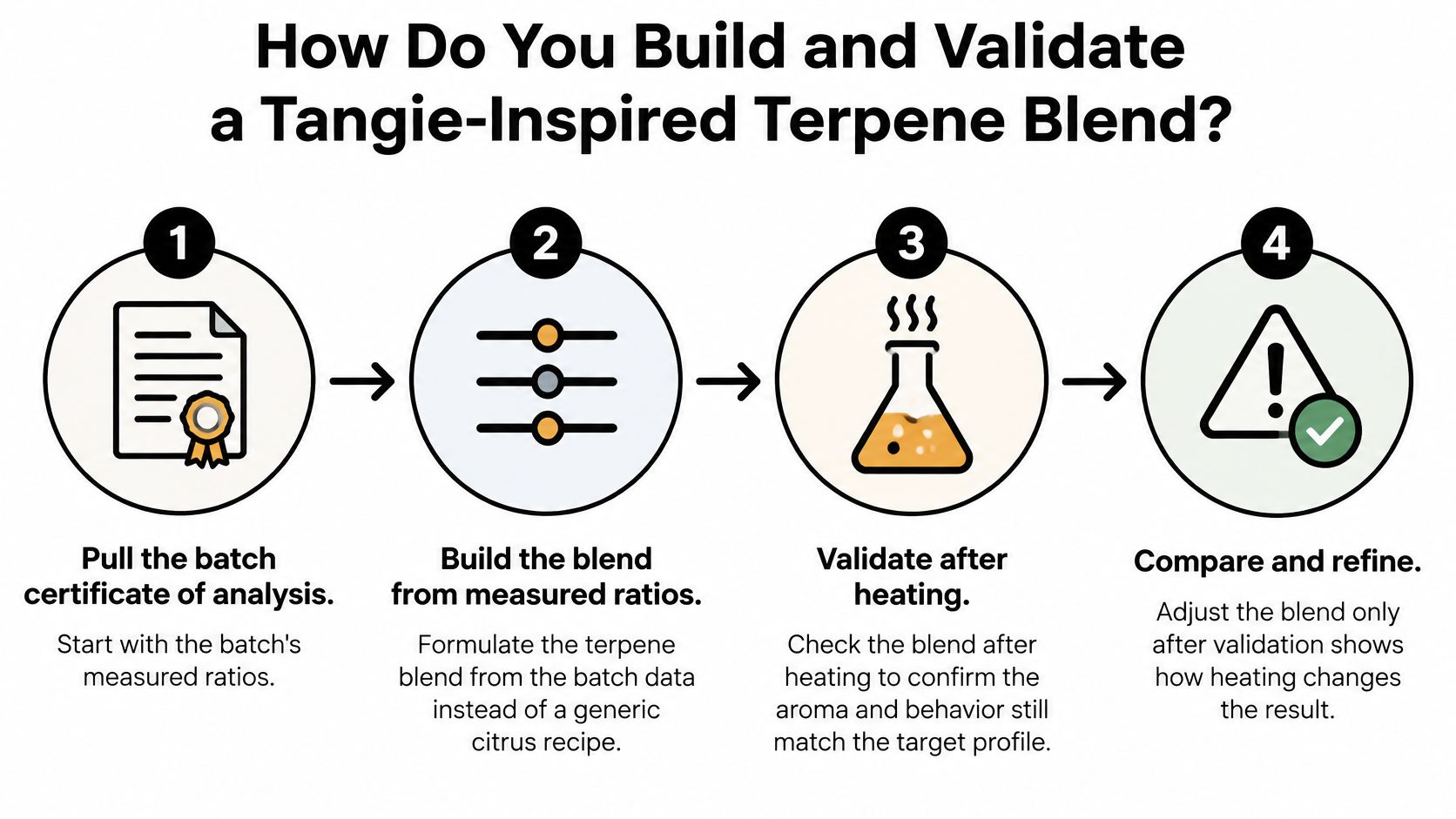
Steps 1 to 3 Build the Architecture
1. Pull the batch certificate of analysis. Record total terpene concentration and dominant-terpene percentage before you weigh anything. Skipping this step makes the blend untraceable, because nobody can tell later whether a miss came from the formula, the input lot, or storage. File the certificate with the batch record and use the same sample ID through sensory testing.
2. Set the base and mid ratios. Use myrcene, humulene, and beta-caryophyllene as the structure, with the 36/15/14 reference split only as a starting point. If your certificate shows a different order, follow the certificate. The common mistake is forcing every lot into the reference split, which creates a consistent internal product that no longer matches the material your customers expect.
3. Add top notes after the base works. Layer limonene, alpha-pinene, or terpinolene as highlights once the body tastes rounded. Adding limonene first is tempting because it's easy to smell progress, but it produces a generic lemon-orange note and hides weak structure. Add top notes in small increments, rest the sample, then smell it again before you decide the citrus needs more force.
Steps 4 to 6 Turn Ratios Into a Testable Oil
4. Blend a small test lot and log every weight. Enter each ratio and weight in the Gold Coast Terpenes Mixing Calculator so the next trial can reproduce the same numbers. Don't rely on drops, pipette counts, or memory. For a technical team, the value of a failed trial is the record, because it tells you which single change moved the aroma.
Use chromatography testing as your verification language when a trial matters, and review the method in the chromatography testing guide before you compare certificates from different labs. A ratio is only useful when your team knows how it was measured.
The short video below is useful as a process check before your team moves from bench ratios to filled hardware.
5. Dilute to working concentration in the carrier. All strains are highly concentrated and need to be properly diluted before use, so don't judge a concentrate at full strength and call it harsh or unbalanced. Judge it at the concentration and in the oil matrix you'll sell. Distillate, live resin blends, and hemp-derived oils don't carry top notes the same way, and viscosity changes how quickly aroma reaches the coil.
6. Compare against a reference in the final matrix. Score aroma, flavor, and freshness side by side, using the same fill volume, hardware, and rest time. Then store filled samples and re-test after two weeks to check top-note fade. A blend that wins on day one but loses its citrus edge in storage isn't ready, even if the premix smelled right.
Step 7 Decide Whether to Scale
Order a sample set from Gold Coast Terpenes when you need a benchmark, confirm MOQ for trial lots, and check volume terms early. Wholesale pricing is available on strain orders totaling over 64oz, so your cost model should separate bench validation from production pricing. Don't let a bulk price talk you into scaling a profile that hasn't passed the heated test.
Set the tolerance before the final tasting. Decide how much drift you'll accept in dominant-terpene percentage, total concentration, and sensory score, then hold the line when a deadline pushes back. I would scale only when the heated sample, the stored sample, and the certificate all fall inside that tolerance.
Bench rule: Change one variable at a time. If you adjust limonene, dilution, and hardware in the same trial, you have not run a test, you have created three new questions.
Say a brand wants Tangie for cannabis product formulation across two distillate suppliers. The sound approach isn't to buy more limonene. It's to lock the base and mid ratios, prove the top note in each oil, and release each supplier lot against the same reference. That's how formulating stays commercial instead of becoming flavor chasing.
How Heat Changes Tangie Terpenes in Cartridges
Heat changes the blend, so terpene survival must be tested after heating, not only in the premix. In the cited study by Korzun and colleagues, summarized in the Entour guide to terpenes for vape cartridges, 12 cannabis terpenes were heated across approximately 100°C to 500°C. Myrcene retained approximately 97–98% under the reported test conditions, whereas terpinolene survival fell to roughly 11–28%.
Terpene Survival at Vape Heating Temperatures
| Terpene | Reported survival | Formulation implication |
|---|---|---|
| Myrcene | 97–98% | Stable base; low aroma drift risk |
| Terpinolene | 11–28% | Heavy loss; retest after heating before scaling |
| Limonene | Measure in your hardware | Test in hardware before scaling |
| Beta-caryophyllene | Measure in your hardware | Test in hardware before scaling |
Only two rows have reported survival values in the cited summary. The other rows need your team's own heated testing, not borrowed confidence.
What That Loss Means in a Filled Cartridge
A terpinolene-led top note can shrink after aerosolization. The liquid in the mixing vessel can smell fresh, sharp, and clearly citrus-pine, while the emitted aroma tastes rounder and less distinct. That's not always a failed blend. Sometimes the base is doing exactly what it should, and the top note cannot survive the hardware settings you've chosen.
Don't correct that gap by pouring in more top-note material on instinct. Excess volatile material can make the unheated oil smell aggressive, change how the blend behaves during filling, and still miss after heating. Use the data on the boiling point of terpenes as background, then let filled-hardware results decide the adjustment.
Document the Heated Retest
- Terpene identity and concentration: Record the premix formula and the final dilution for every trial.
- Cartridge hardware: Log coil type, resistance, intake size, and fill volume, since hardware changes delivery.
- Power or temperature settings: Use the settings your customers can select, not only the setting that flatters the blend.
- Post-heating sensory scoring: Score the emitted aroma against the reference sample for citrus lift, freshness, body, and finish.
If the top note drops, raise limonene or pinene in the premix only after a heated retest shows the size of the gap, never by estimate. Make the smallest change that could close the gap, refill the same hardware, and score it again. Gold Coast Terpenes can supply the Tangie benchmark and individual isolates, but your hardware data still decides the final ratio. I would not approve a Tangie cartridge from a beaker test.
Safety and Labeling Checks Before Launch
A THC-free or natural claim on the bottle does not tell a regulator what leaves the coil. The 2025 review on cannabis aerosol research needs identified vaporizer temperature and its effect on cannabis-aerosol composition as a major research need. That review also summarized toxicology work on terpene mixtures as limited to specific laboratory conditions, without establishing pulmonary safety for heated, inhaled terpene products.
Regulators are asking sharper questions about added flavor compounds versus compounds that occur naturally in the plant. For a Tangie launch, record whether the citrus aroma comes from cannabis material, a botanical blend, or a concentrated additive, and keep that record with the lot. A close match to the flavor target is a sensory result. It is not proof the heated product is safe to inhale.
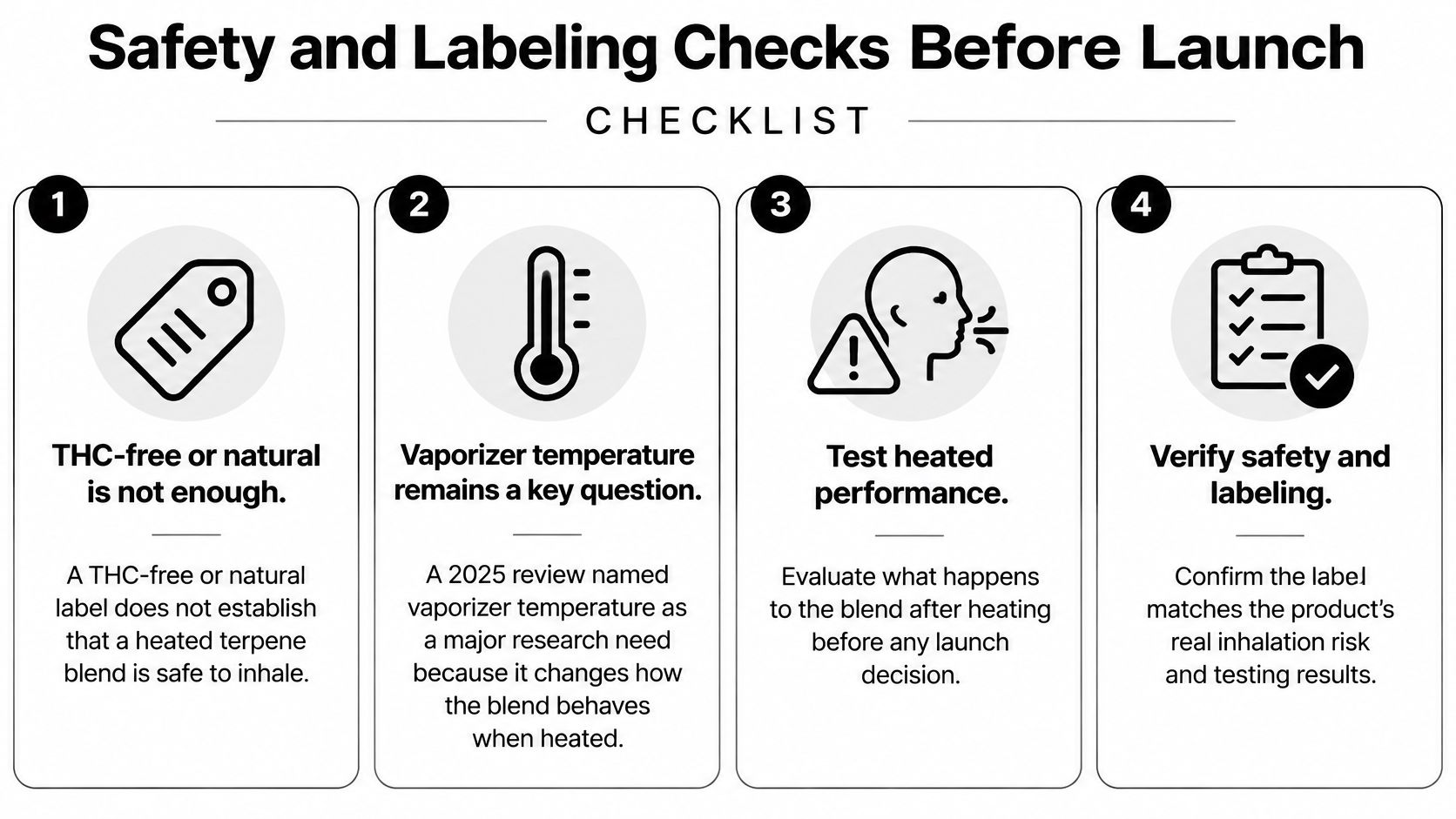
Pre-Launch Checklist
- Confirm botanical source by name: List each added terpene and confirm botanical derivation where your label makes that claim.
- Link a batch certificate to every SKU: Keep the certificate tied to the finished lot, not stored as a generic supplier document.
- Test aerosol at operating temperature: Evaluate the filled product under the hardware conditions customers will use.
- Disclose diluents clearly: Gold Coast Terpenes states its terpenes are free of VG, PG, PEG and MCT, and your finished label should be just as explicit about what is present.
- Remove medical and effect claims: Don't promise a physiological outcome from a flavor profile, and don't let attribute language become a health claim.
- Keep ratio records ready: Maintain measured ingredient ratios, supplier lots, and test results in a file a regulator can request.
Use the regulatory compliance checklist to assign an owner to each item before artwork is approved. A label printed before the batch link is locked turns into a reprint, and the missing lot record is usually what the review was supposed to catch.
The trade-off is speed against traceability. Shipping a Tangie SKU on a good unheated smell skips the file that connects ratio, source, and operating-temperature aerosol data. I would not release artwork until those three records sit on the same lot number. Treat the flavor match and the inhalation review as separate files, and do not let one stand in for the other.
Questions Formulators Ask About Tangie Blends
Is Tangie a Fixed Terpene Recipe
A Tangie name sets a flavor target, citrus, orange, and sweet, not a locked ratio sheet. Lot chemistry moves, so the certificate of analysis is the working formula and a commercial profile is only the first sensory mark. Gold Coast Terpenes offers a Tangie profile you can reorder as that mark, which lets a team compare incoming lots against the same reference instead of treating the strain name as the recipe.
Should a Tangie Blend Use Botanical or Cannabis-Derived Terpenes
Gold Coast Terpenes describes its blends as 100% natural. That description does not assign a botanical or cannabis-derived origin to every compound. Read the certificate for the lot you bought and state each terpene's origin on the label in the same words that document uses. A repeatable citrus, orange, and sweet target still depends on matching the measured ratios on that certificate, whichever input class the lot lists.
How Should a Vape Brand Choose a Terpene Supplier
Match four records to the written batch target before you approve a vendor: the certificate, the dilution instruction, the ingredient disclosure, and the volume terms. A usable supplier lets you tie one certificate and one ratio to one finished SKU without a document chase. A cheap sample that arrives without that trail only delays the cartridge trial.
What Minimum Order and Volume Terms Should a Brand Expect
Set the sample quantity before the trial calendar, because bench fills and production buys run on different clocks. With Gold Coast Terpenes, confirm the sample path first. Use wholesale pricing on strain orders totaling over 64oz only after heated and stored cartridges pass. These blends are highly concentrated and have to be diluted before they go into distillate, so the trial size should cover dilution math and a retained reference, not just a sniff bottle.
Which Terpenes Need Heated Testing First
Terpinolene carries much of Tangie's fresh top and is among the more heat-sensitive fractions in a citrus profile. Run it first in the finished cartridge, at the settings customers use, against a retained unheated reference. If the top note thins, adjust that fraction before you touch the rest of the premix. Then run limonene and pinene through the same hardware so mid citrus and pine lift are judged under the same heat.
Can Limonene Alone Reproduce Tangie
Limonene can supply a bright citrus highlight. It will not carry orange sweetness, base body, dry structure, warm mid notes, and a pine-floral lift at the same time. A limonene-led shortcut usually tastes clean and generic. Build from measured batch ratios, then confirm the result after the cartridge has been heated.
Build the next Tangie trial from those ratios, a filled-hardware retest, and a benchmark the team can order again, including the Tangie profile and isolates such as limonene, terpinolene, and alpha pinene from Gold Coast Terpenes for distillate and cartridge work. Review the strain options, confirm sample and volume terms, and start formulation at Gold Coast Terpenes.