
A blend that smells correct in the beaker can still fail in the cartridge, because heating changes its chemistry. Gold Coast Terpenes, a Redondo Beach, CA supplier, makes 100% botanically derived terpene blends, not cannabis-derived, and that sourcing fact matters only after you've defined concentration, hardware, and testing. Treat a spray as an inhaled formulation decision first and a flavor decision second.
What a Terpene Spray for Weed Actually Does in a Formulation
A terpene spray for weed is a measured terpene blend used to dose flower, distillate, or pre-fill oil at a defined percentage of finished weight. It isn't a universal flavor shortcut, and it isn't validated for inhalation just because the ingredients are natural or edible.
In commercial terms, you're buying isolated or blended terpenes packaged for controlled addition. That addition can sit on the surface of flower, where deposition is external and uneven, or it can be mixed into oil, where it becomes part of an aerosolized product. Those two uses create different label, testing, and exposure questions, so your SOP has to state the intended substrate before anyone picks a percentage.
Why the Inhalation Distinction Controls the Rest of the Work
When myrcene, linalool, limonene, and a commercial mixture were heated and aerosolized, researchers detected methacrolein, isoprene, benzene, aldehydes, and acids, showing that heated chemistry can't be inferred from the liquid's ingredient list, as detailed in laboratory work on aerosolized cannabis concentrate terpenes. An analysis in that research history also found roughly 60 different terpenes, terpenoids, flavor compounds, and fragrance agents across 12 cannabis vape samples, underscoring how complex finished cartridges already are before you add another variable.
That complexity is why supplier inputs need to be narrow and documented. Gold Coast Terpenes produces lab-verified, THC-free profiles that are intentionally free of VG, PG, PEG, and MCT. For buyers shortlisting a terpene profile for cannabis product formulation, the catalog includes 50+ classic and contemporary profiles such as Blue Dream, OG Kush, Forbidden Fruit, and Green Crack, plus isolates like Limonene, Myrcene, and Beta-Caryophyllene.
- External aromatic use: Terpenes are deposited on plant material and judged mainly on distribution, retention, and disclosure.
- Inhalation-grade formulation: Terpenes are incorporated into oil and must be judged on heated emissions, device power, and final concentration.
Don't approve a spray from bottle aroma. Approve it from the finished product, in the intended hardware, at the intended percentage.
Once you accept that framing, the practical questions change. You're no longer asking how strong the spray smells. You're asking what final load you're creating, how evenly it lands, and what the aerosol contains after the coil does its work.
Dosing a Terpene Spray Without Breaking the Formula
Dose by mass percentage of the finished batch, not by drops, sprays per jar, or bench aroma. Weigh the base and the terpene blend, calculate against total finished weight, and record that target in the batch SOP before mixing starts.
A defensible starting screen is 1–5% total terpene, which aligns with the approximate range commonly reported for cannabis products, while some products have reached approximately 25% despite greater irritation, hypersensitivity, and thermal decomposition concerns, according to industry guidance on manufactured cannabis product safety. Higher doesn't mean better flavor. It usually means thinner oil, harsher aerosol, and a profile that reads loud on the bench and unbalanced in the device.
Set the Ceiling Before You Chase Intensity
Nevada guidance restricts terpene content to no more than 10% of the final product and requires the specific percentage in the SOP submitted with the product menu request, as stated in the Nevada Cannabis Compliance Board terpene guidance. Calculate that percentage against the complete mixture, not against the distillate alone. A bench formula that tastes accurate can still need reformulation if it crosses the jurisdictional limit.
Flower needs a separate ceiling from distillate. Spray deposits sit on exposed surfaces, so a nominal batch percentage can create concentrated hot spots on outer buds and almost nothing inside dense material. Distillate incorporation, when mixed properly, distributes the same load through the oil. Using one number for both substrates ignores that physical difference.
Small brands often lose control through volumetric drops. Drop size changes with viscosity, temperature, and pipette angle, which makes repeatability fictional. The discipline is similar in principle to any measured-dose category, and teams building SOP literacy sometimes study unrelated references such as how to dose magic mushrooms to reinforce why weight-based records beat informal counts. For terpenes, use Gold Coast Terpenes' Mixing Calculator, retain batch COAs for purity and residual solvents, and review how dilution ratio changes a finished terpene formula before locking a ratio.
| Target total terpene % | g of terpene per 100 g batch | g of base oil/flower per 100 g batch | Typical use case |
|---|---|---|---|
| 1% | 1 g | 99 g | Subtle restoration screen |
| 3% | 3 g | 97 g | Mid-range distillate prototype |
| 5% | 5 g | 95 g | Upper starting screen |
| 10% | 10 g | 90 g | Jurisdictional ceiling check where applicable |
Copy the math into your SOP, then assay after mixing. If the post-mix result doesn't match the target, your process, not your nose, decides the next batch.
Three Application Workflows for Cartridges, Distillate, and Flower
The same spray can't be used the same way for cartridges, bulk distillate, and flower. Each substrate needs its own mixing method, uniformity check, and post-mix assay before it becomes a SKU.
For cartridges, a strain-inspired terpene blend for vape cartridges is pre-mixed into winterized distillate rather than sprayed into filled hardware. A profile such as Blue Dream is weighed into the oil, mixed under controlled temperature and low-shear conditions until visually homogeneous, then held for sampling. Before filling, test viscosity, cannabinoid potency, terpene concentration, and particulate or microbial contamination. That sequence prevents the common error of discovering separation, clogging, or weak flavor only after hardware is capped.
The production setup below shows why surface application and pre-fill oil work must stay physically and procedurally separate.
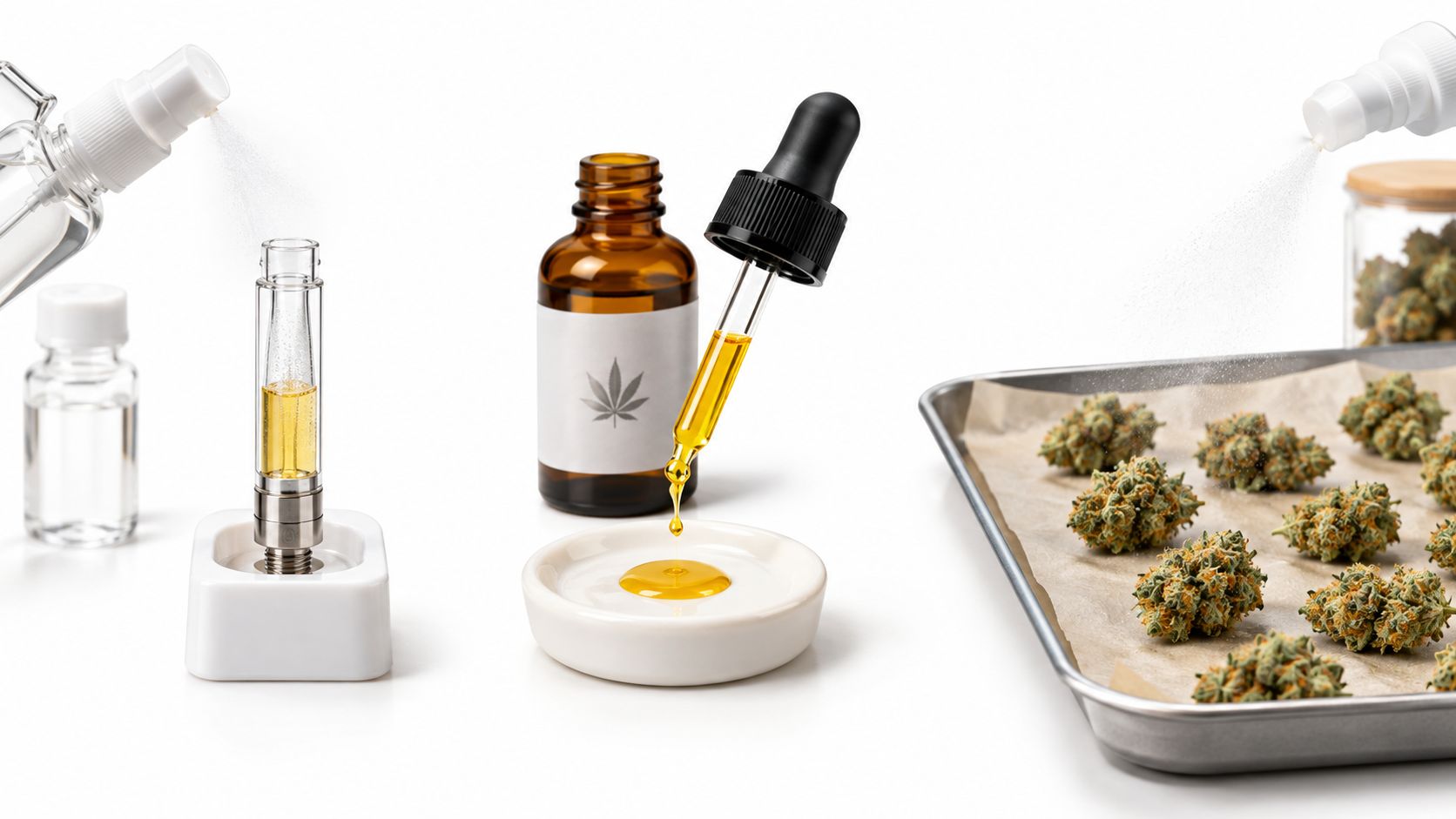
Bulk distillate follows the same chemistry at a different scale. You're dosing a drum or large vessel, so mixing time, sampling location, and temperature control matter more than spray technique. Pull samples from more than one point in the vessel, because a top sample can pass while the bulk remains stratified. Gold Coast Terpenes offers free U.S. shipping over $100, which affects landed cost when you're scaling terpene inputs for larger lots, but freight savings don't replace blend verification. Teams that need the detailed bench sequence should work from practical guidance on how to use terpenes in formulation and adapt it to their vessel size.
Flower surface spraying is the least forgiving workflow. Spread or tumble material so exposed surfaces change during application, apply the weighed amount in controlled passes, then rest the batch in a sealed container. Validate deposition uniformity across the first, middle, and final portions instead of trusting one aromatic handful. If those portions differ materially, adjust batch size, movement, or pass count rather than adding more spray.
When a fruit-forward target is part of the brief, Elevated Strains can be evaluated through the same workflow discipline. Product selection doesn't change the verification step.
Practical rule: Every workflow ends with a post-mix assay. If you can't measure the finished load, you don't have a formulation, you have an aroma treatment.
That rule also protects flavor work. A cartridge oil can be rebalanced before filling, and bulk distillate can be corrected before it's split into SKUs. Sprayed flower gives you fewer correction options once the deposit has landed, which is why its validation has to be stricter, not looser.
How Top, Mid, and Base Notes Shape a Strain-Inspired Blend
Yes, the order in which terpenes reach the nose is partly engineered through volatility. Build a blend in layers, then judge it across the full draw instead of from static aroma in the bottle.
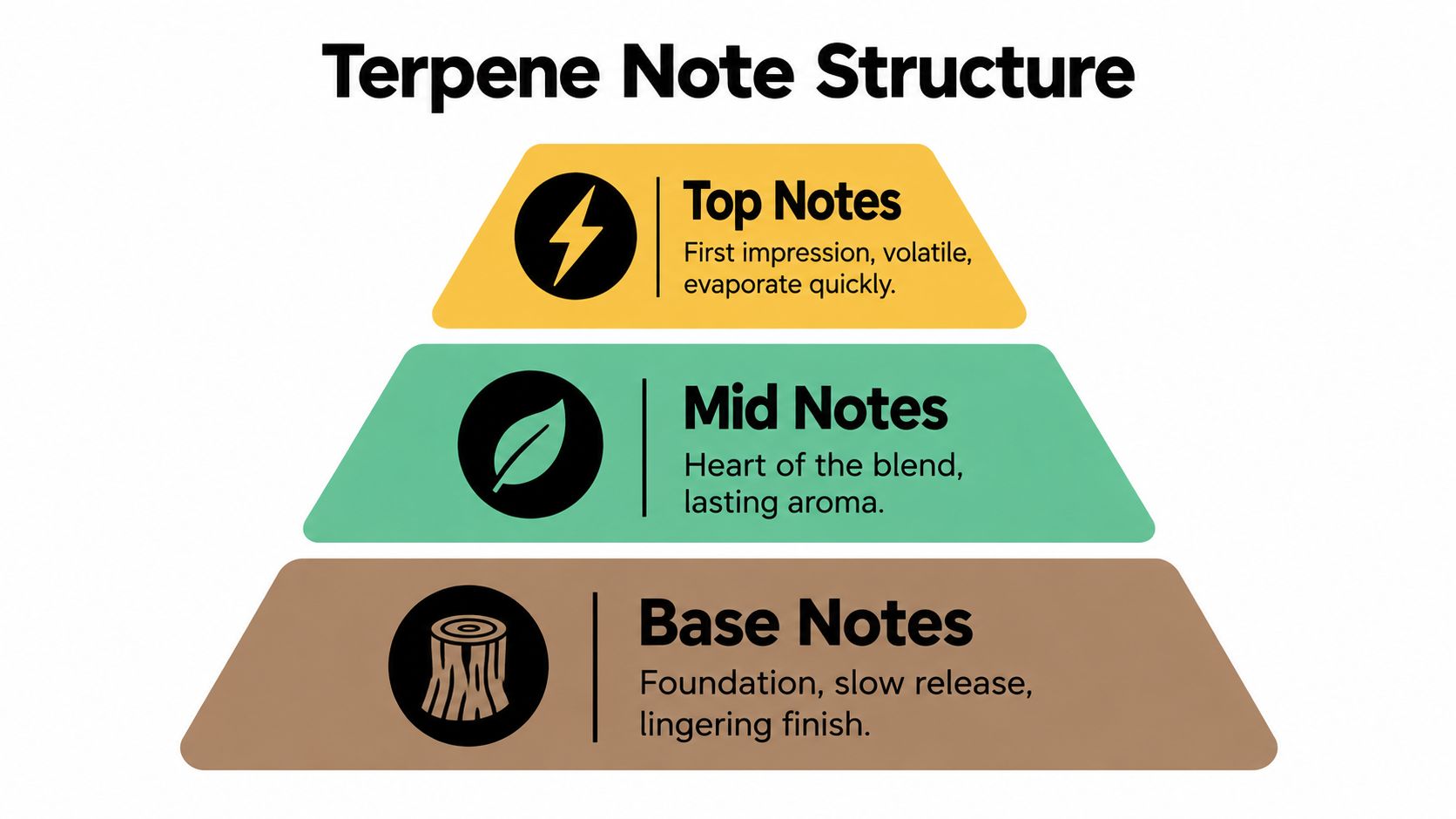
Top notes are the most volatile compounds and are perceived first, middle notes provide body and may persist for up to about one hour, and base notes are least volatile and can remain for several hours, according to a scientific review of essential-oil aroma chemistry and note classification. In cannabis formulation, limonene or pinene-dominant materials suit the bright opening, floral or spicy compounds carry the middle, and lower-volatility compounds provide the lasting body.
The hierarchy below gives formulators a shared language for separating first impact from persistence.
That separation matters even more in a cartridge. Monoterpenes and monoterpenoids evaporate faster than sesquiterpenes and sesquiterpenoids, and terpenes can be inhaled before cannabinoids during vaping, as described in peer-reviewed research on terpene volatility in vape formulations. Vaporization experiments in that review were conducted at 180–220°C for 20–180 seconds, which is why device temperature and puff duration belong in your sensory protocol.
A common mistake is adding more of a volatile top note when the finished oil lacks staying power. That makes the first pull louder without fixing the missing middle or base. Gold Coast Terpenes selectively enhances rare, exotic terpenes in certain profiles to highlight nuanced fruit and dessert notes, giving formulators a structured starting point when replicating flavor of a reference extract.
The short demonstration below is useful for training staff to evaluate sequence, not just intensity.
Evaluate the initial inhale and the exhaled residue. If the opening is accurate but the finish collapses, rebuild the lower layers. If the finish is heavy and the opening is muted, do not raise total percentage. Adjust the volatile fraction and retest in the same hardware.
Storage and Stability After You Open the Bottle
Most spray failures happen after the bottle is opened, not in the mixer. Oxygen, light, heat, and headspace steadily change the blend you thought you approved.
Terpenes oxidize, volatile fractions leave first, and cannabinoid or terpene concentrations in finished oil can drift during storage. One study monitored terpene stability over eight months in cannabis extracts, demonstrating why shelf-life claims need data instead of a sniff test, as summarized in California guidance for inhaled cannabis products. That drift explains why a cartridge can lose its bright opening while the base becomes disproportionately heavy.
Control the Container Before You Blame the Blend
Use amber glass, tight seals, minimal headspace, and a small working bottle so the master container stays closed. Nitrogen headspace can help where your facility can apply it consistently. Keep bulk material cool and dark, and don't store mixed oil warm while waiting for filling. For moisture-sensitive packaging decisions around finished goods, desiccant packaging choices for UK brands offers useful context on matching protection to the product and supply chain. Your own baseline should start with how to store terpenes without accelerating loss and then be adapted to your warehouse conditions.
Sprayed flower is less stable than properly mixed oil because the deposit sits exposed on the surface. A warm retail shelf accelerates top-note loss, repeated opening exposes fresh material to air, and shipping can shift the aromatic balance before purchase. Small-batch application reduces how long treated flower sits waiting for sale.
- At compounding: Record lot numbers, opening date, storage location, and starting aroma against a retained reference.
- At 30 days: Check top-note retention, seal integrity, and any visible separation in mixed oil.
- At 60 days: Repeat sensory evaluation in hardware and compare it with the retained sample.
- At 90 days: Retest terpene concentration where shelf-life claims depend on it.
Gold Coast Terpenes provides safety documents and wholesale options, including discounts on bulk orders exceeding 64 oz. Buying at the right scale can reduce cost, but only rotation discipline prevents an open bulk bottle from becoming your longest-running stability problem.
Testing, Compliance, and the Mistakes That Cost a Recall
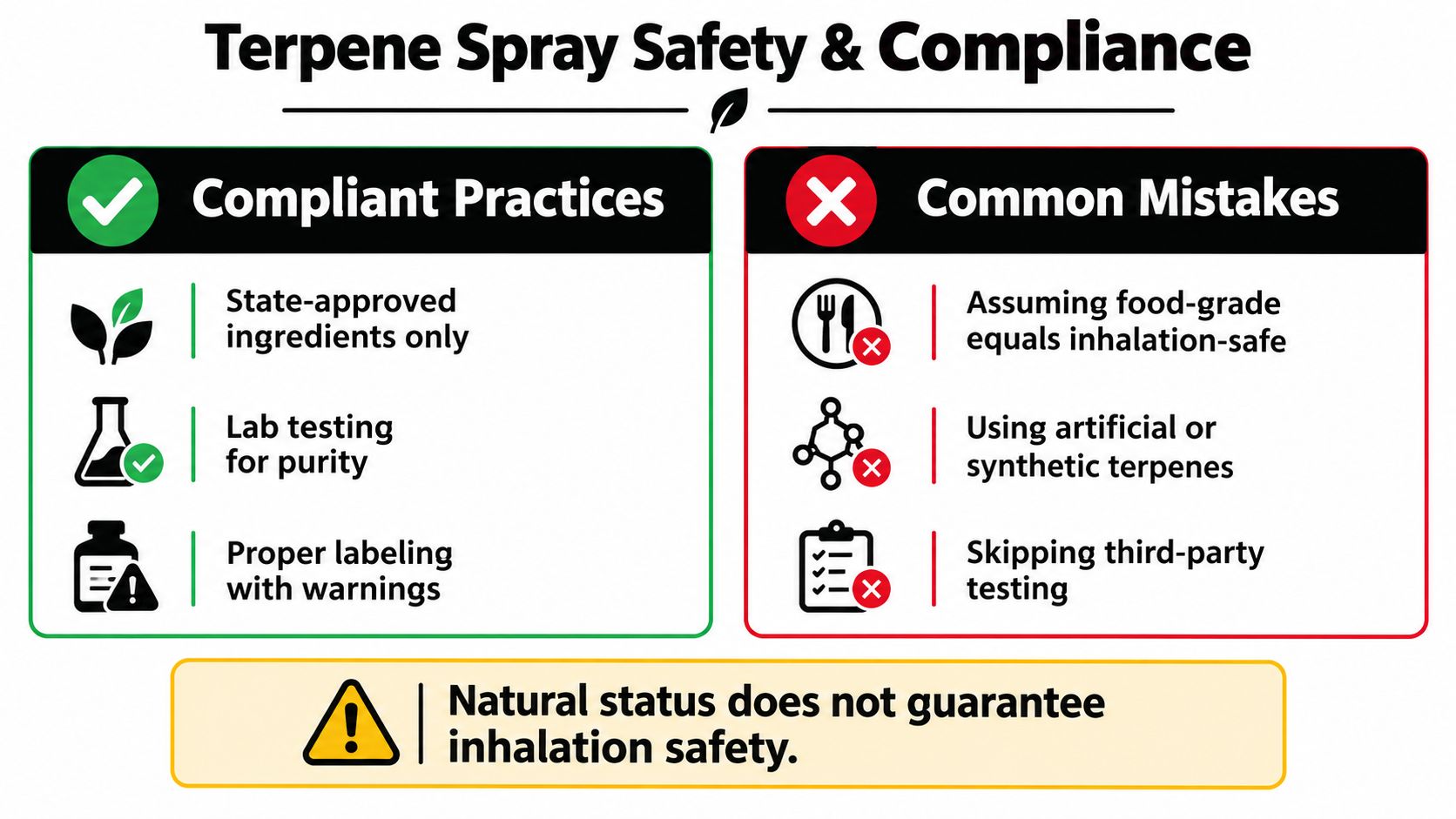
Natural, food-grade, or GRAS status doesn't establish inhalation safety. Test the aerosol from the finished formulation, not just the liquid in the bottle.
Cannabis cartridges may contain roughly 10–20% terpenes by weight, producing estimated aerosol concentrations of 2,500–5,000 ppm, while four degradation products made up 18–30% of the aerosol gas phase in tested THC and beta-myrcene systems, according to research on concentrated terpene exposure and degradation products. Those numbers explain why concentration and power can't be treated as sensory variables alone.
The comparison below separates compliant controls from assumptions that create avoidable exposure.
Build validation in sequence. Verify botanical identity by GC-MS, screen for pesticides, heavy metals, microbial contamination, and residual solvents, then prepare low, mid, and high prototypes. Measure aerosol output and carbonyl emissions under the intended hardware temperature profile, followed by accelerated and real-time stability in the final container. Gold Coast Terpenes profiles are SC Lab-tested and legal worldwide, which gives you a documented input, but your finished product still needs its own testing.
Under Nevada guidance cited earlier, don't use vitamin E acetate, PEG, MCT oil, DMSO, or phytol in an inhaled formulation. California also excludes artificial or synthetic terpenes that don't contribute naturally to cannabis aroma. Use a regulatory compliance checklist for terpene product development to confirm ingredient eligibility before prototypes reach management review.
The costly mistakes are predictable. Teams spray above the SOP percentage because bench aroma seems weak, skip the post-mix assay, test only the liquid, or store bulk oil warm. Each shortcut removes the evidence you'd need during a complaint, failed test, or recall investigation.
Manufacturing Checklist for a Terpene Spray SKU
Use this checklist as a lab hand-off, not a recap. A technician should be able to run it on day one without reinterpreting the formulation rationale.
Four Controls Before Release
- Dosing: Select the target percentage, calculate grams for the exact batch mass, and record both values in the SOP before mixing.
- Workflow: Choose the flower, bulk distillate, or cartridge protocol, mix under its specified conditions, and complete the post-mix assay.
- Sensory: Evaluate top, mid, and base balance on the inhale and exhale in final hardware, not from the bottle.
- Stability: Assign the storage rule, retain a reference sample, and schedule the retest window before the batch is released.
Gold Coast Terpenes provides a Mixing Calculator, safety documents, and curated strain packs, so a manufacturer can start from a tested input instead of raw isolates. That baseline doesn't replace your assay, emissions work, or jurisdictional review. It makes those controls repeatable across the next SKU.
Build your next terpene spray for weed, distillate blend, or cartridge SKU from documented, botanically derived profiles with batch support and formulation tools behind them. Visit Gold Coast Terpenes to compare strain-inspired blends, isolates, and bulk options for your next production run.