
You've matched the citrus opening of a reference oil, but the woody, floral character still isn't there, and adding more top-note terpenes only pushes the blend further away. Gold Coast Terpenes supplies natural, strain-specific blends and isolated compounds for this kind of formulation work, where the task is to reproduce aroma accurately rather than promise an effect from an ingredient name.
Alpha-bisabolol terpene effects for cannabis product formulation are best evaluated through sensory contribution, processing behavior, and evidence boundaries. Treat it as a controlled profile modifier, then verify what it contributes in the finished oil and delivery system.
Why Alpha-Bisabolol Matters in Terpene Formulation
Alpha-bisabolol matters because it gives formulators another way to adjust woody, floral character without just increasing the volatile opening notes. Its strongest commercial role is profile refinement, not serving as a dominant ingredient selected for a promised physiological effect.
A common development mistake is to match only the largest peaks on a reference chromatogram. That can produce a recognizable opening while missing the quieter details that distinguish one target profile from another. The practical question isn't whether alpha-bisabolol appears on the ingredient list, but whether its inclusion moves the blend closer to an agreed sensory reference.
Start with the missing sensory feature
Write a formulation objective before changing the blend. Useful objectives include restoring a missing floral undertone, softening an abrupt transition after the citrus opening, or improving the woody finish.
Less useful objectives include making the cartridge calming or giving it an anti-inflammatory effect. Those statements substitute an unverified outcome for a measurable development task.
- Define the reference: Identify the flower, extract, or approved reference blend you're matching.
- Name the gap: Separate aroma intensity from aroma identity. A stronger blend isn't necessarily a closer match.
- Control the comparison: Evaluate variants against an unchanged control in the same matrix.
- Set the acceptance criteria: Decide what qualifies as an improvement before selecting the preferred sample.
Source descriptions belong in that specification too. Botanical, cannabis-derived, and nature-identical aren't interchangeable purchasing terms, even when suppliers use the same compound name.
Practical rule: Add alpha-bisabolol because a controlled comparison demonstrates a useful sensory contribution, not because an effects chart assigns it a desirable feeling.
For strain replication, a trace-to-minor contribution is a more defensible starting concept than assuming alpha-bisabolol should carry the entire formula. Let the reference and finished-product evaluation determine its role.
How Does Alpha-Bisabolol Shape Aroma and Terpene Notes
Alpha-bisabolol is a high-boiling, oily sesquiterpene alcohol with woody, floral, and fresh character. In formulation architecture, it's useful to evaluate it as a mid-to-base-note modifier rather than expecting the sharp opening associated with citrus or pine materials.
The fragrance analogy is helpful, provided it doesn't become a substitute for testing. Top notes describe the opening impression, mid notes connect that opening to the body, and base notes describe the more persistent impression.
Alpha-Bisabolol Physical and Sensory Profile
The following properties are reported in a supplier safety data sheet for natural alpha-bisabolol.
| Property | Reported value | Formulation implication |
|---|---|---|
| Chemical family | Sesquiterpene alcohol | Evaluate separately from more volatile monoterpenes |
| Molecular formula | C15H26O | Confirm identity against the material specification |
| Molar mass | 222.4 g/mol | Supports identity documentation, not a dosing recommendation |
| Appearance | Clear to light-yellow oily liquid | Establish an incoming visual reference |
| Odor | Woody, floral, fresh | Provides useful sensory specification language |
| Melting point | Below −20°C | Record handling behavior against supplier specifications |
| Boiling point | Approximately 300.2°C | Don't assume evaporation behavior matches top-note ingredients |
| Water solubility | About 22 mg/L | Validate incorporation in the intended oil phase |
A boiling point isn't a recommended mixing temperature or device setting. It doesn't establish thermal stability in a cannabinoid matrix, nor does it predict what a user will inhale from a cartridge.
Limited water solubility also means that adding the ingredient to a water-containing preparation isn't equivalent to incorporating it into an oil. Choose the intended matrix first, document the mixing procedure, and verify homogeneity instead of accepting visual clarity as sufficient evidence.
German chamomile provides the best-established botanical context, but its composition shouldn't become a template for cannabis formulation. An ingredient can be prominent in one botanical oil and remain a supporting component in a different target profile.
For development tools, consult the Gold Coast Terpenes formulation resources and Mixing Calculator. A calculator can support batch arithmetic, but the sensory target and validated material concentration still need to come from the development team.
What Does the Research Say About Alpha-Bisabolol Effects
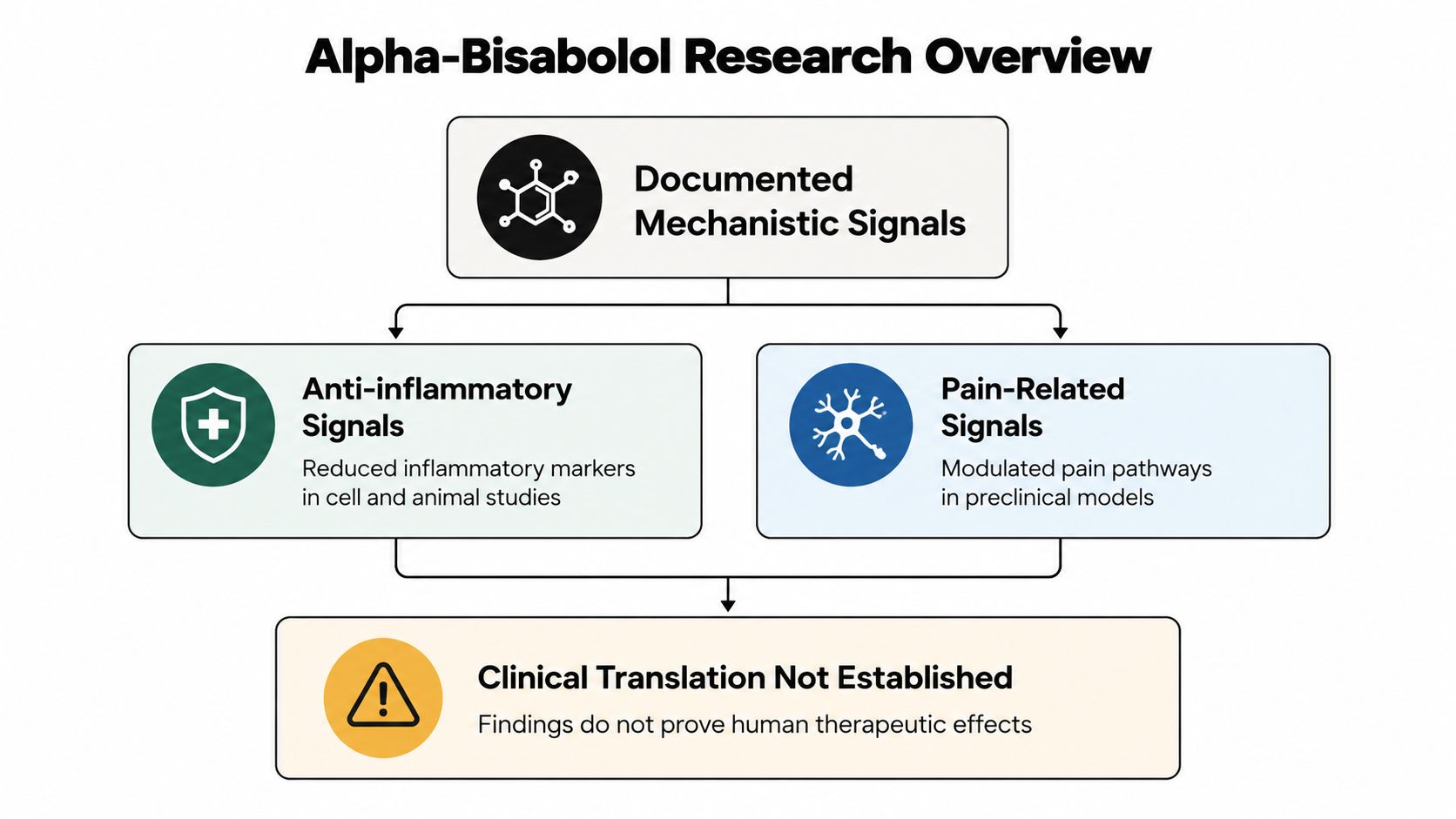
Alpha-bisabolol has documented inflammation-related and pain-related signals in laboratory and animal research. Those findings don't establish therapeutic effects from inhaled cannabis products or finished vape cartridges.
The evidence becomes more useful when separated by experimental setting rather than compressed into a consumer-facing list of benefits.
Botanical history and mechanistic findings
A peer-reviewed chamomile review reports that flowers contain approximately 1–2% volatile oil, with alpha-bisabolol and its oxides among the principal terpenoid constituents. The review discusses historical pharmacological work published in 1979, including inflammatory animal models, and notes that chamomile essential oil can contain up to 50% bisabolol, with substantial compositional variation.
That history supports scientific interest, not equivalence between chamomile preparations and isolated alpha-bisabolol in a cartridge.
A separate murine colitis investigation linked alpha-bisabolol treatment with reduced inflammatory markers, attenuation of MAPK and NF-κB signaling, and increased epithelial PPAR-γ expression. These are mechanistic findings from preclinical systems, not a human formulation specification.
For pain-related research, an electrophysiology and animal-mechanism study reported 29.3% inhibition of Cav3.2 channel activity at 10 μM. Channel inhibition can inform a mechanism hypothesis, but it doesn't establish an analgesic cartridge dose.
Why cancer-cell results aren't product benchmarks
In a 2011 investigation of primary human leukemia cells, average 24-hour IC50 values were 33 ± 15 micromolar for Philadelphia-chromosome-negative B-cell acute lymphoblastic leukemia, 46 ± 11 micromolar for Philadelphia-chromosome-positive B-ALL, and 54 ± 8 micromolar for acute myeloid leukemia.
IC50 describes the concentration producing a specified inhibitory response under the experiment's conditions. It isn't a recommended ingredient percentage, a safe exposure level, or evidence that a terpene product treats cancer.
A laboratory concentration cannot be converted directly into a cartridge inclusion rate. Exposure route, delivered dose, bioavailability, and the measured endpoint are different questions.
Gold Coast Terpenes describes its materials as SC Lab-tested and THC-free. Those attributes concern material verification, not clinical validation; use the terpene effects guide as educational context while keeping finished-product claims within their evidence.
Which Alpha-Bisabolol Effects Matter for Product Development
For product developers, the most defensible alpha-bisabolol effects are sensory contributions that the team can verify in its own formulation. Preclinical mechanisms belong in research evaluation, not in promises of relaxation, pain relief, sedation, focus, or disease treatment.
Separate the job you want the ingredient to perform from the language used to describe it commercially.
What Alpha-Bisabolol Evidence Can and Cannot Support
| Evidence category | What it can inform | What it cannot prove |
|---|---|---|
| Raw-material sensory description | Selection for woody, floral, fresh character | The same perception in every finished matrix |
| Controlled blend comparison | Whether a variant improves the target match | A physiological effect in users |
| Physical-property information | Mixing and processing questions | Safe heated-inhalation conditions |
| Preclinical mechanisms | Research priorities and hypotheses | Human therapeutic efficacy |
| Batch analytical results | Identity and concentration consistency | Clinical benefit or comprehensive inhalation safety |
The development jobs are distinct. Woody floral lift concerns character. Mid-to-base persistence concerns how the profile develops. Roundness is a sensory judgment about integration, while profile differentiation asks whether the formula becomes more recognizable against the reference.
None should be assumed merely because alpha-bisabolol is present. Compare the modified formula with its control, and document whether trained evaluators can identify the intended improvement without introducing a new mismatch.
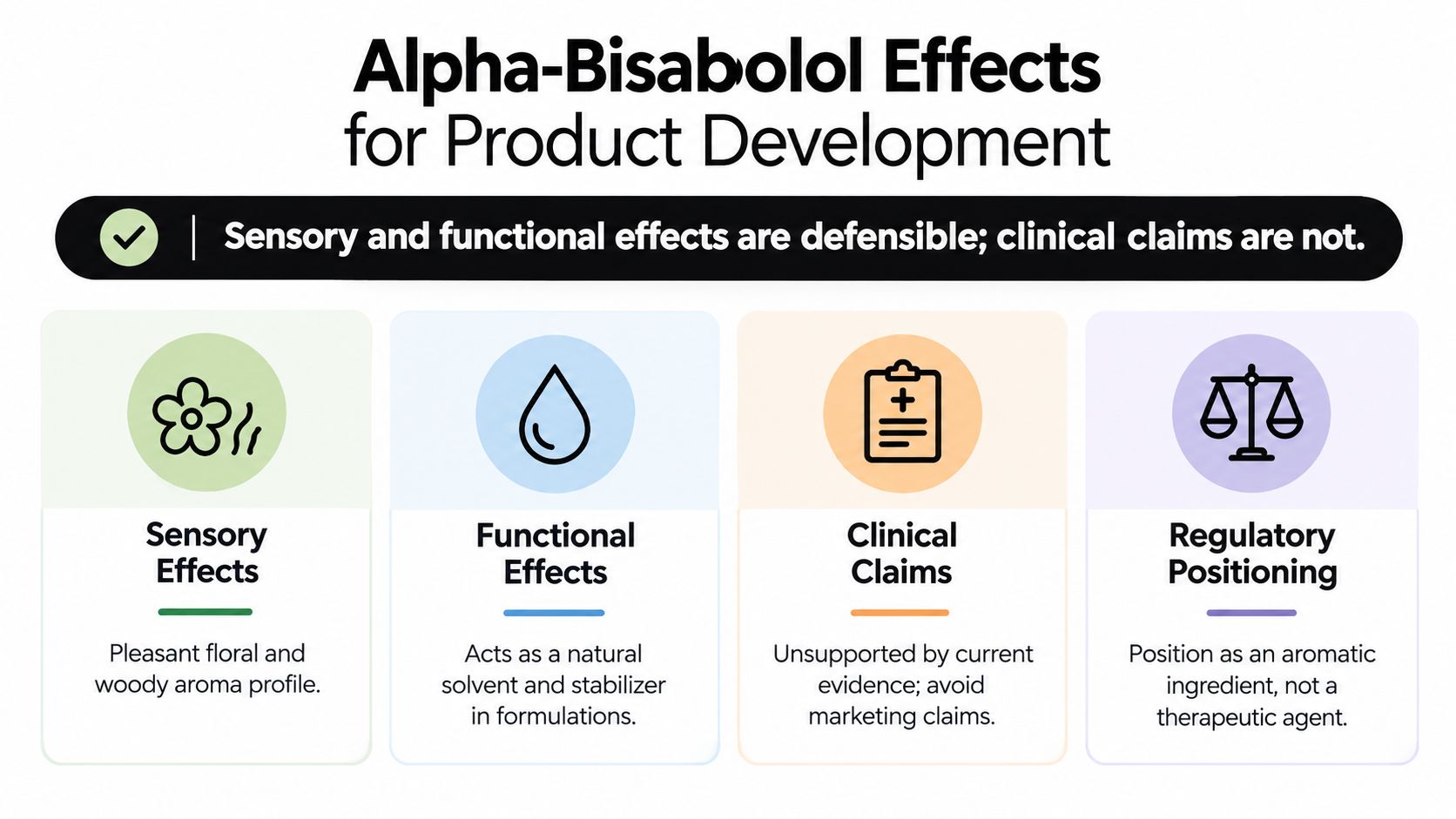
The graphic's solvent and stabilizer wording requires qualification: the evidence discussed here doesn't establish alpha-bisabolol as a validated stabilizer or a suitable cartridge diluent. Don't substitute that wording for viscosity, compatibility, stability, or aerosol testing.
Likewise, matching a compound name doesn't complete source qualification. Request production-route and identity documentation when comparing botanical and nature-identical materials, then confirm that purchasing descriptions and finished-product labeling accurately reflect the material supplied.
A useful specification therefore includes both the chemical target and the sensory acceptance criteria. Neither a source story nor a chromatogram alone tells the team whether the final profile is correct.
How to Use Alpha-Bisabolol in Vape Cartridges and Distillate
Use alpha-bisabolol as a controlled aromatic modifier, define its concentration in the finished oil, and evaluate it under the intended delivery conditions. Don't select an inclusion rate from a cell-study concentration or a generic terpene-effects chart.
The following development scenarios illustrate decisions to test, not validated recipes.
A citrus-led strain-inspired terpene blend
Suppose the opening matches the reference, but the body feels incomplete. Hold the citrus-led portion constant and prepare documented alpha-bisabolol variants to test whether woody floral depth improves the match.
The acceptance criterion isn't just that evaluators notice more floral aroma. It's that they judge the overall profile closer to the reference without losing its intended opening.
A formulation for distillate
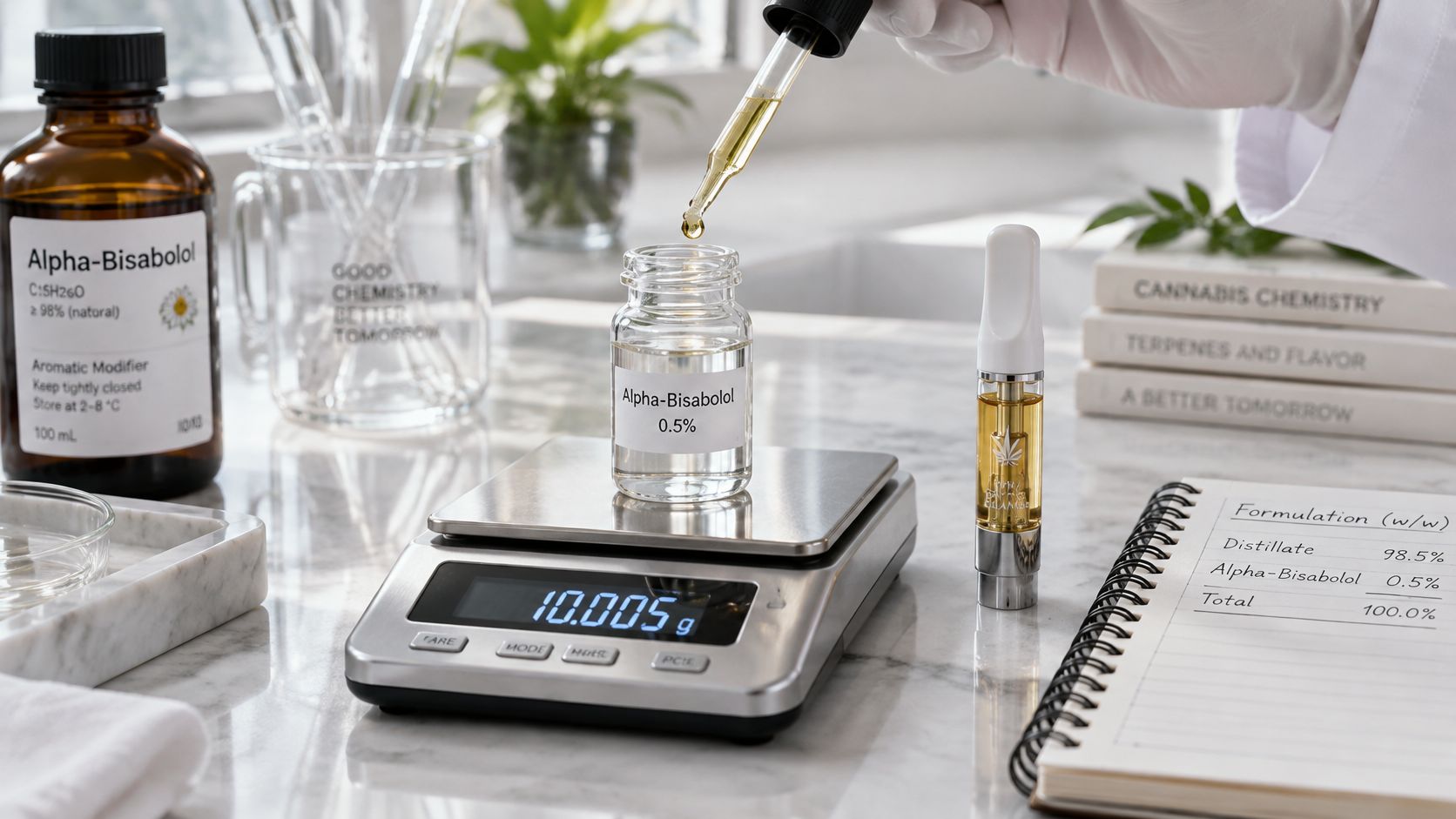
In distillate, evaluate integration throughout the oil rather than judging the isolated terpene on a blotter. Record ingredient mass, finished batch mass, order of addition, mixing conditions, and sampling locations.
A clear sample isn't enough to establish uniform distribution. Use an appropriate analytical plan and compare samples taken from different parts of the batch before approving the mixing process.
Alpha-bisabolol for vape cartridges
Cartridge development adds the delivery system to the evaluation. Compare the bulk oil with the filled product, then assess whether the selected hardware preserves the intended sensory balance under controlled test conditions.
The physical-property discussion above explains why alpha-bisabolol shouldn't be treated as interchangeable with limonene or pinene. Don't raise processing temperatures just to pursue evaporation, and don't infer safe operation from an ingredient's boiling point.
- Keep the matrix fixed: Avoid changing the cannabinoid oil, terpene blend, and hardware simultaneously.
- Track the finished concentration: Distinguish the isolate's proportion in a terpene premix from its proportion in the final oil.
- Approve the complete system: A successful bench blend isn't automatically an approved cartridge formula.
Gold Coast Terpenes states that its blends are formulated without VG, PG, PEG, or MCT and are tested to be THC-free. Its guide to using terpenes provides application context, but each manufacturer still needs its own validated process and product-release criteria.
How Should Buyers Compare Terpene Suppliers
Choose a supplier that can document source, identity, consistency, application fit, and fulfillment requirements. The lowest quoted ingredient cost isn't useful if the material cannot meet the approved profile or documentation standard.
For botanical versus cannabis-derived terpenes, compare evidence rather than assuming either source guarantees better flavor matching.
| Purchasing question | Botanical terpenes | Cannabis-derived terpenes |
|---|---|---|
| Source labeling | Request botanical origin and production-route records | Request cannabis-origin and extraction records |
| Identity | Require a batch-specific analytical specification | Require a batch-specific analytical specification |
| Variability | Verify the supplied blend against its target | Verify the extract against its target |
| THC-free positioning | Confirm with appropriate testing | Confirm with appropriate testing |
| Flavor replication | Evaluate against the intended reference | Evaluate against the intended reference |
| Regulatory review | Check intended-use and jurisdictional requirements | Check intended-use and jurisdictional requirements |
Nature-identical options introduce a separate production-route question. Don't allow the absence of a cannabis source to become an automatic botanical-origin claim.
Compare the commercial terms that affect production
Ask suppliers to state their MOQs, sample policy, bulk-price structure, lead times, shipping terms, and procedure for handling a nonconforming lot. Request safety documents and technical support before the purchase order, not after a development batch fails.
- Testing scope: Ask which analytes and methods appear on the lot report.
- Change notification: Establish how source or formulation changes will be communicated.
- Application support: Ask what evidence supports use in the proposed matrix.
- Reorder control: Confirm how future lots will be compared with the approved sample.
A structured scorecard helps purchasing and development teams compare supplier performance without allowing price to outweigh unresolved technical requirements.
Gold Coast Terpenes offers strain-specific profiles, isolated compounds, and wholesale or bulk purchasing options. Its terpene purchasing guide is a useful starting point for requesting current commercial terms and documentation.
The catalog's Elevated Strains entry provides a flavor-specific page to review during shortlisting. Don't infer alpha-bisabolol content, concentration, or application suitability from the product name or page address; obtain the relevant specification before selecting a sample.
How Can Teams Verify Quality From Batch to Cartridge
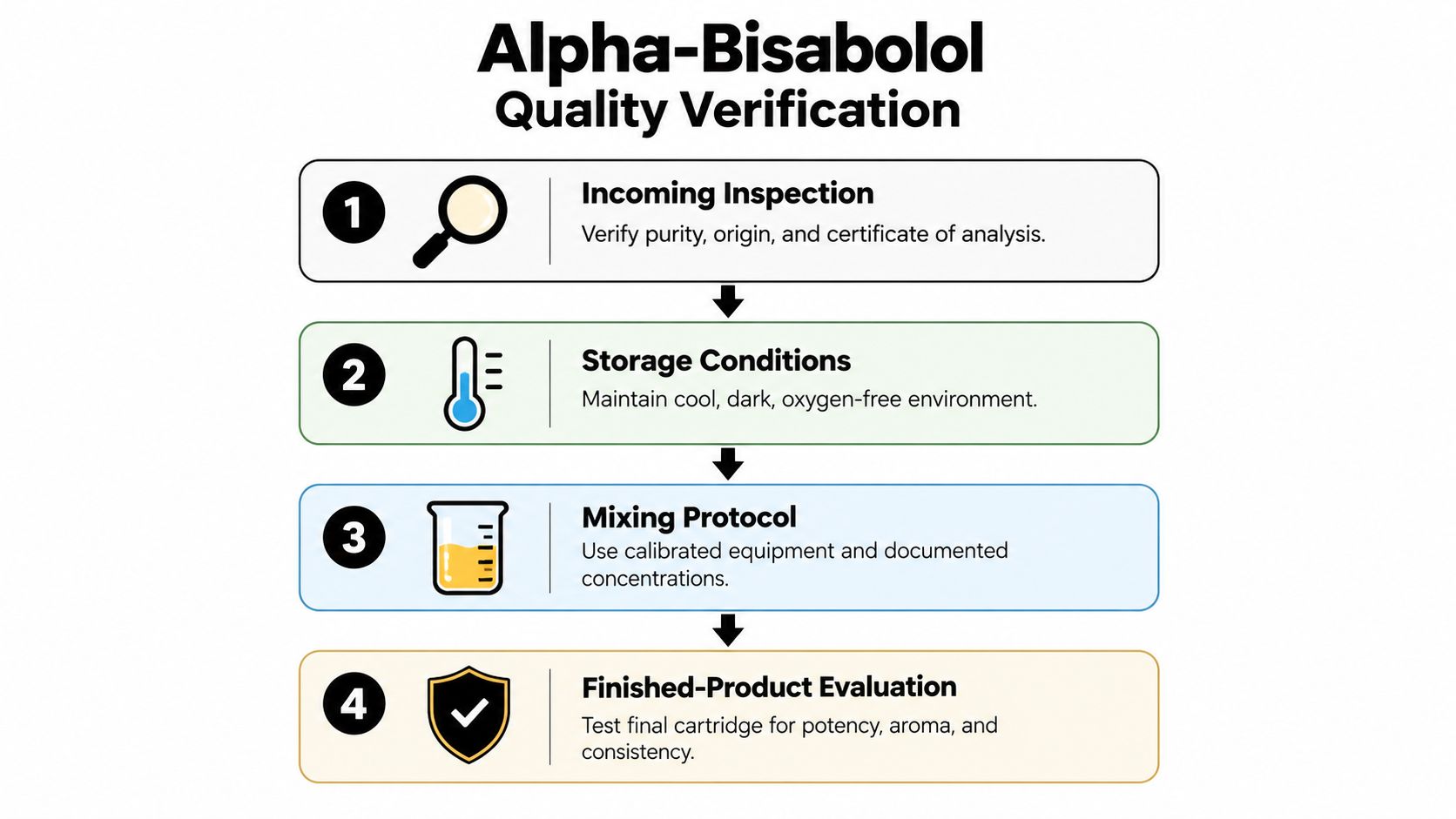
Reliable performance requires control from incoming material through mixing, storage, and finished-product evaluation. A supplier certificate is an input to quality control, not a substitute for releasing the final cartridge against defined criteria.
Assign each check to a responsible person and retain the records with the batch documentation.
Build a traceable release process
- Inspect incoming material: Reconcile the lot number, identity, appearance, specification, certificate of analysis, and safety documentation.
- Verify the target: Confirm the intended alpha-bisabolol concentration and the broader reference profile using an appropriate analytical method.
- Validate mixing: Record calibrated measurements, addition sequence, process conditions, and evidence of homogeneity.
- Control storage: Follow supplier recommendations and document container closure, temperature, light exposure, and handling.
- Retain samples: Keep representative incoming and finished samples for comparison.
- Evaluate after processing: Check the filled product rather than releasing it solely on the premix result.
A cannabis GC-MS application note reports that terpene levels may fall by more than half after three months of storage, with losses varying among individual terpenes. That finding doesn't establish an alpha-bisabolol-specific shelf life, but it supports recording storage history when comparing flower, incoming extract, and finished distillate.
Address the heated-inhalation gap directly
The alpha-bisabolol safety data sheet identifies incomplete health-hazard knowledge and components with unknown acute inhalation toxicity. An acute classification result therefore shouldn't be presented as proof of safety during repeated heating and aerosol exposure.
Route-specific review should address thermal degradation products, aerosol exposure, delivered dose, and repeated-use uncertainty. Natural origin and THC-free status don't resolve those questions.
Use conservative development practices, qualified safety review, irritation and adverse-event monitoring, and jurisdiction-specific compliance assessment. Gold Coast Terpenes' quality-control testing resource can support documentation discussions, but manufacturers remain responsible for their finished-product decisions.
Batch consistency is a reproducibility tool. It helps teams make the intended formula again; it doesn't establish therapeutic efficacy or settle inhalation safety.
What Questions Should Buyers Ask Before Purchasing
Buyers should resolve the ingredient's intended job, evidence limits, documentation requirements, and source preference before ordering production quantities. Sample approval should produce a written specification, not just a preferred aroma.
Will alpha-bisabolol dominate a strain-inspired terpene blend?
It shouldn’t be assumed to dominate; assign its role from the reference profile and controlled sensory comparisons. Ask Gold Coast Terpenes for the relevant isolate or blend specification before deciding whether a premade profile or a separate modifier better suits the project.
Can preclinical research support therapeutic cartridge advertising?
The laboratory findings discussed above don’t substantiate therapeutic advertising for a finished cartridge. Keep the commercial description focused on verified composition and sensory attributes, and have qualified reviewers assess proposed claims.
What documentation should arrive before a purchase order?
Request a current specification, batch-testing example, safety data sheet, origin statement, intended-use information, and written commercial terms. Gold Coast Terpenes provides safety documents, state information, and wholesale or bulk programs, but buyers should confirm which records and terms apply to the selected material.
When should a team sample botanical versus cannabis-derived terpenes?
Compare both when source labeling, target fidelity, and procurement requirements remain open development decisions. Evaluate samples in the same finished matrix, then select the option that meets the documented sensory, analytical, and compliance criteria rather than choosing by source category alone.
Gold Coast Terpenes offers strain-specific blends, isolated compounds, and formulation tools for teams developing cartridges and distillate products. Visit Gold Coast Terpenes to review the matching strain-specific offering or inquire about alpha-bisabolol, request supporting documentation, and arrange samples before committing to a production formula.