
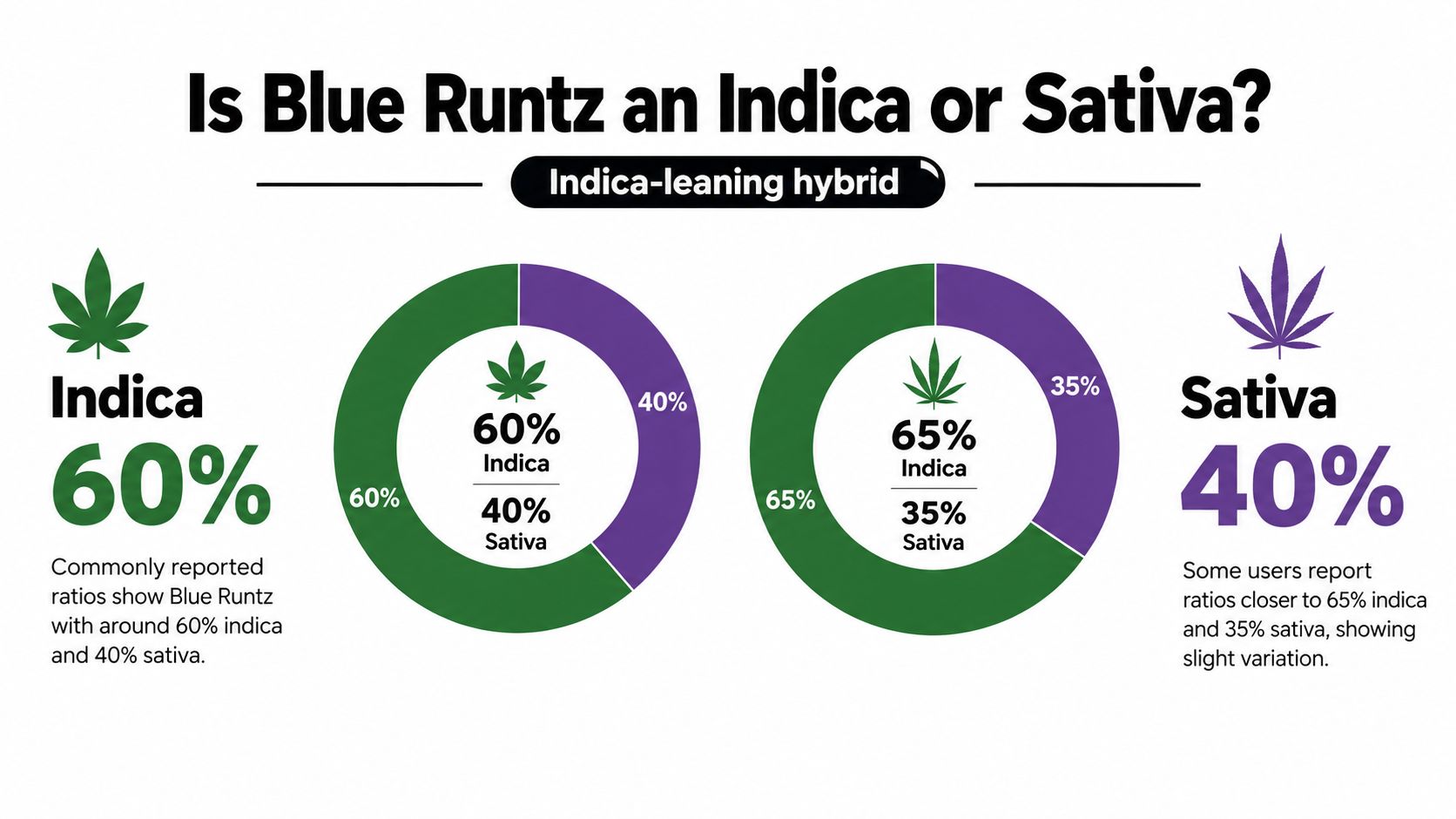
Blue Runtz is an indica-dominant hybrid, commonly described at roughly 60% indica / 40% sativa. That ratio is a marketing convention, not a reliable flavor or effect spec, and Gold Coast Terpenes builds strain-inspired profiles around measured terpene data instead of leaning on labels alone.
For a vape brand, that matters more than the headline split. Blue Runtz is better treated as a chemistry-first rebuild of a cultivar name, not a fixed formula.
Is Blue Runtz an Indica or a Sativa
Blue Runtz is an indica-leaning hybrid, and the buyer answer is simple, indica-dominant is the right classification. Most references put it near 60% indica / 40% sativa, while some databases push it closer to 65% / 35% (Blue Runtz strain overview).
Why the split is a weak formulation spec
That percentage tells you a little about structure and broad cultivar positioning. It does not tell you the terpene load, the dominant aroma compounds, or how the profile will behave once it's diluted into distillate, then pushed through hardware. A formulator who builds from the ratio alone is guessing.
Gold Coast Terpenes, a Redondo Beach, CA supplier, focuses on strain-inspired terpene blends and isolated compounds for cartridge and concentrate work, which is the right lens here. If you're sourcing or building around Blue Runtz, the first question isn't "indica or sativa," it's "what does the batch test like?"
Practical rule: Use the indica/sativa split as a rough orientation, then throw it out as a flavor specification.
The practical use of the split is limited. It can hint at grow structure and flowering behavior, but it won't predict whether the finished oil reads as candy, berry, cream, spice, or something else. If you need a broader ingredient-reference mindset for a formulation line, browse grain neutral spirits options as a reminder that input class and downstream handling matter as much as the name on the label.
If you're writing SOPs for a Blue Runtz SKU, keep the internal reference anchored to data, not folklore. The closest useful shortcut is Gold Coast Terpenes' own guidance on indica vs sativa terpenes, because it pushes the conversation toward measurable aroma architecture.
Blue Runtz Genetics and Phenotype Variation
Blue Runtz is commonly listed as Blueberry crossed with White Runtz, but that label does not lock the plant into one fixed expression. Other listings attach the name to broader Runtz-related genetics, so the menu name can point to more than one phenotype, not one clean cultivar.
Why that matters for sourcing
That variation changes how a brand should buy and spec the material. A Blue Runtz label can describe a flavor family, a breeder line, or a phenotype bucket, so the name alone is too loose for production planning. One batch may read fruitier, another creamier, and another may push a sharper candy note.
Reported flowering windows also vary. One commonly marketed seed line sits around 60 to 70 days, while a GLK Genetics listing reports roughly 63 days. Those numbers describe cultivation timing, not a guarantee of finished-oil flavor, and they matter more to growers than to brands trying to hold a repeatable cartridge profile.
For extractors and product developers, the takeaway is blunt. Plan for batch-level variation, not just SKU-level variation. Match each lot against the sensory target you intend to sell.
A catalog note helps here too. Gold Coast Terpenes lists Bananna runtz under its Elevated Strains flavor set, and that kind of naming signals a flavor direction rather than a single botanical truth. Use the same lens for Blue Runtz.
For phenotype buckets, see our guide to male vs female cannabis plants.
Treat the name as a starting point, not a chemical guarantee.
A cleaner formulation approach is to define the sensory goal first, then choose the batch that best supports it. That keeps the SKU from drifting when breeder attribution shifts or source material changes.
Dominant Terpenes in the Blue Runtz Profile
Blue Runtz is best handled as a terpene architecture problem, not a candy-name exercise. The clearest lab starting point is limonene at 0.64%, beta-myrcene at 0.50%, linalool at 0.42%, beta-caryophyllene at 0.41%, and caryophyllene oxide at 0.32% (Blue Runtz terpene database).
What each compound is doing
Limonene should carry the top note, because it gives the profile citrus lift and keeps the blend from flattening into vague berry sweetness. Myrcene and linalool belong in the mid layer, where they soften the edges and add body, while beta-caryophyllene sits in the base note, bringing peppery depth and a warmer finish.
That lab ladder also includes lower-level humulene, nerolidol, beta-pinene, and alpha-pinene. Treat those as support, not the point of the formula. A proper Blue Runtz build uses a three-tier profile, with each tier assigned a job before anything goes into distillate.
| Blue Runtz Terpene Ladder by Lab Report | ||
|---|---|---|
| Terpene | Reported Concentration | Note Role |
| Limonene | 0.64% | Top note, citrus anchor |
| Beta-myrcene | 0.50% | Mid note, soft earthy body |
| Linalool | 0.42% | Mid note, floral lift |
| Beta-caryophyllene | 0.41% | Base note, spicy depth |
| Caryophyllene oxide | 0.32% | Base support, woody nuance |
| Humulene | Lower level | Base support, earthy wood |
| Nerolidol | Lower level | Mid-to-base complexity |
| Beta-pinene | Lower level | Bright supporting note |
| Alpha-pinene | Lower level | Bright supporting note |
Retail copy usually leans on sweet berry, grape, candy, and cream. Those labels help sell the story, but they do not help a blender sheet. A cartridge responds to mass percentage, volatility, and how the compounds open on the palate, not to menu language.
Gold Coast Terpenes has a Runtz terpene guide that is worth keeping beside your bench notes for the same reason. It keeps the conversation on structure instead of branding.
Formulator's rule: If you cannot translate the aroma into top, mid, and base notes, you do not have a blend yet.
Building a Blue Runtz Strain-Inspired Terpene Blend
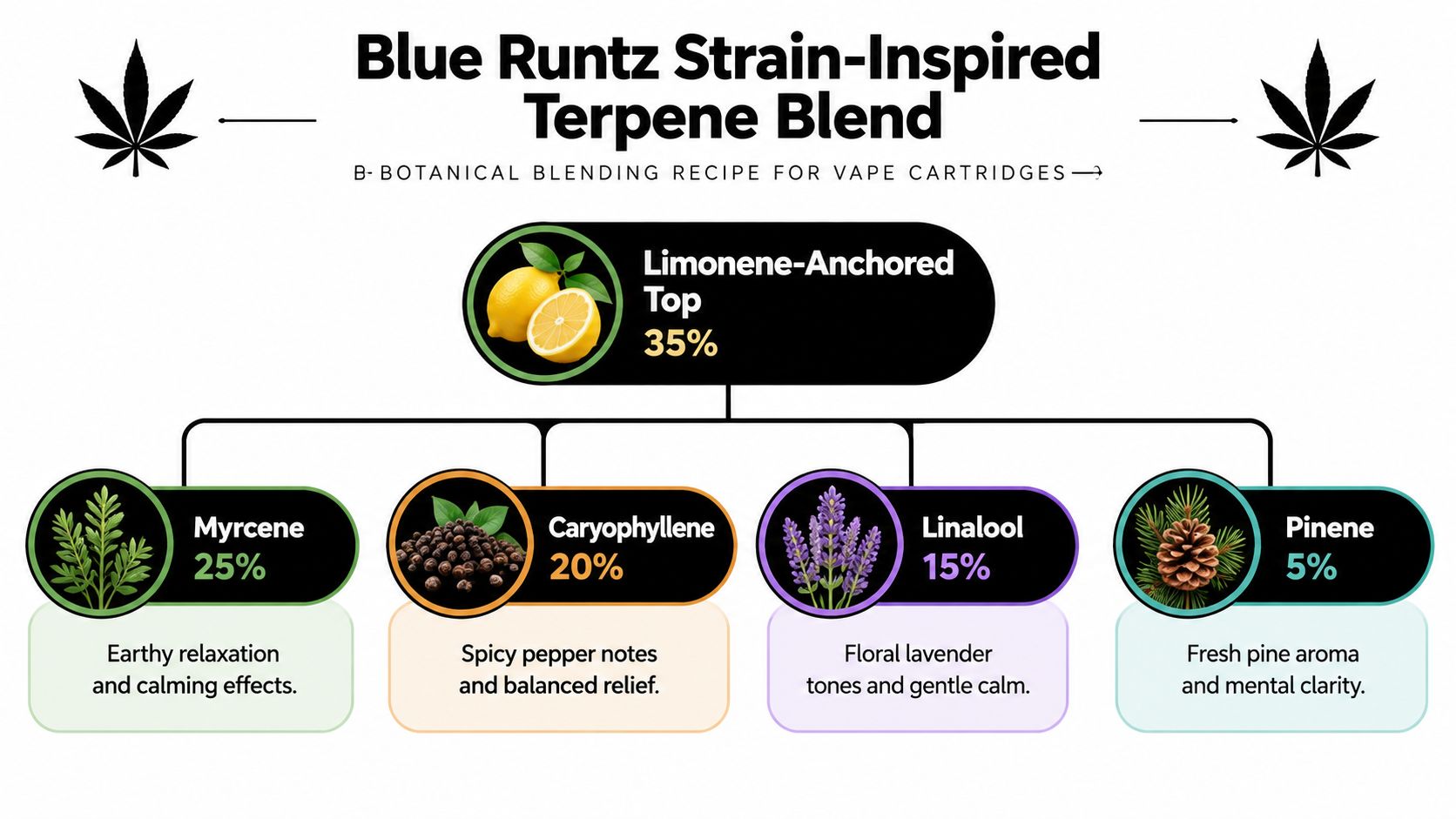
A Blue Runtz-inspired cartridge should start with a limonene-led top, then add myrcene, linalool, and caryophyllene in proportions that preserve the lab profile's shape. For a first pass, I'd treat the blend as a measured architecture, not a copy of flower, because the oil you're adding it to has already been processed.
A practical starting architecture
Use this as a pilot-batch framework, then tune by sensory feedback:
- Limonene: 35% of the blend for citrus lift and top-note clarity
- Myrcene: 25% for earthy roundness and mid-body
- Caryophyllene: 20% for peppery base depth
- Linalool: 15% for floral softness and smoothing
- Pinene: 5% for a clean pine edge
That is not a universal prescription. It is a sane starting point when you're trying to land a Blue Runtz feel in distillate without chasing the exact chemistry of the flower, which changes too much from batch to batch anyway.
For cartridge work, load rate matters as much as blend makeup. In distillate systems, teams commonly test in the 5% to 15% range by mass depending on hardware and the intensity target, then document the final blend by weight so lot-to-lot output stays reproducible. If you're matching this kind of profile across production, the exact mass record matters more than the strain label.
How to keep the blend honest
The biggest mistake is overbuilding sweetness and underbuilding structure. Blue Runtz can smell candy-forward on paper, but in a finished vape that reads flat unless the citrus top and spicy base are present in the right relationship.
Gold Coast Terpenes sells terpenes for distillate with a formulation mindset that fits this workflow, especially when a brand needs repeatable lots rather than a one-off flavor stunt. That doesn't make the profile “authentic” in a botanical purity sense, it makes it controllable.
The other number that matters here is potency variability in the source market. Reported Blue Runtz THC ranges span approximately 19% to 30% across sources, an 11-percentage-point spread that can change perceived intensity and concentrate formulation strategy (Blue Runtz potency guide). That spread is another reason to blend by target sensory outcome, not by the flower label alone.
Why Processing Changes the Profile Before It Reaches the Cart
Blue Runtz only behaves like Blue Runtz in a cart if you treat the incoming oil as the source of truth. The flower label is a starting reference, not a formulation spec.
Drying and handling change the starting material
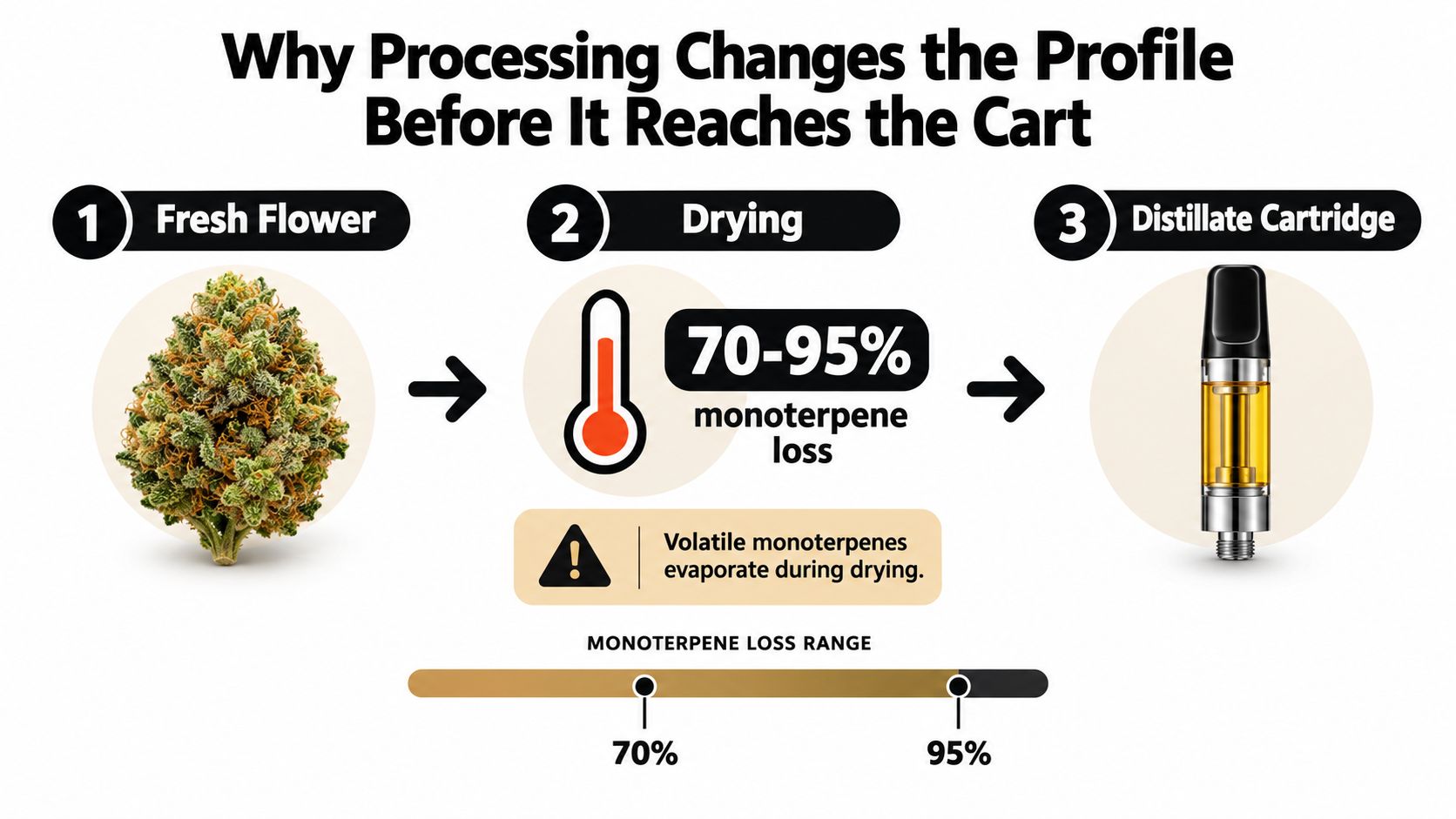
A peer-reviewed drying study reports 70% to 95% volatile-terpene loss under the studied conditions, because monoterpenes evaporate first and relative loss is governed by vapor pressure (drying study). By the time extraction, distillation, and storage are finished, the original flower aroma is already altered.
That is the practical takeaway for a formulator. Base the test on the incoming oil rather than the flower label. If the processed oil is short on bright monoterpenes, restore the desired top-note structure after processing, then confirm the finished blend against a sensory reference.
What to do instead
Build the Blue Runtz profile as a post-distillation correction layer. That lets you restore the limonene-led top and keep the base notes from turning muddy or overcooked.
Gold Coast Terpenes positions its botanically derived blends for this kind of add-back work, where a processed oil needs a stable terpene correction instead of a flower clone. For cartridge production, that is the right standard. The cart responds to what survives processing, not to what the cured flower smelled like.
Botanical vs Cannabis-Derived Sourcing for a Blue Runtz SKU
Botanical sourcing is the practical choice when a Blue Runtz SKU has to scale, move across markets, and stay reproducible. Cannabis-derived input can fit certain premium positioning strategies, but it gives brands less control over batch consistency and distribution planning.
The sourcing decision should be operational, not poetic
If you need THC-free labeling, broader state compatibility, and a simpler compliance story, botanical terpenes make sense. If you need repeatable supply across multiple runs, botanical input also helps because you are not tied to one cultivar harvest to support a line extension.
Gold Coast Terpenes publishes SC Lab-tested, THC-free terpene blends that are free of VG, PG, PEG, and MCT. That kind of documentation matters when a vape brand has to ship through multiple channels. The label-clean part matters. The supply chain part matters too, because scale only works when the profile can be rebuilt the same way every time.
When to prefer botanical input
- Multi-state distribution: Botanical terpene blends simplify label and supply planning.
- Reproducibility: Batch-to-batch matching is easier when the source class is controlled.
- MOQ flexibility: Brands can test and scale without tying the launch to a cannabis harvest.
- Flavor tuning: You can emphasize citrus, floral, or spice without depending on one flower phenotype.
No botanical blend is a perfect duplicate of a living flower sample. That is acceptable. A cartridge SKU needs a profile that hits the target every time.
The Banana Runtz profile noted earlier shows how a strain-inspired name can work as a flavor direction rather than a genetic claim. Use that same standard for Blue Runtz. Build to the measured limonene, myrcene, and caryophyllene target, then verify that the finished blend survives processing without drifting into a flat or overcooked result.
Batch Verification Checklist for a Blue Runtz Cart
Approve a Blue Runtz SKU only after the batch clears a hard QA gate. Reproducibility across runs matters more than a decent first batch.
Minimum checks before release
- Input oil panel: Confirm total THC and CBD in the oil before blending.
- Minor cannabinoids: Verify the full minor cannabinoid panel where available.
- Terpene total: Measure total terpene percentage after reintroduction.
- Ratio match: Confirm dominant terpene ratios against the target architecture.
- Sensory match: Compare the finished oil to a reference sample.
- Hardware fit: Test compatibility at the planned load rate in the actual cartridge hardware.
- Mass record: Document the final blend by mass for traceability.
If one of those pieces is missing, the SKU is under-controlled. Gold Coast Terpenes publishes lab documentation and offers a Mixing Calculator on its site, which fits this workflow when a brand needs to turn a sensory target into a repeatable formula.
A Blue Runtz label is not a QA plan. Your blend sheet is the QA plan.
Gold Coast Terpenes' flavor-enhanced strain line uses selective enhancement, so the formulation still has to pass your own checks before release. The goal is a lot that behaves the same way every time you fill it. That is what keeps a strain-inspired SKU from becoming a moving target.
Choosing the Right Blue Runtz Terpene Profile for Your Production
Blue Runtz is not really a “blue runtz strain indica or sativa” question. It's a flavor and chemistry question, and the answer should anchor on a limonene-led top, myrcene and linalool in the mid, and caryophyllene in the base.
For a production trial, choose a botanical source class that supports compliance and scale, then request a batch-specific lab sheet and sample. Gold Coast Terpenes offers free U.S. shipping over $100 and bulk discounts above 64 oz, which makes it easier to move from bench testing to a real production run without changing suppliers midstream.
Gold Coast Terpenes supplies strain-inspired terpene blends, isolated compounds, and formulation tools for teams that need repeatable flavor, not just strain names. If you're building a Blue Runtz cart or distillate SKU, visit Gold Coast Terpenes to review terpene options, request a sample, and compare lab-backed profiles before your next pilot batch.