
A cartridge team can produce two batches labeled Lemon Cherry Gelato that smell unrelated, test differently, and behave differently in the same hardware. Gold Coast Terpenes supplies lab-verified, THC-free botanical terpene blends made without VG, PG, PEG, or MCT, giving formulators a way to translate a recognizable sensory target into a documented blend instead of relying on the cultivar name alone.
For product developers, Lemon Cherry Gelato isn't a fixed recipe. It's a variable chemotype with a recurring identity, lemon and citrus brightness, cherry and berry fruit, sweetness, cream, and a spicy-herbal backbone. The practical job is to define that identity with measured ratios, finished-oil testing, hardware trials, and compliance records. This guide applies that approach to a strain-inspired terpene blend for vape cartridges and distillate, using published COA data and a staged top, mid, and base note workflow.
Why Formulators Treat Lemon Cherry Gelato as a Chemotype
Two carts carrying the same Lemon Cherry Gelato label can smell nothing alike because the label doesn't guarantee one chemical profile. Independent research found that commercial cannabis labels are poorly aligned with underlying chemistry, and products sold under the same cultivar name can differ with genetics, cultivation, origin, and processing, as documented in this peer-reviewed chemotype analysis.
Lemon Cherry Gelato is best understood as a selected and propagated phenotype popularized by Backpack Boyz, not as a globally standardized cultivar with one immutable terpene formula. That distinction matters commercially. An extractor can buy flower under the right name and still receive a different ratio of limonene, myrcene, beta-caryophyllene, linalool, or minor constituents from the previous lot.
Start with the sensory target
The useful specification isn't “Lemon Cherry Gelato terpenes” as a label. It's a measurable target such as:
- Top note: bright lemon and citrus impact.
- Middle note: peppery, spicy, herbal depth.
- Base note: sweet fruit, cherry, and creamy dessert character.
- Tolerance: defined limits for dominant compounds and total terpene load.
- Verification: COA review plus sensory testing in the finished oil.
That format gives a brand owner something a supplier can reproduce and a quality team can release against. It also prevents a common failure, copying one dominant terpene and expecting the original aroma to reappear.
Practical rule: Specify the aroma architecture first, then specify the cultivar name as a market reference.
Gold Coast Terpenes fits this workflow as a botanical source for strain-inspired blends and individual compounds. Its indica versus sativa terpene guide is useful for broader profile comparison, but a Lemon Cherry Gelato project still needs its own COA-based target.
Lineage, Origin, and Why the Name Travels
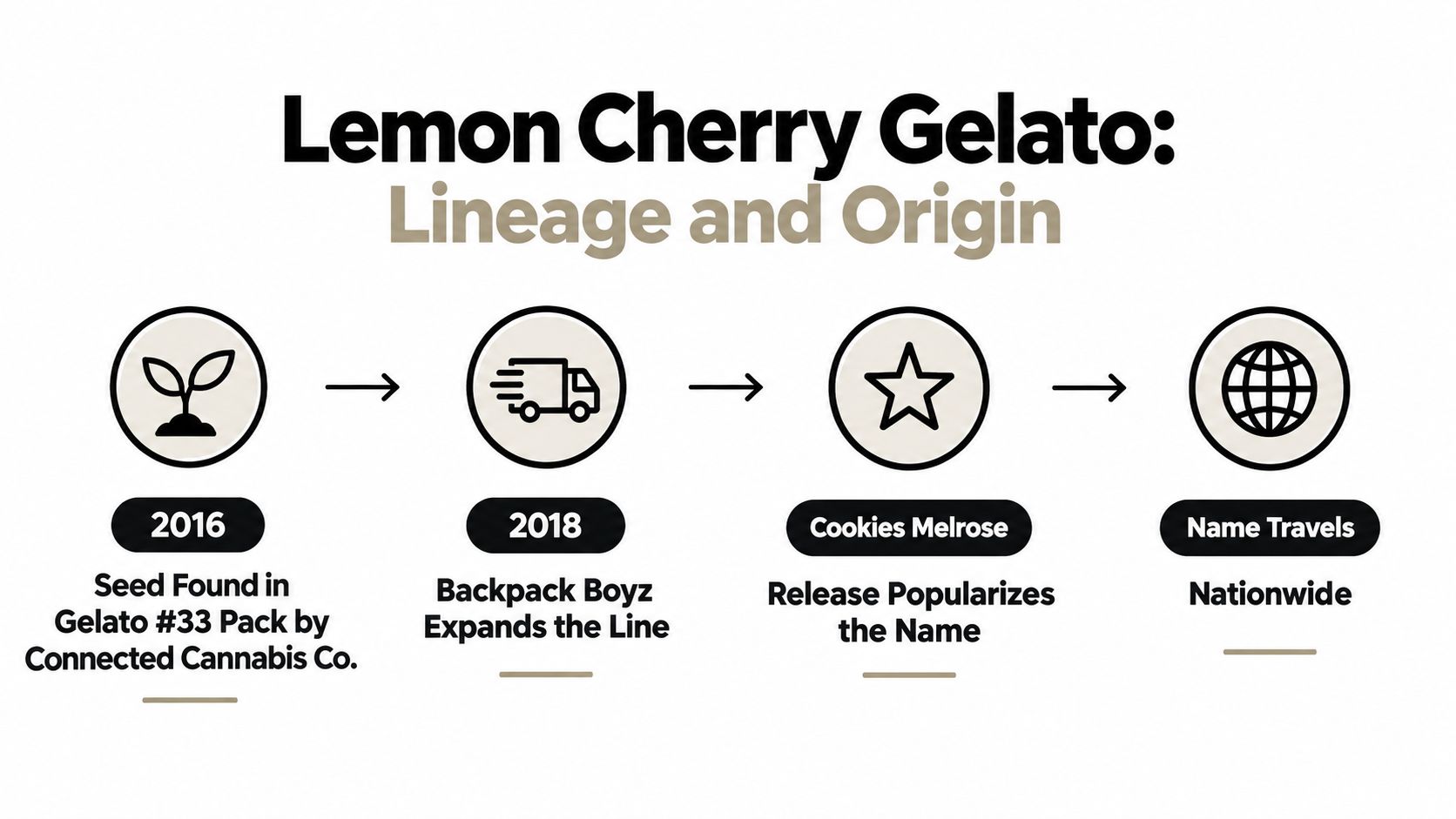
Lemon Cherry Gelato is best specified as a variable chemotype, not a fixed recipe. High Times reports that the original cut came from a seed found in a Connected Cannabis Co. Gelato #33 pack in 2016. Backpack Boyz later became closely associated with the commercial rise of the name.
Gelato #33 traces to Sunset Sherbet and Thin Mint Girl Scout Cookies. That background explains why retail databases often reduce Lemon Cherry Gelato to those parental families. For formulation work, the more accurate description is Gelato #33 offspring with an unidentified direct pollen parent. The name therefore travels more reliably than the chemistry behind it.
Recognition strengthened the sensory shorthand
By 2018, Backpack Boyz had expanded production, and a release at Cookies Melrose helped spread the name through California's cannabis market. A Leaflybuds listing identifies Lemon Cherry Gelato as the second-place finisher at the 2021 High Times Cannabis Cup and describes a commonly marketed 24% to 28% THC range. The figures support premium positioning, but they do not establish a chemical standard.
High Times reports a broader 20% to 29% THC range for typical results. Leafly's general profile lists approximately 20% THC and 0% CBD, while marketplace products have been listed at 24.2%, 25.22%, 25.7%, 27.68%, and 32.54% THC. Those marketplace values are product-specific. They should not set terpene ratios, but they show why a strain name cannot replace batch documentation.
For a formulator, the practical lesson is clear: the flavor reputation travels, while plant chemistry varies. Define the sensory target, set acceptable compound ratios, and verify each incoming lot against its COA before building a cartridge or distillate profile.
Dominant Terpene Breakdown From Published COAs
A Lemon Cherry Gelato reference profile needs a tolerance window, not a fixed recipe. Across the certificates cited here, beta-caryophyllene, myrcene, and limonene recur as major constituents, but their proportions shift. Specify the ratio first, then confirm each incoming lot before using it in a cartridge or distillate blend.
One GC-FID certificate measured 1.9536% total terpenoids, with beta-caryophyllene at 6.691 mg/g, myrcene at 2.659 mg/g, and limonene at 2.513 mg/g, as documented in the COA certificate of analysis guide. A separate flower certificate reported 2.11% total terpenes, including beta-caryophyllene at 0.53%, d-limonene at 0.40%, linalool at 0.35%, beta-myrcene at 0.34%, and alpha-humulene at 0.14%. These are useful reference points, not specifications for every batch.
What the comparison means for a blend
| Compound | COA A mg/g | COA A percent | COA B percent | Role in premix |
|---|---|---|---|---|
| Beta-caryophyllene | 6.691 | Not reported in the cited format | 0.53% | Spicy mid note |
| Myrcene | 2.659 | Not reported in the cited format | 0.34% | Herbal base |
| Limonene | 2.513 | Not reported in the cited format | 0.40% | Citrus top note |
| Linalool | Not reported | Not reported | 0.35% | Floral accent |
| Alpha-humulene | Not reported | Not reported | 0.14% | Herbal, peppery depth |
For the first profile, the three reported major compounds scale to an approximate 1,000 mg starting premix allocation of 562 mg beta-caryophyllene, 223 mg myrcene, and 211 mg limonene. The remaining 4% represents minor constituents. This calculation preserves the observed relationship among those compounds. It is not a universal Lemon Cherry Gelato formula.
Review the total terpene result, compound list, production or harvest date, product format, and laboratory method before approving material. Confirm the lot with GC-FID or GC-MS before scaling, since genetics, curing, extraction, and storage can change the measured profile.
A release specification should record each target ratio and its permitted tolerance. A batch can match the strain name and still fail the sensory brief if those ratios drift.
Flavor and Aroma Notes Staged as Top, Mid, and Base
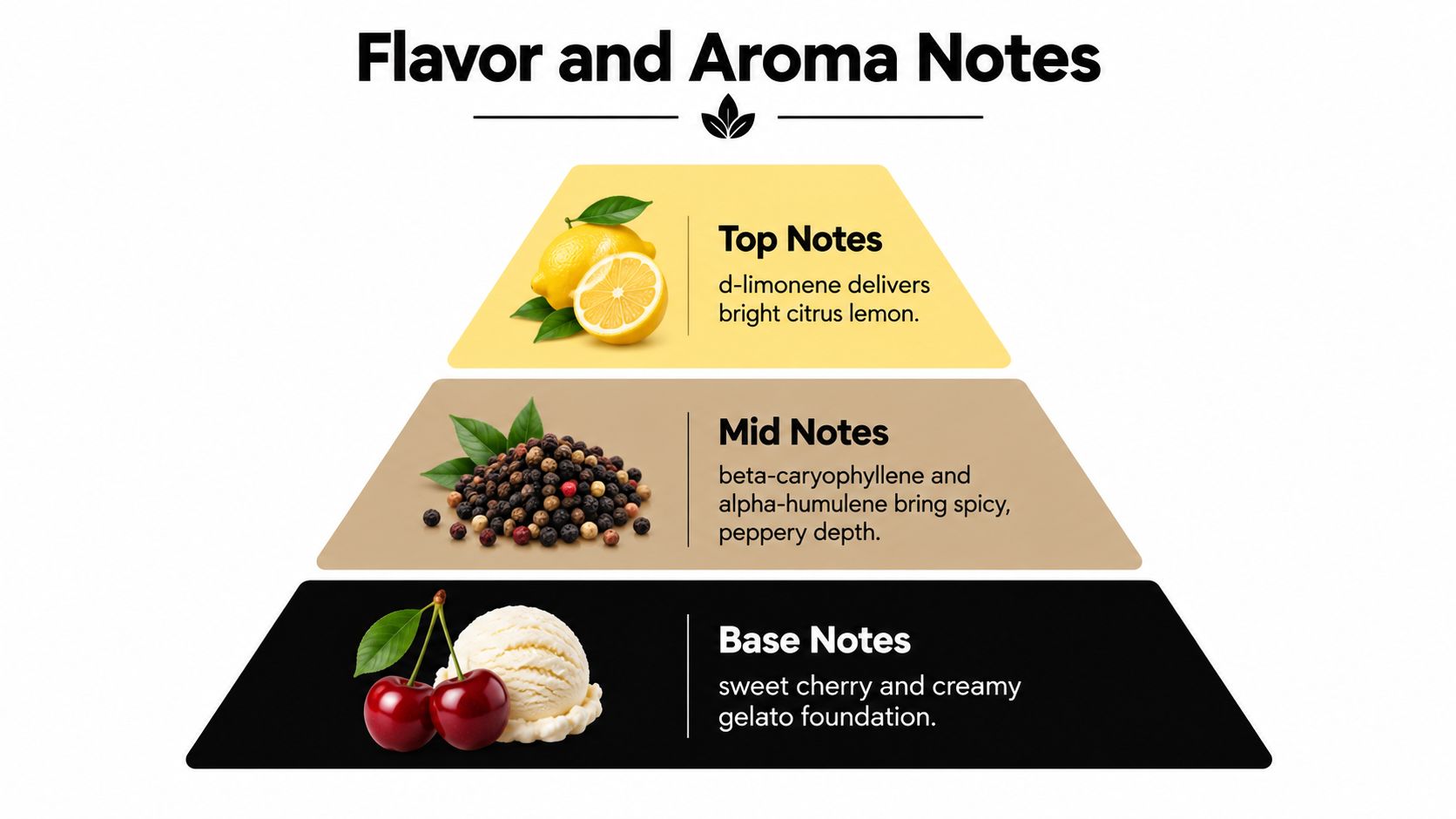
The most reliable way to build Lemon Cherry Gelato flavor is to stage the blend. D-limonene supplies the citrus top note, beta-caryophyllene and alpha-humulene provide spicy depth, myrcene anchors the herbal body, and linalool adds a floral lift. A representative laboratory certificate associates those compounds with citrus, spicy, herbal, and floral character respectively.
Build the profile in layers
Top notes come first. Establish limonene at the opening stage so the lemon brightness reads clearly in the raw blend and in the first part of the draw. If the citrus note is weak, adding more total blend later may only increase heaviness and harshness rather than restoring brightness.
Mid notes create continuity. Add beta-caryophyllene and, where supported by the target COA, alpha-humulene to form the peppery, spicy, slightly herbal bridge between citrus and dessert. These compounds stop the profile from reading like a simple lemon flavor.
Base notes carry the finish. Myrcene gives the blend a deeper herbal body, while a controlled linalool addition can bring floral lift that supports cherry and berry perception. Linalool should come after the core balance is stable. Added too early or too heavily, it can make the profile floral and obscure the fruit.
The terpene flavor chart can help teams compare individual aroma roles before they lock the final ratio. Gold Coast Terpenes' Elevated Strains line is another example of a profile organized around layered flavor rather than a single isolated note.
Judge the finished oil, not only the concentrate
A raw blend can smell accurate in a vial and lose its citrus edge after it enters distillate, moves through a cartridge, or sits in contact with hardware. Excessive volatile loading can create harshness and bury fruit notes, so the endpoint should come from finished-product sensory testing supported by analytical verification.
Keep a panel record for aroma at fill, after equilibration, and after hardware exposure. The exact testing schedule depends on the product and jurisdiction, but the principle doesn't change. Formulators need to evaluate what the consumer receives, not what the mixing vessel smelled like.
Formulating Lemon Cherry Gelato for Cartridges and Distillate
For cartridges, start at the lower end of the supplier's validated inhalation loading window and titrate upward through finished-oil sensory trials. The correct level depends on distillate viscosity, extract type, cartridge construction, coil material, and the behavior of a PG-free formulation, so a higher terpene percentage isn't automatically a better flavor.
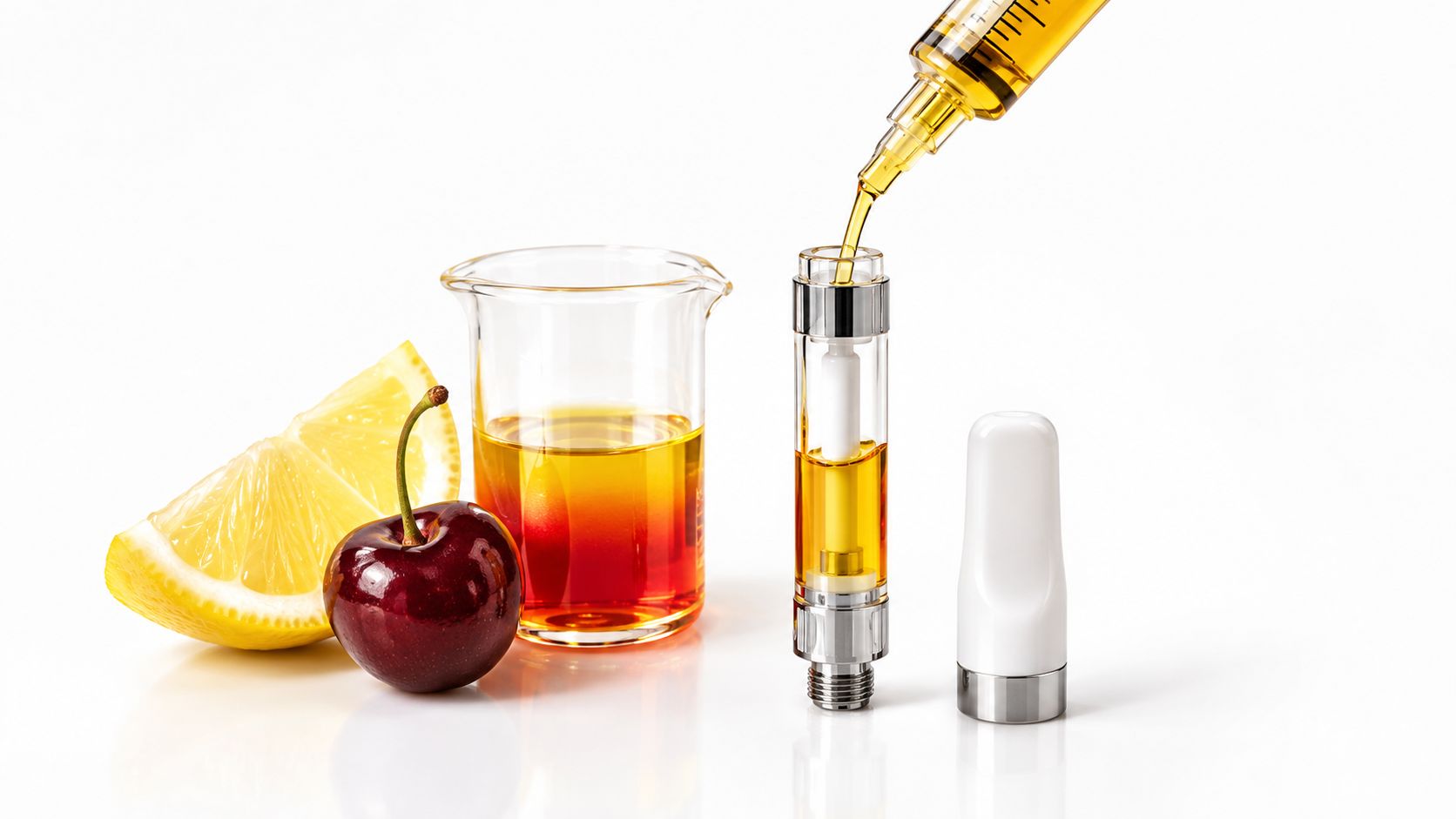
Winterized distillate usually gives a cleaner but less naturally expressive base than live resin or another high-terpene extract. A strain-inspired blend can restore the intended citrus, fruit, and creamy direction, but the oil's viscosity and the cartridge's wick or ceramic system change delivery. Standard 510 hardware and ceramic coils should be tested separately because the same oil can produce different draw intensity, vapor temperature, and perceived harshness.
A practical bench workflow
- Characterize the base oil. Record the distillate or extract's aroma, viscosity, color, and existing terpene result before adding anything.
- Prepare a small weight-based trial. Use a documented blend ratio rather than drops or volume estimates. The guide to adding terpenes to distillate provides useful formulation context.
- Stage the profile. Establish limonene, then build with beta-caryophyllene and myrcene, and add linalool only as a controlled floral adjustment.
- Fill representative hardware. Compare the cartridge systems intended for production, not only a glass vial.
- Review the finished oil. Confirm aroma, draw, aftertaste, leakage behavior, and analytical results before releasing the formula.
Gold Coast Terpenes describes its blends as THC-free, free of VG, PG, PEG, and MCT, and tested by SC Lab. Those specifications can simplify material review, but they don't remove the need to test the final cannabis oil or confirm inhalation suitability for the finished formulation.
A useful way to sharpen the brand's sensory direction is to review Brand Spy ad examples for food, not to copy food flavor claims, but to study how citrus, cherry, and dessert cues are separated in commercial positioning.
The Gold Coast Terpenes Mixing Calculator can help convert a target percentage by weight into a 1,000 mg batch calculation. Treat that output as a bench starting point, then confirm the finished oil with a third-party certificate. The raw blend's COA doesn't prove that the same proportions remain after mixing, processing, storage, and hardware exposure.
Compliance and Botanical Versus Artificial Flavor Risk
A California cartridge brief should separate botanical terpene reconstruction from artificial flavor addition before blending begins. Added terpenes must be naturally occurring compounds that contribute to cannabis flavor or aroma, but they do not have to come from cannabis. Artificial or synthetic terpenes are not permitted under Department of Cannabis Control guidance.
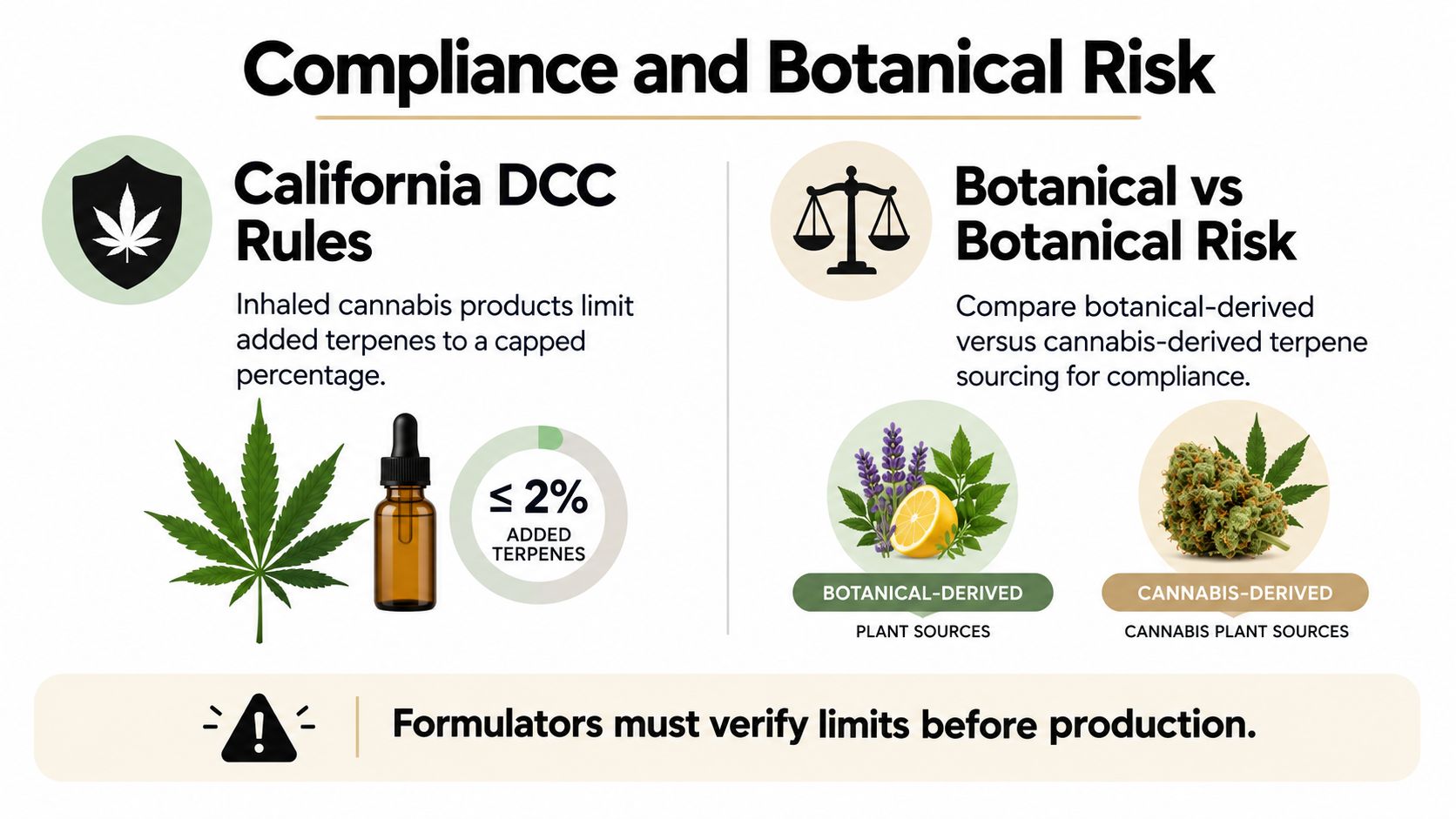
The same California DCC guidance lists cherry, citrus, strawberry, grape, vanilla, chocolate, cinnamon, and other standalone flavor concepts among prohibited examples when used as non-cannabis flavoring. For Lemon Cherry Gelato, formulators can specify the naturally occurring citrus, floral, and peppery terpene structure, then verify that the selected botanical blend supports that profile. Adding a separate confectionery cherry flavor creates a different regulatory question.
Botanical sourcing versus synthetic flavor systems
| Decision | Botanical terpene route | Artificial flavor route |
|---|---|---|
| Aroma strategy | Builds from compounds naturally present in cannabis | Uses independent flavor chemicals |
| California inhaled-product fit | Requires documentation and rule review | Artificial or synthetic terpenes are not permitted |
| Sensory control | Ratio-based, COA-supported profile | May produce a recognizable fruit note but raises compliance concerns |
| Main risk | Batch variation and finished-oil behavior | Inhalation compatibility and prohibited flavor use |
The National Cannabis Industry Association warns that the safety of many flavorings in vaporized products has not been fully evaluated. Its white paper also reports that some chemicals associated with vanilla, cherry, citrus, and cinnamon can form acetals when mixed with PG or VG, and identifies those compounds as capable of causing irritation and chronic lung inflammation. Concentrated terpene exposure can also cause hypersensitive or allergic reactions.
A strong aroma from the raw vial does not establish cartridge suitability. Review each material's identity, purity, concentration, carrier materials, and source, then assess the finished oil after processing and hardware exposure. The same ratio can behave differently across batches, distillate matrices, and cartridge systems.
Gold Coast Terpenes' botanical positioning can support a naturally occurring terpene strategy, but it does not replace product-specific regulatory review. Confirm the applicable state limit, permitted compounds, labeling language, inhalation suitability, and documentation before production.
Putting It Together and Next Steps With Gold Coast Terpenes
A reliable Lemon Cherry Gelato formulation starts with a chemotype-first specification, not a strain-name shortcut. Define the dominant ratio, stage limonene, beta-caryophyllene, myrcene, and linalool by sensory role, test the finished oil in the intended cartridge, and retain compliance documentation for every incoming material and production batch.
Use this working checklist:
- Profile definition: Record the target citrus, spicy, herbal, floral, cherry, and creamy notes.
- Analytical control: Compare incoming COAs for cannabinoids, total terpenes, dominant compounds, date, product format, and test method.
- Bench development: Convert the selected ratio into a weight-based trial and adjust one note at a time.
- Hardware review: Test the actual 510 or ceramic system planned for sale.
- Release decision: Confirm the finished oil, not only the raw terpene blend, through sensory review and third-party analysis.
Gold Coast Terpenes describes its product line as lab-verified, THC-free, free of VG, PG, PEG, and MCT, SC Lab-tested, and legally available worldwide, according to its official product information. For a formulation team, the practical next step is to review the relevant product page, consider isolates such as limonene, myrcene, or beta-caryophyllene when one note needs independent adjustment, and use the Terpenes 101 resources and Mixing Calculator to document the trial.
Wholesale, affiliate, and bulk programs can support a path from bench work to scaled production, including free U.S. shipping over $100 and discounts on orders exceeding 64 oz. Confirm current terms directly before placing a production order, then keep the supplier COA, finished-oil certificate, sensory record, and compliance review together in the batch file.
Gold Coast Terpenes offers botanical, THC-free terpene blends and isolates for teams developing Lemon Cherry Gelato-inspired cartridges, concentrates, and distillate products. Review the available formulation materials and strain-inspired options at Gold Coast Terpenes, then build a small weight-based trial and verify the finished oil before scaling.
Frequently asked questions
Is Lemon Cherry Gelato a consistent chemical formula?
No. Lemon Cherry Gelato is better treated as a variable chemotype and market-facing cultivar name, with published COAs showing different terpene concentrations across samples. Formulators should specify measured ratios and tolerances rather than relying on the name alone.
Which terpenes should lead a Lemon Cherry Gelato blend?
Published COA data repeatedly places beta-caryophyllene, myrcene, and limonene among the leading compounds, with linalool and alpha-humulene appearing as additional contributors in a separate certificate. Gold Coast Terpenes can be used as a botanical source for a ratio-based blend, but the final target should come from the product's own COA and sensory brief.
Should formulators use botanical or cannabis-derived terpenes?
California allows added terpenes in inhaled cannabis products when they naturally occur in cannabis and contribute to cannabis flavor or aroma, but they don't have to be cannabis-derived. Gold Coast Terpenes describes its blends as botanically derived, so brands should still verify the individual compounds, documentation, labeling, and jurisdiction-specific requirements before production.
How should Lemon Cherry Gelato flavor be staged for cartridges?
Start with limonene for the lemon top note, add beta-caryophyllene and myrcene for spicy and herbal depth, then use linalool as a controlled floral adjustment. Gold Coast Terpenes' weight-based Mixing Calculator can help prepare a bench batch, but finished-oil sensory testing and third-party verification should control the release decision.
Does a higher terpene load make the cartridge taste more accurate?
Not necessarily. Excessive volatile loading can create harshness and suppress fruit perception, especially after the blend enters oil and hardware. Test the finished cartridge at the lowest level that delivers the intended citrus, cherry, creamy, and spicy balance.