
You've got a cart labeled Zkittlez Mintz, but the first draw tastes like generic citrus and the finish disappears before the second puff. That usually isn't a THC problem. It's a flavor reconstruction problem, and Gold Coast Terpenes, a Redondo Beach, California supplier, offers 100% botanically derived, cannabis-free terpene blends designed for vaporization that can help you approach the profile with more control.
For product developers, the useful question isn't how potent the Zkittlez Mintz strain is. It's whether your blend reproduces the expected candy-sweet, citrus-bright, peppery, floral, and cooling progression across distillate, live resin, badder, or shatter. Public strain references consistently describe Zkittlez Mintz as a Zkittlez crossed with Kush Mints hybrid, but reported cannabinoid and terpene results vary by source and batch. That makes the aroma system more reliable as a formulation target than a single potency label.
What Zkittlez Mintz Tastes Like and Why Formulators Care
Zkittlez Mintz works best as a flavor-system target, not a THC-led product decision. The expected profile begins with candy sweetness and citrus or tropical fruit, moves into a sharper cooling mint impression, then resolves into a soft floral, lightly soapy, and peppery finish. A successful formulation has to preserve that sequence rather than flattening it into generic fruit, fuel, or straight menthol.
Gold Coast Terpenes supplies 100% botanically derived blends made from plant materials such as fruit, herbs, and tree resins. The company's positioning is relevant to vape developers because the blends are cannabis-free and intended for vaporization, giving formulators a practical alternative to relying on variable flower-derived material.
Read the strain as an aroma sequence
The front of Zkittlez Mintz should arrive quickly. Citrus brightness and candied fruit create the opening, while the middle needs a cooling, mint-adjacent lift. That cooling impression shouldn't be treated as proof that one dominant mint molecule defines the cultivar. It can emerge from the interaction of sharper top notes, floral compounds, peppery support, and trace mint-like or ester-like components.
The finish matters just as much. Linalool-style floral softness can round the profile, while beta-caryophyllene gives the sweetness structure and keeps the blend from reading like confectionery flavoring alone. If the base is missing, the first draw may smell attractive but the exhale will feel thin.
Practical rule: Build for the complete inhale-to-exhale arc. A recognizable Zkittlez Mintz profile needs contrast, not maximum intensity from one note.
A strain-inspired blend or isolate stack also gives you better batch control than treating every lot of flower as chemically interchangeable. Neutral references describe the dominant terpene pattern as beta-caryophyllene followed by limonene and linalool, with reported THC and minor-cannabinoid values varying across listings, including 17% to 23% THC, 24% THC with 1% CBD, and 32% THC with 1% CBG in different references. Those differences make a potency-only replication brief weak. For flavor matching, start with the sensory architecture and verify each production lot by COA.
For a related reference point, compare the Zkittlez strain terpene profile before you lock the Mintz variation. The overlap in candy and fruit character can help you identify which notes belong in the shared Zkittlez family and which must be pushed toward the Kush Mints side.
Breaking Down the Dominant Terpenes in Zkittlez Mintz
Beta-caryophyllene should anchor the blend, limonene should open it, and linalool should round it. That hierarchy matches neutral strain descriptions that identify caryophyllene as dominant, followed by limonene and linalool, producing a sweet-fruit profile with mint and menthol undertones (strain profile reference).
The following working ranges are formulation targets, not a universal lab specification. Public references report terpene concentrations in the finished flower or product, while the table expresses each ingredient as an approximate share of the recreated profile. Treat the ratios as a starting skeleton and adjust against the actual distillate, hardware, and finished-vape sensory result.
Use the hierarchy as a functional map
| Terpene | Approx. % of Profile | Sensory Role |
|---|---|---|
| Beta-caryophyllene | 35% to 45% | Peppery, spicy, woody base that supports candy sweetness |
| Limonene | 20% to 30% | Citrus lift and bright front-end candy effect |
| Linalool | 10% to 18% | Floral, soft, lightly soapy roundness |
| Humulene | Lower supporting level | Herbal bitterness and dry structure |
| Myrcene | Lower supporting level | Body and weight through the middle |
| Pinene | Lower supporting level | Green lift that sharpens the mint impression |
| Terpinolene | Lower supporting level | Tropical fruit and aromatic brightness |
The caryophyllene component prevents the top from collapsing into sugar. Too little, and the blend can taste like citrus candy with a hollow exhale. Too much, and pepper becomes the first impression, masking the fruit and making the profile feel dry.
Limonene supplies the recognizable flash. It should lift the opening without turning the entire blend into lemon peel. Linalool is the smoothing tool. It can connect the bright front to the cooler finish, but excess loading may make the result floral, soapy, or heavy in a cartridge.
Don't confuse mint with a single isolate
The cooling-mint impression is better understood as a combination of trace menthol-like compounds and ester interactions than as a one-compound identity. Pinene can sharpen the green edge, terpinolene can add a tropical sparkle, and linalool can make the finish feel softer. Myrcene adds body, while humulene can contribute useful dryness when used sparingly.
For bench work, keep an isolate such as myrcene for terpene formulation available for controlled comparison, but don't expect it to reproduce the strain by itself. A convincing result comes from the ratio between the base, lift, roundness, and cooling impression.
Independent guidance places commonly reported Zkittlez Mints THC in the 20% to 28% range, total cannabinoids in the 22% to 30% range, and total terpenes around 1.5% to 3.5% by weight, with standout batches exceeding 4% (independent strain guidance). That supports a practical conclusion for formulators: terpene load changes aroma intensity and persistence, but a higher total does not automatically create a more accurate profile.
Botanical vs Cannabis-Derived Terpenes for Replication
Botanical terpenes offer predictable, THC-free inputs, while cannabis-derived terpenes can bring greater strain-specific nuance with more sourcing and compliance complexity. For a scalable vape line, the commercial decision usually comes down to repeatability, documentation, and whether the added cannabis origin justifies the batch variation.
Gold Coast Terpenes operates in the botanical category, using non-cannabis plant sources and presenting products as THC-free and SC Lab-tested. That positioning can simplify a developer's documentation workflow, but it doesn't remove the need to confirm applicable state, federal, and destination-market requirements with qualified regulatory counsel.
Compare the supply models
| Decision area | Botanical terpenes | Cannabis-derived terpenes |
|---|---|---|
| Source material | Non-cannabis plants, including fruit, herbs, and resins | Cannabis flower or extracted cannabis material |
| THC exposure | Intended to be THC-free, subject to current COA verification | May carry cannabinoids from the source material |
| Batch control | Easier to standardize through defined ingredients and blending | More dependent on cultivar, harvest, extraction, and storage |
| Strain nuance | Requires deliberate strain-inspired reconstruction | Can preserve more of the source flower's volatile character |
| Documentation | Often simpler for ingredient and contaminant review | Requires closer review of cannabinoids, solvents, pesticides, and jurisdictional rules |
| Commercial scaling | Suited to repeatable, larger production programs | Can be more difficult to hold consistent across lots |
Botanicals don't automatically authorize a brand to make an unsupported strain-name claim. The label, marketing language, and finished product identity still need review. A botanical blend can recreate a Zkittlez Mintz-inspired sensory profile, but the brand should distinguish between flavor inspiration and a claim that the product contains cannabis-derived compounds from a named cultivar.
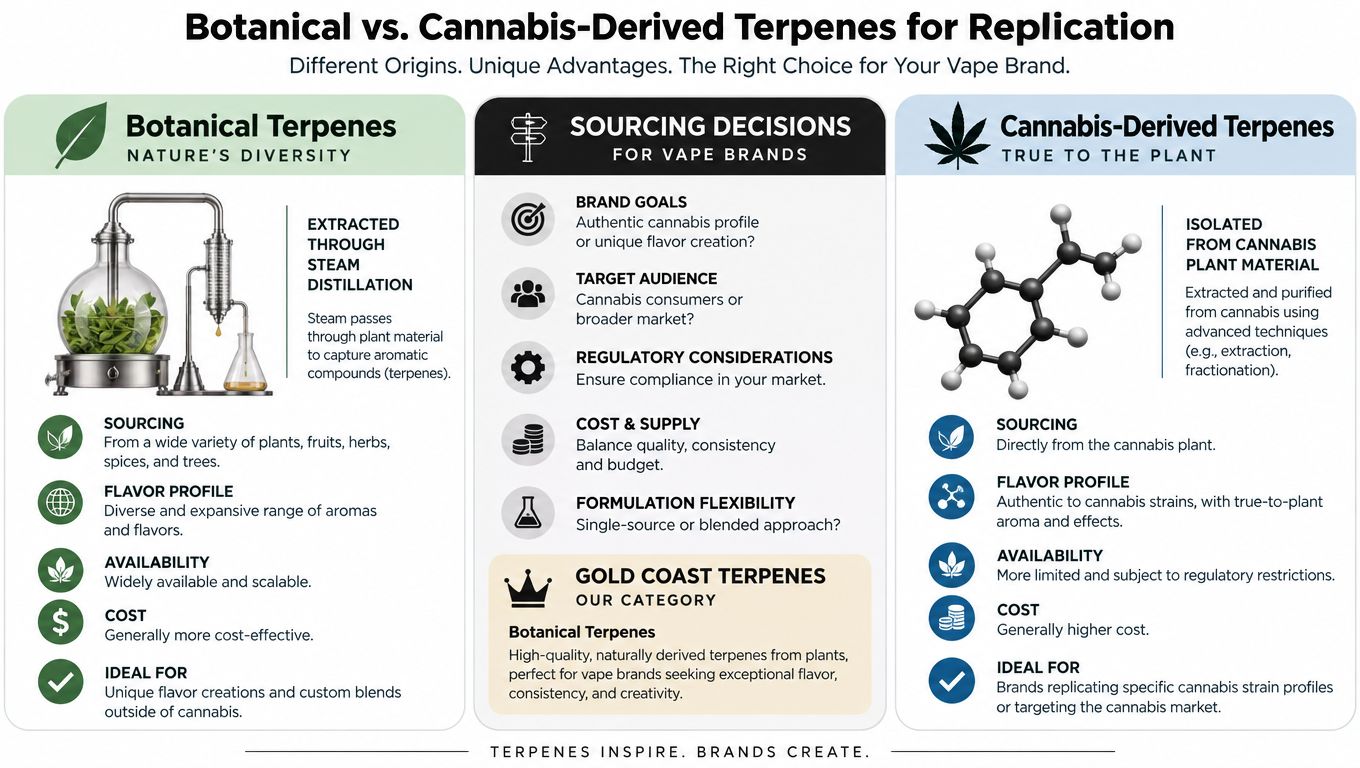
The botanical versus cannabis-derived terpene guide is useful when procurement, marketing, and compliance teams need to evaluate the same ingredient decision from different angles. Botanical inputs generally make more sense for a scaled cartridge program when the priority is predictable flavor, repeatable specifications, and brand protection. Cannabis-derived inputs may be appropriate when the product brief specifically values flower-origin nuance and the business can manage the accompanying testing and supply variability.
Replicating the Zkittlez Mintz Flavor Step by Step
Build the profile in two phases. First, create an isolate-only skeleton so you can identify structural errors. Then add a botanical strain-inspired blend to supply complexity and roundness without losing control of the core ratio.
Phase one builds the skeleton
Start with beta-caryophyllene, limonene, and linalool. Add supporting materials only after you can recognize the intended three-part movement: peppery base, citrus lift, and floral finish.
A practical isolate screen can use 0.1% to 4% per isolate, with the final selection determined by odor strength, matrix, and hardware. The broad range is a bench-testing window, not a recommendation to load every isolate at the upper limit. Caryophyllene, in particular, can become aggressive quickly in a concentrated system.
- Anchor caryophyllene first. Establish enough peppery structure to hold the candy note in place.
- Add limonene in measured increments. Stop when the front becomes bright and fruit-like, before it turns sharp or peel-heavy.
- Round with linalool. Use it to soften the transition into the cool finish, watching for a soapy or overly floral result.
- Test the support notes separately. Compare small additions of myrcene, pinene, terpinolene, and humulene rather than adding them all at once.
Keep a written dilution log and evaluate strips, oil, and finished hardware separately. A blend that smells balanced in a vial can shift after dilution into distillate because the matrix changes volatility and mouthfeel.
Phase two adds the strain-inspired layer
Once the isolate skeleton is stable, add a botanical strain-inspired blend for the nuanced candy, tropical, and mint-adjacent details. Keep the addition incremental. If the blend overwhelms the skeleton, you won't know whether the problem came from excess citrus, a heavy floral fraction, or an unsuitable cooling component.
Independent guidance reports total terpene content commonly around 1.5% to 3.5% by weight, with standout batches exceeding 4% (terpene benchmark). For distillate carts, a total target within that benchmark can be a useful development range, but hardware and viscosity testing must decide the final production load.
Bench note: Don't add mint isolates first. If the cooling note arrives before caryophyllene is anchored, the blend often reads as toothpaste or generic menthol instead of candy-mint cannabis.
Caryophyllene can also create a crash or haze at 0.5% in live resin, depending on the matrix and temperature history. Treat that value as a specific warning from the formulation brief, not a universal failure threshold. Run an incremental series, allow the oil to equilibrate, and inspect clarity, flow, and coil behavior before approving the sensory result.
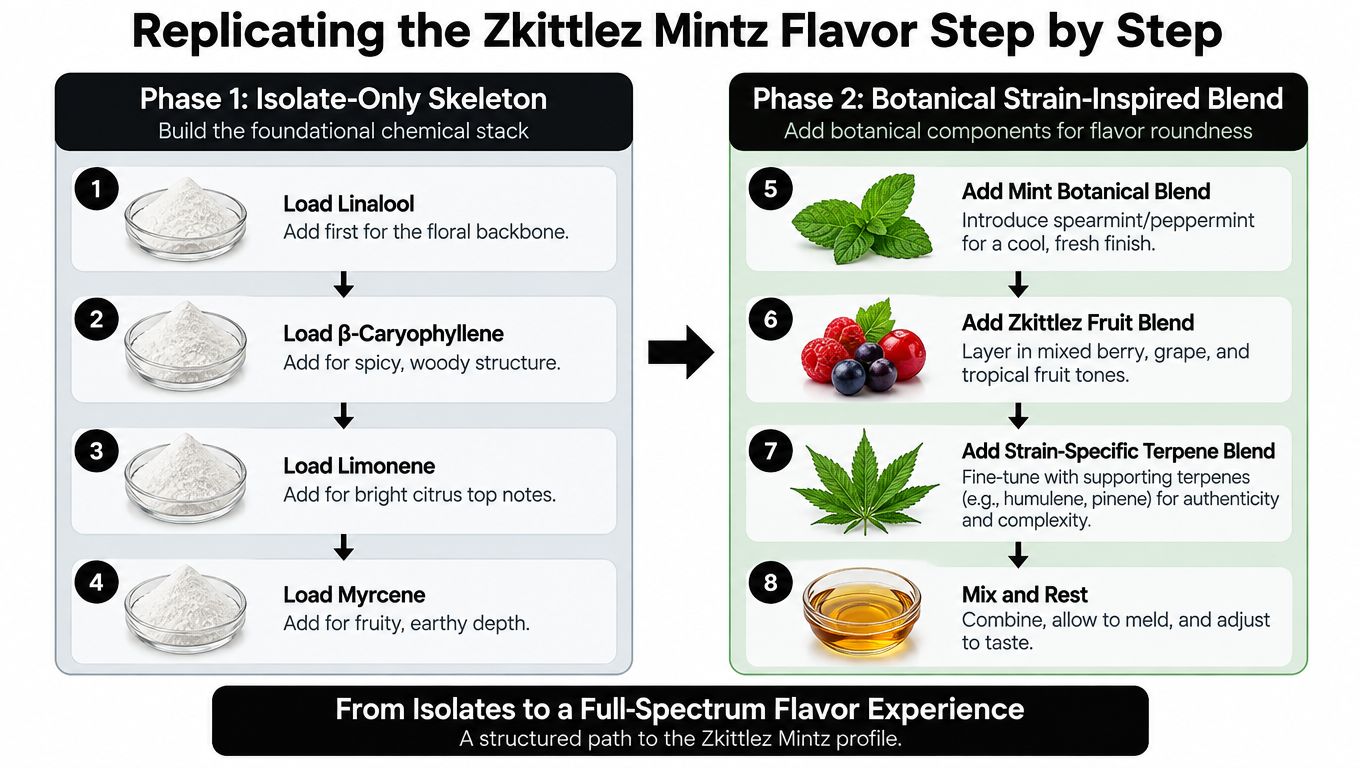
A concise visual summary of the two-stage approach is useful for production handoff. For teams building a repeatable workflow, the Zkittlez Mintz formulation video can sit alongside the written batch record, provided the team verifies every input against current supplier documentation.
Formulating Vape Carts and Concentrates With the Profile
Hardware compatibility matters more than chasing the highest terpene load. The same Zkittlez Mintz blend can feel bright and clean in one ceramic cartridge, then become harsh, thin, or overly minty in a cotton-wick device because heat, airflow, and oil delivery change how the volatile components arrive.
For distillate, model the batch mathematically before mixing. A 2% total terpene load means the terpene portion is calculated against the intended finished blend, not added casually to a full tank after filling. The terpene use and dilution guide can support the calculation workflow, but the production record should still state the target mass, actual mass, lot numbers, and final homogenization method.
Match the load to the matrix
A distillate cart needs enough terpene material to express the citrus and mint arc, but overloading can reduce viscosity and increase harshness. A concentrate needs a different balance because the starting matrix already contains native volatiles and solids.
| Format | Total Terpene Load | Hardware Compatibility |
|---|---|---|
| Distillate cartridge | 1.5% to 3.5% | Ceramic hardware is generally easier to tune; validate cotton-wick flow |
| Live resin cartridge | Start conservatively and increase only after clarity testing | Ceramic systems can preserve detail, but caryophyllene precipitation risk needs review |
| Sugar wax | 1% to 1.5% | Use hardware and viscosity checks before filling |
| Shatter | 1.5% to 2% | Confirm that the thinner blend doesn't overrun the intended texture |
| Diamonds or crystalline concentrate | Matrix-dependent | Test dissolution, separation, and thermal behavior before scale-up |
The 1% to 1.5% range for sugar wax and 1.5% to 2% range for shatter are practical targets specified for this formulation approach. They shouldn't be treated as universal standards for every extract, because native terpene content, residual solvent profile, and texture vary.
Control storage and sensory drift
Storage at -40°C to -20°C is specified for preserving the blended material before use. Even with controlled storage, let the formulation equilibrate before judging the final aroma. Cold samples can mute the top notes, while warmed samples can exaggerate limonene and mint volatility.
Liquidizer cuts deserve caution. They can distort the mint finish and make a technically accurate blend taste less like the intended strain profile. A cleaner route is to tune the terpene system and choose hardware that delivers the required flow, rather than using dilution to solve a mechanical problem after the fact.
Pairing Zkittlez Mintz With Other Profiles and Stocking Strategy
Zkittlez Mintz is more valuable as a flavor system than as an effects anchor. Public records show stronger agreement around its candy, citrus, mint, caryophyllene, limonene, and linalool character than around reproducible subjective outcomes. For a brand, that makes the profile useful as a recognizable flavor node across multiple SKUs.
Build pairings around shared chemistry
A gassed dessert profile can add a heavier crossover direction without erasing the candy-mint identity. The key is to preserve the Zkittlez Mintz front and use the partner profile to deepen the base. A mint-adjacent sativa profile can extend the cooling impression, but it should be screened for excessive sharpness before it reaches production.
Triads are more efficient than collecting unrelated single flavors. Shared terpinolene or linalool backbones can make three profiles easier to merchandise and easier to formulate because the developer isn't rebuilding every sensory layer from zero.
A practical pairing matrix might include:
- Candy fruit plus dessert gas: Keep limonene and caryophyllene visible, then add a darker base for a richer crossover SKU.
- Mint plus citrus brightness: Use the Zkittlez Mintz structure as the center and extend the top with a cleaner citrus-forward profile.
- Floral fruit plus cooling finish: Share linalool as the bridge, then adjust the caryophyllene ratio to prevent the result from becoming too dry.
- Tropical lift plus peppery depth: Use terpinolene as a shared aromatic cue while preserving the original caryophyllene-led finish.
Gold Coast Terpenes presents a catalog of 50+ profiles, including classic and contemporary strain-inspired options, and also lists 37 Strains and 40 Elevated Strains as distinct merchandising concepts. Those labels can help a brand organize a flavor matrix, but the procurement team should still ask for current COAs, ingredient details, MOQ terms, and sample quantities before committing to a stock plan.
Choose stock depth by production role
A single Zkittlez Mintz SKU may be useful as a signature flavor, but a three-profile pairing can support more efficient sampling for distributors, vape shops, and wholesale buyers. Stock the core profile for direct recognition, then keep complementary dessert, fruit, and mint-adjacent options available for line extensions.
Don't let catalog size create unnecessary SKU bloat. Choose profiles that share a chemical backbone, can be tested in the same hardware family, and have clear botanical versus nature-identical labeling documentation. That approach gives sales teams a coherent story and gives formulators reusable building blocks.
Common Formulation Mistakes and Quick Answers for Buyers
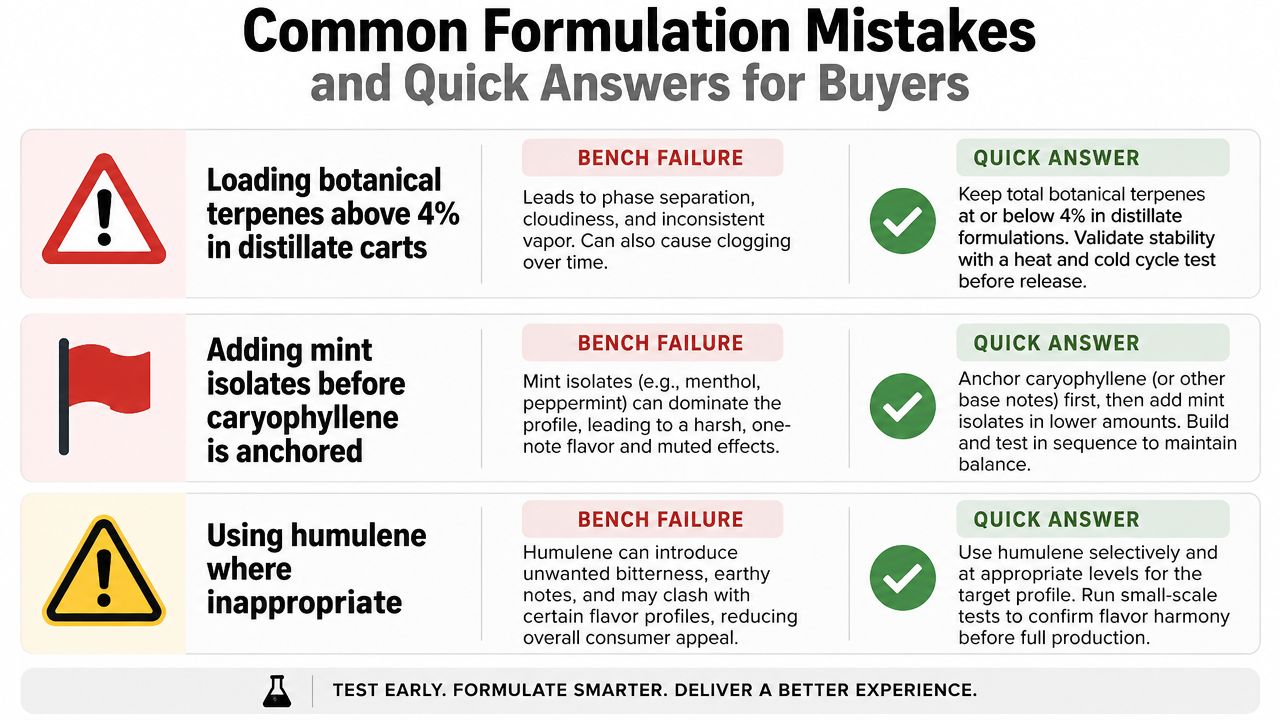
Most failed Zkittlez Mintz builds fail through imbalance, not lack of ingredients. The common errors are excessive total loading, premature mint addition, an unsuitable bittering note, and skipping viscosity checks between low and high terpene conditions.
Correct the bench failures
- Loading above 4% in distillate carts: The blend can become harsh, thin, or dominated by volatile top notes. Run a lower-load comparison before increasing intensity.
- Adding mint before caryophyllene: The cooling note takes over and the product reads as generic menthol. Anchor the peppery base first, then add cooling support.
- Using humulene indiscriminately: Humulene can add useful herbal dryness, but it can also introduce bitterness where the target needs softer rounding. Test whether a gentler floral or woody support is more appropriate.
- Chasing THC instead of flavor balance: Public references report wide THC variation, including 22% to 28% in guide content and a Leafly listing at 32% THC (Leafly-linked strain reference). That spread doesn't tell you whether the cartridge tastes like the target.
- Skipping the 1.5% versus 3.5% hardware check: Flow, wicking, vapor density, and mint persistence can change materially across those loads. Approve the formulation only after testing the actual cartridge and power range.
Buyer questions that affect purchasing
Are botanical terpenes suitable for vape hardware? They can be suitable when the specific ingredients, purity, intended use, and finished formulation are verified. Gold Coast Terpenes describes its blends as free of VG, PG, PEG, and MCT, but buyers still need current documentation and hardware compatibility testing for the exact product.
What starting load should a developer test? For this profile, a development screen can span 1.5% to 3.5% total terpenes, with smaller isolate additions inside that total. The final production rate depends on the matrix, native terpene content, coil, airflow, and sensory threshold.
Can the profile pair with live resin? Yes, but the native resin profile can shift the balance and may increase precipitation or clarity concerns. Test caryophyllene and linalool behavior in the actual live-resin lot rather than transferring a distillate recipe unchanged.
What shelf life should buyers expect after blending? Don't promise a fixed shelf-life period without stability data for the finished product. Use retained samples, documented storage conditions, and periodic sensory, appearance, and analytical checks to establish a defensible specification.
How do wholesale buyers verify a supplier? Ask for current SC Lab certificates, ingredient and labeling documentation, MOQ and bulk terms, and a usable terpene calculator. Gold Coast Terpenes also provides a Mixing Calculator and wholesale or bulk purchasing support, which can help California buyers and other markets organize repeat orders, but each business remains responsible for its own regulatory review.
Procurement checkpoint: A supplier is only useful at scale if the flavor sample, COA, labeling category, MOQ, and reorder process all align.
Gold Coast Terpenes offers botanical strain-inspired blends, isolated compounds, formulation tools, SC Lab documentation, and bulk purchasing support for developers rebuilding Zkittlez Mintz across distillate carts and concentrates. Review the available options and start your next flavor-matching test with Gold Coast Terpenes.