
The most popular advice about the F1 Durban strain is also the least useful for a product developer: treat it as one fixed genetic and sensory target. That approach fails as soon as the incoming flower, live resin, or distillate expresses a different Durban-derived chemotype. A reliable strain-inspired terpene blend for vape cartridges starts with provenance, batch chemistry, and a defined aroma envelope, not with a label alone.
Durban Poison became internationally known through South African landrace material, Ed Rosenthal's role in broader seed circulation, and Amsterdam breeding networks. Its reported role as the sativa parent in the original Girl Scout Cookies cross, OG Kush × F1 Durban Poison, also makes Durban lineage relevant to later lines such as Gelato and Wedding Cake. High Times' historical account of Durban Poison provides useful context, but history doesn't turn every product labeled F1 Durban into the same material.
For formulators, the practical question is narrower and more valuable: which Durban expression are you trying to reproduce, and how will you hold that expression across batches?
Why F1 Durban Is Not the Strain You Think It Is
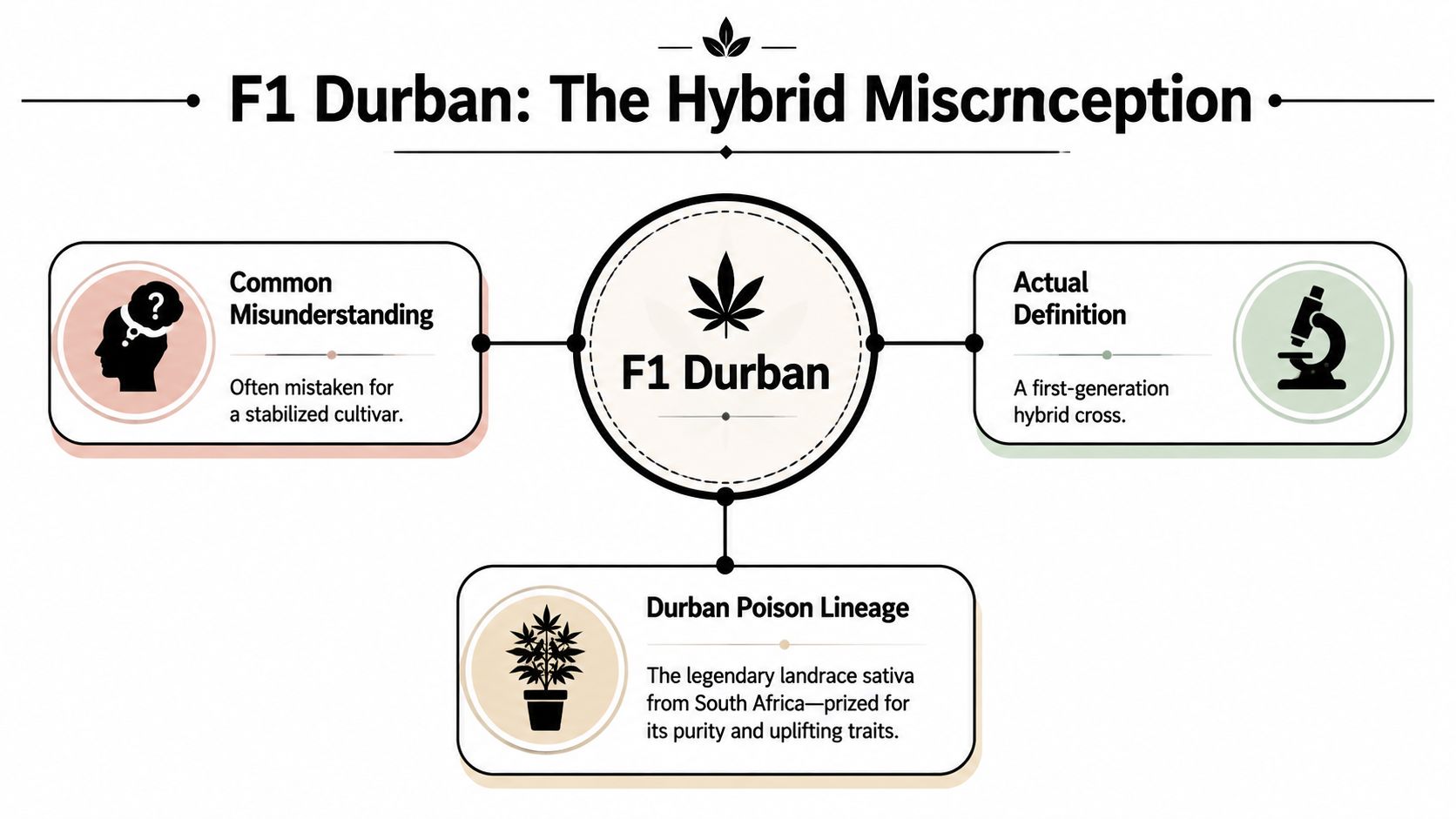
F1 Durban isn't a universally standardized shelf cultivar with one dependable GC-MS fingerprint. Independent databases describe it as “unknown or legendary,” note that it wasn't broadly released as feminized seed, and present it more as a closely held breeder line or lineage node than as a consistently available commercial variety. SeedFinder's F1 Durban entry captures that naming uncertainty.
The name may point to a first-generation cross involving Durban Poison lineage, a landrace-derived Durban selection, or a breeding parent used in a later hybrid. Those are different sourcing realities. A breeder may use F1 Durban to identify a specific private line, while a seed seller or processor may use Durban language to communicate ancestry, aroma, or market recognition.
Why the label creates formulation risk
A single certificate of analysis can describe one batch, not the entire name. Durban-type material has been reported with a terpinolene-dominant profile, while another tested sample showed a more pronounced beta-caryophyllene, limonene, and humulene structure. Calling either one the definitive F1 Durban profile encourages the wrong sourcing decision.
The same problem appears before material reaches the lab. Clone libraries, seed banks, and extract suppliers can market related Durban genetics under overlapping names, even when their breeding records and phenotype selection standards differ. If you need to identify plants with Google Lens, that can help with basic botanical reference work, but visual identification won't establish chemotype or breeding provenance.
Practical rule: Treat F1 Durban as a chemotype envelope until the supplier provides lineage documentation and a current certificate of analysis.
For commercial work, start with the batch rather than the name. Record the dominant terpene order, secondary support, total terpene content, cannabinoid context, extraction method, and storage history. A broader strain terpene profile guide can support that intake process, but your internal reference standard should come from the actual material you plan to formulate.
Modern Durban-labeled flower also shows meaningful potency variation. Reported THC ranges include 15% to 25% and 15% to 22%, with one listed sample at 19.33%. Lower-potency landrace-style expressions have been reported around 8% to 16%, while optimized indoor phenotypes have reached 23% to 26%, reinforcing the need to specify the source rather than assume the label is enough. Hytiva's Durban guide documents that spread.
Decoding the Two Dominant Durban Chemotypes
In practice, Durban-inspired material tends to fall into two useful sensory families. The first is terpinolene-forward, bright, piney, herbal, and volatile. The second is caryophyllene-limonene-led, warmer, peppery, citrus-driven, and more grounded.
The important distinction is not merely which terpene ranks first. Minor compounds can change the transition from the opening aroma to the lingering finish, so a blend built around limonene alone usually reads as generic citrus rather than Durban.
The terpinolene-forward expression
Kannapedia lists one Durban Poison profile with terpinolene at 6.619%, gamma-terpinene at 5.543%, myrcene at 2.163%, total ocimene at 2.885%, limonene at 0.656%, alpha-pinene at 0.485%, and beta-pinene at 1.065%. The Kannapedia Durban chemistry entry shows why this expression smells sharper and greener than a simple lemon profile.
The sensory read is immediate. Terpinolene supplies the sweet herbal and pine-like center, while gamma-terpinene and ocimene add a volatile citrus-green lift. Alpha-pinene and beta-pinene reinforce the forested edge. Myrcene gives the blend enough body to prevent the aroma from disappearing after the first draw.
The caryophyllene-limonene expression
A separate Durban certificate reported total terpenes at 1.3327%, with beta-caryophyllene at 0.4355%, limonene at 0.2866%, alpha-humulene at 0.1664%, linalool at 0.1391%, and alpha-bisabolol at 0.0839%. The Durban Poison certificate of analysis gives this profile a distinctly different formulation direction.
Here, caryophyllene and humulene create pepper, dry wood, and herbal depth. Limonene adds citrus brightness, while linalool softens the edges. The result is less needle-like and more rounded, making it useful for a flavor-forward distillate or a cartridge intended to retain a recognizable mid-palate.
| Terpene | Terpinolene-Dominant (%) | Caryophyllene-Limonene (%) |
|---|---|---|
| Terpinolene | 6.619 | Not reported |
| Beta-caryophyllene | Not reported | 0.4355 |
| Limonene | 0.656 | 0.2866 |
| Myrcene | 2.163 | Not reported |
| Ocimene | 2.885 | Not reported |
| Alpha-humulene | Not reported | 0.1664 |
| Linalool | Not reported | 0.1391 |
These values aren't interchangeable blend targets. They represent different reported samples, and their units and reporting formats should be checked before direct reconstruction. For a commercial terpene profile for cannabis product formulation, use the table as a directional map, then build against your own reference lot.
A Durban Cookies-style architecture offers a useful bridge between the families. Its published starting approach places myrcene in the base, beta-caryophyllene and humulene in the middle, and limonene with a small amount of pinene on top. The Durban Cookies formulation guide provides that layering logic.
Building a Durban-Inspired Terpene Layer Structure
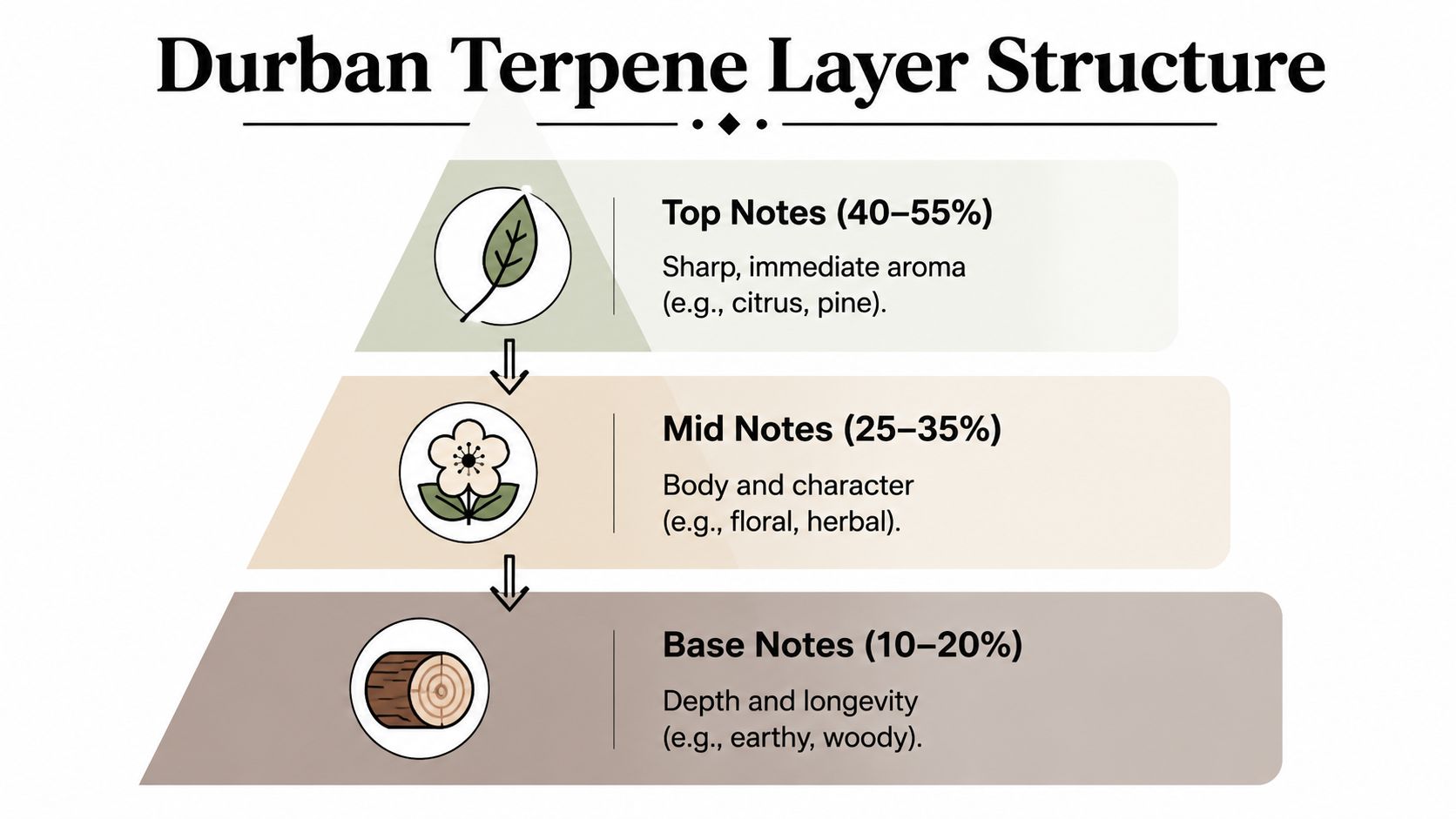
A Durban profile works better as a layered architecture than as a flat list of isolates. The top note creates recognition during the first part of the draw, the mid layer supplies identity after the initial volatility drops, and the base keeps the finish from becoming thin or solvent-like.
For the overall terpene portion, a practical starting framework is 40% to 55% top notes, 25% to 35% mid notes, and 10% to 20% base notes. These are formulation architecture ranges, not claims about the composition of any particular flower batch.
Start with the top
For the terpinolene-forward route, let terpinolene carry the opening, then support it with ocimene and pinene. The objective isn't maximum brightness. Excessive top-note loading can make the cart smell sharp at room temperature and hollow after vaporization.
For the caryophyllene-limonene route, use limonene as the lift and keep the citrus profile attached to a peppery mid. A published Durban Cookies starting split uses limonene at 35% to 45%, beta-caryophyllene at 20% to 25%, myrcene at 15% to 20%, humulene at 5% to 10%, and minor terpenes such as pinene and linalool at 5% to 10% of the terpene blend. That starting ratio guidance is a useful benchmark, but it shouldn't be treated as a universal F1 Durban formula.
Give the middle enough authority
Beta-caryophyllene and humulene connect bright top notes to the distillate matrix. Caryophyllene supplies pepper and warm spice, while humulene contributes dry wood and herbal structure. Ocimene can make the center feel greener and more lifted, particularly in a terpinolene-led design.
A common failure is to add enough limonene to create instant recognition, then underbuild the middle. The result smells citrus-forward in the bottle but loses Durban character in the first draw. A second failure is adding too much caryophyllene without a bright counterpoint, which produces a dense pepper profile with little sativa-derived lift.
Use the base to control the finish
Myrcene gives the vapor a fuller, musky, herbal tail. Trace linalool can round harsh transitions, while humulene can extend the woody finish. Base notes should support the matrix, not dominate it.
Distillate temperature and device design matter. A 510-thread cart and a pod can present the same oil differently because heating behavior, airflow, and reservoir geometry change how volatile compounds leave the matrix. Validate the final blend in the actual hardware, and don't assume a pleasant bottle aroma will survive the complete draw.
Terpinolene-Forward vs Caryophyllene-Limonene Blends
The two architectures solve different product problems. A terpinolene-forward blend communicates Durban lineage through pine, sweet herbs, green citrus, and a fast aromatic opening. A caryophyllene-limonene blend offers a more familiar citrus-and-pepper profile with greater mid-palate weight.
Terpinolene-dominant material is a strong choice for a daytime-positioned vape concept when the brand wants a sharp, focused sensory identity without making a medical or performance claim. Caryophyllene-limonene material fits a flavor-first concentrate or distillate SKU where the product needs sweetness, spice, and a longer finish.
Formulation decisions by target
For the terpinolene route, build around terpinolene, then add ocimene, pinene, and myrcene in measured support. Keep the blend coherent rather than chasing every note found in a certificate. For the caryophyllene-limonene route, make limonene the opening, use beta-caryophyllene as the structural center, and bring in humulene or myrcene to prevent a lemon-peel profile from becoming narrow.
| Parameter | Terpinolene-Forward | Caryophyllene-Limonene |
|---|---|---|
| Opening aroma | Pine, sweet herb, green citrus | Citrus peel and sweet brightness |
| Mid-palate | Herbal, resinous, volatile | Pepper, dry wood, warm spice |
| Finish | Light, green, aromatic | Fuller, woody, peppery |
| Best product direction | Daytime-positioned vape concept | Flavor-forward concentrate or cart |
| Main bench risk | Excessive sharpness and volatile loss | Heavy spice or flat citrus |
| Useful support | Ocimene, alpha-pinene, myrcene | Humulene, myrcene, linalool |
Don't blend both chemotypes at equal strength because they came from the same lineage. Equal blending often muddies the profile, producing a citrus-herbal top with an indistinct spicy base. A better method is to choose one as the primary identity and use the other only as a controlled bridge.
The terpinolene terpene effects guide is useful when evaluating how a terpinolene-centered design changes the sensory and product brief. Keep all effect language qualitative and non-medical, since terpene aroma doesn't justify therapeutic promises.
Managing Phenotype Variability in Commercial Batches
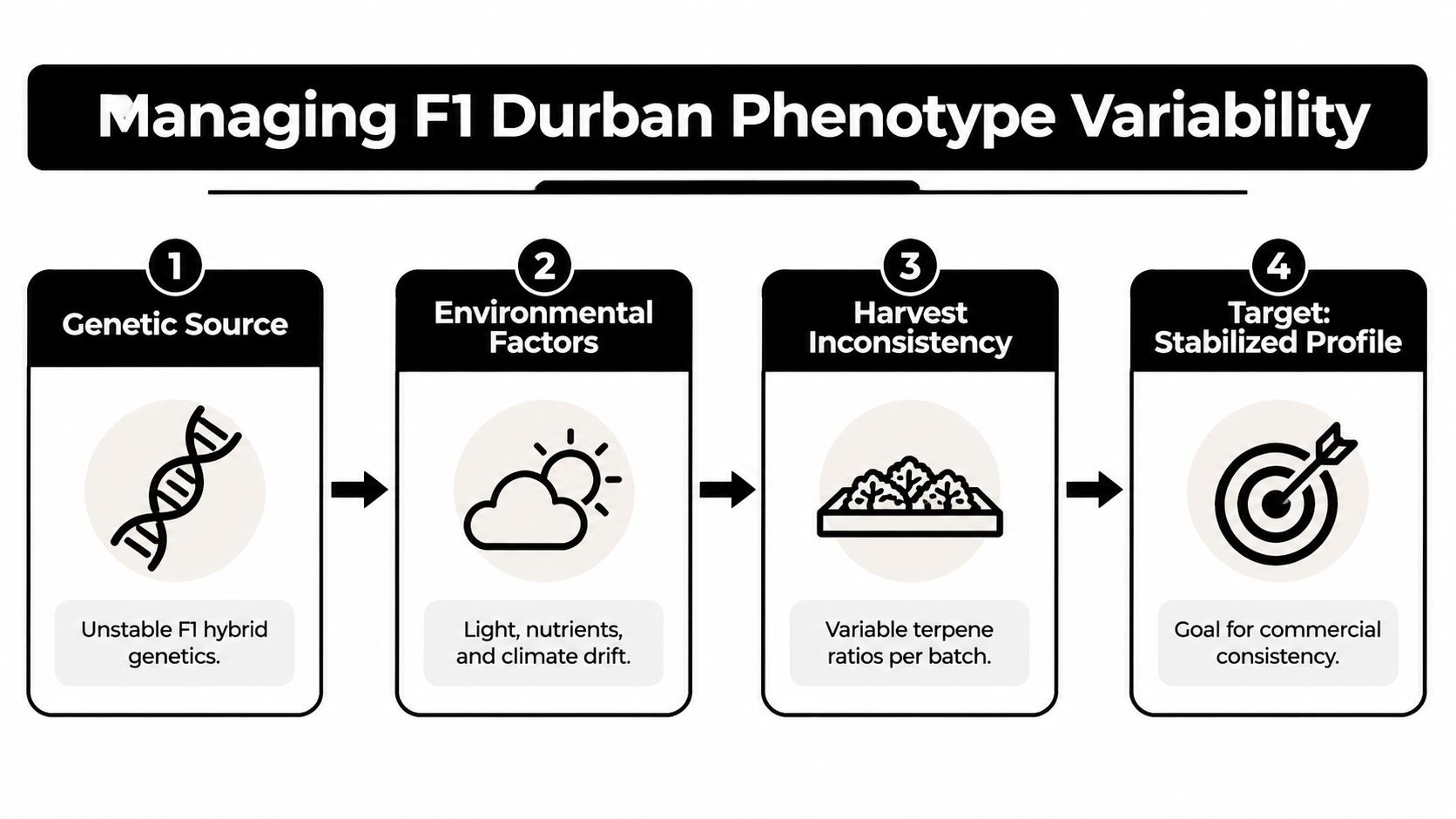
The F1 Durban label creates a sourcing problem because the underlying material may not be genetically or chemically uniform. Environmental conditions, harvest handling, extraction method, and breeder selection can all shift the profile supplied to the formulation bench.
A commercial buyer should request a current GC-MS certificate before approving biomass or oil. The certificate should identify the dominant terpenes and their relative order, not merely confirm that the material contains “Durban” genetics.
Build a chemotype acceptance window
Your specification should describe the sensory target and the analytical boundaries that protect it. For example, a team may choose to monitor the terpinolene-to-myrcene relationship and establish an internal acceptance window such as 2:1 to 4:1, provided that ratio is appropriate for the selected reference profile and documented in the product specification.
That ratio is a control tool, not a universal Durban truth. A caryophyllene-limonene product may need a different acceptance framework entirely. The key is to define the window before procurement, then reject or correct material that falls outside it.
Keep a reference library with at least three practical positions: a bright terpinolene-led sample, a warm caryophyllene-limonene sample, and the approved commercial target. The library lets sensory and analytical teams discuss drift using shared physical references instead of relying on memory.
Correct drift without losing identity
Isolates can correct a batch that is close to target but not balanced. If a lot leans too heavily toward caryophyllene, a measured terpinolene addition can restore lift. If the profile feels dull or lacks citrus definition, limonene may restore the opening, but it should remain connected to the chosen mid and base structure.
Even a 5% shift in the concentration of a dominant terpene can change the perceived aroma of a strain-inspired blend. The Durban Cookies formulation reference supports the use of defined blend ratios and a 24-hour homogenization period before evaluation.
Document every correction, including the source lot, starting certificate, isolate identity, addition amount, mixing conditions, sensory result, and final analytical outcome. That record supports traceability and helps the team learn which corrections preserve the brand signature.
Homogenization and Quality Control Workflow
A blend isn't production-ready because it looks clear in the mixing vessel. Durban-inspired formulas contain volatile components that can be lost during handling, and incomplete dispersion can create separation, inconsistent dosing, or a different aroma between the first and last filled cartridges.
Use a controlled bench sequence
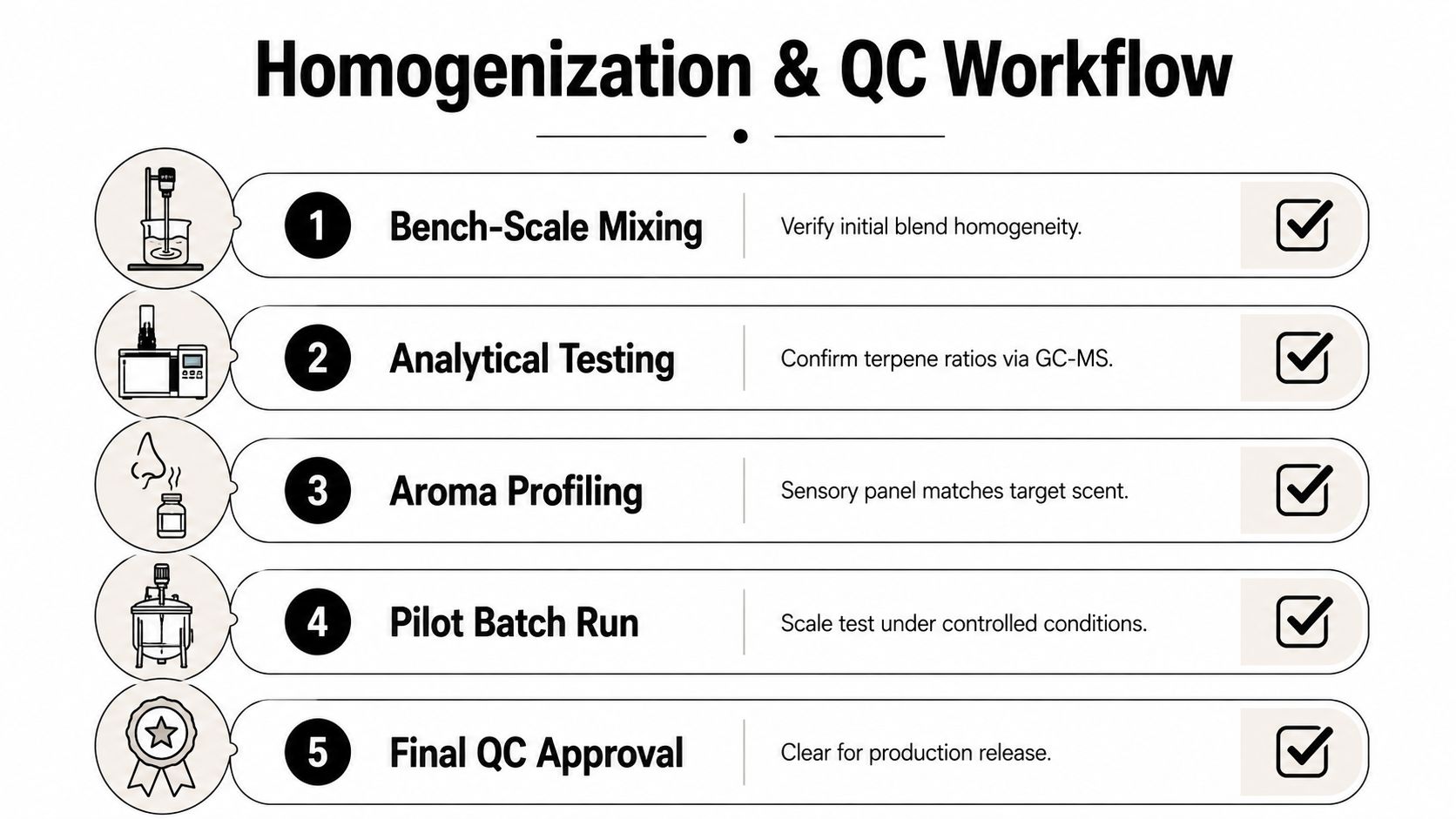
A practical starting workflow is:
- Precondition the distillate. Bring the matrix to 60°C to 65°C so it flows consistently without exposing the blend to unnecessary thermal stress.
- Add the terpene phase. Introduce terpenes at 5% to 8% w/w under low-shear mixing.
- Homogenize. Ramp to 2,000 to 3,000 RPM for 15 to 20 minutes, using equipment appropriate for the batch size and matrix.
- Hold for evaluation. Allow a 24-hour homogenization period before final aroma judgment when the formulation and facility protocol permit it. The Durban Cookies replication guidance identifies that evaluation interval.
- Release only after testing. Compare the blend with the reference standard before filling.
The numbers above are starting process parameters, not a substitute for equipment qualification, safety review, or product-specific validation. Heat, shear, vessel geometry, and headspace all affect volatile retention.
Check the blend analytically and sensorially
Visual clarity is the first screen. Haze, streaking, droplets, or visible separation indicate that the team shouldn't proceed to filling. Measure viscosity at 25°C so comparisons between pilot and production batches use the same condition.
Headspace GC-MS should verify the dominant terpene order against the approved reference. A sensory panel still matters because instruments can confirm composition without fully describing how the mixture reads during vaporization. Use a triangle test with trained panelists, presenting coded samples and asking them to identify the odd sample against the reference.
Common failure modes point to different root causes:
- Separation: Incomplete homogenization, incompatible matrix behavior, or insufficient hold time.
- Harsh throat sensation: Possible oxidation or an overbuilt sharp top note, especially in a terpinolene-led design.
- Aroma drift: Volatile loss during heating, transfer, or extended open mixing.
- Device mismatch: A blend that performs in a bench vial but changes in the selected cart or pod.
For deeper process controls, use a documented quality control testing resource alongside your approved specifications, test methods, and batch-release records.
Turning Strain Ambiguity Into a Formulation Advantage
Naming inconsistency becomes commercially useful once the brand stops pretending that one Durban profile fits every batch. Instead of offering a generic Durban label over a single terpinolene formula, build a modular library with a terpinolene-dominant core, a caryophyllene-limonene variant, and a 60/40 hybrid bridge between them.
That structure gives the product team three controlled sensory positions. The bright core can serve a pine-herbal vape concept, the warmer variant can support a citrus-pepper concentrate, and the bridge can preserve Durban recognition when incoming material falls between the two families.
The advantage isn't that the name becomes more certain. The advantage is that your formulation becomes more disciplined. Each module can carry its own GC-MS baseline, sensory description, acceptable ratio window, hardware validation record, and correction history.
Commercial principle: A defensible strain-inspired SKU is defined by its documented sensory and analytical target, not by the cultivar name printed on the input invoice.
Brands that win premium vape placement will treat Durban ambiguity as a formulation design space. They'll know which phenotype they're buying, which isolates can correct drift, and which deviations require rejection rather than rescue.
Gold Coast Terpenes offers natural, THC-free terpene blends, strain-specific profiles, isolated compounds, safety documents, and formulation tools for cartridges, concentrates, and distillate development. Review the available options for your Durban-inspired program and visit Gold Coast Terpenes to source components for a controlled, phenotype-aware blend.