
You're standing at the bench with a strain-inspired cartridge that smells pleasant but doesn't behave like the reference material. The first pull reads bright and focused, then the blend becomes flat, heavy, or overly sweet after a longer session. That gap usually isn't solved by adding more fruit. It's solved by treating Mac Daddy strain effects as a dose-dependent sensory arc and building the terpene system around that transition.
For formulators, the useful question isn't whether Mac Daddy is “energizing” or “relaxing.” It's how the oil moves from an opening cerebral lift into a more settled body profile, and how that movement survives distillate, hardware, heat, and cumulative exposure. The blueprint below translates reported effects into a practical strain-inspired terpene blend for vape cartridges and distillate, with clear top, mid, and base functions.
Why Mac Daddy Strain Effects Matter for Terpene Formulation
A Mac Daddy-inspired cartridge needs an effect-first chassis, not a generic fruit-candy accord. At the bench, the working hypothesis is straightforward: lower cumulative exposure presents a brighter, more focused headspace, while higher cumulative exposure brings forward body weight and calm. That doesn't mean terpenes independently determine pharmacological effects. It means the sensory profile can reinforce, soften, or distort the way users interpret the product over a session.
This distinction matters commercially. A cartridge that reads bright and social during a short session, then becomes settled and physical during a longer session, gives users room to self-select their preferred window. A formulation that only delivers sweetness at the opening may satisfy the first pull but lose strain identity by the time the mid and base notes arrive.
Build around the session, not the label
Start by defining three sensory checkpoints:
- Opening: citrus, pine, and a light floral lift should appear quickly without becoming sharp.
- Middle: herbal, creamy, and lightly spicy notes should bridge the initial brightness into a warmer body.
- Finish: earthy, peppery, and soft floral tones should remain after the top notes recede.
This is particularly important in a 1.0–1.5 mL ceramic cart at 3.3–4.0V, where the user may experience a concentrated vapor pulse rather than the slower progression of flower. The hardware settings and fill volume are part of the product experience, so the blend should be evaluated in the intended device rather than only on a blotter or in the distillate jar.
A useful primer on how individual compounds shape aroma and perceived character is the Botanist Seeds terpene guide. Use that type of reference to separate aroma contribution from effect claims, then let your own sensory panel and lab data determine whether the finished oil expresses the intended arc.
Practical rule: If the first pull is accurate but the third pull becomes one-dimensional, the problem is usually the balance between tiers, not a lack of total flavor.
The Two-Phase Effect Arc from Lift to Body Calm
Mac Daddy's reported effect pattern supports a two-phase formulation model. Independent listings describe an early combination of euphoria, energy, hunger, and focus, followed by calm, tingling, and sometimes sedation. Leafly review data reports that 38% of reviewers identify anxiety support, 30% pain support, and 25% depression support, but those figures describe reviewer-reported therapeutic patterns, not controlled outcomes, so they're best treated as contextual user feedback rather than a formulation promise. Leafly's Mac Daddy listing also fits the broader reported timing pattern of inhaled onset within 2–5 minutes, peak effects around 30–60 minutes, and flower duration of about 2–3 hours.

Map time windows to formulation levers
During the first 5–15 minutes, the bright cerebral impression should lead. Limonene provides the citrus edge, while a controlled floral or pine accent can keep the opening from reading like candy. The purpose isn't to force an “uplifting” claim. It's to create an unmistakable first-stage identity that matches the reported early lift.
The 20–45 minute band is where the blend needs continuity. Myrcene should already be audible, but not so dominant that it erases focus immediately. Caryophyllene, pinene, and the softer middle notes help the profile move from alert citrus into a rounded, physical center without producing an abrupt flavor drop.
Past 60 minutes, the base becomes the product's memory. Linalool, caryophyllene, and humulene can carry the earthy, floral, and peppery finish after the brighter compounds have faded. This is also the point where the reported “focused” experience may become foggier with cumulative exposure. That inflection is the most important behavioral signal for a strain-inspired cart because it determines whether the blend feels layered or heavy.
For additional context on staged subjective effects, formulators can review stages of being high, then validate the actual timing in their own hardware and oil matrix.
Terpene Profile Behind the Mac Daddy Experience
Mac Daddy is commonly described as an indica-dominant or balanced hybrid, with a terpene profile centered on myrcene, beta-caryophyllene, and limonene. A neutral strain guide places total terpene content in the 1.5%–3.5% by weight range, with caryophyllene commonly at 0.4%–0.8%, limonene at 0.3%–0.7%, and myrcene at 0.2%–0.6%. Those figures describe reported strain material, not a universal finished-cart recipe, so they should anchor the sensory target rather than dictate a blind addition rate. Joint Commerce's Mac Daddy strain guide provides the relevant profile context.
Three drivers define the arc
The first driver is the citrus and gas top. Limonene supplies the recognizable brightness, while a measured floral or pine component keeps the opening from becoming a simple lemon flavor. The second is the herbal-spice middle, led by beta-caryophyllene and supported by pinene. This tier gives the blend structure as the initial lift softens.
The third is the earthy, creamy base. Myrcene and linalool provide weight and softness, while humulene can add a dry, woody finish. A separate indexed sample reported limonene at 0.24%, carene at 0.18%, myrcene at 0.12%, linalool at 0.10%, phellandrene at 0.10%, caryophyllene at 0.10%, camphene at 0.09%, humulene at 0.04%, and pinene at 0.01%, showing why batch-level data matters when replicating flavor instead of relying on a cultivar label. Gentleman Toker's Mac Daddy data documents that indexed sample.
| Driver | Key Terpenes | Range in Cart (%) | Effect Arc Role |
|---|---|---|---|
| Bright top | Limonene, pinene, floral support | Qualitative target guided by batch data | Fast citrus-led entry |
| Herbal middle | Beta-caryophyllene, pinene, supporting compounds | Qualitative target guided by batch data | Focused to physical transition |
| Soft base | Myrcene, linalool, humulene | Qualitative target guided by batch data | Settled finish and lingering body |
The strain terpene profiles resource is useful when comparing a reference chromatogram with a strain-inspired reconstruction. Shipping and compliance decisions belong in a separate workflow, particularly when products involve different cannabinoid categories, so review the Delta-8 vs Delta-9 THC shipping rules before commercial distribution. A related catalog example is Elevated Strains, which can serve as a flavor reference point without being treated as a Mac Daddy match.
Translating Lab Data into a Top Mid Base Blueprint
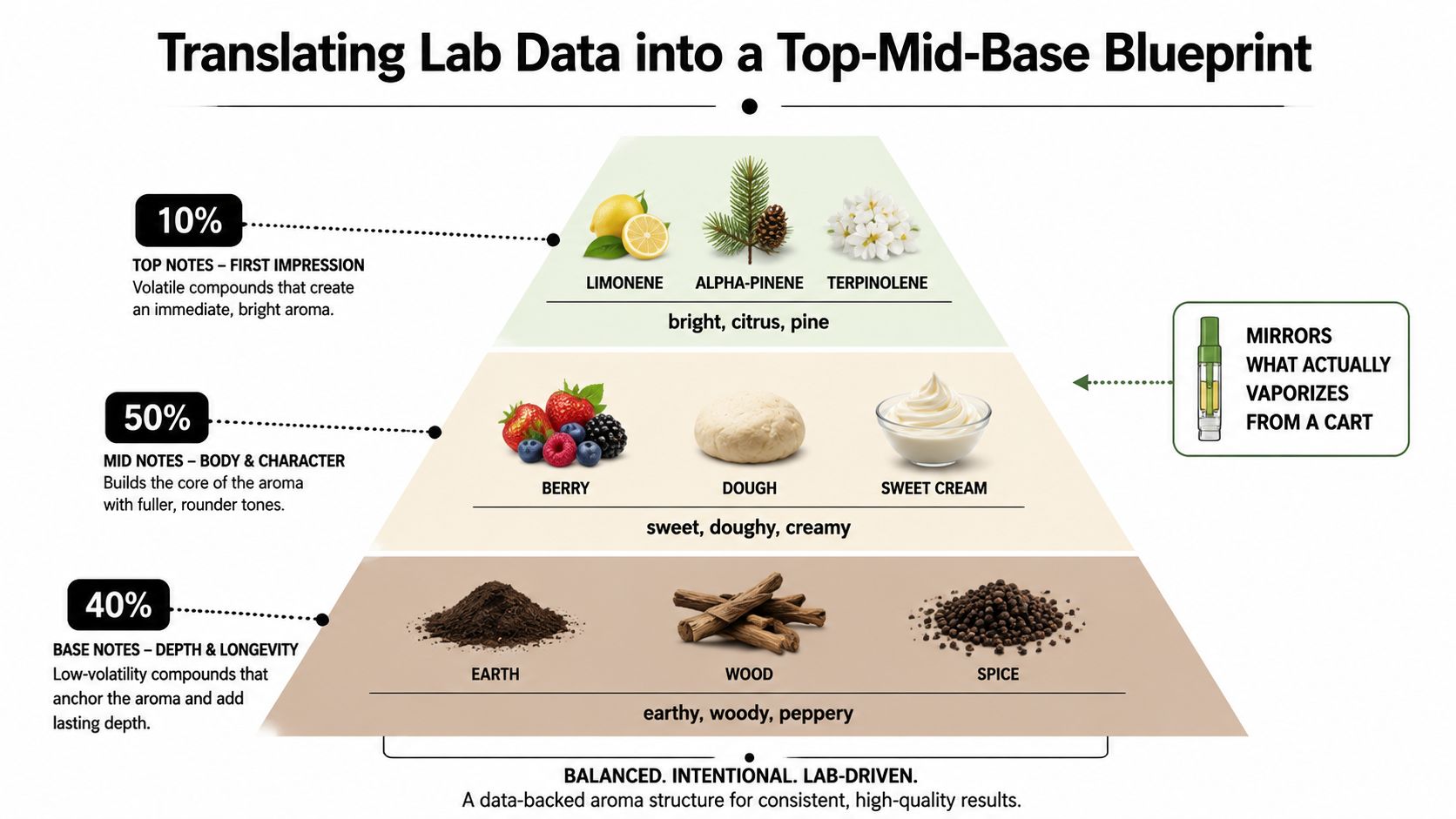
A chromatogram becomes useful only after the formulator assigns each compound a job. For a Mac Daddy-inspired profile, a practical starting architecture is 30% top notes, 50% mid notes, and 20% base notes by weight, based on independent formulation guidance that uses this top, mid, and base structure. Joint Commerce's formulation guide provides that 30/50/20 framework.
The ratio is a design scaffold, not a guarantee that every compound will vaporize or taste proportionally. Volatility, matrix interaction, heat, and hardware all alter perception. Start with the structure, then compare the finished oil against the reference profile at the intended voltage.
Assign a function to every tier
Top notes carry the first impression. Limonene, terpinolene, and alpha-pinene create the bright citrus, pine, and floral entry. Keep this tier clean and controlled. Too much limonene can make the profile abrasive, while too much terpinolene can push the blend toward a sharp, perfumed character.
Mid notes create continuity. Myrcene, ocimene, and beta-pinene can supply the warm, herbal, slightly earthy body that connects the opening to the finish. This is the broadest tier because it carries the central identity of the cartridge.
Base notes extend the landing. Caryophyllene, humulene, and linalool contribute pepper, wood, and soft floral depth. They shouldn't dominate the first pull, but they need enough presence to prevent the oil from disappearing into a thin citrus note.
A lab interpretation workflow should check both the raw abundance and the sensory hierarchy. The lab report interpretation guide can help organize that review, but the final decision still belongs to the product team's reference standard.
Bench translation: Don't ask whether the blend contains the “right” compounds. Ask whether the right compound is arriving at the right stage of the vapor session.
Usage Ranges for a Mac Daddy Inspired Cartridge Build
Usage rate must follow the chassis and hardware. A live resin matrix may already carry native aroma, while an isolate-based distillate often needs more external flavor architecture. The product chart cited for this formulation work lists myrcene at 1.5%–4.0% as a base note, limonene at 0.5%–2.5% as a top note, linalool at 0.2%–1.5% as a mid note, and caryophyllene at 1.0%–3.0% as a base note. MedBud's terpene chart supplies those working ranges.
For a hypothetical 100 g distillate batch, translate a percentage directly into grams. A 1.5% limonene addition equals 1.5 g, while a 2.5% addition equals 2.5 g. The same method applies to every compound, but don't treat the upper end of each individual range as a target. Combining several upper-range additions can quickly overwhelm both flavor and viscosity.
Match the blend to the hardware
| Compound | Sub-ohm 2.0–3.0 ohm | 510 Pod 1.2–1.5 ohm | Distillate Type |
|---|---|---|---|
| Limonene | 1.5%–2.5% | Use the lower part of the working range | Bright top note |
| Terpinolene | 0.6%–1.0% | Use a restrained level | Floral top support |
| Myrcene | 1.8%–2.5% | Keep controlled to protect finish quality | Body and base |
| Caryophyllene | 0.8%–1.2% | Use conservatively | Peppery structure |
| Remaining drivers | Balance of the blend | Balance of the blend | Pinene, linalool, humulene, and supporting notes |
The listed compound bands are working targets for this blueprint, while the overall cut depends on the oil. For sub-ohm ceramic systems, the planned total terpene load is 6%–10% by weight. For 510-thread pods at 1.2–1.5 ohm, pull the cut back to 4%–7% to reduce flooding and burnt flavor risk at lower wattages. Those rates are hardware-specific formulation guidance, not a universal specification.
Check viscosity before scaling
Blend thoroughly, allow the oil to equilibrate, and evaluate draw behavior at room temperature. Look for slow recovery, seepage, inconsistent wicking, and a burnt finish during repeated pulls. A 30-day stability check should track appearance, phase separation, viscosity drift, cartridge leakage, and flavor change at the intended storage condition.
Use a terpene mixing calculator to scale the math, then confirm the result by weight. Calculators prevent arithmetic errors, but they can't predict how a particular ceramic, wick, oil viscosity, and voltage combination will taste.
Comparing Mac Daddy Against Fruit Forward and OG Profiles
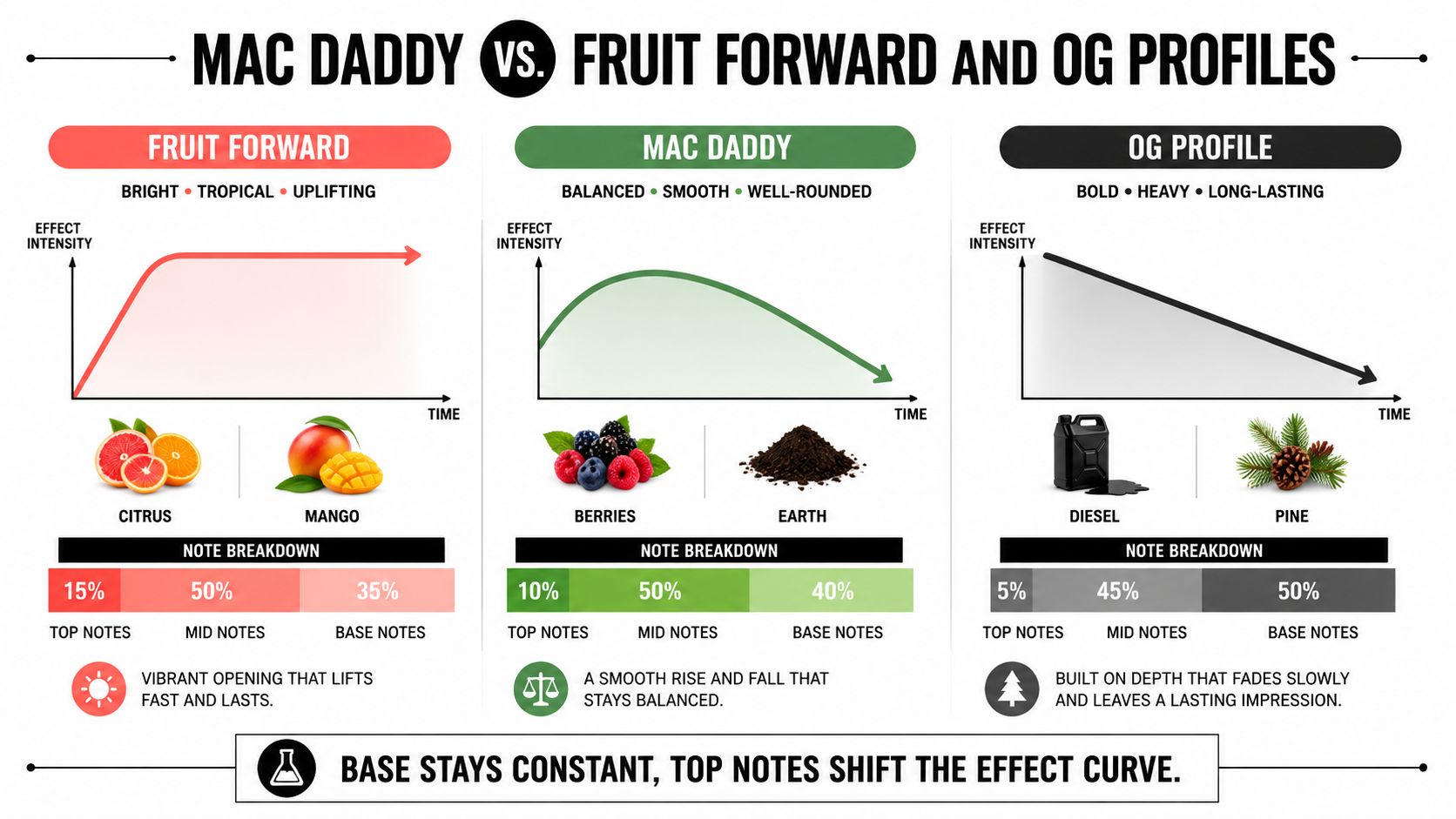
Top-note selection can move the perceived effect curve even when the distillate base remains unchanged. That's why a formulator should compare Mac Daddy against neighboring profile families rather than evaluate it in isolation.
A fruit-forward tropical profile led by limonene, valencene, and geraniol tends to peak early. It gives the opening a bright, expressive character, but it may not produce the same grounded finish unless the mid and base tiers are deliberately reinforced. This can work for a flavor-first cartridge, but it won't automatically reproduce Mac Daddy's lift-to-body movement.
An OG-leaning profile weighted toward myrcene, limonene, and caryophyllene compresses the phases. The opening can feel immediately earthy and heavy, with less separation between the initial brightness and the later relaxation. That profile is effective when the desired result is a continuous, dense arc, but it sacrifices some of Mac Daddy's staged contrast.
The top tier changes the whole read
Mac Daddy sits between those two structures. Terpinolene in the top tier extends the bright, lifted impression before myrcene and caryophyllene take over. The result isn't “balanced” because the base is moderate. It's balanced because the top notes create enough distance from the base for the user to notice the transition.
| Profile | Top-note direction | Mid-note behavior | Base-note impression |
|---|---|---|---|
| Fruit forward | Limonene, valencene, geraniol | Sweet and open | Lighter unless reinforced |
| Mac Daddy-inspired | Limonene, terpinolene, alpha-pinene | Warm, creamy, herbal | Earthy, peppery, settled |
| OG leaning | Myrcene, limonene, caryophyllene | Dense and compressed | Heavy, woody, persistent |
The comparison is most useful when the distillate, cart, and test voltage stay constant. Change only the top three compounds, then score the first pull, middle session, and finish separately. That isolates whether the effect curve is shifting because of the top-note architecture or because the base chassis is behaving differently.
A stable base doesn't create a stable identity. The top tier determines how quickly the user encounters that base.
A Formulator's Checklist for Mac Daddy Strain Effects
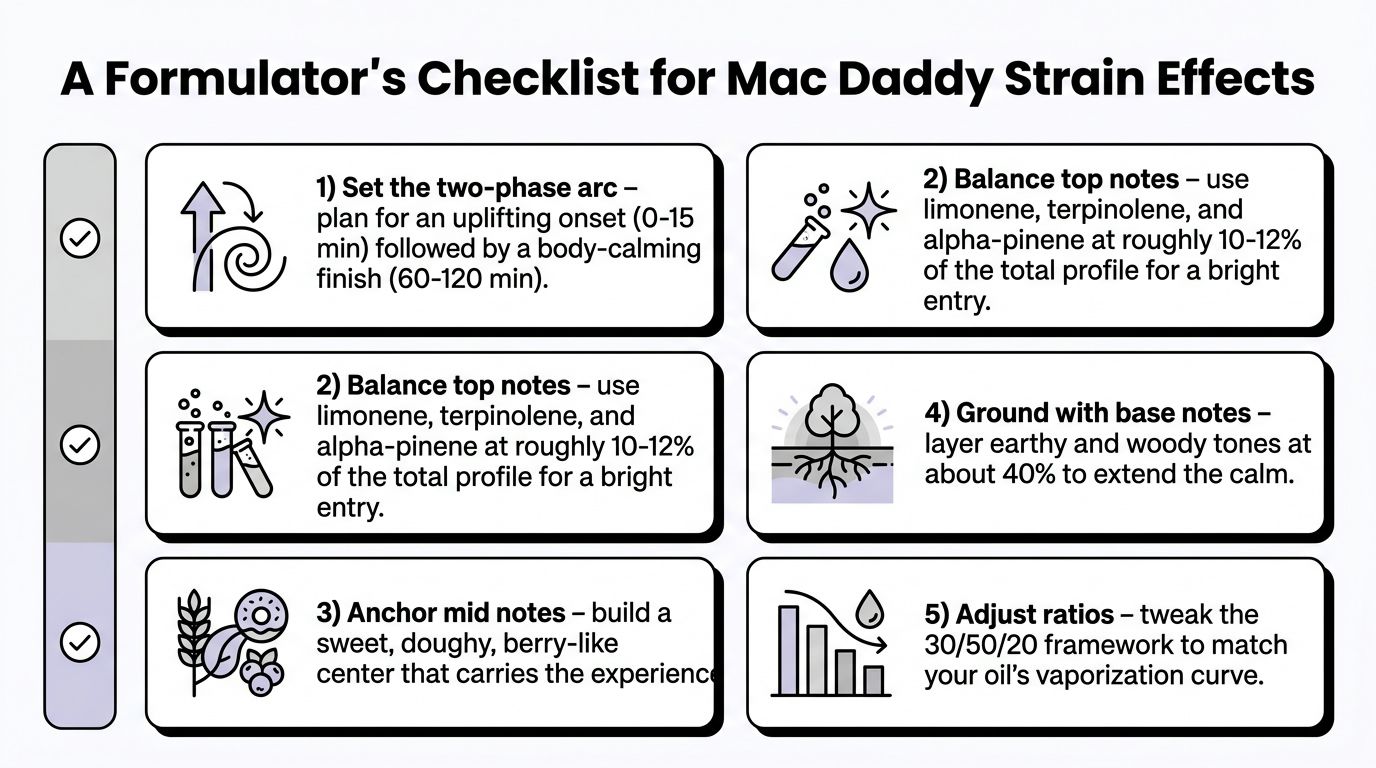
A first-pass Mac Daddy-inspired build should be evaluated as a sequence, not as a single aroma score. The reference target is a two-phase arc, with an uplifting opening and a body-calming finish. Your sensory panel should record what appears first, what remains through the middle, and what survives after the brighter notes have receded.
Use the following checklist at the bench:
Define the arc before blending. Set the intended opening around the reported 2–5 minute inhaled onset, then assess the transition toward the reported 30–60 minute peak window and the later finish described in the reference data. These timing markers come from Leafly's Mac Daddy strain listing, and they should guide testing rather than serve as guaranteed product behavior.
Set the total terpene architecture. The reported flower profile commonly falls within 1.5%–3.5% total terpene content by weight, as documented in the earlier profile guide. Use that range as a reference for the strain character, then choose the finished-cart cut according to the distillate and hardware.
Start with the 30/50/20 structure. Allocate the blend across top, mid, and base functions, then verify whether the actual chromatogram supports that distribution. Limonene and pinene should make the entry legible, myrcene should carry the center, and caryophyllene and linalool should keep the finish from collapsing into a thin or overly sharp profile.
Check the hardware window. Test viscosity at room temperature and inspect wick compatibility around a 2.5% total terpene level as a controlled evaluation point. Don't assume that a successful oil in one ceramic cart will wick identically in another device.
Confirm flavor at the top note. The first pull should identify the Mac Daddy direction without tasting like isolated lemon, pine, or perfume. A second and third pull should reveal the mid and base rather than flattening into sweetness or harsh spice.
Run the first-pass GC check. Confirm the intended top, mid, and base distribution before scaling the batch. If the chromatogram disagrees with the sensory result, investigate heat exposure, compound loss, matrix interaction, and hardware output instead of correcting the formula by intuition alone.
The most reliable build is the one that keeps the opening recognizable, lets the middle develop, and leaves a credible earthy finish. Record each adjustment by compound, weight, hardware, voltage, and sensory stage so the next batch improves from evidence rather than memory.
Gold Coast Terpenes supplies natural strain-specific blends and isolated compounds for cartridges, concentrates, and cannabis product formulation, including components such as limonene, myrcene, and beta-caryophyllene. Visit Gold Coast Terpenes to compare profile options, use formulation resources, and source components for your next Mac Daddy-inspired distillate or vape cartridge build.