
A terpene report can look perfect while the finished cartridge tastes flat. The usual failure doesn't begin at the filling line. It begins when someone samples the wrong part of the flower, leaves a distillate vial exposed to light, or sends a formulation to the lab after volatile compounds have already shifted. By the time the cart reaches sensory review, the laboratory number may describe a different material from the one your customer receives.
A reliable test for terpenes is therefore a chain of controlled decisions, from sample collection through GC-MS validation and final blend adjustment. For formulators replicating a flagship strain, the report isn't a flavor description. It's the production blueprint for a repeatable strain-inspired terpene blend, whether you're working with flower, winterized distillate, or a finished vape cartridge.
Why Sampling Decides Your Result Before the Lab Even Starts
A lab can't correct a nonrepresentative sample. If a cart tastes muted even though its COA shows a convincing terpene profile, start by reviewing how the sample was collected, sealed, stored, and transferred. Terpenes are volatile, so heat, light, oxygen, and handling can change the material before the analyst makes the first injection.
For flower, collect material from more than the visible surface. Break the batch into representative portions and combine them according to the laboratory's sampling instructions. Surface-heavy sampling can overrepresent resin-rich material, while a single nug may not reflect the lot you'll process. Use a clean, airtight, opaque container, keep the sample cool, and document the batch identity immediately.
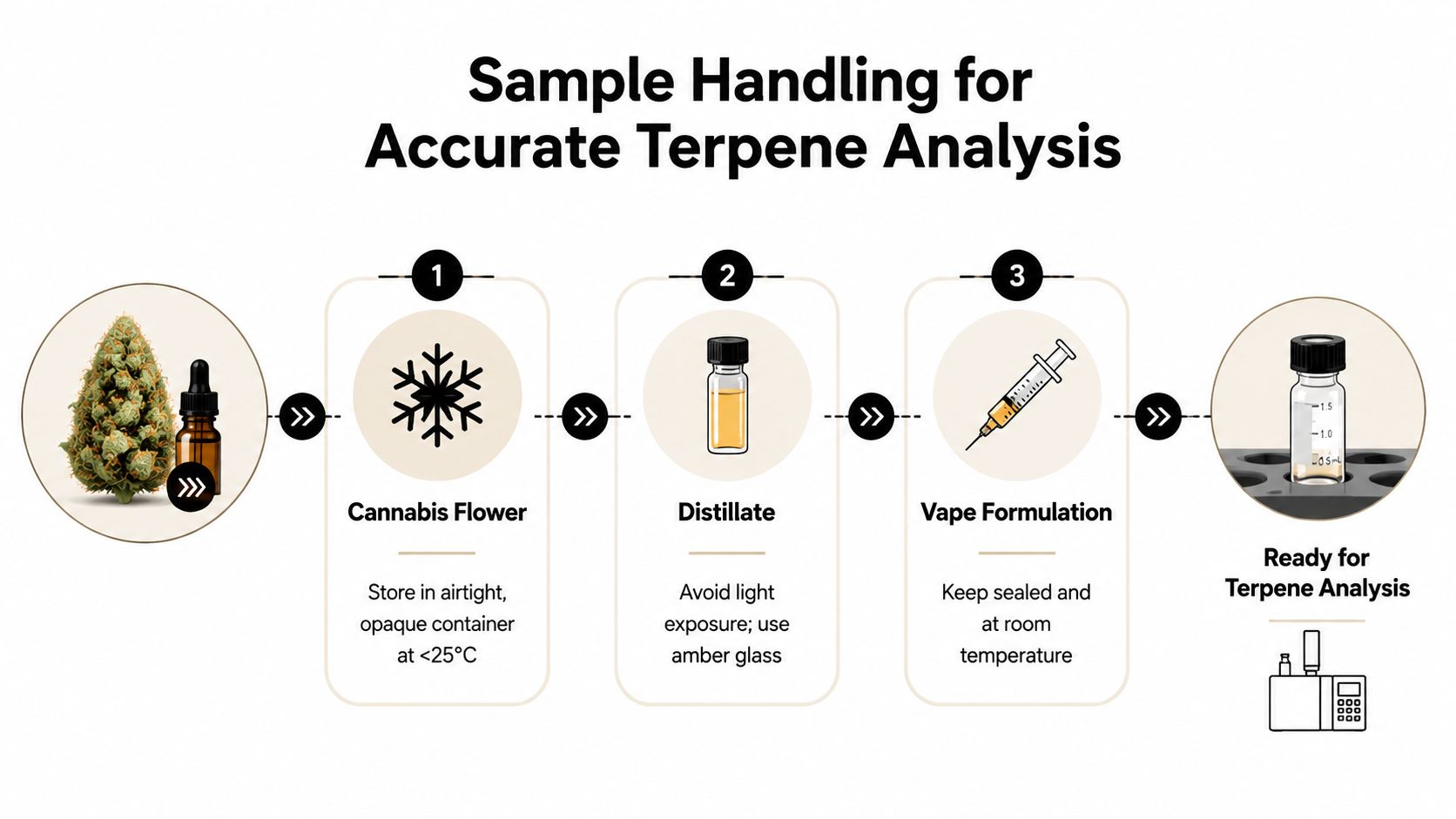
Build the sample around the production batch
Distillate requires a different approach. Transfer it into a sealed vial with minimal headspace, avoid unnecessary warming, and use amber glass when possible. A viscous sample can stratify or hold localized concentration differences, so mix it gently and consistently before collecting the laboratory portion. Don't use the same tools across cultivars without a validated cleaning procedure. Residual limonene or myrcene from a previous batch can distort a low-level result.
Finished vape formulations should remain sealed in their final or representative container. Don't leave filled cartridges uncapped while waiting for pickup, and don't treat a syringe sample as interchangeable with a cart if the hardware, seals, or fill process can affect exposure. Label the sample with the formulation name, lot, matrix, collection date, and storage conditions.
Practical rule: A terpene result is only useful when the sample history is traceable from the production vessel to the instrument.
A written chain of custody helps resolve disputes later. Record who collected the sample, how it was mixed, where it was stored, and when it left the facility. Keep the same procedure for every batch, including reference material used for trichome and harvest timing. Consistency matters more than a complicated protocol that operators won't follow.
The commercial payoff is straightforward. Representative, protected samples reduce false comparisons between cultivars and make your terpene profile for formulation more dependable. If two batches from the same cultivar read differently, sampling variation may be responsible before genetics or processing gets blamed.
Choosing the Right Analytical Method for Your Matrix
No single terpene method fits every product. GC-MS remains the most useful platform for detailed identification and quantification because mass spectral information supports compound confirmation, but the sample introduction technique still determines what the instrument sees.
Direct liquid injection works well for prepared distillates and oils when the lab has a validated dilution, calibration, and recovery procedure. It offers a direct path from sample to chromatogram, but complex matrices can make sesquiterpene quantification more difficult than monoterpene quantification. A cannabis flower workflow using selected-ion monitoring reported a calibration range of 0.04–5.12 µg/mL, average r² of 0.993, average LOQ of 0.047 µg/mL, analytical precision of 1.56% RSD, method precision of 4.97% RSD, and 90.2% recovery. Those figures are useful benchmarks, but only when the lab's matrix resembles yours. The published liquid-injection GC-MS method also emphasizes retention-time confirmation and commercial standards rather than library matching alone.
Compare the practical options
| Method | Strong fit | Main trade-off |
|---|---|---|
| Liquid-injection GC-MS | Distillate, oils, and prepared formulation samples | Matrix effects and injection behavior can affect recovery |
| GC-FID | Routine quantification where identity is already well established | It's efficient for quantification, but compound confirmation is less specific than mass spectrometry |
| Headspace GC-MS | Flower, volatile-rich formulations, and samples where direct injection adds matrix burden | Volatility and partitioning must be controlled during equilibration |
| SPME with GC-MS | Trace volatile screening and minimal-solvent workflows | Fiber selection, extraction time, and saturation can change relative response |
Headspace analysis separates volatile compounds from much of the nonvolatile matrix before the chromatographic run. A validated headspace full-evaporation workflow quantified 45 terpenes across monoterpenes, monoterpenoids, sesquiterpenes, and sesquiterpenoids, with calibration linearity from 10–2000 µg/g and analytical limits at or below 6 µg/g. The method-validation sequence included selectivity, calibration, detection limits, accuracy, and intra-day and inter-day precision, with all analytes passing the reported validation criteria. The full-evaporation headspace GC/MS study is a practical reference for broad flower or biomass panels.
SPME can be valuable when the lab needs a sensitive volatile profile with limited solvent handling, but it's not automatically more representative. Fiber chemistry, exposure time, agitation, and matrix saturation all influence extraction. Ask the lab how it controls those variables.
For a commercial formulation guide for vape cartridges, choose the method by matrix and decision. Use headspace when volatile recovery and broad profiling are priorities. Use liquid injection when the formulation is stable, homogeneous, and the lab has demonstrated matrix-specific recovery. For routine production, method consistency across batches matters more than choosing the most complex instrument on paper. A useful primer on chromatography and terpene testing can help align your internal specifications with the contract lab's capabilities.
Reading a GC-MS Report Like a Formulator
A chromatogram becomes useful only after you translate peak identity and concentration into blend architecture. Start by separating the report into top, mid, and base notes, then ask which compounds control the first impression, the central aroma, and the lingering character in the cartridge.
Gold Coast Terpenes' formulation chart places limonene in the top-note category, linalool in the mid-note category, and myrcene in the base-note category. Top notes appear first and fade quickly. Mid notes form the aromatic center, while base notes provide heavier, longer-lasting structure. That framework is more useful than chasing the largest peak because it explains how the blend will evolve during filling, storage, and use.
Read dominance as structure, not as a quality score
Terpene testing commonly reports composition as percentages. Those percentages can be highly skewed. In one 2025 GC-MS characterization of aromatic plants, terpenoids made up over 70% of the total relative peak area in most essential oils analyzed. Another study reported total monoterpenes of 97.10%, 93.04%, and 97.61% in three essential oils, while total sesquiterpenes were 0.89%, 4.92%, and 2.39%, respectively. The published essential-oil characterization shows why total terpene content alone can hide the shape of a profile.
For replication work, identify the dominant families first, then protect the minor compounds that give the profile its identity. A limonene-heavy sample needs a different correction than a myrcene-led sample with meaningful caryophyllene and humulene support. The target isn't necessarily the highest total. It's the right relationship between volatile lift, aromatic body, and persistence.
Use commercial standards and retention-time confirmation for every compound that drives the blend. Library matches are helpful for screening, but they aren't sufficient when isomers or matrix interference can alter identification. Review the report's analyte list, units, dilution factors, LOQs, and whether the lab reports detected compounds as percentages of total terpene content or another basis.
A flagship profile fails when the formulator copies the loudest peak and ignores the compounds that make the aroma recognizable.
Map the report into a working recipe. Limonene may establish brightness, linalool can provide floral continuity, and myrcene can anchor the base. The exact ratio must come from the measured reference profile and your sensory target, not from a generic strain chart. Keep the original report attached to the batch record so every revision can be traced in this lab-report interpretation guide.
Blending Distillate and Isolates with Measured Precision
The cleanest way to replicate flavor is to treat GC-MS data as the formula's blueprint, not as a suggestion. First define the target profile, then identify which compounds are already present in the distillate and which isolates are needed to restore the architecture.
For winterized distillate, warm the material to 40–50°C and mix for 15–30 minutes, following the practical workflow described in this guide to terpene isolates and blend construction. The purpose of controlled warming is to lower viscosity enough for uniform dispersion. Excessive heat or prolonged exposure works against the volatility you're trying to preserve, so use the lowest workable temperature and keep the vessel covered.
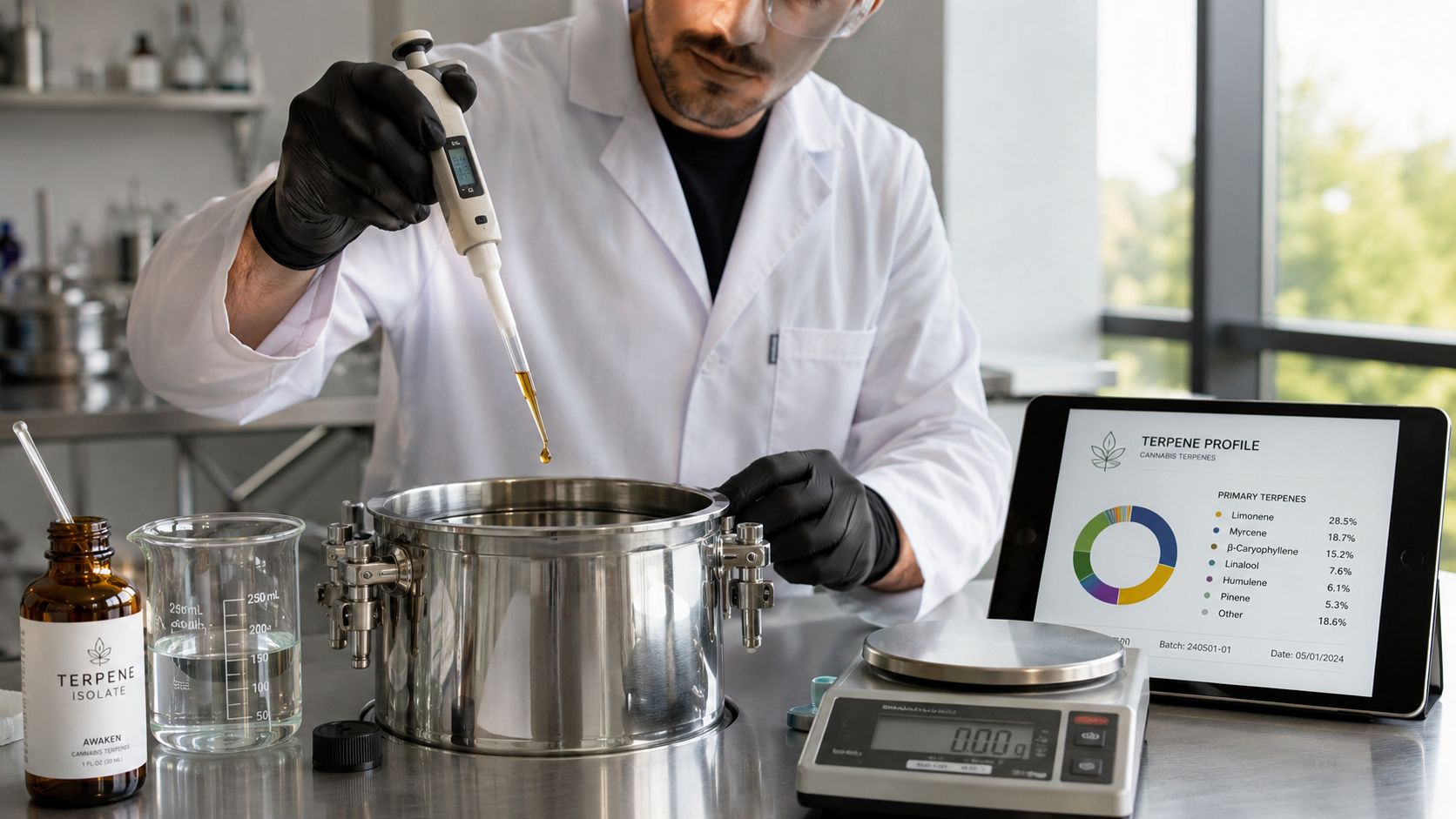
Assemble the profile by note function
Begin with the measured reference ratio. If the target has a strong myrcene foundation, add myrcene as the base rather than trying to create body with a large amount of limonene. Entour describes myrcene's earthy, musky character as a practical contributor to cannabis-like flavor and a useful base for indica-leaning cartridge profiles. That doesn't make myrcene a universal answer. It means the compound has a clear structural role when the reference profile supports it.
Limonene works as a bright top note, while linalool functions as a mid-note floral anchor. Gold Coast Terpenes' formulation guide lists suggested distillate usage rates of 1.5%–4.0% for myrcene, 0.5%–2.5% for limonene, and 0.2%–1.5% for linalool. Use those figures as formulation reference points, not as a substitute for sensory testing or matrix validation.
Commercial loading also needs a viscosity and handling check. Independent cartridge guidance commonly places total terpene loading at 5%–10% for distillate and 7.5%–15% for CBD distillate. The cartridge ratio reference provides those practical ranges for balancing flow, flavor, and fill behavior.
Do not add isolates until the base material has been characterized. Two distillates with the same cannabinoid potency can carry different residual terpene backgrounds, so the same additive ratio won't produce the same final aroma. Blend a controlled pilot, allow it to equilibrate under your documented conditions, then send the finished formulation for a test for terpenes. Compare the final profile with the target and record every adjustment.
The most common failure is overcorrecting a weak top note. A bright initial aroma can disappear quickly if the base and mid notes are missing, while an overly heavy base can make the cartridge feel dull even when the total terpene percentage looks acceptable. Build the progression, not just the first sniff.
QA and QC Protocols That Keep Results Consistent
A production terpene assay needs more than a clean chromatogram. Before you use results to release a batch or approve a strain-inspired blend, confirm that the method can identify, quantify, and recover the compounds in your actual matrix.
Start with the method-validation sequence. The lab should define the analyte panel, check selectivity, build calibration curves, establish detection and quantification limits, and verify accuracy and precision. Include both monoterpenes and sesquiterpenes because the easier response of one class can hide weak recovery or interference in the other.
Use a matrix-specific checklist
- Selectivity: Confirm that retention times and mass-spectral evidence distinguish target terpenes from neighboring peaks and formulation components.
- Linearity: Review the calibration model across the working range rather than accepting a single-point comparison.
- LOQ: Make sure the quantification limit is low enough for minor compounds that influence the target profile.
- Recovery: Spike and recover standards in flower, distillate, or finished vape matrix, not only in a clean solvent.
- Precision: Separate repeatability within one day from reproducibility across different days, analysts, or preparations.
The liquid-injection cannabis flower method reported average r² of 0.993, 1.56% RSD analytical precision, 4.97% RSD method precision, and 90.2% recovery across its validation work. These are useful commercial benchmarks, but they don't automatically transfer to your product. A cartridge oil with hardware contact, flavor isolates, or a complex carrier can behave differently from a flower extract.
QC checkpoint: If a lab can't show recovery in your matrix, its clean-standard performance doesn't prove that your finished formulation is being measured accurately.
Run controls at the beginning of a sequence and monitor drift across the batch. Retest an in-house reference material when a result changes sharply from the established profile. Keep sample mass, dilution, mixing, vial preparation, and instrument parameters fixed across production lots.
For a terpene test for cannabis product formulation, define acceptance criteria before seeing the result. Specify which compounds are critical, how much variation is tolerable, and when a batch requires investigation rather than automatic release. That prevents sensory preference from replacing documented quality control.
Legal Compliance and Partnering with Accredited Labs
Terpene analysis supports more than flavor development. It creates evidence that your material was sampled, identified, tested, and released through a controlled process. The legal requirements for cannabis and hemp products vary by jurisdiction, so the lab and manufacturer must confirm the rules that apply to the destination market rather than treating one COA as universally sufficient.
Choose a laboratory that can demonstrate method competence for your matrix. Ask whether it uses validated GC-MS or another appropriate method, whether its scope covers the compounds you need, and whether the report identifies the sample lot, collection details, units, LOQs, and test date. A polished PDF without traceability isn't enough.
Verify the lab before you send production material
Look for an accreditation status that covers the relevant testing activity, documented quality procedures, instrument maintenance, and staff competence. A capable partner should explain how it handles calibration, selectivity, matrix recovery, precision, and deviations. It should also tell you how it protects samples from light, heat, oxygen, and cross-contamination after receipt.
Your commercial partner should provide equally clear documentation. Verify the identity and concentration of every isolate or blend, review available safety documentation, and confirm whether the formulation contains carriers, diluents, or residual solvents. A supplier that can't explain what's in the bottle creates risk for both consistency and market access.
Third-party verification matters because an internal sensory panel can tell you that two carts smell different, but it can't establish which compound changed or whether the difference came from sampling, storage, blending, or hardware. A controlled external assay gives your R&D team a common reference point. The practical principles in this guide to third-party lab testing apply directly to supplier qualification and batch release.
For a flavor reference, Elevated Strains is one catalog example that can be evaluated alongside your own analytical target. Treat any purchased profile as a formulation input that still requires matrix testing, documentation, and final-product verification.
Accredited labs and verified isolate suppliers protect reproducibility because they let you compare like with like. Require the same sample preparation, analyte panel, reporting basis, and acceptance criteria across development and scale-up. That discipline makes it easier to determine whether a flagship strain replication failed because of the terpene source, the distillate background, the blend ratio, or the production process.
Gold Coast Terpenes offers natural terpene blends, strain-specific profiles, and isolated compounds for cartridges, concentrates, and product formulation, with supporting tools such as a mixing calculator and safety documents. Visit Gold Coast Terpenes to review terpene options for distillate and build your next formulation around measured, repeatable flavor targets.