
The popular advice is simple: choose distillate because higher cannabinoid purity must produce a better product. That advice fails often enough to be dangerous for a formulation team. A near-transparent distillate can still produce a harsh, flat, unstable cartridge, while a less refined winterized oil can deliver better flavor integration and more forgiving blending behavior.
The practical question in winterized oil vs distillate isn't which feedstock has the larger potency figure. It's which one fits your terpene strategy, hardware, viscosity target, stability program, and manufacturing workflow. Winterized oil retains more native complexity but brings additional filtration and re-clouding considerations. Distillate offers a cleaner, more neutral starting point, yet it makes the formulator rebuild the sensory profile almost from scratch.
| Formulation concern | Winterized oil | Distillate |
|---|---|---|
| Primary role | Purified intermediate after cold filtration | Refined cannabinoid-rich output after distillation |
| Native plant complexity | Retains more minor cannabinoids and plant compounds | Minimal native terpenes and plant compounds |
| Cannabinoid purity | About 80–90% in one technical guide, after lipid removal (Cannabis Labs Consulting) | About 85–95% single-cannabinoid purity in technical comparisons (Mr. Terps) |
| Lipid management | Requires close attention to residual waxes and cold stability | Lower re-clouding risk when properly refined, but viscosity and crystallization still require testing |
| Terpene workload | Often needs supplementation and balancing | Usually requires deliberate terpene reconstruction |
| Typical formulation advantage | More layered, strain-oriented sensory character | Consistent potency and neutral base behavior |
| Main production risk | Re-clouding, fouling, and viscosity drift | Flat flavor, harshness, crystallization, or poor terpene integration |
Why Purity Alone Does Not Determine Formulation Success
A product can fail after passing the potency discussion. The cartridge may clog, the blend may separate during a stability hold, or the vapor profile may become sharp because the team treated refinement as the finished formulation strategy. Purity is a feedstock attribute. Performance is a system outcome.
Distillate is often selected for its high cannabinoid concentration and clean appearance. That makes sense when the product needs a neutral base, controlled cannabinoid ratios, or repeatable filling behavior. It doesn't guarantee that the final oil will wick correctly through a ceramic core, remain homogeneous after terpene addition, or preserve the intended flavor after storage.
Winterized oil presents the opposite trade-off. Cold filtration removes much of the lipid load, and one independent technical guide reports removal of about 85–95% of lipid content, with cannabinoid purity rising from roughly 55–65% in crude oil to about 80–90% in winterized oil (Cannabis Labs Consulting). That intermediate may contain more native minor cannabinoids and plant-derived complexity than distillate, which can reduce the amount of flavor reconstruction needed for a strain-inspired product. It can also carry enough residual complexity to create clouding or viscosity changes if the filtration and cold-storage controls aren't strong.
The cartridge is the real test
A brand that chases the highest available purity can still create a poor cartridge if it adds terpenes without evaluating the complete blend. Distillate commonly needs terpene restoration to avoid a one-dimensional sensory result, while winterized oil may need only targeted top-note supplementation. Neither approach is automatically superior.
Practical rule: Evaluate the filled cartridge, not just the incoming oil. A clear feedstock that fails wicking, separation, or shelf-stability checks is not a successful formulation.
The right choice depends on the product's job. Flavor-led, strain-replication work may benefit from winterized oil's broader starting profile. Potency-led disposable products may favor distillate because the formulator gets a more standardized cannabinoid base. Your equipment, analytical program, and ability to manage terpene blending matter as much as the extraction specification.
How Winterized Oil and Distillate Are Actually Made
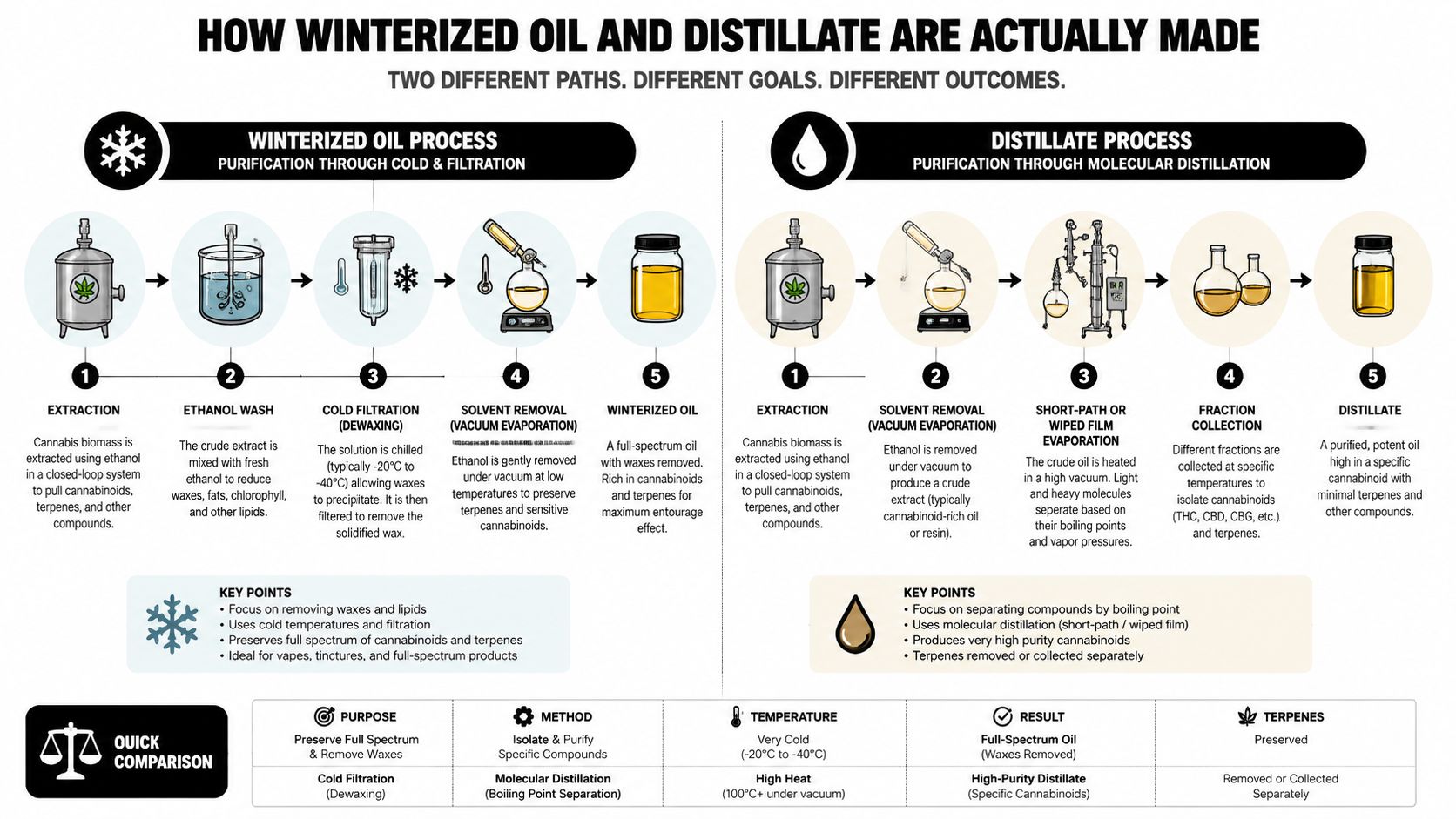
Winterization and distillation are often discussed as if they were competing extraction methods. They aren't. Winterization is primarily a cold-filtration cleanup step, while distillation is a later separation process that concentrates selected cannabinoids through heat and vacuum.
Winterization begins by dissolving crude oil in ethanol. The solution is chilled until fats, lipids, and waxes lose solubility and crystallize, then the solids are filtered out. Practical processing guidance places the chilling range at about −20°C to −80°C for 24–48 hours, with common ethanol ratios of roughly 5–20 mL per gram of oil and 10:1 often cited as a standard (BR Instrument). Cold ethanol around 190 proof is commonly preferred in practical guides, and wax precipitation is expected to be minimal above about −20°C, so a mild cold soak won't deliver the same cleanup.
Winterization preserves more of the feedstock character
The filtered material is solvent-recovered into winterized oil. The process targets insoluble plant fractions rather than selectively isolating one cannabinoid. That distinction matters for formulators because the finished intermediate can retain more minor cannabinoids and native plant compounds than a distilled fraction.
The underlying principle has a long history outside cannabis. Oil fractionation methods have been described for almost 150 years, and the term winterization is associated with leaving oil tanks in winter so higher-melting components crystallize out. Edible-oil refiners used the clear liquid fraction as “winterized salad oil,” primarily to improve cold stability rather than alter the oil's core chemistry (Nabil Rasol, Sulaymaniyah University PDF).
Distillation takes that cleaned feedstock into a different operating objective. Short-path or wiped-film equipment uses controlled heat and vacuum to separate compounds by volatility, collecting a cannabinoid-rich fraction while removing much of the remaining terpene, pigment, wax, and plant-compound load. The result is a far more chemically stripped material, which is why this distillate production overview describes winterization as an input-stage cleanup before the more intensive distillation step.
Solvent recovery and workflow control
Ethanol must be recovered from winterized oil before the intermediate is used in a final formulation. The cold filtration stage also needs temperature control during transfer and filtration, because warming can allow precipitated material to redissolve. Distillation adds a separate thermal and vacuum operation, with feed preparation, fraction collection, and analytical confirmation required to keep the desired cannabinoid fraction consistent.
This creates a workflow distinction. Winterization is comparatively direct, but its success depends on cold residence, filtration quality, and solvent recovery. Distillation offers stronger isolation, but it requires specialized evaporation and vacuum equipment, tighter process control, and a formulation plan for the compounds removed during refinement.
Comparing Purity and Terpene Retention Across Both Feedstocks
Purity is a poor predictor of formulation success. The practical question is how each feedstock behaves in the blending room, through the cartridge, and after storage. Winterized oil carries more native material into the formula, while distillate supplies a more controlled base that requires deliberate sensory and viscosity reconstruction.
Technical comparisons place winterized oil at roughly 80–90% cannabinoid concentration after winterization, while distillate can reach about 85–95% single-cannabinoid purity with minimal native terpenes (Norddampf). That difference matters less than the downstream behavior. Residual waxes, lipid content, cannabinoid ratios, and terpene selection determine whether a batch stays clear, wicks consistently, and remains stable in hardware.
| Parameter | Winterized oil | Distillate |
|---|---|---|
| Cannabinoid concentration | Typically about 80–90% after winterization, as noted in the earlier purity comparison | About 85–95% single-cannabinoid purity is reported in technical comparisons |
| Native terpene contribution | More minor compounds and original plant complexity remain | Native terpenes are minimal, so aroma and flavor usually require deliberate rebuilding |
| Lipid behavior | Proper processing can remove about 85–95% of lipids, but residual waxes may still affect cold stability | Further separation removes most plant complexity, though the finished blend can still crystallize or drift |
| Solvent concern | Ethanol recovery and final residual-solvent verification remain part of the workflow | Incoming crude and post-process material still require the relevant residual-solvent controls |
| Terpene strategy | Usually needs targeted supplementation and correction of missing notes | Often needs a fuller reconstruction of aroma, flavor, and viscosity |
| Hardware interaction | Broader composition can complicate wicking and long-term clarity | More consistent as a base, but terpene chemistry and final viscosity still govern coil behavior |
What the numbers do not tell you
A cannabinoid percentage does not show how an oil moves through a wick. It also does not predict re-clouding after temperature cycling, terpene separation, or crystallization during storage. Those outcomes depend on residual lipids, cannabinoid ratios, terpene chemistry, cartridge construction, fill temperature, power delivery, and storage conditions.
Winterized oil can reduce terpene rebalancing work because some native character remains. That same complexity can increase batch-to-batch variation and make viscosity correction less predictable. A blend that looks uniform when warm may become hazy as it cools, or wick more slowly when residual waxes begin to organize.
Distillate provides a cleaner sensory starting point and usually makes cannabinoid consistency easier to manage. It does not guarantee cartridge stability. The formulator must rebuild the terpene profile without creating an overly thin blend, excessive volatility, or incompatibility with the cartridge materials and coil.
Residual-solvent testing needs equal attention for both feedstocks. Ethanol is central to winterization, so recovery and the final certificate require review. Distillate may begin with hydrocarbon or CO2 crude, making incoming material controls and post-process testing relevant as well. A passing certificate does not replace finished-product stability testing.
For strain replication, winterized oil may preserve useful middle and base notes, reducing the amount of reconstruction required. Distillate offers greater control, but every sensory element must come from the selected terpene system. Volatility, heat, oxygen, and storage can still shift that profile after blending, as outlined in this terpene degradation guide.
Blending Terpenes Into Winterized Oil and Distillate
Terpene integration starts with the base, not the flavor name. Winterized oil usually enters the vessel with higher viscosity and more residual plant character, while distillate needs a more deliberate terpene system to supply both aroma and workable flow. The target is a uniform blend that stays stable after cooling without stripping out the most volatile notes.
For distillate, one Gold Coast Terpenes formulation guide gives a practical terpene range of 5% to 15% and a blending window of 120°F to 140°F (Gold Coast Terpenes clear distillate guide). Its separate thinning guidance lists 4% to 7% for flavor-focused applications, 3% to 7% for lighter additions, and 10% to 15% for stronger cartridge aroma. It also describes a working range of 50°C to 80°C, an ideal target of 60°C to 65°C, and 15 to 20 minutes of magnetic stirring after addition (Gold Coast Terpenes distillate thinning guide). These are starting ranges, not universal recipes. Compatibility, cooling behavior, and cartridge testing still determine the usable formula.
| Blending parameter | Winterized oil | Distillate |
|---|---|---|
| Primary objective | Integrate supplementation without disrupting native complexity | Rebuild aroma while controlling viscosity |
| Practical temperature reference | About 120°F to 140°F, per the cited formulation guidance | About 120°F to 140°F in one guide, with 60°C to 65°C identified as an ideal target in another |
| Terpene starting point | Add only enough to correct top, middle, or base-note gaps | Start with a defined profile, then adjust for flavor and flow |
| Agitation | Gentle, sustained mixing limits unnecessary air incorporation | Magnetic stirring for 15 to 20 minutes after addition is specified in the cited guidance |
| Main failure signal | Clouding, wax bloom, or viscosity drift during cooling | Separation, crystallization, harshness, or inconsistent filling |
A controlled winterized-oil workflow
Warm winterized oil only until it becomes mobile, then add the terpene blend gradually under steady agitation. Heat improves handling, but it does not replace filtration or resolve residual wax and lipid problems. If the oil clouds during cooling, increasing the terpene load may temporarily mask the appearance while leaving the cause untouched.
Start with a small pilot batch and establish the minimum effective addition. First determine which top, middle, and base notes are already present. Add bright volatile notes cautiously, then use middle and base components to improve body and persistence. Pushing the entire formula toward a thin, highly volatile profile can create a fast initial aroma but a weak finish, greater evaporation loss, and less predictable cartridge behavior.
Winterized oil therefore carries a lower rebalancing load, but its native complexity can make cold stability harder to control. A blend that is clear and uniform while warm may re-cloud in storage, change viscosity, or wick slowly as residual waxes reorganize.
A controlled distillate workflow
Distillate benefits from a fixed sequence. Pre-warm the base, add terpenes slowly, mix until the batch is visually uniform, and cool it under controlled conditions before filling. Keep the vessel covered where appropriate, reduce unnecessary headspace exposure, and degas carefully if mixing introduces micro-bubbles.
The rebalancing burden is higher because distillate contributes little native terpene character. Build the profile in layers: a top-note opening, a coherent mid-note body, and a base that remains present after heating. If the result tastes sharp, review total terpene load, compound volatility, blending temperature, and hot hold time before rejecting the cannabinoid base. A thinner blend may fill easily yet leak, evaporate faster, or behave poorly with the cartridge seal and coil.
Production note: A blend that looks homogeneous at fill temperature has not passed. Check it after cooling, after a stability hold, and inside the intended cartridge hardware.
Clouding usually points to incomplete winterization, unsuitable cooling behavior, or an incompatible formulation. Separation indicates inadequate mixing or a poorly matched terpene system. Wicking failure can result from excessive viscosity, hardware mismatch, or filling before homogenization is complete. Correct the process cause before changing the flavor profile.
Choosing the Right Feedstock for Cartridges and Concentrates
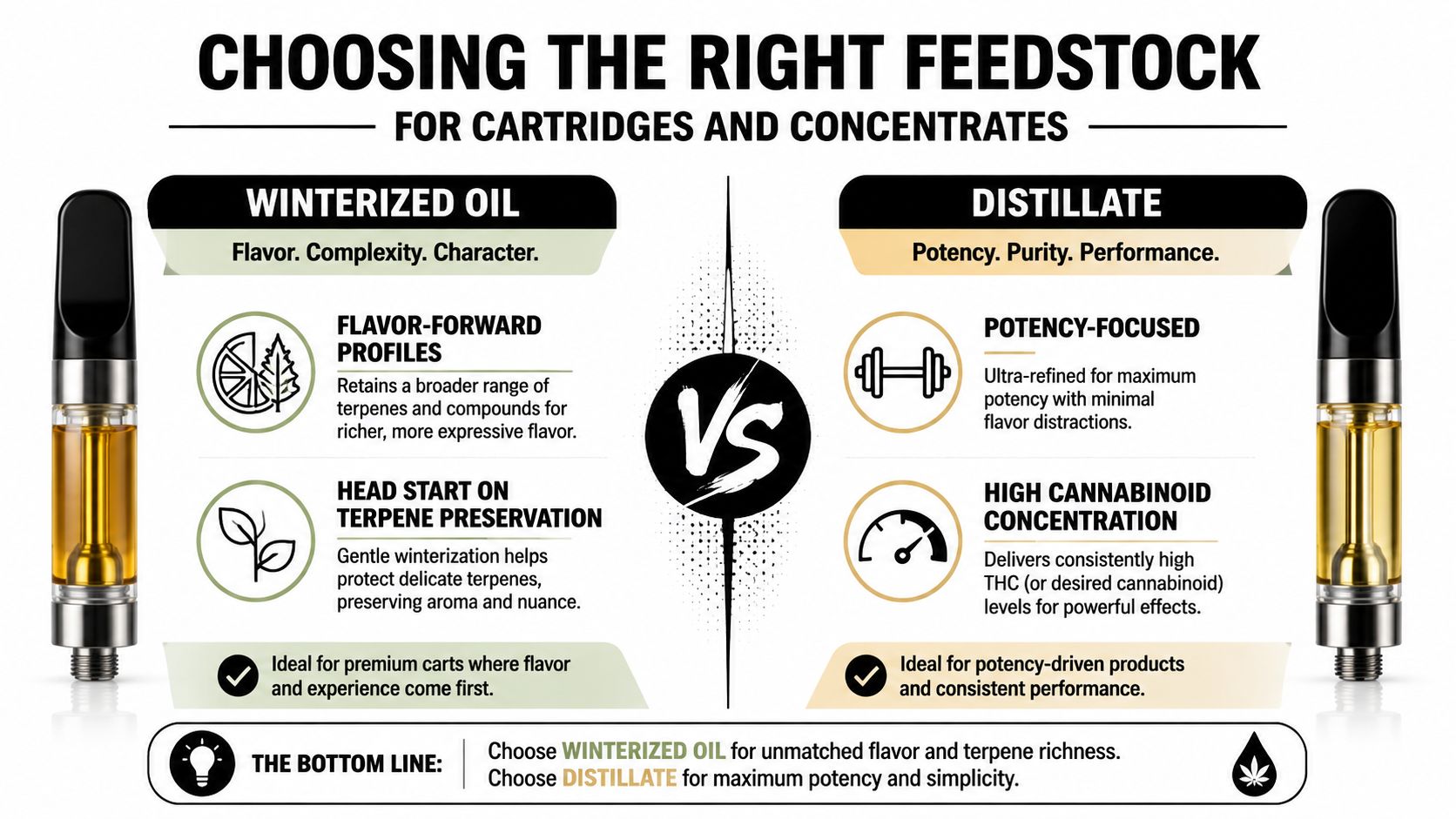
The cleanest feedstock is not automatically the easiest one to formulate. Choose against the device, sensory brief, and storage conditions, because viscosity, terpene reconstruction, re-clouding, and cartridge stability determine whether a batch performs after filling.
A strain-specific 510 cartridge may suit winterized oil when native minor-compound character carries part of the product identity. That character can reduce terpene rebalancing work, but residual waxes may reorganize during storage, causing clouding, slower wicking, or coil fouling. Cold-stability testing must therefore cover the filled cartridge, not only the oil in a vessel.
Distillate is a more controlled starting point for potency-led cartridges and disposables that require repeatable flow. Its relatively neutral profile simplifies batch-to-batch sensory control when the terpene blend is standardized. The formulation workload shifts downstream: the team must rebuild the opening, body, and finish of the vapor, while keeping the blend thin enough to fill without creating leaks or unstable coil behavior.
Match the oil to the format
Ceramic-core hardware places particular pressure on winterized oil. Inspect the blend for wax-related changes after cooling and during storage, then confirm wicking and coil behavior in the intended cartridge. Distillate is usually more predictable, but its viscosity still must match the reservoir, intake openings, wick, and power profile. Lower-power disposables can expose a thick blend sooner than a higher-output 510 device.
Concentrates require a separate specification. Winterized oil can fit products built around retained complexity and controlled nucleation, while distillate suits applications where clarity and cannabinoid isolation carry more weight. Sauce, diamonds, and budder each need their own controls. A cartridge formula should not be transferred directly into a concentrate process.
A flavor reference such as 24k gold punch can indicate a desired profile direction. It does not predict stability. Validate the selected notes against the base, viscosity target, heating conditions, and hardware.
Practical format recommendations
- Flavor-forward 510 cartridge: Start with winterized oil when native complexity matters, then test cold clarity, wicking, and coil behavior.
- Potency-focused disposable: Start with distillate when repeatable flow and a neutral base take priority.
- Strain-replication line: Compare both feedstocks in identical hardware. Winterized oil may reduce terpene reconstruction, while distillate can tighten cannabinoid standardization.
- Concentrate program: Select for texture, clarity, and crystallization behavior rather than cartridge assumptions.
For distillate, review the earlier cited cartridge thinning guidance while setting the viscosity target. No formulation guide replaces a filled-hardware stability study.
Building a Decision Framework for Your Product Line
Don't choose the cheapest feedstock first and retrofit the product around it. That approach often shifts the cost into terpene reconstruction, failed fills, rejected cartridges, and repeated stability work. Score each SKU against the product outcome it must deliver.
Four questions for every SKU
- What is the potency and cannabinoid target? Distillate is useful when a concentrated, more isolated cannabinoid fraction is central to the specification. Winterized oil may be preferable when broader native composition supports the intended product identity.
- How much sensory complexity should come from the base? If the profile depends on layered, strain-inspired notes, winterized oil may reduce reconstruction work. If the brand wants strict flavor control, distillate provides a more neutral starting point.
- What can the hardware tolerate? Review viscosity, intake geometry, wick material, coil temperature, and storage conditions. A base that fills well may still perform poorly after cooling or extended residence in the cartridge.
- Can the production system repeat the result? Winterization needs reliable cold filtration and solvent recovery. Distillation needs controlled evaporation, fraction collection, and analytical confirmation. Choose the process your team can control consistently.
A simple weighted matrix can assign each criterion a priority for each SKU. For a premium flavor line, give greater weight to sensory complexity and cartridge stability. For a high-volume, potency-oriented product, give greater weight to cannabinoid consistency, filling behavior, and QC simplicity. The scores should come from your own pilot data, not supplier assumptions.
Hybrid formulations can also be evaluated, but only as a controlled development strategy. Combining winterized oil and distillate may balance native complexity with cannabinoid concentration, yet it introduces another variable into viscosity, terpene integration, and stability. Test the blend as a new feedstock rather than assuming the two inputs will average cleanly.
Decision principle: Select the feedstock that minimizes the number of uncontrolled variables in your finished product, not the one that sounds most refined on a certificate.
The broader product question also includes whether a live-resin-style sensory goal is appropriate for the chosen base. A technical comparison in this discussion of live resin and distillate can help frame that distinction without turning the decision into a simple purity contest.
Avoiding Common Formulation Failures With Either Feedstock
Incoming inspection should happen before expensive terpene addition. Request a certificate with a full residual-solvent panel, verify cannabinoid results against the product specification, and inspect the oil at the temperatures your logistics and storage systems will create.
Screen the base before blending
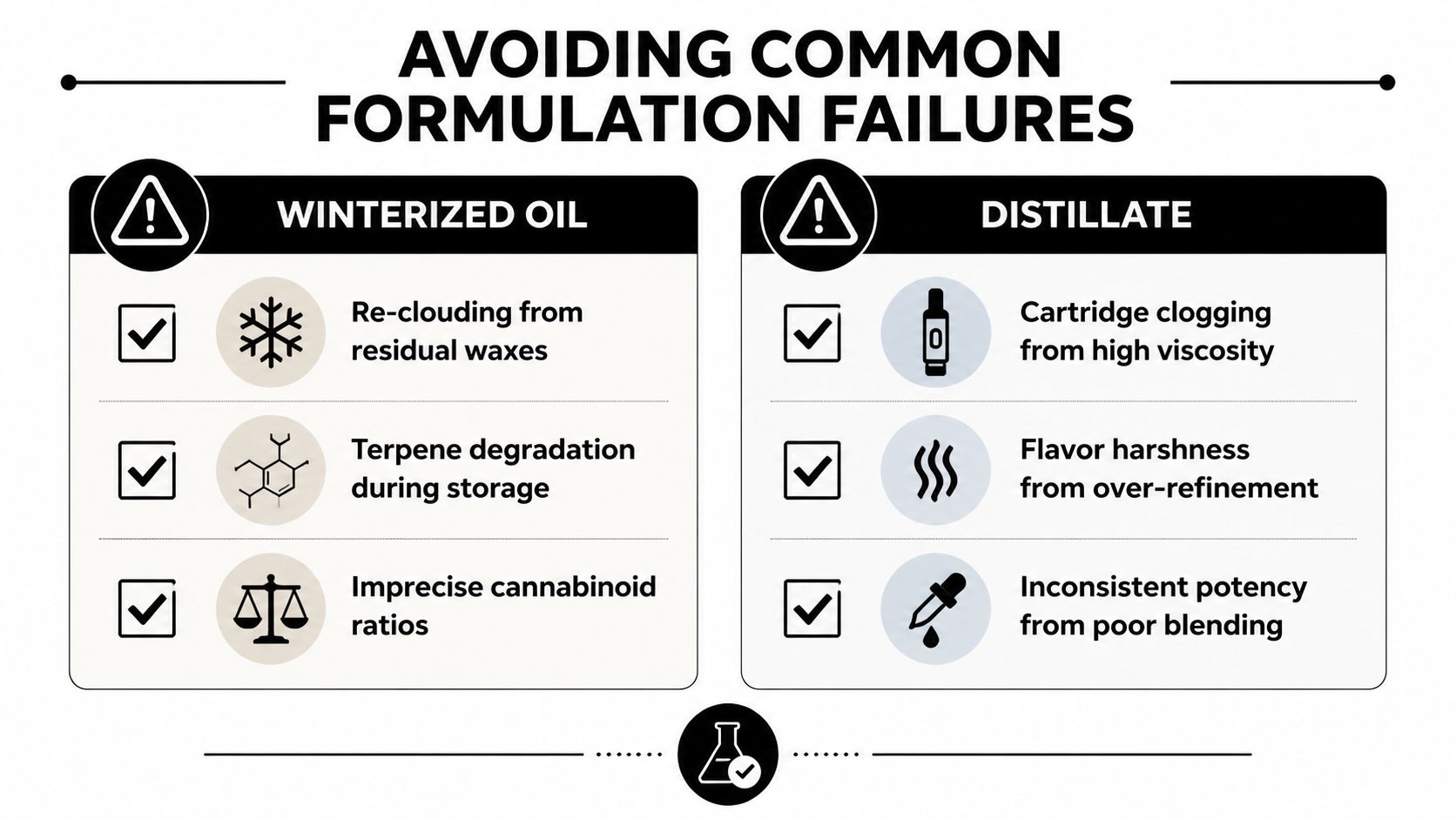
For winterized oil, a cold-test protocol can expose residual wax behavior before the batch reaches the filling line. One practical checkpoint is a 72-hour hold at 4°C, used to look for clouding or precipitate formation before approving the oil for formulation. If the sample re-clouds, repeat filtration or reject the batch according to your quality system rather than masking the problem with more terpene.
Distillate needs a different screen. Confirm potency within ±2% of the stated THC or CBD value before building the final blend, as specified in the planned QC approach. A potency mismatch can distort the entire formulation calculation and create avoidable rework.
Watch for these red flags:
- Phase separation: Reject or investigate any blend that separates after a 48-hour stability hold.
- Color movement: Unexpected darkening or color shifts may indicate oxidation or incompatible storage exposure.
- Viscosity drift: A batch that changes flow after cooling may have been inadequately homogenized or poorly matched to the hardware.
- Wicking and clogging: Repeated intake blockage points toward viscosity, lipid carryover, crystallization, or a hardware mismatch, not a flavor problem.
Use a clear go or no-go path
If the certificate is incomplete, stop. If the base fails the cold or potency screen, stop. If the terpene pilot separates, clouds, or produces unacceptable viscosity, revise the process or reject the batch before filling.
A successful formulation guide for cannabis product formulation should end with a release decision, not just a blend percentage. Approve only when the base, terpene system, hardware, and stability results agree with the SKU specification.
Gold Coast Terpenes offers natural terpene blends, strain-specific profiles, isolated compounds, formulation education, and tools such as a mixing calculator for teams developing cartridges and concentrates. Visit Gold Coast Terpenes to evaluate terpene options for distillate, winterized oil, and strain-inspired product development.