
You've got a Pink Picasso batch on the bench, the COA looks strong, and the aroma still isn't lining up with what the brand team approved. One lot leans candy-sweet and floral, another feels flatter and heavier, and the cartridge spec sheet still expects a single, repeatable profile. That is the formulation problem with Pink Picasso. The strain name is useful, but it doesn't guarantee a stable sensory outcome unless you build around chemistry, not marketing language.
For vape cartridge manufacturers, extractors, and brand owners, the answer is a terpene-driven workflow that treats Pink Picasso as a chemotype family, not a fixed flavor note. Its value sits in the way sweet dessert aromatics, floral lift, and high-potency THC density can be translated into a controlled product format. When you understand the cannabinoid range, terpene layout, batch variability, and safety checks, you can make a cart that reads like Pink Picasso without gambling on whatever the flower happened to express that harvest.
Introduction to Pink Picasso Strain Formulation Context
A formulator opens a fresh lot of Pink Picasso, checks the jar, and immediately sees the problem. The flower smells loud, but not identical to the last lot. One sample pushes candy and rose, another skews more citrus and spice, and the production team needs a cartridge that tastes consistent across fills, not a one-off lucky hit.
That's why Pink Picasso deserves a formulation-first approach. Public strain descriptions repeatedly place it in the premium-potency tier, with THC commonly in the 22% to 30% range, CBD below 0.5%, and total terpene content around 1.5% to 3.0% by weight (Joint Commerce). Those numbers matter because they signal a strain that can carry strong aroma, strong psychoactivity, and strong batch-to-batch consequences if the terpene plan is sloppy.
Why the strain name is not enough
Pink Picasso is commonly described as a balanced hybrid, but balanced doesn't mean uniform. Public descriptions vary from creative and uplifted to sleepy and heavy, which is exactly why a single “Pink Picasso flavor” claim falls apart in production. A formulation team has to map the lot's terpene expression, not just copy the strain label.
Practical rule: treat the flower as input chemistry, not brand language. If the aroma map changes, the finished cart recipe needs to change with it.
A useful starting point is to separate what the strain is known for from what the finished oil needs to do. The strain can give you a sweet floral identity, but the cartridge still needs viscosity stability, vapor performance, and a target sensory arc from first pull to finish. That means the best workflow is to anchor on analytical data, then translate that data into a controlled blend.
For teams building educational or production resources, a good companion reference is a terpene formulation guide for cartridge development that helps standardize ingredient selection before scale-up. Once the input oil is characterized, the rest of the process becomes much easier to repeat.
Genetics and Cannabinoid Profile Overview
Pink Picasso is most commonly traced to Candyland × OZ Kush, and multiple listings identify Wonderbrett as the breeder or original breeder of the cut (Sativa University). That lineage matters because it explains why the cultivar repeatedly shows candy-forward aromatics with floral and spice accents instead of a simple gas-heavy profile. For product developers, lineage is not trivia, it's a clue to likely sensory behavior.
The balanced hybrid read is also important. Pink Picasso is generally reported as roughly 50% sativa / 50% indica, with THC commonly in the 22% to 30% range and CBD usually below 0.5% (Joint Commerce). Independent listings also place THC around 22% to 27%, with some batches reaching roughly 28% to 30% total THC and CBD staying near trace levels (AllBud). That spread is exactly why formulators can't depend on a single generic spec.
Pink Picasso Cannabinoid Metrics
| Compound | Range |
|---|---|
| THC | 22% to 30% |
| CBD | below 0.5% |
| Total terpenes | 1.5% to 3.0% by weight |
Because CBD is so low, it doesn't offer much buffering against THC intensity. In practical terms, the finished extract will often feel driven by THC density and whatever minor cannabinoids survived extraction and post-processing. That pushes the formulation team toward careful dose control, especially if the target product is a cartridge designed for repeatability.
For distillate-based carts, this profile usually means the base oil should be tuned for potency preservation first, then flavored with a terpene layer that can survive heat without muting the experience. A decarb or blending mistake here can flatten the profile fast. If the oil starts too hot, or the terpene addition is too aggressive, the final product can lose the exact premium edge that makes Pink Picasso attractive in the first place.
Terpene Composition and Flavor Profile
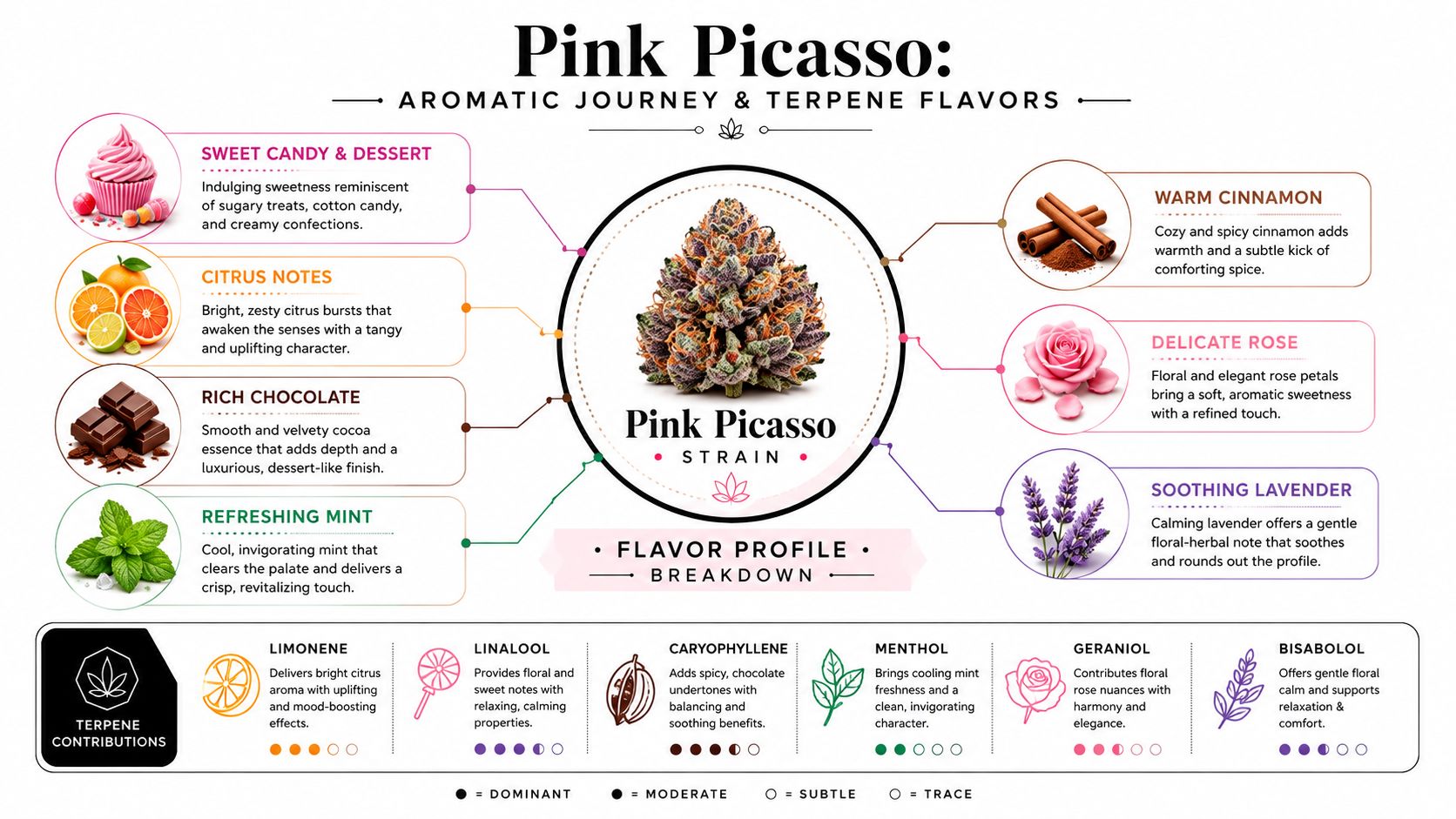
Pink Picasso's flavor profile is one of its biggest formulation assets. Public descriptions repeatedly emphasize a sweet candy and dessert profile with citrus, chocolate, mint, cinnamon, rose, and lavender accents (GrowDiaries). That combination gives you a layered map, not a single-note terpene target. For a cartridge, that means top, mid, and base note planning matters.
Building the flavor map
The cleanest way to think about this strain is through aromatic layers. Citrus sits in the top notes, usually carried by limonene-forward material. Rose and lavender land in the midrange, where linalool-type floral impressions can help give the blend softness. Chocolate, cinnamon, and mint work more like texture and depth, the kind of base support that keeps the profile from reading as thin or overly bright.
A good terpene aroma and flavor guide helps teams distinguish those layers before they start blending. That matters because “dessert” is not a terpene identity by itself. Dessert only becomes believable when the sweet top note has a floral mid and a rounded base.
Formulation insight: the most convincing Pink Picasso carts usually feel sweet on the nose, then floral in the middle, then gently spiced or creamy on the finish.
That structure is also why isolate selection has to be deliberate. A premixed profile can get you close quickly, but isolates let you tune each layer without carrying extra notes that don't belong. If the flower batch leans too citrus-heavy, the blend can be softened. If it comes in muted, the floral and dessert elements can be lifted without forcing the whole profile into generic sweetness.
The point is not to copy every nuance of the flower. The point is to preserve the recognizable aromatic signature in a cartridge format that still wicks, vaporizes, and tastes stable after fill.
Effects and Terpene Role in Product Performance
Pink Picasso behaves differently across phenotypes and product formats, with user reports ranging from creative uplift to couch-locking sedation, which is exactly why terpene titration matters (Graswiese). If the same strain can feel bright in one lot and heavy in another, the cartridge formulation needs to carry some of that decision-making instead of leaving it to chance.

Matching terpene ratios to the intended experience
For a more daytime-leaning cart, formulators usually keep limonene in the brighter role and avoid overloading the base with heavy, sleepy cues. A lower, cleaner myrcene presence can help preserve lift, while beta-caryophyllene can add structure without making the profile feel blunt. That balance supports a clearer first impression and a less congested finish.
For an evening-leaning product, a softer top note and a fuller base can make the same strain feel more settled. Myrcene can deepen the body sensation, while caryophyllene contributes spice and weight. The risk is obvious, if the base is pushed too far, the cartridge stops reading as Pink Picasso and starts behaving like a generic sedative blend.
A good cartridge performance guide is useful here because vapor performance depends on more than flavor. Terpenes affect mouthfeel, volatility, and the way the oil presents at different coil temperatures. If the mix is too top-heavy, it can taste sharp and disappear fast. If it's too base-heavy, the cart can feel dull or muddy.
The most stable Pink Picasso cartridges usually preserve brightness first, then add enough floral and spice depth to make the profile feel complete.
That variability is why terpene percentages should be treated as functional inputs, not decoration. The same brand can keep the Pink Picasso identity while offering a slightly different sensory position for different SKUs. A lower-dose cart can feel more creative and crisp, while a fuller blend can feel denser and more relaxing, without changing the base THC architecture.
Cultivation and Harvest Insights
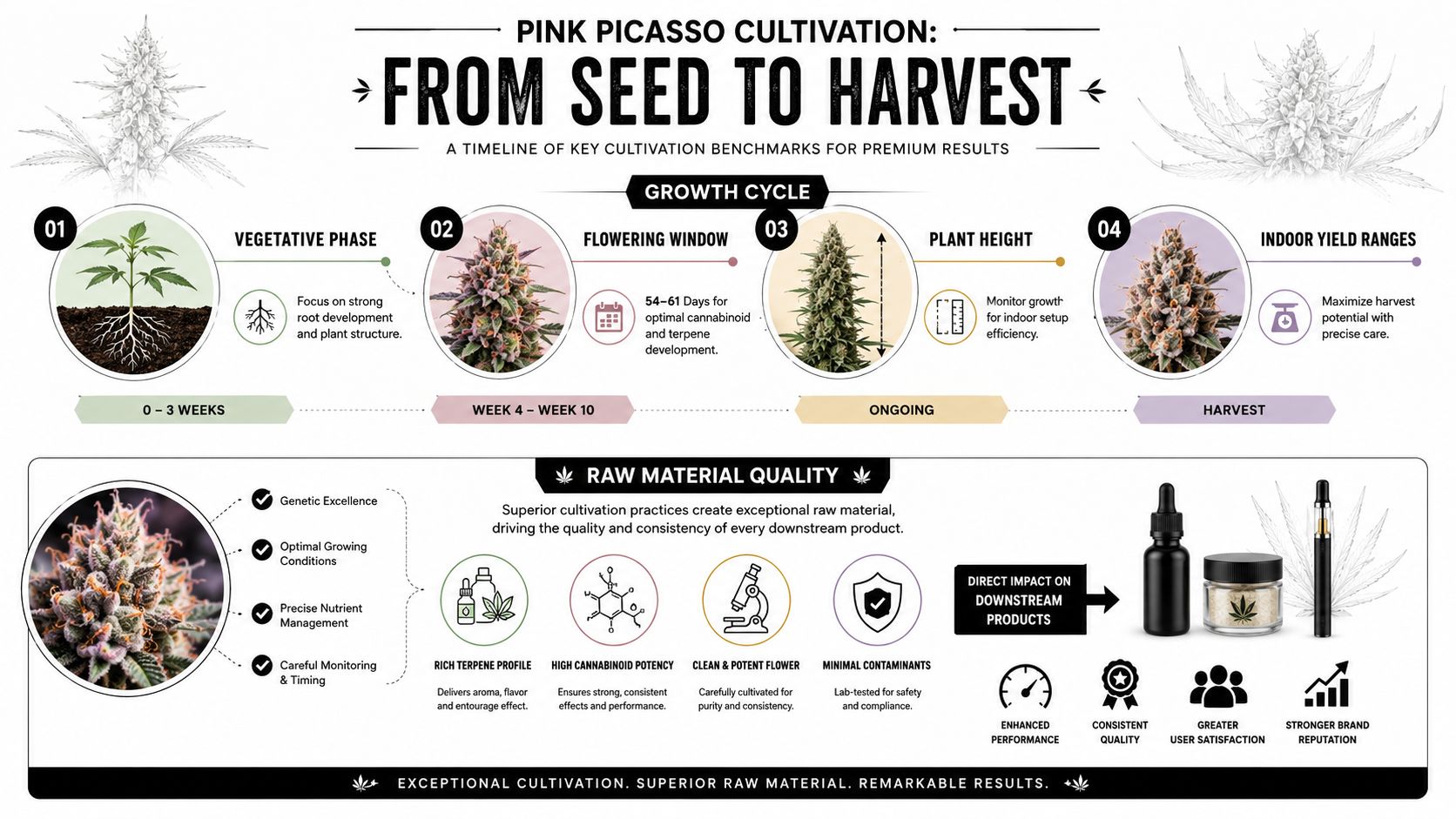
Pink Picasso usually finishes flowering in about 54 to 61 days (AskGrowers). For extraction teams, that window matters because harvest timing shapes resin maturity, terpene retention, and the final clarity of the oil. If the crop comes off too early, the profile can feel underdeveloped. If it runs too long, the aromatic top can start to soften.
What the grow data tells the extractor
One review reports indoor plants rarely exceed 30 to 60 inches and outdoor plants 60 to 80 inches, with yields around 1 to 2 oz per 1 ft² (AskGrowers). Another listing cites 500 to 600 g/m² indoors and 800 to 900 g per plant outdoors, showing how much the phenotype and setup can shift output (AskGrowers). For formulation teams, that variability is a reminder that resin quality can't be inferred from yield alone.
Handling raw material before extraction
Raw flower quality starts with moisture management. If drying is too aggressive, the volatile top notes can fall off before extraction ever begins. If the material stays too wet, you invite inconsistent processing and a flatter aromatic read in the finished blend. The formulation team should ask for post-harvest handling notes, not just a finished biomass weight.
When Pink Picasso is intended for cartridges, the extractor should preserve the highest-value aromatic fraction as deliberately as the cannabinoid fraction. That means drying, curing, and storage all matter before the terpene rebuild stage even starts. Material that looked great on the plant can still underperform if it was handled roughly after harvest.
Operational rule: stable finished oil starts with stable biomass. If the flower was mishandled, no terpene blend can fully recover the original expression.
For teams working across multiple lots, the best practice is to treat each harvest as its own sensory baseline. The strain may be the same, but the output isn't guaranteed to match. That is the core reason Pink Picasso rewards structured, batch-specific extraction and blending rather than a one-size-fits-all recipe.
Lab Testing and Safety Requirements
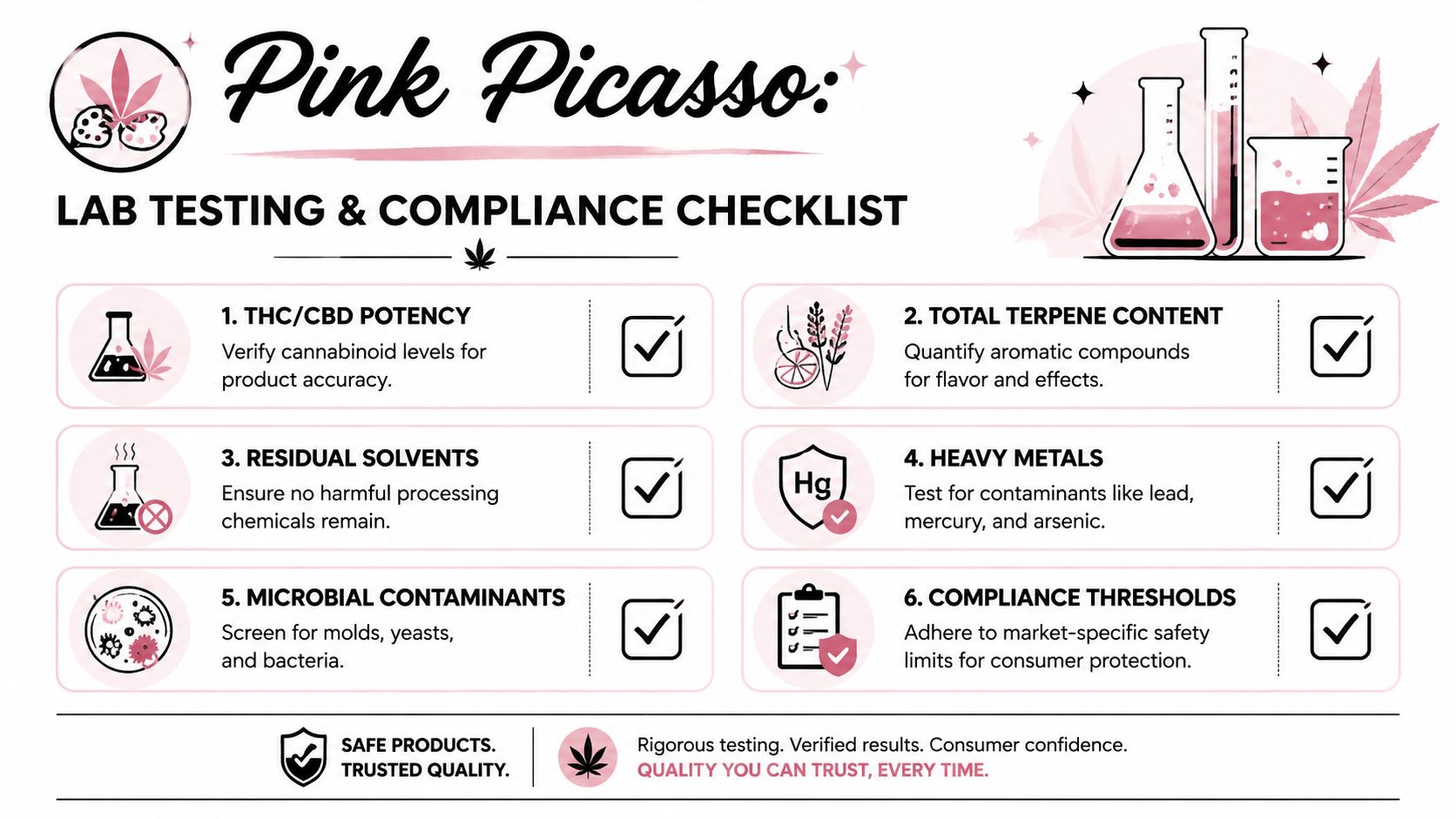
Pink Picasso deserves the same lab rigor as any high-potency cartridge input. The useful package is not just cannabinoid potency, it's the full testing stack, THC/CBD potency, total terpene content, residual solvents, heavy metals, and microbial contaminants. A cart can smell correct and still fail on safety, which is why the analytical side has to sit upstream of any branding decision.
What the paperwork should include
A production file should hold the COA, MSDS, and solvent documentation for every input. If the oil will be sold into regulated channels, the batch record needs to match the lot number on the lab report exactly. Any mismatch creates a traceability problem before the product even reaches filling.
The gap is especially important because existing Pink Picasso coverage often leaves out practical impairment and safety guidance, including dose sensitivity and sedation risk at higher THC concentrations (Graswiese). For formulators, that means the cart label and usage expectations should never be written as if potency alone tells the whole story.
A simple QC checklist for cartridge inputs
- Potency confirmation: verify THC and CBD so the fill target matches the recipe, not an assumption.
- Terpene quantification: confirm the aromatic load before you decide how much supplemental flavoring to add.
- Residual solvents: reject any input that carries unsafe processing residue.
- Heavy metals: check for contamination from the cultivation or extraction chain.
- Microbial screening: confirm the material is clean enough for consumer packaging.
- Compliance thresholds: align the finished product to the market's safety limits before release.
For a deeper lab workflow reference, a third-party testing guide is useful when you're building a repeatable review process across suppliers. The takeaway is simple. If the COA is incomplete, the batch isn't ready for cartridge work, even if the smell is excellent.
Guide to Terpene Blends and Isolates Application
Pink Picasso is a strong candidate for strain-inspired terpene blend development because the profile is recognizable, but still flexible enough to support controlled variation. That makes it useful for for vape cartridges and for distillate applications where the brand wants a premium dessert profile without losing production repeatability. Start by deciding whether you want a close replica or a refined interpretation.
A practical blend structure
For a dessert-forward cart, build the top note with limonene for brightness, add a modest floral mid using linalool, then support the finish with beta-caryophyllene and a restrained amount of myrcene. That architecture fits the Pink Picasso map because it keeps the profile sweet up front, floral in the middle, and gently spiced at the end. If the blend feels too sharp, reduce the top note before you add more base.
For teams that prefer a faster route, a premixed strain-inspired solution can be the cleaner starting point. It reduces trial time and gives you a consistent baseline, especially when you're scaling a run across multiple fills. Then you can fine-tune with individual isolates if the batch needs more citrus lift or a deeper floral finish.
How to scale without losing fidelity
A useful workflow is to pilot the blend in a small test batch, evaluate aroma after dilution, then adjust before moving to production volume. Terpenes don't always read the same once they're in distillate, so the smell in the vial isn't the same as the smell in the finished cart. Solubility, viscosity, and coil temperature all influence how the profile performs.
The Terpenes 101 resource is a natural starting point for teams who need a shared vocabulary before they start compounding, while a mixing calculator and an isolate catalog can help standardize repeat runs. The key is consistency in process, not just consistency in ingredient names. If one batch is built by eye and the next is built by weight, you don't have a stable product line.
Batch-scaling rule: lock your formula by weight, not by scent memory. Scent memory is useful for screening, but it's not a production control.
If your input oil is unusually neutral, lean a little harder on the aromatic layer. If it already carries strain character, keep the supplemental terpenes tight so the finish stays believable. That's how you preserve Pink Picasso's identity without forcing every cart into the exact same flavor volume.
Regulatory Compliance and Quality Assurance Tips
A Pink Picasso cartridge can be technically well made and still get delayed by weak documentation. Batch records, label copy, and QA signoff all need to agree before release. Regulators and buyers both look for traceability, and the fastest way to lose trust is a mismatch between what the oil is, what the label says, and what the COA shows.
Build the release process before the fill line
Start with a written QA path that covers incoming oil review, terpene addition, fill verification, and final packaging inspection. Viscosity should be checked before and after flavor addition because terpene loading can change how the oil moves through the cartridge hardware. Vapor consistency should be sampled from the first units in a run, not only the last ones.
That process should also include retention review. If the terpene top notes drop off during storage, the brand loses the Pink Picasso profile even if the THC number still looks strong. The oil has to remain stable through packaging, distribution, and shelf life, or the consumer experience breaks down in practice.
What to audit on a schedule
- Label accuracy: confirm strain naming, cannabinoid content, and batch identifiers.
- COA alignment: compare every shipped lot against the current lab release.
- Corrective action records: document what changed when a batch misses spec.
- Hardware compatibility: confirm the oil behaves correctly in the chosen cart format.
- Storage controls: protect terpene retention from heat, light, and excess headspace.
- Third-party verification: keep a clean path for outside review when needed.
If you need a process anchor for outside review, a third-party lab testing overview can help frame how documentation supports market access. The larger point is that compliance isn't separate from formulation. It's part of the formulation.
When the QA system is tight, Pink Picasso becomes easier to sell, easier to scale, and easier to defend. The brand gets a cartridge that tastes intentional, the extractor gets fewer surprises, and the production team gets a repeatable standard instead of a moving target.
If you're developing a Pink Picasso cart or refining an existing dessert-forward SKU, Gold Coast Terpenes offers the terpene blends, isolates, and formulation support that help turn a variable strain profile into a repeatable product. Use the same chemistry-first approach in your next batch, then build your flavor map around a controlled, lab-checked formula instead of guesswork.