
You can tell a terpene launch is drifting off track before the first carton ships. Sampling drags on, the same blend keeps coming back from the lab with small but annoying fixes, and someone on the team says the formula is “good enough” even though it still isn't behaving the same way in distillate, cartridges, or pilot fills. That is usually the point where product development support stops being overhead and starts being the thing that keeps the launch alive.
The hard part is that many teams do not fail because they lack ideas. They fail because they do not have a repeatable way to validate the idea, lock the formulation, and protect it through scale-up. Industry data shows 60% of product development effort happens before product development begins and only 59% of new-product projects reach commercialization, according to PMI research. That is exactly why terpene work breaks when it is treated like a flavoring exercise instead of a controlled development process.
Why Most Terpene Formulations Fail Before Launch
A terpene blend can smell right in a 10 ml beaker and still fall apart the moment it moves into production. That happens every day in formulation work, especially when a team moves from hand mixing to commercial filling without a real validation gate. The bigger issue is that product development effort is mostly spent before formal development even begins, yet many cannabis teams still jump straight from concept to scale.
A common failure pattern is easy to spot. A brand spends weeks tuning a Blue Dream-style profile for vape cartridges, gets positive feedback from a tiny test batch, then finds the blend changes in winterized distillate once the tank is larger and hold time shifts. The blend may still smell familiar, but the layers separate, the top notes flash off too fast, or the body goes flat after storage. That is where a lot of “almost ready” terpene products die, not because the idea was wrong, but because the workflow never forced the team to prove stability under real conditions.
What changes when support is real
Strong product development support turns that guesswork into a gated process. Instead of relying on one maker's judgment, the team defines what has to be true before moving on, such as aroma match, batch stability, and fit with the delivery format. Research on development-technique studies links success with top-management support, cross-functional teams, product quality, manufacturing involvement, supplier involvement, and time-to-market discipline ScienceDirect review.
Practical rule: if a terpene profile has not survived a small-batch test, a pilot-scale test, and a storage check, it is not finished, it is just pleasant in the lab.
That matters because cannabis brands often confuse “liked internally” with “ready to commercialize.” Best-performing companies in product innovation report an average 76% success rate, compared with 51% for other companies Tenet product development statistics. The difference is not magic, it is process discipline, clearer ownership, and fewer assumptions hidden inside the formulation.
A good workflow asks one blunt question at every gate. Did this blend scale, or did it only impress the people standing around the bench? If the current process does not include that checkpoint, the team is paying for reformulation later.
Validating Your Terpene Profile Before Formulation
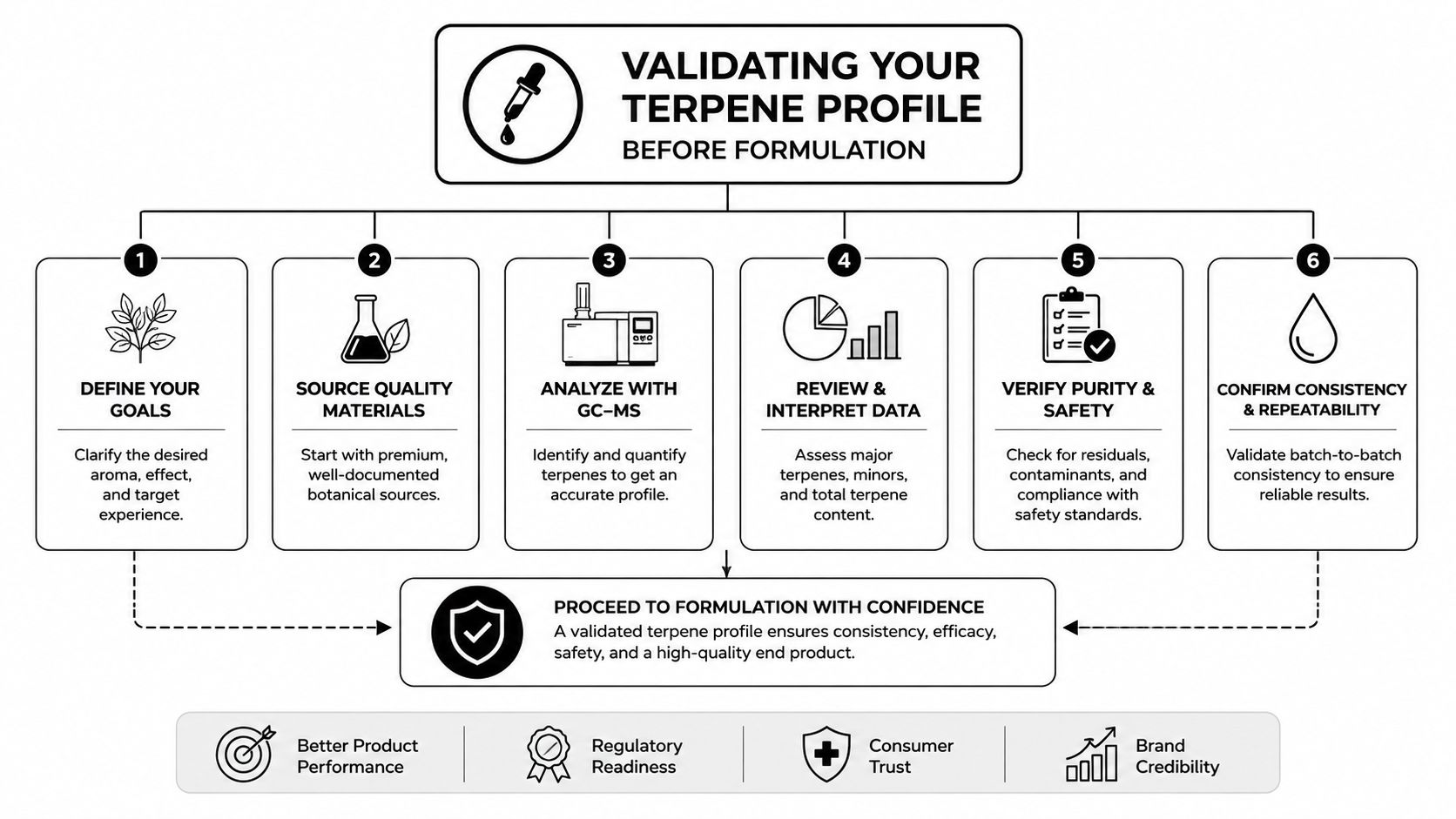
Start with the profile, not the strain name on the label. Strain-inspired blends are useful as shorthand, but the core job is matching aroma, flavor, and delivery format to a commercial target that can survive testing and scale. User research guidance from USP Research encourages teams to ask whether a concept is attractive, relevant, practical, and whether it solves a problem USP Research. That framing works well for terpene development too.
Use a three-tier aroma architecture
Think in layers. Top notes carry the first impression, the bright, immediate aroma that hits when the cart is opened. Mid notes build the body of the profile, the part that makes a blend feel complete instead of thin. Base notes keep the profile grounded after the first flash fades.
That structure matters differently across formats. In vape cartridges, top notes can disappear quickly if they're overused, so the blend has to stay balanced after heating. In tinctures, the profile stays closer to the liquid, so mid and base notes matter more for lingering flavor. In edibles, the terpene profile needs enough structure to survive formulation without turning muddy or overly sharp.
Treat validation as a gated selection process
Gold Coast Terpenes offers 50+ classic and contemporary profiles, including options like OG Kush, Forbidden Fruit, and Green Crack, which makes them useful starting points for concept work. Use profiles like that to compare direction, not to skip validation. If the target is relax, uplift, or focus, the profile still has to fit the dosage format, the solvent system, and the buyer's compliance requirements.
UserVoice recommends defining the scope of research up front by specifying the problem, the features being tested, the data source, the sample size, and the deadline, and avoiding biased or leading questions UserVoice. That logic fits terpene work neatly. Ask whether the profile stays stable at 5 to 15% terpene concentration, whether it passes state-specific compliance testing, and whether the supplier can show batch-to-batch consistency documentation. If any of those answers is vague, the profile is still a concept, not a formulation.
A custom build from isolates like Limonene, Myrcene, and Beta-Caryophyllene makes sense when a pre-blended profile misses the target or when the product team needs tighter control over each sensory layer. A pre-blended strain profile makes more sense when speed matters and the delivery format is already known. The right choice is the one that reduces uncertainty without forcing the team into endless remixing.
Formulation Chemistry and Mixing Ratios That Work
Terpene chemistry is simple only on paper. In real product development, the wrong solvent system or the wrong mixing order can turn a workable blend into a separation problem that shows up three days before fill. Gold Coast Terpenes' terpene products are crafted to be free of VG, PG, PEG, and MCT, which matters because those diluent choices can complicate viscosity, clarity, and final behavior in winterized distillate oils.
Start with concentration, then scale the math
For vape cartridges, a 10% terpene concentration is a common starting point when you're using a proper mixing workflow and checking sensory impact alongside viscosity. For tinctures, 5% is a more conservative place to begin. For concentrates, 15% is the upper edge that should be treated carefully, because pushing beyond that usually adds harshness faster than it adds quality.
The point isn't to chase the highest possible terpene load. The point is to keep the formula strong enough to carry the profile without stressing the carrier. If you're scaling from a 10 ml test batch to a 1 liter production batch, the math only stays useful if the pilot sample is made with the same order of addition, same temperature window, and same mixing time you'll use later.
The Mixing Calculator is useful here because it keeps volume conversion from becoming a manual error source. In the lab, I've seen more bad launches caused by rushed measuring than by bad ingredients. A formula can look elegant in a notebook and still fail because someone added the terpenes to cold distillate, which increases the chance of separation, or because the team chased a high percentage and made the cartridge too sharp.
Diluent choice changes the whole behavior
| Diluent Type | Viscosity Impact | Best For | Mixing Temperature |
|---|---|---|---|
| No added diluent | Keeps the original body of the oil | Cartridges, concentrates | Warm blend, not overheated |
| VG, PG, PEG, or MCT | Can alter flow and sensory behavior in ways that complicate consistency | Not preferred in terpene-only workflows | Depends on carrier, but adds formulation complexity |
| Specialized terpene blend only | Maintains the intended sensory profile with fewer unknowns | Distillate, cartridges, custom flavor work | Controlled warm mixing |
THC-free, lab-verified terpenes also reduce compliance friction when the same product has to move across multiple states. That doesn't remove the need for documentation, but it does make the formulation side cleaner because the ingredient story is easier to defend. If a formula is built to behave well at the bench, the scale-up discussion gets a lot easier.
Lab Testing and Quality Assurance Decision Gates
A terpene launch often fails at the handoff points, not in the first bench sample. One supplier sample looks clean, the pilot blend seems fine, then the formula starts drifting once it meets heat, light, or a different filling line. Product development support earns its value by setting clear gates before that drift turns into a rejected batch.
Testing should function like a set of release doors, not a box to check for paperwork. The first door confirms the supplier sent the material that was promised. The second checks whether the blend still behaves after it has aged under real conditions. The third confirms the finished product still meets spec after the rest of the process has done its work.
That matters most when a brand sells across multiple states, because a documented baseline keeps formulation, compliance, and operations aligned before launch day creates a problem. A lab plan also reduces the hidden reformulation cost that shows up when one team assumes a material is acceptable and another team discovers a mismatch too late. The cleanest development process is the one that catches those gaps before they become a production issue.
Three checkpoints that should never be skipped
Pre-formulation terpene profile verification confirms the incoming profile matches the target before anything is blended. If the sensory match is off here, downstream adjustments only mask the problem.
Mid-formulation stability testing catches the failures that show up after the blend has sat for a while, especially separation and drift at 30, 60, and 90 days. Those checks matter because a formula that looks stable on day one can still fall apart later, and that usually means rework, not rescue.
Final product compliance testing confirms the finished product still supports the claims you want to make, including THC-free status where relevant. If the claim cannot survive the test panel, it does not belong on the label.
Batch consistency warnings usually appear before anyone labels them warnings. A shift in aroma, a cloudy sample, or a change in viscosity is often the first sign that the formulation or incoming material has started to drift.
What to test by format
For vape cartridges, prioritize heavy metals, residual solvents, and potency. For edibles, the focus shifts toward microbial control and water activity. Those checks are not interchangeable, and teams get into trouble when they assume one panel covers the other.
Use quality control testing guidance to match the test panel to the format before release. That kind of discipline cuts wasted sampling cycles because the team is not guessing which failure mode to chase after the batch is already built.
Gold Coast Terpenes also provides safety documents and state information resources, which lowers the research burden when the same team has to answer formulation and compliance questions at the same time. The savings often come from the time not spent hunting down missing information, not from the test itself.
A practical testing timeline should follow the development cycle. Verify the incoming material, lock the pilot batch, run interim stability checks, then move to final release only after the data matches the expected profile. That approach is not flashy, but it prevents the kind of late-stage failure that forces a launch to be rebuilt from the lab backward.
Scale-Up Strategies and Manufacturing Workflows
A blend that behaves cleanly in a 10 ml tube can still fail in a larger tank. Bigger volumes hold heat longer, mix differently, and expose weak points in the order of addition. Small-batch intuition rarely survives commercial production without a pilot stage between bench work and full run.
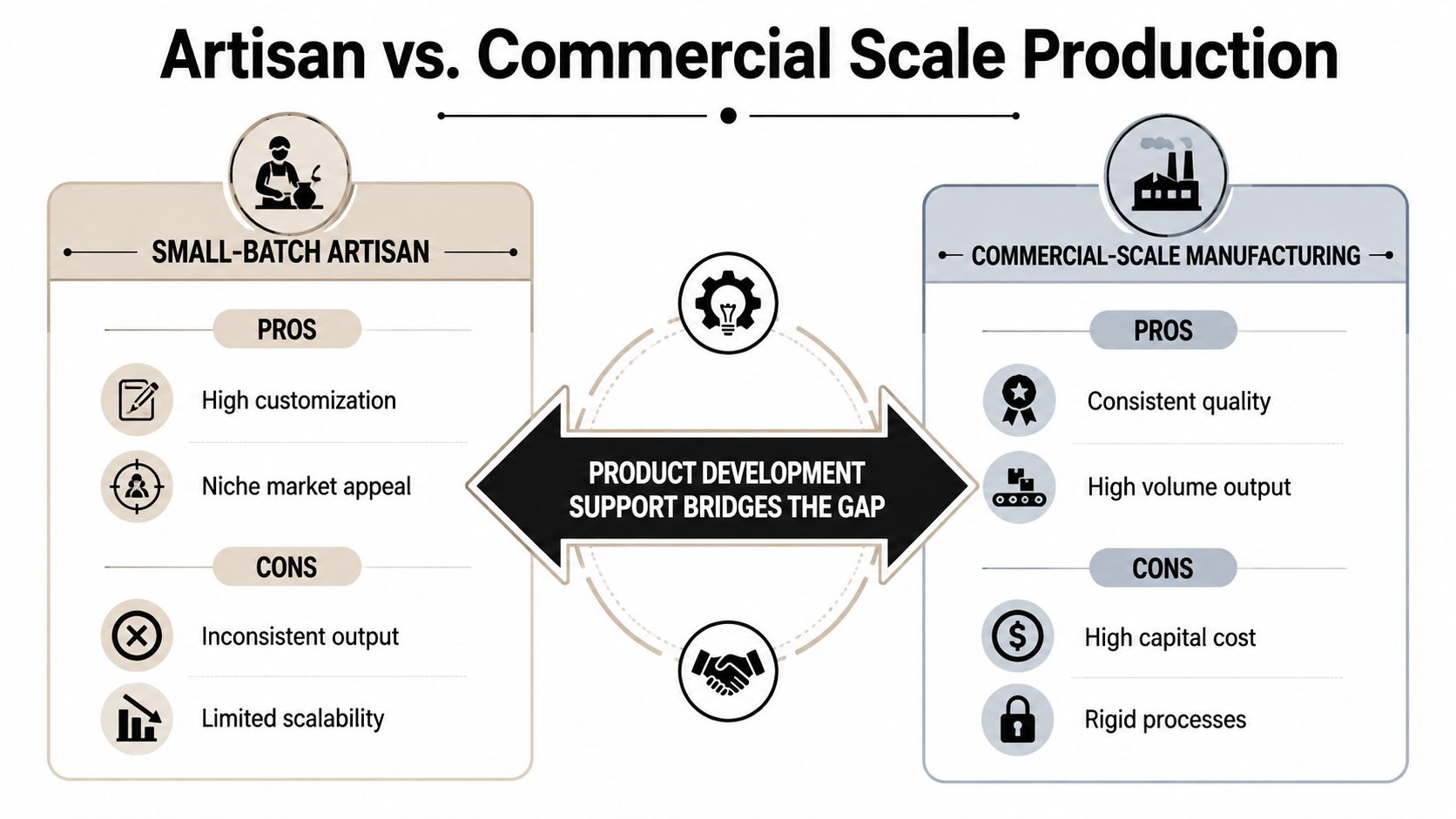
That gap matters because the failure is usually structural, not cosmetic. Small-batch artisan production gives you high customization and niche appeal, but it also creates inconsistent output and limited scalability. Commercial-scale manufacturing gives you consistent quality and high volume output, but it comes with higher capital costs and tighter process control. Product development support has to bridge those two worlds before the batch size turns every correction into scrap.
Match the mixer to the batch
Magnetic stirrers work for very small batches, where the goal is to prove the profile behaves as expected. Overhead mixers fit medium production, where you need more movement without overworking the material. Inline homogenizers belong in larger operations, where uniformity matters and hand mixing starts to create more variation than control.
Pilot runs should validate three things at once, mixing time, temperature, and order of addition. If one of those variables changes between the test batch and the full batch, there is no real scale-up plan. There is only a guess with equipment attached.
The practical reason to run a 1 liter pilot batch before a full production run is simple, it catches issues while they are still cheap. I have seen teams avoid unnecessary waste by proving a formula at intermediate volume first, then discovering the mix needed a longer hold time or a different addition sequence. That is far easier to fix before the tank is full than after material, labor, and scheduling are already committed.
Keep the economics tied to validation
Bulk programs that support larger orders, including discounts on orders exceeding 64 oz, only make sense once the formulation has already been proven at intermediate volumes. Otherwise the savings on raw material get erased by rework, scrap, and delayed launches. The scaling question should come after the pilot question, because the cheapest pound of input means little if it creates a failed batch.
A formula that survives pilot scale earns the right to be cheap at bulk scale. If it has not survived pilot scale, bulk pricing is just a faster way to repeat the same mistake.
Gold Coast Terpenes also offers a How to Scale Recipes resource that fits this exact problem space, because scale-up is less about ambition and more about controlled transfer from one batch environment to another. Once the process is fixed, the team can stop adjusting every variable by hand and start running predictable production.
Packaging, Labeling, and Regulatory Compliance Integration
Packaging decisions should never be made after the formula is locked. A high-terpene blend can interact differently with plastics than a lighter system, which is why glass or specialized barrier materials often make more sense for vape cartridges and concentrates. If the formulation is aggressive and the package is weak, the package becomes part of the failure mode.
Build the label around the formula, not around marketing copy
A label for a strain-inspired profile should describe the profile cleanly without turning into dispensary slang or medical language. Blue Dream or OG Kush can work as profile references when they help the buyer understand the sensory direction, but the copy still needs to stay focused on flavor, aroma, and intended product use. If you need to say it supports a calming experience or a therapeutic result, you've already crossed into risky territory.
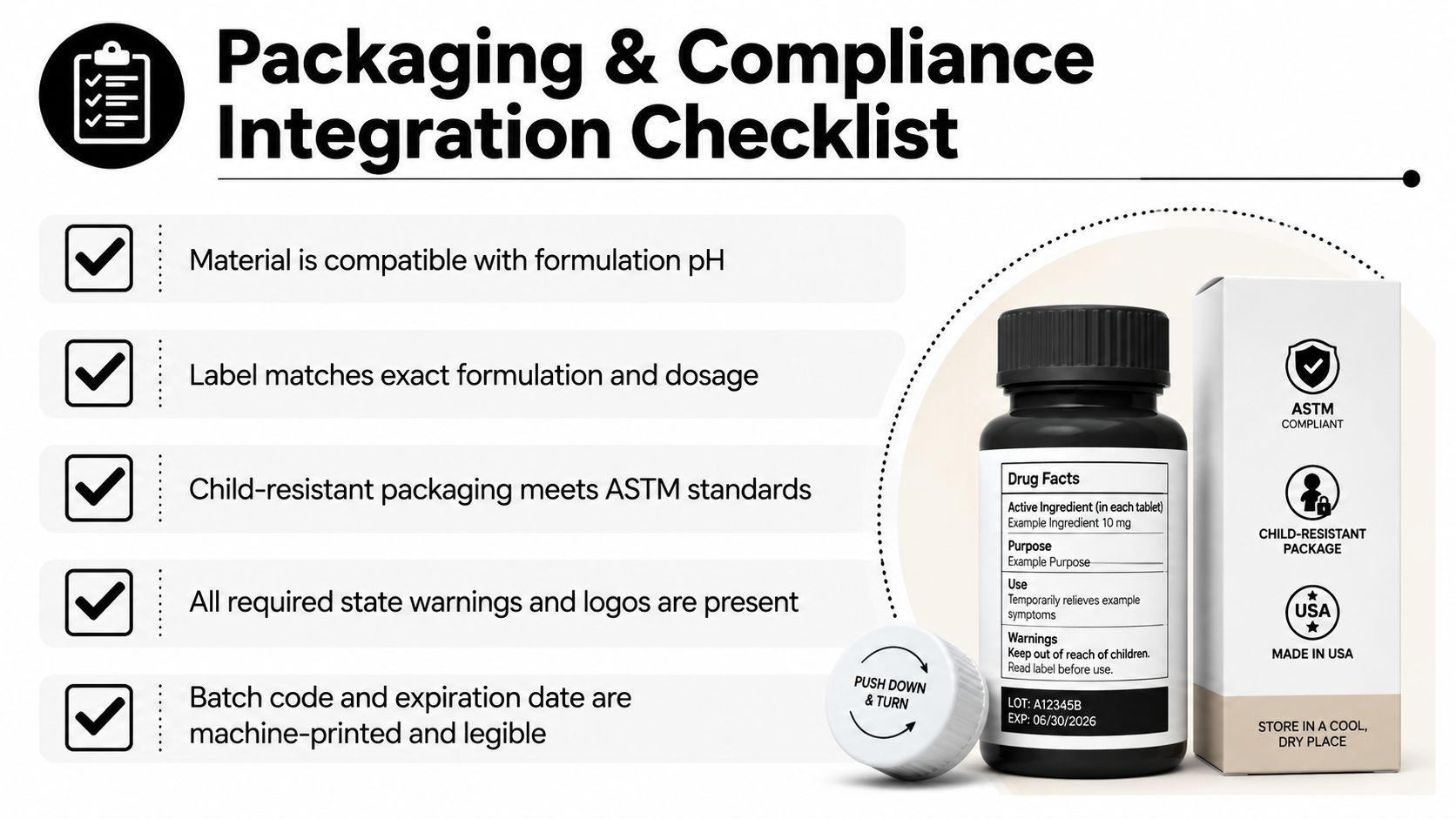
THC-free claims need to match the actual analytical picture, not the hope that the product reads that way on the front panel. Terpene content disclosure also has to line up with what the formula contains, because mismatched labels create avoidable compliance headaches. The same goes for state-specific warnings and logos, which vary enough that a national launch has to be checked state by state.
If the formulation team can't tell packaging what's in the blend, packaging will guess. Guessing is how labels get reprinted.
A clean launch readiness checklist should confirm three things before the first production run: packaging compatibility, label accuracy, and regulatory approval. If one of those is missing, the launch is not ready. Product development support earns its keep by anticipating those downstream details during formulation, not after the cartons are already printed.
The research gap in the market is obvious. Too many teams separate formulation from packaging too early, then discover the container, label, or claim strategy doesn't support the finished blend. Gold Coast Terpenes' state information resources help reduce that gap by giving teams a better shot at aligning product design with actual market entry requirements.
When to Bring in Product Development Support Partners
In-house development looks cheaper until the hidden costs show up in the ledger. Every reformulation cycle consumes time, every failed batch turns into material waste, and every compliance correction pulls people off the launch path. The question is whether internal work is producing measurable progress, not whether it can be done at all.
Use the problem before you buy the solution
Track four numbers before you shop for help, reformulation cycles, failed batch rates, time-to-market delays, and compliance rework costs. Those figures give you a baseline for judging whether the team is stuck or moving.
Support providers should be measured by outputs, not broad confidence. Ask whether they can run pilot-scale testing, provide batch consistency documentation, and work across formulation, testing, and regulatory compliance. If the provider only talks in general terms, your team still carries the risk.
Gold Coast Terpenes' custom formulation services fit teams that need help turning a concept into a repeatable sensory system, especially when internal staff is strong on sales or sourcing but thin on formulation depth. Their wholesale, affiliate, and bulk programs serve different business sizes, while their Terpenes 101, formulation guides, and safety documents give technical teams practical reference material.
Know when outside support matters most
Outside help makes the most sense when you are launching in multiple states at once, developing a new delivery format, or moving from artisan production into commercial manufacturing. In those cases, the risk is not only the blend, it is the coordination burden around testing, packaging, and release. In-house development is often enough for a single-state launch, a minor SKU extension, or a simple flavor variation.
A basic scorecard should compare providers on measurable outputs.
- Fewer reformulation cycles: Did the provider reduce the number of times the formula had to be remixed before approval?
- Faster sampling: Did the provider shorten the time between first concept and usable sample?
- Clear documentation: Did the provider supply batch records, safety information, and testing support?
- Commercial fit: Did the provider understand the delivery format, packaging constraints, and compliance path?
The best support partner does more than make the blend. It cuts uncertainty across the path from concept to shelf, and it does that by catching reformulation drift, validation gaps, and packaging conflicts before they become reprint costs or failed batches. That is the part many teams underestimate, and it is where launches usually break.