
Most GG4 advice gets the commercial part wrong. If you treat GG4 strain effects as nothing more than couch-lock, you miss the formulation challenge, a fast opening lift, then a heavier finish that has to be built into the aroma and terpene structure, not just the label copy.
That two-phase behavior is why GG4 still matters for vape cartridges, distillate, and strain-inspired terpene blend development. A competent replication isn't just about matching “diesel” or “pine,” it's about staging the experience so the first impression feels brighter before the profile settles into a dense, resinous body.
Why GG4 Is More Than Just Couch-Lock
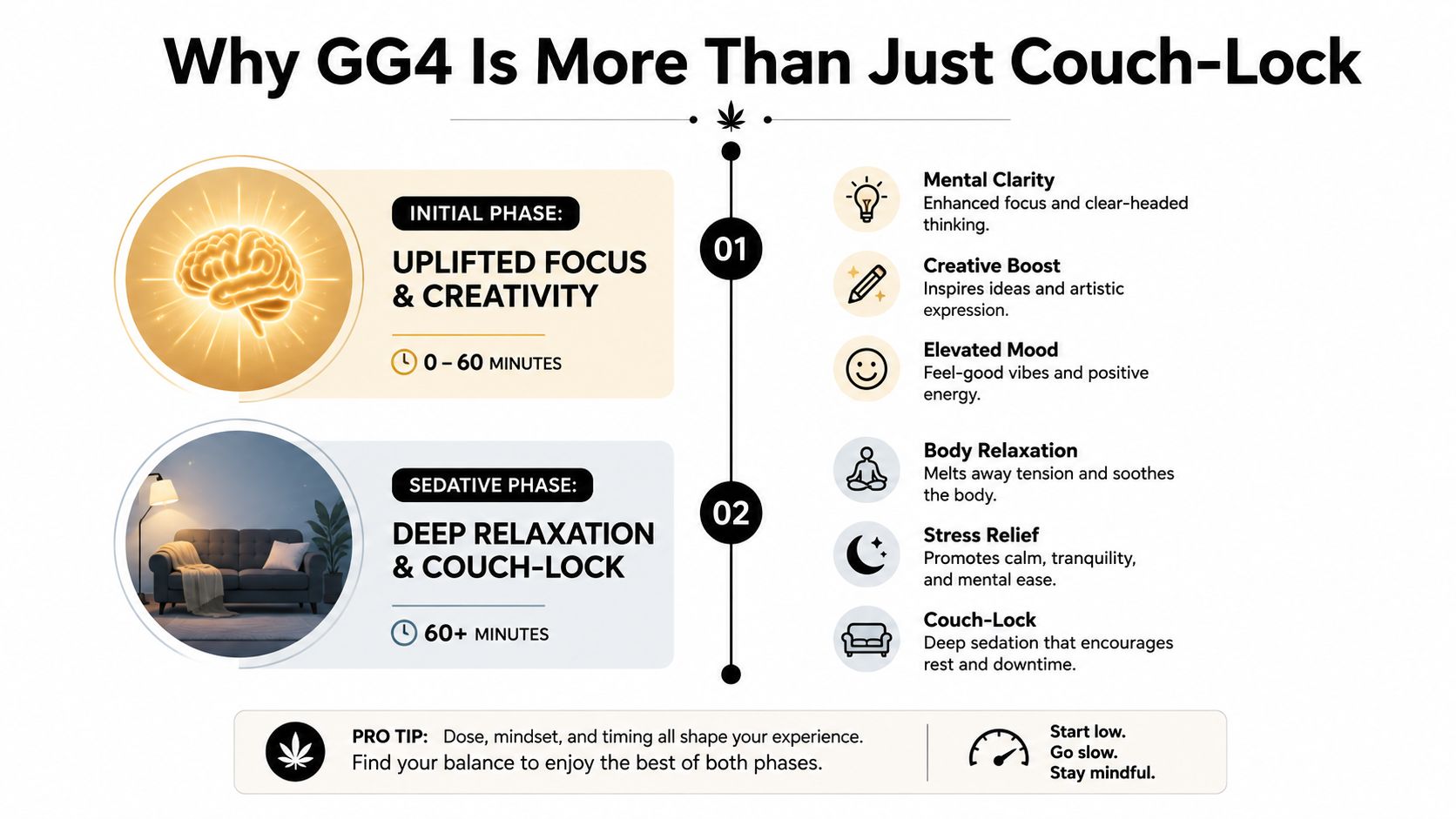
The lazy read on GG4 is that it's a pure shutdown cultivar. That's not how it behaves in practice, and it's not how I'd brief a formulation team if the goal is a credible terpene profile for cannabis product formulation. The strain's value comes from a biphasic effect pattern, not a single-note sedative profile.
The sequence matters more than the label
GG4's effects are strongly biphasic, with an early cerebral lift often appearing within 1 to 3 minutes after inhalation, then shifting into a heavier body stone and possible couch-lock within 15 to 30 minutes. Inhaled effects usually peak around 30 to 60 minutes and last about 2 to 4 hours. That sequence is why the strain reads as both uplifting and relaxing, depending on where the consumer is in the session.
For product development, this matters because a single “sedating” impression doesn't tell you how to build the first puff. A cart that opens flat and heavy can miss the strain's real identity. A better build gives the user a short-lived lift up front, then lets the profile descend into weight and finish.
Practical rule: if the opening tastes and feels sleepy, you've already lost the GG4 reference.
Positioning follows the time curve
The first phase supports a functional evening position. The second phase supports shutdown, deeper unwinding, and end-of-day use. That's a very different commercial story from a uniformly sleepy strain, because the buyer isn't getting just “relaxation,” they're getting a profile that changes as it develops.
That's why GG4 became such a benchmark cultivar in the hybrid market. The combination of fast onset, high THC, and a long, winding comedown gives brands a template for nighttime products that still need a discernible opening note. If you're replicating GG4 for a cart or concentrate, you're not chasing one effect. You're programming a sequence.
The Terpene Chemistry Behind GG4's Two-Phase Response
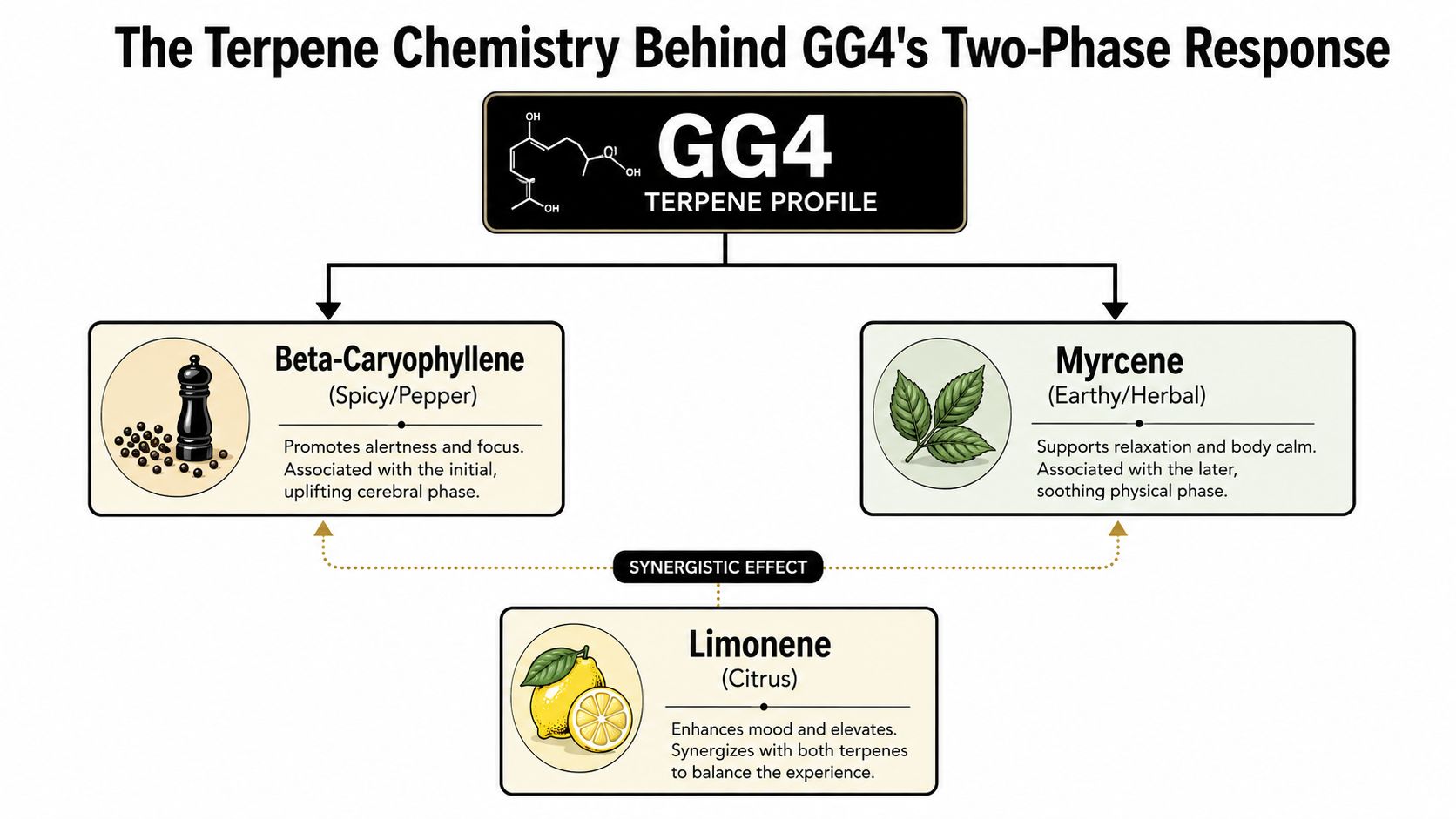
GG4's effect profile comes from a chemistry stack that pulls in two directions at once. The dominant terpenes are usually beta-caryophyllene, myrcene, and limonene, and the practical mistake is treating them as simple aroma markers instead of effect-shaping inputs. In a proper formulation guide, each one has a job.
What each dominant terpene is doing
Beta-caryophyllene is usually the anchor. Lab reports show dominant terpene levels that often place caryophyllene in the 0.4% to 1.0% range and myrcene around 0.3% to 1.2%, and the spread matters because small shifts can move a blend from calmly weighted to distinctly heavy and sedating. The chemistry does not need to be dramatic to change the read on the finished cart.
Limonene is the brighter counterweight. It keeps the opening from feeling locked from the start, which is part of why GG4 can present with a short cerebral rise before the body weight settles in. If you suppress that top layer too much, the blend goes stale and the first impression collapses into pure earth.
Why caryophyllene changes the body feel
Beta-caryophyllene matters because it acts directly on peripheral cannabinoid receptors, especially CB2, rather than only contributing aroma. That gives the spicy, earthy fraction real functional weight in formulation. In a GG4-inspired profile, caryophyllene is not just “pepper,” it is a structural component of the body-forward finish.
The ratio logic is straightforward. Limonene is the lift. Caryophyllene is the spine. Myrcene is the sink. If the ratios are off, you do not get a nuanced hybrid, you get either a sharp fuel note with no depth or a dead-heavy blend with no opening character.
The strongest GG4 replicas do not overload one terpene. They let each layer hand off to the next.
For a broader chemistry reference, Gold Coast Terpenes' terpene chemistry archive is useful because GG4 shows how ratio changes alter perceived effect.
Replicating the Diesel-Pine-Resin Aroma Architecture
GG4 doesn't smell like generic cannabis, and that distinction is commercially important. Its aroma is repeatedly described as diesel, pine, and thick resin with a heavy, sticky character. If your formulation lands in generic “earthy” territory, it won't read as GG4 to buyers who know the profile.
Build the profile from the bottom up
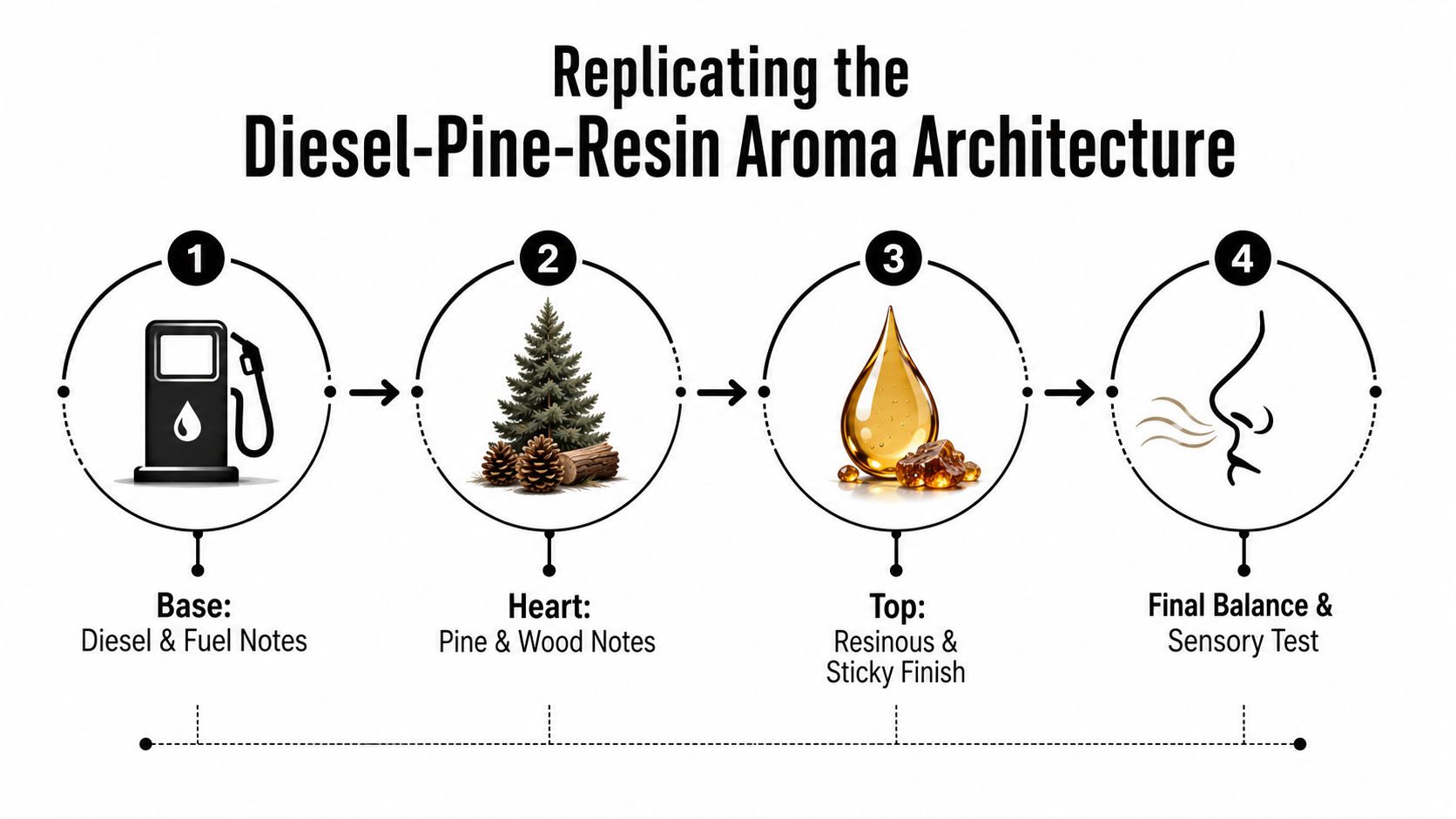
Start with the fuel base. That means designing a sharp enough opening to suggest diesel without turning the cart harsh or burnt. The mistake I see most often is going too far on the top-note solvent impression, which makes the strain smell loud but not credible.
Then bring in the pine heart. The profile stops being just fuel and starts feeling like a real cultivar reference. Pine also helps bridge the transition from a volatile first hit to the denser middle of the draw, which is exactly where GG4 earns its reputation.
The final layer is resin. That sticky finish is what keeps the aroma hanging around after exhale, and it's one of the reasons GG4-inspired products are used as benchmarks in vape flavor retention. If the finish disappears too fast, the product feels thin even if the opening is accurate.
Don't flatten the aroma into one note
A good GG4-style blend needs top, mid, and base notes that stay distinct long enough to be perceived in sequence. If the diesel note dominates every stage, the profile turns abrasive. If the wood note takes over too early, it becomes generic pine cleaner instead of cannabis resin.
The most practical way to think about it is as a controlled fade. The first hit should signal fuel, the middle should show conifer depth, and the exhale should leave a sticky resin trail. That's the sensory architecture buyers recognize.
For formulators cross-checking profiles, King Louis OG as a terpene reference can be useful because it shows how another heavy, base-note-driven cultivar reads when the finish is weighted correctly.
Formulation Approaches for Distillate vs Live Resin Bases
Base material changes the formulation brief. A distillate base is stripped and neutral, so the terpene system has to carry most of the strain identity on its own. A live resin base already brings native character, which means the terpene package should reinforce the extract instead of trying to overpower it.
What changes by base type
| Base Type | Terpene Strategy | Onset Character | Best For |
|---|---|---|---|
| Distillate | Build the profile from scratch with layered top, mid, and base notes | Clean first draw, then adjustable body weight | Tight flavor control and broad SKU replication |
| Live resin | Use lighter reinforcement and preserve native complexity | More natural, less staged opening | Extraction-led brands that want a more organic read |
| Isolate blend | Add full-spectrum terpene balance carefully to avoid flatness | Depends entirely on terpene design | Controlled prototypes and custom market tests |
Distillate gives the most control, and it also exposes weak design fast. If the terpene system is too thin, the oil tastes hollow and the GG4 identity drops out before the finish lands. Live resin brings more built-in depth, but that same depth can resist a clean replica if the native oil is pulling in a different direction.
For potency framing, lab summaries from Is live resin better than distillate for terpene design? describe GG4 as a very high THC cultivar, with reported averages around 32% THC and many batches in the 25% to 30% range. That potency matters for positioning because buyers often expect a dense, evening-leaning experience, so flavor accuracy alone will not carry the brief if the base material feels too light.
Choose the foundation that matches the brand promise
A sharp retail SKU usually starts with distillate plus a deliberate terpene stack. That route gives the cleanest control over the first draw, the mid-palate, and the heavier exhale. For an extraction-forward product, live resin can preserve more native depth, but the team has to accept that the replication target shifts to fit the extract rather than forcing the extract to fit the target.
Isolate blends only make sense when the team wants total control over the sensory curve and has time to tune the edges. They are useful for prototypes, but they punish sloppy terpene loading because there is no native material to hide behind.
I would choose the base on brand promise first, then tune the terpene architecture around it. If the goal is a precise GG4 read with a staged lift and body drop, the formulation has to support that two-phase experience instead of just matching the aroma.
How Terpene Choices Influence Side Effects and Consumer Experience
Consumer feedback matters because it explains why GG4 is usually read as an evening profile rather than a daytime hybrid. One documented user dataset reported 84% relaxed, 76% euphoric, 67% happy, and 61% sleepy, with 71% reporting dry mouth and 44% reporting dry eyes. Those outcomes match a strain that is built for shutdown, not for light functional use. Source dataset on GG4 effects and user reports
Side effects shape the finish
If users expect heaviness, the flavor path should support that expectation. A bright citrus opening can feel out of step if the blend never settles into deeper notes. GG4 works because the sensory arc and the effect arc move in the same direction.
Dry mouth and dry eyes also shape perception. When the profile is built around soft, rounded base notes, the experience feels less sharp and more aligned with the reported body load. That does not remove side effects, but it does make the product feel internally consistent.
Build for unwind, not for sparkle
The main formulation mistake is trying to keep GG4 lively from start to finish. That runs against consumer memory of the cultivar. The opening can suggest lift, then the body weight should take over before the session settles into its plateau.
If a brand wants to translate that experience into product language, it should emphasize winding down, not productivity. The strain has a strong reputation for stress-oriented use and late-day relaxation, and the side effect pattern reinforces that positioning. For a practical reminder on how terpene choices can shape adverse responses, these terpene side effect considerations are useful for formulators who need to keep the finish coherent.
A GG4 cart that stays bright too long usually reads as off-profile, even if the aroma is technically close.
Actionable Blending Ratios and Testing Protocols
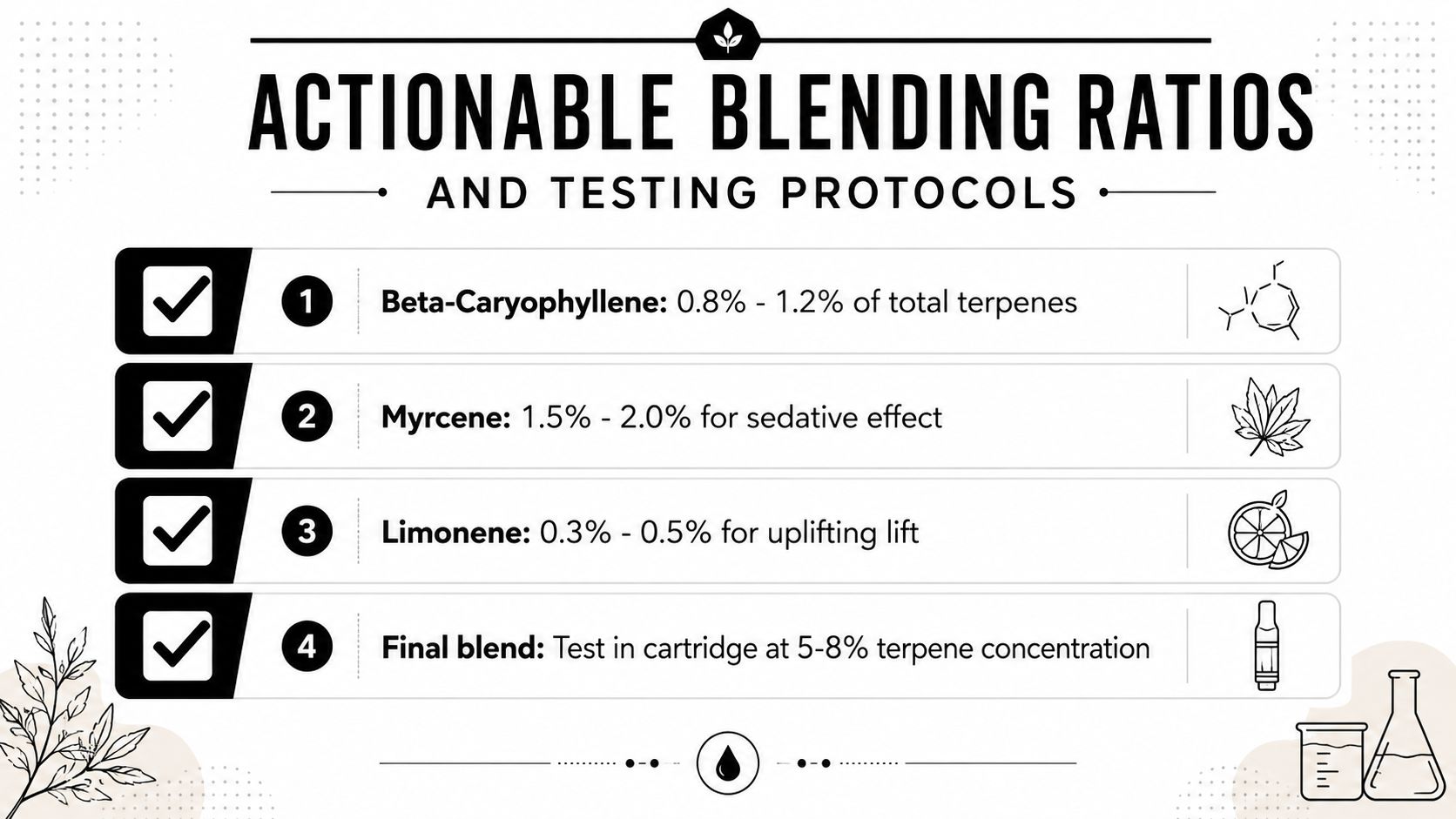
A workable GG4-style cartridge starts with ratios that support the effect sequence, not just the aroma target. For a first production pass, keep beta-caryophyllene in the role of structural base, let myrcene provide the weight, and use limonene as the lift layer. The target isn't a perfect clone on batch one, it's a profile that behaves like GG4 on the first pull and the third pull.
Start with a staged test plan
For a prototype, build three versions. One should lean brighter on limonene, one should lean heavier on myrcene, and one should sit in the middle with caryophyllene as the anchor. That gives you a real read on how the opening, middle, and finish move as the terpene balance shifts.
Then evaluate the cart in sequence, not just on the first draw. The first puff tells you about top-note accuracy. The second and third puffs tell you whether the resin and body notes are holding. That matters because GG4's identity is time-based as much as it is aromatic.
Keep the blend stable in production
Volatile compounds drift if you don't handle them carefully. Use consistent mixing order, document every batch, and avoid letting a sharp top-note system sit exposed longer than necessary before filling. If the profile loses its opening brightness during handling, the final cart can feel flat even when the recipe was correct on paper.
For a team building around commercial repeatability, Gold Coast Terpenes offers strain-specific profiles, including a GG#4 terpene strain option, plus isolates that can be used to tune the blend. That kind of library is useful when you need to hit a target effect arc without rebuilding the whole profile from scratch.
Positioning GG4 Against Newer Exotic Cultivars
New cultivars come and go, but GG4 still earns its place as a reference point because the effect profile is already familiar. That matters in formulation work. When a strain has a known arc, the team can position it with less explanation and more confidence, especially for evening products built around a heavy unwind. GG4 user-reported effect profile
Why the benchmark still sells
New exotics can be louder on the shelf, but louder does not mean clearer in use. GG4 has recognition on its side, and that recognition reduces the need to sell the consumer on the concept from scratch. For a brand trying to present a dependable relaxation SKU, that is a practical advantage, not just a naming one.
Expectation management is the other reason it still sells. Buyers already connect GG4 with deep relaxation, physical heaviness, and late-day use. If the blend respects that memory, the product feels familiar without reading as tired. The job is not to make it smell like everything else in the market. The job is to deliver the same opening lift and the same weighted finish people associate with the cultivar.
Where newer cultivars beat it
Newer exotics can beat GG4 on novelty, fruit brightness, or a sharper first impression. That gives them value when a brand needs a fresher story or a more colorful terpene signature. GG4 still holds the stronger position when the brief calls for a heavier, more established evening reference with a clear two-phase arc, a brief cerebral rise up front, then a body-forward drop later.
That is why I would keep GG4 in a portfolio instead of treating it as a relic to replace. It gives formulators a stable commercial anchor, a recognizable flavor target, and a sensible way to build carts that open with lift and finish with weight. In practice, the stronger products usually do not chase aroma alone. They layer the top note for the first impression, then let the body-heavy terpenes take over as the session develops.
If you are developing a GG4-inspired cart, concentrate, or distillate blend, Gold Coast Terpenes can supply strain-specific terpene profiles and individual compounds for tuning the opening, middle, and finish. Use that as a starting point for replication, then test the blend against your own hardware and base material before locking the SKU.