
The popular advice misses the core challenge. If you're building a product for mood support, “best weed for depression” is not a strain list, it's a formulation brief, and the brief has to start with cannabinoid ratio, terpene profile, dose, and hardware. A name on a menu can't tell you whether the cart will feel bright, settling, or too strong.
For manufacturers and brand owners, that shift matters. The same cultivar can feel different after extraction, reintroduction, and device selection, and the experience can change again once the user takes the second puff instead of the first. That's why profile engineering beats strain chasing, especially if you're formulating for vape cartridges, distillate, or any SKU that needs repeatable sensory output.
Why Best Strain Is the Wrong Question for Mood Formulation
A strain name is marketing shorthand, not a formulation spec. For mood products, the working brief starts with cannabinoid ratio, dominant terpene profile, dose, and delivery format, because those variables shape how the product feels in use. A label that says sativa, indica, or hybrid cannot tell you whether a cart will read bright, settling, or too strong.
That's why strain labels deserve less credit than they get. Even consumer guidance on the subject treats those categories as oversimplified, and the more practical question is how to build a profile that feels uplifting without pushing the user toward discomfort Leafly's depression strain overview. If you want a broader look at why people still associate certain labels with mood outcomes, this discussion of whether sativa is good for anxiety and depression shows how quickly the conversation runs into the limits of strain language.
Think in terms of effect architecture
For a formulator, the useful brief sounds direct, daytime mood uplift with low-anxiety onset, or evening calm with minimal cognitive drag. That gives the lab something concrete to tune against, and it stops the team from treating a cultivar name like a substitute for a designed sensory effect.
Practical rule: brief your lab on the effect target first, then assign strain inspiration, cannabinoid ratio, and terpene balance to match it.
That matters even more once you move into distillate or reintroduced terpene systems. Two batches can share the same cultivar identity and still land differently if the aroma top note is heavier, the base note is flatter, or the THC feels harsher at the chosen wattage. A product is the experience, not the strain name.
Why profile engineering is the commercial move
A branding team can safely ask for a strain-inspired terpene blend without implying that the blend treats anything. A formulation team can build for brightness, clarity, or softening of THC edge, then check whether the sensory result holds in hardware. That is a better commercial process than ranking cultivar names and hoping one of them happens to fit the brief.
For carts and concentrates, the more useful starting point is a sourcing page for a terpene blend that matches the target effect, then a formulation note that defines the ratio and delivery format. A strain label is a shortcut for shoppers. A profile spec is what lets a manufacturer repeat the same experience across batches.
What the Evidence Shows About Cannabis and Mood
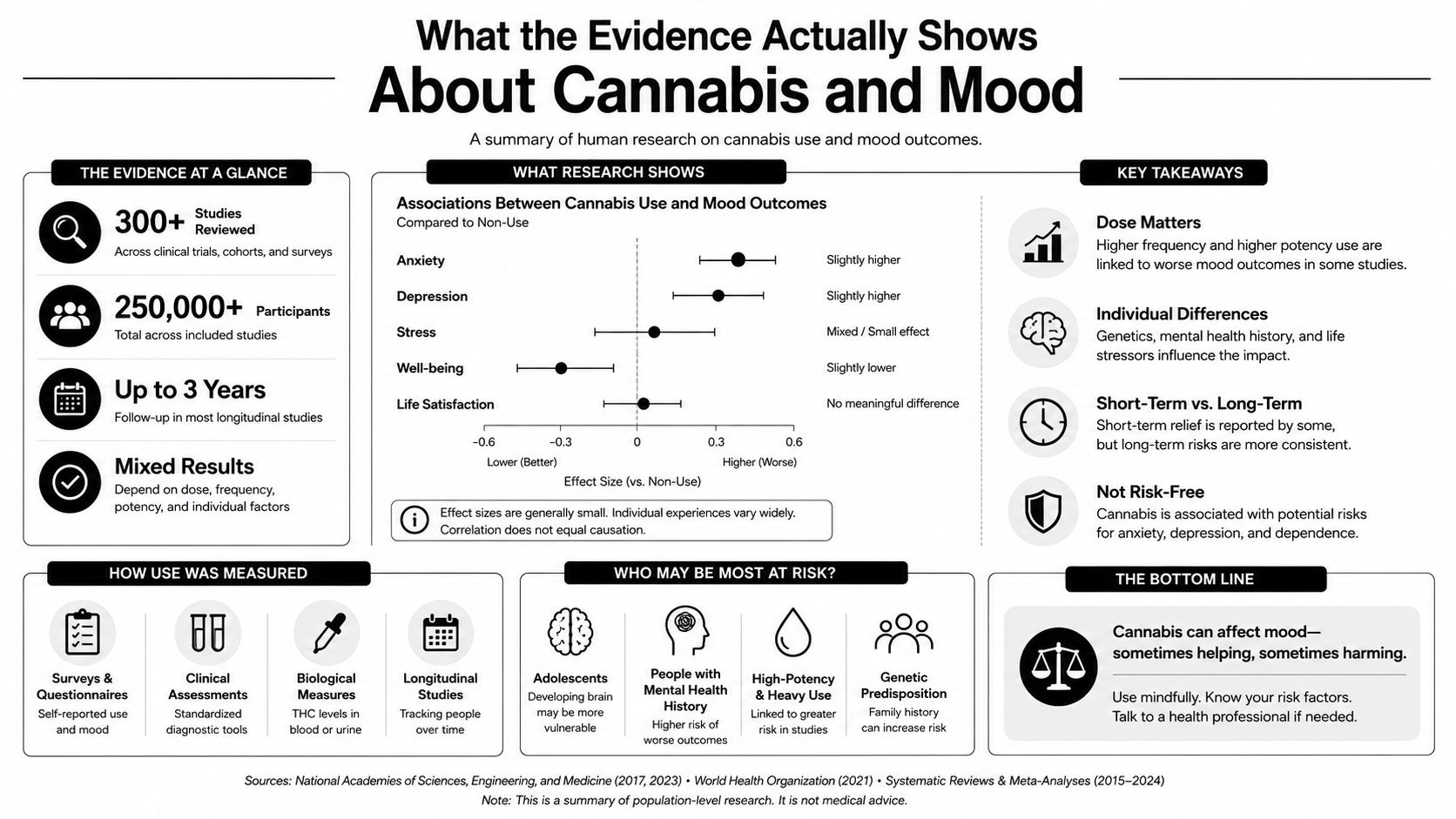
The evidence is mixed in a way product developers need to respect. In acute settings, users often report short-term relief, but that is not the same as a validated treatment claim. A 2020 review of acute cannabis flower use found that 95.8% of users reported symptom relief, and among participants reporting depression, symptom scores fell from 5.85 to 2.08 on a 0 to 10 scale, a mean drop of 3.76 points with a very large effect size, d = 1.71, p < .001 review cited in the depression-and-cannabis literature.
The same evidence base also carries a caution flag. A separate review concluded that cannabis, especially heavy use, is associated with a small increased risk of depressive disorders, with pooled estimates of pOR 1.17 overall and pOR 1.62 for heavy use. That is why the phrase best weed for depression stays scientifically unsettled. People can report acute relief, but the broader literature does not point to a clear winner for depression.
Acute experience versus durable efficacy
A useful product distinction is between acute experiential signal and clinical efficacy claim. The first tells you how a user may feel shortly after use, which matters for flavor design, dose design, and consumer satisfaction. The second would require a stronger evidence base, and the literature on depression does not support that jump.
A 2023 observational study of medical cannabis is often cited because it gives a concrete real-world signal. Mean depression severity dropped from 6.9 to 3.8 by week 18, and 50.8% of patients achieved a response defined as more than 50% reduction in their initial score PubMed record. Useful as a market signal, yes. Enough to support a mood-targeted formulation brief, yes. Enough to claim treatment of depression, no.
Labeling line to avoid: anything that reads like the product treats depression, resolves depressive disorder, or replaces clinical care.
What the regulatory line looks like
That distinction is where good brands stay safe. You can formulate for uplift, calm, or reduced harshness, and you can talk about sensory and experiential targets. You cannot convert acute self-report data into a medical claim.
The strongest practical takeaway is simple. Cannabis may support a mood-uplift experience, but the evidence does not identify a single therapeutic strain, and it also does not remove the possibility of longer-term risk. So the formulation brief should stay commercial and sensory, not medical.
For teams deciding whether to specify CBD vs THC, the practical framework starts with effect target, not strain folklore. A clear explainer on CBD and THC differences helps anchor that ratio discussion before anyone writes a mood claim.
Choosing the Right Cannabinoid Ratio for Mood Products
Once strain names are off the table, cannabinoid ratio becomes the first real decision lever. For mood-oriented SKUs, three scaffolds show up repeatedly in product development: CBD-dominant with low THC, balanced THC:CBD, and low-to-moderate THC with trace CBD. The right one depends on whether you're targeting a softer, steadier feel or a more noticeable lift with tighter dose control.
The most specific strain-related evidence favors CBD-dominant, low-THC cannabis rather than a single named cultivar. In one study of medicinal cannabis users, cannabis use was associated with lower baseline depression scores, and within the cannabis-user group, CBD-dominant product use was linked to significantly lower HADS depression scores, t(359) = 2.609, p = 0.009, d = 0.36 CBD-dominant findings in the cannabis-user study. That doesn't mean CBD is a cure. It does mean CBD-forward design is a defensible starting point for mood-sensitive formulations.
How to brief the ratio
A CBD-dominant scaffold makes the most sense when the brand wants to reduce the chance of THC edge, especially for users who are anxious, sensitive to intoxication, or new to the category. A balanced ratio is useful when you want more noticeable effect without leaning hard into THC. A low-to-moderate THC with trace CBD approach can still work for a lift-oriented cart, but it needs tighter dose discipline.
The Washington State University-related report in the brief supports that logic. One puff of high-CBD, low-THC cannabis was enough to lower depressive symptoms, while two puffs of any cannabis were associated with reduced anxiety, and depressive symptoms reportedly halved in the acute setting same source. The same report also noted that repeated long-term use did not appear to produce lasting reductions in depression, which is exactly why a packaging claim has to stay experiential.
A workable product design lens
The cleanest positioning framework is this.
- CBD-dominant, low THC: best for cautious users, daytime clarity, and less jagged onset.
- Balanced THC:CBD: best for brands that want a middle path between mood lift and anxiety control.
- Low-to-moderate THC with trace CBD: best for users who already tolerate THC and want a brighter, more noticeable effect.
If you're building a cart line, the ratio should be written into the formulation brief before terpene selection. A good internal reference point is a CBD versus THC guide that clarifies how each cannabinoid behaves in product design, then the lab can set the target without drifting into unsupported medical language.
Terpene Profiles That Map to Mood Targets
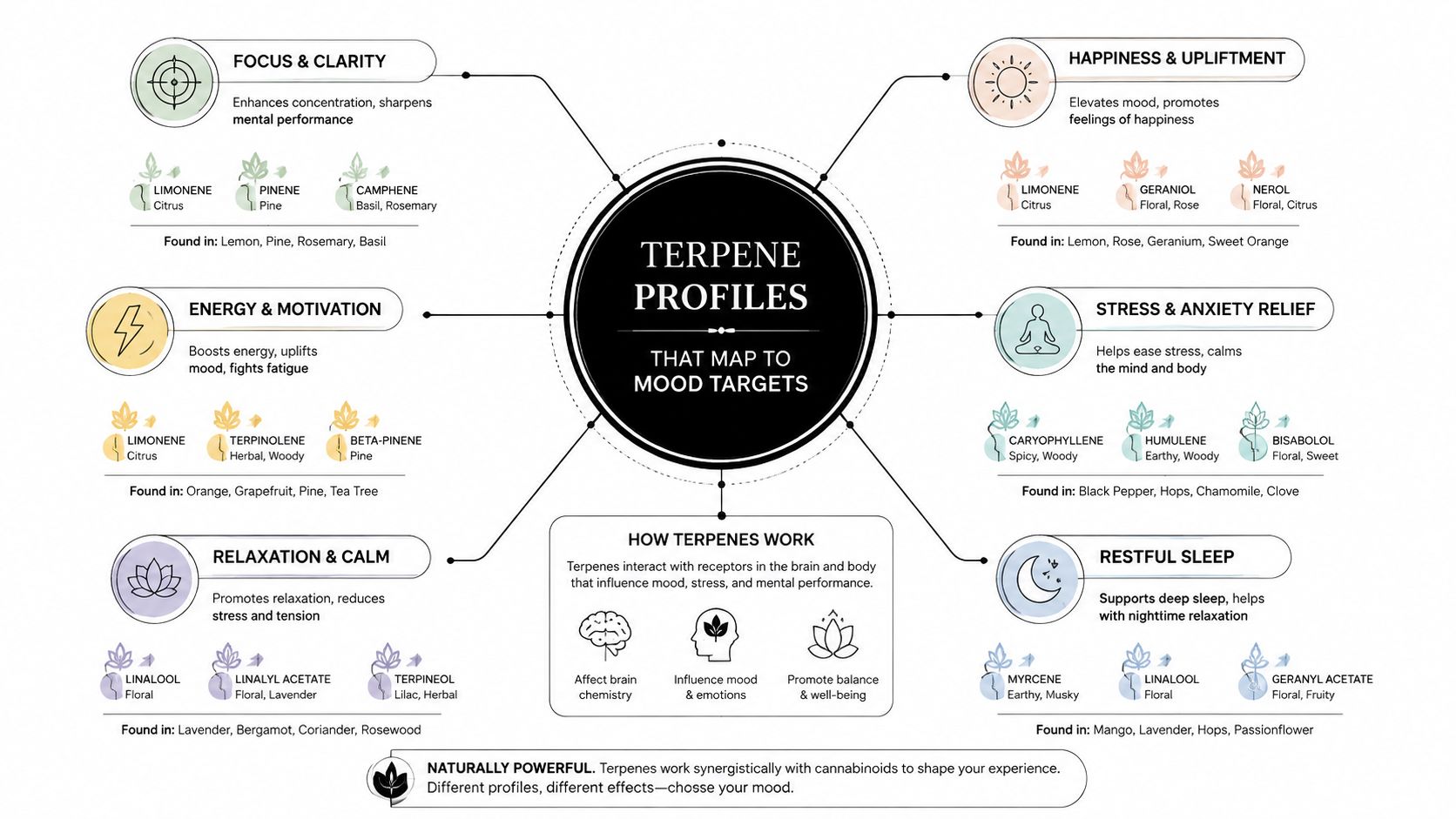
The craft work happens here. Terpenes do not replace cannabinoid design, but they shape the first impression, the middle palate, and the finish, which is where mood products either feel coherent or feel muddy. For a formulation team, the job is to build a profile that matches the intended state, then make sure the hardware preserves it. If you want the profile to hold up in production, quality control testing has to sit beside aroma design, not after it.
The clearest way to think about it is in top notes, mid notes, and base notes. A top note drives the first burst of aroma, a mid note carries the body of the profile, and a base note softens the edge and gives the blend staying power. That structure is useful whether you are recreating a cultivar, building a new SKU, or tuning a distillate blend for a specific user pattern.
Daylight uplift
For apathy, low drive, or a flat daytime profile, limonene works well as the top note, alpha-pinene can carry the mid-note clarity, and beta-caryophyllene makes sense as a grounding base note. That combination usually reads as brighter and less foggy than a heavy, sleepy profile. It is the kind of blend that supports an uplift cue without pushing into loud or sour territory. A practical overview of how terpenes can shape mood-focused formulations is useful here, because aroma accuracy has to match the intended product brief.
Soft reset
For rumination-heavy or anxiety-adjacent patterns, linalool and beta-caryophyllene sit well in the mid and base of the blend, with myrcene used sparingly to round the finish. This is the better archetype when the user does not need stimulation, only a quieter internal texture. In aroma terms, it should feel smoother, not sharper. Heavy citrus or a sharp pine note can pull the profile away from that goal.
Evening unwind
For sleep-adjacent symptoms, nerolidol and humulene over a myrcene base create a more muted, settling profile. That is the formulation direction for a nighttime cart or tincture where the goal is to reduce stimulation rather than to drive lift. It is also where overdoing citrus or sharp pine can work against the brief. If the finish feels too bright, the blend will read as alerting even if the cannabinoid ratio says otherwise.
| Mood-Targeted Terpene Archetypes for Formulation | Dominant Terpene | Supporting Notes | Target Symptom Pattern |
|---|---|---|---|
| Daylight Uplift | Limonene | Alpha-pinene, beta-caryophyllene | Low motivation, apathy |
| Soft Reset | Linalool | Beta-caryophyllene, myrcene | Rumination, anxious tension |
| Evening Unwind | Nerolidol | Humulene, myrcene | Sleep-adjacent symptoms |
A useful sourcing reference for this kind of work is a terpenes and mood guide, especially if your team is matching aroma accuracy to a specific effect brief. That keeps the conversation on profile design instead of strain mythology.
Picking the Right Delivery Format for a Mood SKU
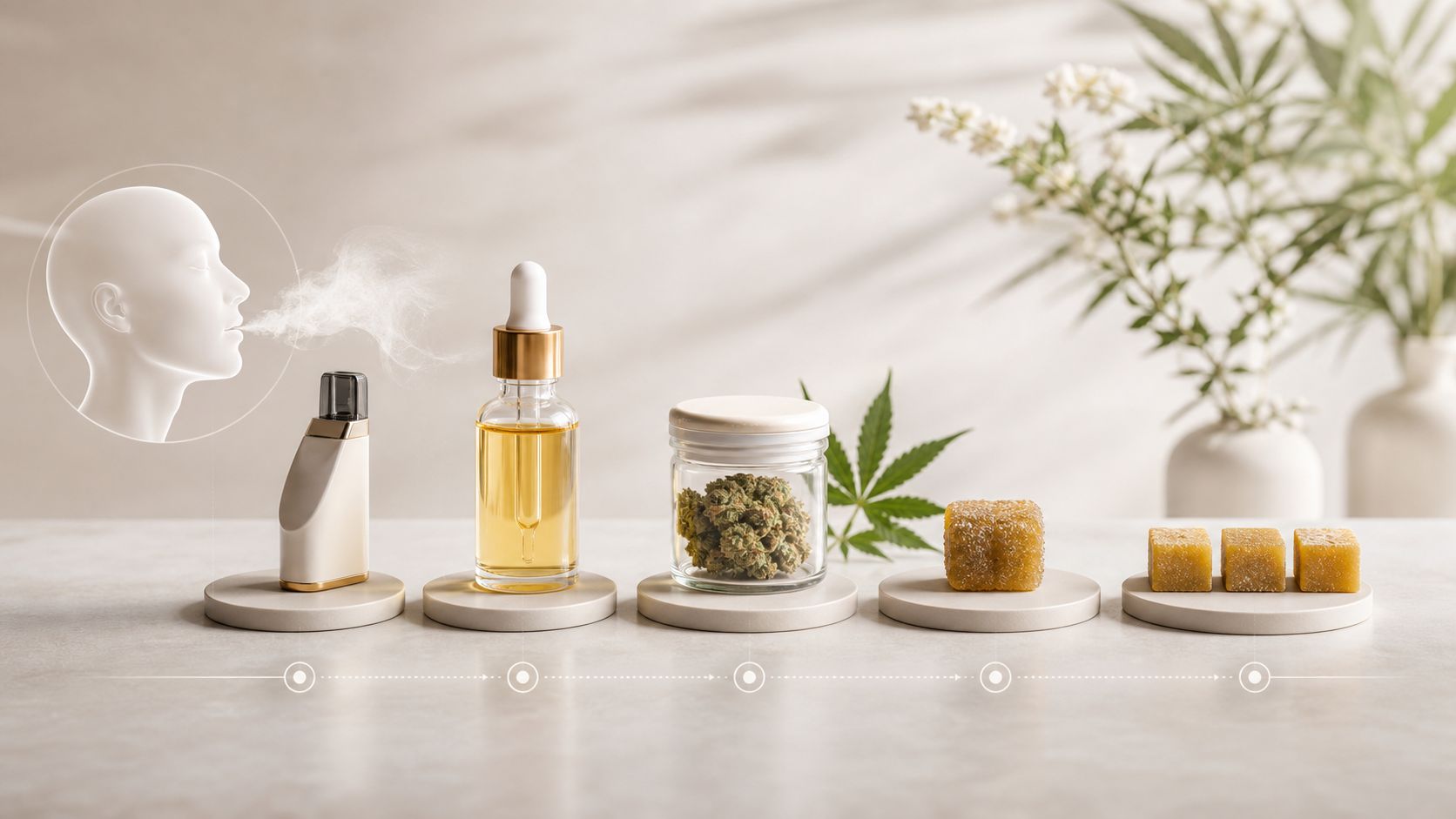
The format matters because the hardware decides how much of the profile survives to the user. A beautiful blend can still fail if the oil oxidizes, separates, or hits too hot. For mood-oriented products, the practical choice usually comes down to distillate carts, live resin carts, tinctures, or low-dose edibles.
Match the format to the effect target
Distillate carts with reintroduced terpenes are the most flexible for custom profile work. They let you tune aroma and mouthfeel precisely, but they also demand clean viscosity management and careful terpene loading. Live resin carts preserve native terpene character better, which helps when the brand wants authenticity over total control.
Tinctures work when the brief needs dose flexibility and a non-inhaled format. They're useful for users who want slower onset and more measured titration, but separation can become a manufacturing issue if the carrier system isn't stable. Low-dose edibles fit best when the brand wants slower, steadier onset and longer duration, though dose uniformity becomes the main QC concern.
Practical rule: the more you need aroma precision, the more you need to protect against heat, oxygen, and over-thinning.
A sensible internal tool for this stage is a Mixing Calculator so the team can work out realistic percentages before pilot fill. That matters because a cart that tastes great in bench testing can still clog, thin out, or lose top-note character if the formulation ignores hardware limits.
For mood products, I'd usually treat live resin as the authenticity play, distillate as the precision play, tincture as the measured-use play, and edibles as the long-tail play. The brief should decide the format first, then ask what kind of mood story the format can carry.
Dosing Strategy From One Puff to Microdosed Edibles
Dose is where a mood SKU becomes a mood liability if you get it wrong. The evidence already points to a practical threshold, low doses are more likely to help, higher doses are more likely to backfire, especially in THC-sensitive users. That's why the one-puff finding matters more to manufacturers than a generic strain ranking does.
A practical starting point for vape
For a vape SKU, the cleanest guidance is a single two-second draw on a low-wattage device, then wait about ten minutes before deciding whether to take more. That mirrors how experienced users self-correct while giving the formula a chance to show its actual character. If you build a cart for mood, you want the first pull to be legible, not overwhelming.
Why microdosing matters
A daytime edible often works better when it stays in the microdose range rather than jumping into a full recreational-sized serving. A 2.5 mg THC microdose is a sensible starting point for many mood-focused edible concepts because it's easier to titrate and less likely to tip into anxiety. CBD buffering can help blunt acute unease in THC-sensitive users, which is why many brands prefer a balanced or CBD-forward design.
The dose story also lines up with the broader literature on rapid response. Acute effects can show up quickly, but they don't translate into durable depression relief, so the formulation target should stay modest and controlled. That gives the user a better shot at feeling uplift without pushing the product into a rebound pattern.
Start low, wait, then titrate. The user experience usually falls apart when the first dose is treated like a finish line.
If you're writing packaging copy or a lab sheet, the safe move is to recommend a starter dose, a wait period, and an escalation rule, not a broad promise of relief. The product can be designed for a gentle lift. It shouldn't be designed to overdeliver on the first inhale.
Manufacturing, Stability and Testing Guardrails
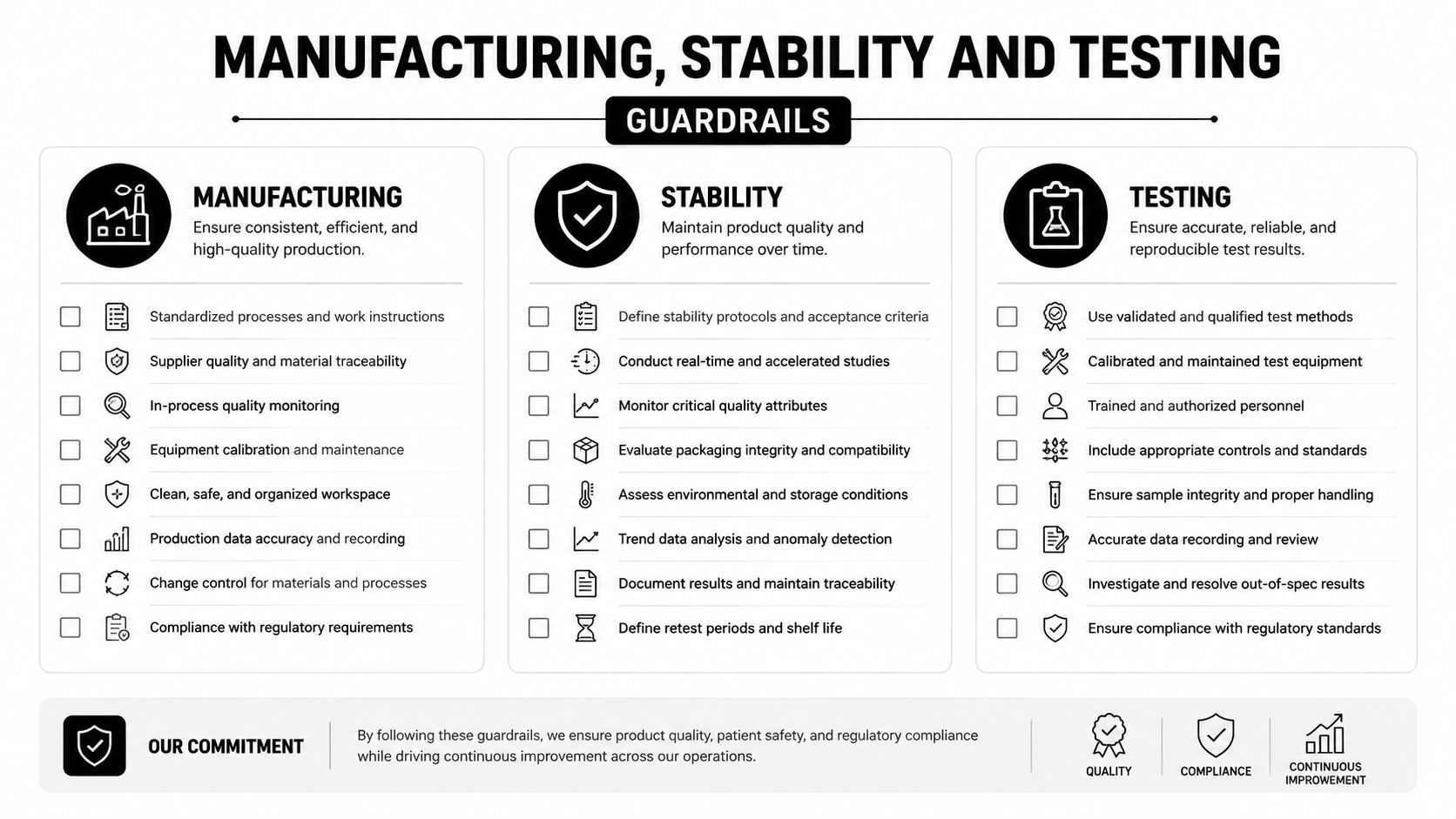
A mood-target cart that tastes burnt by week four has already failed. Stability is part of the user experience, because oxidation changes aroma, viscosity, and sometimes the whole perceived effect profile. That's why the formulation brief has to include storage, hardware, and analytical guardrails, not just a nice terpene idea.
Protect the profile before fill
Store blends away from heat and light, use opaque hardware where possible, and keep oxygen exposure as low as your process allows. Nitrogen blanketing is useful when the workflow supports it, because it helps reduce oxidative drift before fill. Those steps don't make a weak formula strong, but they do keep a good one from degrading early.
For distillate blends, the viscosity target has to match the device. Many carts end up in the 5 to 12 percent total terpenes by weight range depending on hardware, but the exact ceiling still depends on the oil, the coil, and the wick geometry. The point is not to chase the highest terpene load, it's to preserve flow, flavor, and consistency.
Choose clean inputs
The ingredient stack should stay free of VG, PG, PEG, and MCT in blends where those carriers create compatibility or sensory issues. That's especially important if you want a clean aroma and consistent atomization. A cart that separates, darkens, or feels thin at the wrong time can ruin an otherwise strong product story.
Test what you're actually selling
A Certificate of Analysis should tell you more than whether the input passed a basic screen. It should support consistency in sensory profile, confirm the material matches the intended blend, and give your team confidence that the batch is reproducible. SC Lab-tested inputs are useful here because they support a tighter quality culture around the material you're putting into market.
For a working checklist, a quality control testing resource is worth keeping close during development. It's the difference between a concept that sounds good in R&D and a product that still tastes like itself after shipping and storage.
Turning the Framework Into a Real Product Brief
A clean brief beats a clever strain name every time. If the product is meant to support a mood-uplift experience, the document should start with the target state, then work outward into chemistry, hardware, and QC. That keeps the lab focused on repeatable sensory design instead of chasing a label that means too many different things.
A practical one-page brief looks like this. Define the target effect as daytime mood uplift with low-anxiety onset or evening calm with minimal stimulation. Choose the cannabinoid scaffold, such as CBD-dominant, balanced, or low-to-moderate THC with trace CBD. Then assign a terpene archetype, a format, and a starter dose band.
Brief elements that belong on the same page
- Target effect statement: keep it sensory and experiential.
- Cannabinoid ratio: specify the THC and CBD relationship before terpene work starts.
- Terpene archetype: use a daytime, soft-reset, or evening profile instead of a strain name.
- Delivery format: cart, tincture, or edible, selected for onset and stability.
- Starter dose: define the first-use amount and the wait period.
- Guardrails: list oxygen, light, viscosity, and input-material requirements.
The evidence gap still matters. Acute relief signals exist, but the literature does not support a claim that cannabis treats depressive disorders, and long-term risk is part of the picture. So the best commercial answer to best weed for depression is not a strain ranking. It's a profile specification that can be built, tested, and repeated without overclaiming.
For formulators ready to turn that spec into a shelf-ready SKU, Gold Coast Terpenes offers strain-inspired blends, isolated compounds, and practical formulation resources that fit this exact workflow. Visit Gold Coast Terpenes to review terpene options, source matching profiles, and build a product brief that's grounded in aroma design, dose control, and manufacturing reality.