
Most advice on live resin vs live rosin gets the business end wrong. Solventless does not automatically make a cartridge base better, easier to fill, or more profitable, and a clean-label story won't rescue a formulation that clogs hardware or drifts batch to batch. For product teams, the core question is which extract gives you the most controllable path to flavor, viscosity, shelf stability, and compliant manufacturing.
| Decision Factor | Live Resin | Live Rosin |
|---|---|---|
| Extraction path | Hydrocarbon solvents such as butane or propane | Ice water, heat, and pressure, solventless |
| Scale-up profile | Better throughput and easier process control | More labor-intensive and lower-yield |
| Cartridge behavior | Typically flows more easily and is often more cart-friendly | Thicker and more likely to need formulation help |
| Cost position | Generally lower cost per gram | Premium pricing due to yield and labor |
| Compliance focus | Residual solvent management | Moisture, sanitation, and input-material control |
A cartridge brand can't spec based on romance. It has to spec based on what fills, vapes, and stays stable in the tank. If you're comparing live resin and live rosin for a new SKU, start with the manufacturing reality, not the marketing label.
Why the Solventless Label Does Not Settle the Debate
Solventless sounds cleaner, and in a branding meeting that often ends the discussion too early. In production, it doesn't. The better question is which extract gives you the most reliable route to a repeatable cartridge, a stable fill, and a compliance path your lab can defend.
The label is not the process control
Live rosin gets praised because it avoids hydrocarbon solvents, but the label only tells part of the story. The starting material still matters, the wash still matters, and the press conditions still matter. A solventless extract can still carry contamination risk from upstream biomass, processing equipment, or poor sanitation, which is why extraction labels never replace a testing program. That caution is spelled out well in this live rosin overview.
For cartridge makers, that means the decision starts with manufacturing fit. If the goal is a line that fills consistently on standard equipment, hits the same flavor note every run, and doesn't slow the packaging room with viscosity problems, the solventless badge alone isn't enough to choose rosin. The process has to fit the equipment, not just the brand story.
Practical rule: choose the extract that reduces process variation first, then layer on the label story.
Commercial viability depends on the bottleneck
Hydrocarbon live resin usually gives formulators more room to work because it's easier to integrate into larger-scale throughput and easier to tune for downstream use. Live rosin shifts the work away from solvent management and into mechanical separation, moisture control, and press discipline. That changes where the risk lives, not whether risk exists.
For a cartridge SKU, the bottleneck is rarely “Can we make this concentrate?” It's “Can we make this concentrate at the right viscosity, in enough volume, with enough repeatability to keep the line moving?” If the answer is no, the better extract on paper becomes the worse extract on the floor.
Extraction Methods and Production Physics
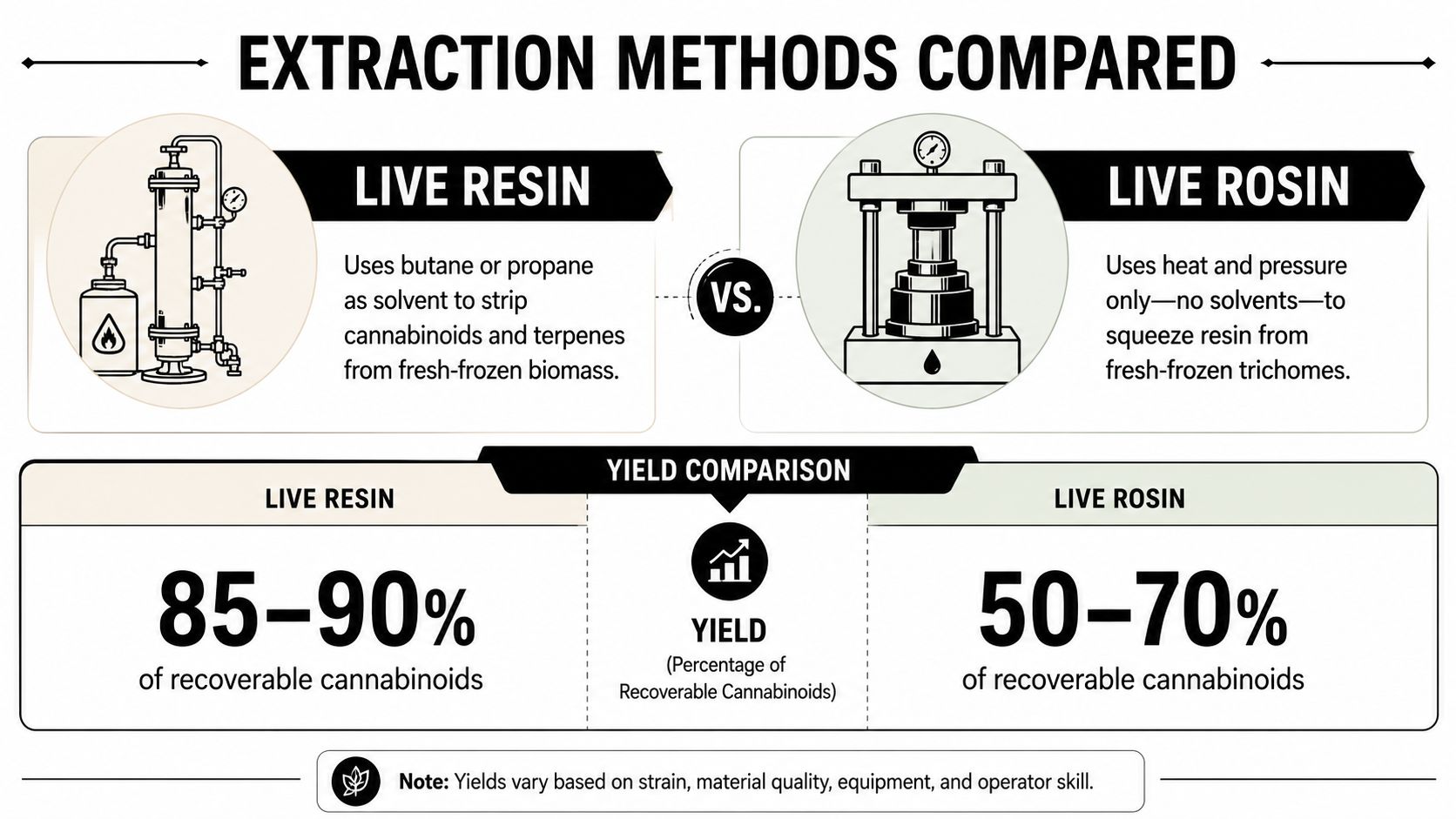
Both start with fresh-frozen cannabis, but the process path changes the product before it ever reaches a cartridge room. Live resin relies on closed-loop hydrocarbon solvents such as butane or propane. Live rosin skips the solvent stage, washing flower in ice water, collecting bubble hash, then pressing that hash at roughly 180 to 200 °F under high pressure. A solid primer on the broader solvent extraction methods helps frame why those choices matter in production. That split in process flow drives the rest of the formulation work (Good Grades NYC).
What hydrocarbon extraction gives you
Live resin is built around dissolution and recovery. The solvent does the pulling, and the closed-loop system is designed to contain, recover, and purge that solvent after extraction. For formulators, that setup is easier to steer toward low-residual-solvent compliance and larger batches, which is why live resin is usually the more scalable base for cartridge production.
The practical upside is control. If the extraction team stays disciplined on purge parameters, the material usually arrives in a form that is easier to standardize before it hits the fill line. That matters when a multi-SKU launch has to stay on schedule and the packaging room cannot stop to troubleshoot every syringe or jar.
What mechanical pressing changes
Live rosin shifts the burden from solvent control to mechanical control. The wash, hash drying, moisture content, and press temperature all become critical, because the material is being separated and expressed rather than dissolved. In manufacturing terms, quality control moves from residual solvent management to moisture control and press conditions (Good Grades NYC).
That process can produce excellent flavor, but it asks more from the operator and the product developer. If the wash is inconsistent or the hash is not prepared cleanly, the press output can vary in ways that make cartridge filling harder to predict. Rosin often behaves more like a craft format, while resin is usually easier to run as an industrial base.
Yield Economics and Cost Per Gram
The premium on live rosin is not a branding myth, it's a yield story. One comparison guide reports live rosin at $80 to $140 per gram in New York versus $50 to $90 per gram for live resin, and another notes rosin can cost two to three times as much as resin (CannaMD). Those numbers track with production reality, not just consumer preference.
| Metric | Live Resin | Live Rosin |
|---|---|---|
| Retail price reference | $50 to $90 per gram in New York (CannaMD) | $80 to $140 per gram in New York (CannaMD) |
| Relative retail price | Lower | Two to three times resin in some comparisons (CannaMD) |
| Yield from starting material | Around 10 to 15% per pound of flower (CannaMD) | Around 2 to 5% per pound of flower (CannaMD) |
| Overall rosin yield reference | Not stated in the source data | 3 to 6% from fresh-frozen material (CannaMD) |
Those yield gaps explain a lot. A lower-yield, more labor-intensive process naturally lands in a premium slot, and that premium has to be absorbed somewhere, either by the brand, the distributor, or the customer. If the SKU is meant to sit in a value or mid-tier cartridge range, live resin usually gives the margin room to operate without compromising fill economics.
Commercial takeaway: rosin can be the right choice for premium positioning, but it's a costly way to chase a cartridge price point that the market doesn't support.
If you're modeling cost of goods sold, use the actual batch math from your extraction partner and not a generic concentrate assumption. The source material, labor, press time, and post-processing losses matter more than the label on the jar. A useful way to sanity-check that math is through a break-even framework like this production cost guide.
Terpene Preservation and Profile Fidelity
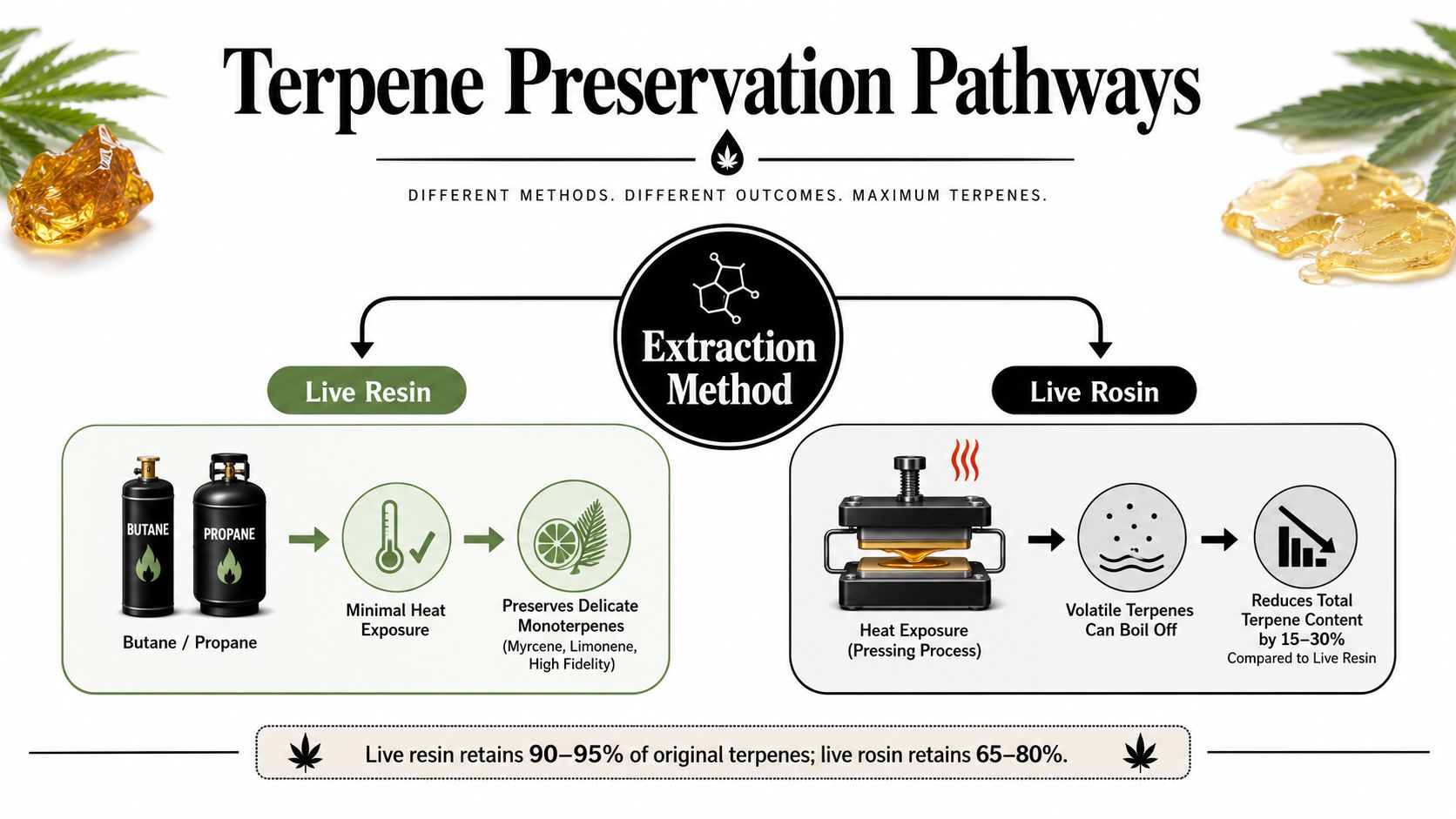
Flavor is why brands spec live material, but the preservation story is not equal across extracts. Live resin usually keeps more of the volatile aromatic picture because hydrocarbon extraction pulls terpenes efficiently from fresh-frozen biomass. Live rosin can still taste clean and true to flower, yet the press step adds heat and pressure that can narrow volatility and shift the aromatic balance. For a cartridge brand, that difference shows up in how much corrective formulation you need before the oil is stable enough to run.
Top notes, mid notes, and base notes
A formulation team should read the profile in layers, not just chase terpene percent. Top notes give the first impression, the bright compounds that jump out on the nose. Mid notes provide body, while base notes hold the profile together in the tank and keep it present on the palate.
That layering matters more than the strain name on the box. If the base extract is thin in brightness, a well-built terpene blend can restore lift. If it is too heavy, the cartridge can taste muddy, especially in hardware that runs warm.
Why fidelity is a formulation problem
Live resin usually gives product developers a broader aromatic starting point, which makes it easier to reproduce strain-like signatures and keep flavor consistent from batch to batch. Live rosin can be excellent, but the output usually needs tighter tuning if the brand wants the same sensory target across runs. That is a production reality, not a knock on the material.
The practical move is to treat the extract as the backbone, then correct the profile with a strain-inspired terpene blend only where needed. That gives the formulator control over brightness, body, and finish without forcing the extract to do every job. For teams building a resin-heavy SKU, a live resin sauce reference is useful because it shows how terpene-rich resin formats are commonly used to carry aroma and mouthfeel.
Use the extract for texture and authenticity, then use the terpene system for repeatability.
Cartridge Hardware Compatibility and Formulation
Most comparison pieces stop at flavor, then ignore the part that costs money, hardware. Live resin generally flows more easily, which is why it's often better suited to cartridges. Live rosin is thicker, and that thickness can be a real issue for fillability, clogging, and how the oil behaves once it's in the tank (Mood).
What the fill line wants
A cartridge line wants predictable flow through pumps, nozzles, and holding tanks. If the concentrate is too viscous, operators start compensating with heat, dwell time, or formulation changes that weren't in the original spec. That's where a rosin SKU can become expensive fast, not because the extract is bad, but because the process window is narrower.
Live resin usually gives more flexibility here. It can be easier to fill on standard equipment, and it's often less likely to turn a packaging run into a slow, stop-start job. Live rosin can still be made cartridge-ready, but it usually needs a tighter formulation strategy.
Voltage, dilution, and stability
Rosin often vapes better at lower voltage or with special formulation attention, while live resin is generally more forgiving in common cart hardware (Mood). That doesn't mean every resin cart behaves perfectly. It means the formulation team has more levers to work with before the product becomes a hardware problem.
Here's how I'd think about it on the bench:
- If the oil is too thick: adjust the terpene system carefully before reaching for aggressive dilution.
- If the cart clogs on storage: check viscosity, fill temp, and whether the hardware wicks the oil properly.
- If the flavor collapses after a few pulls: the extract and terpene balance is probably wrong for the device.
- If shelf stability is weak: revisit moisture, viscosity, and the way the concentrate is interacting with the cartridge seal.
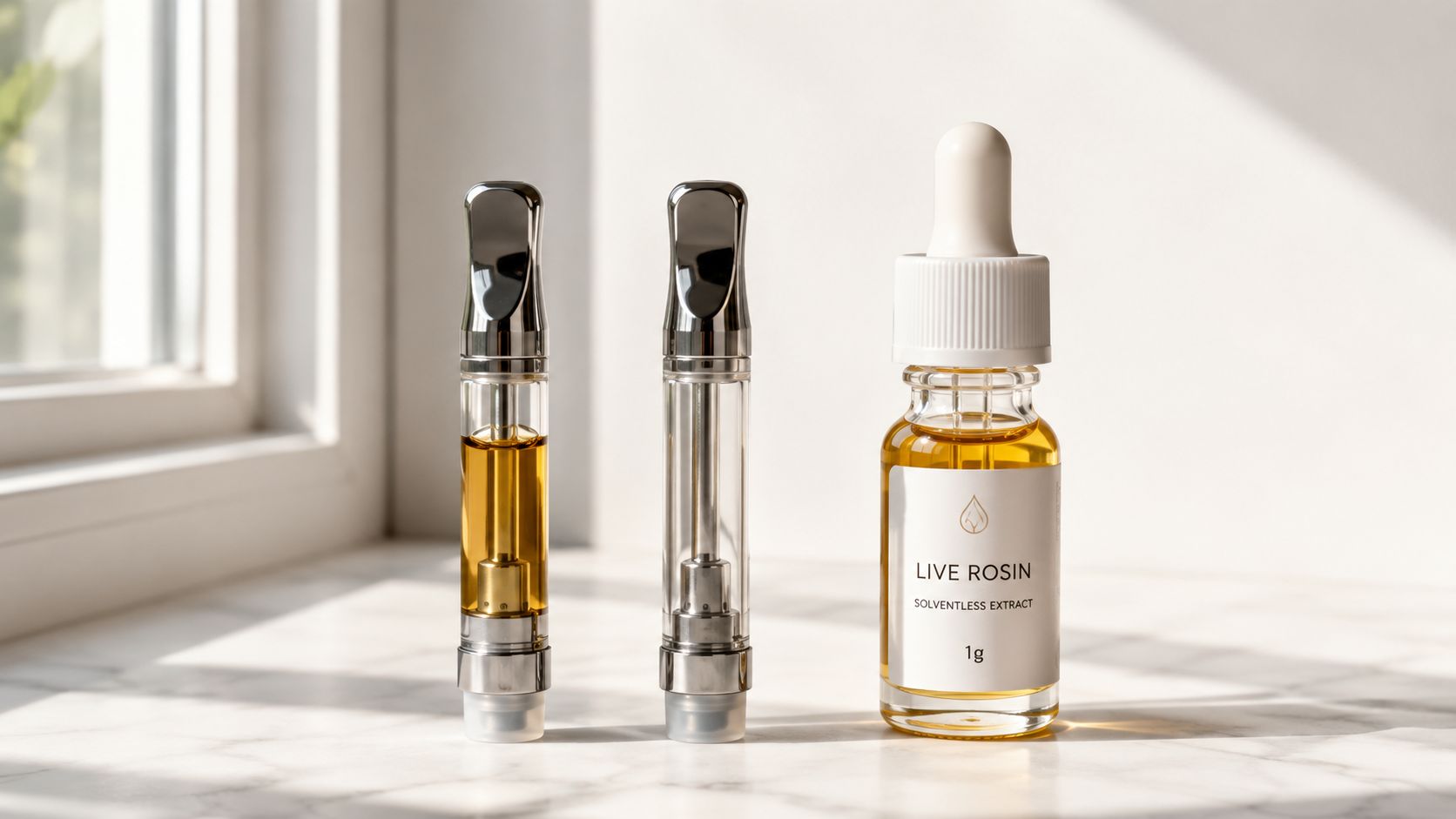
For a cartridge brand, the useful question isn't “Which one is purer?” It's “Which one lets us fill cleanly, ship reliably, and keep the same draw quality through the life of the cart?”
Safety Testing and Regulatory Compliance
Solventless does not mean risk-free, and hydrocarbon does not automatically mean unsafe. Live resin brings residual solvent into the compliance discussion, but that only becomes a failure if the finished oil is outside the required limits. Live rosin removes solvent residue from the equation, yet it can still fail for other reasons, including pesticides, microbes, or heavy metals carried over from the starting material or the hash-processing equipment, as Happy Valley notes.
Testing has to match the actual risk
A compliance program should test the hazard in front of it, not the one a label suggests. Hydrocarbon live resin needs residual solvent testing at the release gate. Live rosin shifts the center of gravity toward biomass quality, sanitation, and the cleanliness of the wash and press workflow.
That shift matters because a solventless label can give operators a false sense of security. A product can be solventless and still fail on contamination. It is a different failure mode, not a free pass.
The upstream material decides the outcome
A safe formulation starts with clean input material and a process that is documented well enough to audit. Sourced biomass, wash equipment, press plates, collection tools, and storage practices all need to be part of the review. The extraction label is only one part of the safety stack, and it is usually not the first place I look.
Compliance note: if the testing program only checks the extract and ignores the input stream, the brand is gambling on the wrong variable.
For brand owners, the practical move is to map the expected hazards before choosing the base. Hydrocarbon systems need solvent control. Solventless systems need tighter discipline around contamination, moisture, and sanitation. Either path can work, but neither path works on assumption.
Choosing the Right Extract for Your Product Line
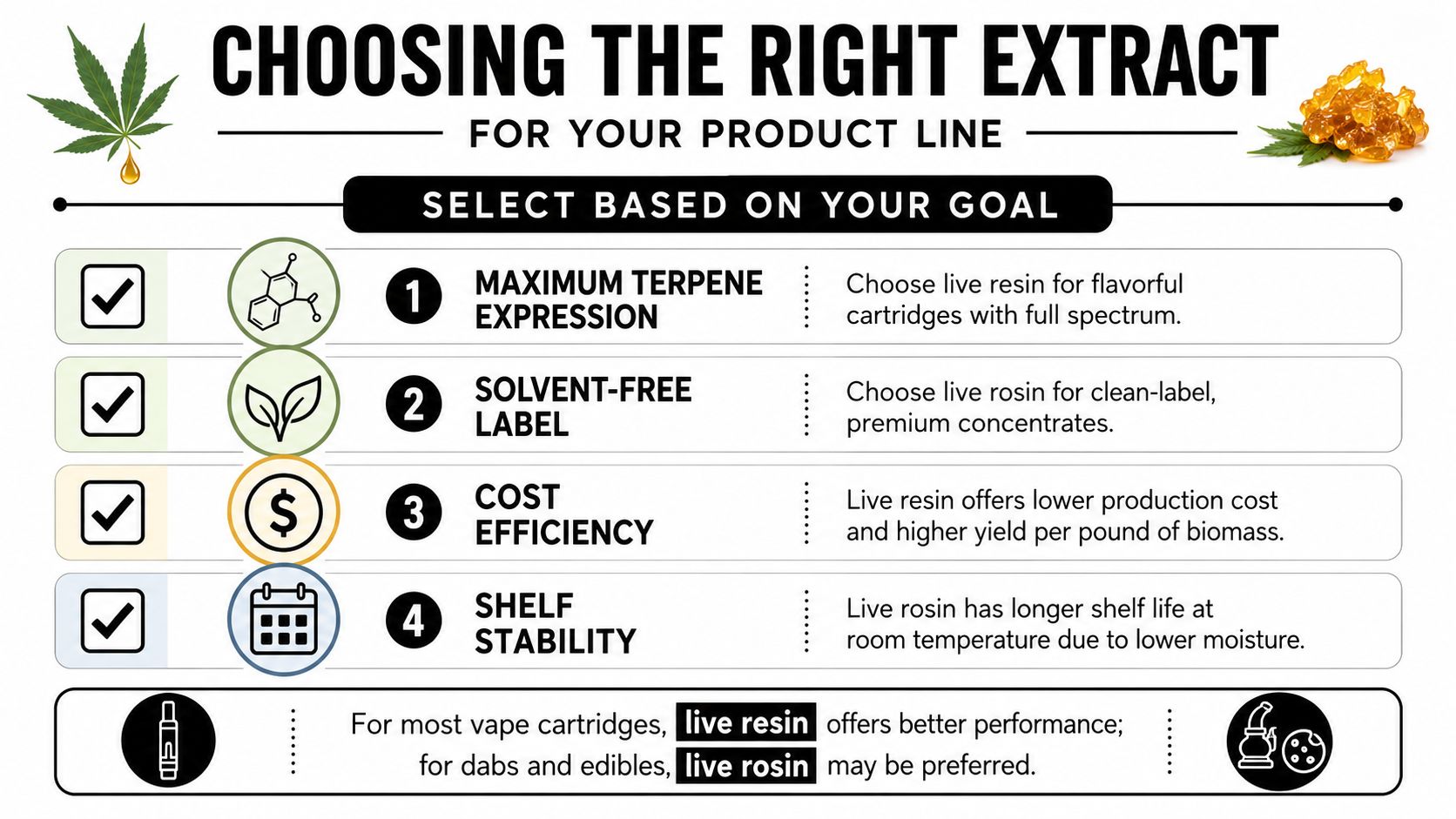
For for vape cartridges and for cannabis product formulation, live resin is usually the more practical base when the priorities are fillability, throughput, and predictable hardware behavior. Live rosin makes more sense when the SKU is built around premium positioning, solventless messaging, or a dabbable format that can absorb the cost and viscosity trade-offs.
A simple decision frame
- Choose live resin when you need a scalable base for cartridges, easier flow, and more predictable production economics.
- Choose live rosin when premium price, solventless positioning, and artisanal processing are central to the SKU.
- Choose a terpene blend system when you need to stabilize flavor, rebalance top, mid, and base notes, or replicate a specific strain-inspired profile across batches.
- Choose the hardware first, then the extract when shelf stability and draw performance matter more than a marketing claim.
For most cart programs, live resin offers the cleaner manufacturing path. For premium concentrate lines, live rosin can be the stronger brand signal. The smartest teams don't treat those as moral categories, they treat them as tool choices.
If you're building a new cartridge or concentrate SKU, Gold Coast Terpenes can help you spec strain-inspired terpene blends, isolated compounds, and formulation support that fit either live resin or live rosin bases. Visit Gold Coast Terpenes to review profile options and choose the right terpene system for your next production run.