
You're tuning a cart, adjusting a blend, or reworking a distillate profile, and the core problem isn't flavor alone. The core issue is timing. A product can smell right on the bench and still deliver the wrong stages of being high because the onset is too abrupt, the peak is too flat, or the comedown lingers in a way that doesn't match the brief.
For formulators, that timing is not a mystery. It's a system made up of delivery method, dose, and terpene architecture, and each of those variables changes how the experience unfolds. If you treat the high as a predictable sequence of phases instead of a vague consumer feeling, you can design products with much tighter sensory control, more reliable repeatability, and a better fit between SKU and use case.
Beyond the Buzz A Formulators Introduction
A cartridge, dab, or edible fails the brief the moment the experience curve is left to chance. In formulation work, the stages of being high should be engineered as a predictable sequence, with a fast start, a rising middle, a peak, and a controlled decline that each respond to different inputs.
Consumers do not buy THC in isolation. They buy a finished format and expect it to behave a certain way from first inhale to finish. A product that hits hard at onset, then falls off too fast, reads very differently from one that builds steadily and leaves a cleaner tail.
Practical rule: if the onset is wrong, the whole product is usually wrong, because every later stage inherits that first impression.
The commercial task is to shape that curve intentionally. Match the route of administration to the intended experience, then use aroma chemistry to adjust the top note, mid note, and base note so the product does more than taste good, it performs consistently. For a formulation team, that is a more useful framework than strain myth or consumer slang.
Thermal behavior also matters at the bench, since activation and volatility influence how quickly the user moves through the early phase and into the main body of the experience. A useful reference for that relationship is THC activation temperature, because heat and delivery conditions shape whether the first stage feels clean, delayed, or overly aggressive.
A formulation that respects that transition is easier to control. It can make a cartridge feel tighter, a dab feel more immediate, or a blend feel more complete without forcing the user into an unpredictable curve.
Deconstructing the Experience The Pharmacokinetic Stages
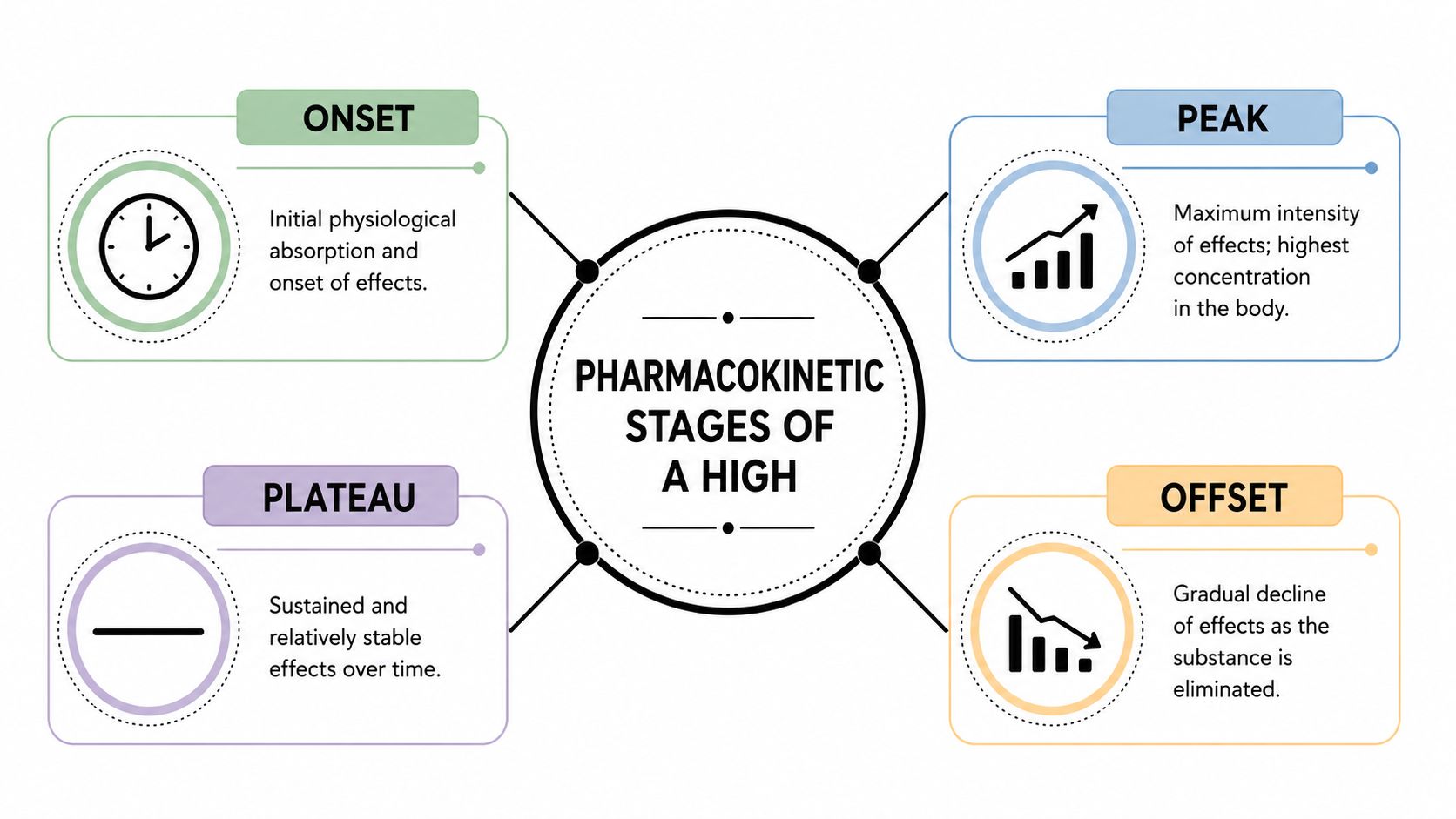
A cartridge that feels sharp at first pull, then settles into a flat middle, is already being read as a curve by the user. The same is true of a gummy, a tincture, or a dab. The stages of being high are not a vague consumer story, they are a sequence of pharmacokinetic phases that can be planned around product format, dose, and terpene profile.
Onset is the first detectable shift. Peak is the point where the strongest effects are concentrated. Plateau is the short span where the experience holds steady enough to judge. Offset is the controlled return toward baseline, and it is part of the product, not an afterthought.
Onset and peak
Onset is where formulation choices show their work first. In inhaled products, the first change is often subtle, a slight change in head pressure, sensory focus, or tempo before the stronger effect arrives. For a formulator, that early window matters because it determines whether the product feels clean or abrupt, and it starts with how efficiently the active compounds are released and absorbed, which is why a technical resource on THC activation temperatures belongs in the development process.
Peak is the point where the product has the most commercial risk and the most commercial value. A fast peak can feel powerful, but it can also flatten the flavor arc and make the aroma seem front-loaded. A slower rise gives more room for the sensory profile to unfold, which is often preferable in cartridges built for repeat use rather than immediate force.
That timing changes real formulation decisions. If a cartridge is designed for a quick onset, the team may choose a lighter terpene top note and a cleaner inhalation profile so the first impression is not masked by harshness. If the brief calls for a slower climb, a denser aromatic blend can support the transition without making the product feel slow or dull. The choice is not just about taste, it is about how the user moves from first pull into the main body of the experience.
The core reference point for inhaled cannabis is a quick progression from onset to peak and then a gradual fade, not a single continuous block of intensity, as summarized in consumer education from Try CannaVine.
Plateau and offset
The plateau is where product consistency shows up. If the formulation is working, the user does not experience a hard spike followed by a drop, they feel a stable middle where the sensory character stays readable. That middle phase is what lets a brand feel controlled instead of erratic.
Offset shapes the memory of the product. A published overview notes that during the decline phase, users are more likely to notice hunger, sleepiness, anxiety, or mild paranoia, while the peak is the point where euphoria is most likely to be strongest Medical News Today's overview of cannabis intoxication. For formulators, that is a practical distinction. The tail can make the same base formula feel clean, heavy, edgy, or sedating, depending on how much residual intensity remains and how quickly it drops.
The strongest-feeling stage does not always line up with the highest measured concentration. That lag is one reason the subjective high can keep intensifying even as the blood level starts to fall.
For product design, that lag is the primary constraint. A formula that peaks too late can feel disconnected from the flavor arc. A formula that peaks too quickly can overwhelm its own aroma profile before the user registers the top notes, which is a poor trade if the cartridge is meant to feel balanced and repeatable.
How Delivery Method Dictates the Timeline
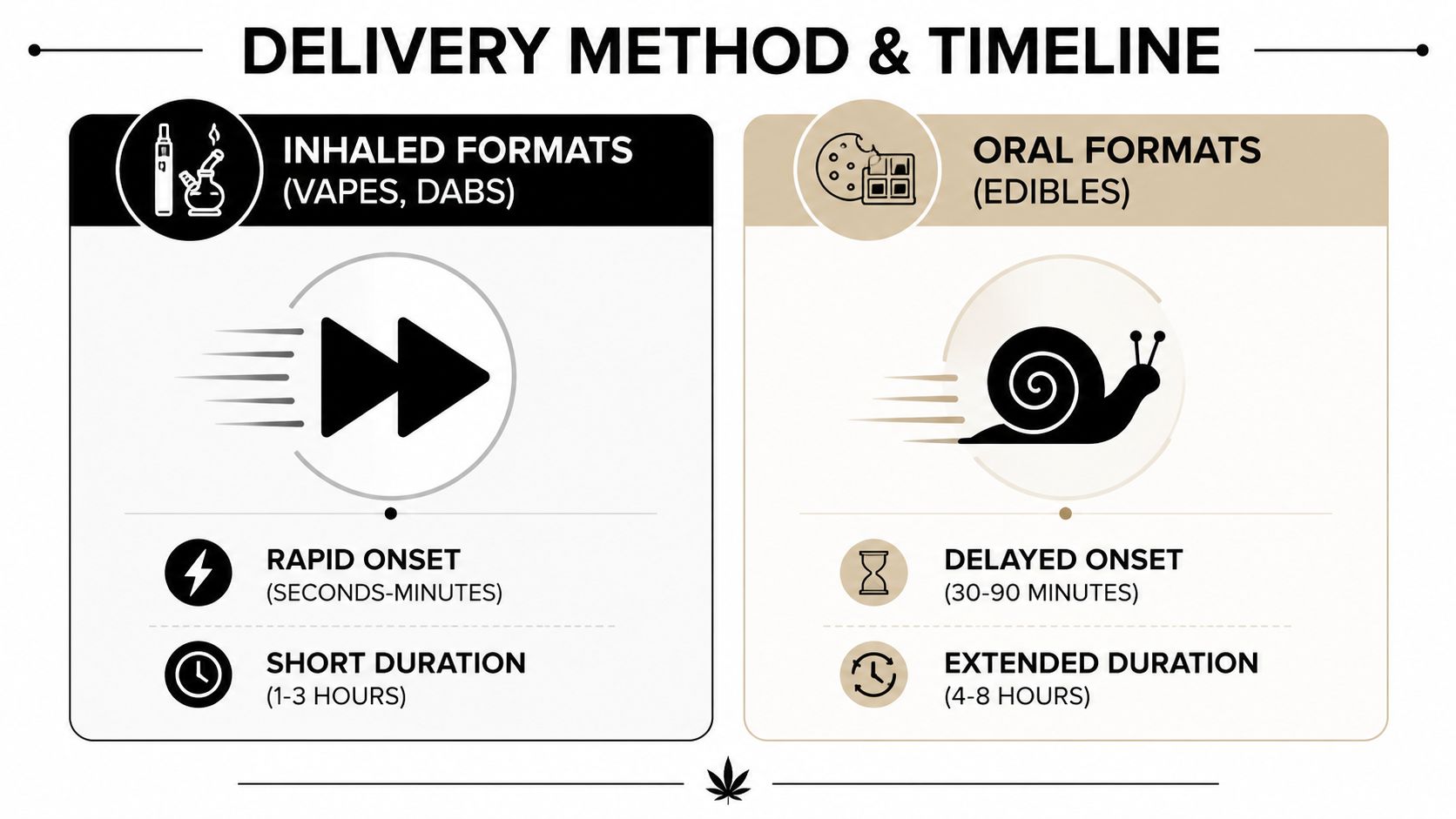
Delivery method sets the clock. It also sets the shape of the curve, which is why inhaled and oral products rarely feel interchangeable even when the cannabinoid content looks similar on paper. If the route is wrong for the intended job, flavor tuning can only correct so much.
Inhaled formats versus oral formats
Inhaled cannabis usually starts fast, often within minutes, then moves into a clear rise, a short peak, and a relatively quick exit Healthline. That fast curve is why vapes and dabs work when the brief calls for immediate feedback and a tighter sensory arc. In a cartridge, the onset window also has to match the volatility of the terpene system, since lighter top notes can flash off quickly and set the tone before heavier compounds fully register.
Oral products run on a different timetable. Edibles commonly take longer to start, peak later, and stay active much longer, with aftereffects that can linger well past the main rise Northwestern. Digestion and first-pass liver metabolism push the experience back and stretch it out, so the user is not sampling the stages in real time the way they do with an inhaled format.
What that means in development
A terpene profile for vape cartridges can be built around the early curve. Bright top notes support onset, while more persistent aroma compounds help the middle feel coherent instead of thin or abrupt. Carrier selection matters here too. The same liquid base can change how evenly the active fraction aerosolizes, which affects whether the first impression feels crisp or muted. For a practical reference on how liquid behavior shapes cartridge performance, this cannabis vape liquid resource is useful because it puts carrier and volatility choices in the same frame.
Oral formulas need a different mindset. The sensory readout is delayed, so the formulation has to carry the user through a longer onset gap without creating a misleading early signal. That is where pacing discipline matters. Northwestern's harm-reduction guidance says to “start low” and “go slow,” then wait before re-dosing because the delay can cause people to stack doses before the first one fully registers Northwestern. In manufacturing terms, that translates to temporal control, not just potency control.
Route of administration sets the timeline before the flavor system does. The formula should match that timeline, or the product will feel misaligned from the first pull to the final aftereffect.
Formulating Each Stage with Terpenes and Cannabinoids
Once the timeline is fixed, terpenes become the instrument panel. They don't replace THC, and they don't override route of administration, but they do help define how each phase presents itself. In a commercial formulation workflow, that means thinking in top notes, mid notes, and base notes, the same way a perfumer would build a fragrance, except the objective is sensory progression, not just scent.
Top notes shape onset
Volatile compounds are your opening move. Citrus-forward or bright top notes can make the first impression feel cleaner and more immediate, especially in inhaled products where the user perceives aroma and effect almost together. For a strain-inspired terpene blend, that early character is often where the product either reads as lively or falls flat.
Mid notes define the body
The middle of the experience is where the formulation's identity becomes obvious. Heavier terpene structures can help the profile feel fuller and more coherent during the peak, especially when you want the product to move from sharp entry into a rounded center. In practical terms, during this phase, you stop chasing novelty and start building texture.
Base notes carry the finish
Base notes matter because they control the memory of the product. A smoother, heavier tail can make a cartridge feel calmer and more anchored, while a thinner tail can leave the user with a quick exit and a cleaner finish. For teams working on replicating flavor of well-known profiles, the base note is often where the approximation either succeeds or feels synthetic.
The broader question of whether terpenes affect the high is covered in this terpene guide, and the practical answer for formulators is simple, they affect how the experience is perceived and how the flavor arc is read. That doesn't mean they create a new pharmacology on their own. It means they help steer the sensory interpretation of the active phase.
Good formulators work backward from the target stage. If the product brief calls for a bright onset and a calm finish, you don't assemble the same blend you'd use for a heavy night profile. You choose ingredients that support the intended curve, then verify that the inhalation profile doesn't fight the aroma profile.
Practical Dosing for Predictable Product Performance
A well-dosed product is easier to trust because its curve is repeatable. Too much THC, or too much variability batch to batch, turns the experience into guesswork and makes the stages of being high harder to control. In a market crowded with similar SKUs, predictability is not a safety extra, it's part of the value proposition.
The clearest commercial benchmark available from consumer-health guidance is simple. A dosing reference from GoodRx recommends starting with 2.5 mg THC or less and going slow, especially because edible effects can take longer to appear GoodRx. That low-dose anchor is useful even outside edibles, because it reminds formulators how little it takes for small potency changes to shift the user's perception of the curve.
Why conservative dosing helps brands
Conservative dosing gives you room to preserve the intended stage progression. If the first exposure is too intense, the user may never notice the nuance in the top notes or the shape of the comedown. If the product starts too soft and then surges late, it can feel inconsistent even when the lab numbers are technically within spec.
Clear labeling matters for the same reason. It doesn't just reduce confusion. It helps the user match the route, the dose, and the expected time-to-peak, which is exactly what prevents overcorrection and bad re-dosing decisions. That's a formulation outcome, not just a compliance box.
Commercial takeaway: the best dosing strategy is the one that makes the product easier to predict, easier to repeat, and easier to buy again.
For manufacturers, that means building around stable potency targets and resisting the temptation to push intensity before the sensory architecture is ready. A profile that performs consistently at a lower dose usually scales better than one that depends on brute force. In a crowded cartridge lineup, that consistency becomes part of the brand's quality signal.
Case Study Designing Uplifting vs Relaxing Cartridge Profiles
A cartridge brief usually starts with a use case, not a terpene list. One team wants a daytime profile that feels bright and active. Another wants an evening profile that reads softer, slower, and more settled. The formulation choices are different because the stage objectives are different.
Uplifting cartridge profile
A daytime uplifting profile should lead with a crisp opening. Bright citrus and pine-adjacent top notes are a practical fit because they create a fast, energetic first impression and support a sharper onset. Mid notes should stay lighter so the peak doesn't feel heavy, and the base should avoid dragging the finish into something sleepy.
Relaxing cartridge profile
A relaxing profile should do the opposite. The top note can still be clean, but it should hand off quickly to a softer body, then settle into a calmer base that supports a gentler decline. That kind of profile reads as smoother because the middle and tail are doing more of the work than the opening flash.
| Formulation Comparison, Uplifting vs. Relaxing Cartridge | ||||
|---|---|---|---|---|
| Target Effect | Top Note Terpene (Onset) | Mid Note Terpene (Peak) | Base Note Terpene (Comedown) | Intended Stage Progression |
| Uplifting | Limonene, Pinene | Lighter supporting terpenes | Cleaner, less heavy finish | Fast onset, active peak, brief tail |
| Relaxing | Brighter top note in a small amount | Myrcene, Linalool | Fuller, calmer finish | Smooth onset, rounded peak, calm decline |
For a more focused citrus-and-energy reference, the best terpenes for energy and focus resource is a useful formulation companion. The important point is not to copy a name from the market. It's to match the sensory arc to the intended moment of use.
The mistake many teams make is overloading every phase at once. They chase a bright start, a heavy body, and a sleepy ending in the same cart, then wonder why the product feels incoherent. A cleaner brief produces a cleaner profile, and a cleaner profile is easier to reproduce.
Conclusion Engineering Experiences Not Just Products
The modern formulator isn't just making extract taste better. You're designing the sequence that carries the user through onset, peak, and offset, and every one of those stages is shaped by decisions you make before the first batch leaves the lab. Delivery method sets the clock, dose sets the ceiling, and terpene architecture sets the character.
That's why the phrase stages of being high is more useful in product development than it is in casual conversation. It gives you a practical framework for building carts, concentrates, and other formats with a defined temporal profile instead of a generic psychoactive effect. Once you can describe the experience as a curve, you can engineer the curve.
The strongest products usually don't try to do everything. They do one thing clearly, and they do it in the right order. A sharp onset, a stable middle, and a controlled finish are easier to sell, easier to repeat, and easier for customers to understand.
If you're building a product line around specific onset, peak, and after-effect targets, Gold Coast Terpenes supplies strain-specific profiles, isolated compounds, and formulation tools that fit this kind of work. Explore the catalogue, compare terpene options against your brief, and visit Gold Coast Terpenes to source the components you need for tighter, more predictable product design.