
You can get a terpene blend right on the bench, send it domestically without drama, and still have the first international order sit untouched because the carrier won't move it, the broker wants different paperwork, or the destination doesn't allow that commodity at all. That's the part most shipping guides miss. For terpene brands, the hard stop usually isn't the label or the invoice, it's whether the parcel is legally accepted as a product at all, and whether the carrier is willing to touch a flammable aromatic liquid.
For a formulator, extractor, or brand owner, international shipping guidelines only matter if they protect the shipment before it leaves the dock. That means thinking like an operator, not like a shopper. The right question isn't “How do I ship overseas?”, it's “What exactly is this bottle in the eyes of customs, the carrier, and the destination market, and what fails first if I get any of that wrong?”
Why Terpene Shipping Is a Different Game
The first failure usually shows up after the box is already packed. A freight desk flags the parcel, a broker asks for more detail, or the carrier rejects it because the product description doesn't match the service rules. At that point, the issue isn't speed, it's that the shipment never got past the first gate.
Three controls decide the outcome
Terpene shipping is not just a paperwork problem. It sits under destination commodity law, carrier hazardous-liquid policy, and customs tariff classification at the same time. If one layer says yes and another says no, the shipment still stops. That's why a bottle of limonene or a strain-inspired blend can move cleanly into one country and get held or refused in another.
The global rulebook behind shipping is highly centralized. The International Maritime Organization has 176 member states and is the United Nations agency responsible for regulating shipping, which carries about 80% of world trade by volume IMO and shipping guidance context. That centralization matters, because shipping compliance isn't built around one country's common sense, it's built around layered international rules and local enforcement.
Practical rule: If a carrier won't accept the product, customs never gets a chance to clear it.
The other trap is assuming THC-free means unregulated. It doesn't. A terpene blend can still be treated as a chemical, a hazmat-class liquid, or a controlled commodity depending on destination and transit mode. Gold Coast Terpenes' own product positioning shows the commercial reality: a lab-verified, THC-free terpene blend still needs to move through the same compliance stack as any other regulated liquid.
Why generic ecommerce shipping advice falls short
Generic shipping content tends to focus on labels, invoices, and package tracking. That's useful, but it skips the part that kills cross-border orders, commodity legality and service eligibility for the product itself. USPS, for example, explicitly bans items such as hemp-based products including CBD, marijuana, aerosols, perfumes containing alcohol, dry ice, and other hazardous or controlled items from being sent from the United States to any country USPS international restrictions.
That's the operational lesson, natural and THC-free are not enough. If the commodity is restricted, the parcel is dead on arrival no matter how clean the invoice looks.
How Regulators and Carriers Classify Your Terpene
A terpene bottle gets judged through multiple lenses before anyone talks about delivery timing. One authority sees chemistry, another sees hazard class, and another sees trade category. If those lenses don't line up, the shipment gets delayed, reclassified, or refused.
Chemical identity comes first
The first lens is the chemical profile. For regulated movement, the product needs a defensible identity under frameworks such as REACH and CAS, because the carrier and the broker both want to know what the liquid is. A terpene blend isn't just “aroma,” it's a chemical mixture with a defined composition, and that composition drives the rest of the file.
Hazmat status changes packaging and service options
The second lens is transport hazard status under IATA, IMDG, and DOT frameworks for air, ocean, and domestic movement. If the liquid falls into a flammable category, the service level, packaging spec, and labeling all change. That's why a bottle that looks simple on a shelf can require a much more disciplined export setup.
Commodity category drives customs treatment
The third lens is the commercial one, the product's customs and tariff identity. Even a THC-free, naturally derived blend still needs a commodity description that matches the actual product and intended use. Mislabeling it as a vague “fragrance sample” or “aroma oil” doesn't make it easier to ship, it usually makes it harder.
For a terpene house, classification is upstream work. It determines the packaging spec, the version of the safety data sheet, the tariff path, and whether a carrier will even book the lane. That's why the working file has to be built before the order leaves the warehouse, not after someone in customs asks questions.
A clean classification file saves more time than any faster box label ever will.
One practical example matters here. If you're buying or selling a strain-inspired profile for formulation, the blend can still be fully legal as a product and still fail transit if the export paperwork, hazard classification, and commodity description don't match. The label on the bottle doesn't overrule the rules attached to the liquid.
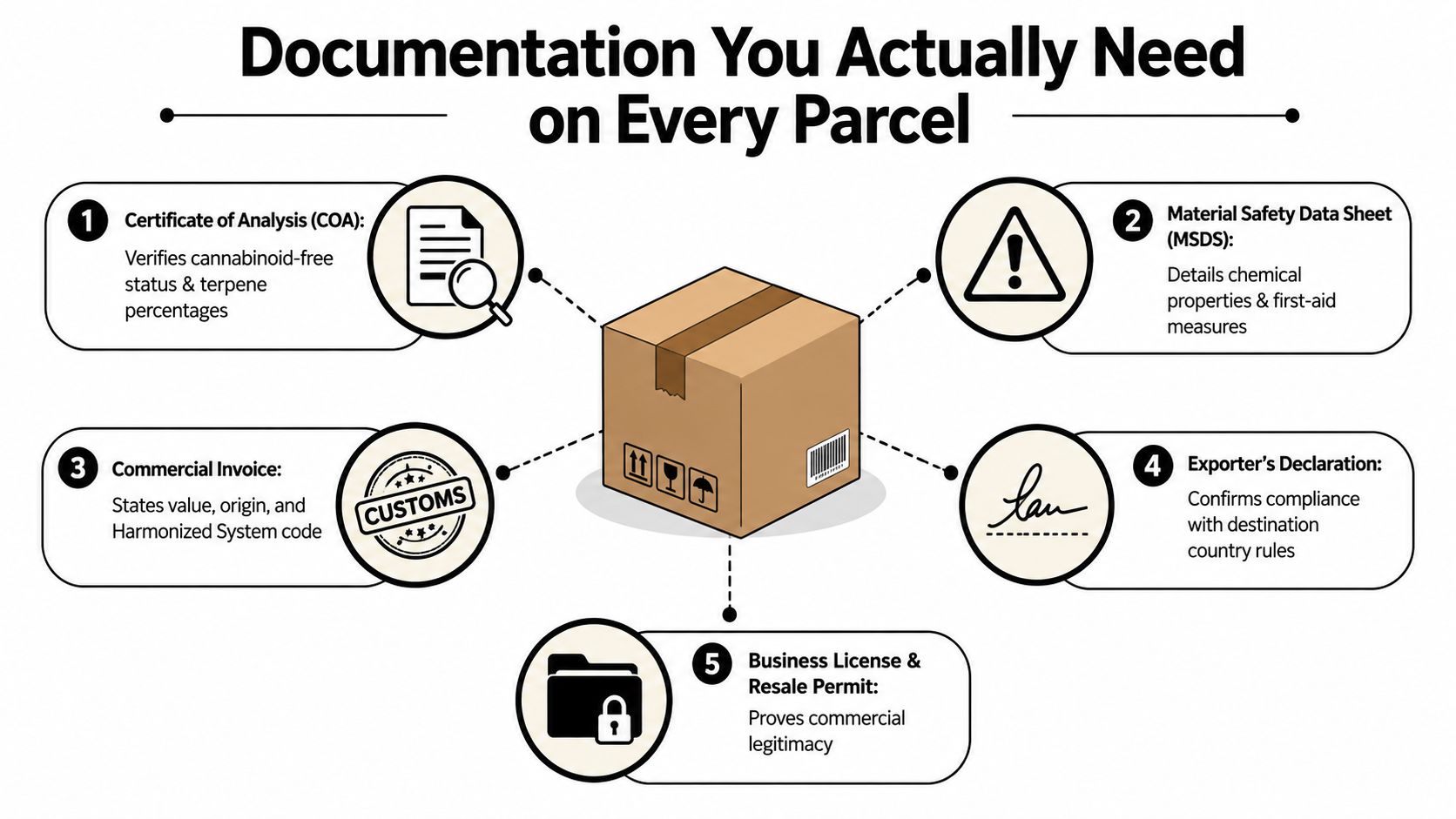
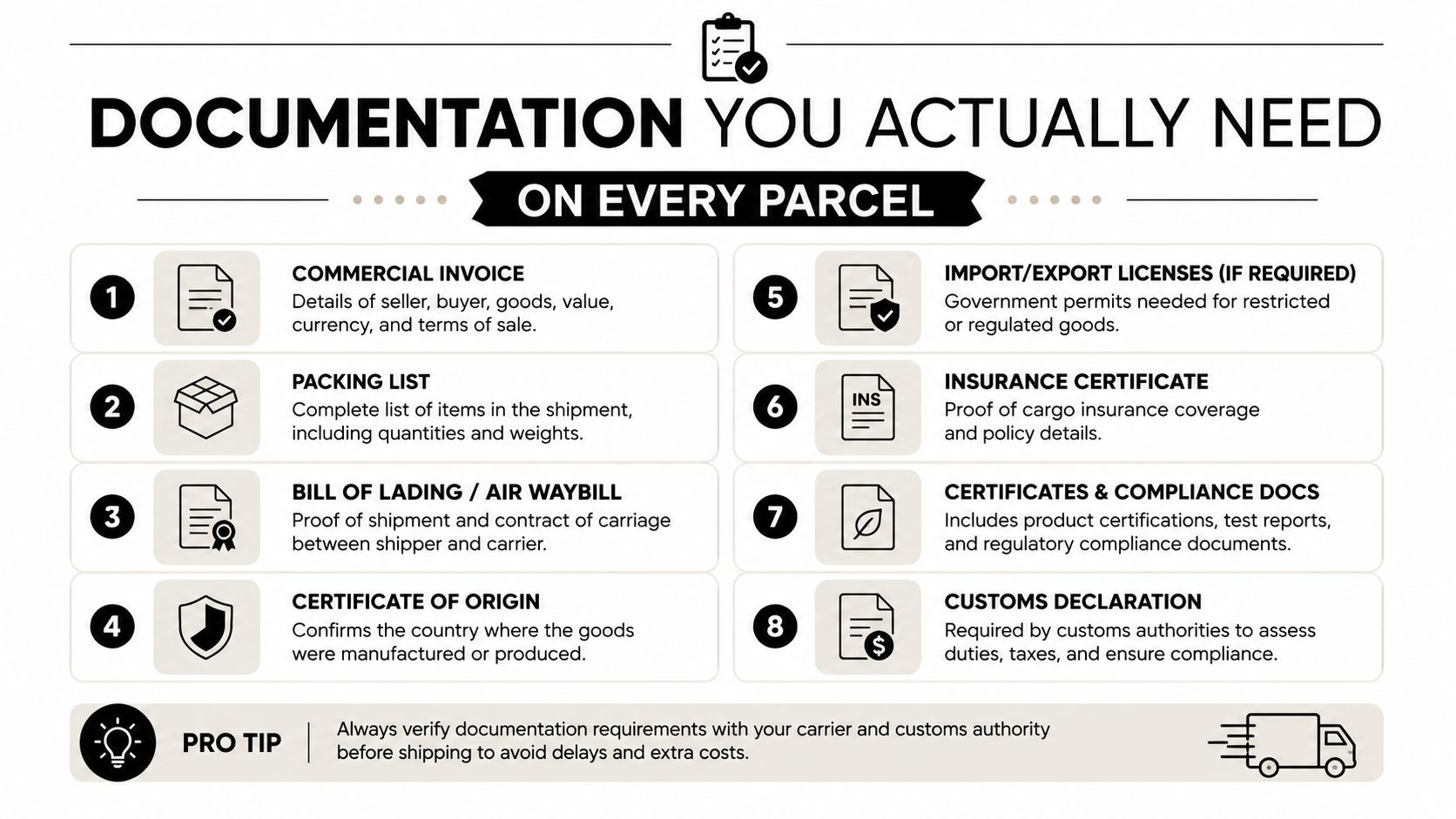
Documentation You Actually Need on Every Parcel
A parcel can clear the warehouse and still get held at the border if the paperwork tells three different stories. The safer approach is to treat the shipment file as one record, because customs, carriers, and brokers will compare every line.
Start with the product documents
A Certificate of Analysis has to prove the product identity, not just confirm that a bottle was tested. For terpene shipments, that means the document should reflect cannabinoid-free status where relevant, terpene percentages, and any other lab result that helps show what is inside the container. A current Safety Data Sheet matters just as much, because the shipper, carrier, and broker use it to read the chemical profile and handling requirements.
The safety sheet also needs to match the export lane. If the SDS says one thing and the invoice says another, the file invites review. That is why the document set has to be current, not pulled from an old batch and reused without checking the details.
Get the commercial invoice precise
The commercial invoice needs a clear product description, declared value, country of origin, and HS code. Those are the first fields customs and freight teams inspect. If the invoice says one thing, the packing list says something else, and the declaration calls it a “sample,” someone down the chain will stop the shipment to reconcile it.
Know when extra documents are needed
Some destinations want extra proof, such as a phytosanitary document or certificate of free sale, depending on product type and local rules. That is destination-specific work, and it is easy to miss if the team only ships from a domestic playbook.
Gold Coast Terpenes keeps a resource on why a current Safety Data Sheet matters in shipping files, and it is worth bookmarking for internal process work when your team is reviewing how SDS language affects a parcel.
A useful pre-tender check looks like this:
- Product name matches everywhere. The COA, SDS, invoice, and packing list should all describe the same blend.
- Declared value is defensible. The invoice should not understate or inflate the shipment.
- HS code is consistent. The tariff line has to match the actual commodity.
- Origin is clear. Customs needs to know where the product was made.
- Handling language matches the hazard profile. The service file and the label cannot contradict each other.
If one field is vague, the whole parcel becomes harder to defend.
HS Codes, Tariffs, and the Landed-Cost Trap
Classification decides cost, not just compliance. A terpene shipment can look cheap at checkout and become expensive once duty, tax, and brokerage are applied under the wrong tariff logic.
The code has to fit the actual use
Terpene isolates, blends, and finished formulation inputs often land in different HS code families, commonly within 2902, 3302, or 3824 depending on use case. That's not just an accounting detail, it's the line that shapes the duty calculation and the way a broker frames the entry. A broad description may feel safer, but a broker usually defends the more specific classification if the product data supports it.
| HS Code | Description | Typical Use Case |
|---|---|---|
| 2902 | Aromatic hydrocarbons and related chemical classes | Certain terpene chemical inputs and isolates |
| 3302 | Fragrance and flavor mixtures | Blends used in aroma, flavor, or formulation work |
| 3824 | Chemical preparations not elsewhere specified | Mixed or specialized formulation inputs |
The right code depends on the product, the declared use, and the supporting paperwork. If those don't align, you don't just risk a correction, you risk a landed-cost surprise the buyer didn't budget for.
Incoterms decide who carries the tax burden
The next decision is the trade term. EXW, FOB, DDP, and DAP shift who pays freight, duty, VAT, and the administrative headache. That choice changes the economics of the quote before the order is even placed.
Practical rule: Classify to the highest specificity your broker will defend, then pick the Incoterm before you quote the buyer.
For terpene brands, that matters because buyer-side surprise charges kill repeat business. If the seller quotes an attractive outbound freight rate but leaves the buyer to absorb a messy import bill, the landed cost may no longer support the sale. That's why the quote should be built from the shipping model, not from the parcel rate alone.
For more process context, Gold Coast Terpenes has an import-export guidelines resource that fits well into a shipping SOP library alongside your broker notes and product files.
Carrier Rules That Decide Whether You Ship at All
Carrier acceptance comes before customs clearance. If the line will not take the liquid, the parcel never gets a real chance to move.
Different carriers solve different problems
USPS is usually the first place people check for convenience, but its international restrictions are strict on categories that overlap with terpene-adjacent products, including aerosols and alcohol-bearing fragrance items. For commercial terpene movement, that can rule out the postal path on certain lanes USPS international restrictions.
UPS, FedEx, and DHL are often more workable for regulated liquids, but only when the service tier matches the product profile and the account is set up for that kind of handling. Standard international services are not the same thing as hazmat-ready freight handling, and a quote that looks better on paper can become useless if the parcel fails the carrier's acceptance screen.
What usually gets rejected
The rejection points are usually predictable. Alcohol-containing perfumes, aerosols, and dry ice are obvious problems, but the deeper issue is undeclared regulated liquid content. “Natural” and “THC-free” do not make a product eligible for every service level.
Carrier selection should follow the lane, not habit. If the product is a small parcel and the destination allows it, a postal path may work. If the shipment is commercial, repeated, and sensitive to rejects, a negotiated carrier or freight-forwarding setup usually gives you more control over acceptance and routing.
For general cost discipline, Gold Coast Terpenes keeps a shipping cost reduction resource that fits the operational side of the equation, especially when packaging density and service level start affecting margin.
If the line cannot tolerate the product, a cheaper label will not save the shipment.
The decision is straightforward. Choose the carrier that can legally and consistently move the commodity on the lane you need, then build the shipping promise around that reality.
Packaging and Labeling for Hazmat-Class Liquids
Once the paperwork is aligned, the physical package has to match it. That's where many otherwise solid shipments fall apart, because the warehouse follows a domestic routine instead of a hazardous-liquid routine.
Build the package from the inside out
For infectious-substance-type liquid handling, the packaging model uses triple packaging, a leak-proof primary receptacle, a leak-proof secondary layer, and a rigid outer package triple-packaging model. Even when the product isn't an infectious substance, that structure is a useful way to think about terpene liquids because the logic is the same, containment, redundancy, and protection from failure.
If the liquid is being packed for a regulated lane, absorbent material belongs between the primary and secondary layers when the substance can leak. The outer box needs to be rigid enough to survive handling, not just presentable on a pallet.
Label for the mode of transport, not the shelf
The package has to carry the right handling marks. That includes the hazard class when applicable, orientation marks, and any shipping name or UN number required by the carrier or route. The brand-facing label on the bottle can stay on-brand, but the transport label has to mirror the lab and customs description.
A warehouse team should use the same pre-tape check every time:
- Primary container sealed. No leaks, no weak closures, no loose caps.
- Secondary containment added. Bag, liner, or other containment sized to the product.
- Absorbent ready. If the shipment is liquid, use material that can capture a spill.
- Outer box rigid. The parcel should survive stacking and sortation.
- Marks readable. Handling and destination labels can't be hidden by tape or corners.
The point is to prevent failure before it turns into a claim. A package that arrives looking neat but violates the handling logic is still a bad shipment.
Gold Coast Terpenes also offers a GMP compliance resource that can help teams keep the packaging and documentation process consistent across batches.
Country-Specific Restrictions You Cannot Guess Your Way Through
The fastest way to lose a shipment is to assume every destination treats terpene liquids the same way. They don't. The product can be legal in one market and blocked in another before anyone even reaches the customs duty step.
Destination checks have to happen before the quote
The EU, UK, Canada, Australia, Japan, and several Middle East jurisdictions all apply their own rules to ingredient imports, regulated liquids, fragrance materials, and cannabis-adjacent commodities. A THC-free blend may still need different paperwork, licensing, or import permission depending on the market. In some jurisdictions, the product is not a paperwork issue, it's a prohibited or tightly controlled item.
The practical answer is a destination pre-check. Before quoting a buyer, confirm whether the lane is even open for the commodity and whether the service can legally carry it. That's especially important when the order is for formulation work, where the buyer may think they're purchasing an ingredient while the destination sees a restricted chemical.
Don't rely on the same file for every country
The same terpene blend can need different supporting documents depending on where it goes. A country that accepts one kind of commercial description may ask for a different certificate, a different labeling format, or a different import pathway. That's why “THC-free” is a useful statement, but never the whole answer.
A destination rule that seems minor on paper can be the only thing that matters at the border.
The cleanest operational habit is to maintain a country-by-country note for each regular lane. That note should say what the market allows, what paperwork the broker expects, and whether the carrier accepts the liquid on the chosen service.
Insurance, Liability, and the Compliance Workflow
The last mistake to avoid is treating shipping compliance as a one-time setup. It runs as a repeating operating rhythm, and every cross-border purchase order should pass through the same sequence before anyone books freight.
A customs hold or carrier rejection often starts with a gap in the file, then turns into a liability fight over who accepted which risk and when. That is why terpene shipments need insurance, document control, and a clear handoff trail from the first quote to final delivery.
Insurance follows the risk, not the wish
The U.S. government's trade guidance says overseas shipments should account for INCOTERMS, packing, labeling, documentation, and insurance, and it specifically says merchandise should be packed correctly, labeled correctly, have correct export documentation, and be insured against damage, loss, pilferage, or delay trade.gov shipping options. That is the right baseline for terpene logistics too. If the parcel is valuable, fragile, or likely to sit while compliance is reviewed, insurance belongs in the quote, not in a last-minute add-on.
Liability also shifts with the trade term. A delivered-duty arrangement leaves more import risk with the seller, while an earlier handoff in the chain pushes more border exposure to the buyer. That difference matters when a liquid is stopped for paperwork, reclassified by the carrier, or held for a destination review that was never reflected in the commercial terms.
Run the same SOP every time
A repeatable workflow keeps the team from improvising under pressure:
- Confirm destination legality. Check whether the product is allowed in the market and on the lane.
- Classify the product. Lock the chemical, hazard, and commodity identity.
- Pull current COA and SDS. Use the latest version, not a stale file.
- Assign the HS code. Make sure the tariff line matches the actual use.
- Choose carrier and service tier. Use the line that can legally move the commodity.
- Pack to spec. Match containment, absorbent, and outer packaging to the product.
- File advance data where required. The U.S. uses Importer Security Filing (ISF 10+2) before cargo is loaded, and EU maritime cargo screening typically wants advance data about 24 hours before loading, so the habit is to file early, not late advance filing guidance.
- Tender the shipment. Hand it over only after the file and the carton match.
- Archive the documents. Keep the record for audit, dispute handling, and repeat orders.
The compliance file should also support your quality system. A shipment backed by the right GMP records is easier to defend if a broker, insurer, or customer asks why a specific product was classified or packed a certain way. That file does not need to be bloated, it needs to be consistent, current, and easy to read when the lane is under pressure.
The best shipping teams do not guess their way through international orders. They verify the lane, document the product, choose the right carrier, and keep the file tight enough that customs, brokers, and warehouse staff all read the same story.