
You can tell the cart is going to give you trouble before it ever leaves the bench. The blend tastes clean in a vial, the aroma seems right, then the first production run turns sharp in hardware, the oil shifts in color, and the lot starts drifting as soon as it sits. That's usually not a terpene problem by itself, it's a control problem, and industry best practices are the control system that keeps a good formula alive from bench sample to finished batch.
The useful mindset is simple. A terpene blend is not a flavor idea, it's a manufactured product with tolerances, records, and acceptance criteria. The United Nations' Statistical Best Practices framework treats quality as a repeatable end-to-end workflow, with clear governance, documentation, training, confidentiality, and a structured lifecycle from planning through dissemination, which is a better model for formulation work than “try it and see” statistical best practices framework. If the bench recipe can't be verified, replicated, and scaled, it isn't finished.
Why Most Cartridge Profiles Fail Before They Reach Production
The first failure usually happens in the gap between sensory intuition and production reality. A new formulator can build a balanced vial blend that smells right on the bench, but the same profile can hit too hard in a 510 thread, cloud in transit, or separate after storage because the formula was never treated like a production system. The recipe may be “good,” but the process around it is weak.
Bench taste isn't a production spec
On the bench, you're judging flavor, aroma, and balance in a small, forgiving sample. In production, you're also fighting hardware behavior, batch variability, fill temperature, contact time, headspace, and packaging time. That's why the profile has to be documented as a controlled formulation, not a loose blending note.
The standard that works is a batch mindset. Write the target profile, the acceptable range, the order of addition, and the hold points before anything gets mixed. That's the only way a second technician can reproduce the same result without guessing.
Practical rule: if the profile only works when the original formulator is standing at the bench, it's not ready for scale.
Best practice is control, not creativity
The phrase industry best practices gets misused when people treat it like a checklist of terpenes. In a real lab, it means traceability, repeatability, and a documented path from target to finished unit. The batch ticket model used in concrete quality control is a useful analogue here, because every load arrives with documented values that can be checked against the approved design before placement batch-ticket control model.
That's the standard to copy. A terpene blend should arrive at production with a target, a measured mix, and a sign-off path, not just a memory of what smelled good in R&D. If you want the profile to survive from 100 mL to 10,000 units, you need controls that survive personnel changes, shift handoffs, and vendor swaps.
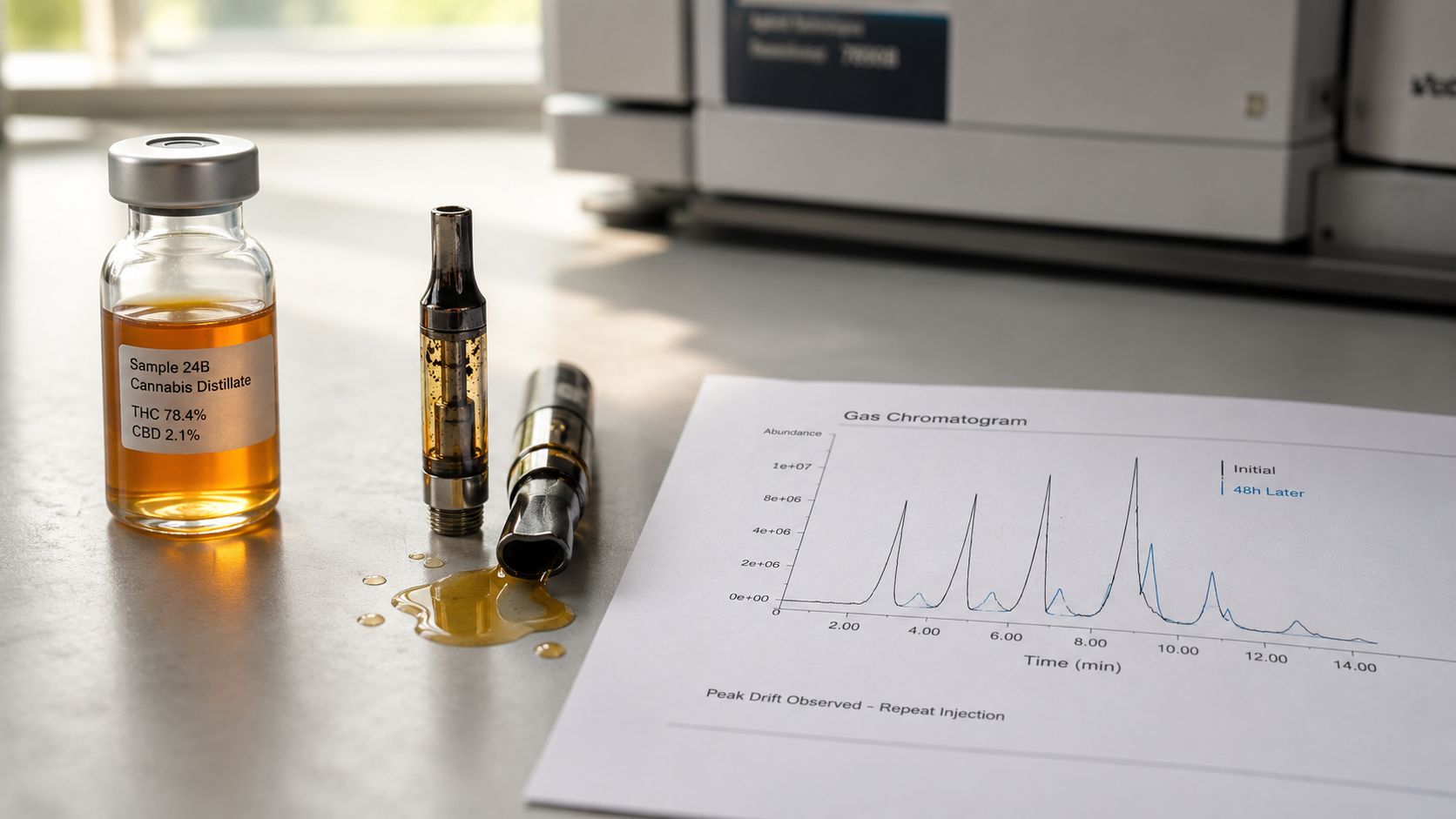
The production question isn't “does this smell good?” It's “can this profile be made the same way tomorrow, by someone else, in a different vessel, with the same result?” That's the test.
Read more about terpene behavior in cartridges
The Seven Domains of Terpene Industry Best Practices
A cartridge or distillate operation doesn't fail in one place. It fails where one control domain was assumed instead of managed. The clean way to think about industry best practices is as seven linked controls that all have to work together.
| Domain | What It Controls | Failure It Prevents |
|---|---|---|
| Strain replication | Sensory target, note structure, blend intent | “Close enough” formulas that drift from the reference |
| Analytical testing | Identity, potency, contamination signals | Blind formulation and false confidence |
| Safety | Worker exposure, storage, handling | Accidents, contamination, and avoidable downtime |
| Regulatory compliance | Documentation, labeling, traceability | Product holds, vendor rejection, audit trouble |
| Manufacturing scale-up | Vessel behavior, mixing, transfer loss | Bench success that collapses in production |
| Quality control | Acceptance criteria, deviation handling | Lot-to-lot inconsistency |
| Documentation | Version control, approval history, records | Version drift and untraceable changes |
Each domain has a different failure mode
Strain replication protects the sensory target, but it can't save a weak analytical program. Testing tells you what's in the material, but it won't compensate for sloppy documentation. Safety procedures protect people and assets, while scale-up controls protect the recipe when the process gets bigger.
The common mistake is to overinvest in one domain and ignore the others. A lab can have a beautiful GCMS library and still produce inconsistent carts if the mixing SOP changes every week. Another team can have great sensory people and still lose batches because nobody owns records, approvals, or deviation logs.
The domains have to talk to each other
A good lab doesn't treat these as separate departments. The terpene spec should feed the QC plan, the QC plan should shape the scale-up method, and the documentation system should capture every change. That's the point of a control system, each domain reinforces the next instead of operating in isolation.
In practical terms, the weakest link is usually the one that gets handled last. If the team only notices a domain after a batch fails, that domain isn't part of best practice yet. It's just a recovery cost.
Strain-Inspired Terpene Blend Design and Replication
A strong strain-inspired terpene blend starts with a sensory target, not with a shopping list of terpenes. The target can come from a retained reference, a trained-panel note sheet, or analytical reference material, but the formulator has to define what the profile is supposed to do across top, mid, and base notes before building the bench recipe. Without that structure, the blend becomes a guess with nice marketing language attached.
Build the note structure first
Top notes carry the first impression, mid notes carry the body, and base notes anchor the finish. That's not poetry, it's formulation logic. If the top note is too aggressive, the cart reads as harsh. If the base is too heavy, the profile feels flat or muddy after the first hit.
The practical move is to map the reference into a simple note ladder, then choose individual isolates that support each layer. The order of addition matters too, because lighter notes can get buried if they're introduced too early or overworked in a hot mix. For distillate carts, the working blend window is often 2 to 10% by mass, so the margin for error is real, not theoretical.
Replicate, then verify before it touches oil
A replication workflow should look disciplined:
- Identify the sensory target and define the profile.
- Source reference material or analytical data.
- Break the target into top, mid, and base notes.
- Formulate a small-batch trial with measured isolates.
- Compare the bench result against the target before scale-up.
That flow is the difference between a documented recipe and a one-off mix. The “like with like” repair principle used in municipal concrete best practice is a useful analogue here, because the closest stable match usually outperforms a creative substitution when the goal is replication repair like with like.
A profile should also be written in a way that another formulator can follow without your memory in the room. If the recipe can't be handed off cleanly, it isn't replicated. It's only personally interpreted.
Use this terpene mixing guide when building bench ratios
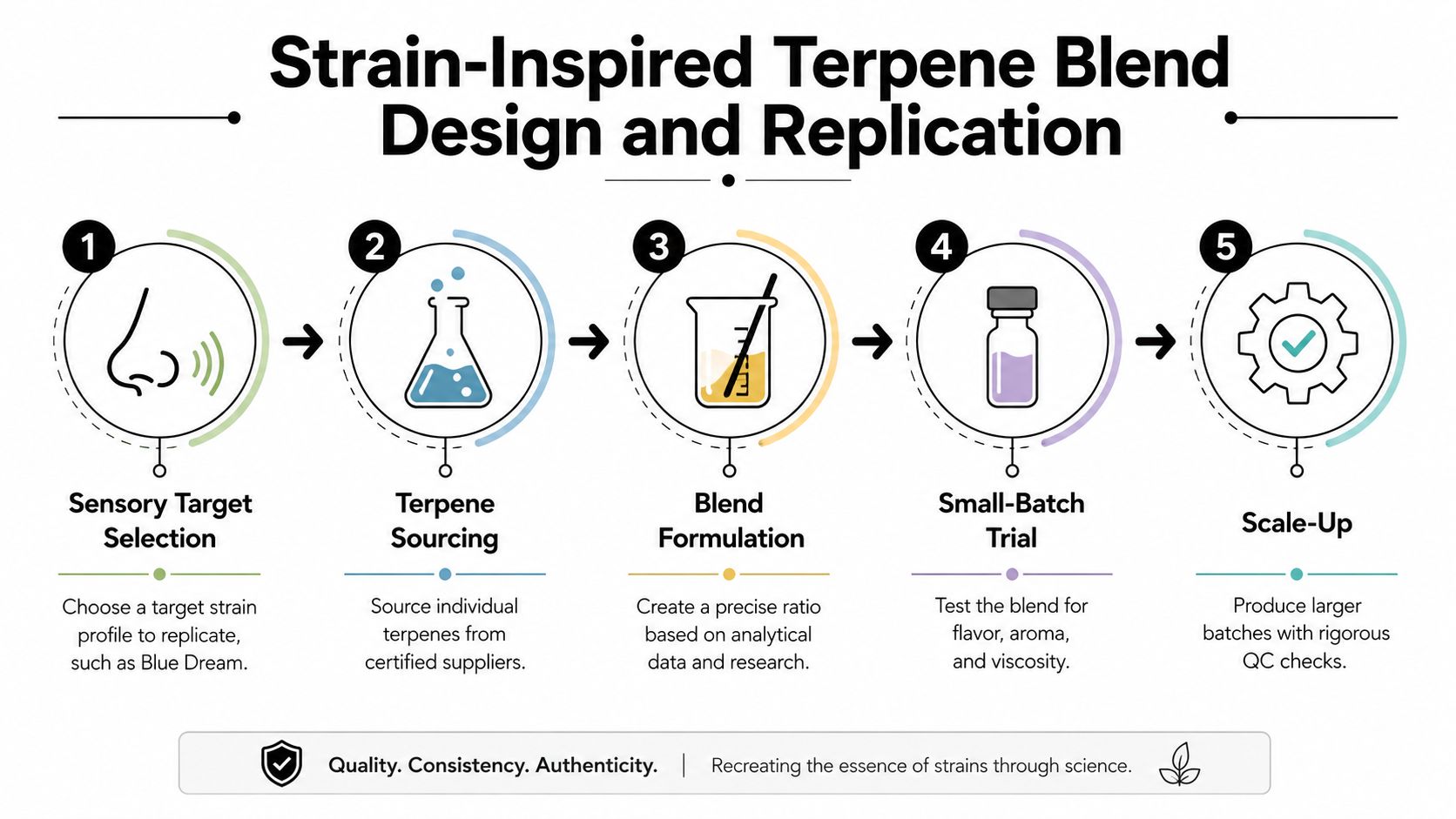
The final check is sensory, but it has to be disciplined sensory. Don't ask whether the blend is “good.” Ask whether it matches the target, holds the note structure, and can be written as a repeatable bench recipe.
Testing That Actually Drives Formulation Decisions
Testing works when it changes what the formulator does next. It fails when it just becomes a certificate in a folder. The three analytical pillars that matter most in terpene and cartridge work are GCMS or GC-FID, heavy metals screening, and residual solvent analysis, because each one answers a different production question.
GCMS tells you identity and fit
GCMS chromatograms are useful when they confirm whether the blend matches the intended profile and whether the key compounds are where they should be. They're also the fastest way to catch a mismatch between the bench target and the finished blend. If the chromatogram tells a different story than the bench notes, the recipe needs revision, not reassurance.
A vendor COA is necessary, but it's not enough. A document can say the material is compliant and still leave the formulator guessing about how it behaves in the final matrix. That's why reference standards matter, and why periodic comparison against retained standards helps keep the library honest.
The other two tests answer different risks
Heavy metals screening belongs at incoming raw-material qualification, especially where extract inputs or contact surfaces create contamination risk. Residual solvent analysis matters any time the oil feedstock or process history can carry volatile leftovers into the finished cartridge. Neither test tells you whether the flavor is right, but both tell you whether the material is safe to keep moving through the process.
A good acceptance spec should match the product format. Copying a generic sheet from another operation doesn't help if your cartridge, distillate, or concentrate behaves differently under heat or storage. The best practice is to set criteria from your own historical logs, then manage to the percentiles that reflect your actual process, not an average someone else wrote down real-time analytics benchmarking approach.
Testing rule: if the result doesn't change a mixing decision, a vendor decision, or a release decision, it's paperwork, not quality control.
See chromatography testing methods and workflow
Safety, Compliance, and Regulatory Controls in the Lab
A cartridge lab lives or dies on boring habits. Correct labels, storage rules, safety documents, and training records keep production moving when a buyer asks for proof, an auditor walks in, or a new hire reaches for the wrong bottle. Governance has to sit inside the quality system, not outside it, and the same logic applies to documentation, training, and confidentiality.
The lab has to be auditable every day
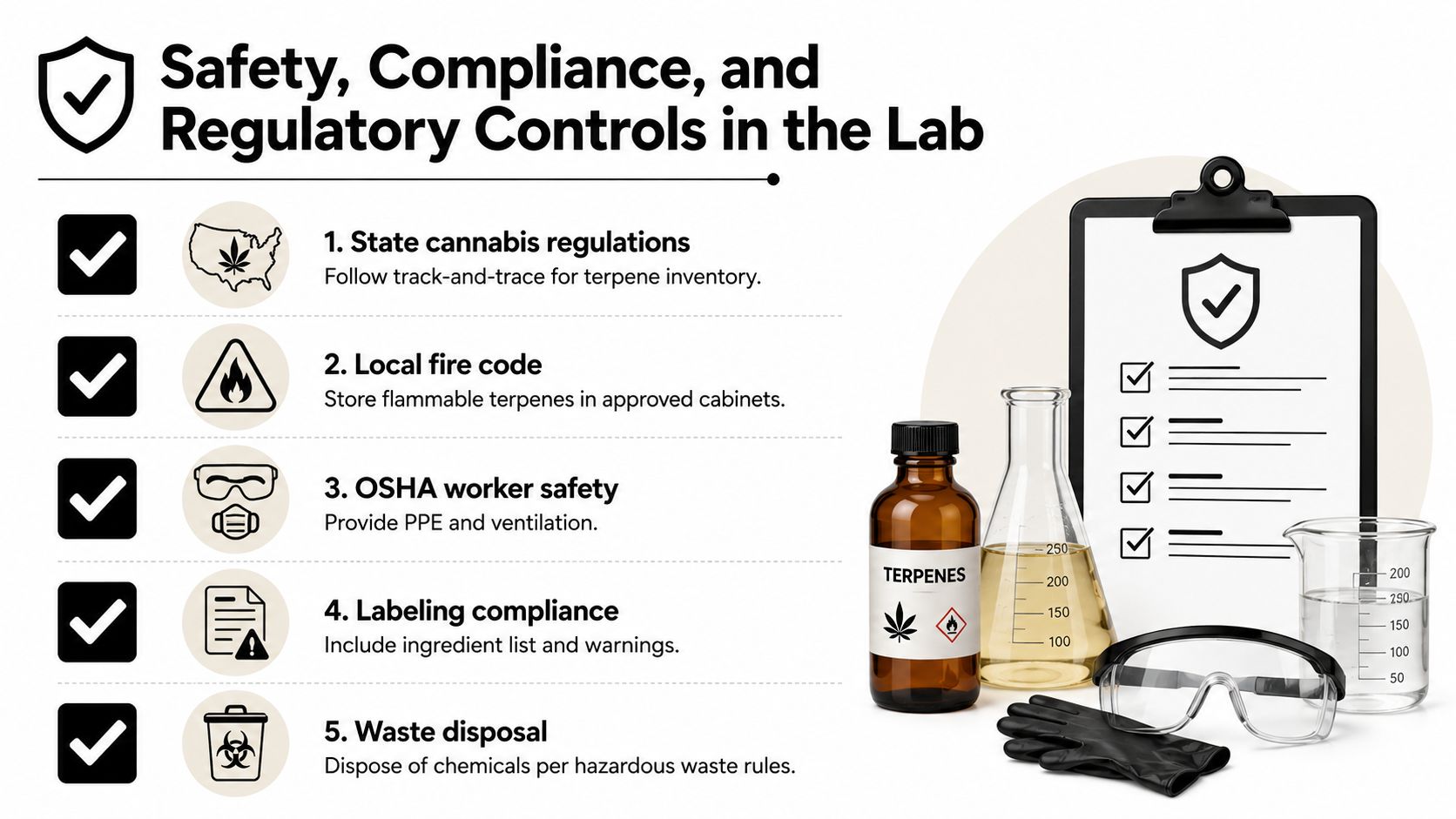
Keep an SDS on file for every isolate and input. Keep lot-traceable receipts for incoming terpene material. Segregate flavor inputs from extract storage so the inventory story stays clean. If the room handles hot plates, sonication, or volatile transfers, PPE and ventilation have to be built into the work, not added after the fact.
Documentation matters because it shows the operation knows what it is doing before anyone is forced to ask. Labeling should match the actual ingredient story, and waste handling should follow hazardous disposal rules, not convenience. That matters in operations that buy and resell across state lines or serve wholesale partners with their own vendor qualification checklists.
Training is a control, not a formality
New hires need documented instruction on handling, transfer, storage, cleanup, and deviation reporting. If the team uses different phrasing for the same process, the SOP is too loose. If the team improvises around flammables or waste, the lab is carrying hidden risk.
A room runs better when every action is legible. When a buyer or auditor asks how the lab controls flammables, traces lots, or handles waste, the answer should already be in the SOP binder and reflected in the way the room operates. The same standard should be visible in the batch ticket, the storage map, and the deviation log.
How to scale recipes without losing control
One more hard truth. If safety and compliance only show up during vendor onboarding, they are not controls yet. They are cleanup.
Scale-Up and Quality Control From Bench to Production Run
Scale-up is where good bench work gets punished. A 100 mL beaker and a 10 L mixing vessel don't behave the same way, even if the formula is identical, because temperature gradients, shear, transfer loss, headspace, and mixing time all change the final result. The recipe can be locked and still fail if the process isn't scaled with it.
The vessel changes the blend
The main mistake is assuming that time and volume scale by instinct. In real production, you need to think about volumetric efficiency, contact time with the extract, and how long the mix has to reach a uniform state at the actual fill volume. If the top notes disappear, the vessel may be holding too much heat or too much headspace. If the finished lot reads heavier than the bench sample, the transfer path or mixing order probably changed the profile.
A simple rule works better than heroics. Adjust mixing time as a function of batch volume, then validate the first production lots against the bench reference before the run is accepted. If the first lot drifts, do not call it “close enough” and hope the next one comes in.
Deviation logs keep the recipe honest
Every out-of-spec event needs a written deviation. That includes temperature excursions, unexpected color shift, transfer loss, and any lot that doesn't match the documented target. The log isn't just for paperwork, it's how the team learns what changed the product.
That's where batch-ticket thinking becomes practical. The lot should arrive with a target, the measured values, and sign-off from the person who released it. If those three things aren't attached to the run, the production line is flying blind.
Use this scale-up guide before moving a bench blend into production
Scale-up standard: do not approve the first production lot on hope. Approve it on match data, process notes, and a deviation-free run.
Putting the System Together With a Recurring Review Cadence
A lab doesn't become controlled because it wrote seven SOPs. It becomes controlled because someone reviews the right signals on a predictable schedule and acts when the signals move. Best practice is a meeting rhythm, not a binder on a shelf.
Weekly, monthly, quarterly, annual
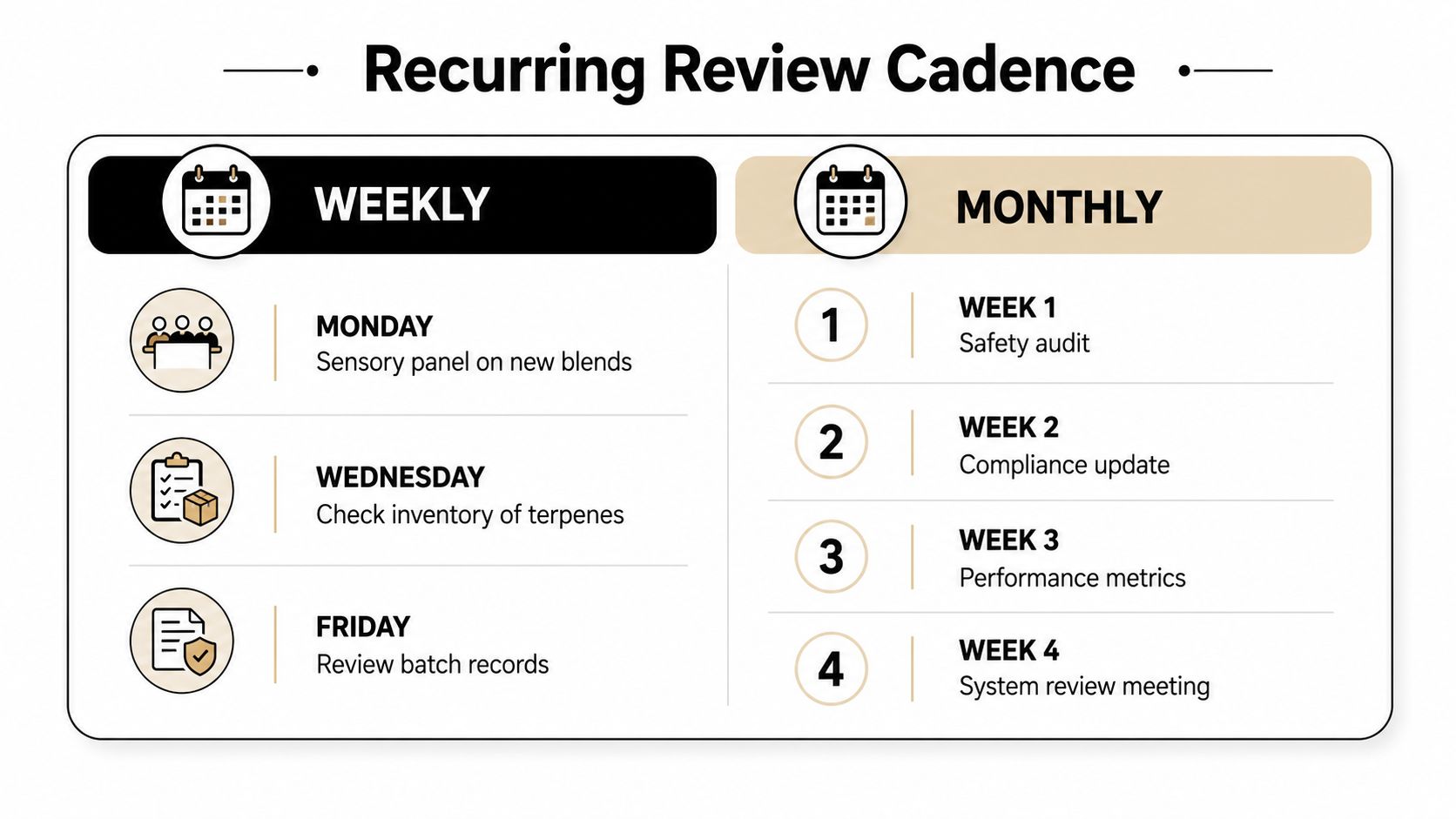
Weekly, run GCMS spot-checks on new finished batches and review inventory movement for the most active materials. Monthly, go through deviation logs, vendor issues, and the first-pass yield story for the prior period. Quarterly, audit suppliers and recheck whether your reference materials still match the market. Annually, review every SOP against current regulations, equipment capability, and the actual bottlenecks the lab has lived through.
That cadence should produce a one-page scorecard. Keep the scorecard focused on sensory drift, batch rejection, and on-time fulfillment. If the team can't explain what moved, why it moved, and what got changed in response, the review was too vague.
Match the cadence to the operation size
A small, single-line operation doesn't need the same review load as a larger white-label shop with multiple product families and turnover points. That's where the underserved-segment lesson matters, because best practice has to be adapted to the economics and workflow of the lab, not copied from a bigger player's model underserved market angle guidance.
The point is consistency, not ceremony. If reviews happen when people are already overloaded, they won't get done well. If they happen on a fixed cadence with clear owners, the lab stays ahead of drift instead of chasing it after release.
Frequently Asked Questions From Cartridge and Distillate Labs
What terpene load should a distillate cart start with? The practical working window is often 2 to 10% by mass, but viscosity is the signal you watch. If the blend gets too thin, you're probably overloading the cart. If it stays too thick or won't integrate cleanly, reduce the load or adjust the note structure.
How do I verify a vendor blend is diacetyl-free and free of VG, PG, PEG, and MCT? Ask for a current COA that explicitly names those exclusions, plus the test method used and the lot number tied to the sample. If the paperwork doesn't state the exclusions clearly, treat it as unqualified.
What does cloudiness or color shift in a finished cart mean? It usually points to compatibility, temperature, or formulation instability, not a flavor preference problem. Check storage history, fill conditions, and whether the terpene load is pushing the matrix too far before you assume the batch is bad.
How should a small lab qualify a new terpene supplier? Start with a sample review, COA verification, documentation check, and a small bench trial against your own reference. If the supplier can't support traceability and repeatability, don't move them into production, no matter how good the first sample smells.
If you're building or revising a terpene program, start with your weakest control point, not your favorite strain profile. Review your batch records, tighten your acceptance criteria, and compare your current vendor documentation against the standards that matter in production. Then reach out to Gold Coast Terpenes to evaluate strain-specific profiles, isolated compounds, and formulation support for cartridges and distillate workflows.