
You already know the hard part isn't naming a cart after a popular cultivar. The hard part is getting the same aromatic read in every batch, across different oil bases, hardware, and production runs. That problem gets sharper with the Pink Rose strain, also sold or discussed as Pink Rozay, because public descriptions sound consistent while the underlying lab snapshots often don't.
For a formulator, Pink Rose only matters if you can turn it into a repeatable sensory target. That means separating romance-language descriptors like fruit, floral, dessert, and rosé from the terpene architecture that survives blending and vaporization. If the profile can't be standardized, it can't be scaled.
Deconstructing the Pink Rose Sensory Objective

Pink Rose isn't useful to a vape developer as a strain story. It's useful as a sensory brief. Public market data places Pink Rozay as an indica-dominant hybrid at 80% indica and 20% sativa, bred from Lemonchello 10 and LPC75 (London Pound Cake), with 20% to 29% THC by weight in U.S. legal markets, 24% to 32% total cannabinoids including minor constituents, and CBD below 0.5% according to Joint Commerce's Pink Rozay strain guide.
Those genetics matter because they explain why Pink Rose keeps getting described with both bright and dessert-like language. Lemonchello 10 pushes the profile toward lifted citrus and fruit. LPC75 contributes the denser pastry, sweetness, and body that stop the aroma from reading thin or one-dimensional.
What the commercial target actually is
In the lab, the target isn't “make it smell like good flower.” That's too loose. The target is tighter:
- Lead with brightness so the first draw opens with sparkle rather than heavy sweetness.
- Hold a floral center that reads polished, not perfumed.
- Anchor the finish with enough warmth to keep the profile from turning candy-like.
That's the difference between strain-inspired branding and real terpene profile for vape cartridges work. A good Pink Rose-inspired profile has to feel effervescent on the front end, rounded in the middle, and dry enough on the finish that repeated hits don't become cloying.
Practical rule: If the blend opens sweet before it opens bright, you've already drifted away from the Pink Rose objective.
Why flower descriptors alone fail in formulation
Descriptors such as berry, rosé, floral, and fruit punch can guide evaluation, but they can't guide production by themselves. They don't tell you which compounds should dominate, what belongs in the middle of the blend, or how much warmth the base needs to carry the top note through atomization.
That's why I treat Pink Rose as an aroma architecture problem first. The flower description supplies the destination. The formulator still needs a map.
A strong palate helps, but it has to connect back to measurable inputs. If you need a sharper vocabulary for evaluating aroma structure before building a Pink Rose strain-inspired terpene blend, Terpene Tasting 101 and developing your palate for cannabis flavors is the right kind of foundational reference.
The Pink Rose Terpene Profile Blueprint
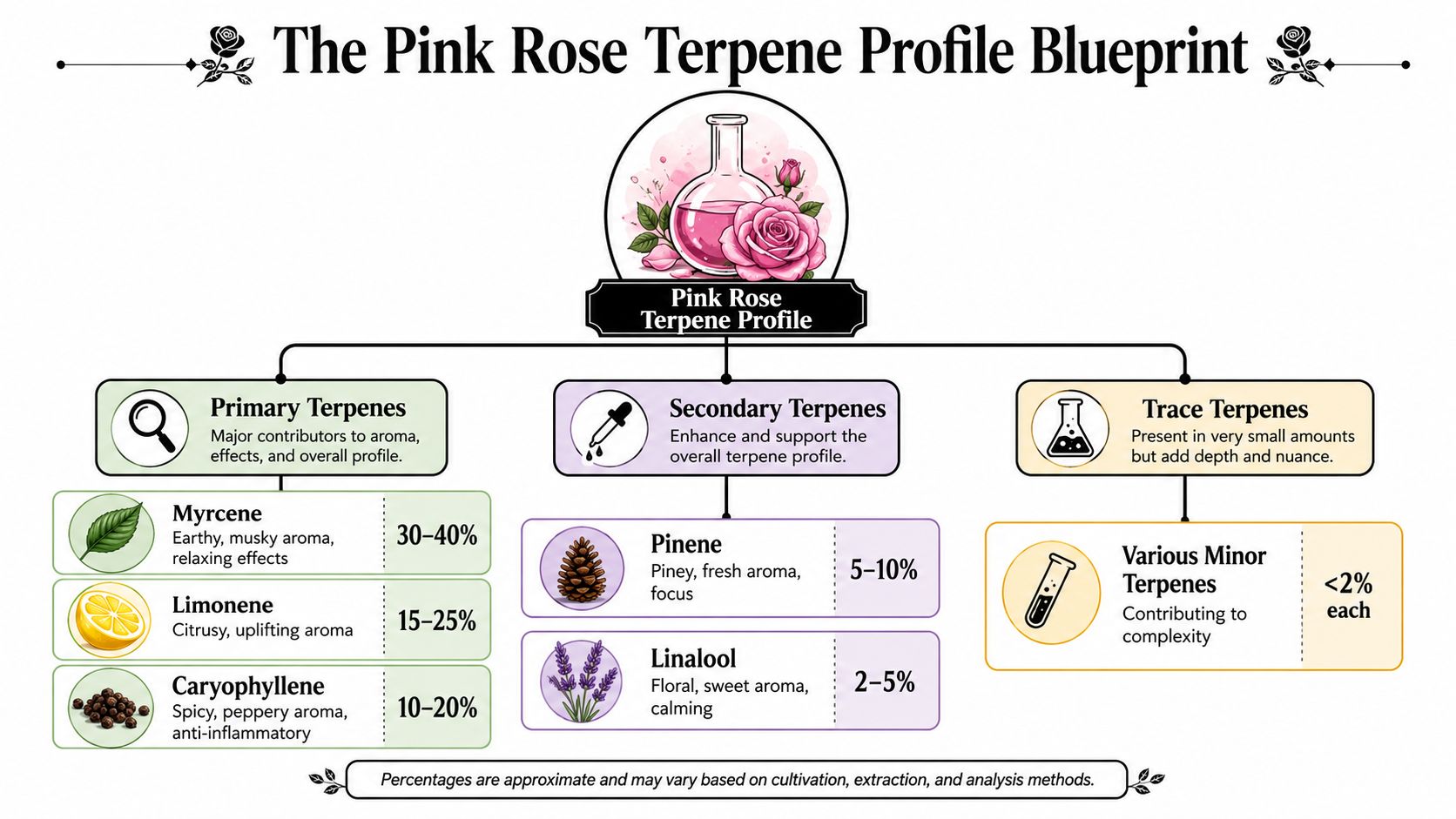
A common production problem looks like this: the flower reference tastes bright and rosé-like in one lot, then the next public description pushes it toward candy, floral soap, or generic berry. That kind of inconsistency is normal in strain media. It is not acceptable in a commercial vape formula. To make Pink Rose reproducible, the profile has to be reduced to a stable terpene hierarchy that survives dilution, heating, and repeated batches.
For replicating flavor of Pink Rozay for vape cartridges, I would treat three terpenes as the fixed core. Limonene leads. Beta-caryophyllene provides frame and persistence. Linalool supplies the floral polish that keeps the profile in rosé territory instead of plain citrus fruit. A public strain reference from Joint Commerce's Pink Rozay strain guide aligns with that general order of dominance, which is the useful part for formulation.
Pink Rose terpene profile reference
| Terpene | Role | Typical Range (%) |
|---|---|---|
| Limonene | Primary top note | 0.4–0.9 |
| Beta-caryophyllene | Primary structural mid-to-base support | 0.3–0.7 |
| Linalool | Primary floral softener | 0.1–0.3 |
Those numbers are a starting window, not a finished formula. In distillate, limonene can smell louder in the bottle than it presents on vapor. Linalool can feel understated at mix and then bloom after a steep. Caryophyllene often decides whether the profile holds together after the third or fourth pull.
That is why the hierarchy matters more than any single public description. If limonene and linalool trade places, the blend turns cosmetic. If caryophyllene falls too low, the finish drops out and the profile reads thin.
Secondary support compounds
The core trio gets you the signature. Secondary terpenes determine whether the signature feels natural or assembled from isolates.
Humulene is useful here because it trims sweetness and gives the finish a drier edge. Myrcene is riskier. A small amount can add fruit weight and help the middle feel less hollow, but too much pushes the blend toward jammy, heavy, and less sparkling. Pink Rose usually performs better with restrained myrcene than with aggressive myrcene.
I document the profile in a way the bench team can execute without interpretation drift. Use a note like this: limonene-led, caryophyllene-supported, linalool-softened, with humulene for dryness and myrcene capped below the point where the fruit turns dense. That language is more useful than broad tags like fruity floral because it tells production what to protect and what to limit.
For teams building a repeatable library of strain-style formulas, how terpene strain profiles define cannabis strains in a detailed breakdown is a solid reference for turning sensory targets into a spec sheet.
Mapping Terpenes to Aromatic Notes
A blend becomes more stable when you stop thinking in ingredient names and start thinking in note placement. Pink Rose works best when each major terpene has a clear job in the aroma stack.
Top note behavior
Limonene is the first impression. In Pink Rose, it shouldn't read like plain citrus cleaner or generic lemon candy. It needs to carry the “sparkling” part of the profile. That means bright, lifted, and slightly juicy.
When limonene is set correctly, the first draw feels active and polished. When it's pushed too far, the blend becomes loud and narrow. It smells attractive in the bottle, then loses sophistication once heated.
Mid note behavior
Linalool handles the floral body. Many Pink Rose attempts commonly fail at this juncture. Formulators either underuse it and lose the rose-petal identity, or they overemphasize it and turn the profile cosmetic.
The floral center should read as part of the fruit accord, not a separate perfume layer. That's what gives Pink Rose its rosé-like character instead of a simple citrus dessert profile.
Bench note: If your floral note appears late and abruptly, the middle is underbuilt. If it sits on top of the citrus from the start, it's probably overbuilt.
Base note behavior
Beta-caryophyllene is the ballast. It gives the profile a warm, lightly spicy base and keeps the blend from evaporating into a fleeting top-heavy aroma. In cartridges, that matters because the base note often determines whether the profile still feels coherent halfway through the hardware.
A good Pink Rose finish shouldn't taste woody in an obvious way. It should taste settled. Caryophyllene creates that settled effect.
The full aromatic stack
Here's the simplest way to think about formulating the Pink Rose strain for cannabis product formulation:
Top note
- Limonene: brightness, citrus-fruit lift, opening volatility
Middle note
- Linalool: floral softness, rosy body, bridge between fruit and warmth
Base note
- Beta-caryophyllene: peppered warmth, persistence, structural depth
Supporting material then adjusts texture. Humulene can dry the finish. Myrcene can broaden fruit body. Both should stay subordinate to the main stack.
For teams training sensory evaluators, a terpene flavor map speeds up alignment between bench staff and brand managers. This terpene flavor chart is useful because it helps people describe what they're smelling instead of defaulting to vague terms like smooth or premium.
Formulation Guide for a Pink Rose Terpene Blend
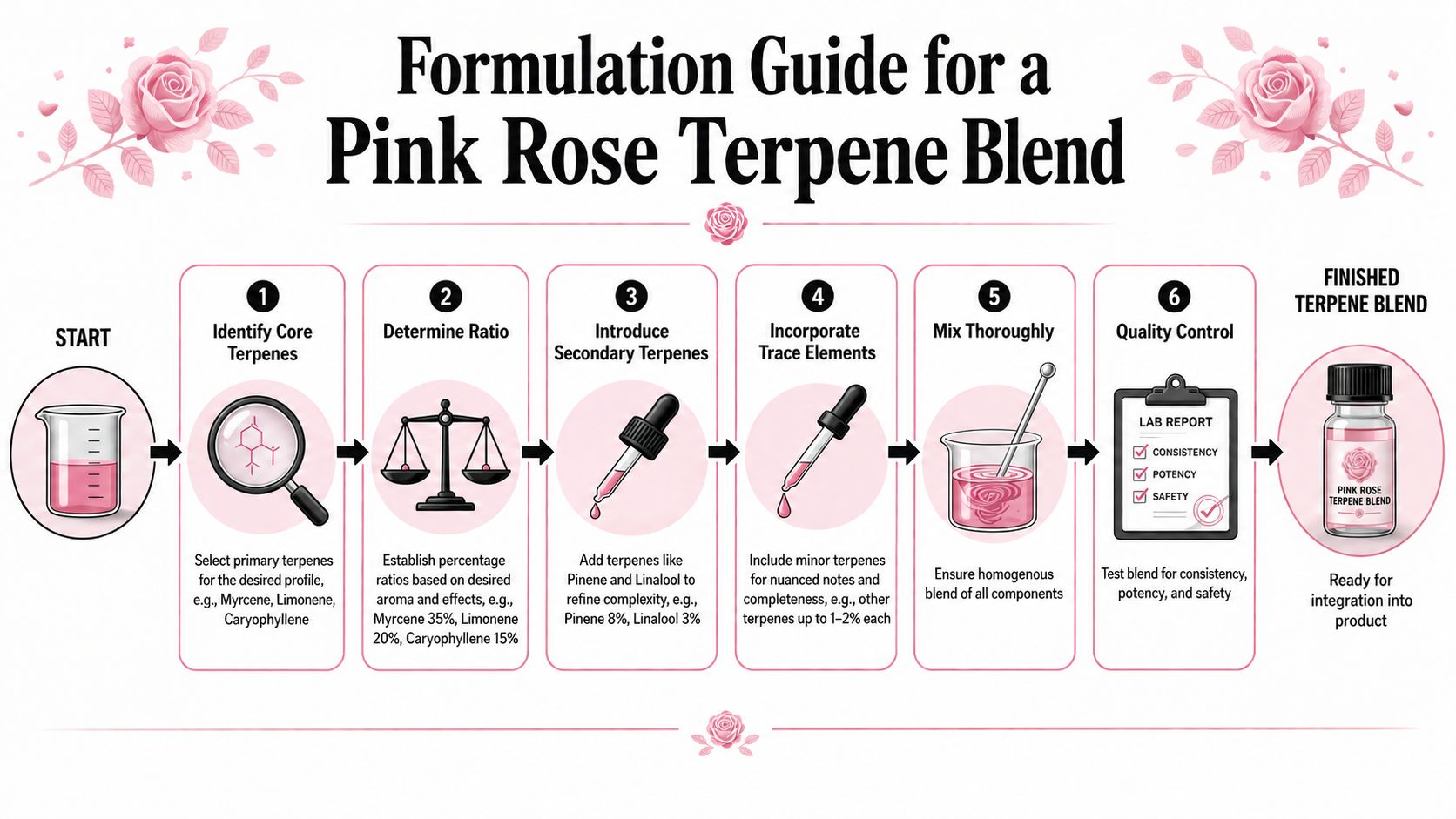
When I build a Pink Rose strain-inspired terpene blend for distillate, I don't start with every possible supporting compound. I start with the core accord and force it to work on its own. If the core doesn't work, extra ingredients won't fix it. They'll only make the failure harder to diagnose.
A practical starter build is a 4:3:1 ratio of limonene to beta-caryophyllene to linalool. That ratio isn't a claim about the flower's full natural composition. It's a useful bench starting point for recreating the sensory relationship among the main notes in a commercial vape blend.
Starter bench workflow
Build the core accord first
Combine limonene, beta-caryophyllene, and linalool at the starter ratio. Evaluate it alone before adding any secondary terpenes.Smell cold, then warm
A blend that smells perfect at room temperature can collapse under heat. Pink Rose should keep its brightness after warming, while the floral center remains integrated.Adjust one variable at a time
If the opening is too sharp, don't immediately add more floral material. First check whether caryophyllene is too low. The wrong base often gets mistaken for missing mid notes.
What to add carefully
Once the core accord is stable, supporting terpenes can refine the profile.
- A trace of myrcene can give the fruit portion more width.
- A small humulene addition can make the finish drier and more realistic.
- Restraint matters because both can pull the profile away from the bright-floral identity that makes Pink Rose recognizable.
“Build the first version until it's recognizable. Build the second until it's believable.”
What usually doesn't work
Some choices consistently push the blend off target:
- Over-sweet interpretation: If you chase candy or frosting notes too early, the profile stops reading as Pink Rose and starts reading as generic dessert.
- Excess floral loading: Too much linalool turns a rose nuance into a soap problem.
- Weak structural base: A limonene-heavy blend without enough caryophyllene may smell attractive for a moment, then disappear in the cart.
Documentation matters here. Record your version numbers, isolate lots, sensory comments, and heating observations for every bench sample. Without that discipline, teams end up rebuilding the same failed Pink Rose concept every quarter.
If your team needs practical handling guidance while moving from isolates to finished blends, how to use terpenes is a solid operational reference.
Blending with Distillate and Other Bases
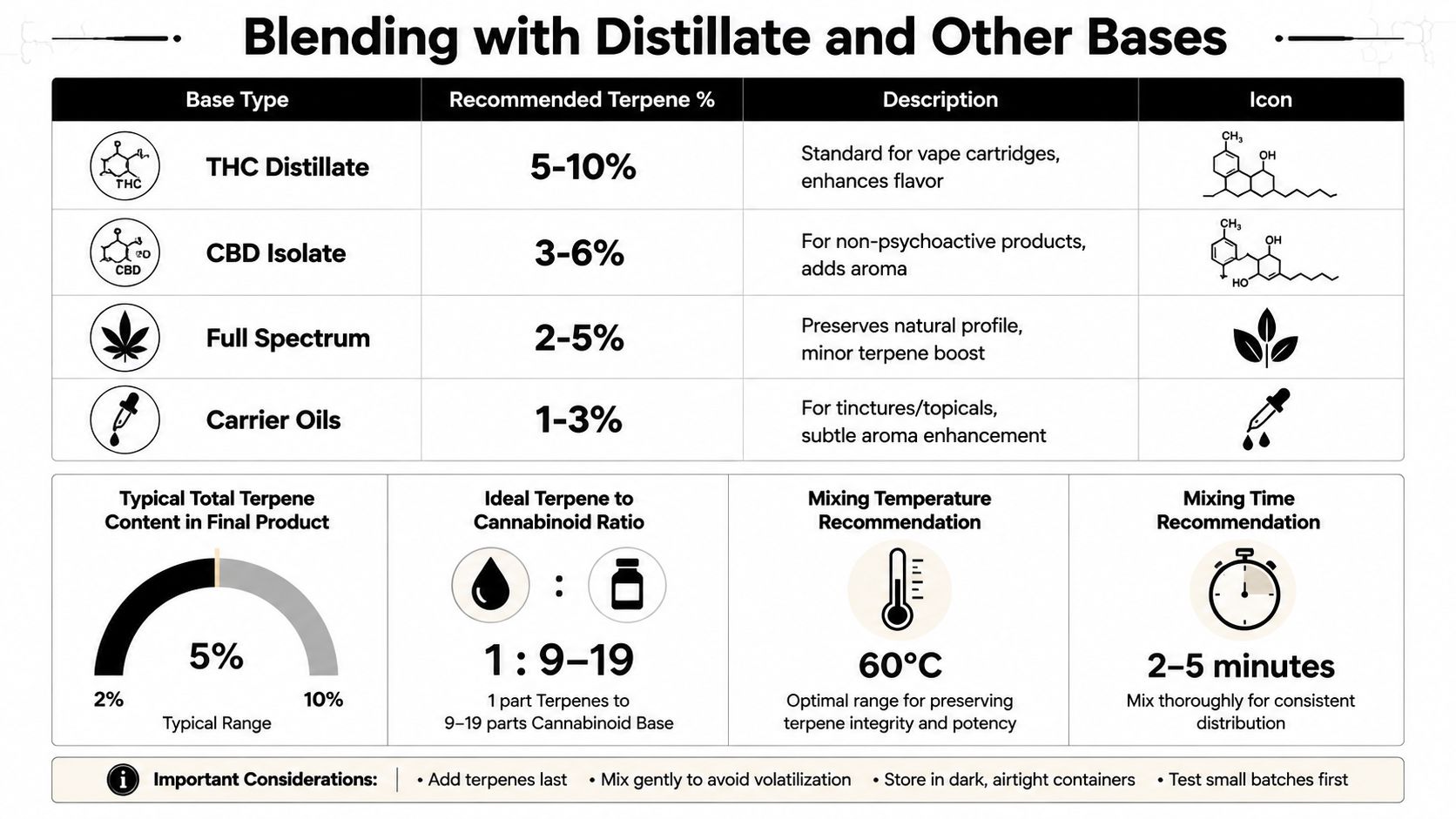
A bench sample smells right at room temperature, then the first cartridge run comes off brighter, drier, and less floral than the retained vial. That is a base problem until proven otherwise.
Pink Rose is one of those profiles that exposes matrix effects fast. The sensory target may be stable on paper, but distillate polarity, minor cannabinoid content, and hardware temperature curve all change how the same terpene formula presents. Public flower data, as noted earlier, points to a recurring hierarchy built around caryophyllene and limonene with supporting humulene, myrcene, and linalool. For formulation work, that hierarchy matters more than any single published strain description because it gives you a structure to preserve as the oil changes.
Why the base matters
Highly refined distillate usually throws the top note forward. In Pink Rose, that often makes the opening feel more citrus-led and less rosy than the bench accord suggested. Broader-spectrum bases can do the opposite. They add body, but they also crowd the floral center and make the finish read heavier.
I treat base selection as part of the formula, not a later production variable.
The same terpene blend will not give the same sensory result in every oil. If the goal is a standardized commercial SKU, the job is not to find one "perfect" Pink Rose blend. The job is to set a repeatable target and then tune the blend for each matrix so the finished cart lands in the same sensory window.
Practical trade-offs during blending
- Neutral THC distillate gives the clearest read on the terpene system, but it can expose sharp limonene and make the profile feel hollow if the mid note support is thin.
- CBD or minor-rich bases often add weight and persistence, though they can suppress the delicate floral lift that keeps Pink Rose from reading woody or generic.
- Fuller-spectrum oils may improve realism, but they reduce control. Native volatiles and darker base notes can shift the formula away from the reference target.
- Hardware output changes perception again. A hotter atomizer can burn off the floral top and exaggerate spice on the finish.
How to make the profile replicate across bases
Start by locking the terpene concentrate in a neutral evaluation medium. Then test that same blend at production dose in each intended base, using the actual hardware and a fixed preheat and puff protocol. Compare all samples against one retained reference, not against memory.
If the cart reads too bright, do not rewrite the whole formula on the first pass. Check whether the base is exposing limonene too aggressively. If the profile feels muddy, check whether the oil is muting floral lift or extending the heavier sesquiterpene finish. Small ratio corrections usually solve the problem faster than rebuilding the accord from scratch.
Production check: Approve Pink Rose only after it is evaluated in finished oil, in final hardware, at operating temperature.
That step saves time in scale-up. A blend that wins in the vial but drifts in the cartridge is not production-ready, no matter how good the bench aroma seems.
Quality Control and Testing for Flavor Accuracy
A lot of teams assume terpene sourcing is interchangeable if the labels list the same compounds. That assumption breaks fast with Pink Rose. Public strain content often treats it as a uniform cultivar, but available batch data shows the opposite. According to 420VL's analysis of Pink Rose profile inconsistency, lab-tested samples span 16% to 28% THC and terpene expression shifts between myrcene-dominant samples and limonene/caryophyllene-dominant samples.
That variability is exactly why a commercial formulator can't rely on generic “Pink Rose” descriptions. The name alone doesn't guarantee the aromatic structure you need for carts or distillate products.
What to verify from suppliers
Ask for batch-specific documentation and review it every time. The terpene source matters as much as the formula.
- Identity confirmation helps ensure the named isolate or blend matches what your formulation sheet expects.
- Batch consistency records tell you whether the sensory profile is likely to drift between production runs.
- Transparent COAs make troubleshooting possible when the finished product suddenly tastes sharper, flatter, or less floral than the retained sample.
How to test the finished product
A competent QC workflow for Pink Rose includes both analytical testing and sensory review. One without the other leaves blind spots.
Use a small retained sample library. Compare the current lot against your approved reference under the same conditions, in the same hardware, after the same resting period. Keep evaluator comments structured around opening note, floral body, warmth, finish, and persistence.
The most expensive flavor problem is the one your team notices only after the product is filled, packaged, and shipped.
Failure modes worth catching early
A few problems come up repeatedly in strain-inspired vape development:
| Failure mode | What it usually means |
|---|---|
| Bright but hollow | Top note is carrying the blend without enough structural support |
| Floral but soapy | Mid note is too exposed or poorly integrated |
| Warm but dull | Base is overpowering the opening and muting the target identity |
Pink Rose is a good test of process discipline because the profile sounds easy in marketing language and behaves with more difficulty on the bench. Teams that treat QC as a release gate instead of an afterthought get much closer to true repeatability.
Perfecting and Scaling Your Pink Rose Formulation
The most reliable Pink Rose formulations don't start from a strain myth. They start from a controlled sensory target. That target is a bright-fruit opening, a restrained floral heart, and a warm finish that keeps the profile stable in vapor form.
For commercial work, the key move is standardization. Build around the primary trio already established earlier. Keep limonene in front, let beta-caryophyllene provide the frame, and use linalool to shape the rose-like body without letting it dominate. Then tune the edges with supporting material only when the core accord already feels right.
A repeatable development sequence
- Define the target clearly so everyone on the team evaluates the same profile, not their own mental version of “pink” or “rose.”
- Build the core first using the dominant terpene relationship before introducing support compounds.
- Evaluate in the final matrix because a bench blend and a finished cartridge never behave exactly the same.
- Lock down QC inputs so the approved profile can survive scale-up and reorder cycles.
Scaling also means knowing what not to change. If a blend is drifting in production, don't adjust three variables at once. Check source materials, matrix interaction, and sensory reference order before changing the accord itself.
A disciplined Pink Rose formulation guide for cannabis product formulation should end with one standard inside the organization: if the profile can't be reproduced, it isn't finished.
Gold Coast Terpenes supports formulators who need repeatable strain-inspired profiles, individual isolates, and practical tools for carts, concentrates, and new product development. If you're refining a Pink Rose-style blend for vape cartridges or distillate, explore Gold Coast Terpenes for strain profiles, isolate options, and formulation resources that help turn a recognizable aroma target into a consistent production formula.