
Most advice on terpenes to avoid for anxiety is too blunt to help a formulator. A blacklist can keep obvious problems out of a blend, but it won't tell you why one cartridge feels calm and grounded while another turns sharp, restless, or mentally noisy. In product development, that difference usually comes from concentration, note balance, and the cannabinoid frame underneath the terpene layer.
That's why a workable terpene profile for vape cartridges can't be built from a simple good-versus-bad list. Some compounds deserve firm exclusion in calming SKUs. Others only become problematic when a blender pushes them too high, lets them dominate the top note, or drops them into a high-THC base with no buffering. If you're formulating for a relaxation-oriented effect, the job isn't just removing stimulating aromatics. It's controlling how the whole system lands.
Beyond Blacklists A Nuanced Approach to Terpene Formulation
A lot of formulators inherit bad habits from consumer-facing content. The usual pattern is familiar: terpinolene is bad, limonene is risky, pinene is activating, so remove them all and call the job done. That approach might reduce complaints, but it also strips out useful aromatic tools and usually produces flat, muddy blends with weak strain resemblance.
In practice, terpenes to avoid for anxiety fall into two different buckets. The first bucket contains compounds that consistently work against a calming target. The second contains compounds that become a problem when their concentration, context, or pairing is wrong. Those aren't the same formulation problem, and they shouldn't be treated the same way.
Why formulators need a concentration mindset
A terpene blend isn't only an effect layer. It's also a sensory structure. Top notes shape first impact, mid notes organize the body of the profile, and base notes determine persistence and weight. If a blend opens too brightly, too thinly, or too aggressively, users often describe the effect as stimulating even before the cannabinoid system fully expresses itself.
That's one reason simplistic avoidance lists fail. They ignore how a bright terpene behaves at trace level versus dominant level, and they ignore how one volatile note can pull the entire profile toward perceived intensity.
Practical rule: Formulate for response, not ingredient reputation. A terpene can be useful in a trace role and disruptive as a lead note.
For teams building a strain-inspired terpene blend for distillate, chemistry and perception have to align. The best calming formulas usually smell coherent, not exciting. They don't spike upward on the first inhale. They settle, round out, and leave room for the cannabinoid base to do its job. That broader neuroactive context is worth understanding, especially when looking at how terpenes affect the brain.
What actually works in formulation
A better development process starts with three questions:
- What must be excluded: Some terpenes consistently clash with a calming design target.
- What must be constrained: Some terpenes are manageable only within tight ranges.
- What must anchor the blend: Base-note terpenes and cannabinoid ratios determine whether the profile stays stable and usable.
That framework gives you a cleaner path for formulating for cannabis product formulation work than a generic blacklist ever will.
The Primary Terpenes to Exclude from Calming Formulations
When the target is a calming profile, two compounds deserve much more scrutiny than the rest: guaiol and terpinolene. These aren't just terpenes with mixed reputations. They have the strongest documented fit with poor anxiety-relief outcomes in the source set available here.
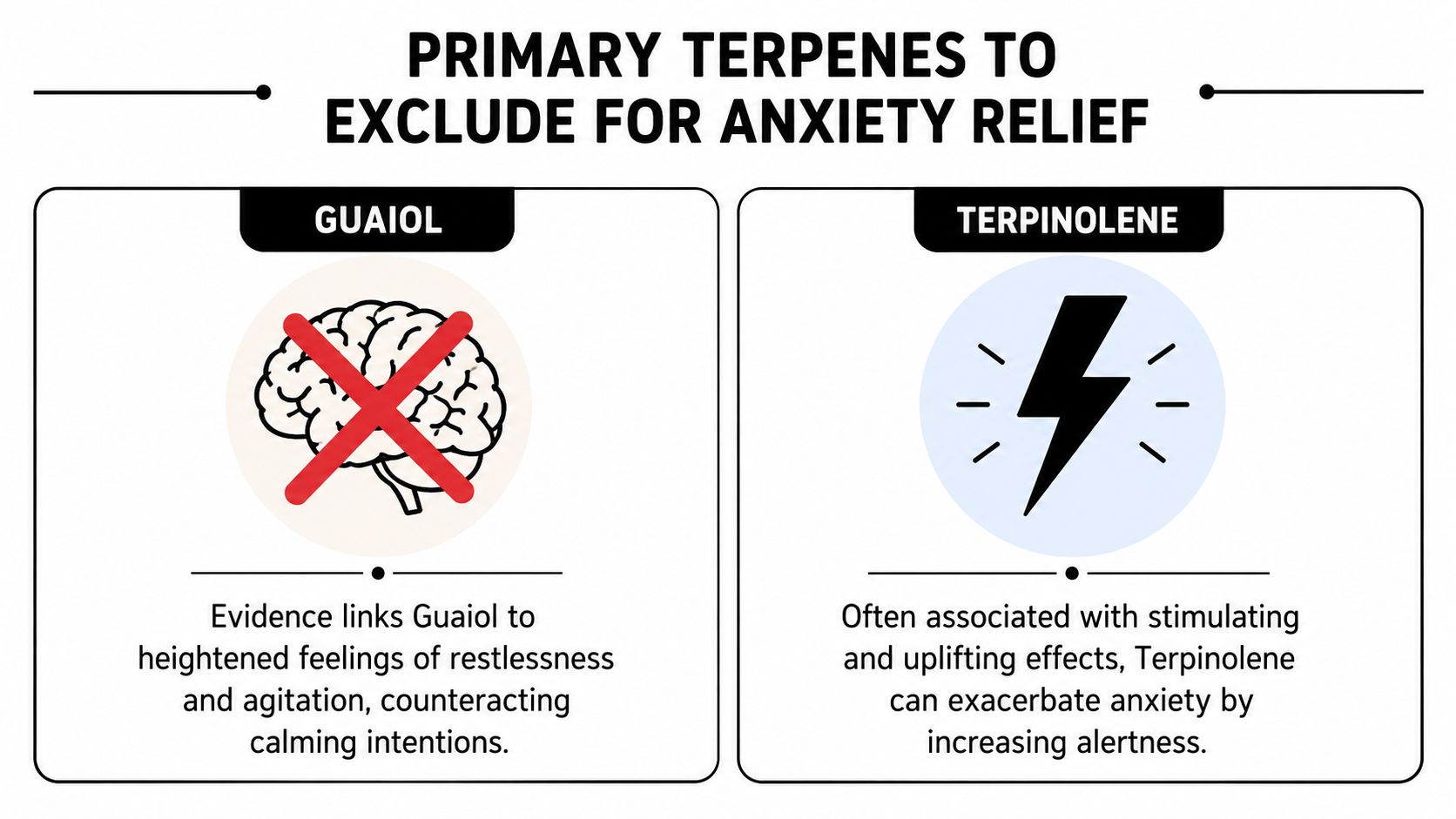
According to a 2018 systems analysis of cannabis chemotypes, guaiol demonstrated a perfect negative correlation with anxiety reduction, appearing in three of the four lowest-rated strains for anxiety relief. Terpinolene was identified as the second worst terpene signal for anxiety relief in this same landmark study, establishing them as the two most reliably documented terpenes to avoid for anxiety management.
Guaiol and why it conflicts with calming design
Guaiol sometimes gets overlooked because it isn't as widely discussed in mainstream terpene content as limonene or pinene. From a formulation standpoint, that's a mistake. If a terpene repeatedly clusters with poor calming outcomes, it shouldn't be treated as a neutral background component in a relaxation SKU.
For a blender, the implication is simple. Don't let guaiol sneak into a calming profile just because it appears in a strain replication target. If the product brief prioritizes a grounded and anxiety-conscious response over strict one-to-one strain mimicry, guaiol is an easy candidate for removal or aggressive minimization.
Terpinolene and stimulation risk
Terpinolene presents a different kind of problem. It tends to push a profile upward. That can be useful in energizing or daytime concepts, but it usually works against products meant to feel settled, soft, and controlled.
A separate source describes terpinolene as a terpene with a documented anxiogenic correlation and notes that high concentrations above 0.5% by dry weight correlate with increased self-reported jitteriness and paranoia in susceptible users, particularly in high-THC contexts without sufficient CBD buffering, as outlined in this discussion of terpenes to avoid for anxiety reduction. For a professional formulator, the exact mechanism matters less than the repeated pattern: terpinolene tends to sharpen the profile and increase physiological arousal.
Don't judge terpinolene by aroma alone. A pleasant fresh note can still drive the wrong effect direction.
Exclusion criteria for calming SKUs
Use stricter standards when a product is marketed around relaxation, decompression, or evening use:
- Remove guaiol first: It carries the clearest negative signal for anxiety-oriented outcomes in the verified data.
- Treat terpinolene as a red flag: If it's dominant or even strongly supportive, the blend usually moves away from calm.
- Override strict strain loyalty when needed: A precise replication that creates an agitated user experience is a bad commercial formulation.
If your team needs more mechanism-level context for screening ingredients in this category, the best companion reference is this guide on how specific terpenes work on pain inflammation anxiety.
Dose-Dependent Terpenes The Risk of Over-Concentration
The most common formulation error after outright terpene exclusion is over-correction. Teams read a warning about limonene, pinene, or ocimene and decide those materials don't belong in any calming formula. That's too simplistic, and it usually harms flavor accuracy.
Some terpenes aren't wrong on their own for a calming build. They're wrong when they become too loud.
Limonene and pinene need restraint, not panic
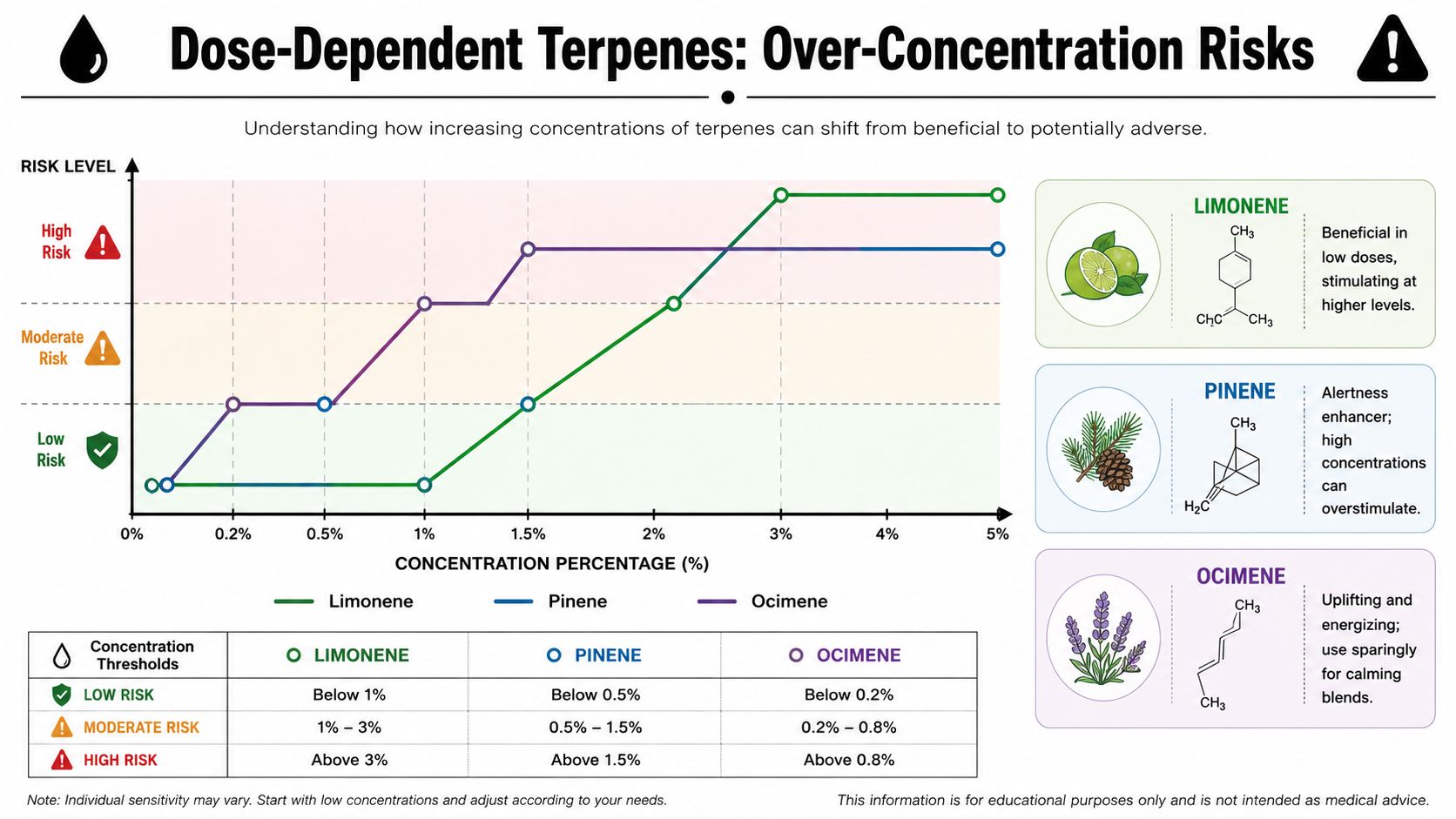
The most useful verified point here comes from a source focused on concentration nuance. It states that clinical and user data reveal that limonene has strong human clinical evidence for buffering stress at moderate levels, yet becomes overstimulating in concentrated doses. Similarly, pinene supports alertness and relaxation in small amounts but causes discomfort in high doses.
That distinction matters in every formulation guide for vape cartridges. Limonene can brighten a dull blend and keep floral or earthy systems from feeling stagnant. Pinene can add lift and definition. But when either one dominates the opening, the user often reads the experience as tension rather than clarity.
Think in note placement
The practical question isn't whether you use these terpenes. It's where you place them.
A clean way to evaluate them:
| Terpene | Best role in calming blends | Main risk when overused |
|---|---|---|
| Limonene | Trace to light top note | Jittery, overly bright opening |
| Pinene | Minor accent for lift | Racing, narrow, high-alert feel |
| Ocimene | Very limited supporting top note | Energetic edge that breaks calm continuity |
The image above includes concentration bands for limonene, pinene, and ocimene. Use it as a visual cue, but rely on bench testing and sensory review to decide whether the top note still reads composed once the blend hits the actual oil.
Bench advice: Evaluate the terpene blend in the finished matrix, not just in a smelling strip or bottle. Distillate changes how “bright” terpenes present.
How to manage over-concentration in development
When a calming profile feels too active, the issue is often structural rather than binary. Before removing a terpene entirely, check these points:
Reduce top-note dominance
If limonene or pinene hits first and hardest, pull them back before changing the rest of the blend.Add weight underneath
A volatile top note can feel much calmer when supported by fuller mid and base components.Re-test in the actual use format
A profile that seems balanced in concentrate may present differently for vape cartridges because heat and delivery shift perception.Use a blending tool instead of guessing
For repeated production work, a ratio tool helps teams hold consistency. This mixing ratios calculator is useful when adjusting a top-heavy profile in small iterations.
This is the essential difference between list-based advice and a technical process. You're not just avoiding terpenes. You're controlling expression.
Formulating an Anxiety-Friendly Terpene Blend for Distillate
Once the obvious exclusions are handled and the stimulating top notes are under control, the blend needs a stable center. That center usually comes from heavier, softer, and more harmonizing materials. For most calming designs, that means building around linalool, myrcene, and a restrained support layer that doesn't pull the profile upward.
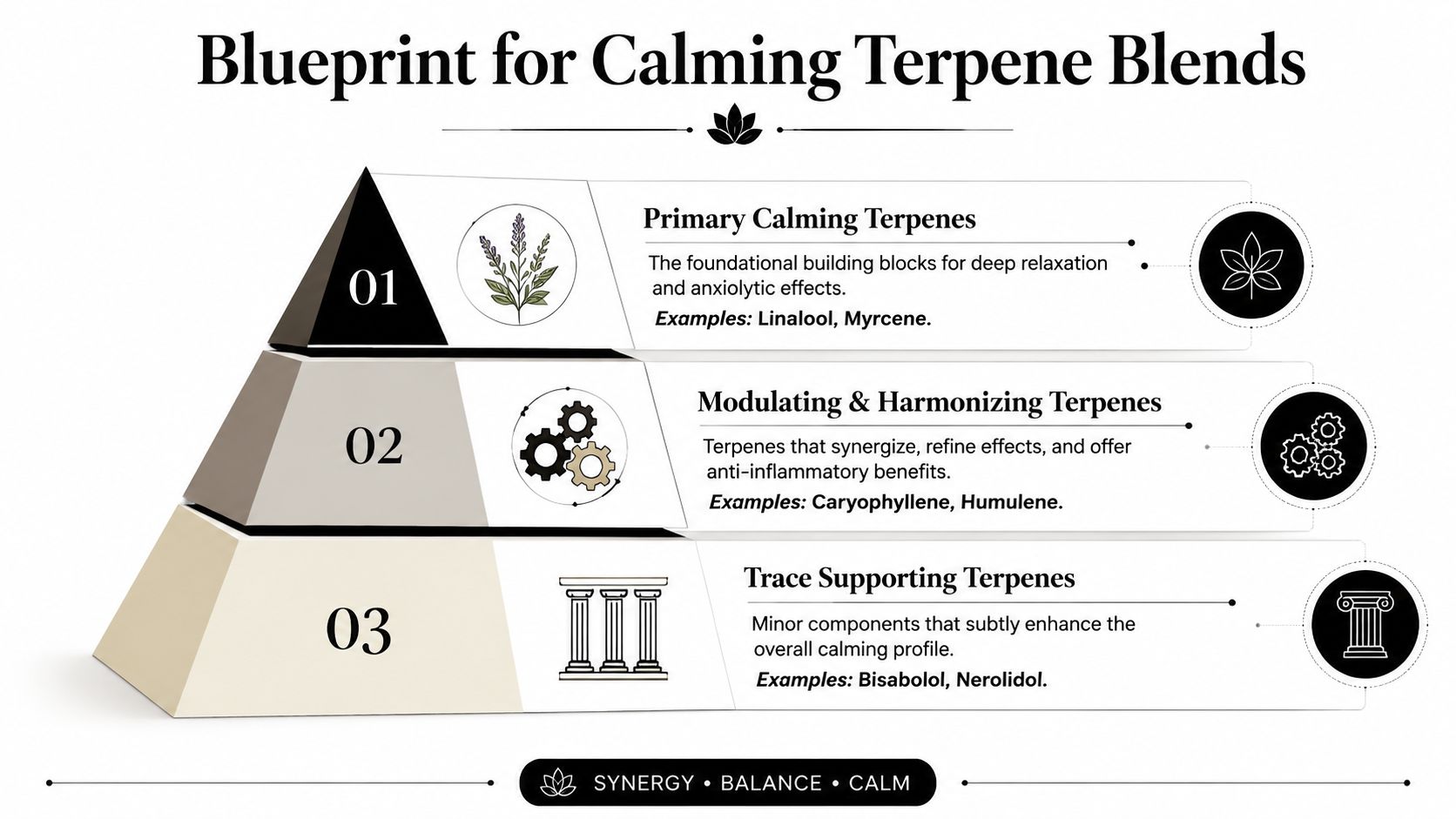
A practical benchmark exists for terpene profile for vape cartridges work. According to this reference on terpene chemistry for effective anxiety reduction, the optimal profile requires Linalool between 0.3% and 0.5%, Myrcene at 0.3% to 0.6%, and Nerolidol at 0.2% to 0.4%, verified via COA.
Assign roles before you assign percentages
Percentages matter, but role assignment comes first. If you don't define what each terpene is doing, your blend can hit the right numbers and still feel wrong.
Use this structure:
- Top note restraint: Keep the opening quiet, rounded, and short-lived.
- Mid note cohesion: This layer prevents the profile from feeling hollow.
- Base note weight: Calming blends achieve their staying power through this.
For most strain-inspired terpene blend for distillate work, linalool behaves like a floral-softening bridge between the top and base. Myrcene provides body and earthy depth. Nerolidol adds a slower, more settled finish. Beta-caryophyllene can serve as a useful mid-note organizer in some systems, especially when the blend needs a drier or spicier backbone without becoming sharp.
A practical layering model
Here's how that usually translates in bench work:
| Layer | Primary purpose | Typical terpene choices from the verified set |
|---|---|---|
| Top | Gentle entry, minimal stimulation | Carefully limited limonene or pinene, if needed |
| Mid | Texture and structure | Beta-caryophyllene, linalool |
| Base | Weight and calm continuity | Myrcene, nerolidol |
That hierarchy matters because calming formulas fail in predictable ways. If the top is too active, users feel overstimulated. If the mid is too thin, the profile seems artificial. If the base is too heavy, the blend becomes dull or overly sedating.
A related resource on best terpenes for relaxation is useful when you need to refine the softer side of the base.
Here's a short process clip worth reviewing before finalizing a production version:
What works and what usually fails
The best calming formulas tend to share a few traits:
- They're weighted downward: The user doesn't get a sharp aromatic spike at inhalation.
- They keep floral notes supportive: Linalool works best when it softens structure instead of taking over the whole sensory identity.
- They avoid false brightness: If a profile smells “energized,” it usually feels energized.
What usually fails is easy to recognize in review sessions. A blend opens citrus-first, the pinene is obvious, the body disappears quickly, and the finish doesn't linger. On paper it may look balanced. In the cartridge it feels restless.
The Cannabinoid Foundation Why Ratios Matter Most
A terpene blend can't rescue the wrong cannabinoid base. That's the part many brand owners miss when they're troubleshooting an anxiety-focused SKU. They'll keep adjusting flavor architecture, swapping out top notes, or softening the profile with more myrcene, while the underlying problem sits underneath.
If the cannabinoid framework is too aggressive, the terpene system often gets blamed for an effect profile it didn't create.
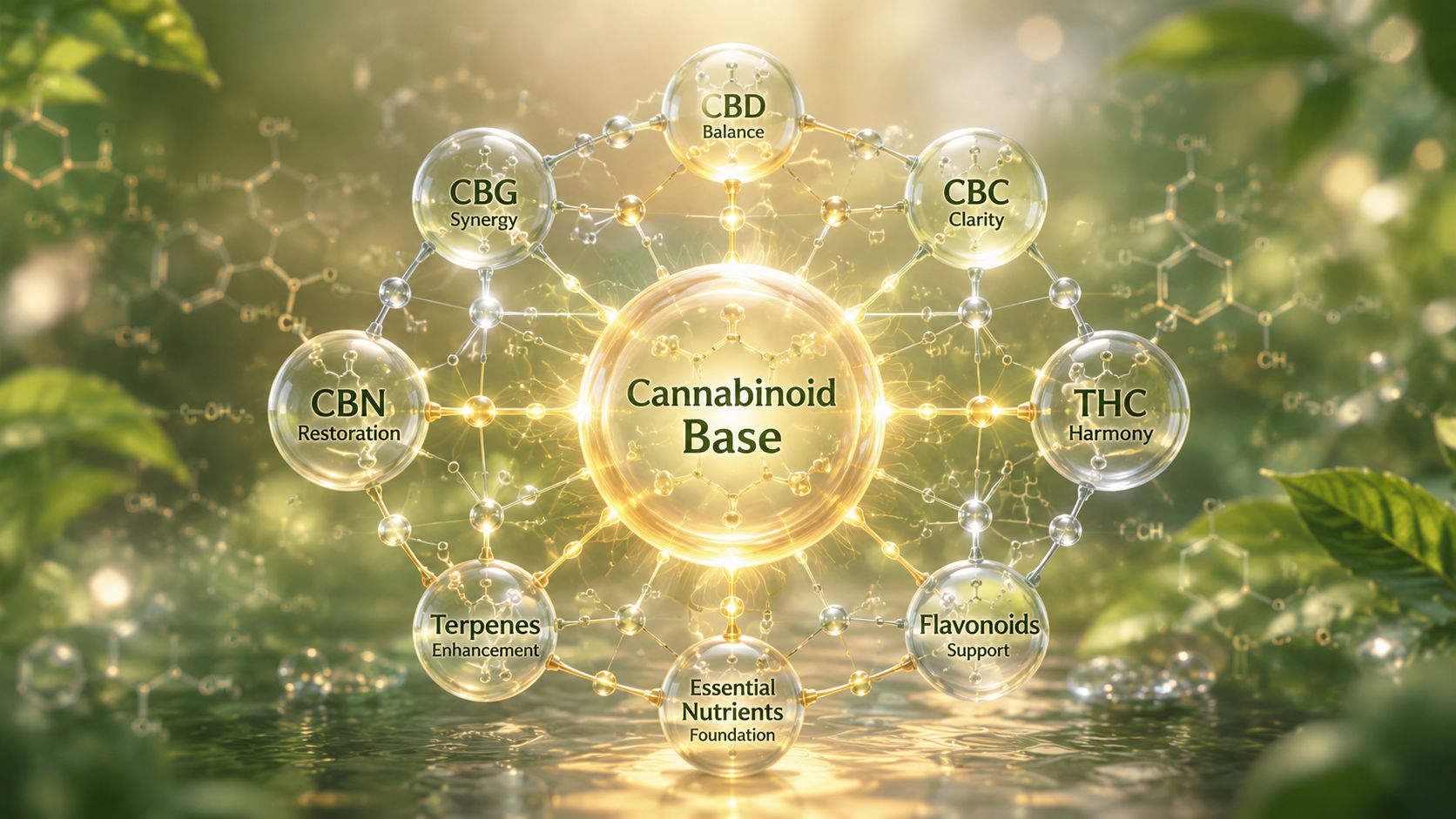
The clearest formulation rule in the verified data comes from this reference on terpenes and cannabinoids formulation strategies. It states that formulators must maintain a minimum 2:1 ratio of CBD to THC in anxiety-focused products. It also states that when building a strain-inspired terpene blend for distillate, total terpene concentration should be capped at 1.0–1.5% to reinforce that CBD anchor without triggering overstimulation.
Why ratios matter more than aroma intent
This isn't just a labeling issue. It's a systems issue. A calming terpene blend placed on top of a base that lacks enough CBD support can still present as edgy, mentally fast, or uncomfortable. In that case, the terpenes may only be shaping the edges of the experience, not the direction.
That's why formulators should decide the cannabinoid architecture before final aroma polish. If the intended product concept is evening decompression, nervous system softness, or lower-intensity functionality, the CBD:THC relationship isn't optional.
The blend should support the base. It shouldn't have to compensate for it.
A practical decision framework
When screening a formulation for cannabis product formulation, ask these questions in order:
Is the cannabinoid ratio aligned with the intended effect?
If not, terpene refinement is premature.Is total terpene load modest enough to avoid overstimulation?
Even a good calming blend can become too loud if overall loading runs too high.Does the finished product still smell calm after dilution into the actual matrix?
Some profiles become brighter and more angular once dispersed.Does the sensory profile match the label promise?
If the package says unwind but the aroma reads fresh, sharp, and daytime-active, users will feel the mismatch.
Labeling and product safety considerations
For commercial teams, this has a second consequence. Clear specification work protects both product performance and customer trust. If the formula is built around a calm-forward design, the label and COA review process should reflect that intent. Don't market a profile as relaxation-focused if the cannabinoid base and terpene load tell a different story.
A reliable internal SOP often includes:
- COA review: Confirm the cannabinoid ratio and terpene composition before release.
- Sensory approval in final hardware: Don't approve from bulk oil aroma alone.
- Version control: Minor revisions in top notes can change the user experience more than expected.
The most stable products come from teams that treat cannabinoids and terpenes as one formulation system, not two separate decisions.
Final Checklist for Creating Anxiety-Conscious Products
A strong calming formula doesn't come from chasing a trendy terpene list. It comes from disciplined exclusion, controlled use of volatile notes, and a cannabinoid base that supports the effect direction from the start.
Use this audit before approving a blend:
- Exclude the clearest problem terpenes: Guaiol and terpinolene shouldn't sit inside a calming SKU unless you have a very specific reason and a strong justification.
- Treat limonene, pinene, and ocimene as concentration-sensitive tools: They can add realism and lift, but they shouldn't run the profile.
- Build the weight in the lower structure: Linalool, myrcene, and nerolidol do more useful work when they create depth instead of competing for top-note attention.
- Check the cannabinoid base first: If the CBD:THC relationship is wrong, terpene optimization won't solve the core problem.
- Approve in the finished format: A blend that seems balanced in a vial can behave very differently in a cartridge.
Final takeaway: The best terpene profile for anxiety-conscious products is usually the one that feels least dramatic on first inhale and most coherent over time.
That's the commercial edge in this category. Brands that understand dose dependency and ratio control make products that feel intentional. Brands that rely on blunt blacklists usually end up with either lifeless flavor or inconsistent user response.
If you're building a terpene profile for vape cartridges, refining a strain-inspired terpene blend for distillate, or need high-purity isolates for anxiety-conscious product development, Gold Coast Terpenes offers the tools that make technical formulation easier, including natural terpene blends, isolated compounds, and practical educational resources for repeatable bench work and scale-up.