
You're filling carts, matching a house profile that sold well last quarter, and the latest terpene lot lands on the bench. The paperwork looks acceptable at first glance. The COA is there. The aroma is close. Then you run the blend, fill production, and the first retained samples tell you something's off. The top note is flatter, the mid-note is muddy, and the finish carries a residue you didn't get in the last run.
That's how brands lose margin and trust. Not from one dramatic failure every time, but from quiet drift. A terpene input changes just enough to push a familiar profile away from what customers expect, or worse, a formulation includes something you never intended to put in a vape product at all.
In practice, supply chain transparency matters because it helps you answer the questions that protect a cannabis brand. What exactly entered this batch? Who handled it? When did it change hands? Under what conditions did it move? Can you prove it's free of PG, VG, MCT, or other unwanted additives instead of just assuming it from a generic certificate?
Beyond the COA Why Your Brand Needs Transparency
The most expensive quality failures usually start with a document that looked good enough.
A standard COA can confirm that a sample met a test panel at one point in time. It usually doesn't tell you enough about how a terpene blend was sourced, how a sensitive isolate moved through storage and transit, or whether the material in your hand is tied cleanly to the lot you approved weeks ago. For a vape manufacturer, that gap shows up as flavor drift, inconsistent fill performance, and hard conversations with wholesale partners.
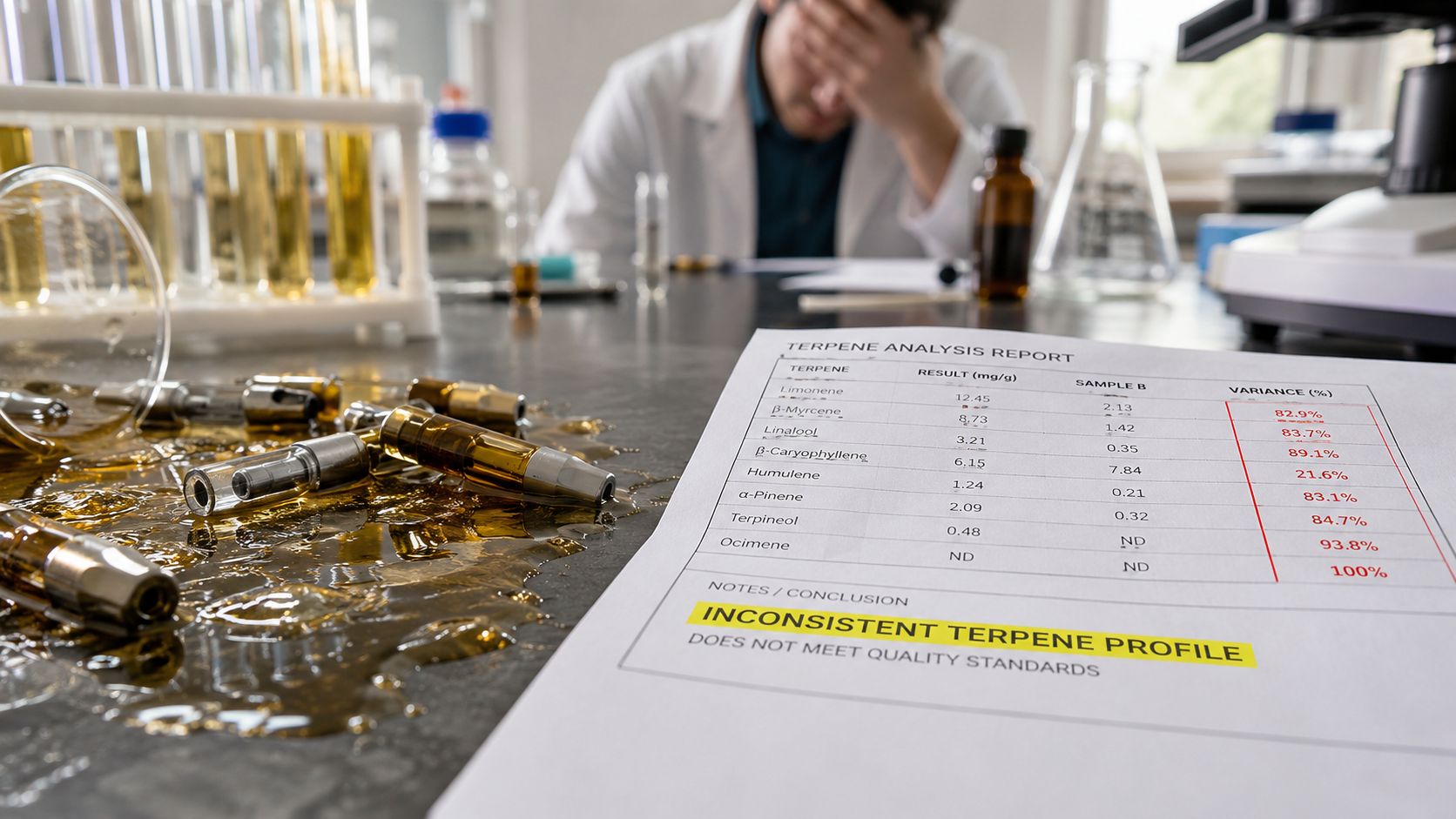
The bigger issue is that most companies still can't see very far into their own networks. Only 6% of companies have full end-to-end visibility beyond their immediate Tier-1 suppliers, which leaves major blind spots in accountability and control, according to this supply chain transparency data summary. In formulation terms, that means many brands know the name on the drum, but not the full path behind it.
Why a COA alone falls short
When a cart formula misses, the root cause often sits upstream:
- Batch substitution: A supplier ships a lot that is technically similar, but not sensorially identical.
- Handling variation: Storage or transit conditions affect volatile compounds before the material reaches your production room.
- Documentation gaps: The paperwork confirms testing, but not chain of custody.
- Specification mismatch: The incoming terpene passes broad purity review but still doesn't match your formulation target.
Practical rule: If your release decision depends on one PDF, you don't have a transparency system. You have a paperwork checkpoint.
A serious brand treats supply chain transparency the same way it treats filling temperatures, hardware compatibility, and incoming QC. It's part of the operating discipline. That includes reviewing why safety data sheets matter in formulation and handling before material ever reaches production.
From Supplier Lists to Batch-Level Data
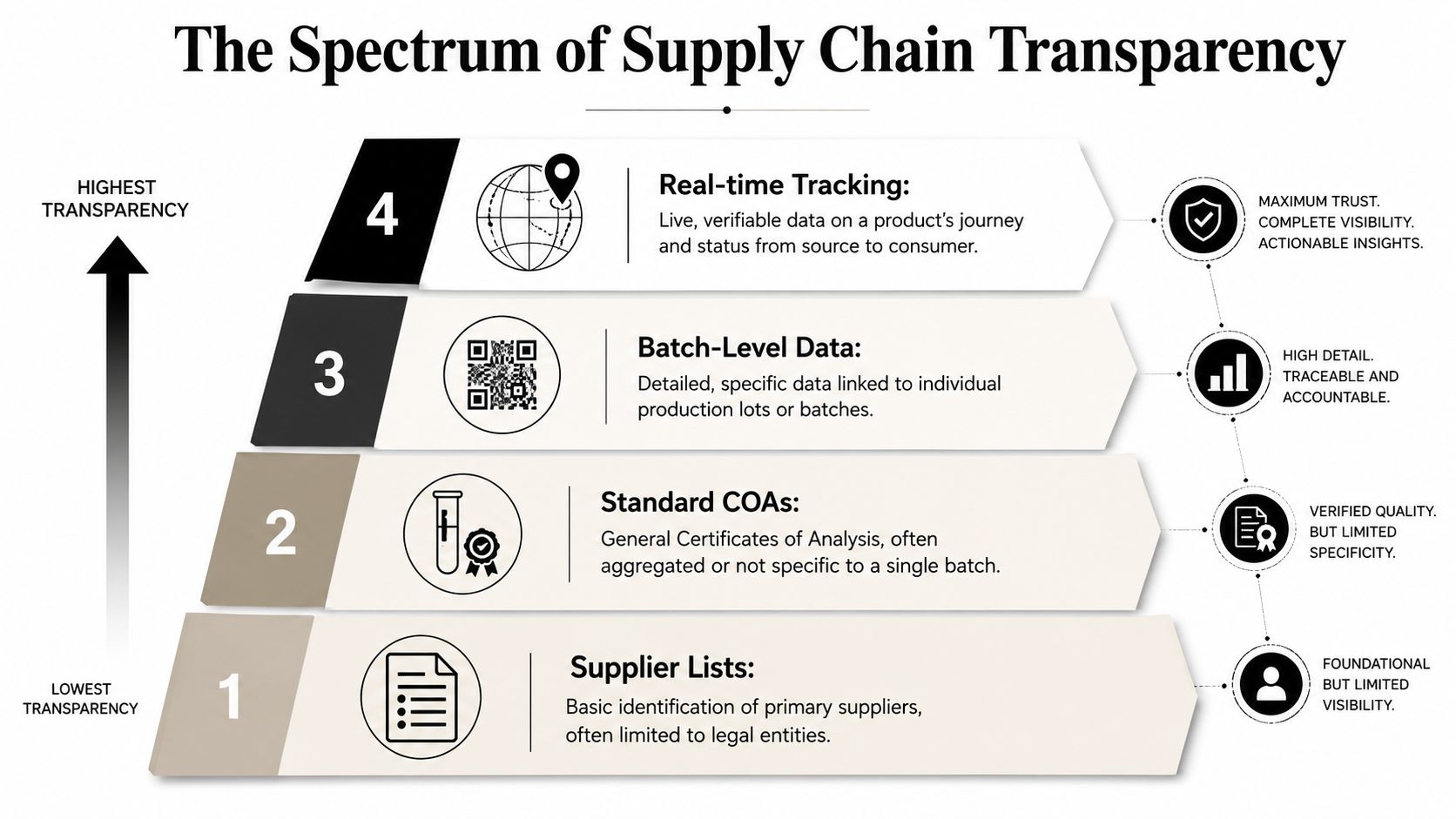
A lot of teams say they want transparency when what they really have is a supplier list.
That's a start, but it won't protect a vape formulation when a terpene lot behaves differently than the previous run. You need to separate transparency from traceability, because they aren't the same thing and they solve different problems.
According to Impact Buying's explanation of transparency and traceability, “transparency is the decision to share parts of that mapped and traced information” while “traceability” involves collecting data systems to track materials. For cannabis formulation, that distinction matters because proving a terpene isolate is free of contaminants like VG or PEG requires traceability, not just a supplier name and a marketing claim.
The restaurant analogy that actually helps
Transparency is like a restaurant showing you where it bought ingredients.
Traceability is the kitchen log, the prep record, the ingredient lot number, and the time-stamped process trail showing what happened before the dish reached the table. One tells you who supplied the kitchen. The other tells you what entered the meal, when, and how.
For terpene buyers, the same logic applies.
| Level | What you get | What it can't prove |
|---|---|---|
| Supplier list | Legal entity or trading partner name | Batch integrity |
| Standard COA | A test result tied loosely to a product | Full handling history |
| Batch-level data | Lot-specific records, timestamps, linked documents | Not enough by itself if records are fragmented |
| Real-time tracking | Ongoing status, custody, condition visibility | Still needs clear SOPs and release criteria |
What batch-level data should include
If you're buying for vape cartridges or formulating for distillate, batch-level data should connect the physical material to the record set. At minimum, you want:
- Lot identity: A unique batch or lot number that follows the material through receipt, storage, use, and retention.
- Document linkage: COA, shipping records, intake review, and any deviation notes tied to that same lot.
- Handling history: Evidence that the lot wasn't exposed to conditions that could alter aroma, oxidation state, or overall performance.
- Processing detail: Enough information to understand whether the material remained aligned with your purity and formulation standards.
That's where chromatography testing in terpene quality review becomes useful operationally, not just scientifically. Analytical separation helps identify whether the lot you received really reflects the profile and purity expected for production.
A supplier who shares names but can't connect a shipped batch to its supporting records is being open in a limited way. They are not giving you proof.
What works and what doesn't
What works is a lot-specific system that ties receiving, testing, approval, and usage together.
What doesn't work is relying on broad product claims such as “natural,” “clean,” or “lab tested” without a traceable chain behind them. Those phrases may describe intent. They don't verify your input.
For brands trying to prove the absence of PG, VG, MCT, or similar unwanted additives in vape formulations, traceability is the operating standard. Transparency supports confidence. Traceability supports release decisions.
How Transparency Drives Profitability and Trust
Most buyers first approach supply chain transparency as a compliance problem. That's too narrow. In formulation, it's a profit protection tool.
The business case is getting stronger across industries. The Global Supply Chain Transparency Market is projected to grow from $3.0 billion in 2025 to $7.6 billion by 2032, at a projected 13.9% CAGR, reflecting growing demand for these systems as a strategic necessity, according to Procurement Tactics' market summary. Cannabis operators don't need to follow broad industry language to see why. The operational benefits are immediate.
Quality consistency protects repeat orders
A strain-inspired terpene blend only works commercially when it can be reproduced with control.
If your Blue Dream-inspired cart tastes bright and berry-forward in one run but turns dull in the next, the customer doesn't care whether the issue came from an upstream substitution, inconsistent isolate quality, or weak incoming controls. They only know the SKU changed. Transparent records help your team isolate the cause faster and keep approved profiles stable over time.
For brands doing terpene profile for vape cartridges work or formulating for distillate, consistency is revenue protection. It reduces rejected lots, lowers reformulation time, and gives sales teams a cleaner promise to take into market.
Risk moves faster than paperwork
State-by-state rules, retailer standards, and distributor scrutiny all create pressure on documentation. But the larger issue is speed. When an input is questioned, your team needs to determine scope quickly.
A transparent system helps answer practical questions on the same day:
- Which SKUs used the affected lot
- Which production dates are tied to it
- Which customers received finished goods from those runs
- Whether the issue is sensory, chemical, or procedural
That's the difference between containing a problem and widening it.
Trust becomes visible when the data is usable
Brand trust isn't built by saying your materials are clean. It's built by being able to show the records behind the claim.
Some teams now use packaging-linked batch information, internal lot portals, or shared verification packets for wholesale partners. The exact format matters less than the standard behind it. If the data is organized, lot-specific, and easy to review, it supports confidence without forcing your customer to guess.
A good operational reference point is supply chain optimization in ingredient sourcing and documentation. The key lesson is simple. Better data flow improves commercial decisions, not just audits.
Buyers remember two things. Whether the product stayed consistent, and whether your team answered hard questions with documentation instead of delay.
Where the return actually shows up
The return on transparency usually appears in less glamorous places than marketing decks:
| Operational area | Why transparency helps |
|---|---|
| Incoming QC | Faster approval or quarantine decisions |
| Formulation | Fewer surprises in aroma, behavior, and compatibility |
| Complaint handling | Quicker root-cause review |
| Wholesale relationships | Stronger confidence during due diligence |
| SKU expansion | Cleaner handoff from R&D to production |
That's why supply chain transparency earns budget in disciplined manufacturing environments. It keeps technical quality connected to commercial credibility.
Building Your Verification Framework
A useful verification framework doesn't have to be flashy. It has to be complete enough that your quality team can trust it under pressure.
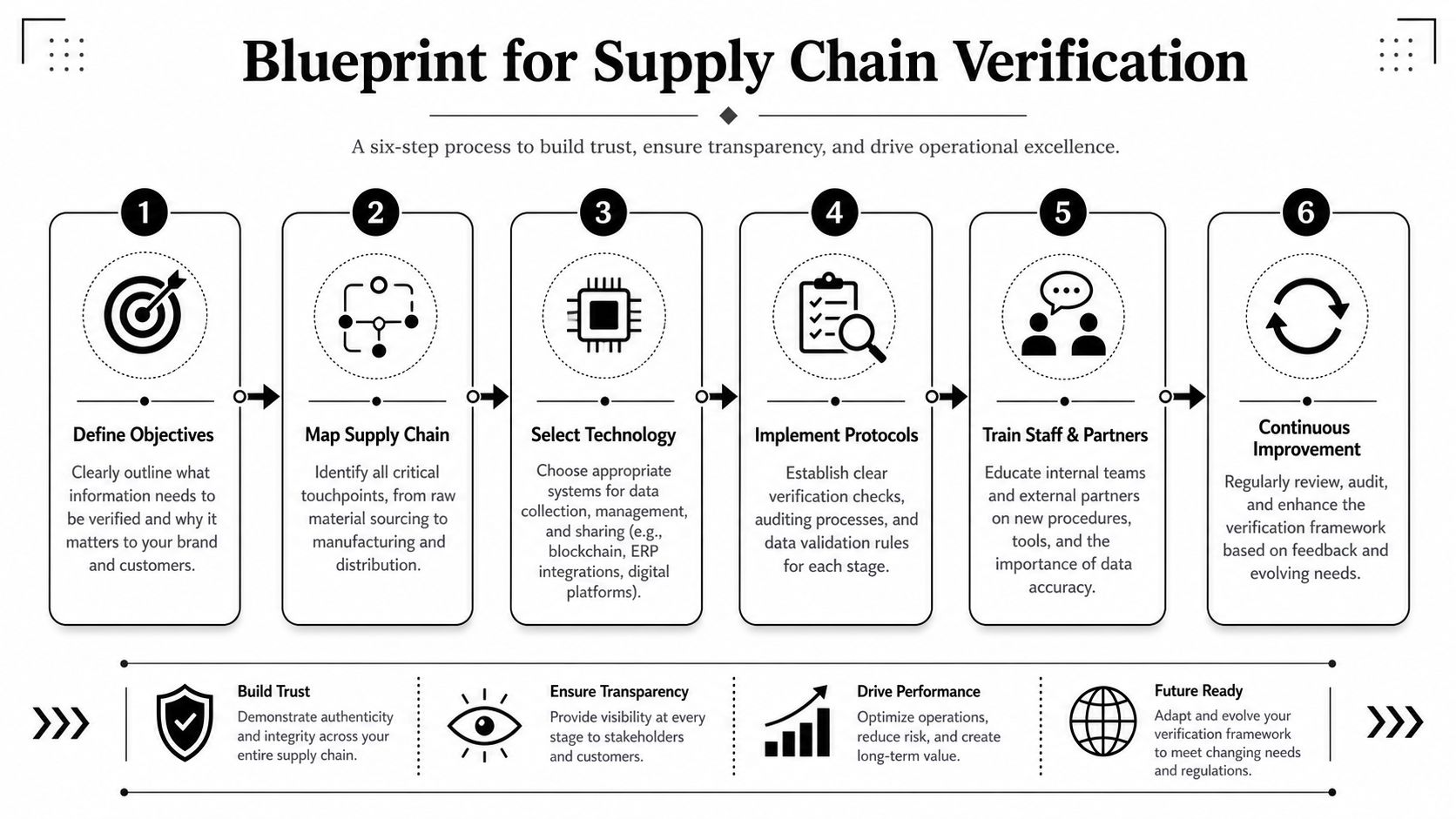
For terpene sourcing, that means building a system around evidence, not assumptions. You need technology that captures the lot trail, testing that verifies purity and composition, documentation that survives review, and supplier controls that hold up when a batch goes sideways.
Technology should follow the lot
For sensitive inputs, shipment conditions matter. Research summarized in this operations reference notes that for high-value, sensitive inputs like isolated terpenes, real-time sensors such as temperature and humidity IoT nodes support custody-chain integrity. If a shipment moves outside specified thresholds, the system can flag degradation risk and trigger re-certification protocols.
That matters because terpenes are volatile. A lot may arrive with the right paperwork and still be the wrong material for release if heat exposure or poor storage altered performance.
A practical setup often includes:
- Batch QR codes: Used internally to connect receiving, storage location, in-process use, and retention samples.
- ERP or seed-to-sale linkage: Enough integration to keep lot identity from breaking between purchasing, QC, and production.
- Shipment condition records: Particularly important for isolates and precision blends where sensory accuracy matters.
- Deviation flags: Any hold, excursion, or relabel event must stay attached to the lot record.
Testing has to answer formulation questions
A weak testing program confirms only what is easy to measure. A strong one answers what your release decision depends on.
For vape work, that usually means reviewing more than a broad identity statement. You need a test package that supports purity review and fit-for-use review. Depending on your operation, that may include incoming confirmation, supplier COA review, retained sample comparison, and targeted follow-up when the lot shows sensory or behavioral differences.
Release standard: Don't ask only “Did it pass?” Ask “Did it pass for this product, this hardware, and this target profile?”
The process itself should be documented in your quality assurance procedures for terpene intake and release. That includes how your team handles discrepancies between sensory evaluation and paperwork.
Documentation should be boring and complete
Good documentation isn't impressive. It's dependable.
Ask suppliers for the records that let you reconstruct a lot without guesswork. That typically includes raw material origin statements, lot-specific COAs, shipping and storage records, manufacturing dates, and any process logs relevant to purity or blend integrity. If a supplier hesitates to provide basics, that's information too.
Here's a useful way to evaluate the file set:
| Record type | Why it matters |
|---|---|
| Lot-specific COA | Confirms the data ties to the actual batch purchased |
| Shipping documentation | Supports custody and timing review |
| Storage and handling notes | Helps explain drift, oxidation, or loss of brightness |
| Raw material origin information | Improves confidence in source consistency |
| Deviation records | Shows whether the supplier tracks exceptions honestly |
Certifications are signals, not substitutes
Third-party certifications can help. They show a supplier has invested in formal systems and repeatable controls.
But don't confuse a certification with product-specific proof. cGMP and ISO-style discipline can indicate process maturity, yet your release decision still has to come back to the lot in front of you. The best verification frameworks use certifications as supporting evidence, not as a shortcut around actual batch review.
Implementing Transparency in Your Operations
Small and mid-sized brands often delay supply chain transparency because they assume it requires a large software budget or a full ERP overhaul. It doesn't. What it does require is discipline in how you define critical data, store it, and use it during release and investigation.
That matters because disconnected systems create expensive blind spots. According to this review of supply chain transparency barriers, disconnected data systems and siloed ERP or WMS architectures can cost companies up to 30% of annual revenue through inefficiency and poor visibility into sub-tier risk. In cannabis operations, the same fragmentation shows up as lost lot history, duplicate documents, and slow root-cause work.
Start with the ingredients that can hurt you fastest
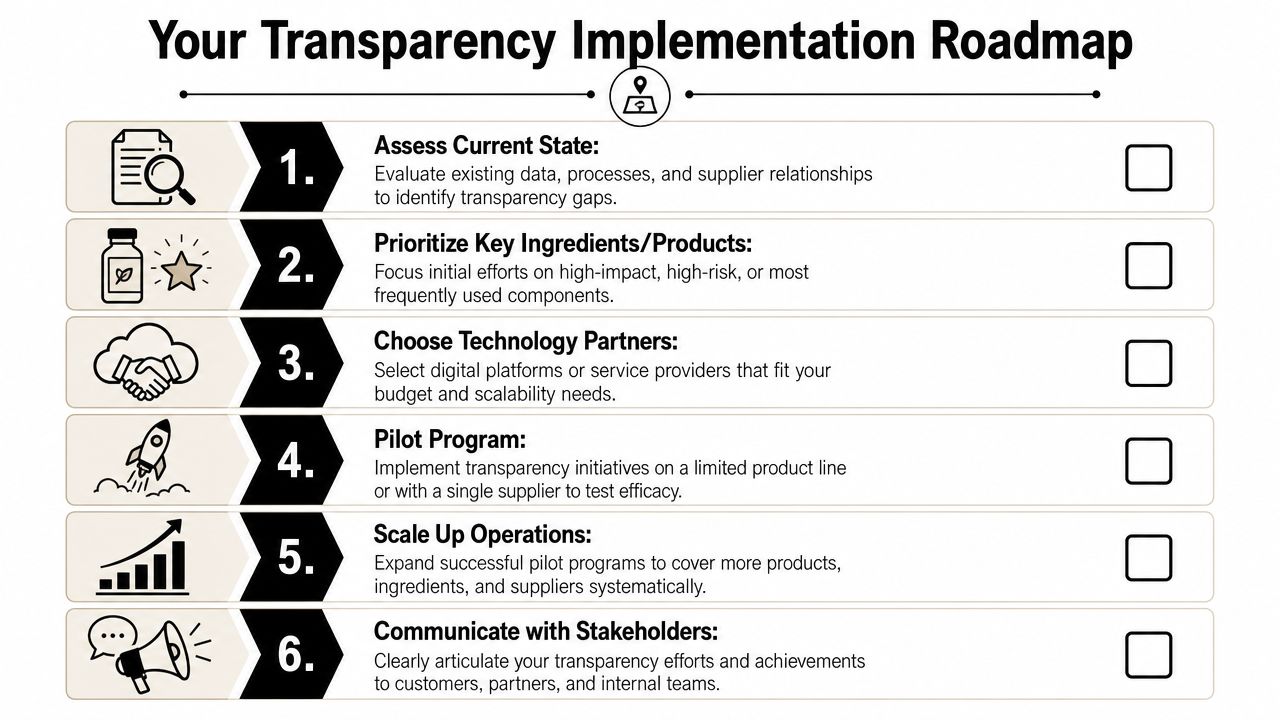
You don't need to map every vendor on day one. Start with the materials that can change flavor, purity perception, or customer safety fastest.
For most vape and extract brands, that means terpene blends, isolated terpenes, and hardware components. If you're doing strain-inspired terpene blend development or replicating flavor of a known profile, terpene inputs belong at the top of the list because minor changes are easy to smell and hard to explain after launch.
A focused first pass should answer:
- Which suppliers feed your highest-risk SKUs
- Which lots are hardest to replace quickly
- Which inputs could introduce unwanted additives or off-notes
- Which materials create the largest complaint risk if they drift
Define your release-critical data
A lot of companies collect documents that nobody uses. That's not transparency. That's storage.
Choose the specific records your team needs to make a release decision with confidence. For a vape-focused operation, the file should help prove absence of ingredients your brand doesn't want associated with the product, such as PG, VG, or MCT. It should also support flavor consistency from one manufacturing run to the next.
Here's a simple decision table:
| Question | Required evidence |
|---|---|
| Is this the exact lot we approved? | Matching lot number across COA, receiving log, and inventory record |
| Is it suitable for this formula? | Internal spec review plus sensory and analytical fit |
| Did shipping or storage compromise it? | Condition records, timestamps, exception notes |
| Can we defend the claim set? | Clean documentation supporting purity and ingredient positioning |
Audit suppliers with direct questions
Supplier audits don't need to be theatrical. They need to be specific.
Ask questions that expose whether the vendor can support your formulation standards:
- How is each lot identified from production through shipment?
- What documents stay tied to that lot?
- How do you handle rework, relabeling, or partial lot transfers?
- What triggers a hold or re-certification decision?
- What records can you provide if a brand reports flavor drift in a finished vape cartridge?
If a supplier answers with broad assurances instead of process detail, assume you'll be doing the investigative work alone when something goes wrong.
Build one source of truth before you buy more software
Organizations can achieve rapid improvements with a structured cloud folder, a naming convention, and a controlled intake checklist.
The goal is one place where purchasing, quality, and formulation can all pull the same approved lot record. Separate inboxes and desktop folders create version confusion, especially when R&D and production are using similar terpene names across multiple SKUs.
A basic but effective framework includes:
- Supplier folders: One folder per approved supplier.
- Lot folders: One subfolder per received lot.
- Core file set: COA, shipping docs, intake review, sensory notes, release decision.
- Retention link: A record of where retained sample data is stored.
- Change log: Notes on spec changes, complaints, and supplier responses.
Teams working on formulation guide for cannabis product formulation projects often benefit from organizing these records alongside calculators, blend worksheets, and validation notes. A practical complement is using formulation-focused educational resources as part of the internal review process so development and quality stay aligned.
Turn verification into a market advantage
Once the system is working internally, communicate it clearly. Not with vague “premium quality” language, but with specifics your buyers can understand.
That could mean lot-linked verification packets for distributors, packaging-level batch references, or product pages that explain your documentation standard. The point isn't to flood customers with data. The point is to show that your claims are backed by process.
Keep the rollout phased
Don't try to fix every ingredient category at once.
Pilot the process on a small product family, ideally one where flavor accuracy matters and complaint history is easy to track. Then refine your SOPs before rolling the same structure across more SKUs. That phased model works because it lets quality, procurement, and production adopt the system without breaking day-to-day operations.
The Future of Formulation is Verifiable
The cannabis brands that hold value over time won't be the ones with the loudest claims. They'll be the ones that can prove what went into the formula and why it stayed consistent.
That's a key role of supply chain transparency in formulation. It protects flavor accuracy in strain-inspired profiles, helps defend claims about what isn't in the product, and gives your team a faster path to root cause when something changes. For vape cartridges and concentrate work, that isn't extra polish. It's operating control.
Transparency alone is only partial visibility. Traceability is what turns that visibility into proof. It connects the supplier, the lot, the handling conditions, the supporting documents, and the release decision into one record your team can effectively use. That's how you protect a profile from drift and a brand from avoidable credibility loss.
For formulators, extractors, and brand owners, the standard is moving toward evidence that travels with the batch. The teams that adopt that discipline early will have an easier time scaling, defending quality, and maintaining trust when scrutiny gets sharper.
If you're building a more defensible terpene sourcing and formulation program, Gold Coast Terpenes is a practical place to start. Explore their strain-specific profiles, isolated compounds, and formulation tools for vape cartridges, distillate, and cannabis product development, especially if you need THC-free, lab-verified terpenes crafted without VG, PG, PEG, or MCT.