
Most advice about sativas for anxiety is too blunt to help a formulator. “Use indica” is consumer shorthand, not a formulation strategy. It ignores the actual problem, which is that an energizing profile can either feel clear and productive or feel overstimulating depending on the cannabinoid load, terpene balance, and delivery format.
For commercial product development, that gap matters. Daytime products need uplift without panic, flavor without harshness, and repeatable effect targets that survive extraction, filling, and shelf time. If you're building a strain-inspired terpene blend for anxiety, strain labels won't get you there. Chemical architecture will.
The Sativa Paradox in Product Formulation
The industry keeps repeating that sativas are bad for anxious users. That's incomplete. The more useful framing is the Sativa Paradox. Some sativas do amplify anxiety through high THC and stimulating terpene balance, but others can be built to deliver a non-sedating calm profile if the chemistry is controlled. Research summarized in the Pennsylvania Marijuana Cards discussion of sativa and anxiety notes that some sativas amplify anxiety via high THC and stimulating terpenes like terpinolene, while those engineered with moderate THC below 20% and dominant linalool or beta-caryophyllene can provide non-sedating relief.

That's not a branding nuance. It's a product opportunity. Brands chasing “day calm,” “social ease,” or “focused uplift” can't rely on indica-style heaviness, because sedation solves one problem by creating another.
Why the old advice fails
A junior chemist usually starts by mapping products into three buckets: energizing, balanced, sedating. That's fine for rough ideation. It breaks down the moment you need reproducibility.
Sativa-labeled profiles often carry the exact aromatic features that make them commercially attractive: bright citrus, pine lift, herbal sharpness, a clean finish. Those same profiles can become too edgy if terpinolene, pinene, and THC all push in the same direction. The answer isn't to abandon the profile. The answer is to buffer it.
Practical rule: Don't ask whether a sativa is “good” or “bad” for anxiety. Ask which compounds are driving the top note, which compounds are anchoring the base, and what happens after heat and dilution.
That's why I treat sativas for anxiety as a balancing exercise, not a category error. If you want a commercial reference point for how effect expectations often get oversimplified, this piece on whether sativa makes you sleepy is useful because it shows how quickly the label itself stops being informative.
What formulators should target instead
For non-sedating calm, build toward:
- Moderated stimulation: Keep highly activating drivers from dominating the finished blend.
- Functional buffering: Use linalool, myrcene, and beta-caryophyllene to soften the arc of the experience.
- Daytime usability: Preserve lift and clarity so the profile doesn't collapse into a heavy indica imitation.
The formulator's job isn't to pick a side in the sativa-versus-indica debate. It's to build a specific outcome that can be manufactured consistently.
Understanding the Sativa-Anxiety Spectrum
The chemistry matters more than the label because THC has a biphasic effect. In practical terms, the same ingredient can feel calming at one level and agitating at another. That's the first thing to keep in view when building sativas for anxiety.
Here's the visual model I use when training teams to think about dose direction, not just strain identity.
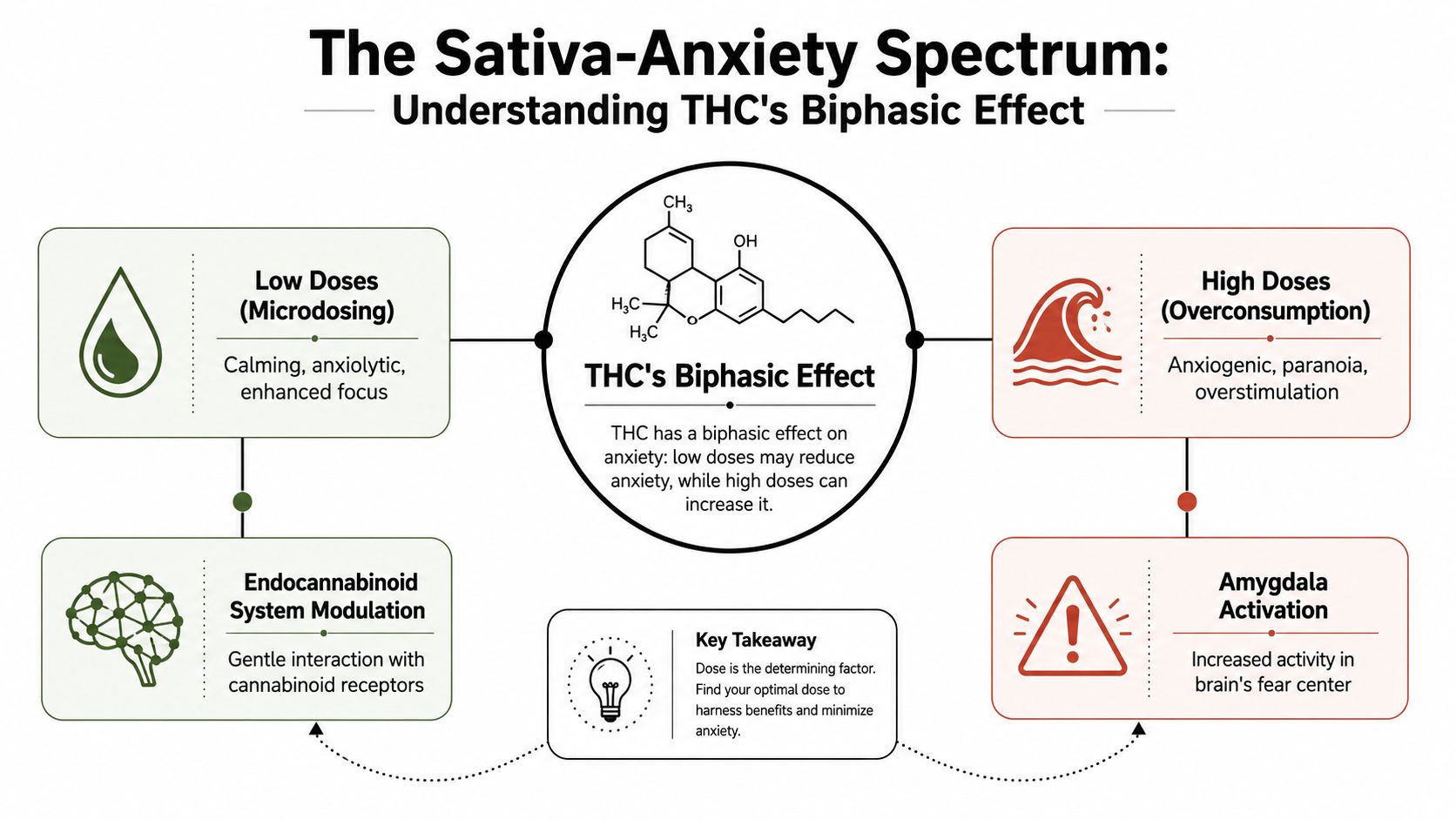
A large Australian study reported that fewer than 1% of participants said anxiety worsened after cannabis treatment, while 71% to 92% felt anxiety improved, and a corroborating survey found 92% of 2,032 respondents said cannabis alleviated anxiety symptoms. The same review also states that acute THC consistently produces anxiety-inducing effects in human clinical studies, with the difference often coming down to dose and chemical composition, where low doses can calm and high doses can “amp up” the user, especially in some sativa profiles (reviewed here).
Why high-output sativas can turn sharp
When formulators talk about a profile feeling “too racy,” they're usually describing a stack of variables moving in the same direction:
- THC is high
- The terpene profile is stimulation-forward
- There's not enough buffering from calming terpenes or balancing cannabinoids
- The delivery format hits fast
That stack can push the consumer from uplift into unease. It's one reason broad claims about whether sativa is good for anxiety and depression usually miss what controls the experience.
Later-stage formulation work should treat anxiety risk as a spectrum, not a switch. A profile doesn't become problematic because it carries a “sativa” name. It becomes problematic when the net pharmacodynamic signal is too activating for the intended use case.
The mechanism is easier to understand in visual form, especially for teams that build both flavor-first and effect-first SKUs.
The compounds don't work in isolation
A good anxiety-focused profile isn't just low stimulation. It needs shape. If you strip away all lift, the product loses its market purpose. If you leave the top notes bright but unsupported, the profile feels thin, volatile, and mentally noisy.
The finished effect comes from the whole ratio. THC level, terpene hierarchy, and product format all matter together.
That's why I tell junior chemists to stop asking “What does this strain do?” and start asking “Which molecules dominate the opening, middle, and finish, and how does that align with the intended use window?”
Formulating a Strain-Inspired Terpene Blend for Anxiety
If you're formulating a strain-inspired terpene blend for anxiety, don't start with the strain name. Start with the outcome. For most daytime applications, the target isn't sedation. It's calm focus, reduced edge, and a stable sensory profile that still reads as bright and modern.
The key technical idea is straightforward. The perceived anxiety risk of sativa profiles is shaped by terpene-modulated pharmacodynamics, and terpenes such as linalool and limonene can counterbalance THC's psychoactive stimulation when the terpene-to-cannabinoid ratio is optimized, as discussed in this review of how sativa strains may induce anxiety.
Build the blend by note structure
A junior formulator often thinks in isolate lists. A senior formulator thinks in top, mid, and base note behavior plus effect contribution.
| Terpene | Note role | Practical use in anxiety-focused sativa formulation |
|---|---|---|
| Limonene | Top note | Adds brightness and mood lift. Useful when you want a clean opening without relying only on sharper energizing drivers. |
| Linalool | Mid note | Softens the center of the blend and helps redirect an otherwise stimulating profile toward calm. |
| Myrcene | Base note | Adds roundness and reduces aromatic sharpness. Useful in small-to-moderate amounts when you want calm without full sedation. |
| Beta-Caryophyllene | Base note | Anchors the profile, adds spice depth, and is one of the most practical buffering tools for “uplift without panic” designs. |
That structure matters because anxiety-focused sativa work usually fails in one of two ways. Either the formulator leaves the top too aggressive, or they overcorrect and turn the profile into a sleepy hybrid with no daytime identity.
A workable starting approach
I usually build in layers.
- Opening layer: Start with the citrus or pine expression you want, but avoid letting the brightest fraction dominate the entire aromatic experience.
- Middle layer: Add linalool to change the feel of the blend, not just the smell. At this stage, many “calm focus” concepts either become coherent or fall apart.
- Base layer: Use myrcene and beta-caryophyllene to give the profile a landing. Without that, the blend often feels all top note and no control.
Bench insight: If the first inhale is exciting and the second feels unsettled, the blend usually needs more support in the middle and base, not more complexity at the top.
For practical sourcing and profile ideation, the article on what strain of weed helps anxiety is useful because it points formulators back toward composition rather than label mythology.
What usually works and what usually doesn't
What works:
- Moderate stimulation with clear buffering
- A bright top note supported by a softer mid
- Base-note depth that survives dilution
- Intentional restraint with the most activating isolates
What doesn't:
- Terpinolene-heavy concepts with no calming counterweight
- High-lift citrus builds that never settle
- Trying to mimic an energetic flower profile exactly in a cart without adjusting for delivery intensity
- Confusing “more terpene” with “more effect control”
A useful mental model is this. You're not formulating a relaxing indica clone. You're engineering a sativa-leaning profile that keeps enough motion to feel functional while removing the parts most likely to become edgy.
Replicating and Modifying Sativa Profiles for Vape Cartridges
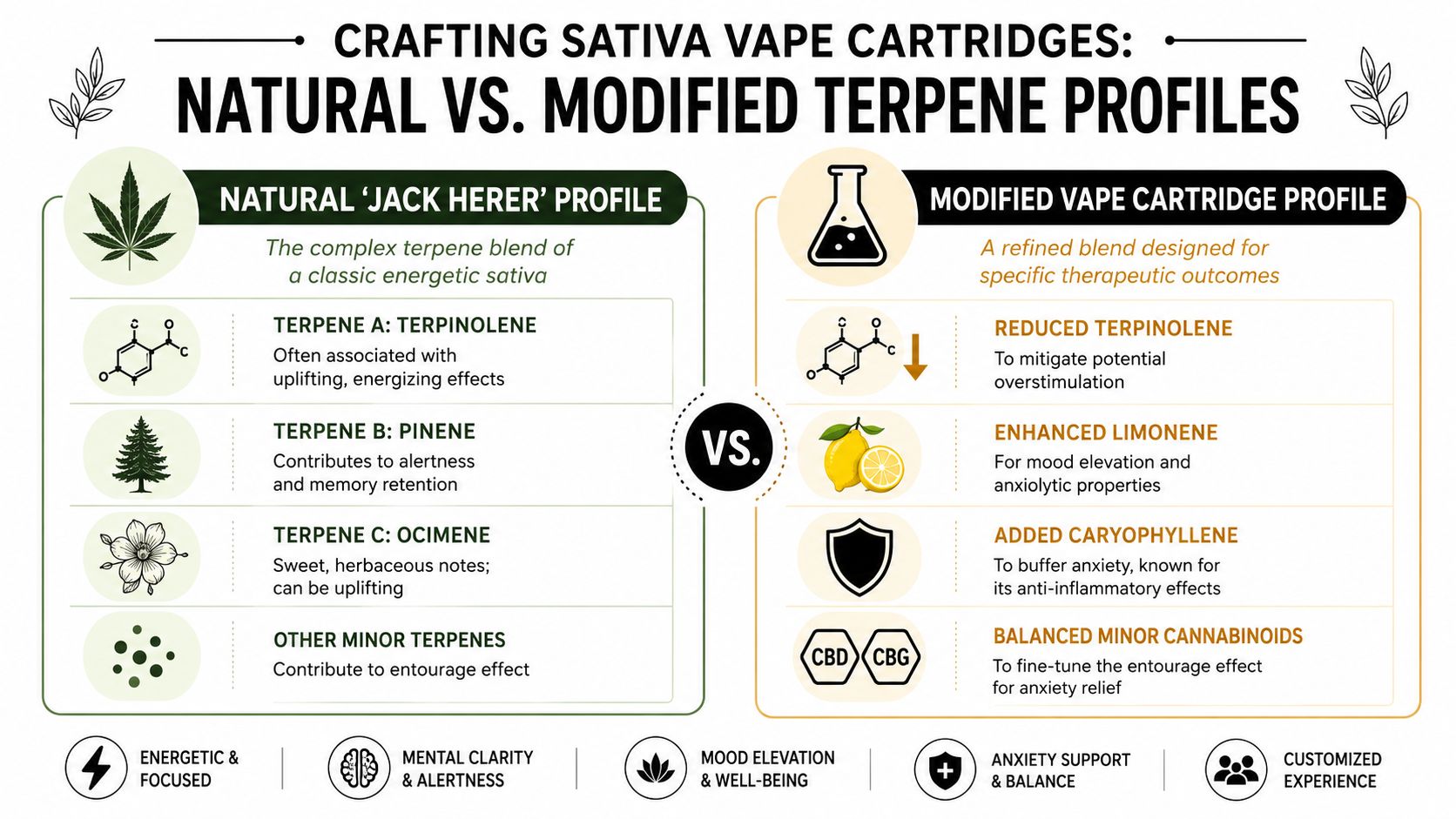
The common mistake in anxiety SKUs is copying an energetic flower profile into a cart and expecting the same emotional outcome. Cartridge delivery changes the profile. It often feels faster, narrower, and less forgiving. That is the sativa paradox in vape formulation. The same terpene pattern that reads bright and functional in flower can feel pushy once concentrated and inhaled through hardware.
The Jack Herer problem
A classic Jack Herer-style terpene blend is built around lift. According to the profile breakdown from Gold Coast Terpenes on Jack Herer effects, terpinolene typically drives 30–40% of the blend, with alpha-pinene at 10–15%, beta-caryophyllene at 8–12%, myrcene at 5–10%, and limonene at 3–7%.
That structure gives the profile its identity. It also creates the exact problem formulators need to solve for anxiety-aware products. In a cartridge, a terpinolene-led opening can dominate the first few pulls before the heavier notes have much chance to shape the experience.
The fix is selective compression. Keep the recognizable Jack Herer signature, but pull terpinolene down enough that pinene, myrcene, and beta-caryophyllene can share the job instead of just decorating the top. The goal is a profile that still reads fresh and active, but does not accelerate the user into the edgy end of the spectrum.
A modified Jack Herer concept should feel focused, not accelerated.
The Blue Dream advantage
A Blue Dream-inspired terpene blend starts from a better position for this use case because the balance is already wider through the middle of the profile. You get roundness from myrcene, lift from pinene, and enough body from caryophyllene to keep the blend from feeling thin.
That matters in carts. Anxiety-friendly sativa products need more than a bright top note. They need a controlled descent after the initial inhale. Blue Dream-style builds usually require less correction because the profile already has some internal restraint.
I rarely try to preserve a flower profile with complete fidelity in this category. I preserve the cue. Then I adjust the ratio so the effect survives the delivery format.
How to modify without losing identity
For commercial work, use a simple decision frame:
| Profile type | Risk in anxiety-focused SKU | Modification direction |
|---|---|---|
| Terpinolene-dominant sativa | Can become overstimulating fast | Reduce the lead driver and increase calming mid/base support |
| Myrcene-pinine-caryophyllene hybrid-sativa | Better balance but can still get too sharp in carts | Keep the lift, shorten the sharp finish, control total terpene load |
| Pinene-forward daytime blend | Can feel thin or angular | Add body and persistence so focus does not turn jittery |
Two practical checks help here. First, evaluate the first three pulls, not just the aroma off the oil. Second, test the blend in the actual hardware because airflow and coil behavior change how aggressively the top notes present. A profile that seems balanced in a benchtop sample can become much sharper in a finished cartridge.
Watch the oil behavior too. A heavily adjusted sativa-inspired blend can create handling issues if the final matrix is already prone to separation or crystal formation. This guide on preventing crystallization in vape formulations is useful when you start pushing a profile toward a narrower functional target.
The practical mistake is preserving every sensory edge from the original cultivar. For anxiety-focused vape products, identity comes from the dominant cues, not from perfect replication. Build the signature, then edit the parts that create speed without control.
Formulation Guide for Distillate and Concentrate Stability
A terpene profile that calms in a jar can turn edgy after production. That is the sativa paradox at the manufacturing stage. The same bright monoterpenes that give a daytime blend its lift are often the first compounds to shift, flash off, or present unevenly once the formula moves through heat, filling, and hardware.
For anxiety-focused sativa products, stability is part of the effect spec. If the profile drifts during processing, the consumer does not experience your bench formula. They experience the post-process chemistry.
Build the calming structure into the part of the profile that survives
In cartridge work, sesquiterpenes such as beta-caryophyllene and humulene usually hold up better through processing than lighter monoterpenes such as pinene, limonene, and myrcene. Terpene Belt Farms explains that heat tolerance differs meaningfully across terpene classes in its guide to terpene effects and heat stability.
That matters in practical formulation. Do not place all anxiolytic function in the most volatile layer of the blend. Use the top notes to shape the opening. Use the more persistent fraction to control the landing. If the calming component exists only in fragile aromatic peaks, scale-up often produces a thinner, sharper result than the benchtop sample.
I treat this as architecture, not garnish. The top note sells the profile. The surviving mid and base notes decide whether the product feels composed on pull three, five, and ten.
Control terpene load before you chase authenticity
Total terpene percentage changes both sensory balance and hardware behavior. In distillate or cart oil, anxiety-oriented sativa profiles usually perform better at restrained loading than at maximal aromatic intensity. Excess terpene content can make the inhale harsher, exaggerate angular notes, and destabilize the ratio you were using to soften an energizing profile.
Blue Dream-style inspiration often tempts formulators to keep stacking bright material because the fresh blend smells attractive in glass. That is a common mistake. For an anxiety SKU, preserve the recognizable cues, then cut anything that makes the finish feel fast, dry, or abrasive after repeated pulls.
Myrcene needs a target, not a guess
Myrcene is one of the easiest ways to take the edge off a sativa-inspired formula. It is also one of the easiest ways to flatten it.
Terpene Belt Farms outlines practical concentration ranges in its myrcene terpene formulation guide. The larger lesson is more useful than any single cultivar reference. Myrcene only helps if it sits in proportion to the rest of the system. Push it too high and the blend loses lift. Keep it too low and pinene, terpinolene, or limonene can dominate the experience in a way that reads as mental speed rather than clarity.
For anxiety-aware sativa development, myrcene works best as a regulator. It should round the profile and slow the handoff from top note to finish. It should not smother the profile into a generic sedating blend.
Production checks that catch drift early
Use a short checklist before blaming the formula itself:
- After thermal exposure: Smell and test the processed oil, not just the cold terpene mix.
- At target hardware settings: Confirm the finish still feels rounded after several pulls.
- During pilot fills: Watch for increased harshness, a thinner body, or an overly fast onset.
- During release testing: Compare retained samples over time to see whether the calming support fades first.
Physical stability matters here too. Separation, viscosity change, and crystallization can alter terpene delivery enough to change the user experience. Keep a crystallization prevention guide for vape formulations in the workflow, especially when you are balancing a narrow anxiolytic window inside a sativa-style profile.
The practical goal is straightforward. Build a bright profile that survives manufacturing without becoming sharp. That is how a sativa-inspired formula stays useful for anxiety after it leaves the bench.
Conclusion Building Products Beyond Sativa and Indica
The useful distinction isn't sativa versus indica. It's whether the product has been built around a defined chemical target.
Chemically, sativa strains in regulated markets are often distinguished by profiles featuring alpha-terpinolene or alpha-pinene as dominant, or by beta-myrcene as dominant with alpha-terpinolene or trans-beta-ocimene as the second most abundant, while indica profiles show different dominant-secondary patterns. The broader formulation lesson is that terpene ratios create more consistent outcomes than botanical labels, as described in this review of variations in terpene profiles across cannabis strains.
What this changes for product teams
If you're building sativas for anxiety, the job isn't to make a fake indica. It's to remove the parts of a stimulating profile that tend to overshoot, then preserve enough lift for daytime use. That requires three habits:
- Formulate by ratio, not folklore
- Separate flavor replication from effect optimization
- Validate the post-processing profile, not just the concept blend
The best anxiety-aware sativa products don't announce themselves as contradictions. They simply feel composed, bright, and usable.
That's where serious formulation is headed. Chemovar logic is more precise. It gives brands cleaner claims, more predictable SKUs, and a better chance of delivering the same experience batch after batch.
If you need terpene inputs for strain-inspired terpene blend development, flavor replication, or formulating for vape cartridges and distillate, Gold Coast Terpenes offers natural terpene blends, isolated compounds, and formulation resources built for product developers. Their catalog includes classic profiles, single-terpene tools, and technical education that can help teams move from broad strain labels to precise chemical design.