
If you ask ten people what temperature THC activates at, you'll usually get one number back. For product development, that answer is incomplete.
The key question is this. Are you trying to activate THC, or are you trying to deliver THC with intact flavor through a vape cartridge? Those are related jobs, but they don't happen at the same temperature. If your team treats them as one event, you'll miss potency targets, flatten your terpene profile, or create a cart that technically works but doesn't taste like the strain-inspired terpene blend you intended.
In R&D, this distinction shows up fast. A decarb profile that looks efficient on paper can still produce a weak sensory result. A cart tuned for dense aerosol can still burn off your top notes before the oil reaches its intended expression. That gap between activation and delivery is where a lot of margin disappears.
For anyone working on a terpene profile for vape cartridges, formulating for distillate, or replicating flavor of a known cultivar, temperature is not just a processing detail. It's one of the main controls that determines potency, flavor accuracy, hardware behavior, and batch consistency.
Why Precise THC Activation Temperature Matters for Formulation
The phrase what temperature does THC activate sounds simple. In manufacturing, it isn't.
Activation starts with decarboxylation, where THCA converts into active THC through heat. Delivery happens later, when the finished oil reaches temperatures high enough to aerosolize cannabinoids and terpenes in the device. Those are separate thermal events with different commercial consequences.
One target temperature doesn't solve the full problem
If you optimize only for activation, you can still lose on flavor. If you optimize only for vapor production, you can burn through volatile compounds and push the profile away from the strain-inspired terpene blend you were trying to build.
That matters in every part of a cartridge program:
- Potency control: Your decarb profile determines how much active THC is available before the oil ever reaches hardware.
- Flavor accuracy: Your terpene blend has top, mid, and base notes that don't all survive heat equally.
- Cost efficiency: Overheating turns expensive active compounds and aromatic materials into waste.
- SKU consistency: If your process window is too loose, one batch will taste bright and the next will taste flat.
Practical rule: The best cartridge formulations don't chase a single heat number. They manage a thermal sequence.
The commercial lens
New R&D staff often focus on chemistry first and hardware second. In practice, those two decisions are tied together. A formulation guide for cannabis product formulation has to account for bulk decarb conditions, terpene addition timing, fill temperature, and the coil temperatures the consumer device will likely hit.
That is why skilled formulators separate the workflow into two thermal goals:
- Activate cannabinoids without unnecessary degradation
- Deliver vapor without stripping the flavor architecture
When teams get this right, they can build products with a cleaner process logic. Decarb becomes a potency tool. Hardware tuning becomes a sensory and delivery tool. Terpene selection becomes a stability decision, not just a flavor preference.
Decarboxylation The Foundation of THC Potency
What temperature activates THC without burning off the value you need later in the cartridge?
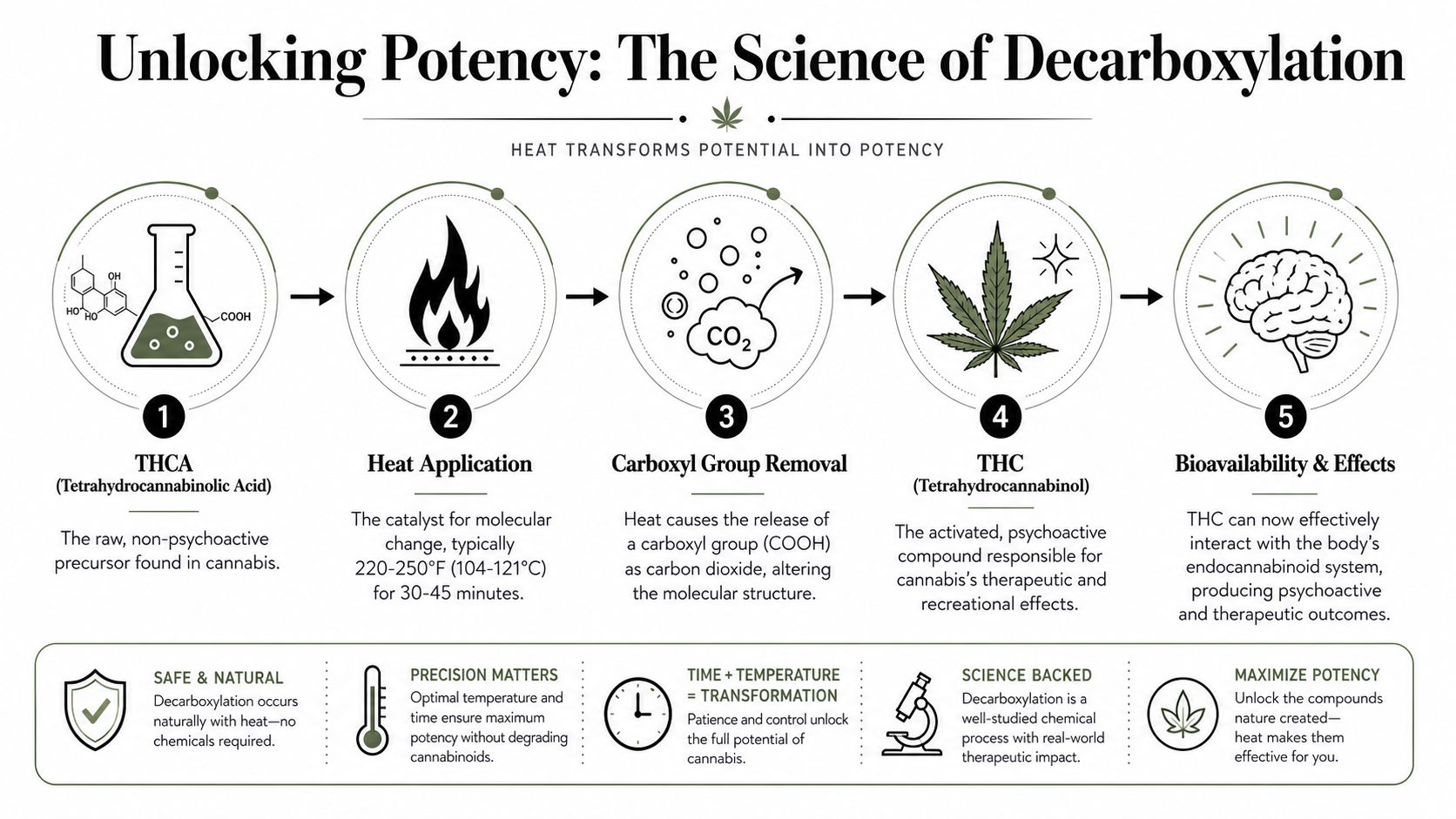
For formulation, that question starts with decarboxylation, not the vape device. THCA is the acidic precursor present before conversion. Controlled heat removes the carboxyl group and converts THCA into THC, which gives the extract the potency profile you intend to sell. If that conversion is incomplete, label potency comes in low. If the process runs too hot or too long, potency and flavor both start slipping before the oil ever reaches a cartridge.
Decarboxylation is also the first place new R&D staff need to understand the formulation gap. Activation happens in bulk processing at one thermal range. Vapor production happens later in hardware at a much higher range. Keeping those stages separate lets you decide where to prioritize THC yield and where to protect the terpene system.
A visual summary helps anchor the process:
The operating window for production
In practice, decarb is a time and temperature problem, not a single magic number. The working range commonly used by processors sits around the low- to mid-100s C, where THCA conversion progresses without pushing the extract straight into accelerated cannabinoid and terpene loss. If you need a processor-oriented reference for setting a conservative starting point, Gold Coast Terpenes' lowest temp for decarboxylation guide is useful for staff training and bench discussions.
The commercial implication is simple. Every degree you add to shorten cycle time has to earn its place by improving throughput more than it harms yield, aroma, or rework rate.
I train teams to treat decarb as a controlled conversion step, not a speed contest. Short, aggressive cycles can look efficient on paper, but they often create oil that tastes flatter, tests less cleanly across batches, and needs more sensory correction during terpene blending.
What goes wrong on the bench and in pilot runs
Three failure modes show up repeatedly in cartridge programs:
- Chasing faster throughput with more heat: This can improve conversion speed while increasing degradation risk and dulling the extract before formulation starts.
- Loading material too deep: Uneven bed depth creates hot and cool zones, so one portion of the batch overprocesses while another stays underconverted.
- Using a decarb profile borrowed from another category: A profile that works for edible oil or crude refinement may not be the right choice for a vape SKU where flavor retention affects repeat purchase.
Decarb protects extract value. Once you lose cannabinoid quality or aromatic character here, later formulation steps usually cost more and fix less.
Thin-layer processing matters as much as oven setpoint because thermal uniformity drives consistency. If heat distribution is uneven, your certificate may still land near target while the sensory performance of the filled carts varies from lot to lot. That is a hidden cost. It shows up later as more batch adjustments, more hold time, and more complaints about one lot tasting brighter or heavier than the previous one.
Why this step drives cartridge economics
Decarb mistakes are expensive because they hit every margin line at once. You can lose active potency, strip out part of the native aromatic backbone, and force the formulation team to spend more time rebuilding profile character with added terpenes. For teams building a terpene profile for distillate, overprocessed oil usually needs more balancing work to get back to the intended strain-inspired result.
A short explainer is useful for staff training before they run their first validation lot:
Decarb benchmarks for R&D handoff
When I hand this process to new staff, I want four points remembered:
- THCA has to be converted before filling. Potency planning starts in bulk processing.
- The useful decarb range is narrow enough to require discipline. Small thermal shifts can change both yield and sensory quality.
- Time is part of the process spec. Setpoint alone does not define a good decarb.
- Overprocessing raises downstream costs. You lose more than potency. You lose formulation flexibility.
If the extract enters blending with poor decarb control, the rest of the cartridge program starts from a weaker position.
The Critical Difference Between Activation and Vaporization
A lot of teams still use "activation temperature" as if it also answers the device question. It doesn't.
THCA begins converting to active THC at about 220°F (104°C), but THC vaporizes efficiently between 330–370°F (166–188°C) based on the temperature distinction outlined here. That difference is the core thermal fact many consumer-facing discussions miss, and it's the reason cartridge formulation can't rely on a single temperature number.
The formulation gap
I call the space between those two events the formulation gap. Below it, you may have activated cannabinoids but poor delivery. Above it, you can create strong vapor but at growing risk to the terpene matrix and cannabinoid stability.
That gap is where R&D teams make meaningful choices:
- Potency-first design: Push toward complete activation before fill, then tune hardware for efficient aerosolization.
- Flavor-first design: Protect volatile notes during manufacturing, then target device temperatures that don't overrun the sensory profile.
- Balanced design: Build a strain-inspired terpene blend and hardware pairing that gives acceptable delivery without flattening the aroma stack.
For a practical device-side reference, the optimal vaping temperature guide is useful because it frames temperature as a performance range rather than a single setting.
What underheating and overheating actually do
Underheating wastes available THC. The oil may contain active cannabinoid, but if the hardware doesn't get the formulation into its useful aerosol range, the end user gets weaker performance than the formulation should deliver.
Overheating creates the opposite problem. The cart produces visible vapor, but the taste turns generic, the top notes disappear early, and the profile can drift away from the intended cultivar expression.
If your cart tastes "hot" or oddly one-dimensional, the problem often isn't the recipe alone. It's the temperature strategy from decarb through device output.
Why this matters for strain replication
Replicating flavor of a known profile becomes difficult. New formulators often think strain replication is mainly a blend design problem. It isn't. It's a blend-plus-thermal-management problem.
You can build a strong formula on paper with citrus, fruit, gas, and spice. But if the cart's operating temperature wipes out the volatile top notes before the cannabinoid fraction reaches efficient vaporization, the result won't resemble the intended profile in use.
That changes how you should evaluate formulas. Don't just smell the oil in bulk. Test it in the intended cartridge hardware. Then compare first pull, mid-cart behavior, and late-cart flavor drift. The formulation gap shows up during actual aerosol generation, not just in the bottle.
Formulating for Flavor How Temperature Impacts Terpenes
Why do two carts built from the same target profile taste different after a few pulls? In formulation work, the answer is often the gap between cannabinoid activation and terpene survival. THC can be fully activated before fill, yet the finished cartridge still fails on flavor because the volatile part of the formula leaves the system earlier than the brand intended.
Terpenes do not behave as one uniform group. Each compound has its own volatility and thermal tolerance, and that sets the sensory order a user experiences in the cart. A blend that smells accurate in bulk can still flatten out in use if the first compounds to aerosolize are not the ones carrying the profile.
For a strain-inspired terpene blend, it is practical to use a fragrance structure: top, mid, and base notes. Top notes create the first recognizable hit. Mid notes supply the main identity. Base notes keep the profile intact deeper into the session, especially in hardware that runs hot or inconsistently. This structure matters commercially because flavor loss shows up as poor strain fidelity, weaker repeat purchase behavior, and more reformulation cost.
Top, mid, and base note behavior under heat
Top notes usually have the narrowest thermal margin. They provide brightness and quick recognition, but they are also the first part of the blend to thin out under repeated heating. Mid notes carry more of the profile through normal use. Base notes, especially heavier woody, resinous, spicy, and earthy materials, tend to persist longer and help prevent the cart from tasting empty halfway through.
That is why flavor design for cartridges is a thermal sequencing problem, not only an aroma selection problem.
If the formula depends too heavily on delicate citrus or floral material, the first draws may feel accurate and the rest of the cart may drift. If the formula is weighted too far toward durable base notes, the cart can taste dense, generic, or overcooked from the start. Good cartridge work balances first-hit identity against late-session persistence.
Some materials give formulators more tolerance. Beta-caryophyllene, humulene, and myrcene are commonly used in cartridge-oriented blends because they hold up better than many lighter top-note terpenes under normal device heat, as discussed in this overview of terpenes used in vape cartridges.
Boiling points shape sensory order
The table below is useful for training new R&D staff because it connects thermal behavior to what the customer tastes first, loses first, and remembers.
| Compound | Type | Boiling Point (°C) | Boiling Point (°F) | Primary Aroma |
|---|---|---|---|---|
| THC | Cannabinoid | 157 | 315 | Neutral to mildly herbal |
| Myrcene | Terpene | 168 | 334 | Earthy, musky, herbal |
| Limonene | Terpene | 176 | 349 | Citrus, bright, sweet |
| Linalool | Terpene | 198 | 388 | Floral, soft, lavender-like |
| CBN | Cannabinoid | 185 | 365 | Heavier, oxidized cannabis note |
The THC and CBN temperature values above match the cannabinoid reference points cited earlier in the article. For terpene boiling behavior, use this terpene temperature chart as a working reference during blend design.
The commercial implication is straightforward. A cart can deliver acceptable vapor density while already losing the citrus lift, floral nuance, or fresh top-end detail that made the profile convincing in the first place. That is the formulation gap in practice. Decarboxylation may be complete, but flavor preservation is still failing.
Blend insight: Judge terpene systems by aerosol performance across the life of the cart, not by cold aroma in the bottle.
How this affects strain replication
Strain replication succeeds when the right compounds survive in the right order. For OG-style gas profiles, durable spice, resin, and earthy components often carry enough of the identity to stay believable in hardware. Dessert and fruit builds are less forgiving. If the device runs hot, sweet notes can collapse into a dull cooked character, and the profile loses definition fast.
Citrus-led blends need support. Use volatile top notes for immediate recognition, then anchor them with mid and base materials that keep the profile readable after the first few pulls. That usually raises formula stability and reduces the number of revisions needed during hardware matching.
For teams sourcing isolates, Gold Coast Terpenes offers beta-caryophyllene as one example of a thermally durable component used in cartridge blend design. The practical lesson is simple. Do not assign all the brand-defining work to the most volatile fraction. Put identity in the opening, but put staying power underneath it.
Heating Methods A Formulators Guide to Hardware
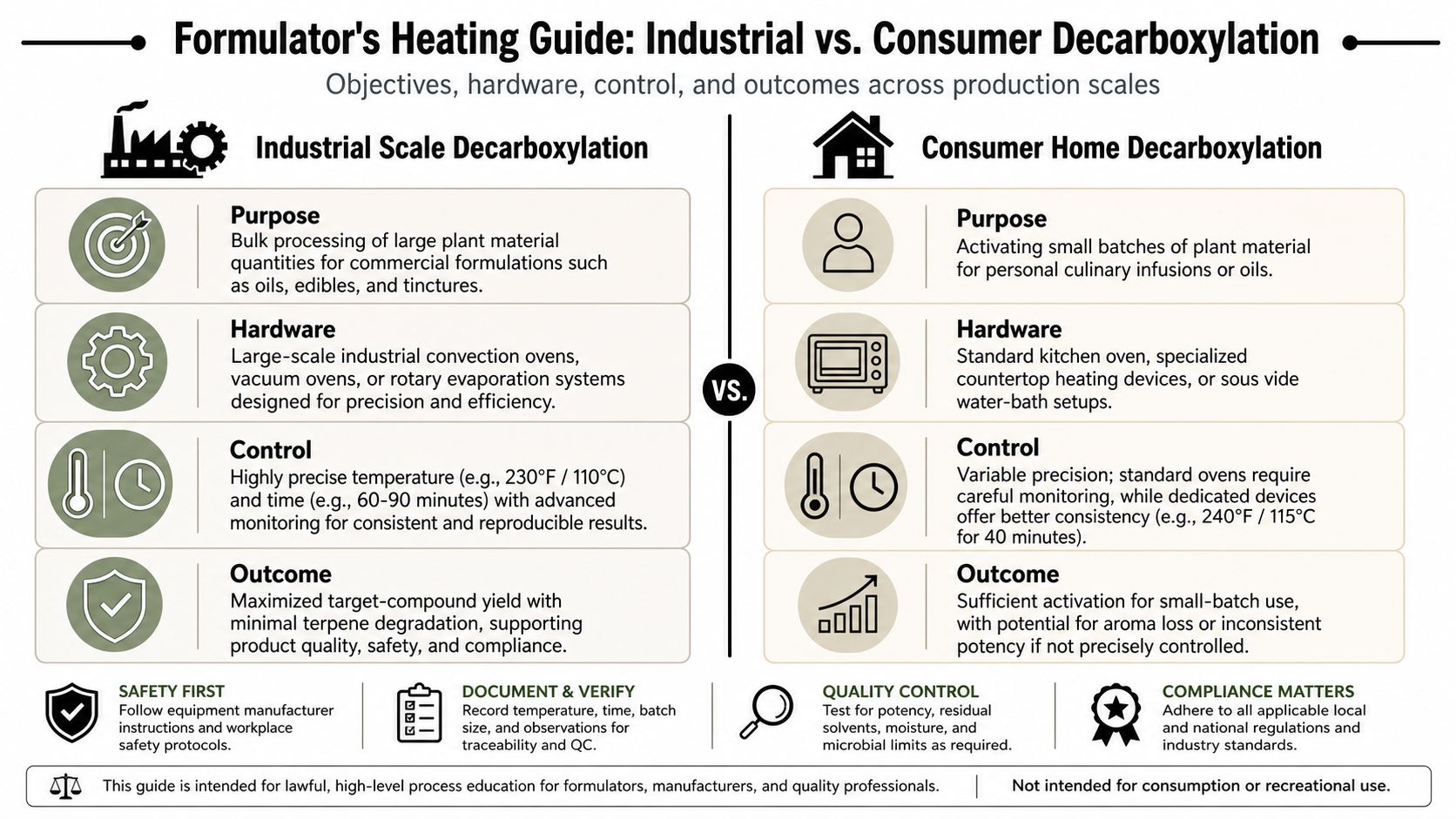
Bulk processing and consumer hardware don't ask heat to do the same job. In production, you want controlled activation and minimal loss before filling. In the cartridge, you want repeatable aerosol generation without wrecking the terpene profile.
That distinction changes how you evaluate every step from post-decarb handling to final device pairing.
Bulk heat versus in-device heat
Industrial decarb is about uniformity. Cartridge heating is about delivery behavior.
In the plant, the goal is a validated and consistent conversion process. In the finished unit, the goal shifts to how the oil wicks, how quickly the coil heats the formulation, and whether the terpene system survives repeated pulls.
That is why the same oil can test well in bulk and still perform poorly in a cart. Hardware exposes weaknesses that the beaker doesn't.
Terpene loading and viscosity
For formulating for distillate, terpene percentage isn't only a flavor choice. It also changes viscosity and hardware behavior. The professional sweet spot for terpene concentration is 5–8% by weight. Distillate typically requires 8–12% loading for proper viscosity, and low-temperature filling at 45–55°C is critical to preserve volatile terpenes according to the distillate terpene use guidance here.
That creates a real trade-off:
| Formulation choice | What it helps | What it can hurt |
|---|---|---|
| Lower terpene loading | Reduced leak risk, softer aroma | Thicker oil, weaker flavor expression |
| Mid-range terpene loading | Better balance of flavor and flow | Requires tight process control |
| Higher terpene loading | Easier flow in some distillates | Greater risk of harshness and hardware issues |
The sweet spot depends on the specific oil and cartridge design. But the process principle stays the same. Every terpene addition changes both sensory output and physical handling.
Filling temperature is a quality control step
Low-temperature filling gets ignored too often by new teams. That is a mistake.
If you heat too much during fill, you can lose the most volatile notes before the customer ever opens the package. The blend may still pass a quick smell test in the room, but the top-end expression is already thinner. By the time the oil reaches the final device and sees another heating event, the profile has even less room to hold up.
This is also where materials selection matters. Ceramic-core systems and other common cartridge styles each impose different stress on the blend because they differ in heating speed, saturation pattern, and repeated-puff behavior. R&D shouldn't approve a terpene blend for general use without checking how it behaves in the exact hardware class the SKU will ship in.
Cartridge development is a three-part match problem. Oil chemistry, terpene loading, and hardware temperature behavior must fit each other.
What works versus what doesn't
What usually works:
- Validated low-temp fill procedures: They preserve more of the intended top-note structure.
- Moderate terpene loading: It gives enough flow and aroma without making the oil unstable.
- Hardware-specific testing: It catches flavor drift and wicking issues early.
What usually doesn't:
- One blend across all carts: Hardware differences change sensory output too much.
- Overheated fill tanks: Easy process shortcut, expensive flavor loss.
- Treating voltage as a marketing setting only: Voltage is a formulation variable in disguise.
Ensuring Product Integrity and Safety
A good cartridge isn't just potent and flavorful. It also stays inside a safe thermal range during use and remains consistent across batches.
The upper boundary matters. Avoiding temperatures above 220°C (428°F) is critical for THC preservation, and combustion begins at approximately 230°C (446°F) according to the temperature safety guidance here. For commercial products, that isn't a suggestion. It's a design limit.
Non-negotiable process rules
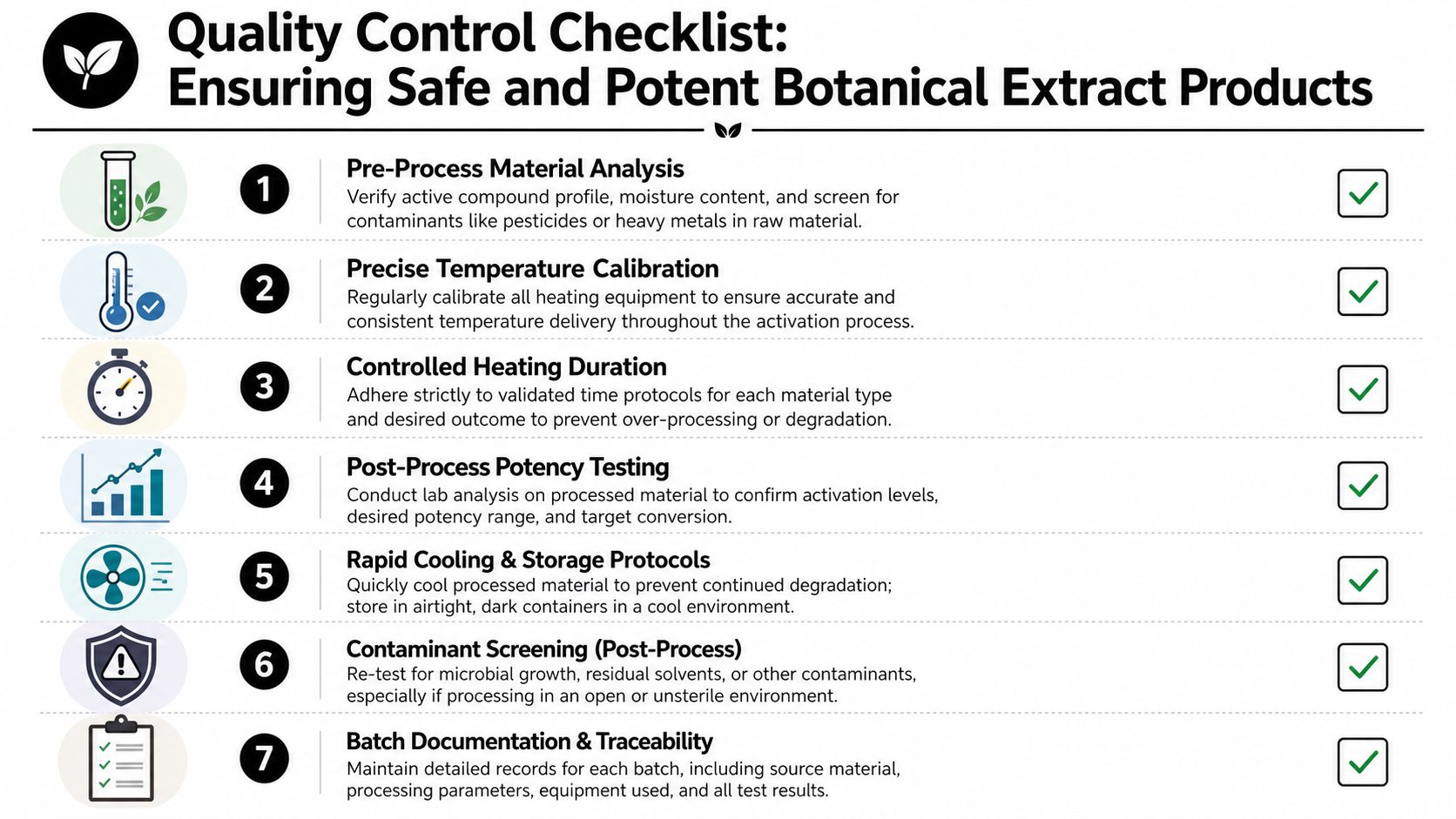
Quality control around thermal handling should be written into batch procedures, not left to operator habit.
- Calibrate heating equipment: Ovens, hot plates, fill systems, and test devices need regular verification.
- Validate post-decarb material: Check whether your activation target was reached before blending.
- Protect the blend during fill: Low-temperature handling helps preserve volatile aroma fractions.
- Test in final hardware: Bench aroma doesn't predict in-cart performance well enough.
- Document every thermal step: Time, temperature, material depth, and operator notes should all stay with the batch record.
A supporting operations reference for documentation and handling is this resource on why safety data sheets matter.
The shortest useful checklist
If a new formulator asks me how to avoid the biggest thermal mistakes, I give them this version:
- Activate cannabinoids in a controlled decarb window.
- Add terpenes with viscosity and volatility in mind.
- Fill cool enough to avoid pre-device aroma loss.
- Pair the formula with hardware that doesn't overshoot.
- Reject any setup that pushes the product toward degradation or combustion.
Heat creates the product, but uncontrolled heat also destroys it.
That is the answer behind the search for what temperature does THC activate. Activation is only the first checkpoint. Primary formulation work is managing every temperature step that follows.
Gold Coast Terpenes supplies terpene blends, strain-specific profiles, isolates, and formulation resources for teams building carts, concentrates, and other inhalable products. If you're working on a terpene profile for vape cartridges, a strain-inspired terpene blend for distillate, or replicating flavor of a target cultivar with better thermal discipline, explore the formulation tools and product options at Gold Coast Terpenes.