
A lot of teams start looking up how to decarb rosin only after a cart batch goes sideways. The oil fills clean, then turns cloudy. A few units sugar up. Flavor shifts from bright to flat. Hardware performance becomes inconsistent across the same run.
That usually isn't a terpene problem first. It's a base stability problem. If the rosin wasn't decarboxylated with control, the rest of the formulation workflow gets harder. You can't reliably replicate flavor, predict viscosity, or expect clean cartridge performance when the starting material is still chemically unsettled.
For commercial work, decarb is not a side task. It's the point where raw rosin stops behaving like pressed concentrate and starts behaving like a usable formulation input for vape cartridges.
Why Decarboxylation Is Critical for Product Formulation
In a production setting, decarboxylation does two jobs at once. It converts THCA into THC, and it stabilizes the rosin so the oil behaves more predictably during blending, filling, and storage.
That distinction matters. A lot of entry-level discussions frame decarb as simple activation. That mindset is too narrow for cartridge manufacturing. In carts, the issue is whether the oil will stay homogeneous after you add your terpene system and put it through filling, capping, and shelf time.
Stable oil makes repeatable formulation possible
Undecarbed or partially decarbed rosin can work against you. The blend may look acceptable while warm, then shift later. That creates problems that show up as poor visual consistency, uneven flow through hardware, and strain-inspired terpene blend performance that doesn't match the target profile.
If you're building products around flavor accuracy, decarbed rosin becomes the neutral foundation. Once the cannabinoid phase is stable, you can make smarter terpene decisions around top notes, middle structure, and heavier supporting notes.
A simple primer on the chemistry sits in Gold Coast Terpenes' explanation of what decarb means, but the formulation takeaway is more practical than academic. You can't tune flavor on an unstable base.
Practical rule: If a cart formula needs constant reworking after filling, check decarb execution before blaming the terpene blend.
Decarb affects brand consistency, not just lab technique
Brand owners usually feel this step through downstream failures. One batch tastes greener than the previous run. Another tastes dull because too much of the native aromatic fraction was cooked off. A third run fills fine but behaves poorly once it sits in hardware.
Those aren't isolated issues. They're symptoms of weak process control.
For product teams developing a terpene profile for vape cartridges, good decarb creates three operational advantages:
- Cleaner flavor rebuilding: You know what native character remains and what needs reintroduction.
- Better viscosity judgment: The oil has moved closer to its final working state before you start dosing terpenes.
- Fewer surprises in packaging: Carts are less likely to change appearance and performance after the fill.
What works and what doesn't
What works is treating decarb like a controlled pre-formulation step with documented temperature, visual observation, and a clear endpoint.
What doesn't work is treating rosin like distillate and assuming a quick heat cycle will solve everything. Rosin carries a broader native chemical profile, and the process window is narrower if you care about flavor retention.
For vape work, decarb is the first quality gate. If it goes well, terpene formulation becomes deliberate. If it goes badly, every later adjustment becomes reactive.
The Science of THCA Conversion and Terpene Volatility
A cart oil can look finished on fill day and still fail a week later. The usual cause is simple. THCA conversion and terpene loss were treated as one heat step instead of two competing process variables.
THCA decarboxylation is a chemical reaction. Heat removes the carboxyl group from THCA, releases carbon dioxide, and leaves THC behind. In rosin, you can watch that reaction happen because CO2 escapes through visible bubbling as the mass liquefies.
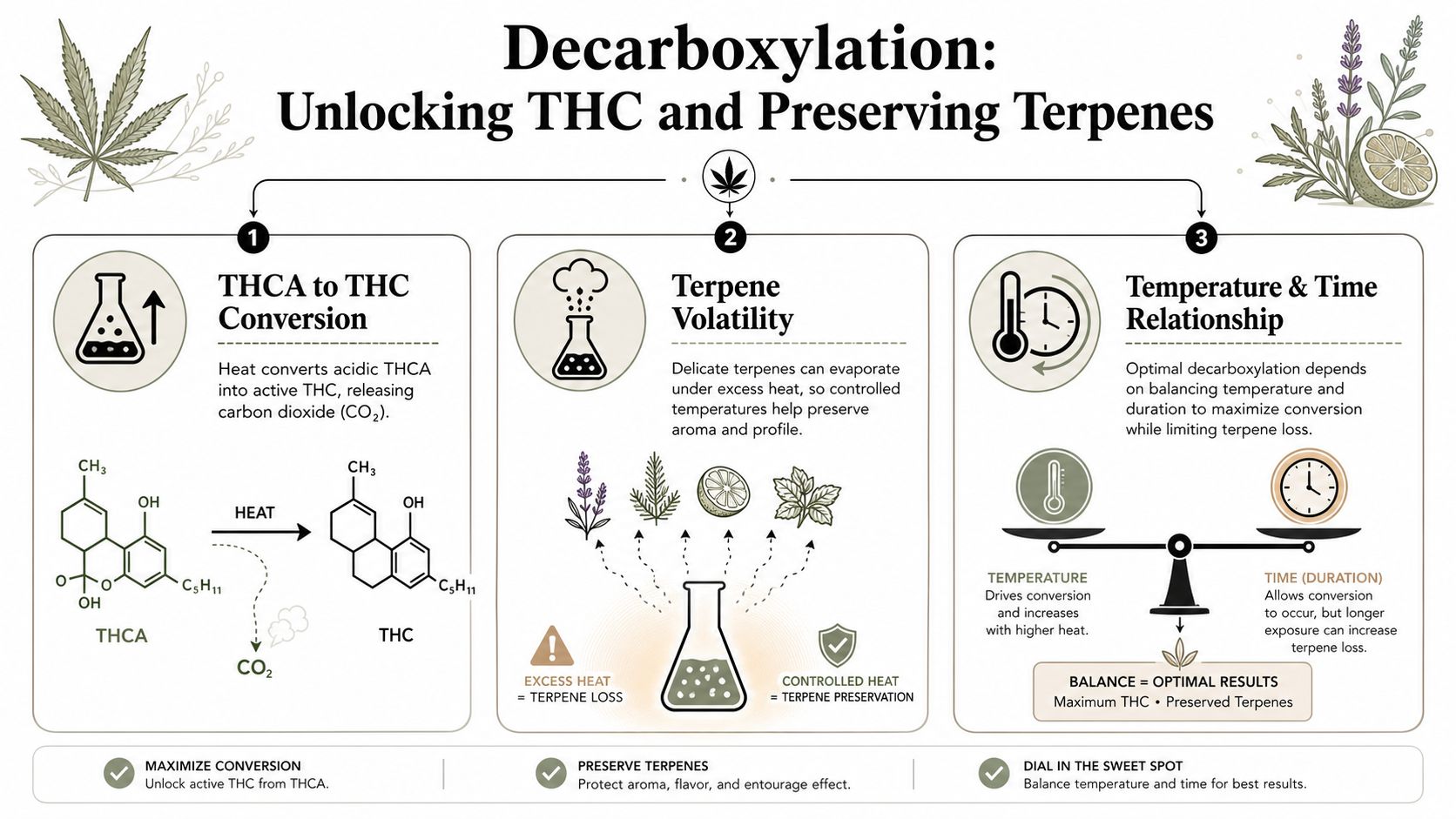
For formulators, that bubbling is more than a visual cue. It is the closest thing you have to a live process signal without running an in-process potency test. Active bubbling means the reaction is still venting CO2. When bubbling drops off and finally stops, decarb is approaching its endpoint. That matters because a chamber setpoint only tells you what the equipment is reading, not whether the rosin mass has fully caught up.
Rosin makes this harder than many new operators expect. You are not heating isolated cannabinoids. You are heating a mixture that also carries monoterpenes, sesquiterpenes, minor volatiles, waxes, and other native compounds that affect flavor and cartridge behavior. Some of the lightest aroma compounds move early, well before the oil looks or smells "overcooked" to an operator standing at the bench.
A useful reference is this boiling point chart for common cannabis terpenes. It helps explain why a decarb that finishes conversion can still leave you with a flatter sensory profile and less accurate strain rebuilding later.
The practical balance is narrow:
- Incomplete conversion leaves residual THCA in the oil, which can show up later as instability, thickening, or crystal formation.
- Excess heat shortens the route to full conversion but strips volatile aroma compounds and muddies the native profile.
- Controlled heat gets the oil closer to a stable cartridge input while preserving enough character to make terpene reintroduction more accurate.
That last point matters in commercial vape work. If the native top notes are gone, the formulation team is no longer refining flavor. They are reconstructing it with less information.
Temperature control also matters more than the oven dial suggests. Small deviations at the chamber level can change how fast the reaction runs and how much aroma you lose, especially in shallow vessels or small development batches. Good operators verify the actual process temperature and watch the material itself. They do not trust the knob position or a timer by itself.
For cartridge production, the science comes down to one operating rule. Finish the THCA conversion, but protect as much of the original volatile fraction as the process allows. That is what gives you a stable oil, a cleaner QC target, and a better starting point for terpene reintroduction.
Equipment and Methods for Controlled Decarboxylation
The method you choose depends on what you're optimizing for. Some labs care most about low capital cost. Others care about terpene preservation, temperature stability, or easy scale-up. There isn't one universal setup, but there are clear trade-offs.
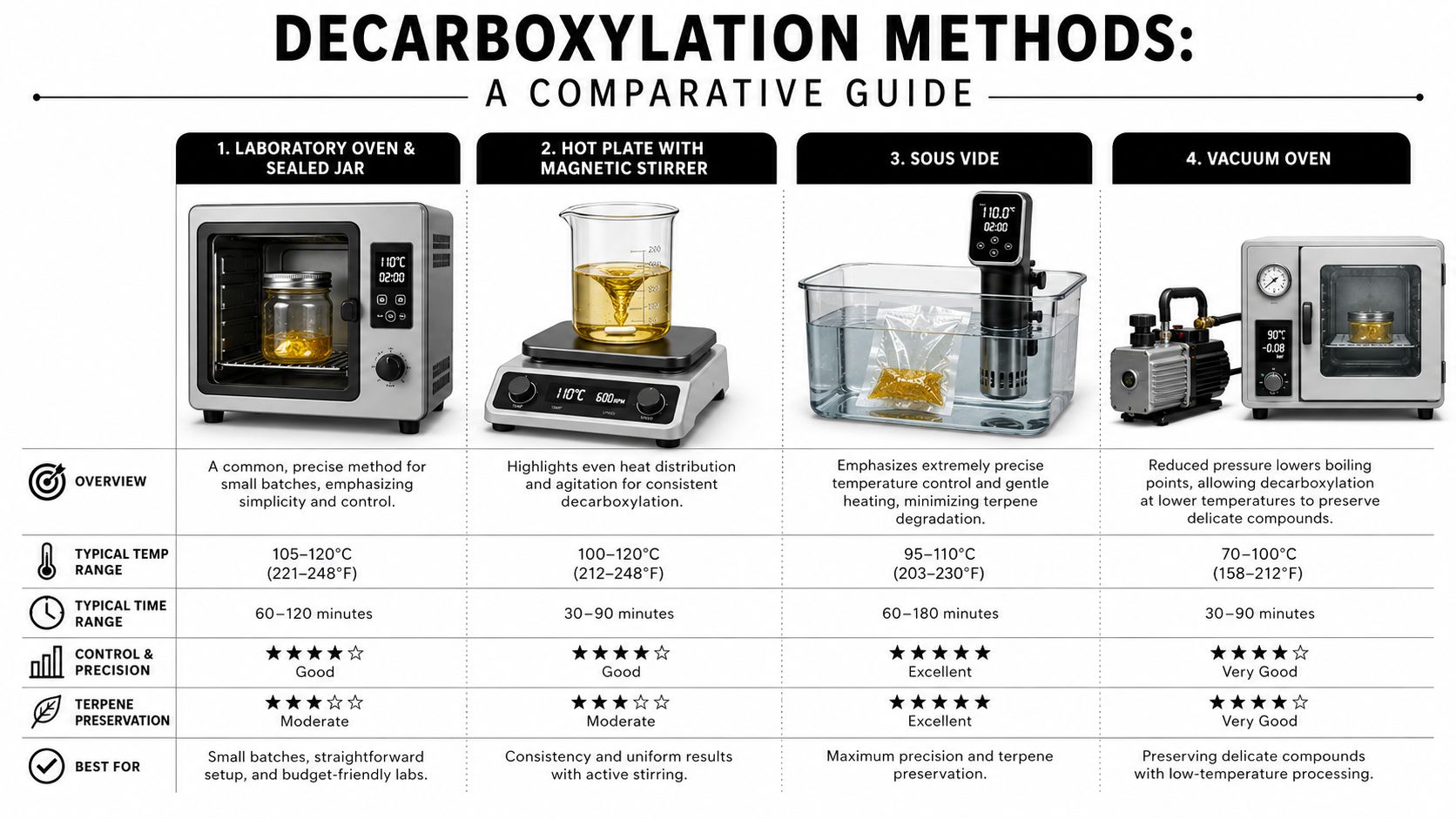
Side-by-side method comparison
| Method | Where it fits | Main strength | Main limitation |
|---|---|---|---|
| Laboratory oven and sealed jar | Small to mid-size controlled batches | Accessible workflow and straightforward observation | Chamber fluctuation can create inconsistency if poorly validated |
| Hot plate with magnetic stirrer | Bench development and small blending runs | Direct control and even heating across a smaller mass | Easy to overshoot if operators rush the process |
| Sous vide | Precision-focused small batch work | Gentle, highly stable heating environment | Slower workflow and less practical for some production layouts |
| Vacuum oven | Labs prioritizing aroma retention | Lower-pressure environment can support gentler processing | Higher cost and more process complexity |
What each setup does well
The laboratory oven with a sealed glass jar is still the most common entry point. It's practical, easy to document, and scalable enough for many formulation labs. If the oven is validated and the vessel is appropriate, this method gives operators good visual access to melt behavior and bubbling.
A hot plate with magnetic stirrer gives more direct thermal contact and can smooth out hot spots in smaller batches. I like it for bench formulation work, especially when a team needs to observe consistency changes closely. The downside is operator error. If someone's impatient, direct heat can become aggressive fast.
A sous vide setup is useful when temperature precision matters more than speed. Water bath systems hold a tight environment and reduce the chance of abrupt overheating. For labs exploring sous vide decarb methods, the appeal is usually terpene preservation through gentler heat exposure rather than raw throughput.
A vacuum oven is the most specialized of the group. Lower pressure changes how volatile compounds behave and can support more delicate processing. That doesn't remove the need for process discipline, but it can give formulation teams more room to protect aroma during decarb.
How manufacturers usually choose
The decision is less about prestige and more about workflow fit.
- Choose the oven-and-jar route if you need a practical SOP that new technicians can learn quickly.
- Use hot plate decarb when you're doing R&D, making rapid bench comparisons, or working with very small lots.
- Move to sous vide when you want highly controlled heating for terpene-sensitive development work.
- Invest in vacuum capability when premium flavor retention justifies added equipment and training.
Operator note: The best method is the one your team can repeat accurately under production conditions, not the one that looks most advanced on paper.
For most brands developing carts, the right answer is often a validated oven process first, then more specialized equipment as flavor targets tighten and volumes increase.
A Step-by-Step Rosin Decarboxylation Workflow
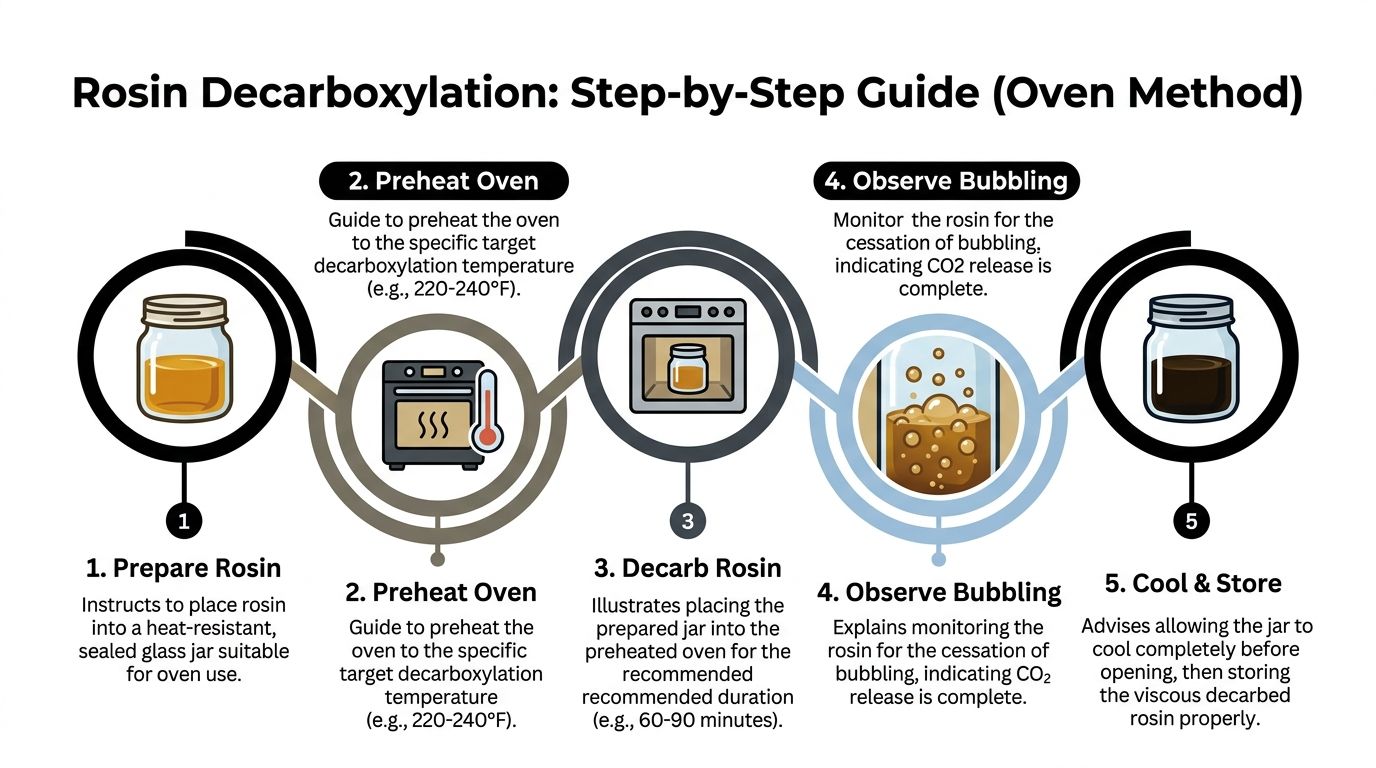
For most formulation labs, the sealed glass jar in a controlled oven is the clearest baseline process. It gives you containment, visible process cues, and a workflow that scales from pilot batches to more routine production.
This visual guide matches the workflow below.
Prepare the vessel and verify heat
Start with a heat-resistant glass jar that seals properly. The goal isn't to pressure-build aggressively. The goal is to contain the material and reduce unnecessary aromatic loss during heating. Keep headspace reasonable so you can still observe bubbling.
Before the jar goes in, verify the oven with an external thermometer. Don't rely on the dial. In real labs, the stated temperature and the actual chamber temperature often aren't the same, and that's enough to push a decarb run off target.
Run the decarb and watch the reaction
Heat the rosin in the validated target range and observe the material, not just the clock. Herbistry420 notes that THCA has a half-life of approximately 30 to 45 minutes at 230°F (110°C), and that bubbling typically resolves over a 30 to 90 minute window depending on the mass of the concentrate (Herbistry420 decarb reference).
That window explains why fixed-time decarb rules often fail in production. Small masses finish differently from larger ones. Rosin texture also changes how the reaction presents.
A simple workflow looks like this:
- Load the jar with the rosin you intend to process and seal it appropriately.
- Place it in the preheated oven once the chamber temperature is confirmed.
- Watch for the melt phase as the rosin softens and becomes more fluid.
- Observe active bubbling as CO2 releases from the conversion.
- End the run only after bubbling fully stops, because that visual change is the most reliable completion cue.
Later in the process, this video can help newer technicians match the written SOP to what the material looks like in motion.
Cool before opening and document the lot
After the bubbling stops, remove the jar and let it cool before opening. Opening hot material too soon increases aromatic loss and makes handling messier than it needs to be.
Then document what happened. Record the mass, equipment used, validated temperature range, start time, endpoint observation, and finished appearance.
A good decarb record should let another technician repeat the run without guessing what “done” looked like.
That documentation matters for more than compliance. It becomes your reference when one rosin lot needs a slight process adjustment and another runs exactly as expected. If you're serious about replicating flavor of a cultivar for vape cartridges, your decarb notes become part of formulation QA.
Formulating for Vape Carts with Terpene Reintroduction
A decarbed rosin batch can smell accurate in the jar and still fail once it goes through filling, sits in hardware, and gets heated by the end user. Cartridge formulation starts with that reality. The job is to rebuild aroma with enough restraint that the oil stays stable, wicks cleanly, and still tastes like the target cultivar after packaging.
Why reintroduction matters
Decarb changes the native terpene balance, even in a controlled run. Some rosin lots keep enough character to anchor the final profile. Others come out flatter, darker, or less distinct, which leaves the cartridge tasting generic unless you rebuild the aromatic structure.
For commercial vape work, terpene reintroduction is a formulation step, not a cosmetic adjustment. You are tuning flavor, viscosity behavior, and shelf performance at the same time.
A practical starting range for vape carts is often 4 to 8% terpenes by weight, with many formulators beginning near 5% and adjusting after hardware testing, as noted earlier. Starting lower gives you room to correct flavor expression without overshooting into harshness or leakage risk.
Build the profile around post-fill performance
Bench aroma can mislead you.
A blend that smells bright in a warm beaker may lose its top end after filling, while a profile that seems slightly restrained on day one often tastes better after the oil settles in the cartridge. That trade-off matters more than first impression because the customer experiences the filled cart, not the mixing vessel.
Arvida Labs notes that monoterpenes such as limonene and pinene may require a 15 to 30% loss factor during filling and initial storage when strain replication is the goal (Arvida Labs formulation strategies). In practice, that means the target profile should be built for where the oil will land after processing, not where it starts on the bench.
Structure the blend by function
For formulation, I treat the profile as a set of jobs the terpenes need to do inside the cart.
- Top notes create the first impression and usually come from the more volatile fraction.
- Mid notes hold the cultivar identity together once the brightest compounds start to fade.
- Base notes add depth and help the flavor stay present through repeated heat cycles.
That structure keeps the blend from becoming all sparkle and no backbone. A cart loaded too heavily with bright monoterpenes may test well in a fresh sensory pass, then taste thin after storage or run sharp on hotter hardware.
Terpenebelt Farms advises keeping monoterpene concentrations below 6% while using sesquiterpenes such as β-caryophyllene and humulene at 3 to 5% to improve thermal resilience and flavor retention in vape cartridges (Terpenebelt Farms product development guide). That is a useful guardrail for cartridge work because it ties flavor design to actual device conditions.
Dose conservatively and test in the actual hardware
Terpene addition is easiest to correct when you undershoot the first pass. It is much harder to pull a blend back once the profile turns solvent-like, irritant, or too thin for the cart design.
For teams learning how to use terpenes in decarbed rosin formulations, the workflow is usually straightforward:
- Evaluate the decarbed base for remaining native aroma and any heat-related off notes.
- Set a target. Decide whether the goal is cultivar matching or a strain-inspired profile built for the hardware.
- Add terpenes at a conservative rate and mix thoroughly under controlled temperature.
- Fill test carts and let them equilibrate before judging flavor.
- Review taste, vapor feel, and stability after short-term storage, then adjust the blend.
The key QC point is simple. Approve the formula from the cartridge, not from the beaker.
Gold Coast Terpenes offers strain-specific profiles and isolated compounds that can be used as one option in that workflow when a formulator needs building blocks for top-note correction, mid-profile shaping, or heavier support notes.
Troubleshooting Common Decarb and Formulation Issues
A batch can look fine in the beaker, fill cleanly, and still fail a week later in carts. In production, that usually traces back to one of three points: the decarb endpoint was called too early, the oil took too much heat, or the terpene blend was built for aroma on the bench instead of behavior in hardware.
Cloudy oil or sugaring in the cart
Cloudiness, haze, or crystal formation usually points to residual THCA. The oil may have seemed stable while hot, then shifted as it cooled and sat in the cartridge. That is a decarb control problem first.
Check the lot record before changing the formula. Review the actual endpoint indicators used on that run, including gas release, visual clarity, and hold behavior at temperature. If the batch was ended on a preset timer while it was still releasing CO2, the cart is showing you what the reactor already missed.
A second check matters here. Compare the failed cart against retained bulk oil from the same lot. If the bulk also starts to haze over time, the instability came from the base. If only the cart shows it, look harder at fill temperature, terpene ratio, and hardware compatibility.
In cartridge work, visual instability usually starts with conversion or composition, not packaging.
Harsh, thin, or burnt flavor
Harshness has two common causes in rosin carts. The first is heat damage during decarb, which strips out the softer native character and leaves the oil flatter and drier on the inhale. The second is a terpene blend that is too sharp or too light for the viscosity and coil conditions of the finished cart.
Start with the base, not the added terpenes. Smell and taste the decarbed rosin on its own. If the oil already carries toasted, dull, or acrid notes, no top-note correction will fully hide that. Rework the decarb profile on the next lot by reducing thermal load and tightening endpoint control.
If the base is clean but the cart still hits thin or hot, pull back the terpene concentration and rebalance the blend. For cartridge formulations, I prefer to build up slowly from a conservative addition rate and judge the result after the oil has equilibrated in the actual hardware. Heavy top-note blends can smell exciting in a jar and still vape sharp, dry, or solvent-like once the coil sees repeated heat cycles.
Flavor work in carts is always a stability decision too.
Clogging, leaking, or poor hardware behavior
These failures often get blamed on the cartridge, but the formula is usually involved. Oil that is too thin can flood the atomizer and leak during warm storage. Oil that still contains partially converted cannabinoids can shift in viscosity and start clogging after fill. A terpene system built around bright, volatile fractions can make both problems worse.
Use a simple shop-floor review:
- Check the decarb record. Confirm the batch reached a true endpoint and was not released on time alone.
- Review viscosity at fill temperature and room temperature. Bench flow has to match the intake design of the cartridge.
- Look at terpene composition. A blend with too much light fraction and not enough structural support can run well for a day and then lose balance in storage.
- Test the exact hardware. Judge draw resistance, leakage, aerosol quality, and flavor from the filled cart, not from a hot stir cup.
- Compare problem lots side by side. Repeating failure in one profile usually points to formulation design, not random hardware variation.
The teams that get repeatable cartridge performance treat decarb, terpene reintroduction, and hardware testing as one workflow. Gold Coast Terpenes supplies strain-specific terpene blends, isolates, and formulation resources that fit into commercial rosin and distillate production when a formulator needs to adjust flavor architecture without losing control of stability.