
A lot of terpene brands hit the same wall at the same moment. The formulation is dialed in, the flavor is finally clean in hardware, the distillate behaves, and buyers outside your home market start asking for samples or wholesale pricing. Then operations steps in with the questions of real importance: what code goes on the invoice, what lab panel will customs accept, what does the destination country call this material, and what wording on the paperwork could get the shipment stopped.
That's where import export guidelines stop being background admin and become part of formulation strategy.
For terpene suppliers, extractors, and cartridge manufacturers, cross-border shipping isn't only about moving bottles from one warehouse to another. It's about proving what the material is, what it is not, how it was made, how it will be used, and whether the receiving country agrees with your classification. If you're building a strain-inspired terpene blend for vape cartridges or sourcing isolates for distillate, the wrong assumption at any point can turn a routine shipment into a hold, a return, or a seizure.
Expanding Your Brand Beyond Domestic Borders
A familiar scenario plays out like this. A brand develops a strong domestic line of carts, concentrates, or terpene blends. Retail feedback is good, distributors want exclusivity in other markets, and the next move looks obvious. Ship internationally.
Then the first freight quote lands, the broker asks for an HS code, the buyer wants origin paperwork, and somebody on the team realizes the existing COA was designed for internal QA, not customs review.

The issue usually isn't one big legal obstacle. It's a stack of smaller decisions that compound. A shipment of terpene isolates might be chemically clean but poorly classified. A terpene profile for cannabis product formulation might be legal in concept but documented in a way that makes customs think it belongs in another category. A blend that ships fine domestically can raise new questions once a border officer, customs auditor, or carrier compliance team sees the words “cannabis,” “vape,” or “extract” on the paperwork.
What operators usually get wrong
It is common for teams to spend too much time on one document and not enough on the full shipment record. They focus on the COA and ignore the invoice language. They verify THC status but leave intended use vague. They assume a broker will fix product classification after the fact.
That approach works until it doesn't.
Practical rule: Customs problems usually start with ambiguity. If your paperwork leaves room for interpretation, someone at the border will interpret it for you.
The workable approach is narrower and more disciplined:
- Define the product correctly: Is it a single isolate, a botanical blend, or a cannabis-derived material that needs additional scrutiny?
- Match the document set: Invoice, COA, SDS, origin records, and import permits need to describe the same thing in the same way.
- Write for inspection, not marketing: “Premium live profile experience” means nothing to customs. Composition, source, and use do.
For teams building a formulation guide for distillate or scaling a strain-inspired terpene blend for vape cartridges, international expansion starts long before pickup. It starts with the records you create before the goods ever leave the floor.
Understanding the Global Legal Framework for Terpenes
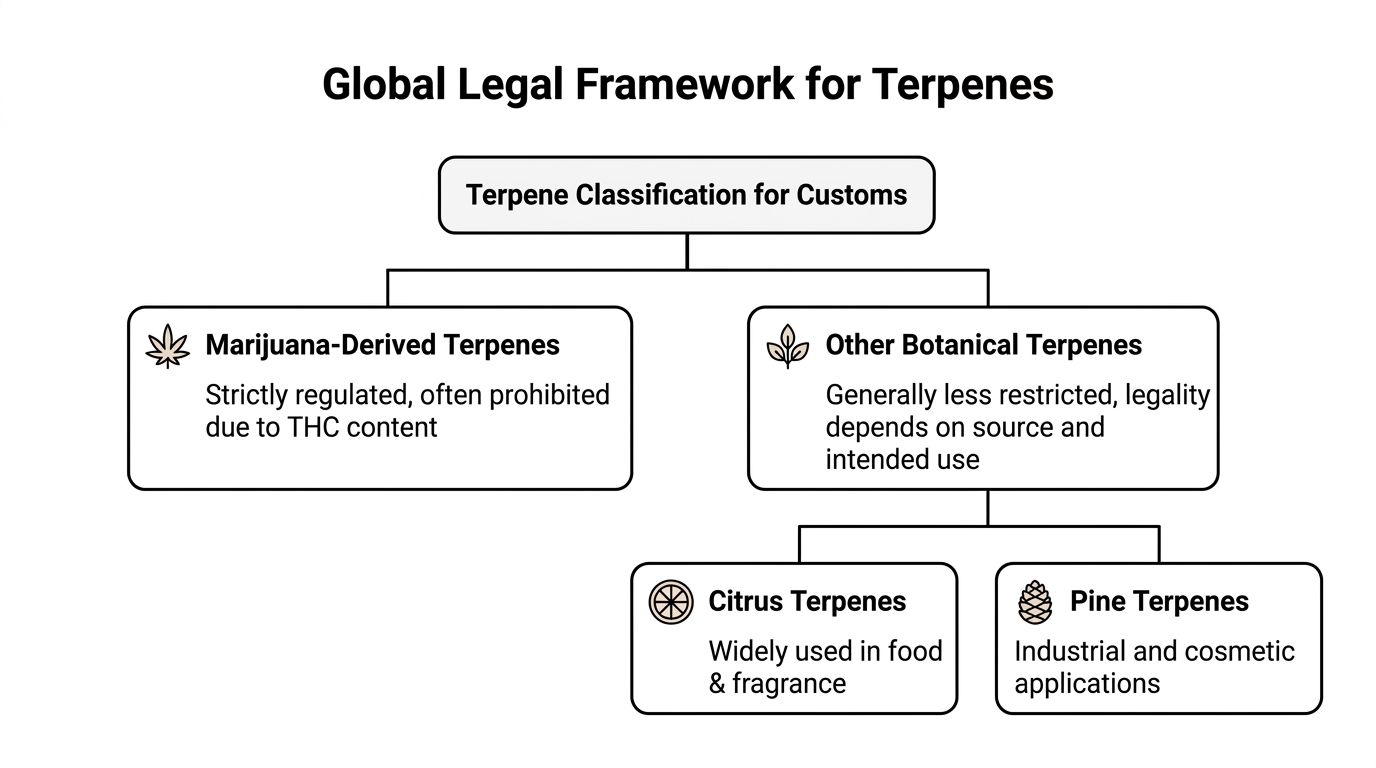
The first distinction customs cares about is source. Not branding. Not strain name. Not whether the product smells like a familiar cultivar. Source.
If a terpene product is marijuana-derived, regulators may treat it very differently from a hemp-derived or other botanical material, even when the product is intended for the same kind of formulation work. For cross-border trade, THC-free status is usually the threshold issue, but it isn't the only issue. A compliant product still has to be classified, declared, and documented in a way the destination country accepts.
Why the paperwork is so rigid
International trade runs on standardized reporting. Under the UN's International Merchandise Trade Statistics guidelines, customs declarations are the primary data source for detailed import and export information, including the geographic breakdown used to enforce import-export rules, as outlined in the UN trade statistics framework. That matters because your shipment isn't just being cleared. It's being recorded in a harmonized system that governments use to track what entered, from where, and under what declaration.
For formulators, that changes the mindset. A terpene profile for vape cartridges may feel like a product development item internally. At the border, it becomes a customs object that needs a precise identity.
A strong baseline for teams that need a refresher on the legal status side is this guide on whether terpenes are legal.
The legal test is product identity plus intended category
Two products can smell similar and still be treated differently. Customs and regulators usually want clear answers to these questions:
- What is the source material
- What is the chemical nature of the item
- What category does it belong to in trade
- What market is it entering
- What use is being declared
That's why a bottle labeled loosely as a “cannabis terpene blend” can create more friction than a bottle described with specific source and composition language.
Later in the process, that same logic affects your tariff code, labeling, and market-specific import permissions.
For teams working on replicating flavor of legacy cultivars for cannabis product formulation, the practical takeaway is simple. Build your export file around provable product identity, not product story.
A short technical refresher helps here:
Classifying Terpenes and Extracts with HS Codes
A shipment can clear every internal review and still get stopped because the tariff code points customs to the wrong product category. I see this happen with terpene isolates and blends that were described correctly for sales, but not classified tightly enough for import review. Once that happens, the officer is no longer looking only at the bottle. They are looking at composition, declared end use, and whether the paperwork supports the category you chose.
The HS code is the starting point for that review. It shapes duty treatment, document expectations, and how much scrutiny the shipment gets in transit or at destination. A weak classification choice also creates downstream risk if the goods move through a third country, because transshipment checks often rely on the same product description and code.
The codes that matter most
For terpene shipments, classification usually turns on composition. A single compound and a multi-component blend do not always belong under the same heading, even if both are purchased by the same formulation team.
In practice, customs often separates products along lines like these:
| Product type | Likely customs treatment |
|---|---|
| Single terpene isolate such as pinene | Often reviewed under a chemical-specific heading if the product fits that definition |
| Multi-component botanical terpene blend | Often reviewed more like an essential oil, aromatic extract, or related preparation |
| Poorly described blend with marketing language only | More likely to trigger questions, reclassification, valuation review, or a hold |
The exact code still depends on the facts of the product. National tariff schedules and customs notes control the final answer, and brokers should verify the code before shipment.
What determines the right code
Classification follows the product's objective characteristics. Branding language does not control the result.
Customs, brokers, and receiving compliance teams usually look at four things first:
- Chemical makeup: single isolate, fraction, or formulated blend
- Source description: botanical, hemp-derived, or another declared origin
- Degree of processing: crude extract, purified constituent, or finished ingredient system
- Commercial presentation: industrial input, flavor or fragrance material, or another declared use
Source wording matters more than many teams expect. If your invoice says hemp-derived, your specification sheet and supporting records should explain what that means in a technically defensible way. This explanation of hemp-derived terpene terminology is a useful reference for aligning that language before the shipment file is built.
A common classification mistake is treating intended branding as the product category. Customs does not clear "strain-inspired flavor systems" as a concept. It clears a defined chemical good, under a specific heading, with a declared use that matches the rest of the file.
What works and what fails
The strongest classification files are boring in the right way. The invoice, COA, specification sheet, SDS, and shipper instructions all describe the same material in the same terms. That consistency lowers the chance that customs will question whether the product was coded to fit a preferred duty rate or to avoid a controlled-category review.
These examples show the difference:
- Works: “Botanical terpene blend for product formulation,” with composition support in the specification sheet and COA
- Fails: “Cannabis flavor extract,” when the product is a non-intoxicating botanical blend and the other records use different terminology
- Works: “Pinene isolate,” with a specification sheet that identifies the compound and purity
- Fails: “Natural aroma concentrate,” with no compositional detail and no clear basis for the selected tariff heading
The hidden trap is that classification does not stand alone. If the code suggests an industrial chemical, but the end-use declaration suggests a consumer cannabis product, customs may stop the shipment to resolve the mismatch. If the goods route through an intermediate country, that same mismatch can trigger transshipment questions even before the cargo reaches the final buyer.
For formulators and manufacturers, the practical rule is simple. Classify the material you are shipping, then make every other document describe that same material the same way. That is what prevents expensive debates at the border.
Assembling Your Essential Documentation and Lab Tests
A shipment can be chemically clean and still get stopped because the file set falls apart under review. I see that pattern more than failed lab work. Customs officers, brokers, and carrier compliance teams are looking for a record trail that answers three questions fast: what is it, who made it, and what will the buyer do with it.
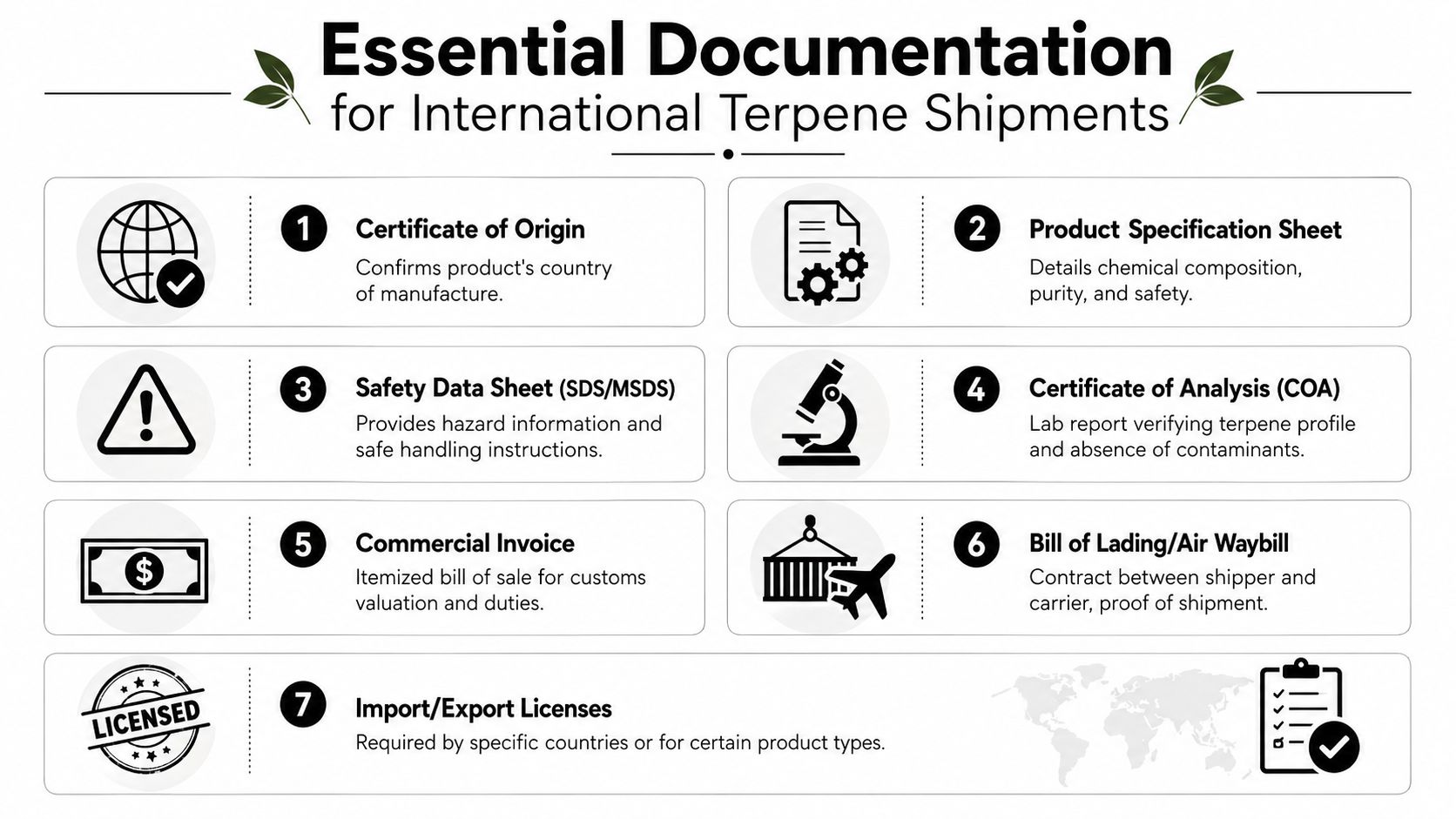
The file has to work as one package. If sales calls the material a flavor, the COA calls it a botanical blend, and the consignee describes it for inhalation use, you have created an end-use problem before the box lands. If the shipment routes through a third country, those same inconsistencies can also trigger transshipment scrutiny.
The records that have to agree
Each document serves a different reviewer, but they need to describe the same product and the same transaction.
- Commercial invoice: Identifies seller, buyer, value, product description, lot references, and declared end use.
- Certificate of origin: Supports origin claims and any tariff treatment tied to where the material was produced.
- Safety Data Sheet: Tells carriers, warehouses, and regulators how the material should be handled and stored.
- Product specification sheet: Defines composition, purity, identity, and intended industrial role in technical terms.
- Bill of lading or air waybill: Ties the freight movement to the shipment record and consignee details.
- Import or export permits: Required in some jurisdictions and often reviewed against the invoice description and consignee license.
- Certificate of Analysis: Confirms that the tested lot matches the shipped lot and supports the legal status being claimed.
Teams that need a stronger SOP baseline should keep this safety documentation requirements resource in their compliance library.
What customs and regulators look for in the lab file
A usable COA does more than show a terpene profile. It has to support the legal story of the shipment.
For cross-border terpene trade, the report should clearly identify the lot, test date, laboratory, methods used, and the material tested. It should also address the issues that tend to drive holds: THC status, contaminant screening, and whether the sample description matches the invoice and specification sheet exactly. If the goods are cannabis-adjacent, reviewers often compare the COA against the declared end use, because a formulation ingredient, an aroma additive, and an inhalation product do not face the same level of scrutiny.
That is where weak files fail. The chemistry may be fine, but the record does not prove enough.
Good COA versus weak COA
A good COA lets a third party connect the shipment in minutes. The lot number matches every other record. The product name matches the invoice and specification sheet. The report states cannabinoid status plainly and shows the lab identity and method without forcing the reviewer to hunt through attachments.
A weak COA creates avoidable questions:
- Unclear sample identity: The report does not clearly tie the tested sample to the shipped lot.
- Vague cannabinoid disclosure: THC status is implied, partial, or buried in notes.
- Method gaps: The lab report lacks enough detail for a regulator or broker to judge whether the test is fit for import review.
- Contaminant blind spots: The file shows aroma composition but does not address the purity concerns the destination market may ask about.
- Description mismatch: The COA, invoice, and shipping record use different product names or different intended uses.
Review rule: If an officer has to reconcile your lot number, end-use statement, and lab record by hand, expect a delay.
The best practice is a pre-shipment file audit done by someone outside sales. Read the packet as a skeptical broker would. Check whether the consignee name, lot references, product description, and end-use language line up across every page. That simple review catches the hidden traps that basic import guides skip, and it prevents a routine ingredient shipment from being treated like a misdeclared controlled product.
Navigating Key Markets US Canada and EU
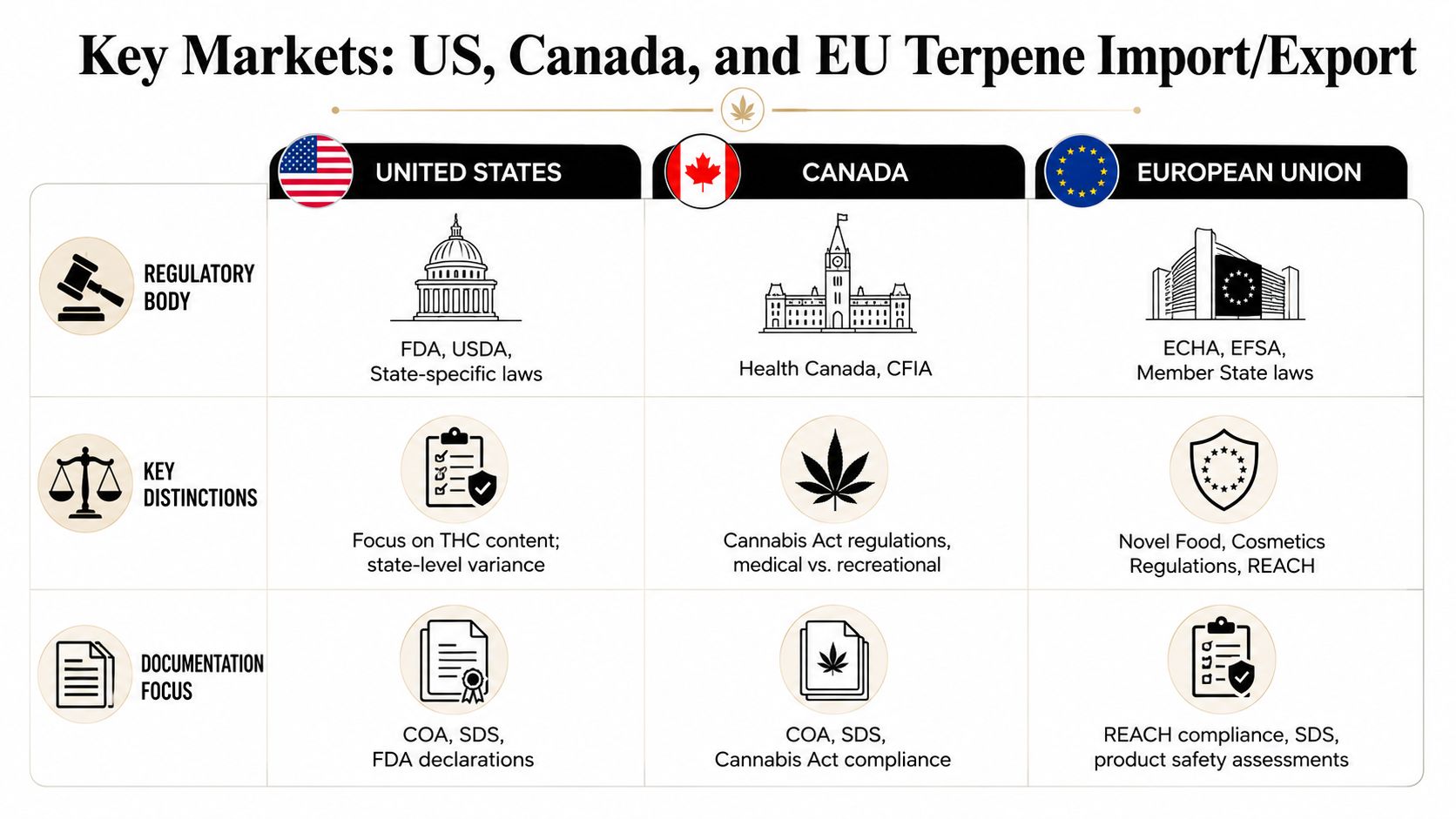
A shipment that clears into one market can stall in another, even when the drum, lot, and COA are identical. I see this most often when a manufacturer assumes the U.S., Canada, and the EU are reviewing the same risk. They are not. One market may focus on declared use. Another may focus on license status. Another may focus on safety documentation, importer registration, and whether the goods passed through a third country under the wrong conditions.
How the markets differ in practice
The United States is rarely a one-agency review. Customs treatment, FDA positioning, state rules, and carrier acceptance can all affect the same shipment. For terpene businesses, the hidden issue is often end use. A blend described for flavor formulation does not draw the same scrutiny as a blend described for inhalation, and a loose commercial description can create problems even when the chemistry is unchanged.
Canada tends to be more permit-driven for cannabis-derived material. The gatekeeping issue is usually not marketing language. It is whether the licensed party, shipment approval, and supporting records are in place before the goods move. If any of those pieces are late, the shipment timing breaks down fast.
The EU requires a different kind of discipline. Import review often turns on product identity, customs classification, CLP alignment, importer registration, and local documentation that matches the member state receiving the goods. Germany is a good example of how strict this can get in practice. A file that looks acceptable to a U.S. operator may still fail if the SDS language, labeling details, or importer setup do not fit the local standard.
Transshipment adds another layer. If goods route through a third country, teams need to confirm that the transit point does not create a new licensing, customs, or documentary issue. That is one of the easiest traps to miss during market expansion.
A side-by-side operating view
| Market | What usually drives review | What experienced teams prepare before booking |
|---|---|---|
| United States | Declared use, agency overlap, and carrier acceptance | Product descriptions that match intended application, aligned technical records, and a broker brief that explains the shipment clearly |
| Canada | License status and shipment-specific approvals for cannabis-derived material | Permit timing, importer coordination, and a file that ties the lot to the approved transaction |
| European Union | Classification, importer setup, safety documentation, and member-state rules | EORI readiness, CLP-aligned SDS files, local label review, and confirmation that transit routing will not create a compliance problem |
For operators building a terpene profile for vape cartridges, expansion plans typically become costly. One export packet rarely works across all three markets without changes to the commercial description, safety file, or importer paperwork.
Where formulators should focus first
Choose the first export market based on documentation fit, not just sales demand. That sounds conservative, but it saves money. If your current records already support the product category, intended use, and importer requirements in one region, that market will usually be cheaper to enter and easier to defend during a review.
Start with four questions:
- Does the declared end use fit how the destination market will classify and review the product
- Can your current technical file support the exact category being imported
- Is the importer or consignee properly set up before the goods ship
- Will the planned route create transshipment issues or extra documentary checks
The best launches I have seen were not the fastest. They were the ones where formulation, regulatory, and logistics agreed on the same market-specific assumptions before the first commercial order moved.
For companies replicating flavor of specific cultivar profiles for distillate, that point matters. The commercial opportunity may look strongest in one region, but if your packet still reads like a general aroma ingredient file while the destination reads it as an inhalation-related input, you have chosen the wrong market to start with.
Avoiding Hidden Compliance Traps and Penalties
Most import export guidelines stop too early. They explain classification, mention the COA, and leave the reader with the impression that clean lab work equals safe trade. It doesn't.
The biggest disruptions I see in terpene logistics often come from details that sound minor on paper. They aren't minor when a regulator, broker, or customs auditor reads them precisely.
The end-use disclosure trap
For non-technical chemicals, many teams treat intended use as a soft descriptor. Something to add loosely on the invoice. That's a mistake.
Civil penalties for violating the Export Administration Regulations can reach up to $13,508 per violation, and standard guides often fail to explain how vague intended-use descriptions for chemicals like terpenes can trigger that risk, according to this U.S. importing and exporting basics guide.
That matters because “terpene blend” alone may not tell the reviewing party enough. “For consumer vaping application,” “for fragrance compounding,” and “for industrial solvent use” don't carry the same regulatory implications.
A vague invoice description creates space for the wrong interpretation.
If your product is for vape cartridge formulation, say so clearly where that disclosure is required. If it isn't for that use, don't let a marketing name imply it is.
The transshipment gap
The second trap shows up in blended products with multi-country sourcing. A lot of terpene businesses source isolates or natural fractions from one country, blend in another, and sell into a third. Standard basics guides mention country of origin, but they usually don't prepare operators for the core issue, which is substantial transformation.
If a blend is processed in a third country, that doesn't automatically mean the third country becomes the valid origin for tariff or Free Trade Agreement purposes. If your origin claim is weak, you can lose preferential treatment or invite an origin-fraud review.
A trade compliance discussion of this gap notes that 5% of market observations with zero exports are classified as underserved because predicted exports differ from actuals due to hidden barriers such as transshipment rules, as described in this import export compliance guide. The number matters less than the operational lesson. Hidden compliance barriers distort real trade activity.
How experienced operators prevent both problems
They don't outsource judgment completely to the broker. They build a transaction file that answers origin and use questions before anyone asks.
Use this internal review before approving an export file:
- Check use language: Does the invoice describe the end use in the same practical terms your buyer and regulator would use?
- Check origin logic: If the product was blended in a third country, can you prove whether substantial transformation occurred?
- Check consistency: Do the origin statement, HS code, and specification sheet point to the same product identity?
- Check downstream exposure: Could the description accidentally place the goods into a stricter category than intended?
For a strain-inspired terpene blend for vape cartridges, these are not edge cases. They're routine failure points.
Packaging Labeling and Carrier Rules
A shipment can clear on paper and still fail in practice. Leaking closures, weak liners, vague outer labels, and carrier-specific restrictions stop terpene freight every week. Volatile aromatic materials aren't forgiving. If the bottle sweats, the cap loosens, or the carton absorbs odor, somebody in the chain will flag it.
Labeling needs to match the document file
Your outer packaging, inner labels, and shipping papers should describe the same material in the same terms. If the invoice says “botanical terpene blend for formulation” and the carton says something broader or more provocative, expect questions.
In the EU, trade reporting relies on customs authority data collected from trade transactions, and the official Integrated Trade in Goods Statistics system has historically derived that information from customs declarations, as explained in the Eurostat ITGS metadata. In practical terms, your label and shipping declaration aren't isolated admin details. They feed the formal record of what moved across the border.
What physical packaging should accomplish
For terpene concentrates, packaging has three jobs. It must preserve chemistry, survive handling, and communicate enough information for safe transport.
A workable packaging review includes:
- Closure integrity: Caps, liners, and seals should resist seepage during transit and storage.
- Material compatibility: Container material should hold aromatic compounds without obvious degradation issues.
- Readable identification: Lot number, product identity, and handling language should remain legible at delivery.
- Outer carton discipline: The external package should support the declared commodity without mixed or conflicting descriptions.
Carrier policies add another layer. DHL, FedEx, UPS, and freight forwarders may all ask different questions about hemp-derived inputs, concentrated aromatics, or products associated with inhalation markets. Don't assume a carrier that accepted one SKU last quarter will accept a revised blend under the same account structure today.
What helps avoid late-stage rejection
Use a release gate before booking freight, not after pickup.
That review should include:
- Carrier acceptance check: Confirm the exact product category is allowed under your account.
- Label-to-invoice match: Compare the shipper carton, bottle label, and commercial invoice side by side.
- Packaging stress check: Review leakage risk and odor containment before palletization.
Teams looking at landed cost and process efficiency can pair compliance review with this shipping cost reduction resource.
A carrier doesn't need to prove your shipment is illegal to reject it. They only need to decide it doesn't fit their policy or handling tolerance.
For operators formulating for vape cartridges, packaging is part of compliance, not the final warehouse chore.
Your Pre-Shipment International Compliance Checklist
The most reliable export teams reduce all of this into a release checklist. Not a training deck. Not a long memo. A repeatable go or no-go control that purchasing, QA, regulatory, and shipping all sign off on.
Product identity and classification
Before anything ships, verify the product description is stable across your internal systems.
- Confirm source language: Hemp-derived, botanical, or cannabis-derived should be stated consistently.
- Verify product category: Distinguish isolate from blend. Don't let SKU nicknames dictate customs language.
- Approve the HS code: Match the code to chemistry and presentation, then confirm the broker agrees.
- Review intended use wording: Especially for a terpene profile for vape cartridges or ingredients for distillate.
Documents and test records
Every shipment file should read like one coherent record.
- Match the commercial invoice to the COA: Product name, lot, and form should line up.
- Confirm THC status is explicit: If the market requires a threshold statement, it should be easy to find.
- Check accreditation and methods: The lab report should support regulated review, not only internal QA.
- Retain origin support: If the blend moved through multiple countries, keep the transformation trail.
A technical buyer or logistics manager often benefits from pairing this checklist with practical formulation tools such as bulk strain profiles and the online mixing calculator, especially when the shipment supports a strain-inspired terpene blend for cannabis product formulation.
Packaging and release control
The final release review should happen with the physical shipment in front of the team, not only inside the ERP.
- Inspect closures and seals: Aromatic materials expose weak packaging fast.
- Check label consistency: Bottle, case, and invoice should use the same product identity.
- Confirm carrier acceptance: Policies change. Reconfirm before dispatch.
- Archive the full export packet: If customs or the importer asks questions, speed matters.
The teams that ship cleanly across borders aren't lucky. They make fewer assumptions, write tighter paperwork, and treat compliance as part of product execution.
If you're building terpene systems for carts, concentrates, or strain replication, Gold Coast Terpenes offers THC-free, lab-verified blends, isolates, technical resources, and formulation tools that make it easier to move from R&D to production with cleaner documentation and more consistent product identity.