
You're probably dealing with a familiar failure mode. The flower smells like creamy raspberry gelato in the jar, the first bench sample smells promising in the beaker, and the finished cart tastes like generic sweet berry with a citrus top note that wasn't supposed to dominate. That gap is where most strain-inspired terpene blend for vape cartridges projects lose commercial value.
Raspberry Gelato is a good example because the profile isn't just “fruit plus cream.” It's a narrow target. If the bright raspberry fraction flashes off too early, or if the creamy body isn't rebuilt correctly, the result slides into candy, sherbet, or standard Gelato territory. For manufacturers trying to launch a premium dessert SKU, that difference matters more than the label copy.
The harder truth is that standard strain writeups don't help much with this. They describe aroma, not replication. For an extraction lab or formulation team, the useful questions are different: which notes need protection, which notes need reconstruction, what survives distillation, and what should be carried by top, mid, and base note architecture instead of wishful strain naming.
The Formulation Challenge of Replicating Raspberry Gelato
A common production scenario looks like this. A team starts with a flower reference that clearly reads as creamy raspberry with soft cherry and vanilla accents. They run extraction, clean up the oil, add a generic dessert blend, and fill hardware that performs well on paper. The first pull tastes acceptable, but not correct. The raspberry is thin, the cream is blunt, and the finish turns spicy faster than expected.
That isn't just a blending problem. It's usually a preservation problem followed by an interpretation problem.
A major issue with the Raspberry Gelato family is that coverage around the profile leaves out the post-harvest and processing details that would help preserve the fragile fruit side of the aroma. One published guide specifically notes a gap in how current coverage handles the variables that separate the “Raspberry” expression from standard Lemon Cherry or Sunset Sherbet expressions, especially because the volatile raspberry esters degrade quickly during post-harvest handling and no current guides spell out the drying, curing, or harvest-window variables needed to preserve them in a repeatable way, as discussed in this technical overview of Lemon Raspberry Gelato processing gaps.
Why the profile collapses in carts
Fruit-forward dessert strains fail in finished vape products for a few predictable reasons:
- Top-note loss: The brightest fruit fraction disappears first during extraction, distillation, open handling, or warm mixing.
- Wrong sweetness cue: Teams often rebuild “raspberry” with loud candy notes that read artificial once they hit hot ceramic.
- Base-note overcorrection: Too much spice or earthy support can pull the formula away from Gelato and toward Kush.
- Hardware mismatch: A hot cartridge can flatten the creamy center and leave only citrus and pepper.
Practical rule: If the formula tastes more accurate in a cold aroma evaluation than it does in the cartridge, the issue usually isn't the concept. It's volatility management.
That's why a serious terpene profile for Raspberry Gelato for cannabis product formulation has to begin with restraint. Don't try to make the fruit louder than the flower. Build the profile so the fruit survives, the cream holds body, and the finish stays soft. Teams that need broader context on Gelato family differences should review this breakdown of the best Gelato strain variations.
Deconstructing Raspberry Gelato Genetics and Lineage
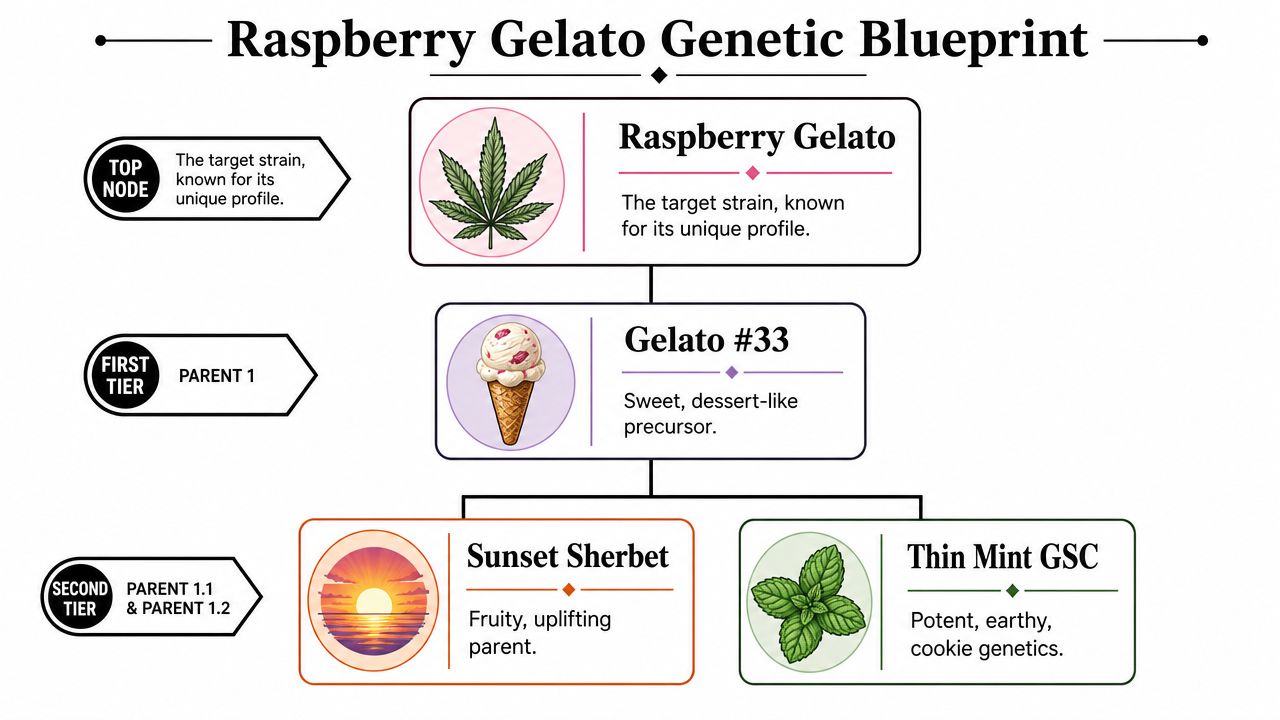
The most useful starting point for formulating Raspberry Gelato for distillate is lineage, not marketing description. Raspberry Gelato is identified as an indica-dominant hybrid with a 70% indica to 30% sativa ratio, created by crossing Raspberry Kush with Gelato #33 according to this Raspberry Gelato lineage reference.
What the parentage tells a formulator
Raspberry Kush contributes the darker fruit direction. In formulation terms, that means your berry target shouldn't read jammy candy or bright artificial syrup. It needs some density under it. The fruit has to feel grounded.
Gelato #33 contributes the dessert structure. That's where the cream, vanilla-like roundness, and polished sweetness come from. Without that layer, the profile won't read as Gelato-derived. It will just read as berry.
This parentage also gives a clue about balance. The profile shouldn't be all top note. The Kush side wants weight. The Gelato side wants softness and body. A flat fruit-forward blend misses both.
Practical implications for a strain-inspired terpene blend
When I'm evaluating a strain-inspired terpene blend for Raspberry Gelato, I'm looking for three things that line up with the genetics:
- A fruit opening that is ripe, not sharp
- A creamy center that doesn't turn buttery or artificial
- A finish with enough structure to keep the profile from tasting like candy
The best Raspberry Gelato replicas don't announce every component separately. They open fruity, settle creamy, and finish with enough spice and earth to feel complete.
That last point matters in commercial development. Teams often over-isolate the “raspberry” idea and forget that consumers don't experience the profile as a single note. They experience a sequence. The lineage supports that sequence.
What works and what usually doesn't
A few formulation choices tend to align better with the genetics:
- Works well: A restrained berry lead with dessert support underneath.
- Works well: Soft spice or earthy structure used to hold the finish together.
- Usually fails: A loud candy berry top note with no creamy mid.
- Usually fails: A citrus-heavy Gelato profile rebranded as raspberry.
The raspberry side should feel integrated into the Gelato framework. If your first inhale says “fruit cart” instead of “dessert cultivar,” the genetic logic has been lost.
Sensory Profile Analysis for Flavor Formulation
The quickest way to miss Raspberry Gelato is to treat it like a single flavor. It isn't. For replicating flavor of Raspberry Gelato for vape cartridges, the profile has to be built as a layered sensory system.
Top notes
The top note is where the profile earns the name. This is the fruit entry, but it shouldn't be one-dimensional. Raspberry leads, with a supporting impression that can lean toward cherry rather than citrus. If citrus becomes the first clear signal, the profile starts drifting toward Lemon Cherry territory.
Top notes need lift, but they also need control. Too much brightness and the profile turns volatile, thin, and short-lived in hardware. Too little and the formula opens dull.
Use the top note to signal identity, not to carry the whole formula.
Middle notes
The middle is often underdeveloped. Raspberry Gelato needs a creamy, dessert-like center that rounds the fruit and turns it into something confectionary rather than generic berry. Within this, vanilla-like softness and a gelato body are found.
If the mid note is weak, the blend tastes hollow. If it's too sweet or too dense, the formula tastes fake. The right middle note should soften the berry, not cover it.
Base notes
The finish needs structure. A slight spicy edge and an earthy backbone keep the profile mature and strain-like. Without that base, the cart often tastes pleasant but anonymous.
That's also why evaluators should check the profile after repeated pulls, not just on the first puff. A lot of blends open nicely and then collapse into pepper, pine, or flat sweetness after heat exposure.
Don't judge a dessert profile only by the first inhale. Judge it by what remains on the third and fourth pull.
A workable note map for formulation
For bench work, I'd organize the profile like this:
| Sensory layer | Target character | Common mistake |
|---|---|---|
| Top | Raspberry, soft cherry, fresh fruit lift | Overbright citrus or candy berry |
| Middle | Cream, vanilla-like sweetness, gelato body | Flat sweetness with no body |
| Base | Gentle spice, soft earth, rounded finish | Dry pepper or heavy Kush finish |
This kind of note mapping is more useful than casual tasting language because it gives the team a correction path. If the top is right but the finish is harsh, don't add more fruit. Fix the base. If the profile smells right but vapes thin, rebuild the middle.
Teams refining that process should use a structured sensory method instead of ad hoc panel comments. A practical framework for that appears in this guide to sensory evaluation methods.
What to listen for during evaluation
Panel comments that usually indicate a good direction:
- “Berry comes first, cream follows.”
- “Sweet, but not candy.”
- “The finish feels strain-like, not flavored.”
Panel comments that usually indicate rework:
- “Nice berry, but not Gelato.”
- “Tastes more like cherry candy.”
- “Spice shows up too early.”
The Raspberry Gelato Terpene Profile for Distillate
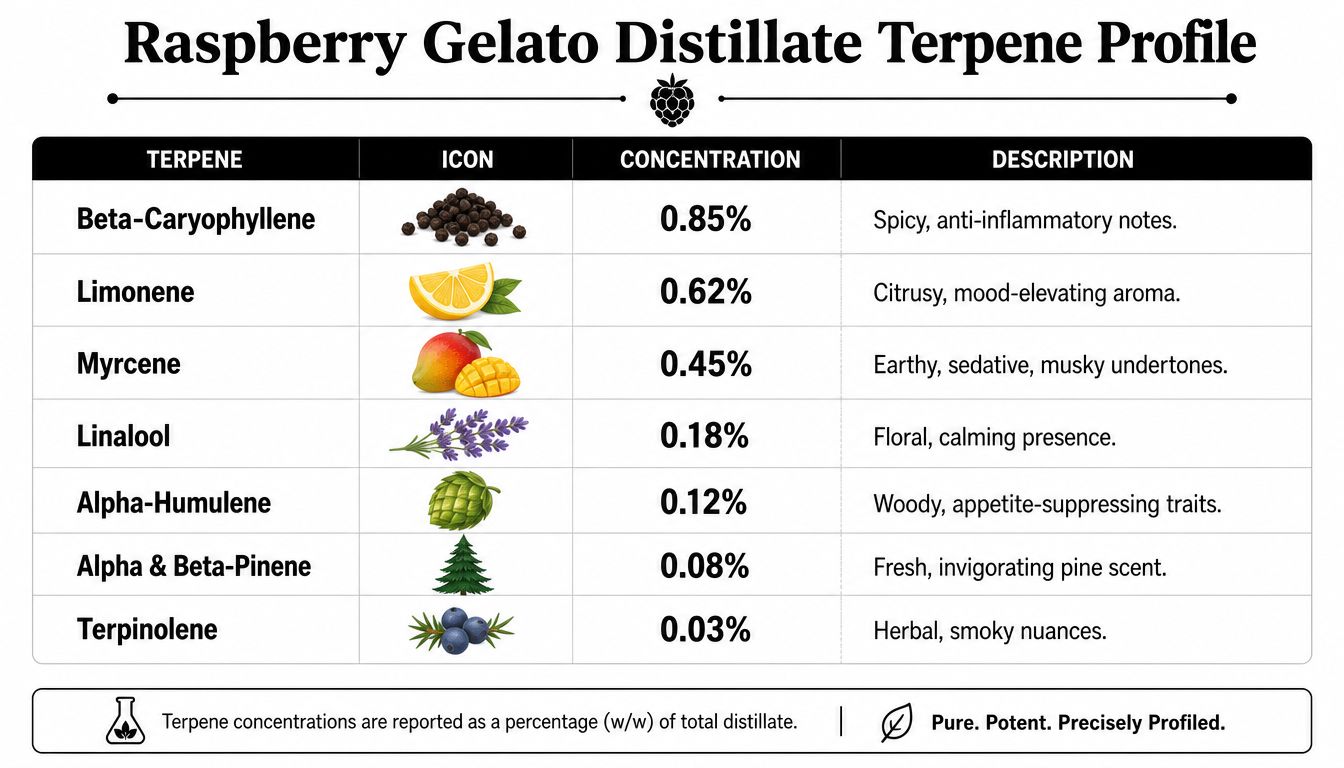
The most actionable hard data for a terpene profile for Raspberry Gelato for distillate comes from cartridge lab data showing a dominant stack of limonene at approximately 0.968%, beta-caryophyllene at 0.442%, and linalool at 0.262%, with pinene at 0.254% as a secondary helper, as listed in this Raspberry Gelato distillate terpene listing.
Reading the dominant stack correctly
Limonene is doing more than adding citrus. In this profile, it provides lift and helps keep the fruit side from feeling dense or stale. Used correctly, it makes the berry feel fresh. Used carelessly, it hijacks the formula and turns the whole profile lemon-forward.
Beta-caryophyllene is the structural base. It contributes spice, depth, and a mature finish that keeps the formula from reading like confectionery flavoring. This is one reason Raspberry Gelato can survive as a premium dessert profile rather than collapsing into novelty sweetness.
Linalool is where the creamy softness starts to make sense. It helps bridge fruit and dessert body. In practical terms, it smooths transitions inside the profile. Without enough of that soft floral support, the blend can feel angular.
Pinene in a secondary role helps with lift and definition. It shouldn't read as pine. It should function more like edge control, keeping the formula from becoming heavy.
Top, middle, and base note assignment
For actual blending, I'd classify the core stack this way:
- Top note driver: Limonene
- Middle note bridge: Linalool
- Base note anchor: Beta-caryophyllene
- Secondary support: Pinene
That note assignment matters because it affects how you correct the blend. If the formula feels muddy, don't automatically increase limonene. You may need to reduce base heaviness or improve the transition through the middle.
Bench note: When limonene is carrying both freshness and identity, formulators tend to overuse it. Raspberry Gelato usually performs better when limonene lifts the fruit instead of impersonating it.
Sample Raspberry Gelato Terpene Blend for 100g Distillate 6% Ratio
The table below is a starting framework, not a claim that there is one universal finished recipe. It uses the available lab-verified dominant terpenes as the core and leaves the remaining profile as qualitative support components. For a 100g distillate batch at a 6% terpene ratio, total terpene addition equals 6g.
| Terpene Isolate | Role in Profile | Percentage of Total Blend | Grams to Add |
|---|---|---|---|
| Limonene | Fruit lift and top-note brightness | 16.13% | 0.968g |
| Beta-Caryophyllene | Spiced base and structure | 7.37% | 0.442g |
| Linalool | Creamy floral bridge in the mid note | 4.37% | 0.262g |
| Pinene | Secondary lift and definition | 4.23% | 0.254g |
| Remaining blend components | Used to complete berry, cream, and body qualitatively | 67.90% | 4.074g |
That final row is deliberate. There isn't verified numerical data here for the rest of the stack, so a responsible formula guide should leave those components qualitative rather than inventing exact percentages.
Practical use in development
For trial work, I'd build the dominant stack first, then adjust around two questions:
- Does the fruit still read as raspberry once the cart is heated?
- Does the creamy center remain present after repeated pulls?
If the answer to either is no, the formula needs support components, not more of the dominant stack. Teams doing this kind of cartridge work can compare approach and process with this guide to the best terpenes for distillate.
Typical Cannabinoid Ranges and Lab Considerations
For sourcing and QC, the key cannabinoid benchmark is straightforward. Raspberry Gelato is described as an indica-dominant hybrid with a verified THC content of 26%, and representative batches in regulated markets typically test between 20% and 28% total THC by weight as THCA, with approximately 1% CBD, according to this Raspberry Gelato potency and cannabinoid reference.
That matters in formulation because strong cannabinoid presence changes how a flavor system performs. A profile that smells balanced in isolation can taste compressed once it's carried in a potent oil. The cannabinoid matrix adds weight, and that weight can mute fragile top notes fast.
Why potency changes sensory design
High-potency flower references create an expectation problem. The aroma from cured flower is dense, resinous, and naturally expressive. Distillate doesn't arrive that way. It needs rebuilding.
A formulator working from a target that sits in the 20% to 28% THC flower range shouldn't assume a thin terpene system will survive transfer into a vape product. The sensory architecture has to be deliberate enough to push through the oil without becoming loud or artificial.
Minor cannabinoids and profile realism
The same source notes approximately 1% CBD and mentions minor cannabinoids in representative batches, including CBG ranging from 0.3% to 1.0% and CBC from 0.1% to 0.5% in broader profile descriptions on that page. For a lab team, the main takeaway isn't to mimic every native cannabinoid ratio exactly in a distillate SKU. It's that the original flower target is not chemically one-dimensional.
That complexity is one reason oversimplified terpene blends often taste less convincing than the flower they're trying to honor. The target reference contains more than THC plus aroma.
A believable strain-inspired vape doesn't need to duplicate raw flower chemistry exactly. It does need to respect the density and balance of the original target.
Lab checks that actually help
For bench validation, focus on the checks that affect repeatability:
- Aroma before fill: Make sure the blend still expresses fruit and cream in oil, not just in the terpene bottle.
- Hot pull evaluation: Test after the hardware reaches normal operating temperature.
- Retained identity: Confirm the profile still reads as Raspberry Gelato after the oil settles.
If a formula only performs in fresh mix and not in filled hardware, it isn't production-ready.
Optimizing for Extraction and Vape Cartridge Stability
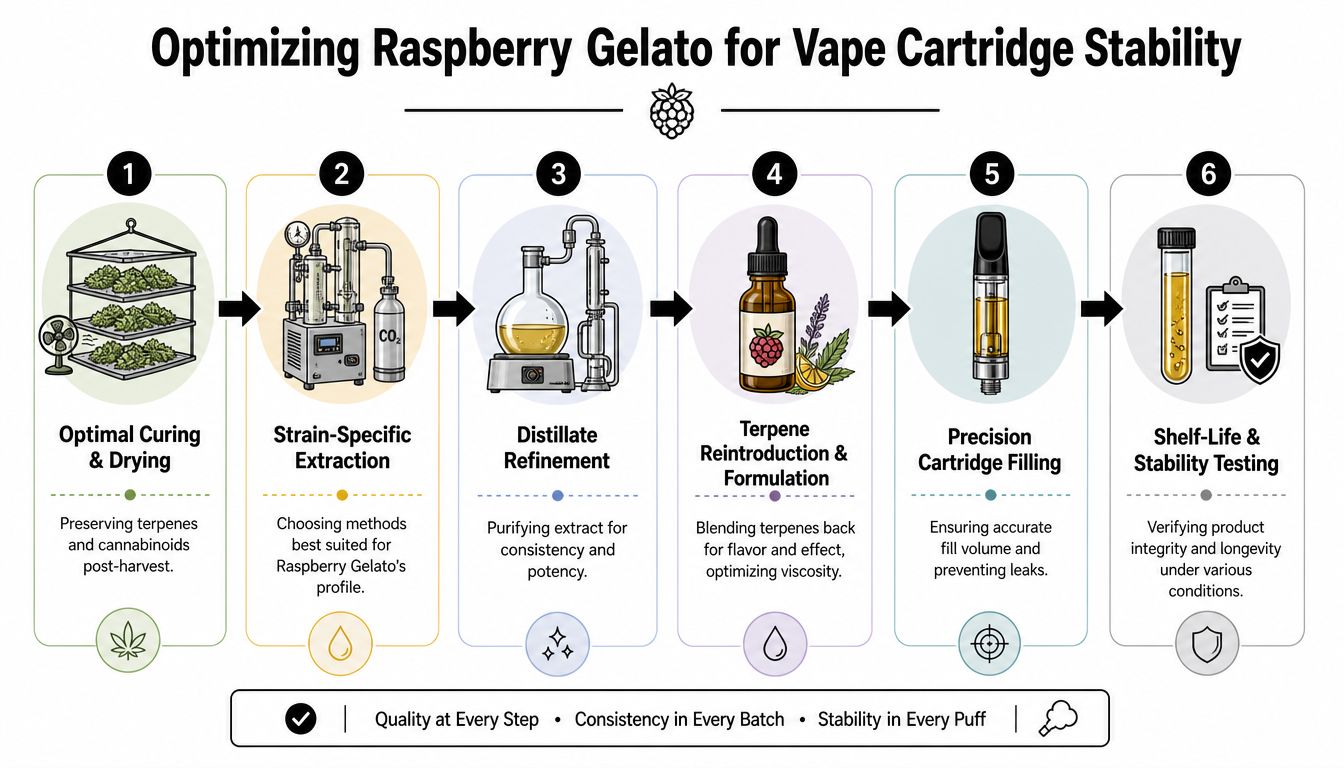
Raspberry Gelato is attractive from an extraction standpoint because the cultivar shows useful resin characteristics. For solventless production, its resin density supports extraction yields often reported between 3% and 6% from fresh frozen inputs, and experienced hash-makers note a favorable ratio of intact heads in the 73 to 120 micron range for premium bubble hash grades, based on this cultivation and extraction reference for Lemon Raspberry Gelato.
Extraction choices that preserve the target better
Those resin traits matter because they give processors options. If the goal is the most faithful expression of the flower, preserving aromatic complexity should be weighted heavily in process design. Once the delicate fruit fraction is stripped away, later formulation can rebuild the profile, but it can't fully recreate what was never protected.
For manufacturers working from distillate, the challenge shifts. You're no longer preserving a complete live expression. You're reconstructing one. That makes handling discipline, terpene timing, and hardware fit more important than the extraction yield itself.
Stability decisions in cartridge development
A stable Raspberry Gelato cart usually comes down to a few operational choices:
- Mix gently: Excess heat during terpene incorporation can flatten the fruit side before the oil ever reaches a cart.
- Choose hardware that respects the profile: Lower-stress heating tends to preserve creamy and floral elements better than aggressive setups.
- Avoid ingredients that mute the profile: If the formulation relies on anything that dulls aroma or changes how the oil wicks, the delicate top note usually pays first.
- Run shelf checks on actual filled units: Bench aroma in a vial doesn't tell you what the cartridge will taste like after it sits.
The fastest way to lose Raspberry Gelato character is to treat it like a robust gas or pine profile. It isn't forgiving.
Practical failure points
The recurring problems are familiar. Fruit-forward carts can crystallize, separate, taste fine at fill and poor after storage, or shift toward spice after repeated heating. Those are formulation and systems issues, not branding issues.
For teams troubleshooting one of the most common physical stability problems, this guide on how to prevent crystallization is worth keeping in the development workflow.
Finalizing Your Raspberry Gelato Strain Formulation
A commercially credible Raspberry Gelato strain-inspired terpene blend for cannabis product formulation needs discipline in three places. First, the profile has to follow the genetic logic of Raspberry Kush plus Gelato #33. Second, the sensory build has to be layered, with fruit on top, cream through the middle, and structure at the finish. Third, the cartridge system has to protect the fragile parts of the formula instead of cooking them off.
That's why this profile tends to separate careful operators from everyone else. It's easy to make something pleasant. It's harder to make something recognizably Raspberry Gelato after filling, storage, and repeated pulls.
A practical path is to start with a strain-specific base profile, then tune it in small bench iterations around the dominant stack already discussed. If the formula is too bright, don't bury it under more sweetness. If it's creamy but anonymous, tighten the fruit identity. If the finish is harsh, rebalance the structure instead of pushing more top note.
The teams that get this right usually share one habit. They validate in the final hardware early, not after they've already fallen in love with the beaker sample. Raspberry Gelato rewards that realism because the profile is narrow, the fruit fraction is delicate, and the creamy body needs support to survive commercial handling.
If you're building a Raspberry Gelato vape line and need reliable starting materials, Gold Coast Terpenes offers strain-specific blends, isolates, and formulation tools for cartridges and concentrates. Use a strain profile as the base, refine with targeted components like limonene or beta-caryophyllene where needed, and bench-test in your actual hardware before scale-up.