
Most advice around 91 Chemdawg seeds starts in the wrong place. It assumes the seed pack is the product. For formulators, extractors, and cartridge brands, it usually isn't.
If your commercial target is a repeatable terpene profile for 91 Chemdawg for vape cartridges or a strain-inspired terpene blend for distillate, seed sourcing is only one variable, and often the least reliable one. What matters is whether the biomass, extract, or finished blend lands on the narrow sensory signature people associate with true Chem 91: sharp fuel, musky body, citrus lift, and a stubbornly pungent finish.
That's why a formulation-first workflow beats folklore. The original clone has a real chemical identity. The seed market mostly sells approximations.
The 91 Chemdawg Authenticity Problem
Buying 91 Chemdawg seeds is often treated like a shortcut to the original profile. It isn't. The commercial market uses the name loosely, and that creates a serious sourcing problem for anyone developing carts, concentrates, or strain-specific product lines.
The biggest issue is the authenticity gap. According to DNA Genetics on the Chemdawg lineage problem, 90% of commercial offerings lack verified lineage, even though Chem 91 is documented as foundational to OG Kush and Sour Diesel. The same source notes that Cannapedia lists 321 strains bred directly from the original 1991 bagseed, which explains why the market is flooded with “Chem-type” material that shares the name family without matching the original profile.
That distinction matters more in formulation than it does in cultivation circles. A breeder can tolerate phenotype spread. A manufacturer can't, because every inconsistency compounds downstream in extraction, terpene reintroduction, and final sensory review.
Why seed labels fail in product development
A packet labeled Chem 91 tells you very little about what your extractor will receive. The aroma can drift. The resin behavior can drift. The fuel note can flatten into generic diesel, or tip too far into skunk, pine, or lemon depending on lineage quality and selection.
For commercial work, the practical question isn't “Are these real 91 Chemdawg seeds?” It's “Can this material support the exact profile my brand needs to reproduce at scale?”
A good place to calibrate that thinking is this guide on replicating high-terpene strains. The core lesson is simple. If genetics are unstable, your specification has to move from the seed label to the chemistry.
True-to-name branding depends on chemical repeatability, not on a romantic origin story.
The better commercial standard
When the source material is unreliable, formulators need a target profile and a pass-fail framework. That usually means:
- Verified lineage where possible: Clone-backed material is more useful than seed-market branding.
- Lab confirmation before scaling: Without a report, “Chem 91” is just a claim.
- A formulation fallback: If the plant input misses the profile, the terpene system has to restore it.
That's the workable path for formulating a 91 Chemdawg strain-inspired terpene blend for cannabis product formulation. You don't chase the myth. You define the sensory benchmark and build to it.
Decoding the 91 Chemdawg Genetic Legacy

Chem 91 became legendary because its history is messy, not because it's clean. That messiness still affects modern sourcing.
Historically, 91 Chemdawg originated from a single bag of high-grade “Dog Bud” purchased at a Grateful Dead show in Indiana in 1991, from which a handful of seeds were popped on the East Coast, and that bagseed lineage became a cornerstone of modern gas-profile breeding, according to Strainpedia's Chem 91 history. The same source describes it as a legendary clone-only cultivar with ultimate genetics that remain unknown.
For product developers, that origin story explains two things at once. First, why Chem 91 became foundational. Second, why reproducing it from seed is so unreliable.
Clone-only reputation, seed-market reality
A clone-only legend doesn't translate neatly into retail seed catalogs. Once a cultivar becomes famous, the market starts building around the name. Breeders make approximations. Sellers make claims. Buyers assume the label carries chemical precision that it often doesn't.
That's why the old distinction between male and female plants still matters operationally, especially if a team is evaluating in-house propagation or screening lots before committing material to extraction. This background on male weed plant vs female identification is basic, but the broader point is commercial. Reproductive variability creates one more route for profile drift.
Why the mystery matters to formulators
Chem 91 is often described as having suspected Thai and Nepalese roots, and some market descriptions also frame it as balanced or slightly leaning depending on phenotype. That kind of ambiguity is manageable in storytelling. It's harder in manufacturing.
When lineage isn't fully pinned down, phenotype spread becomes more than a cultivation note. It becomes a business risk:
- Aroma spread: one lot leans more pine-forward, another more earthy.
- Resin behavior: extraction performance can become inconsistent.
- Brand mismatch: a consumer expecting classic chem-fuel gets a generic diesel expression instead.
Later descendants inherited the fame. Not all inherited the exact profile.
A short visual history helps explain why this family became so influential and so difficult to standardize.
The commercial takeaway is blunt. The more culturally important a clone becomes, the more aggressively the market reproduces the name without preserving the chemistry.
That's why experienced formulators treat Chem 91 less like a seed purchase and more like a reference standard. The legacy matters, but the final spec has to come from measurable output.
The Target Chemical Blueprint of True 91 Chemdawg
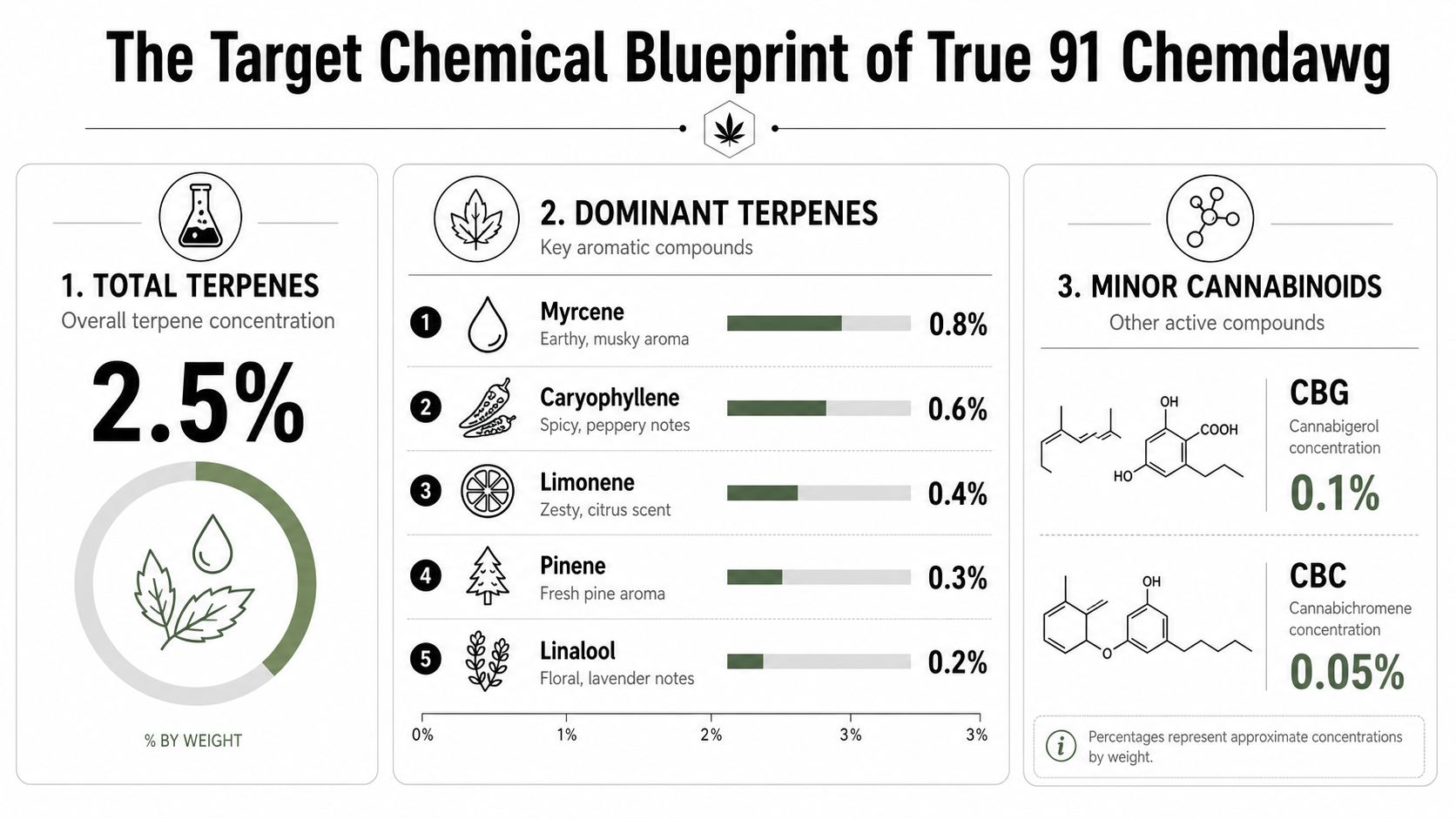
The original profile is valuable because it gives formulators a target that's tighter than the seed market. If you're replicating the flavor of 91 Chemdawg for distillate or building a terpene profile for 91 Chemdawg for cannabis product formulation, the chemistry has to drive the work.
According to SuperCann's Chem 91 genome profile, 91 Chemdawg shows THC ranging from 20% to 27%, with a terpene profile averaging 1.2% to 3.0% by weight. The same source identifies the dominant terpene range as beta-caryophyllene at 0.4% to 0.9%, beta-myrcene at 0.3% to 0.7%, and limonene at 0.2% to 0.6%.
What those numbers mean in practice
Those ranges aren't just descriptive. They tell you where the profile gets its structure.
- Myrcene gives Chem 91 its dense herbal-musky body. Without enough myrcene, the profile loses weight and starts reading thin.
- Caryophyllene supplies the peppery, dry, almost abrasive backbone that keeps the aroma from turning sweet or fruity.
- Limonene provides the bright edge. In a proper Chem 91 build, it doesn't dominate. It sharpens the front of the profile and helps the fuel note cut through.
Presence is not enough
Many formulas fail because they include the “right” terpenes in the wrong hierarchy. A blend can contain myrcene, caryophyllene, and limonene and still miss the mark completely if the balance is off.
Chem 91 is one of those profiles where relative proportion matters more than checklist composition. If limonene gets pushed too hard, the profile skews citrus-clean instead of chemical-fuel. If caryophyllene is too low, the profile loses its gritty depth. If myrcene is underbuilt, the body doesn't carry.
Practical rule: Treat the authentic profile as a ratio problem, not a branding problem.
A useful benchmark for evaluation
When screening flower, crude, or post-distillation reintroduction candidates, I'd evaluate against three questions before approving a Chem 91 claim:
| Evaluation point | What to look for |
|---|---|
| Aromatic front | Sharp chem-fuel with a clear bright edge, not generic lemon |
| Mid-palate body | Musky, earthy, resinous density that holds after the first impression |
| Finish | Dry, peppery, lingering depth rather than soft sweetness |
That framework keeps the work honest. If the chemistry doesn't support the classic profile, the label shouldn't do the heavy lifting.
Sourcing Challenges From Seed to Extraction
The trouble with 91 Chemdawg seeds for cannabis product formulation isn't limited to authenticity. Even when the starting material is promising, cultivation and post-harvest execution can still break the profile before extraction begins.
Chemdawg is known for a “demanding growth paradox,” where its suspected Thai and Nepalese lineage can produce excessive leaf growth if nutrient management isn't adjusted, which can keep the plant from reaching its 27% THC potential, especially outside Mediterranean conditions where it may need protection from heavy rain to preserve terpene quality, according to Growpilot's Chemdawg cultivation analysis.
Where the profile gets lost
This matters commercially because Chem 91 is not forgiving. A lot can look healthy and still underdeliver on the exact sensory profile you need.
Here's where teams usually run into trouble:
- Canopy mismanagement: Stretchy growth can create uneven light distribution and inconsistent resin development across the crop.
- Nutrient imbalance: Excessive leaf production often means the plant is spending energy in the wrong places, which shows up later in weak aromatic concentration.
- Climate mismatch: Wet conditions are especially risky when the goal is a pungent, sharp profile rather than a flatter expression.
- Post-harvest inconsistency: Cure quality can shift the final nose enough that extraction starts from compromised material.
Why this hits extractors hard
Extractors often inherit problems they didn't create. If the biomass enters the room with diluted aromatic expression, the final oil will reflect it. Then the formulation team has to decide whether to correct the profile, relabel it, or reject it.
That decision gets expensive fast because each path carries a different cost:
- Correct it with reintroduced terpenes. Good for salvage, but only if the base still has the right structural character.
- Relabel it as a broader chem or diesel profile. Safer than forcing a false strain match.
- Reject the lot. Painful, but sometimes cheaper than damaging line consistency.
Weak source material usually doesn't announce itself in potency first. It shows up in aroma accuracy.
Seed-grown material versus verified source material
For a hobby grower, variation can be interesting. For a brand owner, variation becomes inventory risk. Seed-grown Chem lines may still be useful, but only if the team treats them as screening projects rather than guaranteed inputs for a named SKU.
That's the practical trade-off. If your product line depends on a narrow strain-inspired terpene blend for 91 Chemdawg for vape cartridges, biomass should be selected for chemical fit, not purchased on name recognition alone.
Deconstructing the Aroma Profile for Formulation
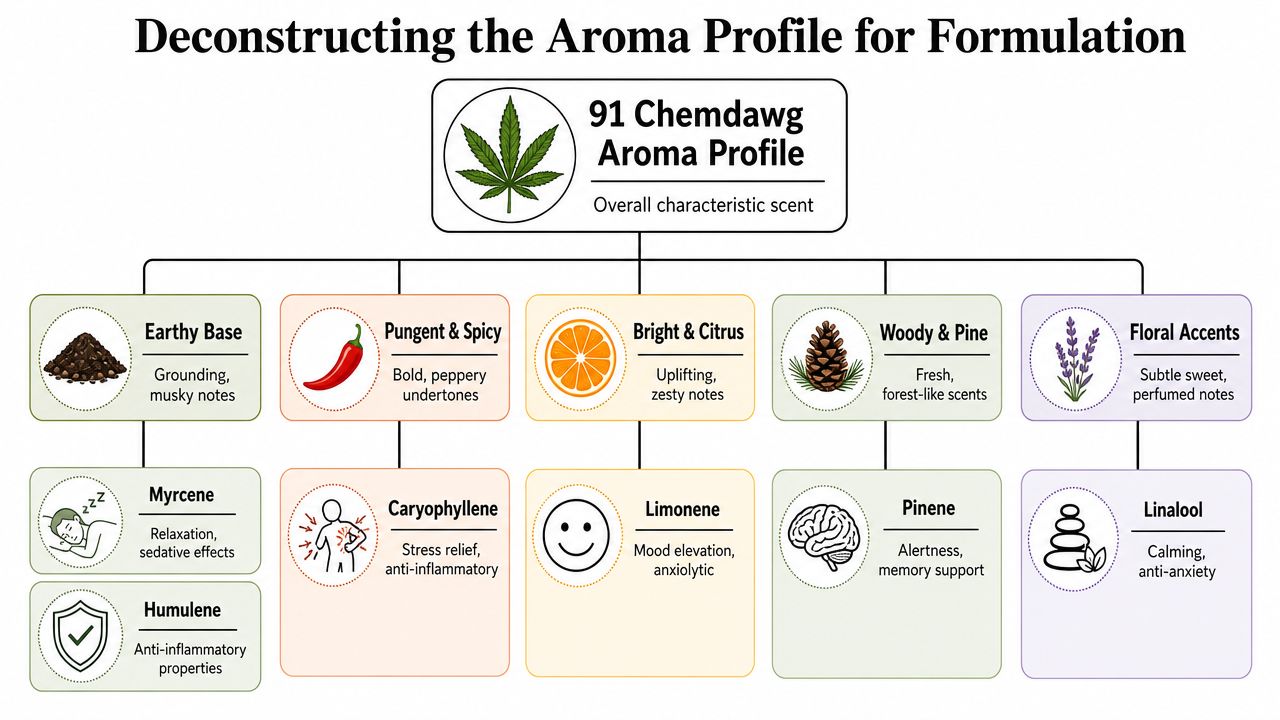
A good terpene profile for 91 Chemdawg for vape cartridges doesn't smell like “diesel” in a broad sense. It smells specifically chemical, musky, bright, and dry. That distinction matters because generic diesel formulas are easy to build and easy to spot.
The fastest way to formulate this profile is to break it into note layers instead of thinking in strain names.
Top notes
The opening has to hit with volatile brightness and chemical sharpness. In Chem 91 work, that usually means limonene providing lift and pinene-adjacent character helping sharpen the edge rather than turning it foresty.
For cartridge applications, there's another key detail. According to Zen Leaf's Chemdawg 91 terpene discussion, terpinolene alongside myrcene and limonene is a critical mechanical requirement for Chemdawg 91 in vape cartridges, because that combination generates the intense chemical fuel aroma with skunky, earthy undertones that separates it from generic diesel profiles.
That's one reason many “Chem” formulas miss. They include fuel cues but omit the terpene interplay that creates the distinctly chemical top note.
A general terpene flavor chart is useful here because it helps teams diagnose why a formula smells like citrus cleaner, pine cleaner, or skunk rather than Chem 91.
Mid notes
The middle of the profile is where myrcene carries the load. This is the body note. It gives the profile that musky, earthy, almost humid density that keeps the bright front end from feeling hollow.
If the mid is weak, the formula opens loud and collapses. That's a common failure in cart development, especially when a team tries to make the profile “cleaner” for broad appeal.
Base notes
The finish comes from beta-caryophyllene and related dry-spice structure. This is the part that makes the aroma feel grounded and mature instead of flashy. It should linger as a peppery, resinous finish.
A useful working model looks like this:
| Note layer | Functional role in a Chem 91-style formula |
|---|---|
| Top | Fuel, sharpness, citrus lift, chemical edge |
| Middle | Musky earth, resin body, profile continuity |
| Base | Dry spice, pepper, persistence, structural finish |
If the top note says diesel but the base doesn't stay dry and peppery, the formula will read as a generic fuel blend rather than Chem 91.
That top-mid-base framework makes replication easier because it forces the team to solve for architecture, not just ingredients.
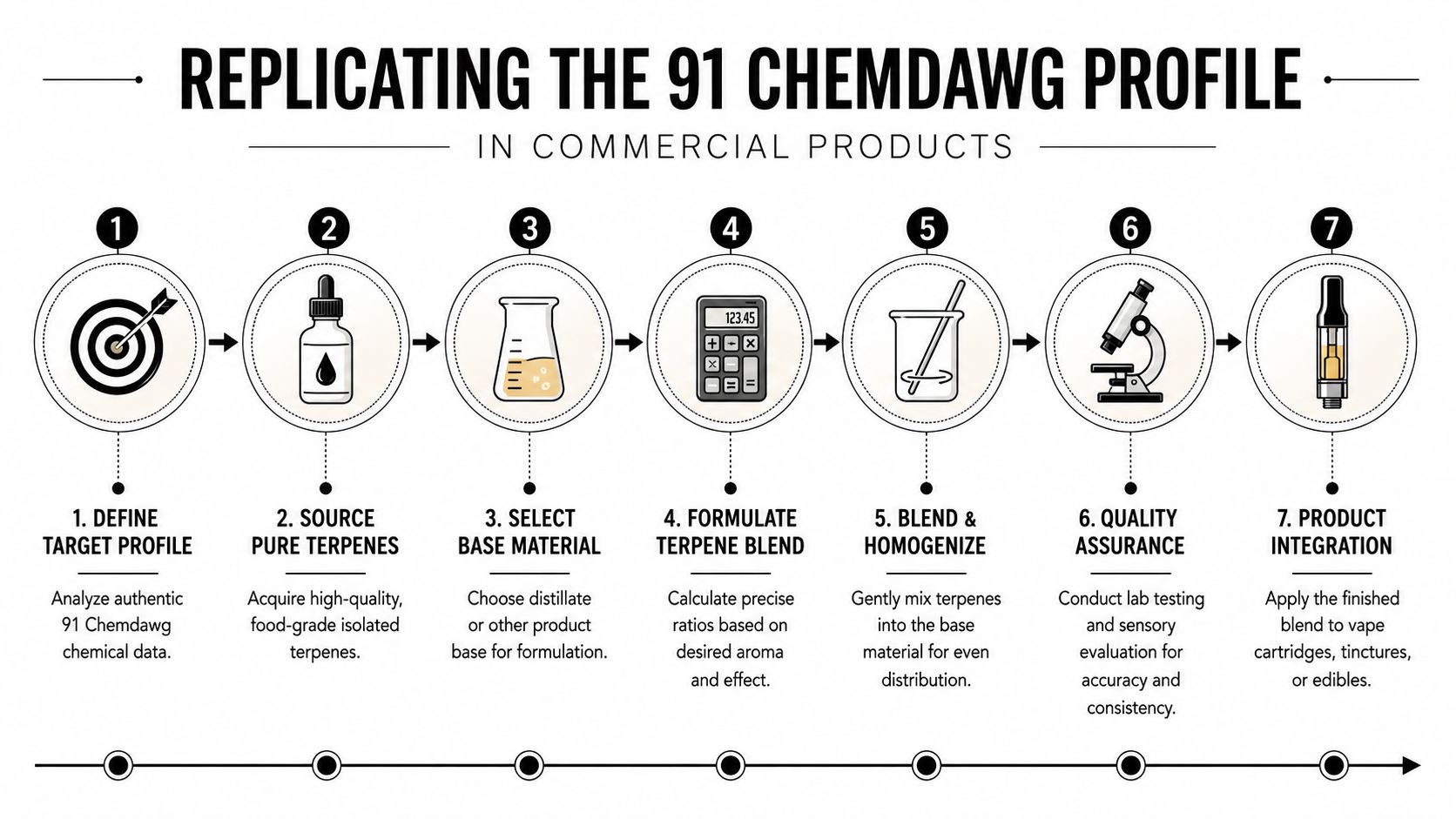
Replicating the 91 Chemdawg Profile in Commercial Products
At the formulation bench, replicating the flavor of 91 Chemdawg for distillate is less about copying a flower menu description and more about controlling proportion. The profile works because the terpene stack has internal order.
According to Apothecary Genetics' Chem 91 formulation guidance, when replicating the flavor of Chem 91 for distillate, myrcene should account for approximately 40 to 45% of total terpene content, while limonene should comprise roughly 20% to deliver the necessary citrus lift.
Start with hierarchy, not equal parts
The biggest formulation mistake is flattening the blend. Chem 91 should not be built as a balanced citrus-diesel profile. It needs a dominant musky core, a controlled bright edge, and enough dry spice to hold the finish together.
That means thinking in layers:
- Build the myrcene body first.
- Add limonene as a lift agent, not the star.
- Use beta-caryophyllene to give the blend backbone.
- Add the smaller supporting compounds needed for the true chemical-fuel impression.
Chem 91 formulation blueprint
| Terpene | Role (Note) | Target % of Total Terpene Blend |
|---|---|---|
| Myrcene | Mid note, herbal-musky body | 40–45% |
| Limonene | Top note, citrus lift | ~20% |
| Beta-caryophyllene | Base note, dry spice and structure | Balance to profile |
| Terpinolene | Top note modifier, chemical-fuel character | Balance to profile |
| Alpha-pinene | Top note sharpness, pine-chemical edge | Balance to profile |
The first two lines are the closest thing to a hard anchor you have in this profile. The rest must be tuned by sensory evaluation, hardware behavior, and the character of the base oil.
Distillate versus cartridge formulation
A strain-inspired terpene blend for distillate can be slightly broader because the delivery system is simpler. A cart formula is less forgiving. Heat behavior, atomization, and headspace expression all affect whether the profile reads as Chem 91 or just “gassy.”
For vape applications, I'd keep the process disciplined:
- Define the sensory reference first: fuel-forward, musky center, dry pepper finish.
- Match the myrcene-led core: if the body is wrong, don't keep tweaking the top.
- Use limonene carefully: enough to lift, not enough to sweeten.
- Bring in terpinolene deliberately: this is often what creates the chemical edge missing from generic diesel formulas.
- Bench test in hardware: the same blend can smell correct in a vial and wrong in a cartridge.
Pro tip: Viscosity and stability work best when the terpene system is treated as part of the hardware design, not just the flavor design. A formula that smells right in bulk can still fail in a cartridge if volatility pushes the top note too hard during heating.
What works and what doesn't
What works is restraint. Chem 91 should feel aggressive, but not chaotic. The profile is pungent, not messy.
What doesn't work:
- overloading limonene until the blend reads as lemon-fuel
- leaning too hard on pine notes and turning the profile coniferous
- stripping out the skunky-chemical complexity to make it more mass-market
- assuming any diesel blend can be relabeled as Chem 91
A commercially useful formulation guide for 91 Chemdawg for cannabis product formulation should always end at repeatability. If your team can't reproduce the same aromatic hierarchy lot after lot, the formula isn't finished.
Ensuring Consistency and Quality in Your Product Line
The business case is straightforward. 91 Chemdawg seeds may be part of a sourcing strategy, but they shouldn't be the foundation of a consistency strategy.
Seed lines vary. Cultivation conditions vary. Extraction outcomes vary. A validated terpene system gives manufacturers something the raw genetics market often can't: a repeatable sensory target that survives across batches, hardware, and product formats.
The quality standard that matters
For a commercial line, consistency depends on three controls:
- Input control: verify what the biomass or oil is before assigning a strain-specific SKU.
- Blend control: keep a fixed aromatic hierarchy for each production lot.
- Verification control: use analytical review and sensory review together, not separately.
Analytical discipline matters most when the market is crowded with lookalike claims. This overview of chromatography testing for terpene verification is worth revisiting because it reinforces the central lesson. If the chemistry isn't confirmed, the profile is still a guess.
Why formulation wins over folklore
The original Chem 91 earned its reputation because it expressed a distinct profile. That doesn't mean every modern seed pack carrying the name will deliver it. Brands that understand this stop treating authenticity as a label problem and start treating it as a specification problem.
That shift improves more than flavor accuracy. It supports cleaner product planning, clearer QA decisions, and better SKU discipline across cartridges, distillates, and concentrate lines. It also aligns with a safer formulation standard built around clean terpene inputs rather than filler-heavy shortcuts.
If you're building a terpene profile for 91 Chemdawg for vape cartridges, a strain-inspired terpene blend for distillate, or a broader formulation guide for cannabis product development, Gold Coast Terpenes offers strain-specific blends, isolates, and formulation tools that help teams work from a repeatable chemical target instead of an unreliable seed label.