
A batch looks fine on fill day, then a few weeks later the oil at the top of the cartridge turns darker, the aroma gets flatter, and the first pull tastes harsher than the sample you approved. Then the emails start. Customers think the oil is contaminated. Retail partners ask whether the lot is still sellable. Your team pulls retained samples and realizes the defect is repeating.
That situation usually isn't random. It's a chemistry problem with a process fingerprint.
If you're building terpene profiles for vape cartridges, working on a strain-inspired terpene blend for distillate, or formulating for cannabis product formulation at any real production scale, oxidation has to be treated as a design variable. It starts in the tank, keeps moving during filling, and keeps moving again in the package. Small decisions compound. So do small mistakes.
The High Cost of Oxidation in Cannabis Products
Returned carts rarely fail for just one reason. More often, the complaint stack looks familiar. Darkened oil. A red or amber ring near the headspace. Flavor that no longer matches the original target. Harshness that wasn't there at release. By the time those signs show up in the field, the damage has already happened.
From a manufacturer's side, oxidation is expensive because it attacks three things at once. It changes appearance, it changes sensory performance, and it changes trust. A cartridge can still contain the right cannabinoid load and still look bad enough to trigger a complaint.
For brands focused on replicating flavor of a specific cultivar or maintaining a precise terpene profile for distillate, that matters even more. Oxidation doesn't just make oil darker. It shifts the profile you worked to build. If you've seen the recurring top-of-cart discoloration problem often called a red ring, this breakdown of why cart oil turns red is a useful reference point for what operators encounter in the field.
What the business feels first
The first signal usually isn't a lab result. It's operational friction.
- Customer support load rises: The team spends time answering avoidable quality questions.
- Retail confidence drops: Buyers hesitate on reorders when two lots don't look the same.
- Production time gets wasted: Staff start retesting, rehandling, and pulling retained inventory instead of moving the next run.
- Brand consistency slips: A product line built around flavor accuracy starts feeling unreliable.
Oxidation is one of the few defects that can make a technically acceptable cartridge look commercially unacceptable.
Why this keeps repeating
A lot of teams treat oxidation like a storage issue only. It isn't. The chemistry starts far earlier. It starts when oxygen meets vulnerable components, then accelerates if light and heat are present. That means the fix can't live in one department. R&D, production, filling, packaging, and warehouse handling all affect the same outcome.
The good news is that oxidation is controllable. Not perfectly, not forever, but enough to turn a recurring failure into a managed variable.
Understanding the Chemistry of Degradation
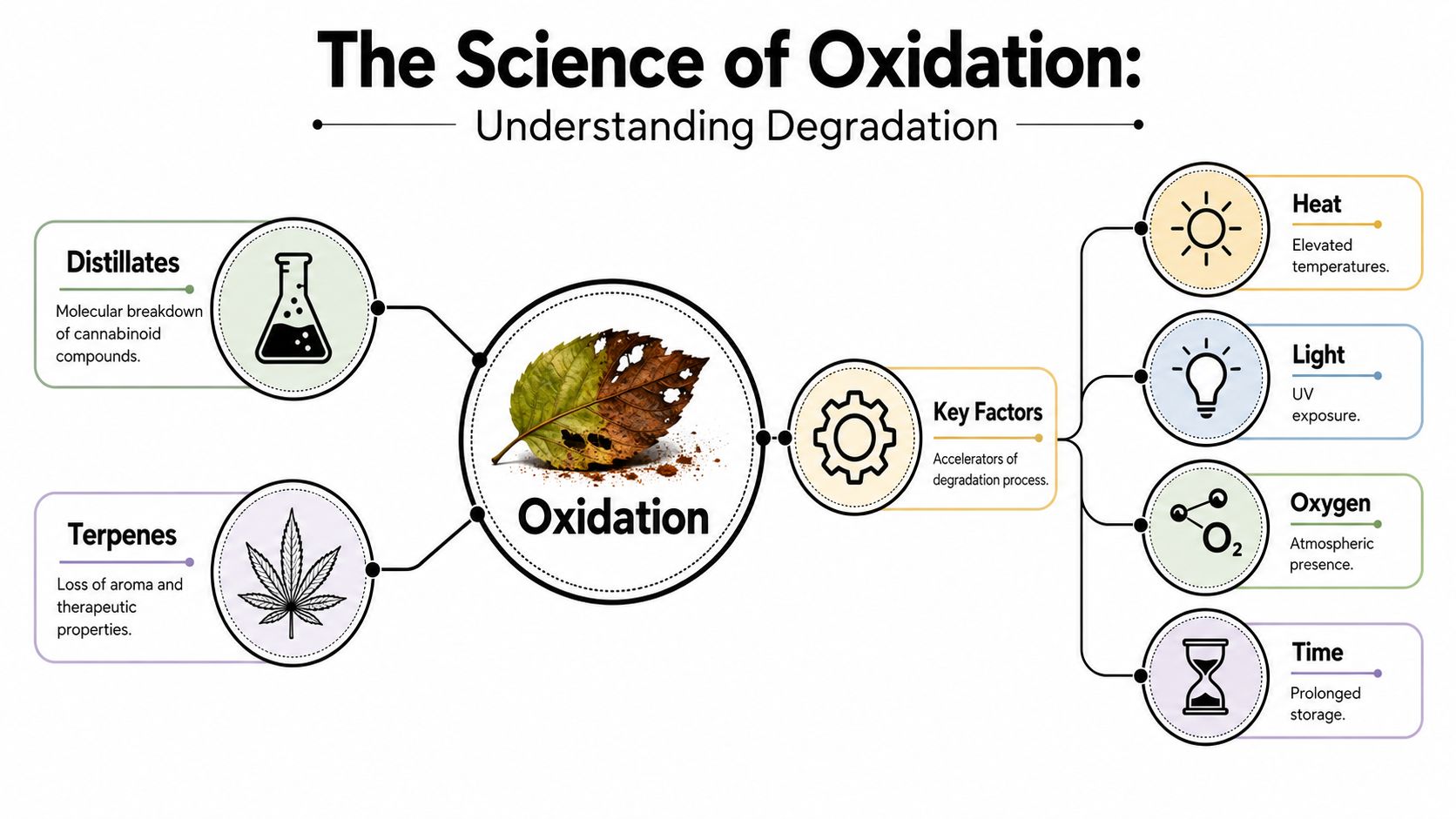
Oxidation is easiest to understand if you think about metal rusting. The chemistry isn't identical, but the logic is similar. A material reacts with oxygen, its structure changes, and the visible and functional properties shift. In vape oils, that shift shows up as color drift, aroma loss, and harsher sensory output.
For cannabis formulations, the most exposed molecules tend to be the most sensitive. Terpenes are especially vulnerable because they're volatile and reactive. Cannabinoid-rich oil can also change, particularly where the oil is in direct contact with air inside the cartridge.
The three main accelerants
Most oxidation problems in formulating terpene profile for vape cartridges can be traced back to a short list of triggers.
| Factor | What it does in practice | Why formulators care |
|---|---|---|
| Oxygen | Contacts the oil surface, headspace, and exposed raw materials | Drives the underlying chemical change |
| Light | Especially UV exposure during storage or display | Speeds degradation and color change |
| Heat | Shows up during processing or poor storage | Increases reaction rate and terpene loss |
Oxygen is the primary feedstock for the problem. Every time a terpene bottle gets opened, every transfer with excess splashing, every half-empty container sitting on a bench, you're giving the reaction more opportunity to continue.
Light acts like an accelerator pedal. UV exposure is particularly damaging, which is why clear storage without shielding is a preventable mistake. Heat does the same thing from another angle. It gives molecules more energy and tends to make unstable systems fail faster.
What happens to terpenes
If you're new to terpene work, don't think of oxidation as only "less flavor." It's often different flavor. The profile moves away from the fresh target. Bright top notes are usually the first thing people notice because they're the easiest to lose.
That matters in any strain-inspired terpene blend for cannabis product formulation because top, mid, and base notes don't all fail the same way.
- Top notes: The first to announce oxidation because they're the most volatile and easiest to distort.
- Mid notes: The body of the profile starts to flatten or skew.
- Base notes: Heavier notes can linger, which sometimes makes the whole blend feel duller or muddier rather than merely weaker.
For a useful primer on component behavior, this guide to terpene chemistry is worth revisiting when you're training a new formulator.
If your retained sample and your aged sample have the same general aroma intensity but a different balance, you're not just looking at evaporation. You're often looking at chemical conversion.
Why the oil darkens at the top first
The top layer is where the oil meets air. That's the front line. In a cartridge, the air-oil interface gets more oxygen access than the bulk oil below it, so discoloration often appears there first. Teams sometimes assume this means contamination entered from the hardware. Sometimes hardware contributes. But very often the pattern tells you where oxidation had the easiest path.
Time does the rest. The reaction doesn't need a dramatic event. It only needs exposure and enough opportunity.
Formulating for Stability A Guide for Vape Cartridges
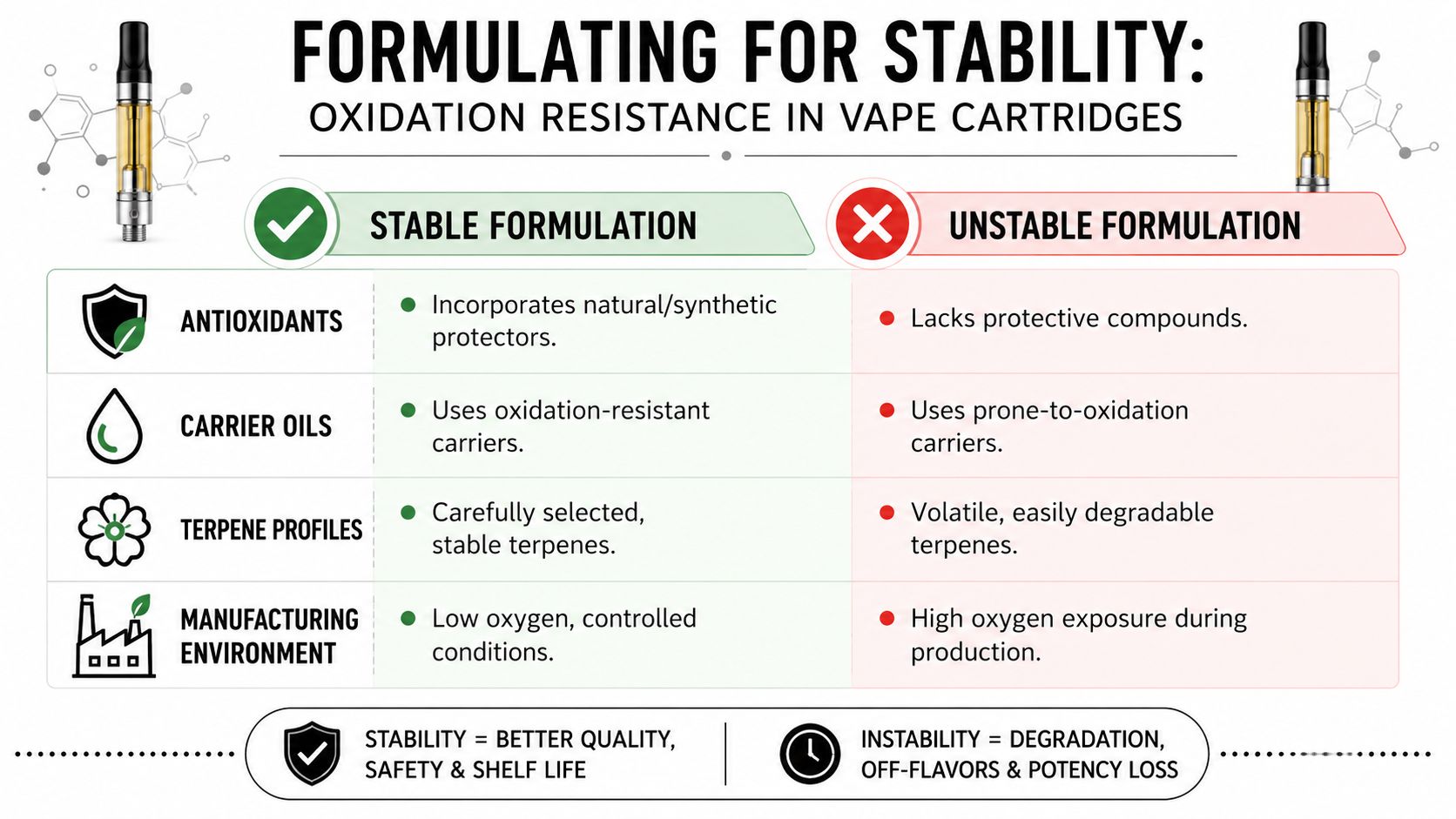
A stable cartridge starts as a formulation decision, not a packaging apology. If the blend is easy to oxidize, clean filling and good storage only slow the problem. They don't solve it. For teams formulating for vape cartridges or tuning a terpene profile for distillate, the first question should be simple: is the formula itself helping you or fighting you?
Start with terpene loading, not guesswork
A lot of oxidation headaches begin with a blend that was overbuilt for aroma and underbuilt for hardware behavior. The industry-standard terpene loading range for vape cartridges is 4 to 10 percent by volume, and concentrations above 15% cause significant throat irritation and formulation instability, with formulators typically beginning at 3% and adjusting by 0.5% increments for hardware-specific tuning, as outlined in this vape cartridge terpene loading guide.
For standard viscosity distillate at 90%+ purity, the optimal terpene incorporation rate is 7.5% by volume. High-viscosity liquid diamonds require 10%, and low-viscosity oils require 5%, according to this R&D vape formulation best practices guide.
Those numbers matter because terpene loading isn't just a flavor setting. It affects wicking, leak resistance, harshness, and the exposed reactive fraction in the final oil.
Think in note structure
When I review a failed strain-inspired terpene blend for distillate, I don't only ask whether the profile smelled right fresh. I ask whether the note architecture had enough durability to survive processing and shelf time.
- Top notes carry identity: Citrus, pine, and bright fruit notes often define the first impression.
- Mid notes create recognizability: Mid notes determine whether many cultivar-inspired blends either hold together or fall apart.
- Base notes provide persistence: They give the profile a landing zone so the blend still reads correctly as the lighter notes age.
A stable profile doesn't mean dull. It means balanced for the way the product will live in hardware.
A formulation-level oxidation inhibitor
For high-THC vape oils, one of the clearest formulation-level strategies is controlled THCA inclusion. Research covered in this report on Abstrax Tech's AmberClear formulation describes integrating 5–8% by weight THCA into distillate or liquid diamond formulations. In that work, THCA acts as a functional oxidation inhibitor, and the process reduced color change by more than 90% over six months compared with conventional formulations.
The useful part for formulators is the logic behind it. This approach isn't trying to hide discoloration after it appears. It's aimed at interrupting the oxidation pathway before the visible byproducts accumulate at the oil surface.
Bench rule: If you use THCA as a stabilizing tool, stay disciplined with concentration control. The cited performance depends on keeping the formulation in the 5–8% range, not treating THCA like a loose additive.
There are trade-offs. Underuse can leave the pathway insufficiently blocked. Overuse can create other formulation issues, including unintended sensory effects or hardware compatibility concerns. Surface oxygen still matters too. A stabilizer helps, but it won't excuse sloppy handling.
What works and what tends not to
Formulators often ask whether they should "just add an antioxidant." That's too broad to be useful. Any additive has to be judged against the product category, sensory goals, compliance position, and hardware behavior. In practice, I separate options into two questions. Does the material protect the formula, and does it belong on the label and in the device?
| Decision point | Strong choice | Weak choice |
|---|---|---|
| Load targeting | Use application-specific terpene percentages | Pick a number by aroma preference alone |
| Stabilization strategy | Use a mechanism-based approach when needed | Hope packaging will correct a weak formulation |
| Hardware fit | Match viscosity to cartridge behavior | Force a blend into hardware it wasn't built for |
If you're trying to dial in viscosity before fill, this practical guide on how to thin distillate is relevant because stability and flow are tied together. A formula that barely wicks or overheats at the coil won't age gracefully.
Processing and Handling Controls to Exclude Oxygen
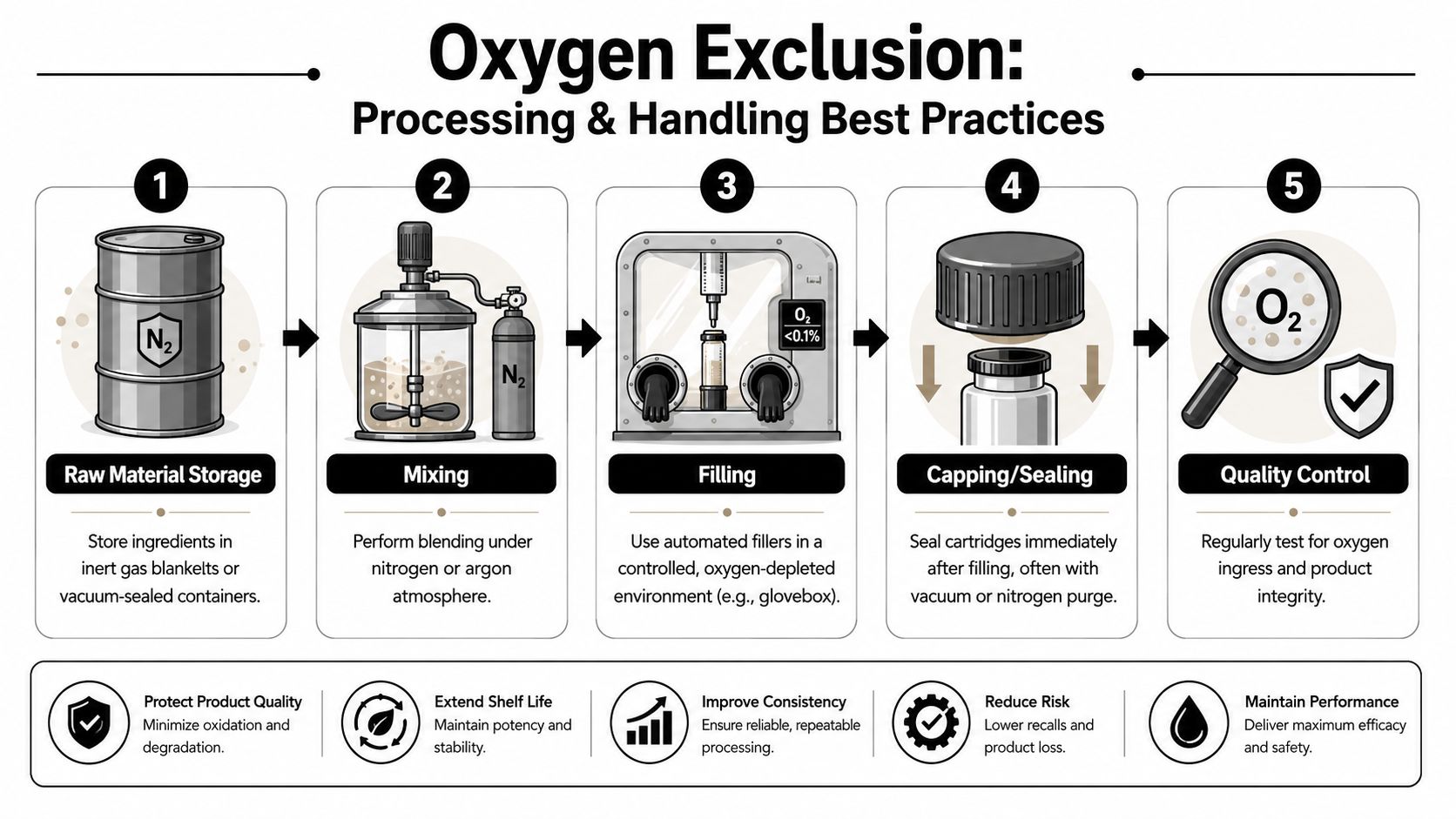
Even a strong formula can be damaged by ordinary production habits. Oxidation control lives in the moments operators usually treat as routine. Opening a drum. Leaving a beaker half full. Mixing in oversized vessels. Delaying capping after fill. None of those steps looks dramatic, but each one adds oxygen exposure.
The practical goal isn't "zero oxygen." In normal manufacturing that isn't realistic. The goal is to keep oxygen contact brief, limited, and controlled at every handoff.
Raw material storage that actually protects terpenes
Best practices for preventing terpene oxidation include storing terpenes in airtight, UV-protected glass containers at 60–70°F, minimizing headspace, and using nitrogen or argon flushing to displace oxygen. Nitrogen flushing is the commercial standard due to cost-effectiveness, according to this terpene preservation guide.
That one sentence captures most of what operators miss. Glass matters because plastic is an inferior oxygen barrier. Headspace matters because the oxygen above the liquid is still part of the system. Temperature matters because stable, cool storage is gentler on terpenes than repeated warming and cooling.
The same source notes that terpenes stored at consistently cool temperatures in the 60–68°F range maintain potency significantly longer than those exposed to temperature fluctuations, and refrigeration can extend shelf life if the containers are completely airtight so condensation doesn't become a new problem.
Nitrogen versus argon
Both gases are used to displace oxygen. In daily manufacturing, the choice usually comes down to practicality.
- Nitrogen fits most production rooms: It's generally preferred for commercial use because it's lower cost and easier to source.
- Argon offers slightly better protection: Its higher density and chemical inertness can improve coverage in some setups.
- Container shape affects outcome: Multiple purge cycles may be needed for complete oxygen removal, especially when geometry creates pockets that trap air.
SOP discipline matters more than theory. A single quick blast into a complex bottle doesn't guarantee the headspace is cleared.
Use the smallest container that reasonably fits the batch. The easiest oxygen to remove is the oxygen you never allowed into excess headspace in the first place.
A workable oxygen-exclusion routine
For teams building or revising line procedures, this sequence is easy to implement and hard to regret:
- Pre-stage vessels correctly: Choose containers that keep headspace tight before any material enters the room.
- Blanket sensitive materials early: Apply nitrogen or argon after opening and again after transfer.
- Mix with intent: Avoid unnecessary splashing, vortexing, or extended open-air holding.
- Fill and seal without delay: The longer the filled hardware sits uncapped, the more vulnerable the oil surface becomes.
- Flush after reopening: If a container is reopened for rework or sampling, treat it as a new exposure event.
Small mistakes that undo good chemistry
What fails most often isn't lack of knowledge. It's inconsistent execution.
| Common habit | Why it causes trouble |
|---|---|
| Using plastic storage containers | They don't block oxygen as well as glass |
| Opening bottles repeatedly | Fresh oxygen re-enters every time |
| Keeping oversized backup containers | Extra headspace means extra oxygen |
| Letting filled carts wait uncapped | The oil surface stays exposed at the most vulnerable stage |
When new team members ask me how to prevent oxidation in real production, this is usually my answer: don't look for one hero step. Build a boring process that excludes oxygen every time material changes hands.
Packaging and Long-Term Storage Best Practices
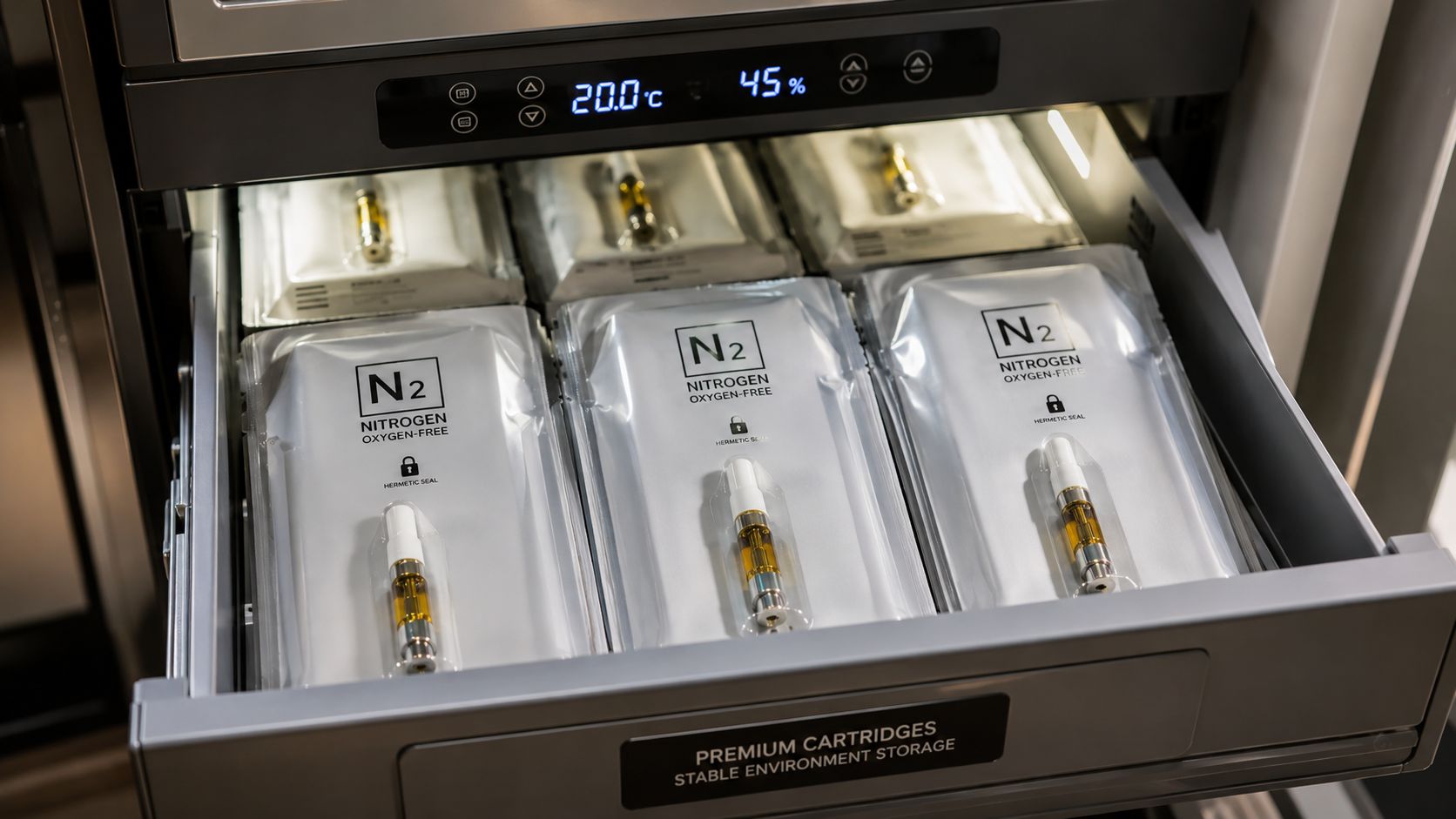
Packaging isn't passive. It either protects the work done in formulation and filling, or it slowly gives that work back. That's why I treat package selection as part of the stability program, not as a downstream purchasing decision.
A cartridge can leave the line looking excellent and still age poorly if the hardware allows oxygen ingress, the retail carton admits too much light, or the finished goods sit in a warm warehouse. If you're serious about replicating flavor of a known cultivar in finished hardware, the package has to preserve the profile you approved.
What to look for in hardware
Not every cartridge platform ages oil the same way. Two carts can wick similarly and still differ in long-term protection.
- Seal quality matters first: A weak seal can allow ongoing oxygen exchange.
- Material choice affects flavor hold: Hardware materials that contribute less flavor interference make profile drift easier to detect and less likely to compound.
- Build consistency matters more than brochure claims: A component that performs well only when assembled perfectly isn't reliable enough for production reality.
I also favor evaluating hardware with retained samples instead of only relying on fresh fill impressions. Fresh carts hide a lot of future problems.
The outer package matters too
Secondary packaging should help with two jobs. Keep out light and reduce environmental stress during storage and transport. UV-blocking formats are worth considering because light exposure can accelerate degradation even when the cartridge itself appears sealed.
For terpene raw materials and partially used blends, this guide on how to store terpenes is a useful companion reference because the same preservation logic applies before those materials ever enter a finished SKU.
A premium formulation in poor packaging doesn't become a premium product. It becomes a future complaint.
Warehouse and retail reality
You can ruin a stable product without touching the formula. Warm staging areas, sunlit display cases, and long dwell times all pressure the system. Storage should stay cool, dark, and consistent. The issue isn't only peak heat. Fluctuation itself can be rough on volatile components.
I also separate retained samples by storage condition whenever possible. One set under ideal conditions tells me what the formula can do. Another set under rough but realistic conditions tells me what the market will probably see.
Troubleshooting QC and Advanced Stability Concepts
When oxidation shows up, don't stop at the visible symptom. A dark ring, a duller aroma, or random cart-to-cart variation is the last chapter of the story, not the first. Good troubleshooting works backward through the workflow.
A simple what-went-wrong checklist
Start with the failure pattern.
- Only the top darkened: Look first at headspace, delayed sealing, or oxygen at the oil surface.
- The whole batch looks older than expected: Review raw material age, storage history, and processing heat exposure.
- Flavor changed more than color: Check terpene storage, repeated bottle openings, and note balance in the original blend.
- Variation appears within the same lot: Suspect inconsistent fill timing, container handling, or hardware seal variability.
Then compare retained samples from each stage if you have them. Raw terpene blend, post-mix bulk oil, filled uncapped carts, and released finished goods can each point to a different failure point.
Build QC around observation, not just release testing
A useful QC program doesn't need to start complicated. It needs to be consistent.
| QC check | What it helps you catch |
|---|---|
| Visual color review over time | Surface darkening and lot drift |
| Aroma comparison against retained control | Loss of top-note accuracy |
| Packaging inspection | Seal problems and handling damage |
| Storage-condition review | Heat, light, and dwell-time issues |
If you're scaling up, trend those observations by lot and by hardware type. Patterns emerge quickly when the same issue repeats in the same cartridge family or storage lane.
Don't ask whether a cart oxidized. Ask where the oxygen got its opportunity.
The more nuanced view of terpene oxidation
Not all oxidation should be discussed as if it produces one flat outcome. An often-overlooked aspect is that oxidation transforms terpenes into terpenoids. While flavor diminishes, data shows these new compounds can retain or even enhance effects like relaxation and muscle recovery, as described in this explanation of how terpenes become terpenoids.
That distinction matters for formulators. If your goal is strict flavor fidelity, oxidation is still the enemy. But if you're developing products around broader functional character rather than sensory purity alone, the chemistry is more nuanced than simple loss.
Whole flower versus extracts
One final caution. A lot of teams assume terpene preservation should follow the same logic used for cannabinoid stability. That's not always true. Emerging peer-reviewed data discussed in this summary on terpene storage conditions notes that terpenoid concentrations decrease rapidly under all storage conditions, with temperatures below −20°C and mechanical grinding being the least favorable. In that dataset, whole inflorescences stored at 4°C in olive oil best preserved terpene profiles.
That doesn't mean you should put vape oil in olive oil. It means terpene preservation can be counterintuitive, and rough handling plus extreme cold isn't automatically protective just because it sounds conservative.
The best operators I know don't treat oxidation as a one-step defect. They treat it as a chain. Formula, oxygen control, packaging, and storage either work together or fail together.
If you're building a more stable terpene profile for vape cartridges, dialing in a strain-inspired terpene blend for distillate, or tightening your formulation guide for cannabis product formulation, Gold Coast Terpenes offers terpene blends, isolates, and formulation resources built for cartridge development, flavor replication, and repeatable production work.