
A batch can look clean all the way through filling and still fail at the finish line. That's the moment brands learn whether they built a testing habit or a testing program.
For cannabis formulators working on a terpene profile for vape cartridges, a strain-inspired terpene blend for distillate, or a formulation guide for cannabis product formulation, pesticide residue testing isn't a side task. It sits right beside flavor accuracy, hardware compatibility, and batch consistency. If you're trying to replicate the flavor of a known cultivar, every input matters. If one upstream material carries residue risk, the final product inherits that risk with it.
The practical mistake is treating pesticide residue testing like a one-time release check. That approach fails under real production conditions. A resilient program starts earlier, reaches deeper into suppliers and sampling, and leaves a documentation trail strong enough to survive a regulator, an auditor, or an angry distributor.
Why a Testing Program Beats Ad-Hoc Testing
The call usually comes after packaging is already done. The carts are filled, labeled, staged, and tied to a launch date. Then the lab says the pesticide screen failed.
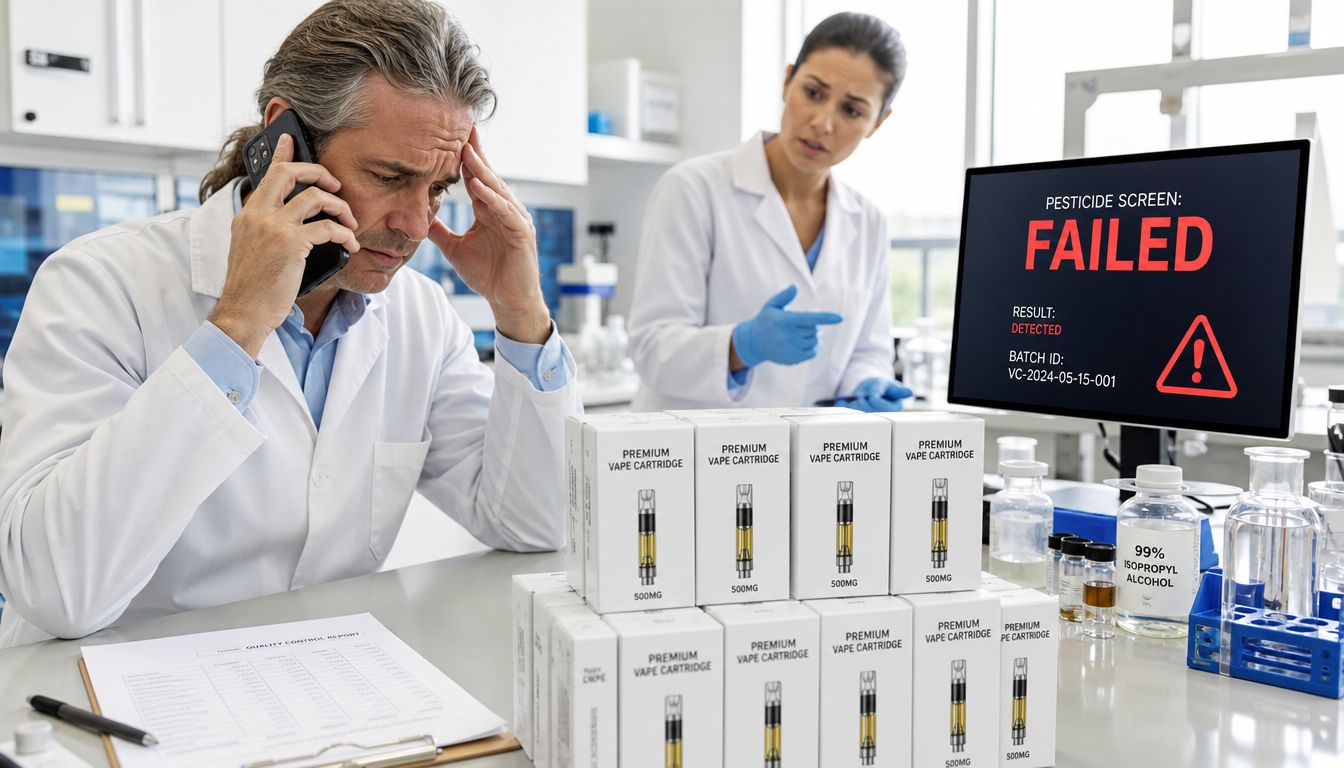
At that point, most brands focus on the wrong question. They ask, “Why didn't the final test catch this earlier?” Instead, the question is why the batch ever made it that far without stronger controls on biomass, extract, additives, and supplier paperwork.
Final-gate testing is too late
Ad-hoc testing treats the lab like a referee. A real program treats the lab like one control point in a chain. If you only test finished vape cartridges, you've already paid for extraction, terpene blending, hardware, labor, packaging, and scheduling. A failed result at the end is expensive because every prior step multiplied the cost of the mistake.
That's why professional QA teams build release decisions in layers:
- Raw material qualification before intake
- In-process checks before a batch moves to the next stage
- Finished goods verification before shipment
- Document control so every lot can be traced back to source
Practical rule: If your first serious pesticide residue testing event happens after filling, your system is backwards.
Programs protect formulation work
This matters even more when you're formulating a strain-inspired terpene blend or dialing in a specific sensory target for distillate. Formulators spend time balancing top, mid, and base notes. Limonene may lift the opening. Linalool may soften the center. Beta-caryophyllene or humulene may anchor the finish. None of that work matters if the batch gets quarantined for a preventable residue issue.
A program also protects scaling. Once you move across product types, operators, and jurisdictions, informal habits stop working. Written SOPs, intake holds, and lot-specific review become the only reliable way to keep production moving. A good starting point is a documented regulatory compliance checklist for cannabis operations, then adapting it to your own ingredients and release flow.
What works and what fails
A simple comparison makes the difference clear:
| Approach | What it looks like | What usually happens |
|---|---|---|
| Ad-hoc testing | Test only when required, usually at the end | Surprises, disputes with suppliers, expensive holds |
| Program-based testing | Test by stage, qualify suppliers, keep records | Fewer late failures, faster root-cause work, cleaner releases |
Reactive testing feels cheaper until a batch fails. Then everyone learns what prevention would've cost.
Navigating the Pesticide Regulatory Minefield
Cannabis operators don't get the luxury of one national pesticide standard in the United States. They get a patchwork.
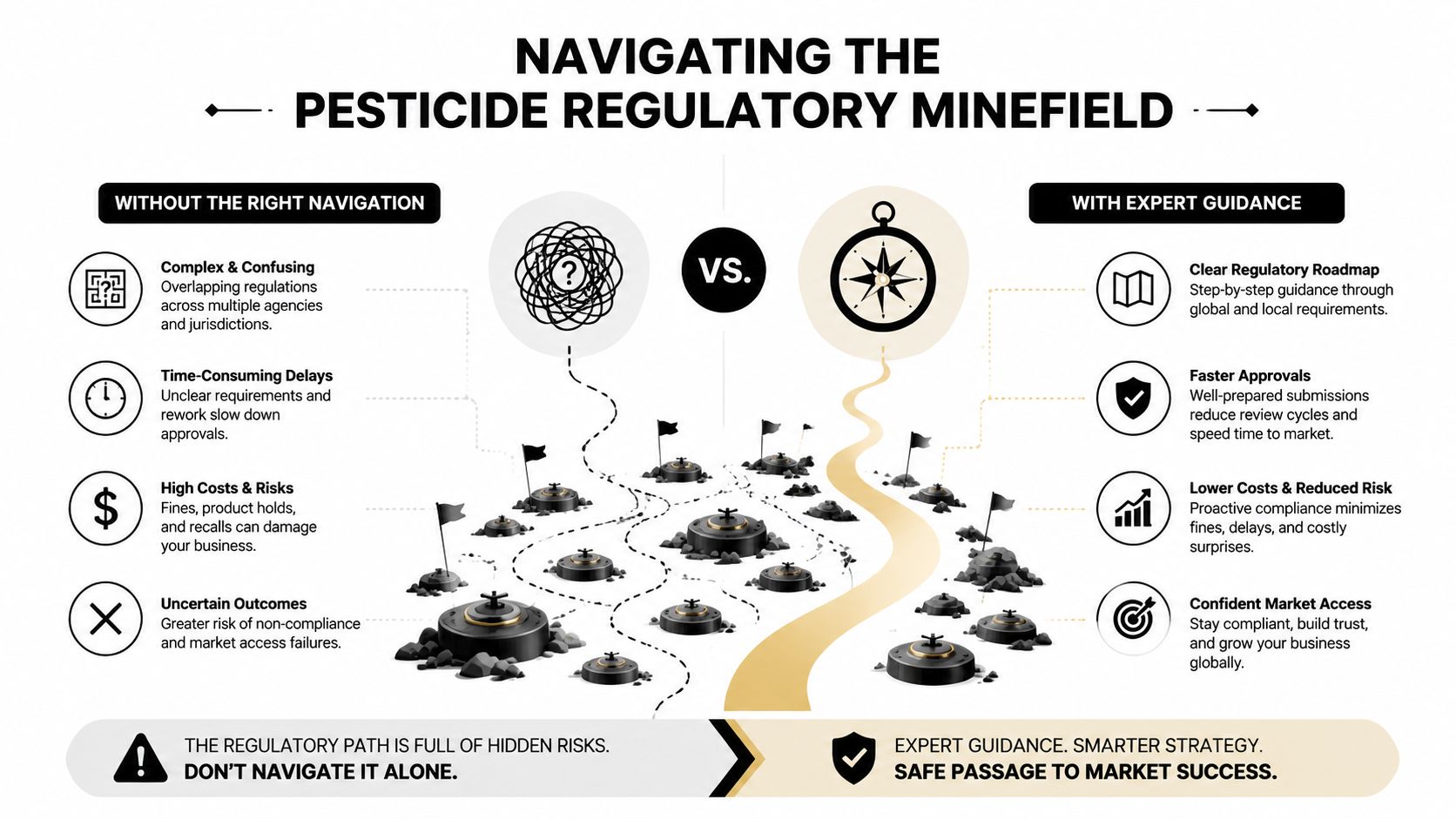
The underlying problem is structural. There is a systemic regulatory gap where the U.S. EPA, USDA, and FDA can't set tolerance limits for cannabis, leaving states to create their own uncoordinated standards. That produces inconsistent action levels, including a dimethomorph range of 0.1 to 60 ppm across 5 states, making compliance difficult for multi-state operators, as outlined in the NIH-published review on cannabis pesticide regulation.
Fragmentation changes how you build specs
If you manufacture in one state and sell in another, your internal specification can't just mirror the least restrictive market. It has to account for where the product might go next, how retesting will be handled, and whether a distributor applies its own acceptance limits.
That means your internal pesticide policy should answer three questions:
- Which jurisdiction sets the strictest relevant limit
- Which materials create the most residue risk
- What happens when a result is technically legal in one market but unsellable in another
If you don't answer those internally, the answer gets imposed later by a lab result, a regulator, or a retail partner.
A short operational review can help teams map those obligations. The useful frame isn't “What does our state require today?” It's “What's the tightest defensible standard we can run without breaking our supply chain?” Teams juggling licenses and production entities should also keep a clean record of business licensing requirements tied to cannabis operations, because pesticide compliance often gets reviewed alongside broader operating controls.
Expert guidance reduces wasted motion
A visual summary helps when you need to explain this internally.
The brands that handle this well don't chase every state update in panic mode. They write one house standard, review it on a schedule, and apply it to sourcing, intake, production, and release. That creates fewer arguments and fewer “but it passed in the other state” conversations.
The cheapest compliance model is usually the one that fails as soon as the business expands.
The practical operating model
A workable model looks like this:
- Set one internal action framework: Use the most restrictive relevant market as the baseline for your own release logic.
- Control product claims and destinations: Don't formulate one batch for multiple states unless the batch meets the strictest target.
- Build supplier language into contracts: Require timely COAs, lot traceability, and disclosure when growing or processing conditions change.
- Treat reformulation carefully: A new botanical input, carrier, or hardware component can change your risk profile even if the formula seems minor.
For anyone developing a terpene profile for cannabis product formulation, this matters because compliance isn't separate from product design. The target flavor may be the same. The acceptable sourcing path may not be.
Establishing a Defensible Sampling Protocol
A batch fails pesticide testing. The grower blames the lab. The lab points to the sample. QA gets pulled into a dispute that should have been prevented before the jar was sealed.
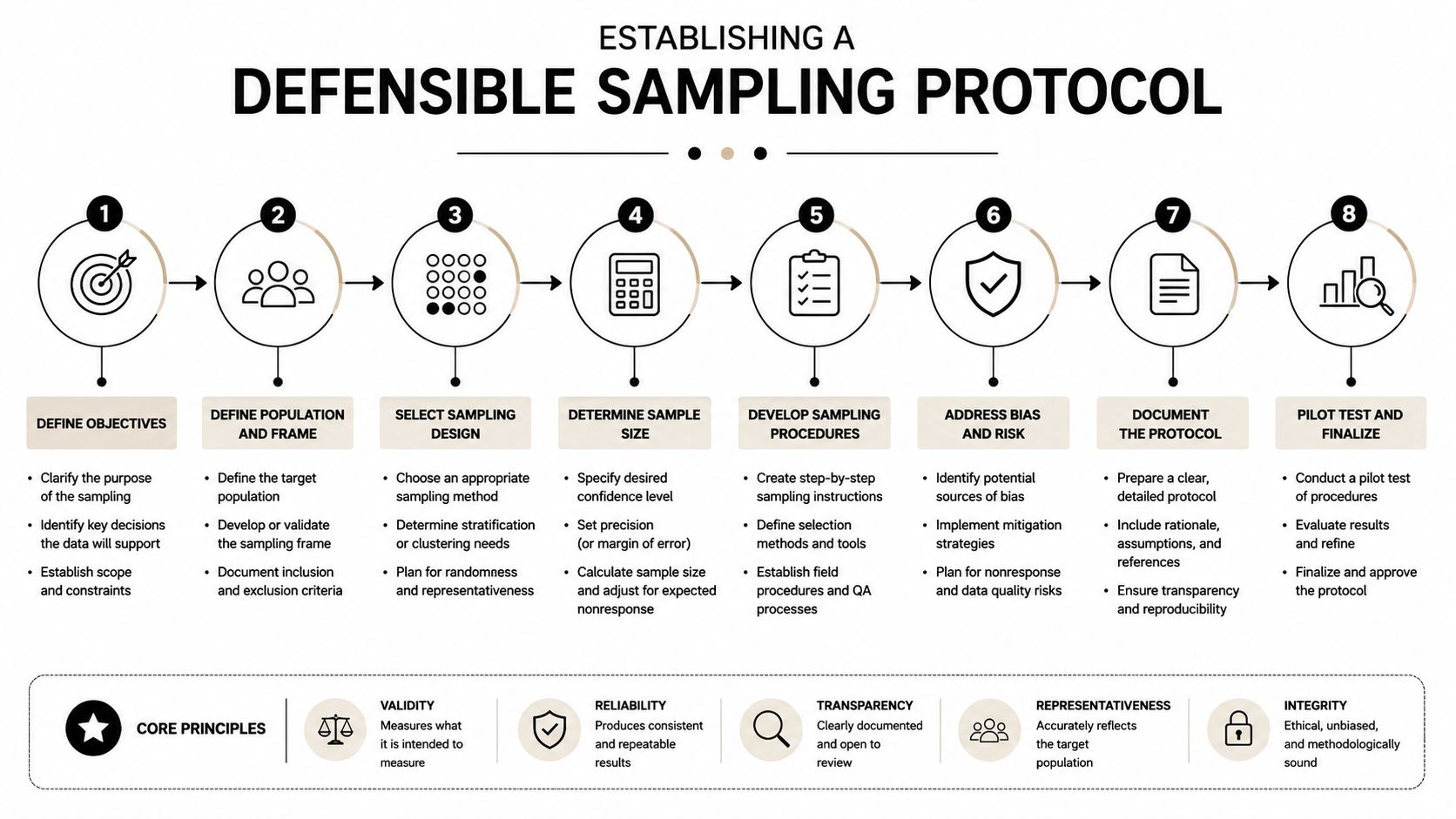
That is why sampling needs to be treated as part of the testing program, not as a quick handoff before shipping to the lab. A lab can only analyze what you send. If the sample does not represent the lot, the COA does not represent the lot. That creates false passes, false failures, release delays, and supplier fights you cannot document your way out of later.
Start with lot definition
Define the lot before anyone samples it. Put the definition in the SOP and in the batch record.
For biomass, the lot may be a harvest lot, a room lot, or a received supplier lot. For crude, distillate, or isolate, it should tie to a specific production batch with tank IDs, processing dates, and transfer records. For filled carts, the lot has to connect the oil lot, terpene lot, hardware lot, and fill run. If that chain is broken, investigations get expensive fast.
Each sample label should tie back to:
- Material identity
- Lot or batch ID
- Date and sampler
- Sampling point
- Intended test panel
Keep it simple and consistent. Good documentation beats clever documentation every time.
Homogenization is a control, not a lab preference
Cannabis is rarely uniform on its own. Flower can vary within the same bag. Extracts can stratify during hold time. Filled cartridges can drift lot-to-lot if the vessel was not mixed consistently or the fill run paused and restarted.
I treat homogenization as a release control because poor mixing makes the rest of the testing process weaker. If one portion of the lot carries more residue than another, the final result reflects the pocket you sampled, not the batch you plan to sell. Labs see this problem often, but the root cause usually starts upstream in production or intake.
The fix is procedural. Define how each matrix is mixed, what equipment is allowed, how long the material can sit before sampling, how the aliquot is pulled, and how the sample is stored and transferred. Teams that already document mixing and hold-time controls for quality assurance in vape blending operations usually adapt faster here because the discipline is already in place.
If homogenization is inconsistent, the test result is hard to defend.
Write separate SOPs by material type
One sampling SOP for every material sounds efficient. It usually creates vague instructions and operator judgment calls.
A defensible program breaks sampling into at least three categories.
Raw materials
Biomass, trim, distillate, isolates, and terpenes should be sampled at intake under a defined plan. The SOP should state how many containers are eligible for selection, where in the container the sample is pulled from, what tools are permitted, and who signs off on release or quarantine.
Brands often cut corners by accepting a supplier COA, pulling a token retain, and moving on. That works until the supplier changes a source lot, storage conditions shift, or environmental contamination shows up in one tote but not the next.
In-process materials
Crude, winterized oil, and post-distillation fractions should be sampled after confirmed mixing and before the next transfer. This gives operations a chance to stop a problem before it spreads across more equipment, more packaging, and more paperwork.
In-process sampling costs time. It saves far more time than a finished goods hold.
Finished goods
Finished vape carts need samples from the actual commercial run. Pull from the run you intend to release, not from a bench trial, a startup purge, or a retain set aside before the vessel reached steady state.
If the line used multiple operators, pauses, or hardware lots, account for that in the sampling record. Those details matter during investigations.
Environmental contamination needs its own record set
Some pesticide failures come from direct application. Others come from drift, irrigation water, soil history, or contaminated propagation material. New Bloom Labs outlines several of these failure paths in its discussion of why cannabis can fail pesticide testing even without direct pesticide use.
That matters because a compliant grower can still send you a risky lot.
Supplier approval should cover more than a no-spray statement. Ask for records on water sources, neighboring land use, clone or seed origin, and any known site contamination history. If your sourcing program ignores environmental exposure, your sampling plan is reacting to risk instead of controlling it.
The goal is not more testing for its own sake. The goal is a sampling program you can defend when a result is challenged, a regulator asks questions, or a supplier insists the lab got it wrong.
How to Select a Qualified Testing Lab Partner
A testing lab isn't a line item. It's a control point that can protect your batch record or expose how weak it is.
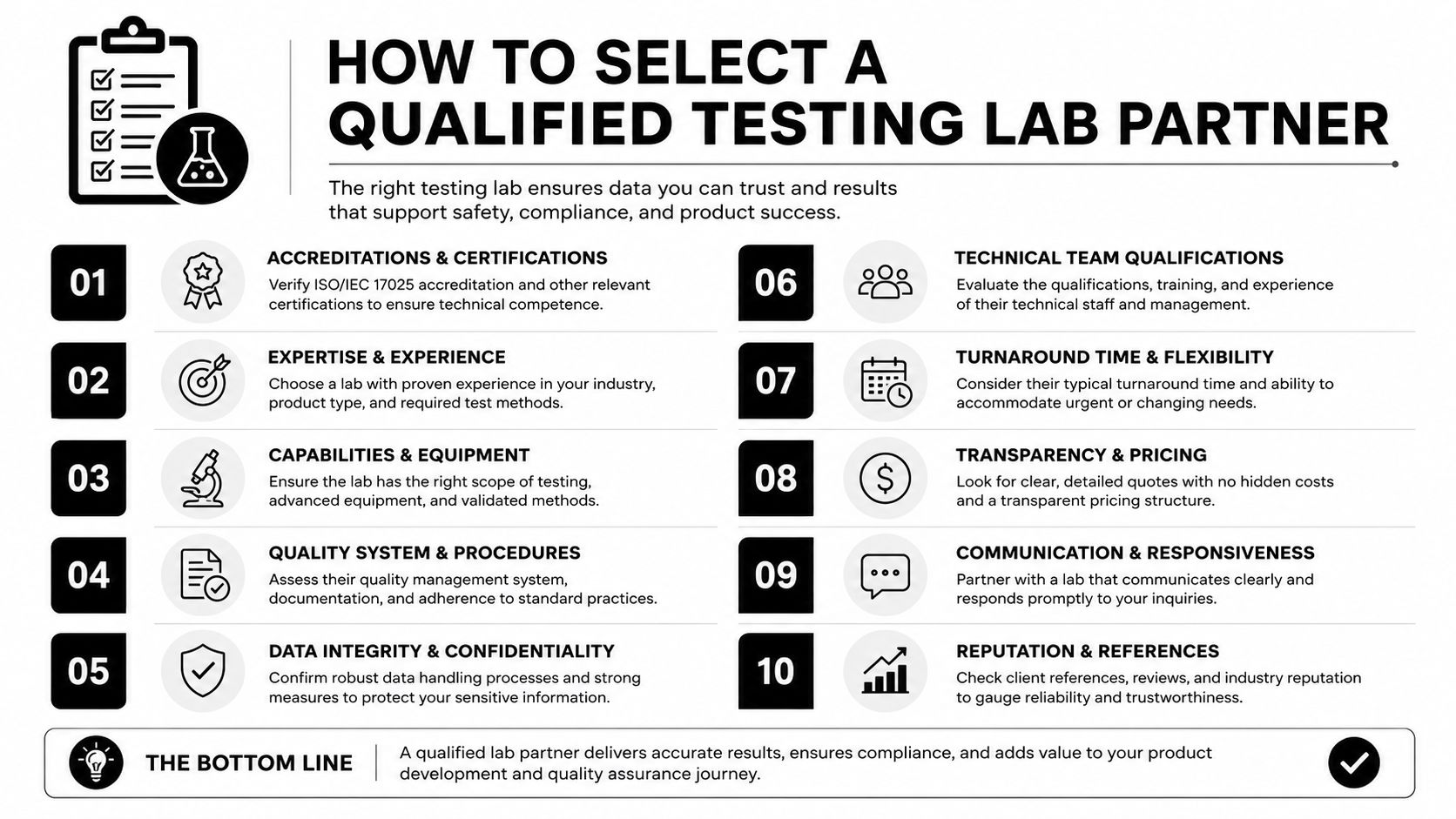
Brands that shop labs by price usually get exactly what they paid for. Slow communication, vague answers, weak method fit, and no useful support when an out-of-spec result lands. That's not a partner. That's a vendor sending PDFs.
Accreditation and method quality come first
ISO/IEC 17025 accreditation is a fundamental requirement. Analytical labs must hold ISO/IEC 17025 accreditation to validate their methods, including a mean recovery between 70% and 120% with RSD of 20% or less across at least five replicates, as described in Thermo Fisher's overview of pesticide residue testing methods and lab quality requirements.
That matters because cannabis extracts are difficult matrices. If the lab can't demonstrate method control in a hard matrix, the COA may look polished while the underlying work is shaky.
Questions that separate good labs from commodity labs
Use a screening list before you sign anything.
- Ask about matrix experience: Can they speak clearly about flower, concentrates, and vape oils, or do they answer in generic food-testing language?
- Ask about instrumentation coverage: Do they explain which instruments support their panel and where limitations exist?
- Ask how they handle outliers: A serious lab has a documented process for rechecks, investigations, and communication.
- Ask for reporting clarity: If they can't explain how they report ND, BQL, and quantified results in plain language, expect confusion later.
A strong lab should also make your internal quality system better. If they never challenge a bad sample, a missing chain-of-custody field, or an unusual matrix note, they're not helping you.
Lab-buying mistake: Teams compare only price per sample and turnaround time. They ignore whether the lab can defend the result.
Choose a lab that supports manufacturing reality
For formulators working on a strain-inspired terpene blend for vape cartridges, the ideal lab partner understands production timing. They know when a result needs to hold a lot, when a trend matters more than a single data point, and when an upstream retest is smarter than arguing over a finished unit.
That's the same mindset behind disciplined quality assurance processes for vape blending. You're not buying paperwork. You're buying confidence in decisions.
Demystifying Analytical Methods for Pesticides
You don't need to run the instrument. You do need to know what your lab is doing when it says a batch passed a pesticide panel.
For most cannabis-relevant residue work, the core methods are LC-MS/MS and GC-MS/MS. In practical terms, both methods separate compounds, identify them by chemical behavior, and quantify them against standards. The business takeaway is simple. A broad pesticide screen usually needs both.
Why labs use QuEChERS first
Before analysis, the sample has to be prepared in a way that pulls residues out of a complex matrix without dragging too much interference into the instrument. The standard approach for multi-residue work is QuEChERS, which uses acetonitrile extraction followed by dispersive solid-phase clean-up with magnesium sulfate and sodium acetate buffering for base-sensitive compounds. That workflow is the industry standard because it's efficient and rugged in difficult matrices, as outlined in this chromatography testing overview.
For operators, the point isn't the chemistry itself. The point is that sample prep drives result quality. A poor extraction or cleanup step can bury real residues or create noisy data that's hard to trust.
What LC-MS/MS and GC-MS/MS each do well
A simple comparison helps:
| Method | Best fit in practice | Common business implication |
|---|---|---|
| LC-MS/MS | Many non-volatile or thermally sensitive compounds | Broad coverage for residues that don't behave well in gas systems |
| GC-MS/MS | More volatile and thermally stable compounds | Important for residues better suited to gas-phase separation |
If a lab can't explain why both methods matter, ask more questions. A thorough screen isn't just a long analyte list. It's the right analytes on the right platform.
Some pesticides need different instrumentation
There's another blind spot that operators miss. Some ionic and polar pesticides, including glyphosate and glufosate, can evade standard multi-residue GC and LC methods. In those cases, ion chromatography becomes important. If the lab lacks that capability, “not detected” may reflect method limitation rather than a clean sample.
That's why method fit matters so much when you're formulating for distillate or building a repeatable flavor system around a fixed ingredient set. You need to know whether the panel covers the risks your materials present.
A long analyte list doesn't guarantee useful pesticide residue testing. Coverage depends on extraction, cleanup, instrumentation, and the lab's ability to validate the method in your matrix.
Standards and verification matter more than most brands realize
One overlooked detail is standard preparation. When labs prepare calibration standards, they should independently verify stock solutions. If the relative chromatographic response difference between two independently prepared standard mixtures exceeds 10%, a third solution should be prepared and the two closest combined. That's the kind of quiet quality control step that prevents systematic reporting error.
Brands don't need to micromanage that work. They do need to ask enough technical questions to know whether the lab has a real method behind the COA.
Reading a COA and Responding to Results
A release meeting gets expensive fast when the room is staring at a COA that says "Pass," but the lot number is wrong, the matrix is misidentified, or the reported result sits right on top of your internal action threshold. I have seen compliant material fail in practice because the team read the summary line and skipped the record check underneath it.
A COA is not the decision. It is one record in the decision file.
The first job is to read it like an investigator, not like a buyer looking for a green light. "Pass" can still trigger supplier follow-up. "Fail" can still require confirmation that the sample, lot, and reporting basis are correct. "ND" does not prove the sample is free of residues. It means the lab did not report a quantified result under the method and reporting limits used for that test.
What ND and BQL actually mean
Teams get into trouble when they treat ND and BQL as zero. They are reporting terms, not proof of absence.
In practice, that distinction affects three things. Lot release. Supplier trending. Root-cause work after an exception. If purchasing logs every ND as "clean," the team loses visibility into low-level recurring findings that may still point to drift in cultivation inputs, environmental contamination, or inconsistent raw material control.
Read the reporting language carefully. Some labs report below the limit of quantification differently. Some add qualifiers. Some only show the final call. If the notation is unclear, ask the lab to explain the result in writing and file that explanation with the batch record.
How to read the report in order
Do not start with the pass/fail box. Start at the top and work down.
Confirm sample identity
Match the product name, lot ID, matrix, sample date, and client information to your internal records. A COA tied to the wrong lot is not a minor clerical issue. It invalidates the release decision until corrected.Confirm the method and panel
Check that the test performed matches the panel you ordered and the matrix you submitted. If the product is a gummy, crude oil, flower, or distillate, the matrix designation matters because recovery and interference can change the result quality.Read the reporting terms
Separate ND, BQL, estimated values, and quantified results in ppm. Those labels have different operational meaning, especially when you are trend-reviewing a supplier across multiple lots.Check the action basis
Make sure the lab is comparing the result to the right jurisdictional limit or to your internal specification, whichever governs release. Fragmented state requirements create avoidable failures. A batch can pass one framework and still be unsellable in the market you intend to ship to.Review the full pattern
One detected analyte matters. Repeated low-level detections across lots matter more because they usually point to a system issue, not a one-off event.
A pass/fail call is the last thing to read, not the first.
A practical response framework
Use a written decision tree. Do not improvise under production pressure.
| Result type | What it means operationally | Immediate action |
|---|---|---|
| Pass | Batch meets the release criteria used for that market | Release only after record review is complete |
| Unclear or borderline | Reporting qualifier, sample concern, or result near an internal threshold | Hold lot. Clarify with lab. Document the basis for any retest |
| Fail | Reported result exceeds the applicable limit | Quarantine lot, stop shipment, open deviation, begin source investigation |
A passing batch still needs a record check. Confirm that the tested sample maps to the released lot, the chain of custody is intact, and the raw materials tied to that batch have acceptable documentation. That matters even more for products built from multiple inputs, where one contaminated component can be diluted, blended, or masked operationally while still creating compliance exposure.
For an unclear or borderline result, hold the lot first. Then verify sample condition, lot mapping, collection records, and the exact reporting basis. If a retest is allowed under your SOP, document why the retest is justified. Retesting to shop for a better answer is how brands create audit problems and lose credibility with regulators and lab partners.
For a fail, containment comes first. Lock the lot in the ERP or inventory system, stop release, and open an investigation. Then work backward through supplier COAs, intake logs, environmental observations, treatment records, and production routing. In cannabis, that step matters because some failures come from direct application, while others come from shared equipment, drift, water, storage, or contaminated packaging components. A clean grow room does not eliminate those risks.
What strong teams document after the result
Strong QA teams do not stop at the COA. They create a short closeout packet for any result that affects release, supplier status, or retest decisions.
That packet usually includes:
- Disposition decision
- Reason for release, hold, rejection, or destruction
- Lot and sub-lot mapping
- Chain of custody and sample verification
- Related supplier lots or incoming materials
- Lab clarification emails or corrected reports
- Deviation, investigation, and CAPA records
- Final approval signature and date
This paperwork protects the company when a regulator, distributor, or internal auditor asks why the lot moved. It also protects the operation when the same issue appears again six weeks later and the team needs to know whether it was a supplier problem, a sampling problem, a reporting problem, or a real contamination event.
That is the difference between reading a COA and running a testing program. The first reacts to a result. The second creates a documented response that stands up under scrutiny.
Building a System for Prevention and Compliance
Reliable pesticide residue testing doesn't come from luck. It comes from records, approvals, and repetition.
The broader market reflects that shift. The global pesticide residue testing market was valued at USD 1.34 billion in 2021 and is projected to reach USD 2.43 billion by 2029, reflecting growing regulatory and consumer demand for safety assurance, according to ScienceDirect's market and methods review. For cannabis operators, that means testing is no longer a box to check. It's part of the business infrastructure.
Documentation is the backbone
If a regulator, distributor, or internal auditor asks why a lot was released, you need more than a COA. You need a decision trail.
That usually includes receiving records, approved supplier status, chain of custody, sampling records, lab reports, deviation reports, and disposition approval. For teams doing formulating for vape cartridges or a formulation guide for distillate, this paperwork also protects product consistency. You can't replicate a successful batch if the input and approval records are weak.
Supplier qualification is your first filter
Most prevention happens before production starts. A serious supplier program should include:
- Initial qualification: Review COAs, lot traceability, and basic process transparency before first purchase.
- Ongoing review: Track whether paperwork stays consistent and whether lots create recurring questions.
- Change control: Require notice when cultivation practices, processing conditions, or source locations shift.
This applies to all inputs, not just bulk extract. If an ingredient enters the batch, it belongs in the quality system.
Operational takeaway: The cheapest contamination event to fix is the one blocked at intake.
Use data to strengthen formulation work
Testing data should feed back into procurement and formulation. If one source causes recurring review holds, the issue isn't only compliance. It's product development friction. Delays in approval slow pilot runs, replicate blends poorly, and create pressure to substitute materials fast.
That's especially important when building a strain-inspired terpene blend with a clear sensory structure:
- Top notes shape first aroma impact. Limonene, alpha-pinene, and ocimene often sit here.
- Mid notes round out the center. Linalool and myrcene often influence body and blend cohesion.
- Base notes carry persistence. Beta-caryophyllene and humulene often help anchor the profile.
In most cannabis formulations, the core terpene decision set often centers on beta-caryophyllene, linalool, limonene, myrcene, humulene, alpha-pinene, terpinolene, and ocimene, as noted in this guide to terpene effects and formulation-relevant compounds. If one of those inputs becomes hard to source cleanly and consistently, your flavor system changes with it.
The resilient model
A strong prevention system is simple to describe and hard to fake:
| Pillar | What it does |
|---|---|
| Supplier control | Keeps risky inputs out |
| Sampling discipline | Produces defensible lab results |
| Lab partnership | Gives you results you can act on |
| COA review and records | Protects every release decision |
That's how compliant brands stay predictable. Not by hoping the final test comes back clean, but by building a process that makes clean results the expected outcome.
If you're building a terpene profile for vape cartridges, refining a strain-inspired terpene blend for distillate, or need reliable components for cannabis product formulation, Gold Coast Terpenes offers natural terpene blends, isolates, and formulation tools that help brands stay consistent from bench sample to production run. Their catalog is built for extractors, manufacturers, and formulators who need repeatable flavor systems, clean documentation, and practical resources that support serious product development.