
A study of 178 products found that only 56.7% of flower products were labeled for THC within a 15% tolerance; 30.3% overstated potency and 12.9% understated it, according to the study summarized in PubMed. A White Bacio label, therefore, cannot establish a lot's chemical profile. Gold Coast Terpenes offers THC-free, botanically derived terpene blends that let product developers treat aroma as a controlled formulation input rather than rely on flower-batch chemistry.
For vape and extract teams, the practical test is whether verified terpene ratios, oil dilution, and production hardware produce the intended creamy, citrus, peppery, earthy profile in the aerosol. A strain name sets a sensory target; the lot's chemistry and the finished product determine whether the formulation meets it.
What Does a White Bacio Strain Name Specify for Formulators?
For formulators, the White Bacio name sets a sensory target. Batch records and product testing establish the chemistry and how it performs in the finished device.
Gold Coast Terpenes supplies THC-free, botanically derived terpene blends that can help build a target aroma without relying on the chemistry of a particular flower lot. The strain name can guide the brief, while batch documentation and finished-product testing establish what is in the oil and what the device emits.
Keep lineage and lot identity together
White Bacio is generally described as The White crossed with Bacio Gelato, commonly identified with Gelato #41. A separate breeder listing gives White Runtz crossed with Gelato #41, so the name alone does not settle genetic identity. The White Bacio lineage overview describes the conflicting lineage claims and recurring flavor direction associated with White-family and Gelato-family genetics.
Record the breeder, cut, and certificate of analysis (COA) together. A familiar strain name is not a substitute for those identifiers. For the sensory brief, the section's lineage descriptions point to dense resin character, creamy sweetness, fuel-like notes, and citrus or pepper accents.
Use lot data to set the blend ratio, then assess the diluted blend in the intended oil and hardware. The marker table below can help organize the target by top, mid, and base notes. Gold Coast Terpenes' mixing calculator can help translate that target into a controlled bench blend and a recorded dilution.
Which Terpenes Set the White Bacio Strain Profile?
No strain name fixes the terpene ratios. White Bacio is better treated as a sensory brief: use a lot's COA to set the starting profile, then assess the diluted blend in the intended formulation and hardware. Published summaries describe beta-caryophyllene, limonene, and myrcene as recurring markers, with linalool and humulene as possible supporting notes. The White Bacio profile review describes variation between phenotypes rather than a single formula.
| Terpene | Note role | Aroma job in the blend |
|---|---|---|
| Beta-caryophyllene | Base | Peppery, sweet, fuel-like foundation |
| Limonene | Top | Citrus brightness |
| Myrcene | Mid | Earthy herbal body |
| Linalool | Mid | Soft floral note; use sparingly |
| Humulene | Base | Woody dryness that tempers sweetness |
| Total terpenes | Whole profile | Use the lot's measured total as a reference, then assess the blend after extraction |
Read the notes as a working map
Limonene can supply the bright opening, while myrcene adds earthy body and beta-caryophyllene supports a peppery, fuel-like base. Linalool may soften the middle with floral character; humulene can bring a drier, woody edge. These are sensory roles, not a fixed ratio. Use the terpene flavor chart to compare note families when defining the target.
Flower cannabinoid figures vary across summaries. One profile reports a typical THC range of 22% to 28%. Another account describes compiled COAs shared from 2019–2024 as showing about 23% to 33% THCA by weight, corresponding to roughly 20% to 30% total THC after decarboxylation; CBD is usually below 0.5% or non-detect. These figures describe flower, not a specification for an extract or finished cartridge.
For formulation, treat the COA as the starting point, not a recipe for terpene loading in distillate. Extraction and post-processing can shift the profile, so assess the diluted blend in the target oil and hardware. Keep the intended balance clear: bright citrus at the top, peppery cream and fuel at the base, with floral notes restrained.
As a separate pastry-fruit reference, Gold Coast Terpenes' Apple Fritter strain profile offers a catalog flavor comparison, not a White Bacio substitute.
How Do You Confirm a White Bacio Strain Batch Before Formulating?
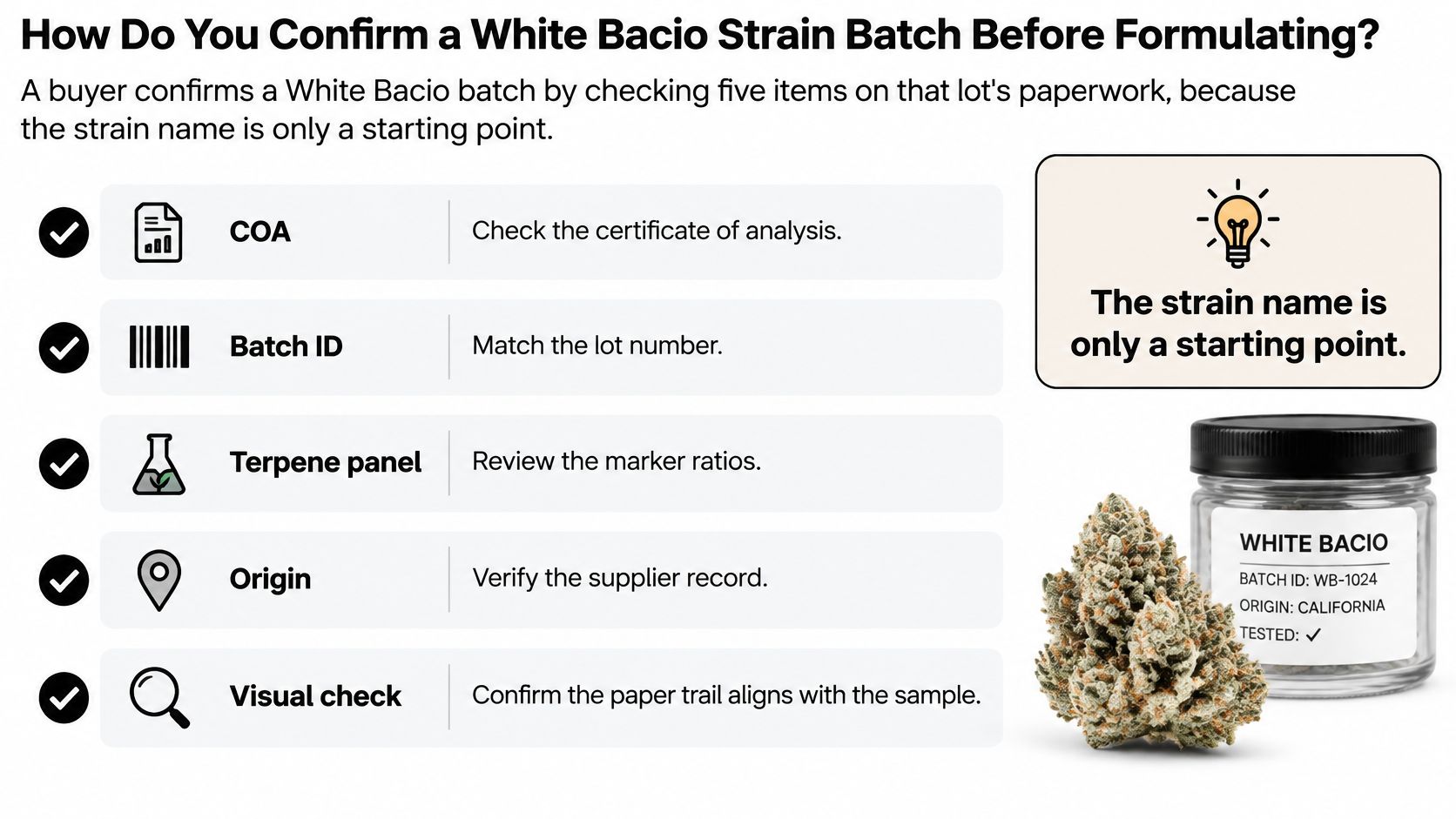
A White Bacio label identifies a sensory direction, not a fixed chemical specification. Confirm the lot's identity through its paperwork before setting a formulation target; public strain pages rarely provide batch-specific records such as a COA, harvest date, cultivation method, or phenotype details.
Let the lot record outrank the label
Indica, sativa, and hybrid labels do not reliably identify chemical composition. Research summarized by PubMed found that these categories did not distinguish samples at the whole-genome level, and terpene variation offered more information than the category. The same PubMed summary reports that, among 178 flower products, 56.7% were labeled for THC within a 15% tolerance, 30.3% overstated potency, and 12.9% understated it.
Potency alone cannot establish a batch's chemical identity. CannaPedia reported a White Bacio listing with THC as high as 33.0% in 2025, but that figure does not identify the composition of the lot in front of you.
Use this five-point intake check before building a formula:
- Lead terpene: Check whether beta-caryophyllene is the lead marker, or record the dominant terpene named on the COA.
- Supporting markers: Compare limonene and myrcene with the published bands. Record deviations rather than forcing a match.
- Total terpene basis: For flower, compare the result with the published 1.5% to 3.2% range. For extracts, record the measurement basis separately; a flower total is not an extract target.
- Cannabinoid context: For flower used as a reference, check whether CBD is below 0.5% or reported as non-detect.
- Traceability: Record the lab name, test date, lot or cut identifier, and COA with the formula.
Pause formulation if the supplier record does not connect the sample to its paperwork. A terpene panel without a matching batch identifier cannot support a reproducible target.
Practical rule: Use verified terpene data to rebuild the White Bacio-style sensory profile. The strain name sets a direction; the lot record defines the usable starting point.
Gold Coast Terpenes' guide to interpreting lab reports can help standardize the paperwork review.
How Do You Formulate a White Bacio Strain Blend for Distillate?
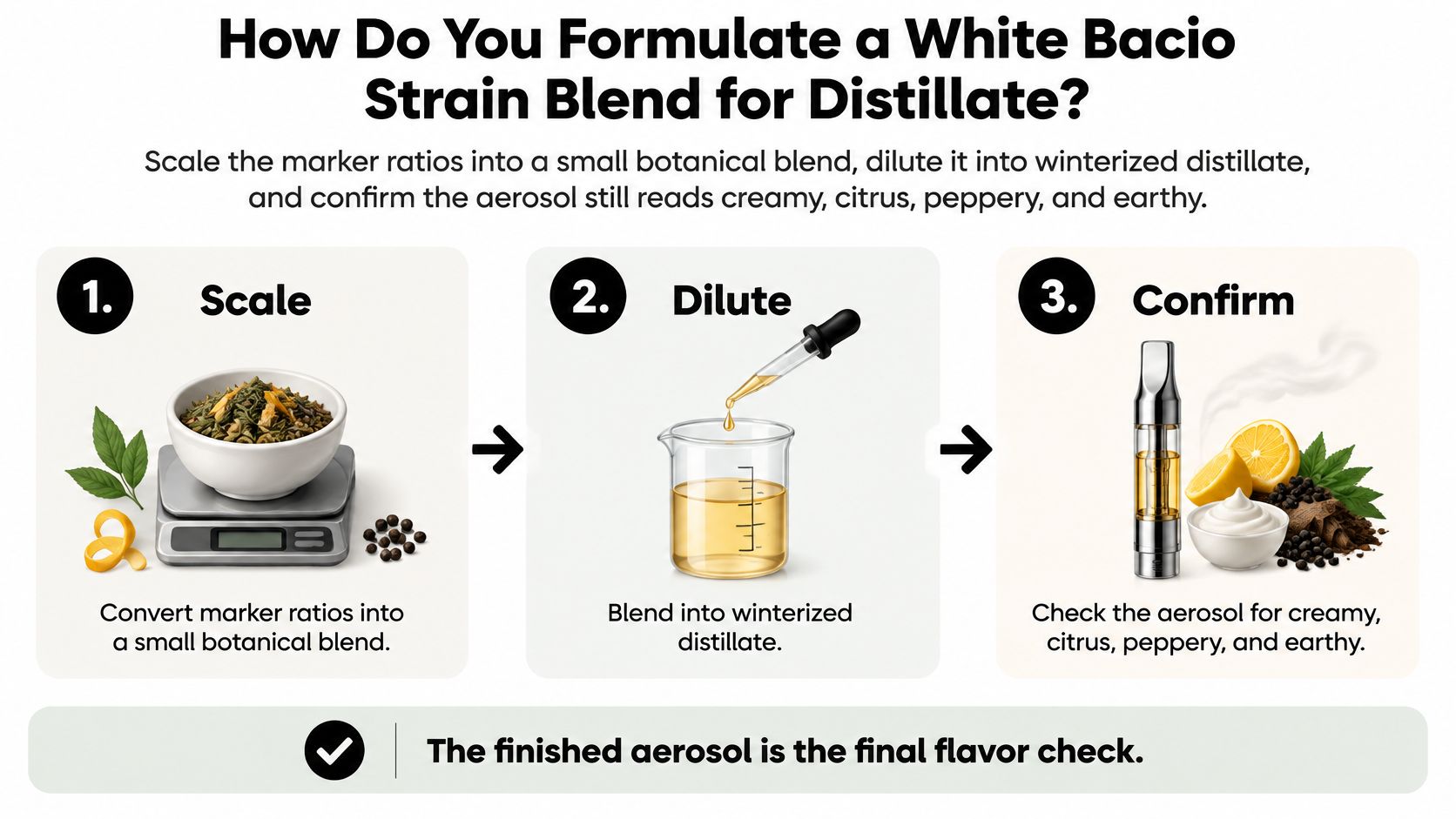
Scale the marker ratios into a small botanical blend, dilute it into winterized distillate, then confirm that the aerosol still reads creamy, citrus, peppery, and earthy. The blend is a working reconstruction, so treat the initial ratio as a testable starting point rather than a COA or a claim of exact plant equivalence.
Build the bench sample in a controlled sequence
Set the ratio. Start with a 100-part sketch: 40 parts beta-caryophyllene, 25 limonene, 20 myrcene, 10 linalool, and 5 humulene. This is a formulation example, not a reported White Bacio COA; the low linalool share keeps the floral note restrained.
Make a small neat blend. Prepare 1 to 2 grams so a poor direction costs little. Label the sample with the ratio, date, and ingredient lot identifiers before it reaches the oil.
Dilute into oil. Add the blend to winterized distillate at the manufacturer's stated cartridge range and record the exact percentage. Gold Coast Terpenes blends are highly concentrated and must be diluted before use; don't use them neat.
Rest the filled sample. Give the oil time to wet the hardware, then compare the liquid aroma with a controlled puff. The nose over the vial can't predict every change the cart will make.
Run the aerosol check. Test through the production hardware before changing total terpene load. Compare the emitted profile with the intended sensory target, not just the bottle blend.
Adjust one failure at a time. If the vapor is harsh pepper with little cream, reduce caryophyllene slightly and keep humulene as the dry base. Don't make several ratio changes at once, or you won't know which one altered the result.
Lock the formula only after a hardware comparison. Confirm the same ratio at two hardware settings before approving it for a production fill. A ratio that works at one setting may not preserve the same balance elsewhere.
A botanical reconstruction stays consistent across lots when the same verified inputs and process are used; a cannabis-derived fraction moves with its extraction lot. For fruit-and-pastry nuance, Elevated Strains are made by the Master Terpologists, who enhance selected rare and exotic terpenes, but that profile should be treated as a pairing reference rather than a White Bacio replacement.
Bench note: Keep the blend record and the oil record linked. That makes a later adjustment traceable to the exact input lot and dilution.
For distillate handling steps and a repeatable mixing workflow, use Gold Coast Terpenes' distillate mixing guide.
Why Do White Bacio Top Notes Fade in a Vape Cartridge?
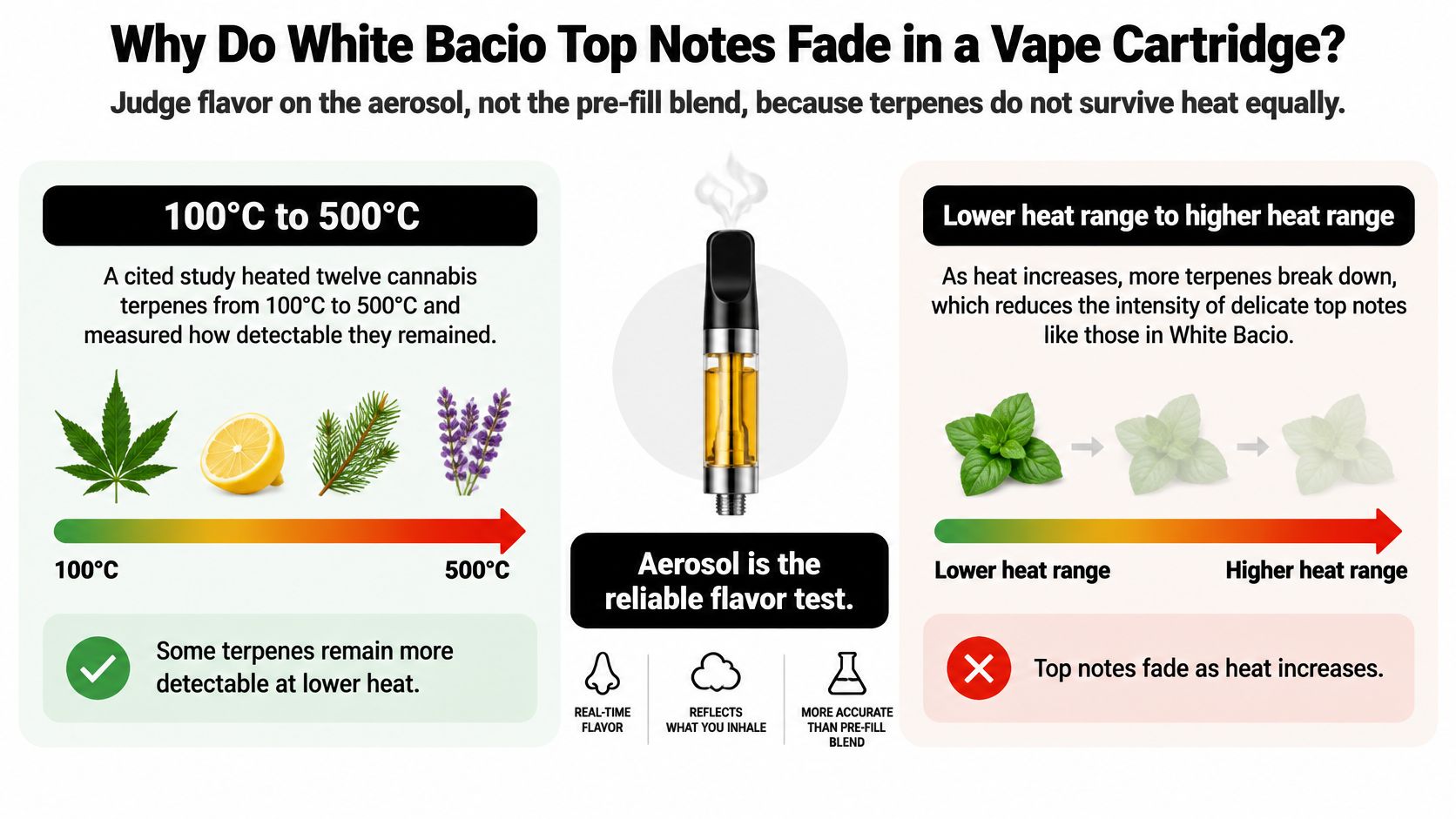
A study heating twelve cannabis terpenes from 100°C to 500°C reported myrcene retaining about 97% to 98% in the cited summary, while terpinolene retained about 11% to 28%, according to the thermal behavior overview. That comparison doesn't set a White Bacio coil temperature or prove every terpene behaves the same way in finished oil, but it shows why the pre-fill blend can't be the final flavor test.
Test the emitted aroma, not just the liquid
In this profile, limonene supplies the bright citrus top and linalool adds a floral mid. Beta-caryophyllene and humulene form a peppery, woody base; after a hot hit, that heavier base can dominate if the brighter notes fade. Hardware power, coil temperature, puff duration, airflow, and oxygen exposure can all shift the emitted aroma.
Run a two-sample check before changing the recipe:
- Liquid sample: Smell and taste the blend at the intended dilution.
- Hardware sample: Run the same lot through production hardware and compare the first, middle, and last third of the cartridge.
Keep the puff pattern consistent across samples so the comparison reflects the hardware and blend, not a different draw. If the aerosol loses citrus, raise limonene slightly or lower power, then retest. Don't increase total terpene load as the first fix; that can amplify other notes without restoring the intended balance.
The reference profile is a performance target, not a promise that the bottle aroma will pass through unchanged. Gold Coast Terpenes' guide to terpene degradation provides further context for evaluating heat-related flavor shifts.
What Should a Small Producer Lock Before a Production Fill?
Lock the ratio, dilution percentage, hardware model, and paperwork before the first saleable lot. Flavor drift often follows a changed input cut or a hotter device, so the production record should capture the entire system rather than only the terpene recipe.
Write a one-page production specification
The spec should name the terpene source identity, each ingredient's part in the blend, total terpene percentage in the oil, fill-viscosity target, and the cart or disposable model. A bench percentage isn't automatically a production-line percentage if the oil viscosity or mixing conditions change; verify the blend in the actual fill setup.
Two edge cases deserve a deliberate check. A hotter disposable may need a higher limonene share than a lower-power cart to preserve the citrus top, while winterized distillate may mute the creamy middle and require a new sensory evaluation after mixing. Keep the target descriptive and consistent: creamy, citrus, peppery, earthy.
Store the terpene COA, distillate COA, and a retained filled unit with the final formula. That retained unit gives the team a physical reference if a later fill tastes different, and the COAs connect that reference to its ingredient lots.
Compare the source before scaling
| Source | Identity | THC content | Batch consistency | Label wording |
|---|---|---|---|---|
| Botanical blend from Gold Coast Terpenes | 100% botanically derived | THC-free | Repeatable across lots | Botanically derived terpene blend |
| Cannabis-derived terpene fraction | Derived from cannabis extract | Document the lot-specific cannabinoid result | Moves with extraction lot | Cannabis-derived terpenes |
Gold Coast Terpenes offers over 50 terpene profiles across Indica, Sativa, and Hybrid categories. Wholesale pricing applies on strain orders totaling over 64 oz, and multiple strains can be included in one bulk order. Those catalog facts may help procurement plan a sourcing route, but the production decision should still come down to the supplier lot whose COA supports the intended caryophyllene, limonene, and myrcene roles.
Keep label wording aligned with the ingredient's actual identity and the applicable requirements for the product and market. Don't use a strain name to imply a cannabis-derived source when the formulation uses botanically derived terpenes, or the reverse. Approve the matching supplier lot, then scale that lot, not the strain name.
What Do Formulators Still Ask About White Bacio Strain Blends?
Does a White Bacio label predict how a cartridge will taste? The name gives formulators a sensory brief, not a fixed terpene formula. Confirm the intended character against the blend's lot data and the finished cartridge's aerosol output.
Does a White Bacio THC figure identify a batch? A strain listing cannot establish the identity or potency of a specific lot. Match the purchased material to its lot-specific documentation; Gold Coast Terpenes blends are formulation inputs, not substitutes for cannabis product records.
Can a Gold Coast Terpenes blend go into distillate neat? No. Its strains are highly concentrated and need proper dilution before use. Record the chosen percentage in the batch formula, then assess the result in the intended cartridge.
How can aerosol testing help? A bench sample may smell different from a filled cartridge. Check the aerosol from the intended hardware and compare it with the target profile before approving the blend for production.
What should a small producer retain after approval? Keep the final formula and a retained filled unit. The unit provides a sensory reference for later fills, while the formula records the dilution used.
Gold Coast Terpenes offers more than 50 terpene profiles, isolated compounds, and formulation tools for cartridge and distillate development. Build a White Bacio-style brief from lot data and finished-product evaluation, then explore options at Gold Coast Terpenes.