
A cartridge batch can smell right in the beaker and still miss the mark once it reaches the customer. That's the frustration behind a lot of “the profile feels flat” feedback. The blend looked correct on paper, the distillate was clean, and the fill process stayed on schedule. Then the finished cart opened with weak pine, a blurred citrus edge, or none of the grounding mid notes the team expected.
That gap usually isn't one mistake. It's a chain of small formulation misses. A volatile top note flashes off during handling. A secondary terpene gets treated like a trace accent when it should be supporting the center of the profile. A team evaluates the pre-fill mix but skips a serious post-fill check. The result is a cartridge that resembles the target in name only.
For teams working on a terpene profile for vape cartridges, the question What are terpenes? ceases to be basic education and becomes production-critical. You're not just identifying aromas. You're managing chemistry, sensory hierarchy, heat exposure, and repeatability.
Starting with a Real Formulation Challenge
A manufacturer is running a fresh batch of an OG-style cartridge. The target is familiar. Bright pine on the first draw, a citrus lift near the front, and a heavier, calmer body that stays present after the exhale. The bench sample seemed close, but the production lot comes back with complaints. Customers say it smells muted. The opening note disappears too fast. The profile feels thinner than the previous run.
The production team retraces the workflow. The terpene blend was mixed into distillate without obvious issues. Hardware matched the prior batch. Fill volumes were consistent. Yet the delivered aroma still drifted from the intended strain character. A quick review of what's in a cart often shows why these misses happen. The cartridge isn't just oil plus flavor. It's a system where formulation, handling, and hardware all shape the final sensory result.
Where the profile usually slips
The first failure point is often volatile loss. Piney and citrus-forward notes tend to feel “missing” because the most delicate aromatic components are also the easiest to lose during open-air handling, transfer, or filling.
The second is ratio design. Teams sometimes chase one dominant molecule and expect it to carry the identity alone. That can create a sharp opening, but not a complete profile.
The third is process discipline. A blend can smell convincing before filling and still land differently in a finished cartridge because heat, evaporation, and contact with hardware change what the customer experiences.
Practical rule: If the profile only works at the mixing bench, it isn't a finished formulation yet.
Good terpene work sits at the intersection of aroma design and manufacturing reality. You need the chemistry to build the right profile, and you need a workflow that protects that profile long enough for the end user to taste it.
Understanding Key Terpene Concepts
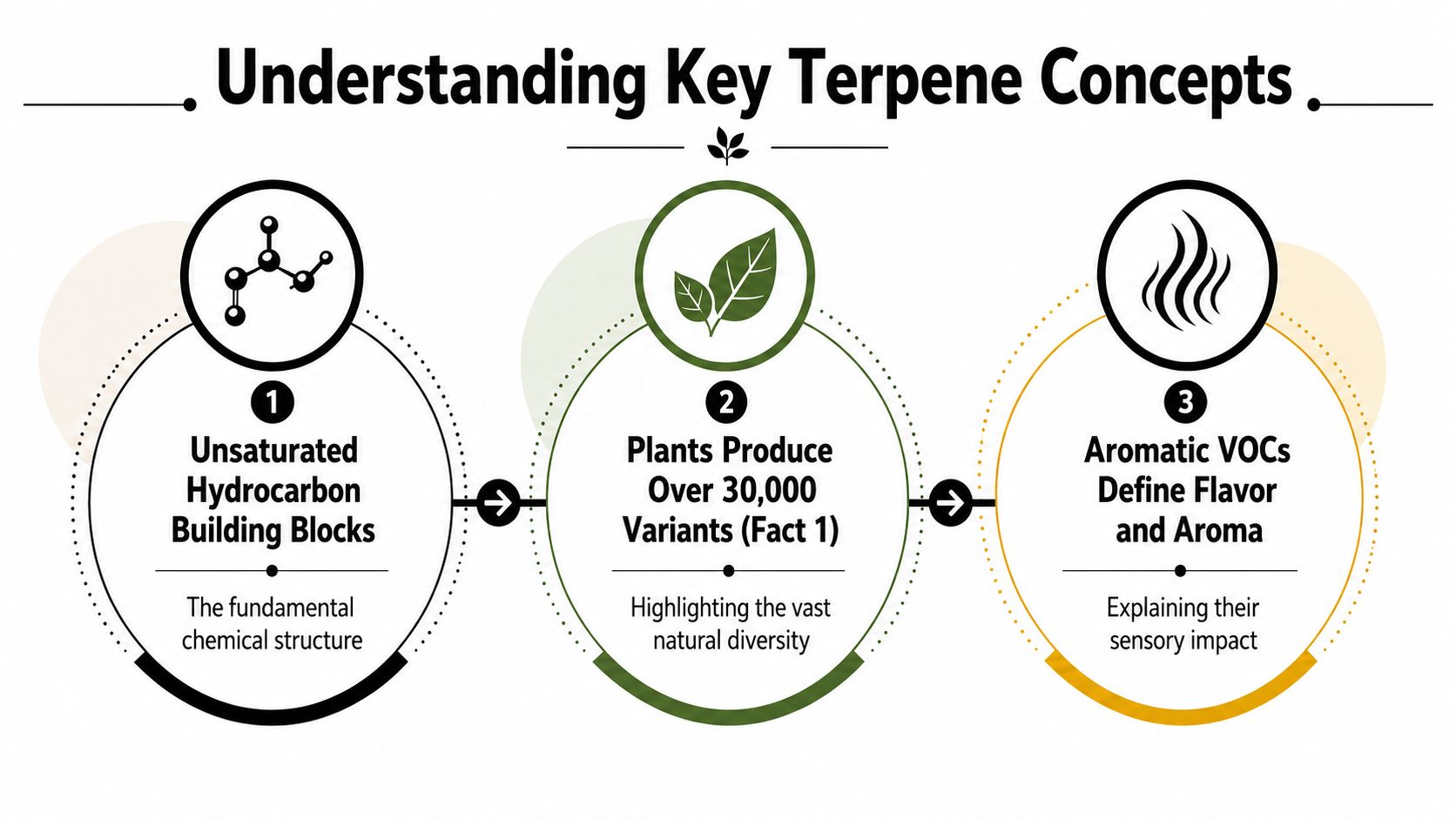
A formulator can smell two blends with the same total terpene percentage and get two very different results. One opens bright, then disappears in the cartridge. The other holds together from first draw through exhale. That difference starts with basic terpene concepts, especially structure, volatility, and ratio.
Terpenes are natural aromatic compounds made by plants. They are a sensory input for the user, but in the lab they are also formulation variables. A citrus note, a pine note, and a floral note do not just smell different. They often behave differently during mixing, filling, and storage.
Researchers at the National Center for Biotechnology Information describe terpenes as a large and diverse class of natural compounds found widely in plants in this overview of terpene chemistry and biological roles. For cartridge work, that matters because you are not choosing from a small menu of flavors. You are choosing from a broad chemical set with different evaporation rates, odor strengths, and stability limits.
The building block idea
Chemically, terpenes are hydrocarbons assembled from repeating isoprene units, a concept explained in this overview of terpene structure from Britannica. That sentence can feel distant from daily lab work, so translate it into a blend bench question. What changes when you swap one small molecule, or shift its percentage from 0.4% to 0.8%? Sometimes the answer is the whole profile.
A spice rack works as a practical comparison. Cinnamon at trace level warms a formula. Push it too high and it dominates. Terpenes behave in a similar way. The identity of a profile depends on which compounds lead, which support, and how the full ratio reads after heat and dilution.
For teams building formulas with production in mind, the chemistry of terpenes is useful background because it connects molecule class to handling and blend behavior.
Why plants make them
Plants produce terpenes because the compounds perform essential jobs. They can help defend against stress, discourage certain pests, and attract useful organisms such as pollinators. That functional diversity helps explain why terpene chemistry spans so many aroma directions, from resinous and herbal to sweet and citrus-forward.
In formulation, that biological variety becomes a design palette. It gives you access to compounds that are bright, heavy, diffusive, subtle, sharp, soft, persistent, or fleeting. Those traits matter more than the name on the bottle.
The volatility question
New formulators often wonder why the most attractive notes are also the easiest to lose.
The reason is volatility. Many terpenes evaporate readily, which is why you can smell them in the first place. Molecules leave the liquid, move through the air, and reach the nose.
That creates a built-in tradeoff in cartridge development:
- Aroma impact: Higher volatility helps create a clear first impression.
- Process sensitivity: Higher volatility can also increase losses during open handling, warm mixing, transfer, and filling.
- Formulation consequence: A usable recipe has to survive the process, not just smell good in the beaker.
Ratio-driven work becomes practical when addressing issues such as a citrus top note disappearing after filling. The fix is not always “add more citrus terpene.” You may need to reduce open-air exposure, lower mix temperature, or support that top note with mid-weight materials that keep the profile recognizable after the brightest fraction fades. QC checkpoints should reflect that logic. Check the concentrate, then the filled cart, then the retained sample after rest.
Monoterpenes and sesquiterpenes
A helpful split in terpene chemistry is monoterpenes versus sesquiterpenes. Monoterpenes are generally smaller molecules and often present as brighter, faster, more volatile notes. Sesquiterpenes are generally larger and often come across as heavier, deeper, and more persistent.
That difference matters at the recipe level. A blend heavy in monoterpenes may smell vivid at the bench but lose definition faster in production. A blend with some sesquiterpene support can hold its shape better, especially when the target profile needs body or finish.
A simple lab habit helps here. Do not record only total terpene percentage. Record the ratio between lighter and heavier components, then compare that ratio at three checkpoints: pre-fill blend, fresh filled cartridge, and post-rest sample. That workflow turns terpene chemistry from a naming exercise into a formulation system you can repeat.
Exploring Terpene Profiles in Cannabis
In cannabis product development, terpene work becomes less about identifying a single aroma and more about building a hierarchy of notes. That's why a solid terpene profile for cannabis product formulation starts with profile reading, not guesswork.
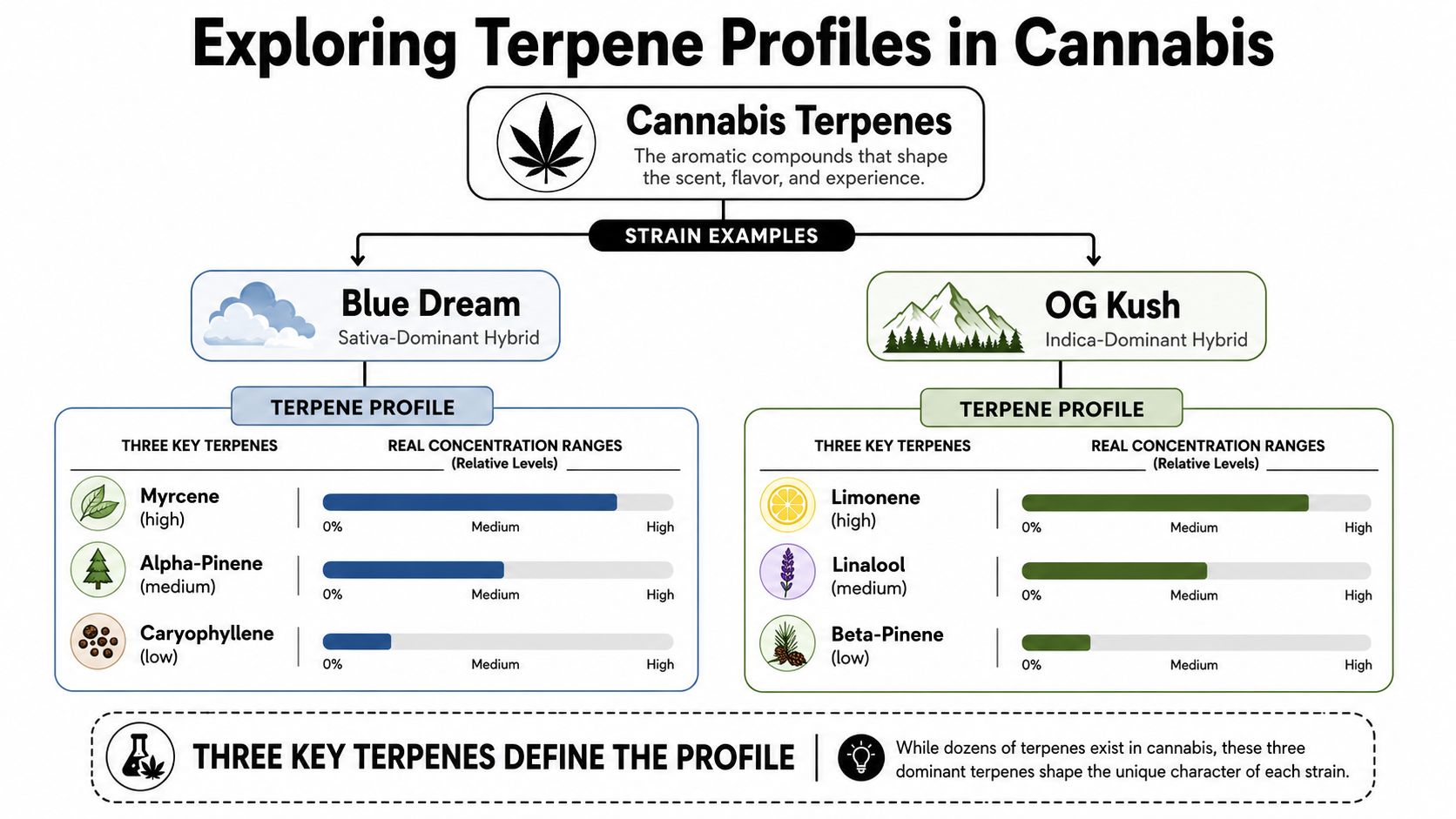
A useful baseline comes from lab-tested cannabis discussion summarized by Healthline. In cannabis, the three most prevalent terpenes often make up around 2% of the profile, shaping unique aroma and flavor experiences, according to this cannabis terpene overview. For formulators, that matters because identity usually comes from a small leading group, not a random list of ingredients.
Thinking in top mid and base notes
Perfume language is useful here because cartridges also unfold over time.
| Note layer | What the user notices | Typical formulation role |
|---|---|---|
| Top notes | First impression on open and first draw | Brightness, lift, recognizability |
| Mid notes | Core body of the inhale and exhale | Identity, fullness, continuity |
| Base notes | Lingering tone and structural depth | Weight, persistence, finish |
A pine-citrus profile that lacks a stable middle often feels harsh or incomplete. A blend with too much heavy body and not enough top expression can feel dull. Good profiles move in sequence.
Reading a strain-inspired profile
Take two broad examples that many product teams know: Blue Dream and OG Kush. Even before precise ratio work, the lab mindset is different for each.
Blue Dream-style targets often call for a brighter, more lifted architecture. OG-style targets usually need a firmer base and a more grounded center. The error many teams make is trying to replicate either style by pushing one terpene harder instead of designing the whole sensory curve.
Here's a practical way to read a target profile:
- Start with identity: What should the first inhale communicate?
- Check the middle: Does the blend keep its character after the top note fades?
- Assess the finish: Does anything anchor the profile, or does it collapse after the opening?
Later in the section, this visual helps map how teams think about profile hierarchy in real product work.
Why profiles fail even when ingredients look correct
A strain-inspired terpene blend can contain familiar names and still miss the target. That usually happens for one of three reasons.
- Wrong lead note: The opening aroma is technically pleasant but doesn't match the intended family.
- Weak mid structure: The cart smells promising before use, then feels hollow during actual inhalation.
- Poor note transition: The profile shifts too abruptly from bright to flat.
A terpene list is not the same thing as a terpene profile.
That distinction matters for anyone replicating flavor of cannabis profiles for distillate. Ingredient presence tells you what's inside. Profile design tells you how the user experiences it over time.
A strong profile behaves like arranged music. The lead comes first, supporting elements hold the theme together, and lower tones stop the whole thing from sounding thin.
Evaluating Functional Effects and Evidence
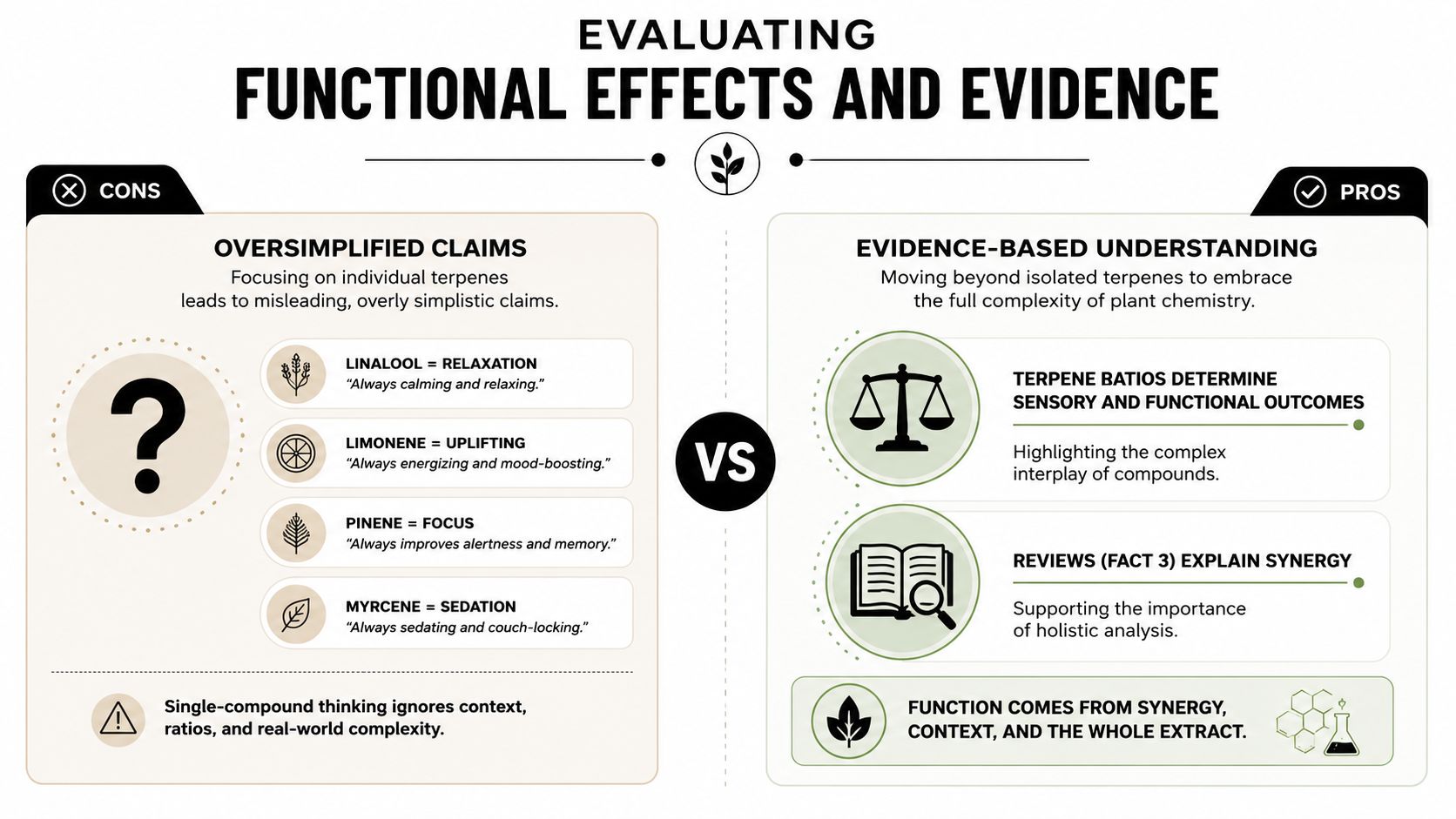
Formulators hear simplified claims all the time. Myrcene is relaxing. Limonene is uplifting. Caryophyllene does one thing. Pinene does another. Those shortcuts are convenient for sales copy, but they're weak tools for product development.
The better question isn't “What does one terpene do?” It's “How does this blend behave as a profile?”
The ratio problem
A more useful evidence-based framing is this: terpene effects depend on ratios. Balanced profiles with multiple compounds produce smoother layered experiences than those dominated by a single terpene, as explained in this discussion of terpene ratios in cannabis.
That aligns with what many labs see in practice. A blend pushed too heavily toward one leading note may smell obvious, but it often performs one-dimensionally. The inhale feels narrow. The finish can turn coarse or unbalanced.
A ratio-driven approach gives you a few advantages:
- Better sensory continuity: The profile doesn't collapse after the opening.
- More accurate strain inspiration: Classic profiles rarely read as one-note aromas.
- Cleaner communication: Teams can describe flavor architecture without drifting into unsupported claims.
Why single-compound marketing creates bad formulation habits
When teams design around one “hero” terpene, they often overcorrect. They raise the loudest ingredient and strip away support. That may make a sample easy to identify in a blind sniff, but not pleasant or stable in a cartridge.
This is also where formulators should be careful with language. Some educational and marketing content blurs terpenes, terpenoids, sensory effects, and therapeutic claims into one vague story. That's not helpful in regulated product work.
A more technical view is that formulation outcomes depend on composition, ratio, delivery format, and process. The same aromatic family can behave differently depending on whether it's built for inhalation, topical use, or another application. For readers looking into broader plant chemistry distinctions, a pharmacological review notes that terpenoids, not only terpenes, show a range of biological properties and that formulation affects bioavailability in important ways, as discussed in this review of terpenoids and formulation context.
A practical standard for technical teams
Instead of promising outcomes you can't substantiate, evaluate blends on reproducible criteria:
| Evaluation lens | Better question |
|---|---|
| Aroma accuracy | Does it resemble the intended profile family? |
| Flavor layering | Do the note transitions feel smooth or abrupt? |
| Batch repeatability | Can the team reproduce the same sensory result? |
| Process resilience | Does the profile survive filling and hardware use? |
Lab mindset: Build around sensory reproducibility, not headline claims about one terpene.
That standard is more useful for procurement, production, and brand integrity than chasing simplistic effect language.
Formulating Terpenes for Vape Cartridges
When teams ask what are terpenes for vape cartridge formulation, the practical answer is this: they are the aromatic framework that gives the cartridge identity. In production, that means selecting the right compounds, assigning each one a role, and blending with enough discipline that the profile survives real manufacturing conditions.
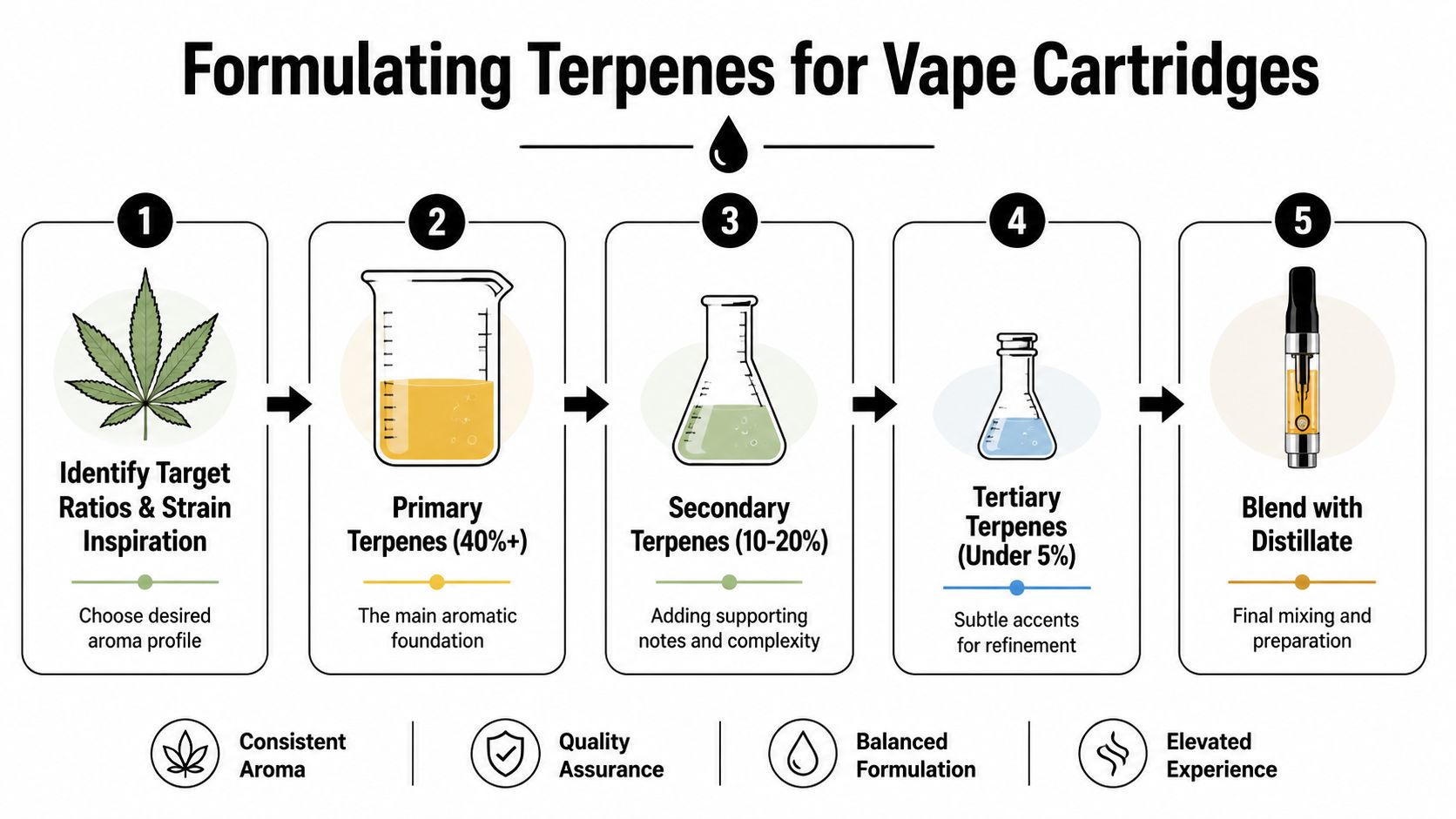
A strong strain-inspired terpene blend for vape cartridges starts with structure. In vape blends, primary terpenes like Myrcene or Limonene should be 40%+ of the profile, secondaries at 10–20%, and tertiaries under 5% for finishing notes, according to this vape blend ratio guide.
Start with profile architecture
Before touching the beaker, define the sensory target in plain language. Don't begin with ingredient names. Begin with what the cartridge must do on first draw, mid-palate, and finish.
For example, an OG-inspired brief might read like this:
- Opening: Pine-forward, sharp, clean
- Middle: Rounded citrus and herb character
- Finish: Dense, peppery, grounded
That kind of brief keeps the team focused on delivered experience, not just component selection.
Assign the blend by role
Once the target is clear, map terpenes by function.
| Role in blend | Typical job in the cartridge |
|---|---|
| Primary | Establishes the dominant identity |
| Secondary | Supports and shapes the body |
| Tertiary | Adds accents and finishing detail |
Primary materials should do the heavy lifting. Secondary materials create contour. Tertiary materials should stay restrained, because accents that smell elegant in isolation can become distracting once heated and aerosolized.
Build for heat, not just for the bench
One of the most important formulation principles for cartridges is thermal survival. Bench aroma and cartridge aroma are not the same evaluation environment.
For heat-exposed products, formulators need to think carefully about terpene class. A useful benchmark from processing-focused terpene guidance is that sesquiterpenes such as β-caryophyllene and humulene are favored for thermal stability, while monoterpenes such as myrcene, limonene, and pinene are more volatile, with a suggested professional target ratio of 60–80% monoterpenes to 20–40% sesquiterpenes when balancing volatility and stability in vape-oriented work, based on this thermal stability discussion for terpene blends.
That doesn't mean every profile should feel heavy. It means your bright notes need structural support if they're going into a cartridge.
Don't ask only, “Does this smell right now?” Ask, “Will this still smell right after filling, storage, and use?”
A simple workflow for formulating
A dependable formulation guide for vape cartridges usually looks like this:
- Define the target profile in note-language, not just terpene names.
- Choose the lead terpene family that creates instant recognition.
- Add support terpenes to build the middle and smooth transitions.
- Use accents sparingly so the profile doesn't become noisy.
- Blend into distillate carefully with attention to handling, exposure, and consistency.
Teams refining this process often use practical resources like how to use terpenes during bench development and scale-up.
Safety and material discipline
For inhalation products, ingredient quality and compatibility matter as much as sensory design. Teams should verify purity documentation, review formulation inputs carefully, and avoid treating terpene addition as a casual flavor step.
A few shop-floor habits help:
- Keep containers closed: Open exposure increases aromatic loss.
- Limit unnecessary transfers: Every extra handling step creates another chance to lose volatile components.
- Document the actual delivered blend: Record what went into the cartridge process, not just the ideal target formula.
- Train sensory evaluators: A team that uses shared language will make better adjustment decisions.
Good cartridge formulation is rarely about chasing novelty. It's about making a profile that survives production and still tastes intentional in the final device.
Ensuring Quality Testing and Compliance
Many cartridge teams still treat QC as confirmation. It needs to be treated as discovery. The mix you prepared is not automatically the mix the customer receives.
That matters most with volatile components. Professional benchmarks indicate a 15–30% loss of monoterpenes during cartridge filling, requiring post-fill QC verification to ensure accurate final concentrations, according to this cartridge filling and terpene loss benchmark. If your profile relies on bright pinene or limonene expression, that loss can change the finished product enough to shift the whole sensory identity.
What post-fill QC should answer
The basic question is not “Did we mix the right formula?” The question is “What ended up in the filled cartridge?”
That's why post-fill analytical review matters. Teams using chromatographic methods need to compare intended composition with delivered composition after filling and handling. A practical overview of chromatography testing helps connect this requirement to routine manufacturing controls.
Compliance is part of formulation
Testing also supports legal and operational discipline. Inhalable products draw scrutiny around labeling, purity, and unsuitable additives. A profile that smells impressive but lacks documentation creates risk for both the manufacturer and the brand.
Here are the failure points worth tightening:
- Label mismatch: The declared profile doesn't reflect the final delivered composition.
- Unverified raw inputs: Aroma materials enter production without adequate documentation.
- Poor change control: A supplier, hardware, or process change shifts the profile without formal review.
- No retained sample workflow: Teams can't investigate complaints because they didn't preserve comparative material.
Quality position: Testing isn't a final box to check. It's the only way to know whether the formulation survived production.
Strong terpene formulation teams build QC into development from day one. That shortens troubleshooting later and protects brand consistency batch after batch.
Using Tools Recipes and Troubleshooting
Good formulation work gets faster when the team turns chemistry into repeatable tools. That means calculators, controlled recipe templates, and a troubleshooting system that ties sensory problems back to likely process causes.
For a strain-inspired terpene blend for distillate, the goal isn't to memorize every possible combination. It's to build a workflow that lets you adjust with intention.
A practical recipe framework
A simple bench template can organize the work without locking you into one profile style.
| Blend layer | What to decide first | What to evaluate next |
|---|---|---|
| Lead layer | Which terpene family defines the identity | Does the opening match the target strain family |
| Support layer | Which materials create body and continuity | Does the middle hold after the first draw |
| Accent layer | Which notes add detail without clutter | Does the finish feel clean or distracting |
That framework works for pine-forward, citrus-heavy, dessert-leaning, or herbaceous targets because it forces the same discipline each time.
Three sample profile directions
These aren't fixed formulas. They're recipe-backed thinking models you can adapt in the lab.
Pine-citrus OG direction
This works when the target needs a recognizable pine opening with a firmer body.
- Lead choice: A pine or citrus-leaning primary creates fast recognition.
- Support choice: A peppery or floral secondary can round the center and reduce harshness.
- Accent choice: A restrained earthy or woody note can stop the finish from feeling empty.
Common failure mode: the opening smells accurate in the bottle but disappears in the cartridge. That usually points to volatility loss or too little support in the middle.
Fruit-forward haze direction
This style depends on lift and clarity. It's easier to overbuild than one might expect.
- Begin with a bright top-note family.
- Keep the middle transparent rather than muddy.
- Use accents carefully so the profile stays crisp instead of syrupy.
Common failure mode: the blend becomes candy-like instead of botanical. That often means the accent choice is too loud or the middle is too soft.
Dense kush-style direction
This profile needs weight without smelling stale.
- Start with a grounding primary identity.
- Add secondary materials that create texture rather than sweetness.
- Use the accent layer to sharpen the finish, not to dominate it.
Common failure mode: the profile turns flat. That can happen when the blend has enough body but not enough opening contrast.
Troubleshooting by symptom
A short symptom matrix helps teams move from complaint to likely cause.
| Symptom | Likely cause | First adjustment to test |
|---|---|---|
| Top notes vanish | Volatile loss during handling or filling | Reduce open-air exposure and recheck support structure |
| Profile feels hollow | Mid layer is underbuilt | Strengthen secondary role in the sensory center |
| Finish tastes noisy | Accent layer is too aggressive | Pull back tertiary notes |
| Blend smells right but vapes wrong | Bench evaluation ignored heat behavior | Rebuild with more thermally resilient support |
| Batch-to-batch drift | Weak documentation or process control | Standardize records, sensory review, and post-fill checks |
Tool use in the lab
Mixing calculators are useful, but only when teams use them as decision aids rather than authority. A calculator can help scale and document a formula. It can't tell you whether the note transition feels abrupt, whether the middle carries enough weight, or whether the profile survives real hardware.
A stronger workflow looks like this:
- Bench draft first: Build a small sensory prototype.
- Record every revision: Note why each change was made.
- Run a fill simulation: Evaluate under cartridge-like conditions.
- Check post-fill behavior: Compare the delivered result to the target brief.
Operating habits that prevent avoidable errors
The biggest gains often come from routine discipline, not heroic reformulation.
- Use shared sensory language: “Brighter” and “cleaner” mean different things unless your team defines them.
- Separate aroma from identity: A pleasant smell isn't automatically the right strain-inspired profile.
- Keep retained samples: They make troubleshooting concrete instead of speculative.
- Review sourcing documents early: Safety and consistency problems are easier to prevent than to fix later.
A reliable profile comes from measured iteration. Teams that document small changes usually solve flavor problems faster than teams that keep remixing from scratch.
When you connect note hierarchy, thermal behavior, and QC feedback in one workflow, formulation gets less mysterious. The same blend decisions start producing repeatable results.
Putting It All into Practice
For cartridge teams, what are terpenes isn't a beginner question. It's a production question. Terpenes are the aromatic building blocks that determine whether a cart opens cleanly, carries a believable mid profile, and finishes with enough structure to feel complete.
The most useful mindset is simple. Build by ratio, not by hype. Formulate for the cartridge, not just the bottle. Test the filled product, not just the pre-fill mix. And describe profile behavior in sensory terms your whole team can apply consistently.
That approach helps with replicating flavor of cannabis profiles for vape cartridges, but it also improves launch reliability. Fewer surprises in QC. Cleaner revision cycles. Better alignment between the intended strain inspiration and the customer's actual experience.
If your next project involves a terpene profile for distillate, start with a written note hierarchy, create a restrained draft, and evaluate it under real fill conditions. Precision beats guesswork every time.
If you need terpene blends, isolates, or formulation resources for your next cartridge project, explore Gold Coast Terpenes for strain-specific profiles, mixing support, and technical education built for extractors, formulators, and manufacturers.