
You've got the brief on your bench, the client wants a Peanut Butter and Jelly profile in a cartridge, and the only reference they handed over is a jar label, a strain name, and a vague note that it should feel “sweet, relaxing, and a little creamy.” That's enough to start a conversation, not enough to formulate a product. In this category, the name can point to more than one cultivar, so the job is turning a marketing phrase into a terpene profile you can test, replicate, and scale with confidence.
The PBJ Formulation Challenge
A PBJ request usually sounds simple until the first sample hits the lab. One batch may read like a nutty dessert hybrid, another may lean fruit-forward, and a third may arrive with a completely different origin story attached to the same name. That's why a strain name by itself is a weak formulation spec, especially in a market where dessert profiles sell on aroma memory as much as on genetics.
Why the name alone isn't enough
The best-supported commercial description of Peanut Butter and Jelly frames it as a balanced hybrid crossed from LA Confidential and Peanut Butter Kush, with a THC profile commonly around 21.93% and a lab example showing THCA 24.19%, THC 21.93%, CBGA 0.48%, and CBG 0.14% (Sativa University). Other trade coverage points to THC commonly in the 18% to 23% range, flowering in 7 to 9 weeks, and yields around 400 g/m² indoors and 550 g per plant outdoors under good conditions (Masterseeds). Those numbers matter to formulators because they tell you the flower sits in a commercial, high-THC lane rather than a soft aroma-only lane.
Practical rule: if the flower spec is missing, treat the name as a creative brief, not a technical one.
That distinction matters even more when the same nickname is used for genetically different plants. If you're building a vape line, the strain name sets the sensory target, but the lab data sets the formulation limits. Start there, then decide whether you're matching a specific cut, a family of PBJ-style profiles, or a retail-facing dessert note that only needs to read as peanut butter, jelly, and cream on the first pull.
What this guide gives a product team
The useful path is straightforward. First, verify the genetic story and the lab fingerprint. Second, map the terpene architecture into top, mid, and base notes. Third, build a cartridge formula that survives heat without losing the sweet, creamy identity the client expects.
For brands and extractors, that means less guessing and fewer reformulations. For product developers, it means every sensory decision has a measurable reason behind it.
Lineage, Naming Confusion, and What the Lab Data Actually Shows
The strongest published baseline for PBJ points to LA Confidential x Peanut Butter Kush (Sativa University). That matters because it gives you one plausible chemical family to work from, but it doesn't erase the naming chaos around PBJ, PB & J, and Peanut Butter Jelly in the broader market. Independent strain guides note that the same nickname can be attached to different cultivars, and that the market still struggles to reconcile those labels with clear provenance (Joint Commerce).
Why provenance matters in formulation work
A cartridge formula built on name recognition alone can drift fast. If one supplier's PBJ leans nutty and another's leans grape-jam, the same terpene recipe won't land the same way in finished oil. That's why breeder attribution and lab fingerprints matter more than menu language.
The cultivation baseline also helps frame expectations. Sources consistently place PBJ in a moderate-to-strong potency lane, with THC commonly reported in the 18% to 23% range, CBD generally below 1%, and flowering usually taking 7 to 9 weeks (Masterseeds). In practical terms, that's a fast-enough commercial cycle for production planning and a strong enough chemotype that the terpene layer has to carry a lot of the flavor work in a finished cart.
The cleanest verification path is simple, breeder claim, lab report, terpene fingerprint. If one of those three is missing, you're still guessing.
How to verify the cut before you spec a blend
A reliable PBJ intake process usually starts with three checks.
- Breeder attribution: confirm who claims the cross, not just the retail nickname.
- COA consistency: compare cannabinoid numbers across batches, especially if the same strain name appears on multiple lots.
- Terpene match: look for the same aromatic pattern in more than one sample, not just one loud jar.
That last point is where naming confusion becomes a real production issue. PBJ-style flower can be described with very different parentage depending on the market, and the strain name alone won't tell you whether you're working from a dessert-dominant line or a more earthy, Kush-leaning expression. For a reference framework, see the related profile for Peanut Butter Cherry Pie strain and compare how closely or loosely dessert naming can map to actual aromatic behavior.
The takeaway is not that PBJ is inconsistent by default. It's that the label is too broad to be used as a formula spec without supporting chemistry.
Sensory Profile and Cannabinoid Architecture of PBJ
A PBJ cartridge starts with a simple formulation question, what has to carry the flavor when the cannabinoid side is already heavy and the buffer is thin? One lab-facing sample showed a THCA-dominant chemotype with 24.19% THCA, 21.93% THC, 0.48% CBGA, and 0.14% CBG (Hytiva). That kind of loading gives you a strong cannabinoid base, but very little CBD to smooth the edges, so aroma design has to do more of the sensory work in the finished oil.
What the major compounds are doing
The same sample listed limonene at 0.826 mg/g, linalool at 0.461 mg/g, and beta-myrcene at 0.423 mg/g as the main terpenes (Sativa University). For a formulator, that trio is useful because it shows how the profile is built from separate jobs rather than one broad “sweet” signal. Limonene adds citrus brightness, linalool brings a floral softness, and beta-myrcene fills in a rounder, more grounded body note.
PBJ is also described in strain references as a THC-forward dessert hybrid with 1.5% to 3.0% total terpenes by weight (Joint Commerce). That range matters in cartridge work because it is strong enough to shape aroma and perceived character, yet still sensitive enough that a small shift in ratio can change how the whole blend reads.
What that means for finished oil
A flower sample with this much THC and so little CBD leaves little room to use cannabinoids as a balancing tool. If the product needs to read as peanut butter, jam, and cream, the terpene system has to carry the illusion. In practice, that means the sweet note should be built in layers, a citrus top note, a floral-fruit middle, and a soft earthy base that keeps the finish from turning candy-like.
A useful reference point is the difference between PBJ and another fruit-forward dessert line such as the Jelly Rancher strain archive. The names may sound similar, but the sensory target shifts depending on whether the blend needs more jam brightness, more creamy depth, or a firmer earthy foundation.
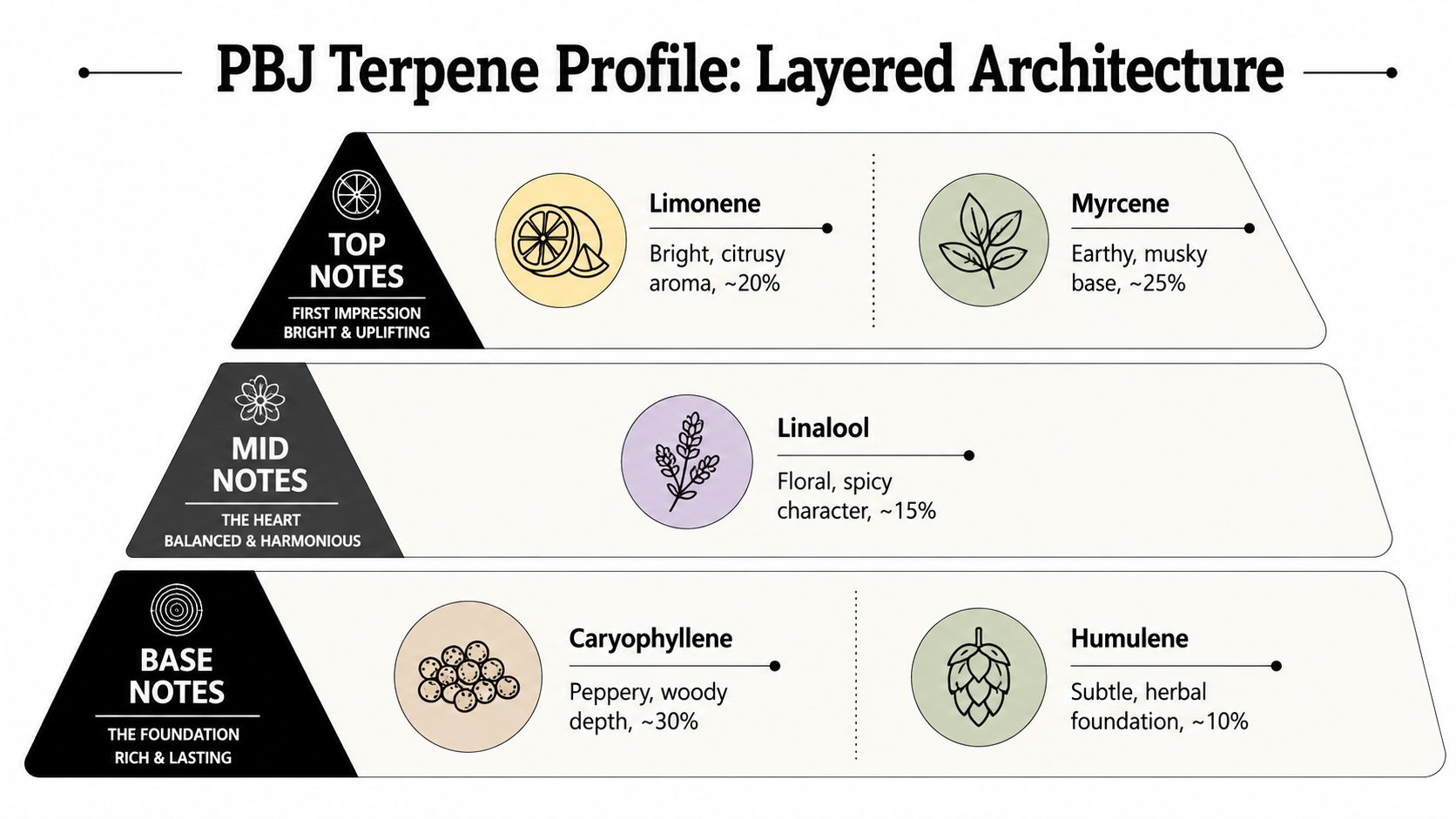
Decoding the Terpene Profile for Strain-Inspired Terpene Blends
A PBJ-style profile works best when you treat it like a layered formula instead of a single flavor note. The top reads bright and citrusy, the middle carries the sweet floral link, and the base gives the earthy, creamy weight that keeps the blend from turning into generic candy oil. That kind of structure is why a PBJ formulation usually needs several terpenes working together, each one covering a different part of the sensory arc.
Building the note stack
The terpene set most often associated with PBJ coverage includes limonene, linalool, caryophyllene, and myrcene. In formulation terms, that gives you a clear note stack to work from, similar to reading a raw oil sample before you decide what needs support and what already stands on its own.
- Top notes: limonene for bright citrus lift.
- Mid notes: linalool for floral sweetness, with caryophyllene adding a warm spice bridge.
- Base notes: myrcene for earthy depth and a softer finish.
That structure fits the peanut butter and jelly idea because each layer supports a different part of the illusion. The citrus helps the jelly character feel fresh, the floral tone keeps the center from going flat, and the earthier base supports the roasted-nut impression without pushing the cartridge into bitterness.
Blend design versus isolate tuning
A strain-inspired blend gives you the quickest route to a recognizable PBJ read. It already carries the broad shape of the profile, so the main work is adjusting intensity and balance rather than building the whole aroma from scratch. Isolates become useful when the base blend is close, but one piece of the profile still needs correction.
For example, if the cartridge opens too heavy and loses the jelly lift, a little more limonene can bring the top back into view. If the profile feels thin or too sharp, linalool can smooth the transition between fruit and cream. If the finish lacks the grounded, nutty feel buyers expect from a dessert hybrid, beta-caryophyllene and myrcene help anchor it.
One practical way to think about this is to use the strain-specific blend for identity, then use isolates to sharpen the edges. Gold Coast Terpenes' guide to using terpenes in formulations fits that workflow, because it starts from how the oil behaves in production rather than from aroma alone.
PBJ-style aromatics only work when the note progression feels natural. Too much citrus and the profile starts to read like a fruit cartridge. Too much earth and the dessert cue drops out. The stronger formulas let each compound do one job clearly, then let the blend carry the rest.
Building a PBJ-Style Terpene Blend for Vape Cartridges
A PBJ cartridge only works if the terpene system behaves in the oil and keeps the peanut-butter and jelly cues in balance. If the blend gets too aggressive, the cartridge reads as generic sweetness or sharp citrus instead of a recognizable strain-inspired profile. Formulators usually start with a vape-ready terpene base, then make small isolate adjustments only where the aroma is still leaving a gap.
Starting ratios that are practical in production
A practical starting range for terpene use in winterized distillate is 2% to 5% terpene-to-oil by weight, depending on how strong the flavor needs to be and how much aroma the base oil can carry (Gold Coast Terpenes formulation guidance). For a PBJ-style cartridge, the lower end usually fits a cleaner, softer profile, while the higher end gives a quicker aroma hit and more chance of harshness if the oil is thin.
| Component | Starting Ratio by weight | Adjustment Guidance |
|---|---|---|
| Strain-specific PBJ style blend | 2% to 4% | Start here if the base oil is neutral and you want the profile to read as PBJ quickly. |
| Limonene isolate | 0.1% to 0.3% | Lift the jelly note if the top feels dull or muted. |
| Linalool isolate | 0.05% to 0.2% | Smooth the floral-sweet bridge if the blend feels too sharp. |
| Beta-caryophyllene isolate | 0.05% to 0.2% | Add warmth and depth if the peanut-butter side feels weak. |
| Myrcene isolate | 0.05% to 0.15% | Soften the finish if the cartridge opens too bright or thin. |
Those ranges are starting points, not fixed rules. Viscosity, cartridge hardware, and the character of the base oil all affect the final result.
What to use and what to avoid
Gold Coast Terpenes offers isolated compounds such as Limonene, Myrcene, and Beta-Caryophyllene, along with strain-specific profiles that can serve as a blending base. Their terpene products are described as THC-free and free of VG, PG, PEG, and MCT, which helps when you need a cartridge that stays cleaner in the heating path and easier to describe on the label. The chemistry still has to be matched to the oil, because a terpene that smells right in a sample jar can still feel out of place once it is heated.
The PBJ profile is easiest to control when each component has a clear job. Limonene supports the jelly impression, linalool smooths the middle, beta-caryophyllene adds the toasted base, and myrcene helps soften the finish. If one note dominates, the cartridge stops reading as PBJ and starts reading as a single-note fruit or dessert oil.
Workflow that holds up in the lab
Start with a gentle warm-up so the base oil is fully workable before blending. Add the terpene system slowly, mix until the sample is uniform, then let it rest before judging the aroma again.
That rest period matters because the top note often shifts after the oil settles. If the base oil is already terpene-rich, use less added flavor and let the original profile do more of the work. If the distillate is stripped and neutral, the PBJ blend needs to carry most of the sensory load.
For a fuller explanation of how terpene systems are handled in product prep, Gold Coast Terpenes' terpene formulation guide is a useful reference point.
The Mixing Calculator helps confirm ratios before you move from bench sample to production lot, especially when the peanut-butter side is crowding out the jelly note.
Formulation, Stability, and Testing Considerations
A formula that reads as PBJ in a beaker can still miss the mark in a cartridge. Heat, oxygen, and storage conditions change terpene-heavy oils, and that matters here because the profile depends on a bright top note resting over a softer, rounder base. If the finish gets too warm or too thin, the jelly impression fades first and the blend starts to read flat.
What changes during processing
A THCA-rich distillate base needs controlled decarboxylation, or the oil can lose the nuance the profile needs to hold together. Full-spectrum or CO2-extracted material brings a different set of concerns, because winterization affects waxes and lipids that can slow flow and cloud the finished cart. The chemistry is only part of the job, because the cartridge still has to perform under coil heat without turning the aroma into something sharp or thin.
Limonene is one of the first compounds to drift when heat management is off. Its citrus lift can flash away quickly, which leaves the blend less like jelly and more like plain fruit candy. Linalool is steadier than many monoterpenes, but it can still oxidize under heat and light, so fill handling and storage need the same attention as the ratio itself. For a reference on why this happens, Gold Coast Terpenes' boiling point of terpenes archive is useful when you are matching terpene choices to process temperature.
Keep the sample cool, keep it dark, and do not assume the jar note will survive the coil unchanged.
What to test before release
The release checklist should stay plain and specific. Run GC/MS after formulation, then confirm residual solvents, heavy metals, and pesticides before the product leaves the lab. If the chemistry shifts during pilot production, record that change so the next batch does not drift in the same direction.
Shelf-life checks should focus on aroma loss, color change, and any sign of separation or thinning. A cartridge that smells flatter after storage usually lost its top notes first, while the heavier base notes held on longer. In a PBJ-style product, that often shows up as the jelly lift fading before the nutty layer does.
Storage and compliance basics
Keep terpene-enriched distillate sealed, away from heat and light, and label it in a way that fits your jurisdiction's cannabinoid and terpene disclosure rules. THC thresholds still control where the product can move legally, and strain-name usage gets messy when the underlying genetics are disputed. If you are selling into adult-use or hemp-derived channels, the label has to match the actual assay and the local rules, not the story the marketing team wants to tell.
Legal, Labeling, and Marketing Positioning for PBJ Products
PBJ works in the market because it sounds familiar before the customer ever opens the package. That familiarity helps, but it also creates labeling risk when the same name may point to different genetics across suppliers and regions. If the label implies a specific lineage, the support files need to back it up.
How to position the product without overclaiming
The safest marketing lane is sensory. Call the profile dessert-forward, sweet, and relaxing hybrid only if that language matches the finished oil and the lab data. Skip medical language, skip therapeutic promises, and keep the copy grounded in taste, aroma, and product style.
That approach also gives brand teams more room to differentiate. One PBJ cart can lean creamy and nutty, while another can lean jammy and bright, and both can still sit under the same family if the chemistry supports it. The point is to describe the sensory outcome accurately, not to force every batch into the same story.
What documentation helps most
Lab-verified terpene data is a strong asset here, especially when the profile is tied to SC Lab-tested documentation and a clear formulation record. It gives wholesalers and brand buyers something concrete to evaluate beyond flavor copy. It also helps internal teams defend why one batch reads slightly more citrus and another slightly more floral.
If you want to build out the education side of the brand, pair this kind of product page with a terpene guide and a formulation resource so customers can understand how the blend was built. A good example is the broader How to use terpenes guide, which is more useful to product teams than a generic strain blurb.
Positioning that actually moves product
PBJ doesn't need hype. It needs clarity. Buyers in vape and extract channels want to know whether the cart is built for a jammy dessert finish, a nutty cream finish, or a brighter fruit lift, and they want that answer to match the COA.
That's the commercial sweet spot, a product story that is specific enough to sell and disciplined enough to scale.
Frequently Asked Questions
Can two different cultivars both legitimately use the PBJ name
Yes, and that's the core naming problem in this category. The market often reuses short dessert names for different crosses, so the question isn't whether the name appears twice, it's which cut your supplier can document with breeder attribution, lab data, and a consistent terpene fingerprint.
Do minor terpenes below 0.1 mg/g still matter
They can, but usually as modifiers rather than anchors. At that level, a terpene may nudge brightness, softness, or finish, yet the main identity will still come from the dominant compounds like limonene, linalool, caryophyllene, and myrcene.
How should I adjust PBJ if my distillate base already has its own flavor
Start by deciding which note must stay obvious. If the base is already earthy, preserve the bright top note and the floral bridge. If the base is already sweet or fruity, back off limonene and let caryophyllene and myrcene do more of the grounding work.
Gold Coast Terpenes supplies strain-specific terpene profiles, isolated compounds, and formulation resources that fit PBJ-style cartridge development without adding VG, PG, PEG, or MCT. If you're building a peanut butter and jelly terpene profile for vape cartridges or distillate, visit Gold Coast Terpenes to compare blends, review lab-facing documentation, and match the sensory target to the chemistry.