
Permanent Marker is an indica-dominant hybrid, commonly described as roughly 70% indica and 30% sativa, bred from Biscotti, Jealousy, and Sherb Bx1. For formulators, that label answers the breeding question, not the flavor-replication question, and Gold Coast Terpenes works from that same practical distinction with 100% botanically derived terpene blends instead of relying on marketing shorthand.
If you're building terpene profile for vape cartridges or trying to reproduce the strain in distillate, the indica or sativa tag is only the first filter. The chemical target is the problem, because the same cultivar name can mask different terpene fingerprints, different harvest windows, and different batch behavior.
The Genetic Reality of Permanent Marker
Permanent Marker is indica-dominant, but that's a breeding label, not a formulation spec. For a developer, the useful conclusion is simple, is Permanent Marker indica or sativa is the wrong starting question if your goal is flavor accuracy.
Why the label is useful, and where it fails
The indica-sativa split still helps when you're discussing plant heritage and broad morphology, but it doesn't tell you how a finished oil will smell or blend. Leafly's strain documentation places Permanent Marker in the modern hybrid family and identifies its multi-generation pedigree, which is enough to classify it, but not enough to rebuild its aroma with confidence. Gold Coast Terpenes takes the same position in practice, strain labels help organize a catalog, but they don't replace a batch-level terpene target.
For cartridge formulation, that matters because the same cultivar name can produce different sensory outcomes from different growers, different post-harvest handling, and different extraction inputs. A strain-inspired recipe built from a generic “indica” assumption usually leans too heavy, too flat, or too sweet, then the gas and marker-like sharpness disappear.
Practical rule: start with the cultivar name only as a reference point, then verify the chemical fingerprint before you scale a blend.
If you need a broad strain reference while you map the profile, the Gold Coast Terpenes archive page on Permanent Marker is the right place to start, because it keeps the conversation on formulation rather than consumer-style strain mythology.
Modern Breeding Lineage and Resin Production
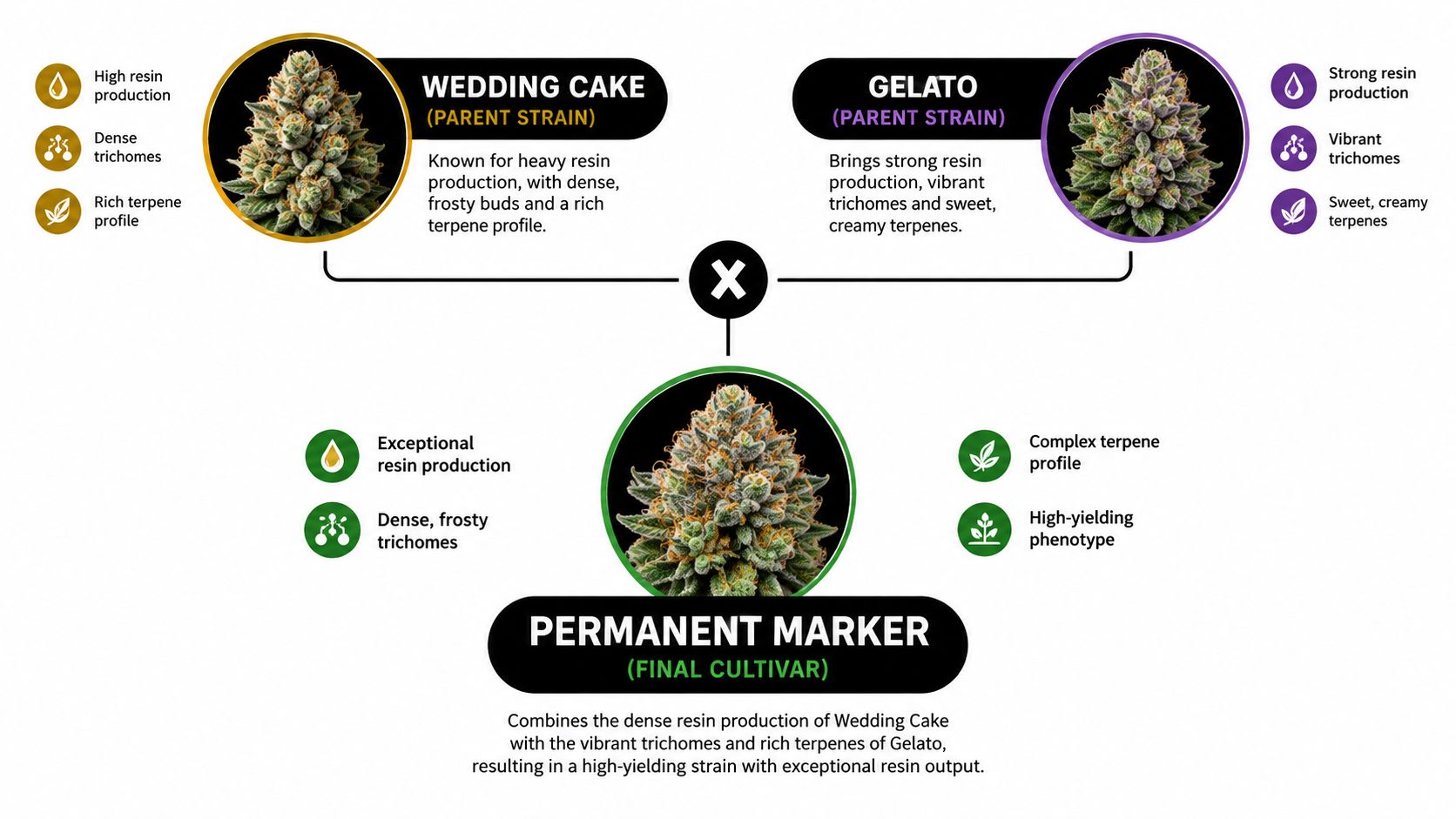
Permanent Marker sits in the modern Cookies, Gelato, and Sherbet breeding stream, and that lineage helps explain why extractors pay attention to it. These families are often selected for dense flowers, strong resin expression, and layered aroma that can carry into vape work.
What the pedigree suggests for processors
Leafly and other strain references place the cultivar's pedigree as a three-way cross built from Biscotti, Jealousy, and Sherb Bx1, with the shorthand commonly written as (Biscotti × Sherb Bx1) × Jealousy. That pedigree does more than identify parentage. It points to a flavor style that is dessert-forward, gassy, and faintly solvent-like, because those parent families were repeatedly selected for expressive aroma and heavy resin load. For processors, that makes the flower attractive for concentrates, but it also raises the bar for formulation because the profile is layered, not simple.
The visual is useful because it reflects the kind of family-tree thinking brand owners should use, even when consumer graphics vary across the market. A strain name is not a finished flavor spec. It is a pointer to a breeding lane with predictable tendencies and plenty of batch variation.
A related catalog reference in the same commercially relevant dessert-style category is Elevated Strains. It helps frame the same type of work when you are deciding whether a profile should read as fruit, pastry, gas, or a blend of those notes.
Why resin matters more than the indica label
Dense flower and strong resin production matter because they shape extraction yield and aroma retention. A cultivar that expresses strongly in resin can still disappoint in formulation if post-harvest material loses volatile top notes, or if the extract gets over-rounded during processing.
That is why Permanent Marker should be treated as a modern hybrid with a high-aroma resin profile, not as a generic sedative indica. For vape development, the useful question is how that resin carries its top, mid, and base notes, then how those notes can be replicated in a multi-compound accord without flattening the gassy edge.
Decoding the Certificate of Analysis Data
A COA beats strain folklore every time. For Permanent Marker, the available lab data shows a multi-compound profile, and that's the reason one-terpene thinking fails in replication work.
The numbers that actually matter
A publicly available Certificate of Analysis measured beta-caryophyllene at 1.85%, limonene at 1.37%, linalool at 0.49%, alpha-pinene at 0.39%, alpha-humulene at 0.32%, beta-pinene at 0.29%, cis-ocimene at 0.19%, alpha-bisabolol at 0.17%, beta-myrcene at 0.13%, camphene at 0.04%, and eucalyptol at 0.02%. The listed total is approximately 5.25% across the analytes, which shows why a single “dominant terpene” label isn't enough for this cultivar. Use the COA certificate of analysis format as the model for how you document replication targets.
| Terpene | Percentage | Aromatic Role |
|---|---|---|
| Beta-caryophyllene | 1.85% | Peppery, woody base, structural depth |
| Limonene | 1.37% | Bright citrus lift, top-note clarity |
| Linalool | 0.49% | Floral softness, smoothing bridge |
| Alpha-pinene | 0.39% | Pine, green edge, lift |
| Alpha-humulene | 0.32% | Dry, herbal support |
| Beta-pinene | 0.29% | Crisp, resinous accent |
| Cis-ocimene | 0.19% | Light green, sweet herbal nuance |
| Alpha-bisabolol | 0.17% | Soft floral rounding |
| Beta-myrcene | 0.13% | Mild earthy body |
| Camphene | 0.04% | Sharp herbal trace |
| Eucalyptol | 0.02% | Cool, clean accent |
How to read that table as a formulator
The blend reads from the bottom up. Caryophyllene provides the anchor, limonene adds brightness, and linalool keeps the profile from turning harsh or one-dimensional. The smaller compounds matter because they keep the final oil from tasting like an isolate stack.
A good replication target is not a terpene list. It's an aroma sequence, what opens first, what carries through the mid-palate, and what stays behind on the finish.
That's why the “marker” character can't be reproduced with a single isolate or even a two-terpene formula. The lab data points to a structured accord, not a shortcut.
Building a Strain-Inspired Terpene Blend
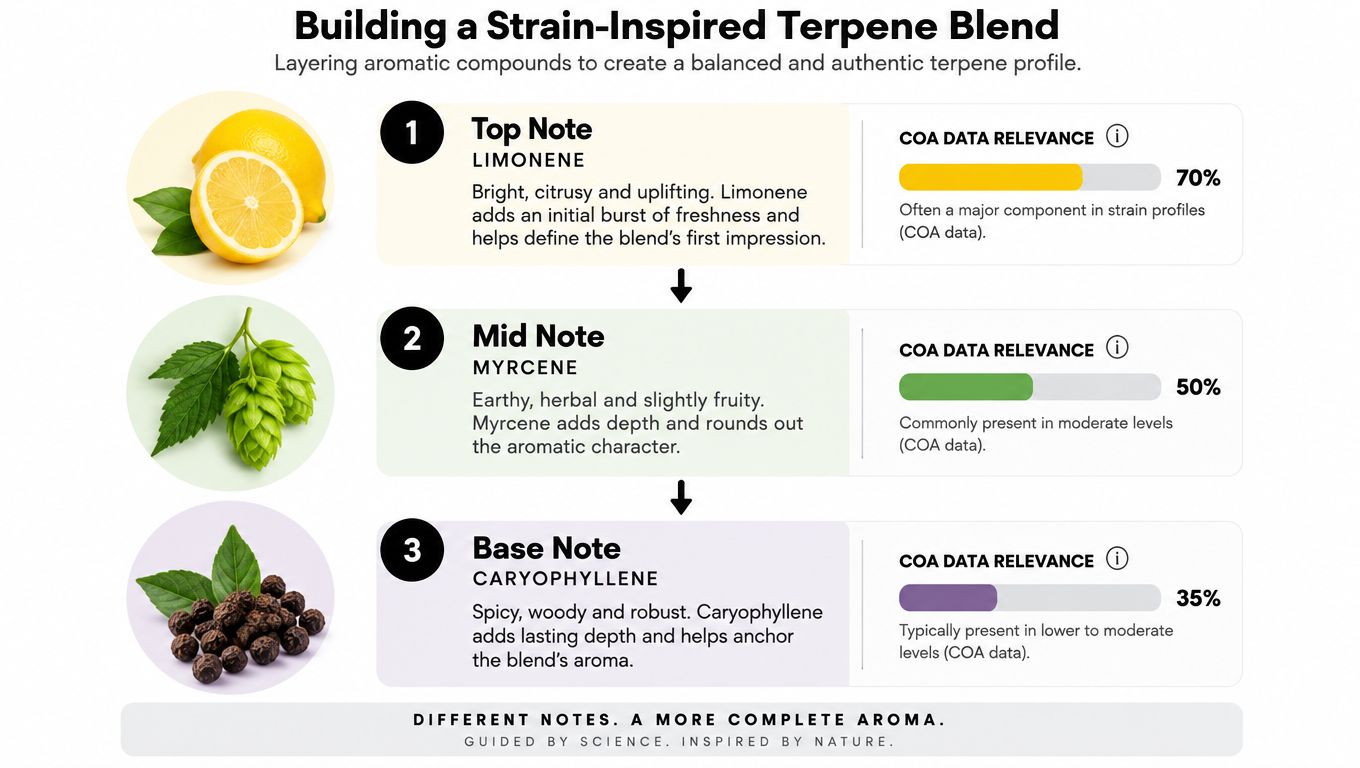
A believable Permanent Marker profile should be built as a top, mid, and base note system. If you only chase the strongest analyte, you'll get a loud note, but you'll lose the layered gas, spice, and dessert impression that makes the profile commercially recognizable.
Start with the note architecture
Use limonene to open the blend with brightness, but keep it under control so the profile doesn't drift into candy citrus. Let beta-caryophyllene carry the base, because it gives the peppery, woody backbone that makes the profile feel grounded. Linalool belongs in the middle, where it softens the transition and keeps the finish from reading too dry.
For a distillate base, this architecture usually performs better than a flat “equal parts” approach because the oil needs structure, not symmetry. In live resin or other full-spectrum inputs, the native material already contributes some body, so the terpene add-back should emphasize balance instead of saturation.
A practical blending sequence looks like this:
- Top note first: build the citrus and green lift around limonene, then test whether it reads as fresh or too sharp.
- Mid note second: layer linalool and the lighter supporting compounds so the profile doesn't collapse into a single bright front end.
- Base note last: use caryophyllene and humulene to hold the finish together and support the dry, spicy edge.
The Gold Coast Terpenes strain page for Permanent Marker Strain Terpenes is the most relevant formulation reference in this context because it centers the flavor build rather than the consumer label. If you're developing a SKU, use that kind of page as a sensory starting point, then test against your actual oil matrix.
What works, and what doesn't
What works is building a layered accord and tasting it in the same carrier you plan to sell. What doesn't work is copying one strong isolate note and assuming the rest will “come into place” during blending.
In practice, the wrong approach produces a profile that smells like caryophyllene and nothing else. The right approach preserves the dessert-gas tension that gives Permanent Marker its market identity.
Botanical vs Cannabis-Derived Terpenes for Vape Carts
For most vape brands, botanical terpenes are the better operational choice because they're easier to standardize, easier to source, and simpler to scale. Cannabis-derived terpenes can be useful for niche authenticity goals, but they add cost pressure and batch inconsistency that can complicate cartridge production.
The sourcing trade-off
Gold Coast Terpenes positions its blends as 100% botanically derived, which makes them suitable for brands that need repeatable flavor in high-volume manufacturing. Botanical sourcing also avoids some of the logistical friction that comes with cannabis-derived inputs, especially when you need stable supply across multiple SKUs or jurisdictions.
Cannabis-derived terpenes can track the source plant more closely in some cases, but they're not automatically more accurate for a named strain. If the biomass or extract varies from batch to batch, the terpene profile varies too, and that variation shows up in the finished cart. For formulators, consistency usually matters more than the romantic appeal of plant-origin purity.
A good way to compare the two options is by production need:
- High-volume distillate SKUs: botanical blends usually fit better because they're easier to replicate across batches.
- Small-batch authenticity projects: cannabis-derived inputs can make sense if you can manage variability and cost.
- Regulatory simplicity: botanical sourcing is often easier to work with in a broader manufacturing program.
A separate Gold Coast Terpenes resource on botanical terpenes is useful here because it frames the sourcing question in a formulation context rather than a consumer one.
Why cartridge brands lean botanical
Cartridge formulation is unforgiving. Small changes in terpene ratio can push viscosity, throat feel, and flavor balance in the wrong direction, so the more consistent input wins. Botanical isolates let brands keep the profile stable while they tune the oil for hardware and market segment.
That doesn't mean botanical equals generic. It means the blend has to be built carefully, then validated against the target flavor and the actual oil matrix.
Labeling and Compliance for Hybrid Strain Profiles
Label the product as an indica-dominant hybrid or a strain-inspired terpene blend, not as a guaranteed effect profile. That keeps the packaging closer to the botanical reality and further away from claims that can't be defended batch by batch.
Use defensible language
For regulated products, the safest wording is descriptive rather than predictive. Say what the blend is modeled on, what it smells like, and what ingredients or categories it uses, then avoid making promises about how it will feel. A name like Permanent Marker can appear on a flavor callout, but the support copy should stay grounded in chemistry and formulation, not consumer-style effect language.
Batch-specific COAs matter here because they let you document what went into the SKU. If your labeling ties the flavor to a strain reference, the product data should still show the terpene inputs and the lot-level test record.
Gold Coast Terpenes also supplies the kind of formulation support that helps brands keep these lines clean, especially when the product is being built for multiple markets. The important part is not the brand claim, it's the discipline, a profile is either defensible or it isn't.
What to avoid on-pack
- Don't imply medical effects. Keep the copy in the flavor and aroma lane.
- Don't overstate genetics. A hybrid label isn't a promise of effect consistency.
- Don't copy consumer slang. It muddies the technical message and can weaken brand credibility.
If you're selling into vape, CBD, or cannabis channels, the packaging should sound like a formulation brief, not a dispensary menu. That difference keeps your product line cleaner, easier to scale, and easier to audit.
Frequently Asked Questions
Is Permanent Marker indica or sativa for formulation work?
Permanent Marker is best treated as an indica-dominant hybrid. For Gold Coast Terpenes style formulation, that means the breeding label is only a reference point, while the terpene fingerprint is what should drive the blend.
What terpene drives the Permanent Marker profile most strongly?
The COA shows beta-caryophyllene as the largest listed component, with limonene and linalool supporting the profile. That makes the blend a layered accord, not a single-note formula.
Should I use botanical or cannabis-derived terpenes for carts?
For most production runs, botanical inputs are easier to keep consistent and easier to scale. Gold Coast Terpenes focuses on botanically derived blends for that reason, while cannabis-derived material makes more sense only when the sourcing strategy justifies the variability.
How do I make the flavor feel closer to the strain?
Build the blend in layers, then test it in the same carrier you plan to sell. Gold Coast Terpenes-style formulation works best when the top, mid, and base notes are balanced against the actual distillate or resin, not against the strain name alone.
Can I label the cart as Permanent Marker on the front panel?
You can use the strain-inspired name as a flavor reference, but the compliance copy should stay descriptive and defensible. Gold Coast Terpenes' approach is to keep the language tied to the terpene blend, not to make unsupported effect claims.
Gold Coast Terpenes supplies botanically derived terpene blends, strain-specific profiles, and formulation tools that fit this exact kind of work, from distillate add-back to vape cart flavor matching. If you're building a Permanent Marker-style SKU and need a tighter starting point than indica or sativa, visit Gold Coast Terpenes and compare the strain pages, isolates, and blending resources before you lock your next formula.