
The most popular advice on this topic is still the least useful for product development. If you build a cartridge around a strain name and assume the name carries a reliable effect, you're designing around folklore instead of chemistry.
That's why the question do different strains have different highs needs a formulator's answer, not a dispensary answer. Yes, products can produce different experiences. No, the label alone doesn't tell you why. For anyone working on a terpene profile for vape cartridges, a strain-inspired terpene blend, or a formulation guide for distillate, the only dependable path is to treat effect as an output of composition.
Why Strain Names Fail to Predict Effects
A strain name is a marketing shortcut. It can point to a flavor family, a breeding history, or a consumer expectation. It can't reliably tell you how a finished vape, concentrate, or infused product will land once it's formulated.
That gap creates real production problems. A brand asks for an “uplifting” SKU based on a famous sativa-leaning profile. The extractor delivers biomass sold under that strain name. The first batch feels bright enough. The next batch is flatter, heavier, or different. The formula didn't fail because the terpene load was wrong on paper. It failed because the name was treated like a chemical spec.

What formulators actually need
For cannabis product formulation, the useful questions are different:
- What's the cannabinoid ratio: THC and CBD still set the broad intensity and balance of the experience.
- What's the terpene architecture: Bright top notes behave differently from dense base notes in both aroma and perceived effect.
- What survived extraction: Distillate strips away much of the original fingerprint, so the rebuild matters.
- What's the target experience: “Relaxed,” “focused,” and “social” each require different chemical decisions.
A brand that wants repeatability needs a reproducible chemical profile, not a nostalgic story about lineage. That's why experienced developers lean on sensory data, cannabinoid targets, and lab work, then use strain names only as a reference point for flavor direction.
Practical rule: Treat the strain name as a creative brief, not as a formulation spec.
If you want a better starting framework, this breakdown of choosing cannabis based on terpene profiles gets closer to how product teams should think.
What works and what doesn't
What works is defining the outcome first, then building toward it. Start with whether the product should feel sharper, heavier, smoother, or more neutral. Then choose the terpene profile for distillate and cannabinoid balance that support that goal.
What doesn't work is buying into inherited assumptions like “this cultivar always gives an energetic effect.” In formulation, “always” usually means “until the next batch proves otherwise.”
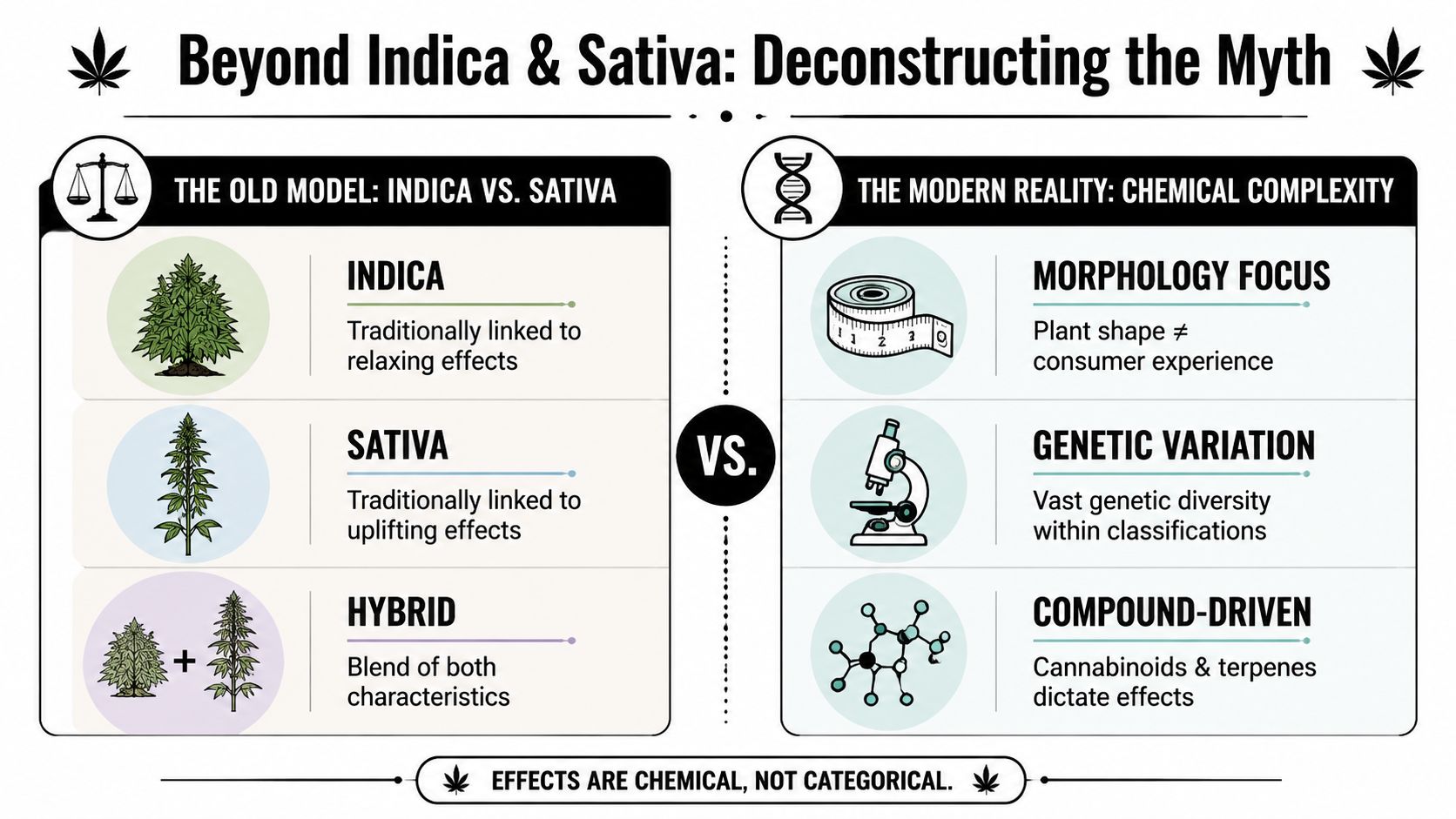
Debunking the Indica vs Sativa Model
The indica versus sativa model still shapes purchasing decisions, product briefs, and retail menus. It shouldn't shape formulation strategy.
A landmark 2016 study in Cannabis and Cannabinoid Research by Dr. Ethan Russo found that the common distinction between indica and sativa is scientifically “total nonsense” and lacks biochemical validity. Russo wrote that you can't infer a plant's biochemical content from its height, branching, or leaf morphology, because widespread hybridization has made those categories largely cosmetic.
Why the old labels break down in manufacturing
For a product team, the old model fails in three places.
First, it describes plant appearance, not finished product chemistry. Shorter plants and broader leaves don't tell you what survives into extract, what gets lost during processing, or what needs to be rebuilt after distillation.
Second, modern commercial material is overwhelmingly hybridized. The verified data notes that approximately 90% of modern commercial cannabis is a hybrid, which makes rigid effect assumptions based on indica or sativa even less useful.
Third, retail language reinforces bad inputs. A 2020 survey of 1,000 frequent cannabis users published in the Journal of Public Health found that 86% believed indicas are sedative and sativas are stimulant, while 78% of retailers recommended indica for insomnia and anxiety and 72% recommended sativa for depression and appetite stimulation. The same survey shows how strongly perception can drift from chemistry, which is exactly the kind of drift that causes formulation inconsistency.
What to replace it with
Use a chemical model instead:
- Cannabinoid ratio first: Potency and balance start here.
- Terpene profile second: This shapes aroma direction and may steer the character of the experience.
- Batch validation third: Confirm that the blend you built still expresses correctly in the final hardware and oil.
Stop buying biomass, extracts, or terpene concepts on “indica” or “sativa” promises. Buy them on composition.
For teams that still need to explain the old terminology to customers or internal sales staff, this overview of sativa vs indica uses, benefits, and differences is useful as a translation layer. It shouldn't be your formulation framework.
Engineering Effects with Cannabinoids and Terpenes
Once you drop the old labels, the work gets clearer. Different highs come from different chemical fingerprints. In practical terms, cannabinoids are the engine and terpenes are the steering input. The engine provides the primary force. The steering changes where that force seems to go.
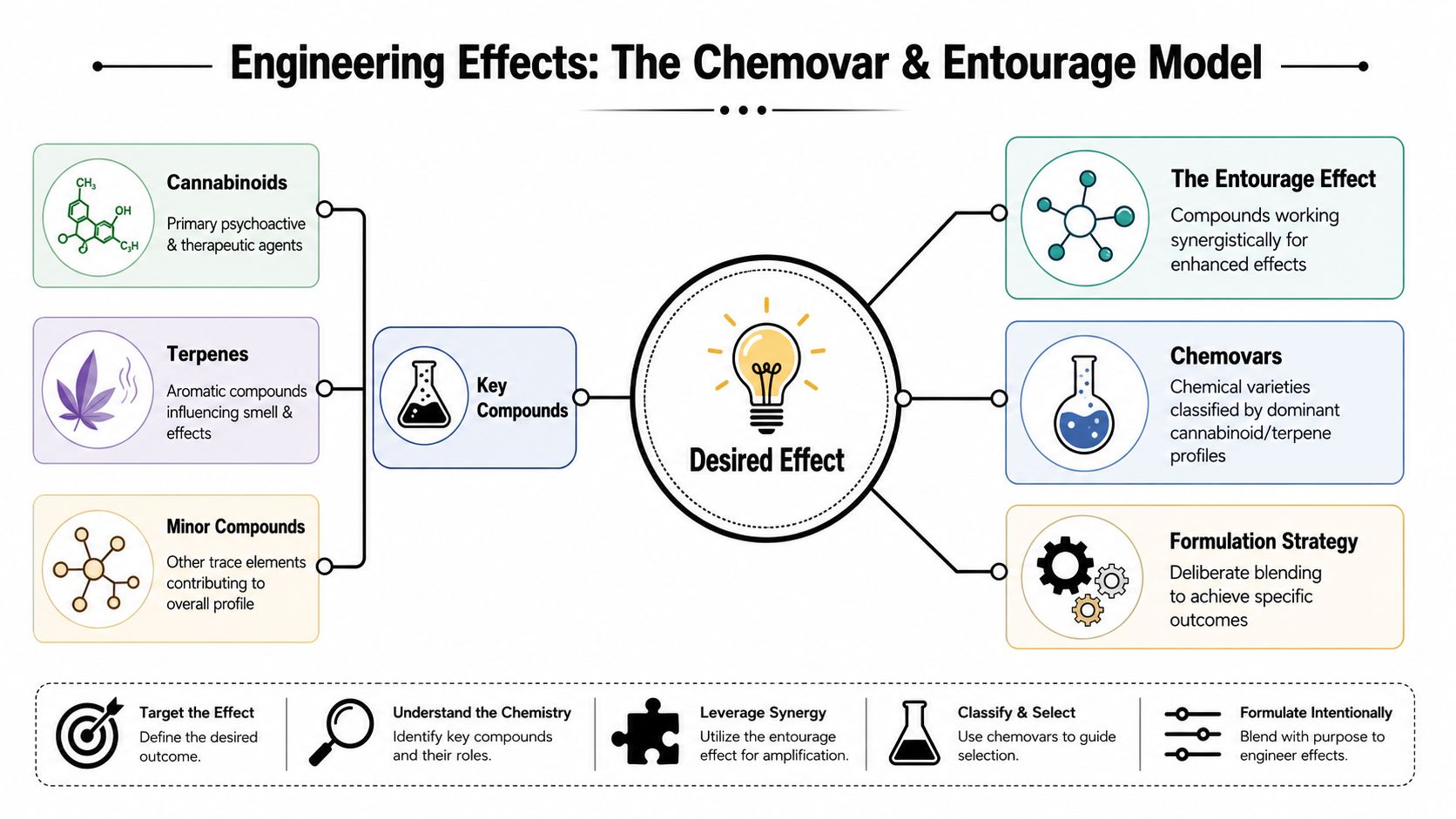
A useful way to think about a strain-inspired terpene blend for cannabis product formulation is as an engineered chemovar. You are not recreating a name. You are rebuilding a profile.
The engine and steering model
THC remains the main psychoactive driver. Verified data also notes that a THC concentration of 21% or higher is commonly classified as strong by industry standards, but the effect still becomes hard to predict without the terpene profile. That distinction matters in product development. Potency can be high while direction remains vague.
The entourage concept is often discussed loosely, but one practical claim is worth keeping. According to this explanation of how to choose the right cannabis strain, the experience is shaped by the balance of cannabinoids and terpenes, not THC percentage alone. It also states that a balanced profile with moderate THC (10–15%) and rich terpenes often produces a more functional result than an ultra-potent 28% THC isolate.
That doesn't mean every minor compound creates a dramatic effect shift. Verified data also includes a peer-reviewed comparison discussed by PBS in which Haney and colleagues found “little, if any, difference” between plant marijuana and oral THC formulations, suggesting THC is still doing most of the heavy lifting and that terpene-driven changes may be subtler than industry marketing often implies.
What a formulator should take from that
That tension is useful, not frustrating. It means:
- Don't ignore THC. It is still the dominant driver.
- Don't reduce everything to THC. Similar THC levels can still feel different when the rest of the profile changes.
- Build for direction, not magic. Terpenes can shape character, but they won't rescue a poorly balanced cannabinoid base.
Here's a good place to pause and recalibrate the mental model:
Where this matters most in distillate work
Distillate makes the lesson obvious because so much of the native fingerprint is stripped away. If you're formulating for vape cartridges or rebuilding oils for distillate, your blend becomes the main lever you control.
That means the workflow should look something like this:
- Define the target outcome: uplifting, grounded, balanced, heavy, or clear.
- Set the cannabinoid frame: decide whether the formula needs more edge, more cushioning, or more neutrality.
- Select the terpene architecture: choose top, mid, and base notes that support both flavor and effect direction.
- Test in hardware: the same blend behaves differently across carts, voltage ranges, and oil viscosities.
For a deeper reference on the chemistry split, this guide to the differences between cannabinoids and terpenes is useful for internal product teams and brand education.
Formulating with Terpenes for Vape Cartridges
The practical answer to do different strains have different highs is yes, but only when the chemistry differs in ways that matter. For cartridge formulation, the fastest way to build that chemistry intentionally is to think in notes.
Top notes shape the first impression and often the perceived lift of the profile. Mid notes connect the opening to the body. Base notes hold the finish together and often push the blend toward weight, warmth, or staying power. This is standard perfumery logic, but it's just as useful in a terpene profile for vape cartridges.
Top, mid, and base notes in formulation
Verified data states that specific terpene isolates work as top, mid, or base notes that influence the sensation of the high. Limonene and Pinene act as top notes associated with energized, head-forward effects, while Myrcene and Caryophyllene act as mid-to-base notes linked to more body-heavy, relaxing effects. The same verified data says that Limonene above 1% is a mechanical requirement for replicating an uplifting high, based on Campfire Cannabis' discussion of different types of highs.
That's the kind of guidance formulators can use. It's not perfect prediction. It is a workable design rule.
A useful blend doesn't just smell correct. It opens, develops, and lands in the direction the product brief promised.
A practical framework for vape cart blends
When I'm evaluating a strain-inspired terpene blend for distillate, I look at four questions before I care about the cultivar story.
- Does the opening match the claim: If a cart is supposed to read as bright or active, the first aromatic impact can't be muddy.
- Does the middle collapse: Some blends flash with citrus or pine, then flatten because there's no supportive middle.
- Does the base drag the profile down: Too much dense material can make a nominally uplifting concept feel heavy.
- Does the hardware distort the balance: Heat and airflow can exaggerate sharper notes or mute delicate ones.
Terpene Formulation Roles and Effects
| Terpene | Aroma Profile | Formulation Role | Associated Effect |
|---|---|---|---|
| Limonene | Citrus, bright, sparkling | Top note that lifts the opening and pushes the profile upward | Commonly associated with an uplifting, energized character |
| Pinene | Pine, fresh, sharp | Top note that adds clarity and keeps blends from feeling dull | Commonly associated with a head-forward, alert sensation |
| Myrcene | Earthy, musky, herbal | Mid-to-base note that adds body and weight | Commonly associated with a heavier, more relaxing character |
| Beta-Caryophyllene | Peppery, warm, woody | Base support that anchors the blend and adds structure | Commonly associated with a grounded, body-centered feel |
What works in actual cart development
A few patterns tend to hold up across repeated trials.
- For uplifting profiles: Start with a strong top-note frame. If the brief calls for social, daytime, or bright, a weak citrus-pine opening usually won't get you there.
- For relaxing profiles: Build body on purpose. A blend can smell pleasant and still miss the target if it lacks enough lower-note weight.
- For balanced profiles: Don't overcorrect. Too much top-note intensity can feel thin. Too much base can feel sluggish.
- For flavor replication: Match the arc, not just the ingredient list. Two formulas can both contain limonene, myrcene, pinene, and caryophyllene and still feel very different depending on ratio and sequencing.
Most failed “strain replication” projects go wrong when teams chase the headline terpene and ignore the architecture around it.
For more hands-on process detail, this guide on how to use terpenes is a practical reference for bench work and production scaling.
Advanced Formulation Considerations Beyond Terpenes
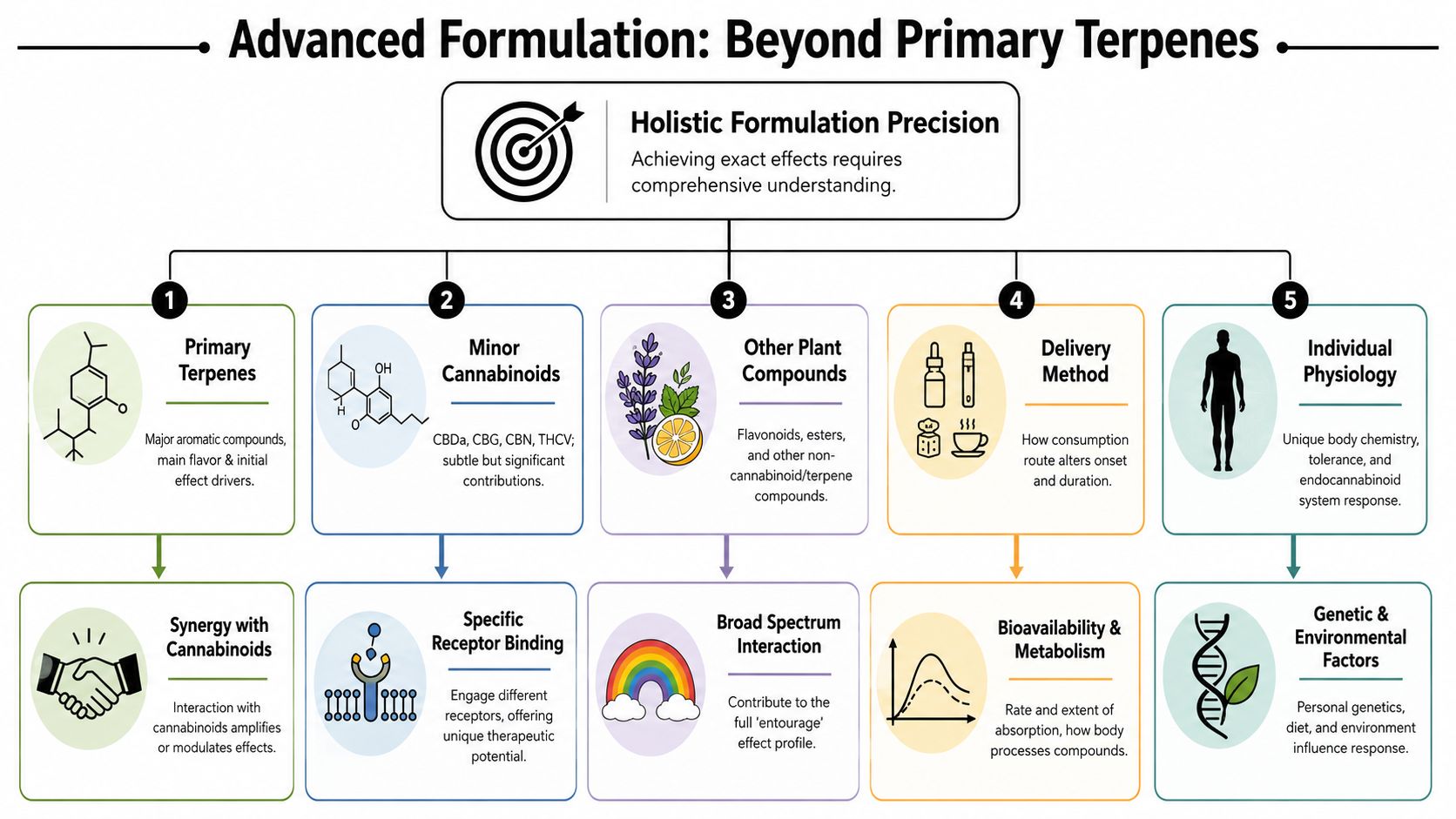
Terpenes matter, but they're not the whole control panel. If a cart feels sharp, anxious, flat, or one-dimensional, the problem often sits in the cannabinoid frame, not just the aroma system.
That's especially relevant with modern high-THC inputs. Verified data notes that modern high-THC flower often contains less than 1% CBD, which removes some of the smoothing influence CBD can provide and can increase the risk of an anxious experience. For formulation, that means many high-THC distillates start from an imbalanced place before the terpene rebuild even begins.
Why CBD changes the outcome
If a blend smells polished but still feels edgy, adding more myrcene or caryophyllene may not solve it. The issue may be that the THC is landing without enough counterweight.
Verified data states that this is why formulators often reintroduce CBD isolate or work toward a specific THC:CBD ratio. The goal isn't to make the formula weak. The goal is to shape the psychoactive intensity into something more usable and less brittle.
Bench note: When a profile feels “too loud,” don't assume the terpene percentage is the only problem. Check whether the cannabinoid ratio is amplifying the roughness.
Other variables worth respecting
Terpenes and major cannabinoids sit at the center, but experienced formulators also watch several outer-ring variables:
- Minor cannabinoids: CBD gets most of the attention, but other cannabinoids can still change how a formula presents.
- Delivery method: A profile that feels composed in one hardware setup can become harsher or less expressive in another.
- Consumer variability: Endocannabinoid response, tolerance, and individual physiology create spread that no blend can fully erase.
- Sensory expectation: Flavor cues can bias how users describe the effect, even when the underlying chemistry is similar.
This is one reason simple one-to-one strain copying often disappoints. Replication isn't only about putting the “right” terpenes back. It's about restoring enough of the broader profile that the product behaves coherently.
A better decision standard
When evaluating a formula for launch, ask whether it meets these criteria:
| Checkpoint | What to look for |
|---|---|
| Cannabinoid balance | Does the THC base need CBD or another balancing input to avoid a harsh presentation? |
| Effect coherence | Does the sensory opening match the way the formula actually lands? |
| Hardware fit | Does the cart preserve the intended note structure under real operating conditions? |
| Repeatability | Can the same formula be rebuilt consistently across production runs? |
The closer your process gets to these questions, the less likely you are to blame a bad outcome on a strain name that never had predictive value in the first place.
Replicating Strain Effects with Precision
The useful answer to do different strains have different highs is this: different chemical profiles have different highs. “Strain” is only useful when it points to a composition you can define, measure, and rebuild.
That changes the role of the formulator. You're not selecting personalities from a menu. You're engineering outputs from ratios, note structure, and cannabinoid balance. A formulation guide for vape cartridges should reflect that reality from the first brief through final validation.
The operating model that holds up
A precise workflow is usually simpler than the folklore surrounding it.
- Start with the target outcome, not the cultivar mythology.
- Set the cannabinoid frame so the product has the right intensity and balance.
- Build the terpene profile as a structured system of top, mid, and base notes.
- Validate the formula in the actual delivery format.
- Keep the strain name as a shorthand for flavor inspiration, not as proof of effect.
That approach is what separates a product that feels consistent from one that borrows a famous label.
What to stop doing
Stop assuming “indica” means sedating in a cartridge. Stop assuming “sativa” means uplifting in distillate. Stop assuming the loudest terpene in a profile determines the whole experience.
What to do instead
Use chemistry as the brief. For replicating flavor of classic cultivars for distillate or designing a new terpene profile for cannabis product formulation, the reliable levers are the ones you can measure and tune.
A modern strain formula isn't a name. It's a build sheet.
If your goal is repeatable carts, credible strain-inspired SKUs, and cleaner effect targeting, that's the mindset that scales.
Gold Coast Terpenes makes that work easier with 100% natural terpene blends and isolates built for cartridges, concentrates, and precision cannabis product formulation. If you're developing a strain-inspired terpene blend, dialing in a terpene profile for vape cartridges, or rebuilding flavor for distillate, their catalog, formulation resources, and lab-tested profiles give product teams the tools to formulate with more control and more consistency.