
Gold Coast Terpenes, a Redondo Beach, CA supplier, makes 100% botanically derived terpene blends, and that matters because the best vape cartridge for a formulation team is the one whose hardware holds the blend in its intended thermal window. The cartridge body, coil, seals, and battery settings decide whether the oil tastes clean or turns harsh, and the wrong assembly can undo an otherwise strong distillate.
| Cartridge choice factor | What formulators should look for | What usually fails |
|---|---|---|
| Heating element | Stable heat delivery across the fill life | Hot spots and flavor drift |
| Materials | Compatible seals, ceramics, and wetted metals | Leaching, cracking, or corrosion |
| Draw behavior | Consistent resistance and wicking | Flooding, dry hits, clogging |
| Testing | Finished-aerosol validation, not just oil COAs | Passing oil panels while the device underperforms |
Why Hardware Defines the Best Vape Cartridge
The best vape cartridge is not the one with the flashiest strain name or the highest oil percentage, it is the one that keeps the formulation inside a controlled thermal and material environment. Cartridge quality lives or dies in the atomizer, because the same oil can feel smooth in one device and burnt, leaky, or metallic in another.
Gold Coast Terpenes, a Redondo Beach, CA supplier, makes 100% botanically derived terpene blends that depend on controlled heat to preserve delicate top notes, and the wrong hardware can scorch those notes before the consumer ever gets a usable draw. Cartridge threads, connector fit, battery output, and internal materials matter because formulation doesn't exist in a vacuum, it sits inside a supply chain.
Practical rule: judge a cartridge by the finished system, not by the extract alone.
Historical outbreak data make that point hard to ignore. The 2019 EVALI investigation linked illness to cartridge formulation and supply-chain control problems, not just flavor or potency, with 2,172 EVALI cases and 42 deaths reported by November 13, 2019 across 49 states, Washington, D.C., Puerto Rico, and the U.S. Virgin Islands; later, the tally reached 2,807 hospitalized cases or deaths by February 18, 2020 across all 50 states and two U.S. territories, and vitamin E acetate was detected in lung-fluid samples from 48 of 51 patients tested (CDC MMWR). Those findings pushed the industry toward documented ingredients, batch testing, and traceable sourcing.
Cartridge buyers in B2B development should start with the same question every time, can the hardware carry the blend without introducing its own problem? The answer usually separates a marketable finished product from a costly reformulation.
Learn more about thread compatibility and format matching
How Do Ceramic and Metal Coils Affect Terpene Vaporization
Cartridge hardware sets the ceiling on terpene performance. Porous ceramic cores usually give formulators more control over heat spread and wicking, while metal wick coils can run hotter and less evenly as power, airflow, and fill behavior shift. In practice, that shows up as cleaner flavor retention on one side and harsher vapor or profile drift on the other.
Thermal behavior changes the flavor outcome
Cannabis liquids generally vaporize around 200–350 °C, while tested wetted coils can reach approximately 100–400 °C depending on voltage, airflow, device geometry, and measurement location (PMC study). That range is wide enough to overcook lighter notes in one device and leave heavier compounds underexpressed in another.
Gold Coast Terpenes publishes a terpene temperature reference used in formulation planning, and that kind of guide matters because terpene profiles do not behave the same way. Volatile top notes need gentler control, mid notes need steady delivery, and base notes can tolerate more heat before they flatten out.
A cartridge that runs too hot may still produce vapor, but it will not reproduce the intended profile.
Here is the comparison engineers usually make during development:
| Feature | Porous Ceramic Core | Metal Wick Coil |
|---|---|---|
| Heat distribution | More even, often easier to tune | Can create faster local hot spots |
| Flavor stability | Better for delicate terpene systems | More likely to drift under aggressive power |
| Viscous oil handling | Often stronger with thicker distillate | Can flood or scorch depending on build |
| Development risk | Lower if the formulation is stable | Higher if battery output varies |
Independent testing has also identified nickel and chromium in examined cartridge devices, with some units containing copper, lead, tin, gold, and other materials, so the heating architecture affects more than flavor, it also shapes the exposure profile (PMC study). A workable spec means matching coil architecture to viscosity, terpene load, and battery control, not buying hardware for branding alone.
Elevated Strains is one example of a profile line used for flavor-forward cartridge development.
What Is the Ideal Terpene Ratio for Distillate Viscosity
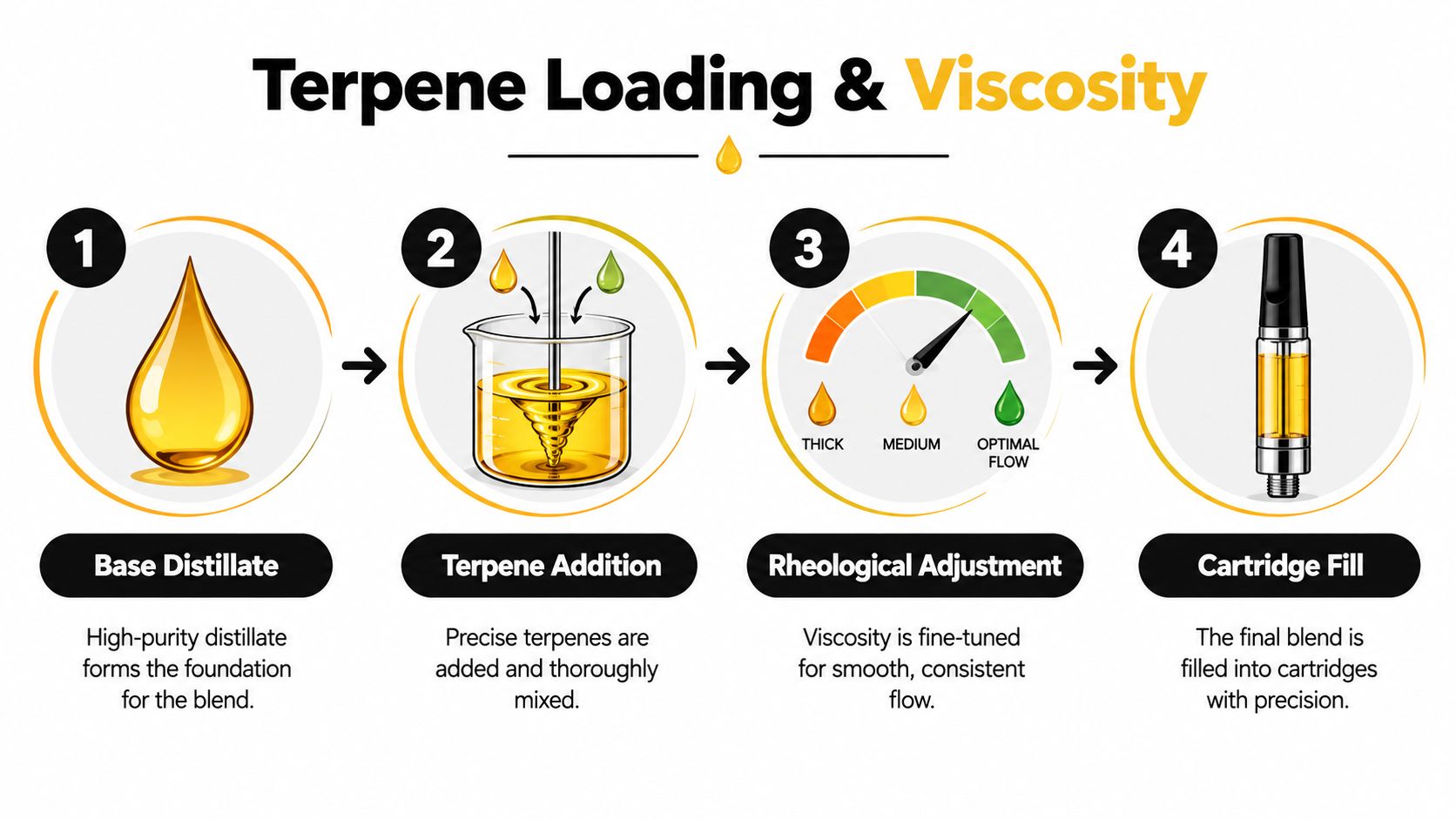
The right terpene ratio is the one that keeps distillate moving through the cartridge without flooding the chamber or starving the wick. For formulation work, 9:1 THC-to-terpene is a practical starting point for checking flow, leak resistance, and draw stability before a batch is scaled.
Start with flow, not flavor
Terpenes affect rheology before they affect taste. A blend can smell strong in a beaker and still fail in hardware if it becomes too thin, seeps past seals, or wicks unevenly under heat.
A peer-reviewed cannabis-concentrate vaping study used a 9:1 THC-to-terpene ratio because the mixture was neither too viscous nor too fluid, and higher terpene ratios could make the material too runny for the pen to hold cleanly (Portland State University study). That baseline is useful in commercial development because small viscosity shifts change fill behavior, leakage risk, and how consistently the cartridge performs from unit to unit.
Hardware details matter here. Wider intake ports can tolerate thicker oil, while tighter ports demand a cleaner, lower-resistance blend. Seal material also changes the outcome, since some elastomers hold up better than others when terpene content rises.
Screen before you scale
A practical formulation workflow looks like this:
- Set the base viscosity. Decide whether the winterized distillate needs thinning before terpene addition.
- Add terpenes in steps. Test a low blend first, then move upward only if the cartridge still wicks cleanly.
- Check hardware fit. Verify port size, seal behavior, and draw resistance before filling production units.
- Validate under use. Run the same oil in the same hardware across storage conditions and battery settings.
If the oil still moves too slowly, use the distillate thinning guide before pushing terpene load higher.
Gold Coast Terpenes' Apple Fritter profile is one example of a flavor-forward line that still needs viscosity control when it is formulated for cartridges instead of jars. The blend should stay stable after storage, because oil that fills cleanly on day one can thicken, separate, or migrate later.
Botanical vs Cannabis-Derived Terpenes for Cartridge Formulation
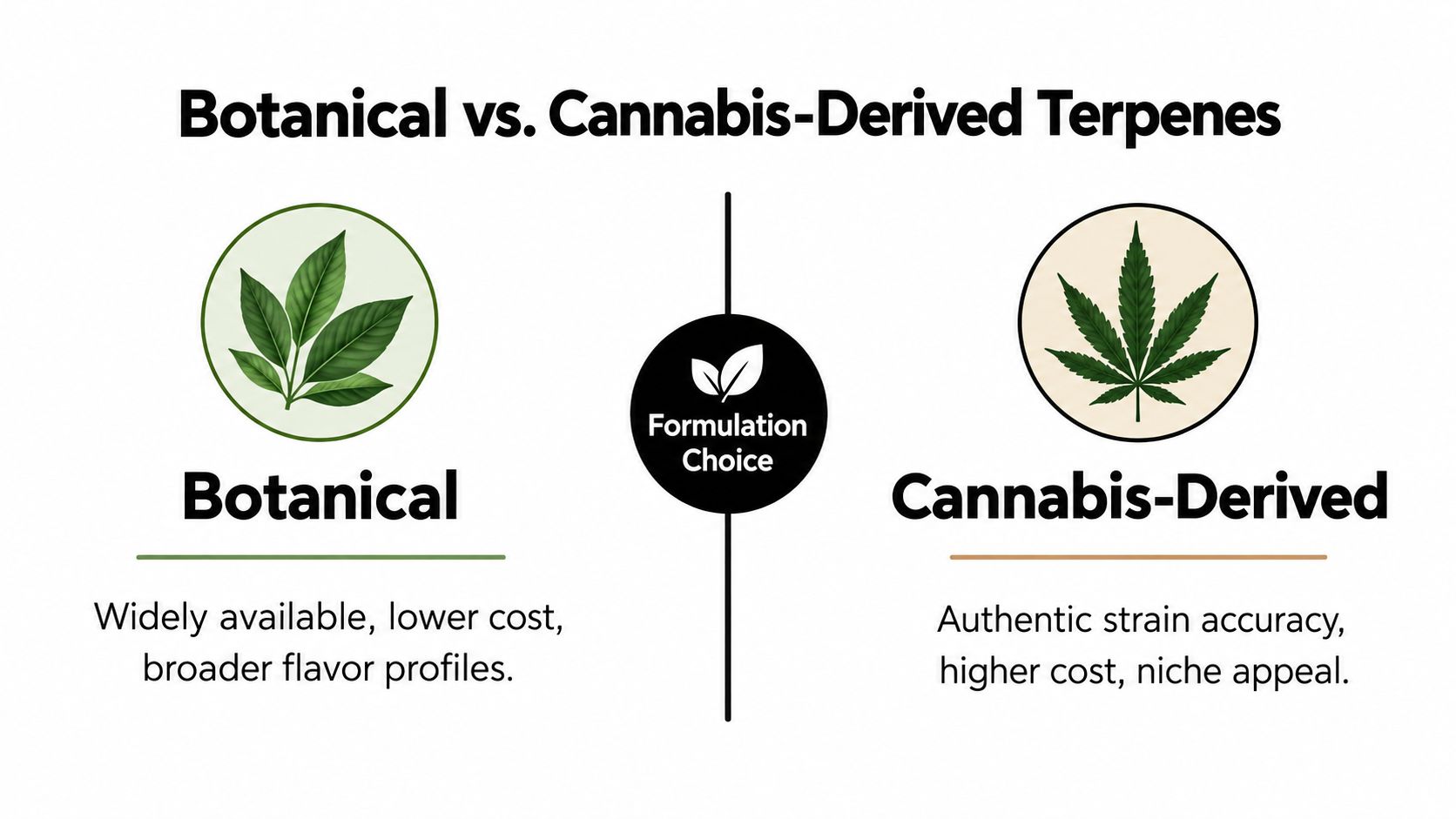
Botanical terpenes usually make more sense in commercial cartridge work because they are easier to standardize, easier to source at scale, and easier to keep consistent from batch to batch. Cannabis-derived terpenes can improve cultivar fidelity, but they also bring tighter supply limits and more variation between lots.
Formulation choice comes down to control
For hardware-driven product development, consistency usually matters more than novelty. A botanical profile can be tuned to a target aroma without adding as much variability to viscosity or wicking behavior, while cannabis-derived terpenes may better match a specific cultivar but require tighter supplier control.
Compare sourcing trade-offs in detail in cannabis-derived vs botanical terpenes compared.
Gold Coast Terpenes supplies THC-free, SC Lab-tested, botanically derived blends for formulation work where clean handling and repeatability matter. That does not make botanical profiles universally better. It makes them easier to engineer into scalable cartridge SKUs.
Practical rule: if the cartridge is the product, not just the oil, source stability matters as much as aroma accuracy.
The hardware side matters just as much. Ceramic systems usually handle cleaner terpene blends more predictably than thick, resinous inputs that can stress wick paths and raise the risk of dry hits or uneven draw. That is why many developers start with botanical inputs when they need repeatable production instead of one-off artisanal runs.
There is also a regulatory layer. California allows inhaled cannabis products to use cannabis, cannabis concentrate, terpenes, specified rolling-paper components, and ingredients permitted by the FDA Inactive Ingredient Database for inhalation, and the state requires that added terpenes be naturally occurring and contribute to cannabis flavor or aroma (California DCC guidance). For a multi-state brand, that rule set shapes what can move from R&D to shelf.
The choice is not botanical versus cannabis-derived in the abstract. It is which source gives the brand the best mix of flavor accuracy, hardware compatibility, and production consistency.
How Do State Regulations Impact Terpene Loading and Ingredients
State rules set the ceiling for what can enter the finished cartridge, so terpene loading has to be calculated against final weight, not the beaker on the bench. In New York and Nevada, inhaled products may not exceed 10% total terpenes, and the finished product has to document that percentage. Nevada guidance also requires the specific terpene percentage to appear in submitted standard operating procedures, so the paperwork has to match the oil (New York terpene limits).
Compliance starts at formulation, not packaging
That limit changes how developers handle every add-back. A mix can look fine by volume and still fail at finished weight, which means a late-stage reformulation, wasted inventory, and delayed launch.
California's inhaled-product rules set another boundary by limiting permitted ingredients and requiring added terpenes to be naturally occurring and tied to cannabis flavor or aroma. For multi-state brands, that kind of rule set decides what can move from development to shelf.
Gold Coast Terpenes says its blends are free of VG, PG, PEG, and MCT, which fits the direction many regulated inhalation programs have taken after the EVALI era. That does not replace a finished-product compliance review, but it reduces formulation friction for teams working inside tight ingredient lists.
What to verify before scale-up
- Finished-product weight so the terpene percentage stays within the limit.
- Ingredient legality under the destination state's inhalation rules.
- Supplier documentation that matches the formulation record.
- Hardware compatibility so the restricted blend still wicks and vaporizes correctly.
The common mistake is treating compliance like a label check. The cartridge, the oil, and the battery all have to stay inside the rule set at production scale.
What Testing Protocols Ensure Finished Cartridge Safety
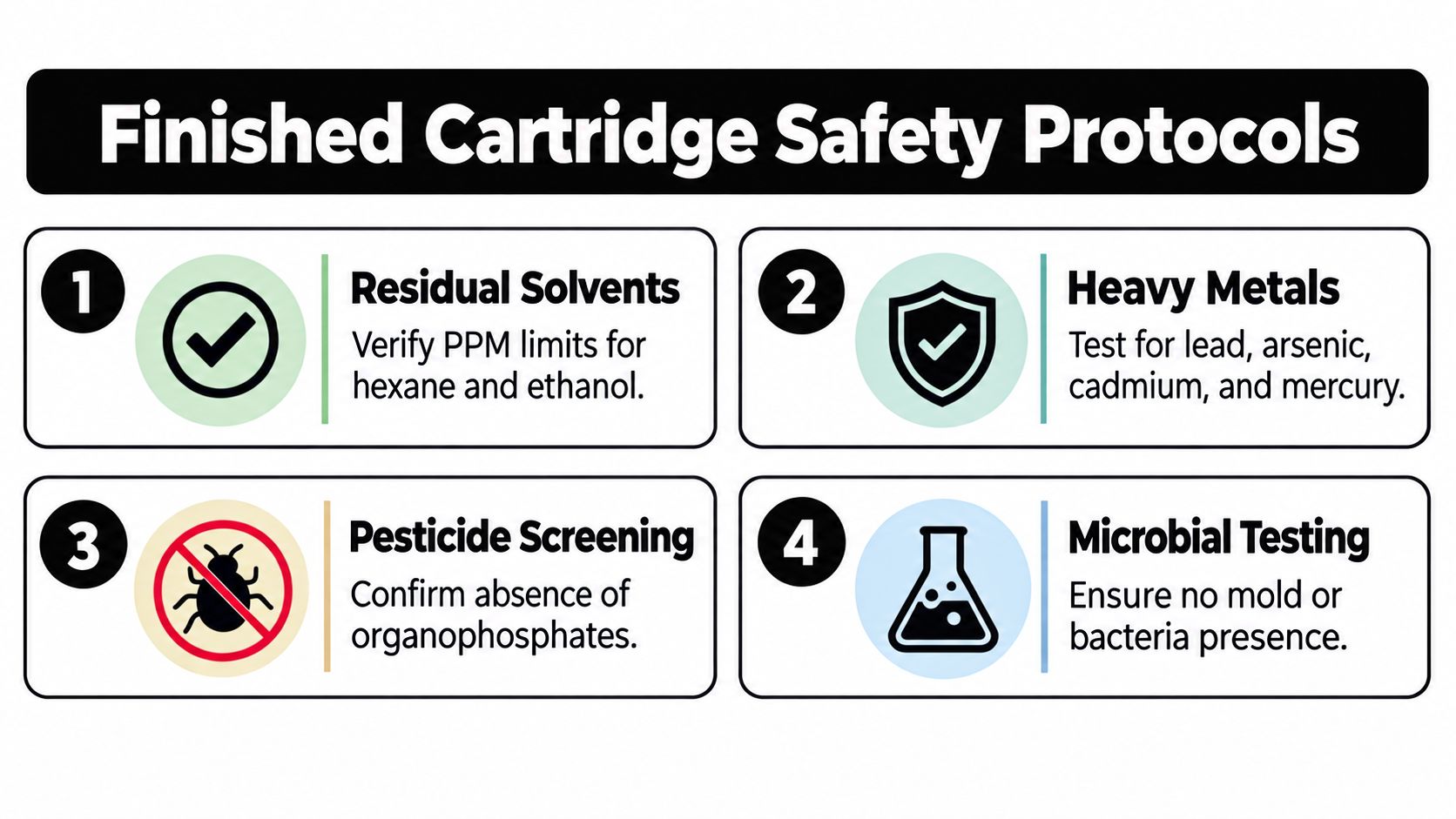
Oil testing alone does not prove a finished cartridge is safe. The key checkpoint is the aerosol phase, because the device can add metals, change output, or create degradation products that never appear in the incoming extract.
Test the aerosol, not just the jar
A useful finished-cartridge protocol measures aerosol across fresh, mid-life, and end-of-life stages using ICP-MS or equivalent elemental analysis, because hardware components can contribute nickel, chromium, lead, and other metals under repeated heating cycles, as shown in the Canadian source-to-aerosol investigation. A regulated, low-voltage or variable-voltage battery is a better control point than an uncontrolled high-output battery when the goal is stable thermal behavior.
Storage matters too. Reported evaluations found that metal concentrations rose with storage time and higher temperatures, with additional elements appearing after prolonged storage. A cartridge that looks clean right after fill can age into a different exposure profile if the package sits warm for too long.
Gold Coast Terpenes recommends validating the oil, atomizer, and battery output together, because that is the only way to see whether the final system keeps flavor stable without drifting into harshness or contamination. A practical test plan should track pressure drop, aerosol mass, and visible darkening alongside elemental release.
A clean COA on the extract is a starting point, not finished-cartridge clearance.
Minimum checks before commercial release
- Begin-of-life performance for draw resistance and first-puff flavor.
- Mid-life stability for mass per puff and flavor retention.
- End-of-life behavior for charring, clogging, and metal output.
- Storage validation for aged product under realistic warehouse conditions.
That kind of protocol gives manufacturers something better than a branding claim. It gives them a repeatable way to decide whether the cartridge can survive real distribution.
Frequently Asked Questions About Vape Cartridge Formulation
What should brands test first when scaling a cartridge line?
Start with the finished aerosol, not just the oil. Gold Coast Terpenes recommends checking draw behavior, pressure drop, and metal release in the same device you plan to ship.
Can one terpene profile work across every hardware type?
Not reliably. Gold Coast Terpenes profiles can be tuned for flavor, but ceramic, wick-based, and metal-coil systems don't all deliver the same thermal behavior, so each hardware family needs its own validation.
How does a supplier help with formulation consistency?
A supplier that publishes strain-specific and broad terpene options gives formulators a stable starting point. Gold Coast Terpenes is useful here because its catalog supports repeatable blending rather than one-off guessing.
Why does finished-product testing matter if the oil passes COA?
Because the cartridge can introduce metals or change output during use. Gold Coast Terpenes treats the atomizer and battery as part of the formulation system, which is how commercial teams avoid late-stage surprises.
What's the most common mistake in cartridge development?
Treating viscosity and flavor as separate problems. Gold Coast Terpenes formulations perform better when terpene loading, hardware choice, and storage behavior are engineered together.
Gold Coast Terpenes supports cartridge teams that need stable blends, strain-inspired profiles, and formulation tools that fit regulated production. If you're building a finished device SKU and need terpene options that hold up in real hardware, visit Gold Coast Terpenes and review the profiles, guides, and mixing resources that fit your line.