
If you're formulating yet another Gelato SKU and the sensory target still feels vague, the problem usually isn't the name. It's the lack of a defined aromatic target, a phenotype strategy, and a hardware-specific delivery plan. A lot of products wear the Gelato label. Far fewer deliver the creamy citrus, peppery depth, soft mint, and dense dessert body that made the profile commercially sticky in the first place.
For extractors and vape brands, the best Gelato strain isn't a single answer. It's the version of Gelato you can reproduce consistently in oil, through your chosen hardware, at commercial scale. That means deciding what kind of Gelato you're building, what notes have to survive heat, and which terpenes need support so the profile doesn't collapse into generic sweet gas.
Beyond the Hype The Formulation Challenge of Gelato
Gelato is crowded as a brand idea. It's much harder as a formulation target.
Most failed Gelato products miss in one of three ways. They lean too hard into candy sweetness and lose the cookie-like depth. They overbuild the gas and erase the creamy finish. Or they chase THC positioning while treating the terpene layer like a decorative add-on instead of the main identity driver.
Where most Gelato formulations go wrong
A usable Gelato profile has tension in it. It should feel dessert-forward without becoming syrupy, and gassy without turning harsh. That balance is where the premium impression comes from.
In practical terms, formulators often run into these trade-offs:
- Too much citrus lift: The oil opens bright, but the finish reads thin rather than creamy.
- Too much myrcene-heavy weight: The profile feels muddy and muted in carts, especially after the first few pulls.
- Too much pepper and earth: The product reads more like a cookie or kush derivative than Gelato.
- Too much “ice cream” flavoring logic: Added sweet character can flatten the natural cannabis structure and make the inhale feel artificial.
Practical rule: If the profile smells accurate in a cold bottle but tastes generic in a warm cart, the formula probably lacks enough structure in the middle and base notes.
What actually creates differentiation
Differentiation comes from precision, not strain naming. You need a target phenotype, a clear note hierarchy, and a process for adapting the blend to oil type and hardware. A Gelato for winterized distillate won't behave exactly like a Gelato for a resin-forward formulation, even if the aromatic target is similar.
That matters because the market doesn't reward broad strain language for long. Buyers notice when one Gelato SKU tastes fluffy and creamy while another tastes like sweetened limonene with a little spice. The first one had a technical brief behind it. The second one had a label.
For commercial teams, the useful question isn't “what is Gelato.” It's “which Gelato expression fits this product line, and what compromises are acceptable in the final device.”
Deconstructing the Gelato Lineage and Its Core Chemistry
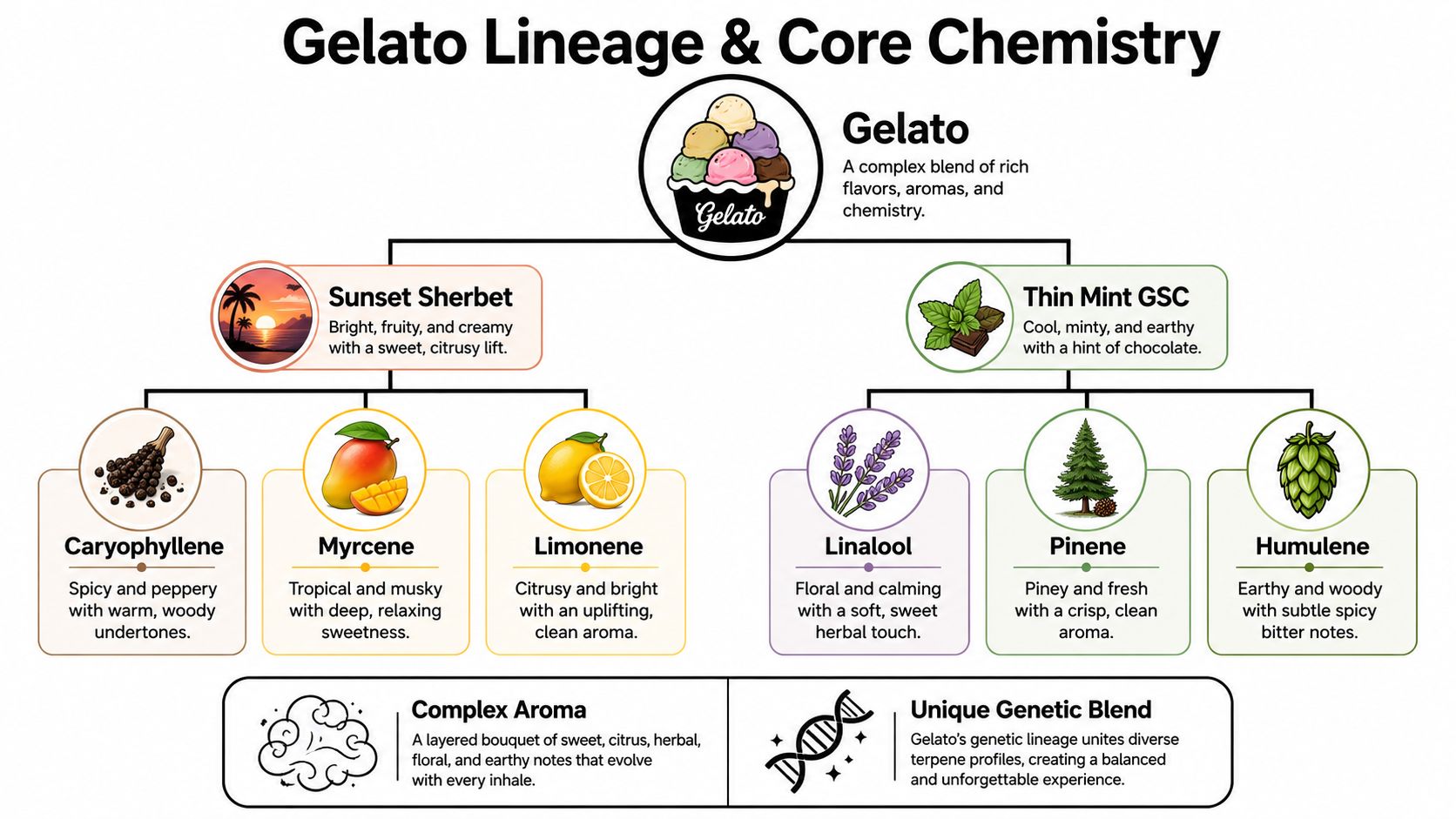
Gelato is widely documented as a slightly indica-dominant hybrid with a typical split of about 55% indica / 45% sativa, and multiple references trace it to Sunset Sherbet × Thin Mint Girl Scout Cookies. Its cannabinoid strength is also consistently placed in the 20%–25% THC range, with some sources noting an average around 20%–21% THC, which helped establish it as a benchmark dessert cultivar in major markets, as summarized in this Gelato strain reference from AllBud.
What the parentage tells a formulator
Lineage matters because it tells you what the profile should feel like structurally, not just what it should smell like at first crack.
Sunset Sherbet points you toward the sweeter side of the build. That's where the brighter citrus and softer fruit lift make sense. Thin Mint GSC explains the denser body. It anchors the profile with the cookie-like, earthy, slightly minty, faintly gassy impression that keeps Gelato from reading like a simple fruit cultivar.
This is why a convincing Gelato profile usually needs both lift and compression. The opening has to be attractive and sweet enough to sell the dessert concept. The center has to feel fuller, warmer, and a little textured. The finish has to leave some earthy or peppery persistence so the whole thing still reads as cannabis.
The chemistry that holds it together
Across strain references, the dominant Gelato terpene stack is consistently described around caryophyllene, limonene, and myrcene, with humulene appearing in some profiles. For formulators, that stack is the useful baseline. It gives you brightness, spice, weight, and enough earthy depth to avoid a one-dimensional sweet profile.
If you're troubleshooting why a Gelato formula feels incomplete, start by thinking in layers:
- Limonene-driven top: creates the bright citrus entry
- Caryophyllene-led core: gives warmth, pepper, and body
- Myrcene-supported base: rounds the finish and adds herbal density
- Humulene accent: helps dry out the sweetness and sharpen the savory edge
A good primer on how these compounds behave in blends is Gold Coast Terpenes' guide to the chemistry of terpenes.
Gelato doesn't work when every note tries to be dessert. The profile needs friction. Sweet, creamy, citrus, earthy, and light gas all have to coexist.
Key Gelato Phenotypes and Their Formulation Implications
Once you move from “Gelato” into named cuts, formulation choices get sharper. Sources describe the Gelato family as expanding into dozens of original phenotypes and countless modern crosses, with standout variants including Gelato 33, Gelato 41, Gelato 45, and Bacio Gelato. They also note that stronger expressions can reach the mid-to-high 20s in THC, while common cuts often cluster near 18%–25% THC, as outlined in this overview of Gelato phenotypes and variants.
That variation matters because phenotype selection isn't a branding detail. It's the difference between a profile that reads creamy berry dessert and one that leans citrus-earth gas with a firmer finish.
Gelato phenotype formulation comparison
| Phenotype | Dominant Flavor Notes | Key Terpenes | Ideal Application |
|---|---|---|---|
| Gelato 33 | Creamy citrus, earthy sweetness, light gas | Limonene, caryophyllene, myrcene, humulene | Broad-market carts where balance matters |
| Gelato 41 | Sweeter dessert body, softer cream, smoother finish | Caryophyllene, myrcene, limonene with a sweeter supporting layer | Premium vape lines targeting a plush inhale |
| Gelato 45 | Darker earth, more spice, firmer gas backbone | Caryophyllene, humulene, myrcene with restrained top-note lift | Heavier distillate blends and kush-adjacent lines |
| Bacio Gelato | Dense dessert, cocoa-like depth, richer gas | Caryophyllene-forward with deeper earthy support | Limited releases and richer concentrate-inspired carts |
How to choose between them
Gelato 33 is often the safest commercial target because it gives you room to balance sweetness and structure without overcommitting either way. If your hardware tends to mute heavier notes, #33 usually survives better than darker expressions because the citrus and pepper contrast stays readable.
Gelato 41 works when your brand wants the dessert side to lead. This is the expression to use when the brief calls for soft cream, rounded sweetness, and a polished inhale. The risk is over-smoothing it. If you remove too much earth or spice, the result can taste attractive but generic.
Gelato 45 is better for teams that want Gelato to feel more grounded and less confectionary. In carts, this can create a more serious profile. It can also turn rough if the hardware runs hot or if the top note isn't supported well enough.
The real production trade-off
The more dessert-forward the phenotype target, the more carefully you need to protect contrast. The more gas- and earth-forward the target, the more carefully you need to manage harshness.
A useful way to frame it is this:
- Choose #33 when you need flexibility and broad recognition.
- Choose #41 when mouthfeel and sweetness are central to the premium pitch.
- Choose #45 when you want Gelato to overlap with cookie, kush, or gas-heavy portfolios.
- Choose Bacio-style direction when you want density and a richer dessert impression.
If you're working on adjacent hybrids, the archive on Lemon Cherry Gelato phenotype direction is useful because it shows how quickly Gelato-derived profiles shift once the fruit side is pushed forward.
Replicating the Signature Gelato Terpene Profile
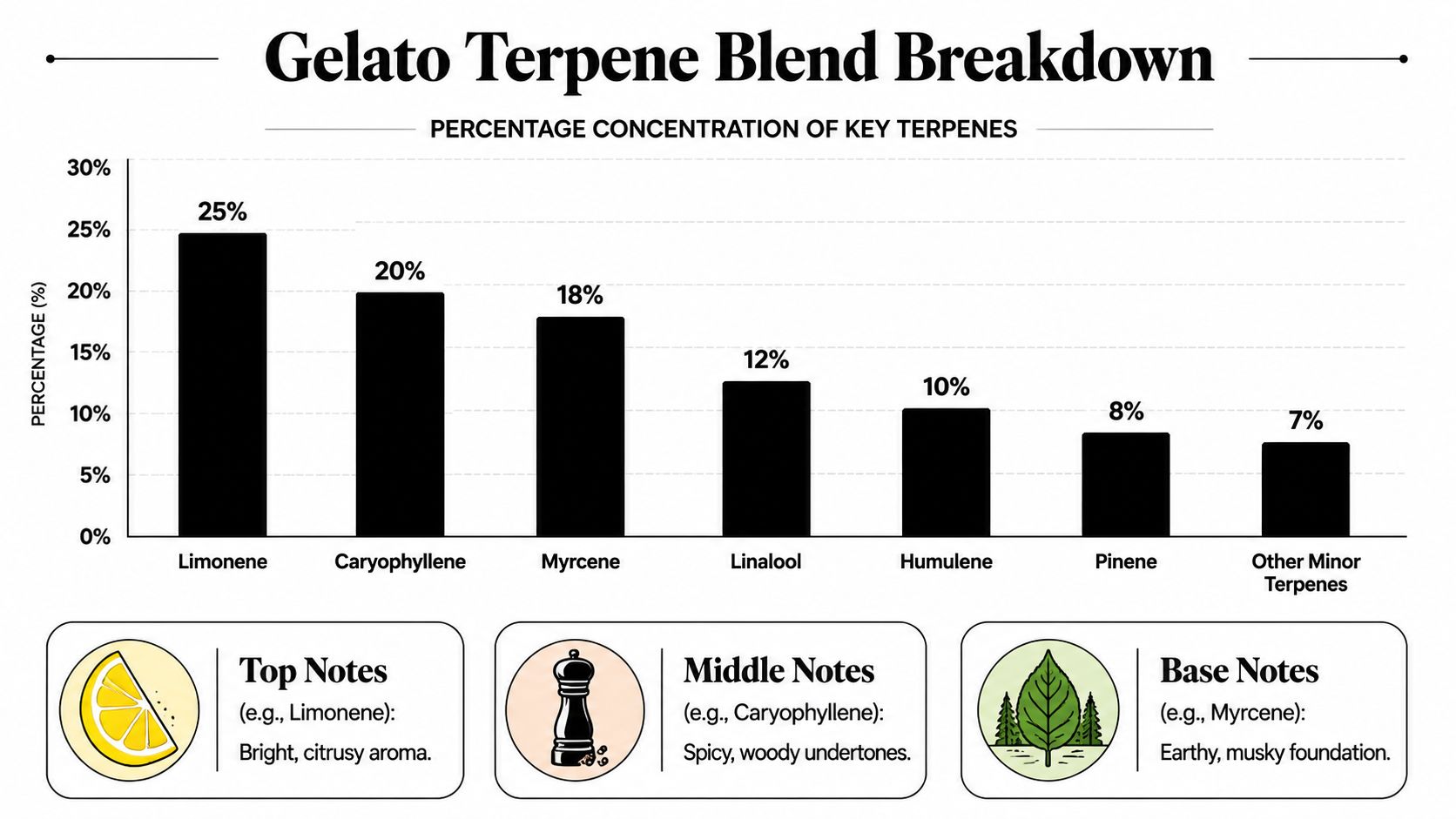
Gelato's dominant terpene stack is consistently reported as caryophyllene, limonene, and myrcene, with humulene appearing in some profiles. That combination maps to the strain's sweet, creamy, citrus, mint, and earthy aroma. For formulation, the practical value is clear. Limonene lifts the citrus, myrcene adds heavier herbal depth, and caryophyllene supplies peppery body, as described in this Gelato terpene profile summary.
Build it in layers, not in a single pass
When I formulate a strain-inspired terpene blend for Gelato, I don't start by asking how sweet it should be. I start by asking what has to remain noticeable after heat, coil contact, and repeated draws. That changes the build order.
Think of the profile in three layers:
- Top notes: limonene-led brightness with a restrained citrus flash
- Middle notes: caryophyllene-driven warmth, slight mint impression, creamy body
- Base notes: myrcene and humulene support for earth, persistence, and finish
A practical blend-building approach
Start with the core stack, then tune for the target phenotype.
Set the citrus ceiling first.
If limonene dominates too far beyond the core, the profile opens well but loses Gelato density. You want citrus to announce the blend, not define it completely.Lock the body with caryophyllene.
This is the terpene that often makes the difference between “sweet cart” and “Gelato-inspired cart.” It gives shape to the center and supports the slight gas-pepper edge.Use myrcene as weight, not as flavor.
Too much myrcene makes the profile feel sleepy, flat, and overly humid. In Gelato, myrcene should support the creamy body rather than dominate the nose.Bring in humulene carefully.
Humulene is useful when the formula feels too soft or too sugary. It dries the finish and restores cannabis realism.
One reference point for a ready-made base in this category is a strain-specific option like the Gelato-style blends sold by suppliers such as Gold Coast Terpenes, then adjusted with isolates if the target needs more citrus, more spice, or a darker finish. If you're benchmarking fruit-leaning Gelato variants, this Cherry Lemonade Gelato profile discussion helps illustrate how far the top notes can move before the profile stops reading as classic Gelato.
A video overview can also help when you're training staff on terpene handling and cart-oriented aromatic design.
What to add when the profile still feels incomplete
You don't always need more of the dominant terpenes. Sometimes the formula is missing support.
- If the blend feels sharp: add softer floral or creamy support in trace form.
- If the inhale feels hollow: increase the center-body contribution rather than the citrus.
- If the finish feels sticky-sweet: use a drier earthy accent to bring it back toward cannabis.
- If the cart tastes accurate only on the first puff: reinforce the base layer so the profile survives heat cycling.
Bench note: The best Gelato strain-inspired terpene blend for vape cartridges usually isn't the sweetest one in the bottle. It's the one that still tastes like Gelato after the oil warms up.
Formulation Adjustments for Different Product Types
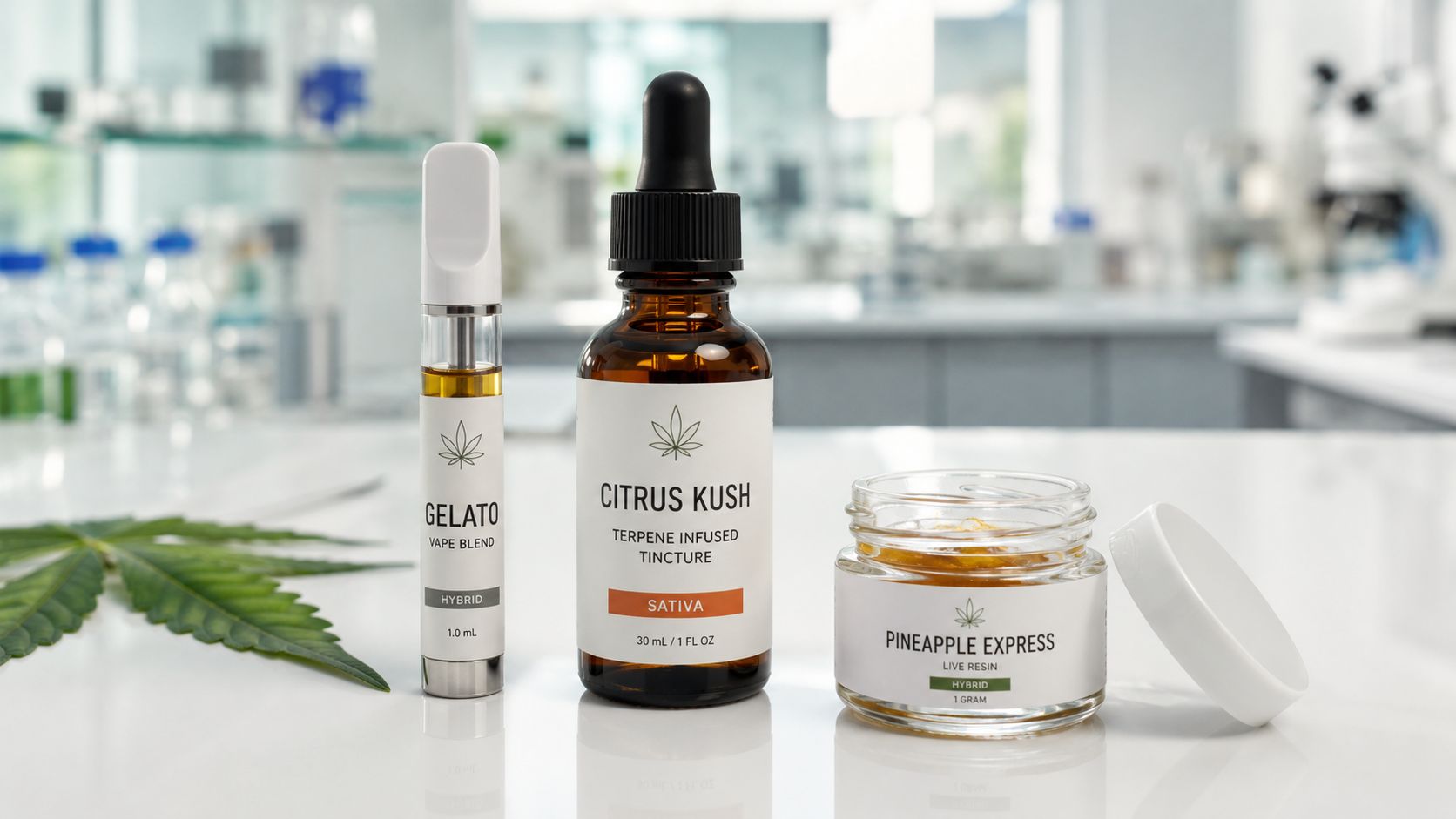
A profile that works in a benchtop aroma test can still fail in production if the delivery format changes. Gelato is especially sensitive here because its appeal depends on the balance between sweetness, creaminess, spice, and earth. Small changes in viscosity, heat, and airflow can shift that balance fast.
For vape cartridges and distillate
Distillate tends to expose imbalance. If the formula is too top-heavy, the cart will smell impressive and taste thin. If it's too base-heavy, the first few draws may feel rich, then the profile turns dull.
For ceramic hardware, I usually preserve more middle and base note structure because the device often presents flavor in a smoother, rounder way. For wick-based systems, harshness control matters more. A caryophyllene-heavy center can become aggressive if the hardware runs hotter than expected.
Useful checkpoints for Gelato for vape cartridges:
- Prioritize the mid-layer: that's where the creamy dessert identity sits.
- Watch heat sensitivity: bright top notes disappear first under repeated thermal stress.
- Evaluate after multiple pulls: the profile needs to hold after warm-up, not just on first activation.
For resin-forward and edible-adjacent applications
In resin-forward products, you may need fewer corrective additions because the extract already carries more native complexity. In highly refined systems, the terpene blend has to do more work by itself.
Edible-adjacent aroma work is different. You can suggest Gelato direction, but the realistic target is often “Gelato-inspired dessert profile” rather than flower-faithful replication. The creamy and citrus notes can translate well. The subtle gas and earthy finish can be harder to keep elegant in non-inhalable products. For teams working across categories, food-safe handling standards matter, and Gold Coast Terpenes has a practical overview on food-grade terpenes.
Why terpene precision matters beyond THC
A lot of Gelato marketing still overweights THC and broad effect language. More useful formulation thinking focuses on the terpene layer because cannabinoid content alone doesn't explain why two similarly potent Gelato samples can smell and feel different. As noted in this review discussing terpene influence and the developing entourage-effect evidence, terpene composition can strongly shape aroma and likely effects, while the evidence around entourage interactions is still developing rather than settled.
That uncertainty is exactly why precision matters. If the science isn't reducible to one headline number, the formulator's job is to control the variables that can be controlled. Aroma architecture, hardware fit, thermal behavior, and batch consistency all sit in that category.
Quality Control and Testing Your Gelato Formulation
A Gelato product doesn't earn repeat orders because the label says Gelato. It earns repeat orders when the second batch tastes like the first one.
Multiple strain profiles describe Gelato as a 55/45 indica-dominant hybrid bred from Sunset Sherbet × Thin Mint GSC, with THC around 17–22% on average and some phenotypes testing into the 20–25% range. For manufacturers, the important point isn't just potency. It's that Gelato's appeal is tied to strong psychoactivity paired with a dessert-style sensory profile, as summarized by DNA Genetics' Gelato strain profile.
What your QC process should actually check
Potency consistency matters. So does sensory consistency.
For Gelato-inspired products, the QC sequence should include:
- Incoming terpene verification: confirm the blend matches the intended aromatic target before it ever reaches production.
- Controlled pilot mixing: keep oil type, mix temperature, and rest time consistent so you're evaluating the formula rather than process noise.
- Device-specific sensory checks: test in the exact hardware you plan to ship, not in a generic lab setup.
- Warm-state evaluation: recheck flavor after repeated activation, because that's when weak formulas start separating into sweet top note and burnt finish.
Common failure points
I've seen more Gelato profiles damaged by handling than by concept. Oxidation, excessive heat during blending, and poor storage can all flatten the creamy citrus character and leave behind a harsher pepper-earth residue.
Release standard: If the product only tastes “right” in one device, at one temperature, on the first draw, it isn't production-ready.
Sensory panel work also needs a real target vocabulary. “Sweet” and “gassy” aren't enough. Your team should know whether the target is creamy citrus, mint-cookie, peppered dessert, or darker earthy Gelato. Otherwise every reviewer will approve a different profile, and your batch decisions will drift.
Manufacturer Checklist for a Successful Gelato Product
The strongest Gelato launches usually come from teams that make a few hard decisions early and refuse to blur them later. They define the phenotype target, build around note hierarchy, test in real hardware, and reject batches that only perform in ideal conditions.
Use this as a go or no-go list before launch:
- Choose the phenotype first: Decide whether the product should read closer to #33, #41, #45, or a denser Bacio-style direction.
- Write the aromatic brief: Define the required top, middle, and base-note behavior in plain sensory language.
- Match the blend to the extract: A formula for distillate may need different support than one for a more complex extract.
- Test in shipping hardware: Don't sign off from bottle aroma alone.
- Judge warm performance: Repeated draws tell you more than a cold sniff ever will.
- Control storage and mixing conditions: Good raw materials can still produce a poor cart if the process is sloppy.
- Approve only repeatable formulas: If your team can't reproduce the same sensory result twice, keep iterating.

The best Gelato strain for cannabis product formulation is the one you can define, build, and reproduce without guesswork. That usually means less hype, more sensory discipline, and tighter control over what the cart delivers.
If you're developing a Gelato strain-inspired terpene blend for vape cartridges, distillate, or broader cannabis product formulation, Gold Coast Terpenes offers strain-specific blends, isolates, and formulation resources that can help you dial in a more repeatable target profile.